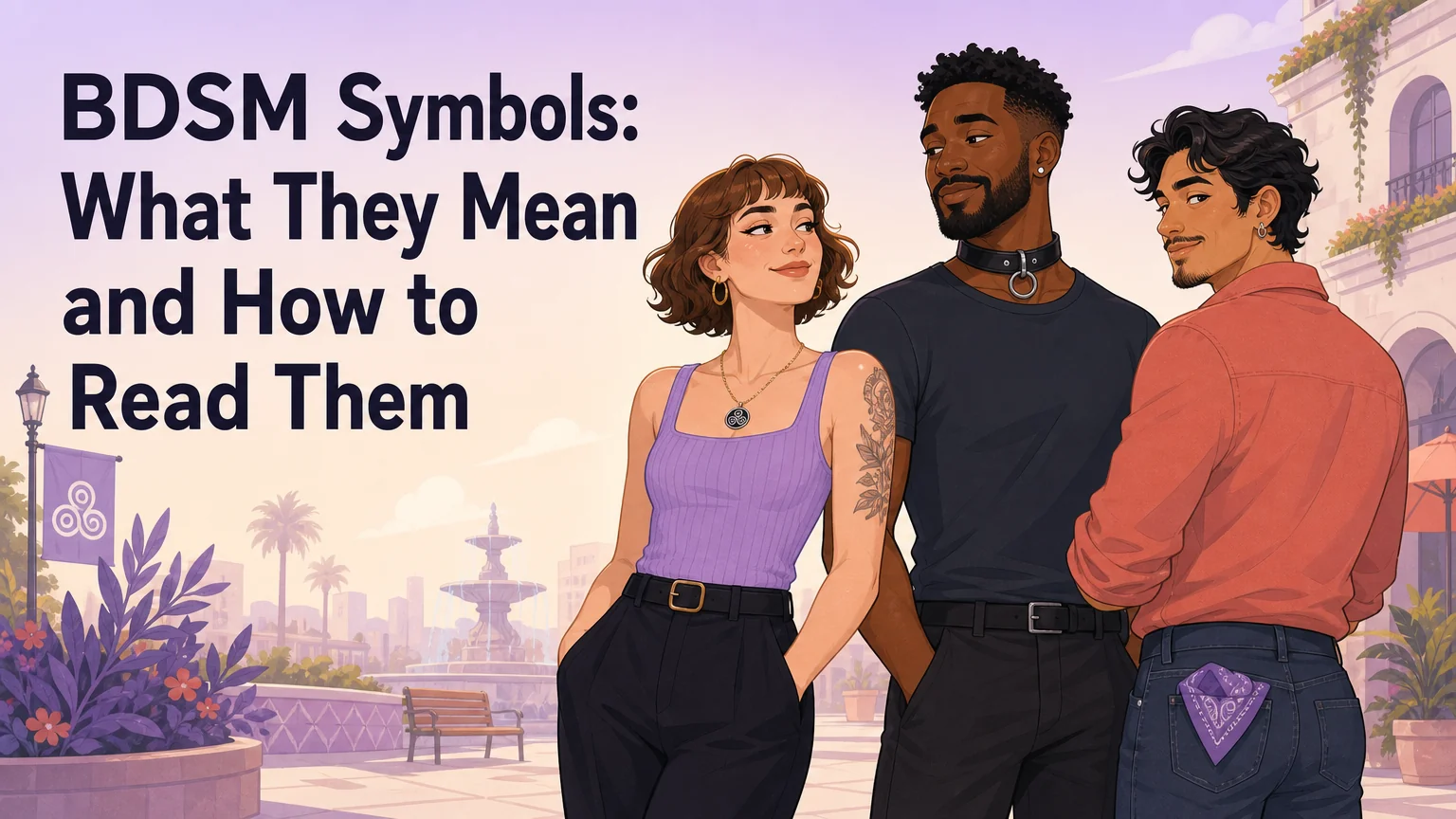
You have probably seen one before, even if you could not read it: a circle of three curved black branches on a pendant, a slim chain collar, a bandana folded into a back pocket. These are BDSM symbols, a shared vocabulary designed to be read by the people who know it and to pass quietly over everyone else. The full list of BDSM symbols and meanings is shorter than you might think, and most of it is easy to decode once you know the rules.
These marks are also the original BDSM signal symbols: a code that worked long before apps existed, and that still does the same job today on profiles, on collars, and in back pockets. This guide runs through the twelve symbols you are most likely to meet, the history behind each one, and the exact questions that get you out of guessing. One thread runs through all of it, and it is worth carrying from here: a symbol advertises interest, not consent. Knowing how to read one is how you start a conversation, not how you skip one.
1. The BDSM Triskelion: The Meaning Behind the Master Symbol
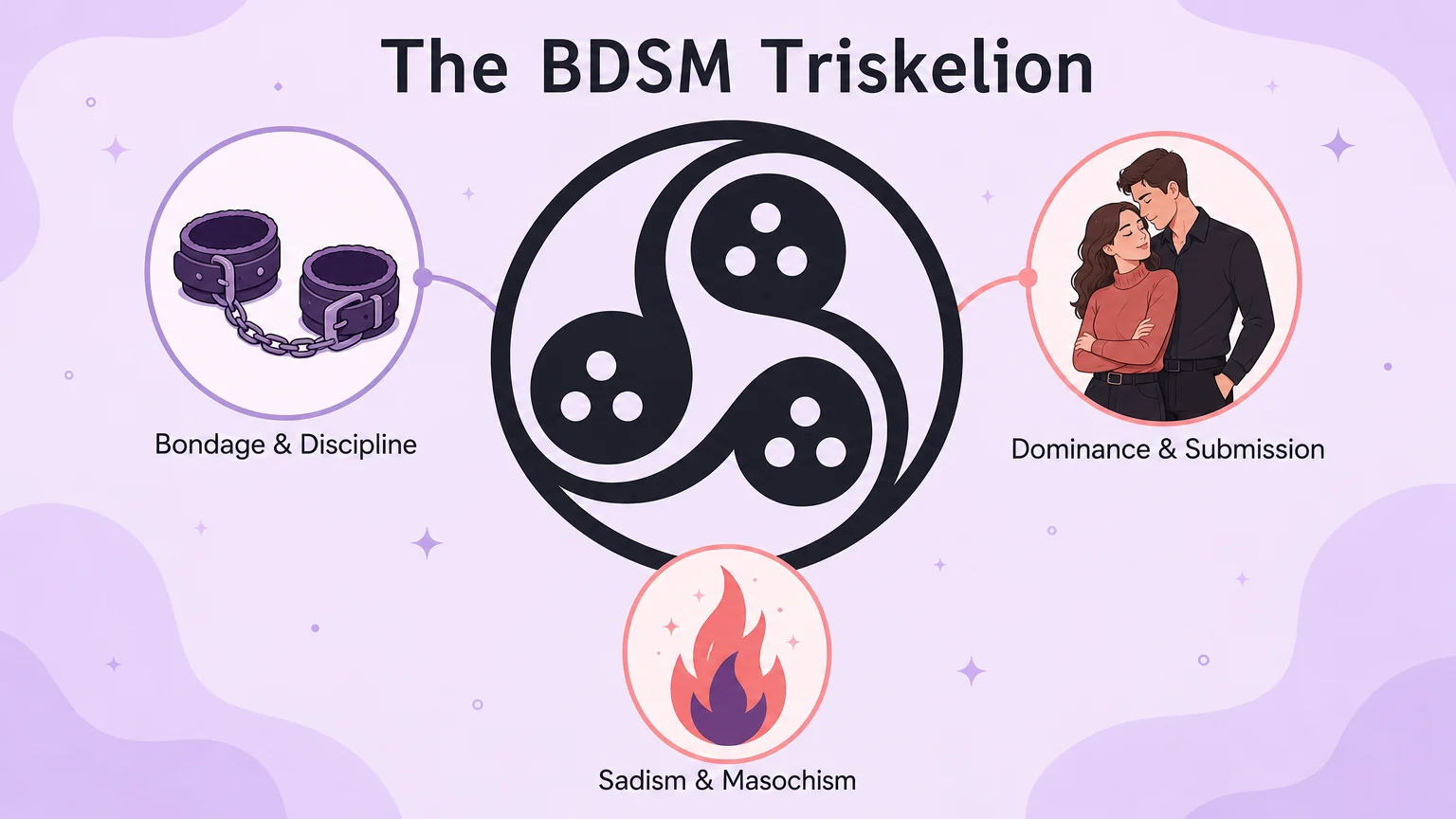
The one symbol everyone names first. The BDSM triskelion meaning starts with its shape: a circle of three curved branches radiating from the center and merging into an encompassing ring. You will see it on pins, pendants, rings, and tattoos, and the detail that separates the real thing from the look-alikes is in the holes. The authentic emblem carries three actual holes, not dots, in each of its three black fields, a deliberate choice made to steer clear of trademark claims on older triskelion designs.
What does the BDSM triskelion mean? The three fields stand for the three pairs that make up the term: Bondage & Discipline, Dominance & Submission, and Sadism & Masochism. The same three-way shape is also read as roles: Top, bottom, and switch, and as the consent shorthand SSC: Safe, Sane, Consensual. All three readings are correct, because the design was built to hold them.
The origin story is where the record gets muddled. A designer using the pseudonym Steve Quagmyr created the emblem in 1994 and 1995 on an America Online BDSM board, under what became the BDSM Emblem Project. The copyright line read “copyright 1995 by Quagmyr@aol.com,” and the design deliberately echoed the iron-and-gold ring with a triskelion seal described in Story of O.
The name Tanos belongs to someone else: Tanos separately designed the BDSM Rights Flag in 2005, and the two stories are often merged into one. They are two different symbols from two different designers.
The BDSM symbol meaning you need, reduced: black fields, a metallic rim, holes rather than dots, and a correct rotation. See those, and you are looking at the real emblem. See anything else, and you are likely looking at a look-alike triple spiral, a reading habit this article will return to.
2. BDSM Collar Symbolism: What a Collar Is Really Saying
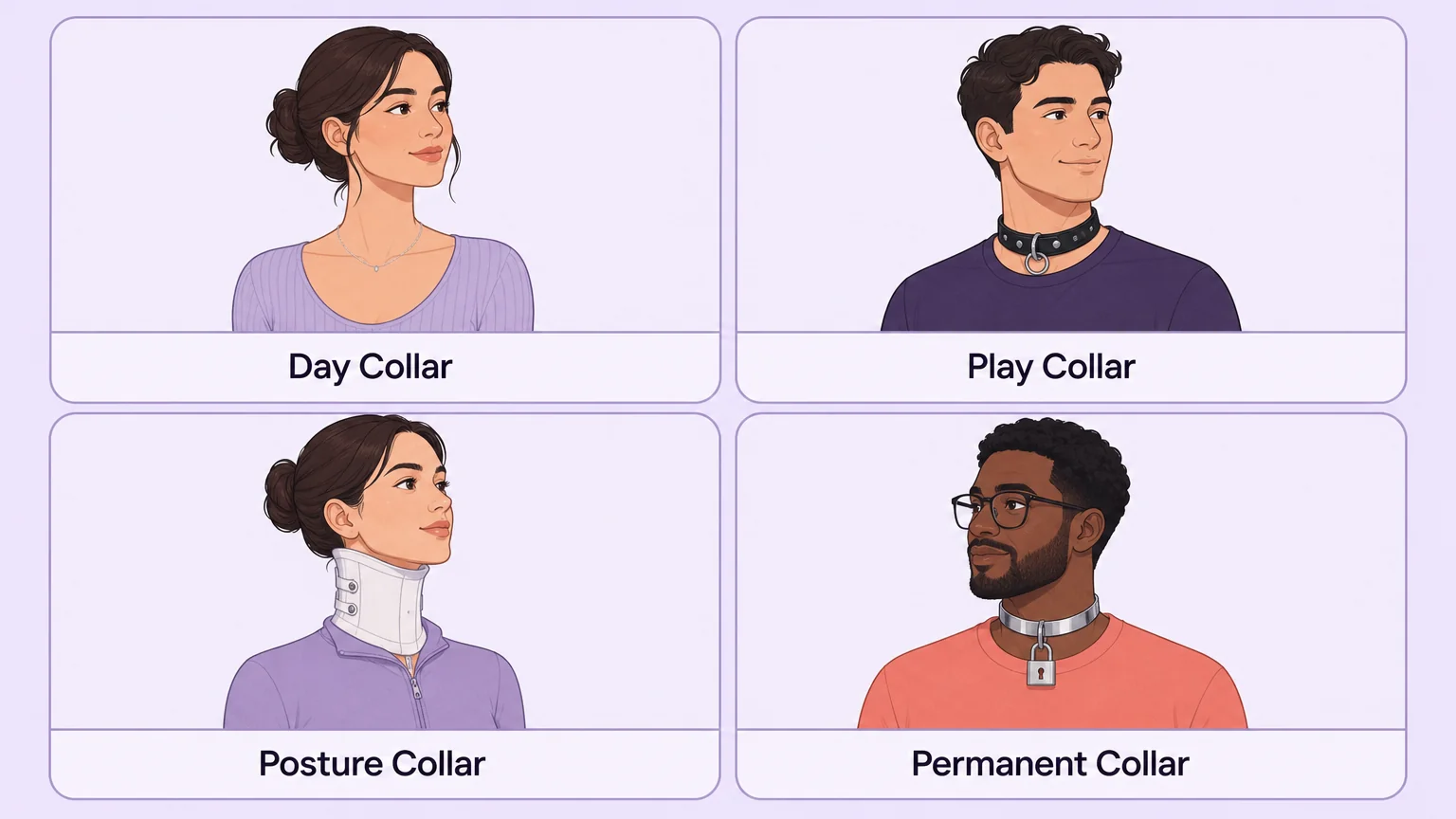
Call them the wedding ring of BDSM, and you are only half joking. Collars are the most visible commitment symbol in the scene, and they come in four distinct shapes.
A day collar looks like an ordinary chain or choker and is built for everyday wear, showers and gym sessions included. Many day collars are ordinary necklaces bought from a jeweler and given meaning by the pair alone. A play collar is sturdy leather or metal with an O-ring or D-ring for a lead, and it is scene gear. A posture collar is tall and rigid. A permanent collar locks closed, with only the Dominant holding the key or the tool that opens it.
Here is the BDSM collar symbolism in one line: a lockable collar transfers power from the person wearing it to the person holding the key, the same gesture as chastity keyholding. But not every collar does that work. A play collar does not mean the wearer is owned; it means a scene is happening or is welcome. An O-ring collar, the kind with a single large ring at the front, is often worn to signal a steady relationship, the collar equivalent of an engagement ring.
The rule that makes all of this make sense: a collar means exactly what the two people say it means. That is why self-collaring is valid, and why bracelets, anklets, rings, tattoos, and piercings all carry the same weight when a couple assigns it. The community-canonical way to ask without assuming is direct and polite: “Are you collared or uncollared?” It opens the conversation and respects whatever the answer is.
3. The Handkerchief Code: How a Bandana Color Signals Your Kink
Freddie Mercury once walked on stage with an armband on his right arm and signaled his role to an entire stadium. Almost nobody knew. That was the handkerchief code doing exactly what it was built to do: visible to the people who could read it, invisible to everyone else.
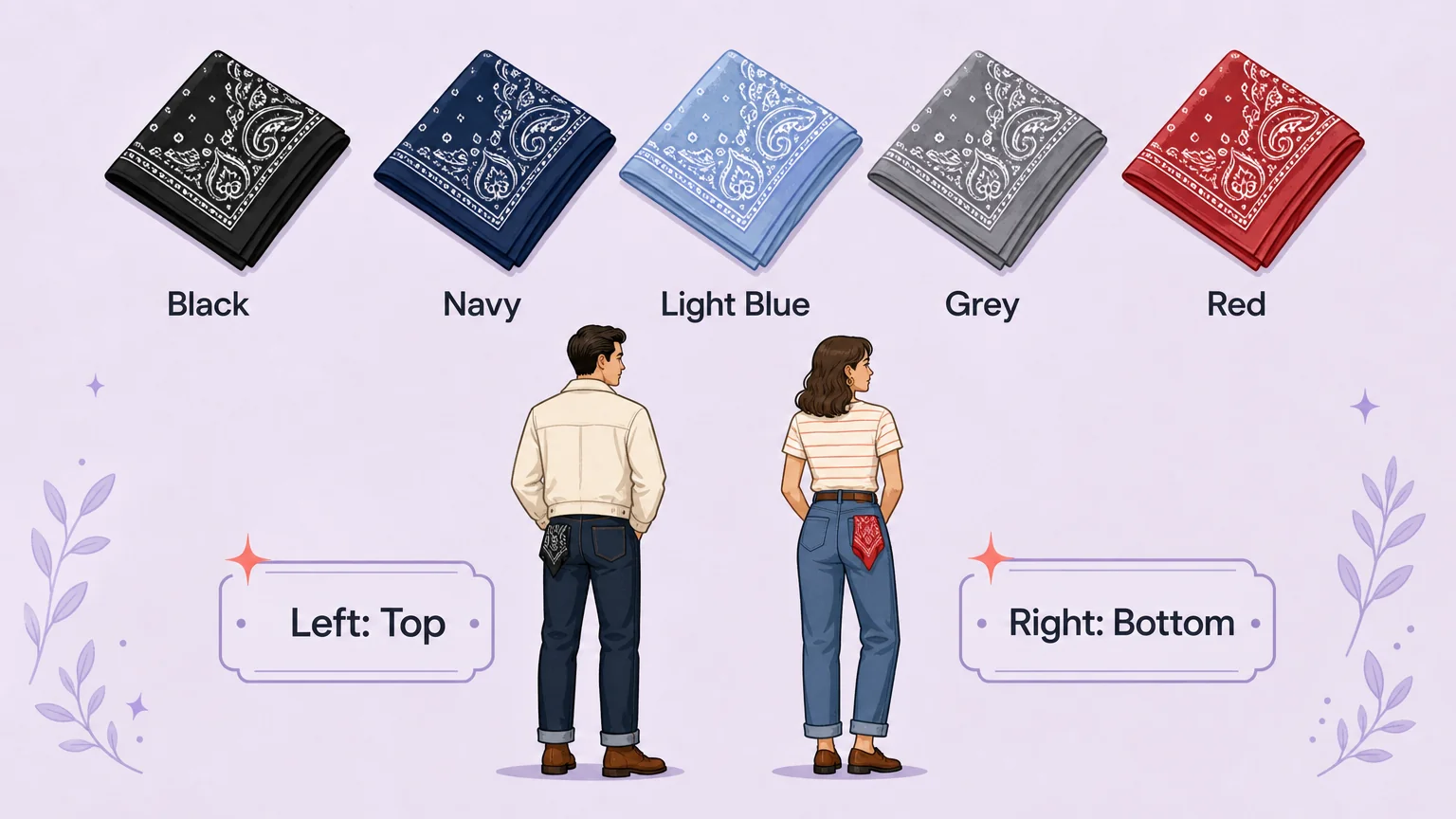
The mechanic is elegant. The color names the activity, and the side names the role. Left pocket or arm means top or giver; right means bottom or receiver.
The left-right convention descends from leather tops carrying keys on the left belt loop, a detail that mattered before bandanas existed. The code grew through the 1960s among kinky gay men and hit its cruising prime in 1970s San Francisco, where the Castro scene went from an undone bottom button on a pair of 501s, to keys, to a folded bandana.
The canonical color list from Larry Townsend’s Leatherman’s Handbook II (1983) still does the heavy lifting: black for S&M, navy for anal, light blue for oral, gray for bondage, yellow for watersports, red for fisting, green for hustler, orange for anything goes, brown for scat, purple for piercing. Later additions filled in white for a hand job, hunter green for daddy, royal blue for cop. The trouble came when the lists ballooned to roughly two hundred mostly-invented colors that sex shops created to move unsold bandana stock, and the code became barely usable.
It survives in two places. Color trims on leather gear still carry the old meanings, so in a traditional leather bar red leather reads as a fisting signal. And the code’s icebreaker, “Do you flag?”, remains the best way to open a conversation without guessing. Use the BDSM signal symbols rule the same way: it only works in daylight, and when in doubt, you ask.
4. The Ring of O: The Story of O Symbol You See on Jewelry
The Ring of O comes from a novel, but it left the page and became real jewelry. In Pauline Réage’s 1954 novel Story of O, the ring is a signet of dull iron lined with gold, stamped with a golden triskelion, worn by trained slaves of the secret Roissy society and obligating the wearer to obey any member. The modern BDSM symbol jewelry version first appeared in September 1989, in issue four of the German BDSM magazine Schlagzeilen, and spread across continental Europe, especially German-speaking countries, through the 1990s.
Today you will see it as a signet ring, a pendant, or a pair of stud earrings, quiet enough to pass as ordinary jewelry to outsiders and legible enough to do its job for people in the know. It is also the direct basis of the slave bracelet: a ring joined to a bracelet by a short chain. The hand placement convention says right hand means submissive or bottom, left hand means dominant or top, and switches wear it on a neck chain. Treat that as a convention, not a law, because published accounts vary, and a detail that varies is not a detail to build assumptions on.
The practical note: the Ring of O has been drifting into mainstream fashion, so a plain signet on a stranger’s hand does not necessarily signal anything at all. Read it as jewelry first, and let a conversation, not an assumption, tell you more.
5. Leather Pride Flag vs BDSM Rights Flag: Two Flags, Two Histories
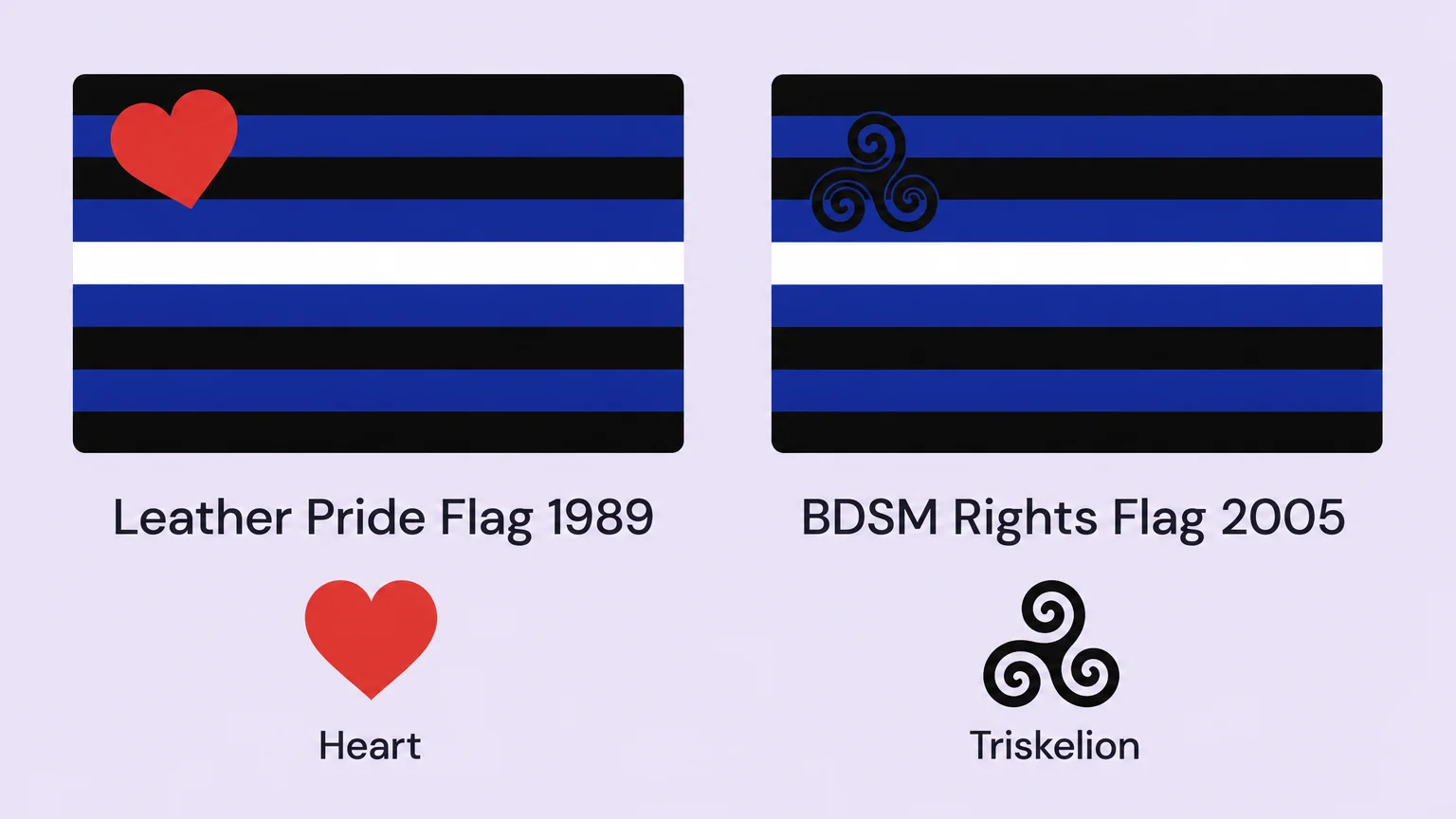
Quick test: a flag with a red heart, or a flag with a triskelion? That single detail is the fastest way to tell the two most-seen kink flags apart.
The leather pride flag came first. Artist Tony DeBlase designed it and first presented it on June 25, 1989, at an International Mr. Leather event. It runs nine equal horizontal stripes that alternate black and royal blue, with a white central stripe and a red heart in the upper left quadrant. It stands for the whole leather community, not only gay men, and it is the one most people picture when they think of a kink flag.
The BDSM Rights Flag came sixteen years later. Tanos designed it in 2005 with the same nine-stripe pattern, but carrying a deliberately modified triskelion instead of the heart. The modification was a legal choice: it was drawn to fall outside the copyright claims on Quagmyr’s emblem, which is why the triskelion on the rights flag does not match the authentic BDSM emblem. Heart, DeBlase, 1989. Triskelion, Tanos, 2005.
You will see both at Folsom Street Fair, in leather bars, on event wear, and occasionally flown from a house. That public visibility cuts both ways: a flag is legible to everyone, including people who will misread it or object to it. The respectful reading is to treat a flown flag as an invitation to say hello, not as a full biography of the person flying it.
6. BDSM Ownership Symbols: Locks, Keys, and the Icon Family
Ownership in BDSM is usually signaled with the quietest objects in the room. The cleanest mechanic is also the oldest: a lockable collar transfers power from the person wearing it to the person holding the key, exactly the way a chastity device does. Every other ownership symbol is a variation on that transfer.
The visible family is small. Keys worn as pendants on a necklace, an anklet, or a bracelet signal access to cuffs, locks, and cages, readable to a trained eye. The lock-and-key motif is the most legible of the family, which is why it keeps showing up in jewelry. The slave bracelet, a ring joined to a bracelet by a chain, is a direct descendant of the Ring of O. An O-ring or D-ring collar works as a quiet I-am-in-a-steady-relationship marker.
None of these scream, and that is the point. They are BDSM ownership symbols for people who want their commitment legible to the right audience only. The Tanos icon family, including the ownership shields, the owned circle, and the open cage, belongs to the same possession-marking vocabulary. Their exact meanings are not universal; they are agreed between the wearer, the partner, and their community, and they deserve respect and honor on those terms.
So the respectful read is simple: if you notice a lock-and-key motif, treat it as a likely ownership signal, and let the respectful move be to ask rather than to assume. Curiosity is welcome. Guessing is not.
7. Everyday Gear as BDSM Symbols: Cuffs, Floggers, Rope, and O-Rings
Before you ever meet a triskelion, you have probably seen the first layer of BDSM symbols on people: the gear itself. Cuffs, a flogger on a hook, rope, a leather mask. The meaning rarely comes from the object alone. It comes from the context around it.
Take the rope community. A Rigger may wear a specific tie on one wrist while the bunny wears the matching tie on the opposite wrist, flagging their roles to each other and to the room without a word. That is everyday gear doing signaling work. The same is true of leather color trims, which quietly inherited the old handkerchief-code meanings. A harness in a traditional leather bar says more than its buckles. A lot of what passes for edgy fashion, leather jackets, chunky hardware, high boots, reads as a quasi-BDSM signal to people in the know, sometimes without the wearer realizing it.
The BDSM symbols and meanings here stay tied to the setting. A flogger hanging in a play space is an invitation and a tool. The same flogger on a bedside table is a private promise between two people. The same cuffs that read as scene gear at a party pass as fashion at a coffee shop. So read the room before you read the gear, and remember that most equipment was built to be useful first and symbolic second.
Collaring Ceremonies and the Stages of Commitment: The Engagement Ring of BDSM
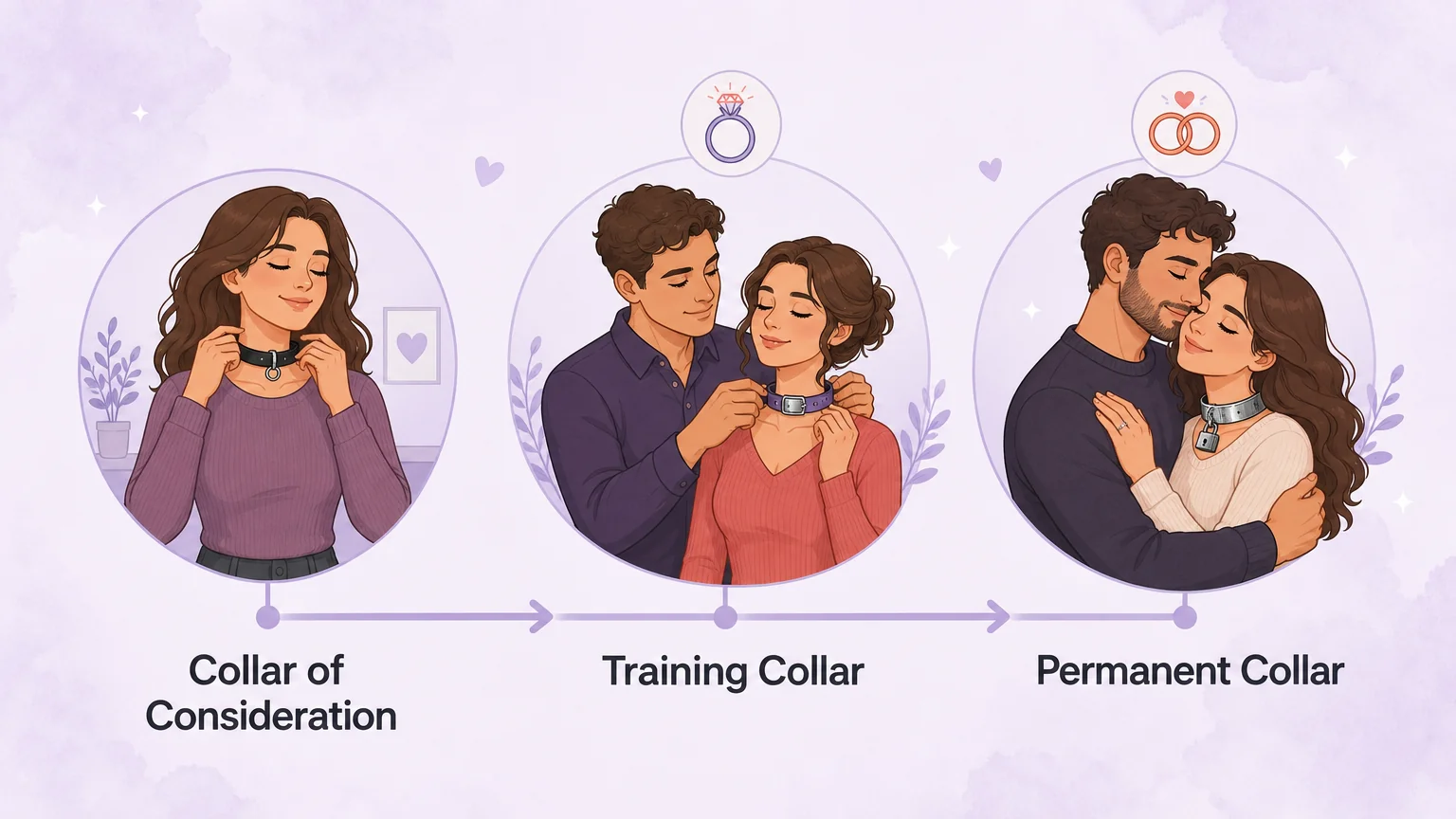
Collaring follows a ladder that maps onto ordinary dating: consideration, engagement, marriage. That framing is the fastest way to understand BDSM collar symbolism when it turns into commitment.
The first stage is a collar of consideration, worn for a negotiated period while both people decide whether the fit is right. Either party can remove it at any time, for any reason, and that is the point. The second stage is a training collar, the engagement ring equivalent. It follows real negotiation of likes, dislikes, and needs, and it signals that the relationship is heading somewhere definite. The third stage is a permanent or slave collar, the wedding band. Only the Dominant removes it, and it marks a formal ownership commitment.
Around that ladder sits a whole ecosystem. Scene collars are for a single scene and only appropriate when the bottom is uncollared. House collars and collars of protection are offered by established Dominants to newcomers, and approaching the wearer requires the protecting Dominant’s permission.
Formal collars often get a collaring ceremony of their own, with witnesses or without, and many couples design a personal ritual to mark the moment. There are no universal rules; the meaning is whatever the two of you negotiate. So if collaring is on your horizon, agree on the stages together before you buy anything. The ladder works best when both people built it.
BDSM Symbols on Dating Apps: What a Profile Is Really Saying
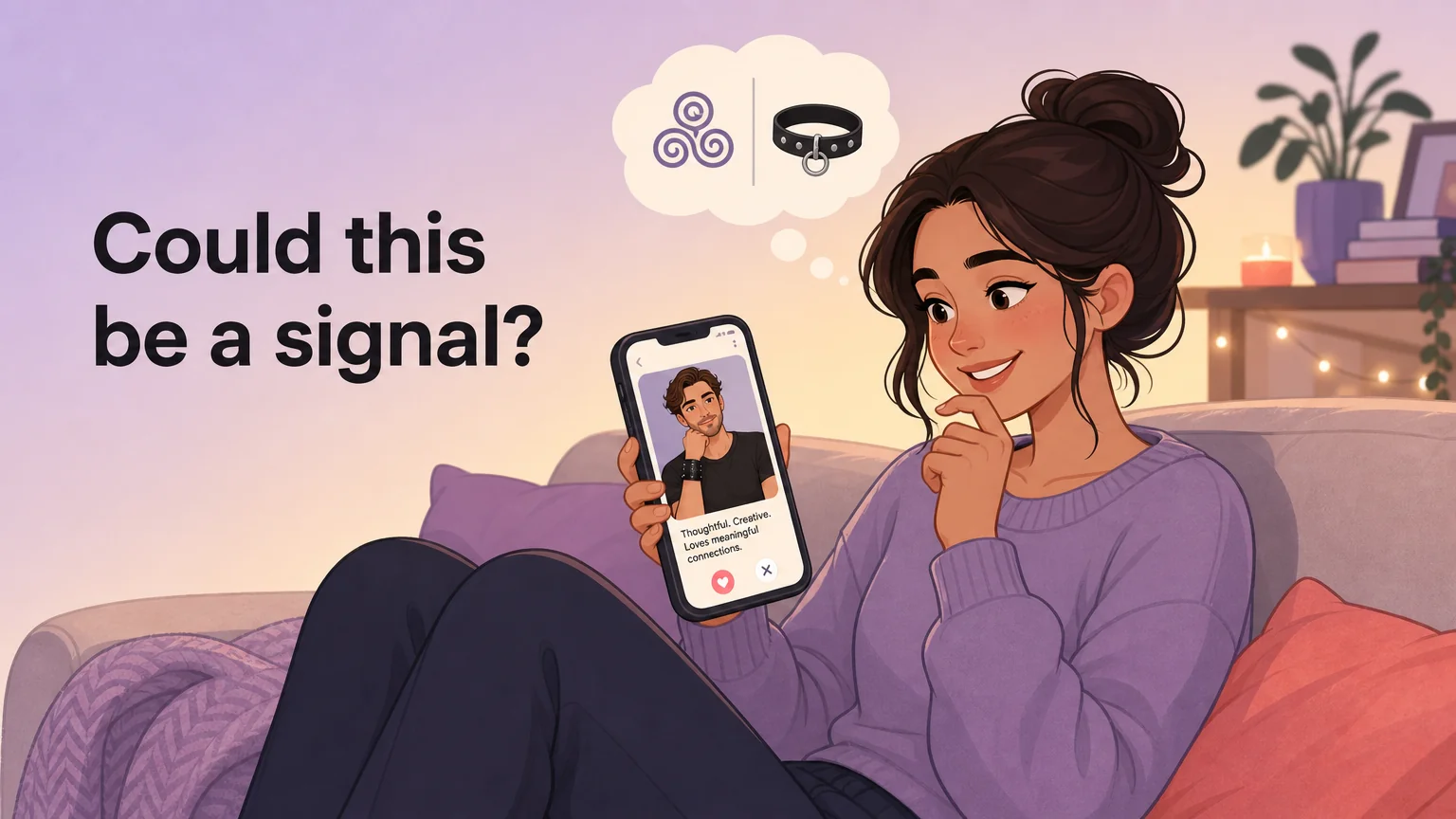
The hanky code was the original dating profile. Long before apps, you flagged your interest with a bandana in a pocket, and a person either read it or did not. The job is identical today; the pocket is just a bio now.
The BDSM signal symbols on a modern profile are mostly words and photos. Code phrases like open-minded, adventurous, alternative lifestyle, dynamics, SSC/RACK, and D/s compatible all translate within the community. Photo cues work the same way: a leather jacket, heavy boots, cuffs, or a collar that could be fashion or could be more.
The platforms each set the volume. Feeld offers desire tags built for this. OkCupid asks kink questions directly in its matching surveys. FetLife allows full explicitness, and it is explicitly not a dating app, so treat it as community first. On Hinge, Bumble, and Tinder, the signaling stays subtler by default, a cuff in one photo or a single loaded word in a bio. ENM-friendly apps such as 3Fun and Feeld sit in that middle ground for people who want the signal clear without it taking over the profile.
One caution applies everywhere. A symbol on a profile is public and screenshottable. Balance clarity with privacy, which is exactly why the code-words-and-cues approach works: it is legible to the right reader and opaque to the casual one.
The in-person rule carries over unchanged. The ask-don’t-assume etiquette that governs reading a bandana governs reading a profile. Signal enough to start the conversation, then let the conversation do the work. A profile that signals a little invites a question; a profile that signals too much invites a crowd.
Symbols Advertise Interest, Not Consent: How to Read and Approach a Symbol Wearer

The rule that keeps every symbol in this article safe to use: wearing one advertises interest, not consent. A collar, a flag, a bandana: all invitations to conversation, never guarantees of anything. Nobody owes anybody a thing because of what they wear.
The approach playbook is short and polite. In a flagging space, ask “Do you flag?” and ask what the color means; that is the standard opener. If you see a collar, the community line is direct: “Are you collared or uncollared? I am just asking.”
In Master/slave settings, a collar of protection means you need the protecting Dominant’s permission to approach the wearer at all. And with a choker, a triskelion, or a Ring of O, the default is to assume nothing, because those read as fashion to most of the world.
Underneath the etiquette sits the consent framework the scene actually runs on. The older SSC, Safe, Sane, Consensual, coined by David Stein in 1983, still gets public airtime. The modern consensus is RACK, Risk-Aware Consensual Kink, coined by Gary Switch in 1999, which treats the promise of safety as an illusion and manages risk through study and technique. RACK does not make a scene safe; it makes the risk an informed choice. That is why the BDSM symbol meaning always resolves the same way: when a symbol is ambiguous, the respectful default is curiosity, not assumption.
BDSM Symbols You’ll Misread: Triskelions, Chokers, and Locks
The same three-armed shape shows up in a dozen places that have nothing to do with kink. The Sicilian triskelion is three running legs representing Sicily’s three capes. Celtic and neopagan triskeles, the Isle of Man symbol, Okinawan martial-arts marks, the Taoist taegeuk, even the US Department of Transportation logo, all borrow the same geometry. A darker variant exists too: some neo-Nazi groups have misused a triskele form, which is exactly why context matters before you read any three-armed spiral as a BDSM signal. The authentic emblem’s metallic rim, black fields, and holes are what separate it from the rest.
The fashion blur is just as active. Velvet and plastic chokers are more likely fashion accessories than collars. Chains and padlocks are multivalent across motorbike culture, punk, and gym wear. Gothic chokers and studded dog collars blur the line further, so the trained eye checks hardware and setting together. The Ring of O’s meaning is blurring as it moves into mainstream BDSM symbol jewelry. The leather pride flag can read as nothing more than stripes to someone who has not seen it before.
None of this means the symbols are broken. It means the BDSM symbols and meanings you carry are only as legible as the person reading them, so read the setting before you read the symbol. The same object says different things at a play party, a coffee shop, and a concert.
Collar Blindness: How to Want a Collar Without Losing Yourself
Collar blindness is a term worth knowing before it happens to you. It describes acting blindly in a relationship to obtain a collar, instead of letting the collar serve the relationship. Evie Lupine, who expanded the term, puts it as chasing the ring while missing the forever. The term itself was coined by Pup Amp of Watts The Safeword and popularized by kink writer Race Bannon, and it names a very real trap.
The pressures are structural. Collared couples are treated as the pinnacle of kink, while uncollared subs get suspicion and blame when a dynamic ends, as though it were always their fault. That pressure makes people stay in relationships that are not working, and desperation attracts predators who overstate their experience to move fast. The online version is the Velcro collar: a collar handed out quickly and casually, with no real commitment behind it, often by someone who barely knows you.
The cure, in the community’s own voice, is direct. Want the compatible person first and the collar second. Talk to other subs privately as a reality check on what collaring actually changed. And give yourself permission to wear a collar for fashion or scene use without any D/s relationship at all, if that is what you want.
Evie gives that permission explicitly, and it extends to you. The BDSM collar symbolism is at an all-time high, but a collar is a map, not the destination. Let it point you toward the right person, and let the right person matter more than the collar.
BDSM Symbols FAQ
Who created the BDSM triskelion?
Created in 1994 and 1995 on an America Online BDSM board by designer Steve Quagmyr, under the BDSM Emblem Project; the copyright line read “copyright 1995 by Quagmyr@aol.com.” Tanos is separate: he designed the BDSM Rights Flag in 2005 with a modified triskelion.
Is the BDSM triskelion the same as the Sicilian one?
No. The Sicilian triskelion is an ancient emblem of three running legs representing Sicily’s three capes. The BDSM version is a modern design with black fields, holes instead of dots, and a metallic rim. They share only a generic three-fold shape, also used by the Isle of Man and Celtic neopagans; context matters.
Does wearing a collar mean you are owned?
Not necessarily. A play collar is scene gear, a velvet choker is usually fashion, and a self-collared chain means only what its wearer gives it. Ownership signals come from a relationship collar with a lock and key or a declared collaring stage. The community rule is to ask: are you collared or uncollared?
Is the handkerchief code still used today?
Mostly no. The color lists grew to roughly two hundred invented shades and became unusable, and apps replaced the need for it. It survives in some leather communities and on gear trims, where old-school bars read them.
SSC vs RACK: what’s the difference?
SSC, Safe, Sane, Consensual, was coined by David Stein in 1983. RACK, Risk-Aware Consensual Kink, was coined by Gary Switch in 1999 and accepts that nothing is fully safe, managing risk through study and technique. Modern consensus favors RACK; many use SSC in public.
Are BDSM symbols safe to wear in public?
It depends on the symbol and setting. The triskelion is ambiguous, sharing its shape with Celtic and pagan marks. Chokers are mainstream fashion, so most symbols read only to a trained eye. Collars and flags are legible to everyone, so treat those as public statements.
That is the whole language. Read the setting, ask when unsure, and treat every symbol as a map, not the destination: an opening, never an obligation.