
BDSM isn’t one person controlling another. It’s a set of bdsm rules you and your partner build together, the shared agreements that let both of you let go without losing the ground underneath you. These 12 rules are not a killjoy checklist. They’re the safety architecture every scene runs on: consent, limits, safewords, sober judgment, and the aftercare that holds it all together. Think of them as load-bearing walls, not decoration. Agree on them together and you can both push further, because neither of you is left guessing where the edges are.
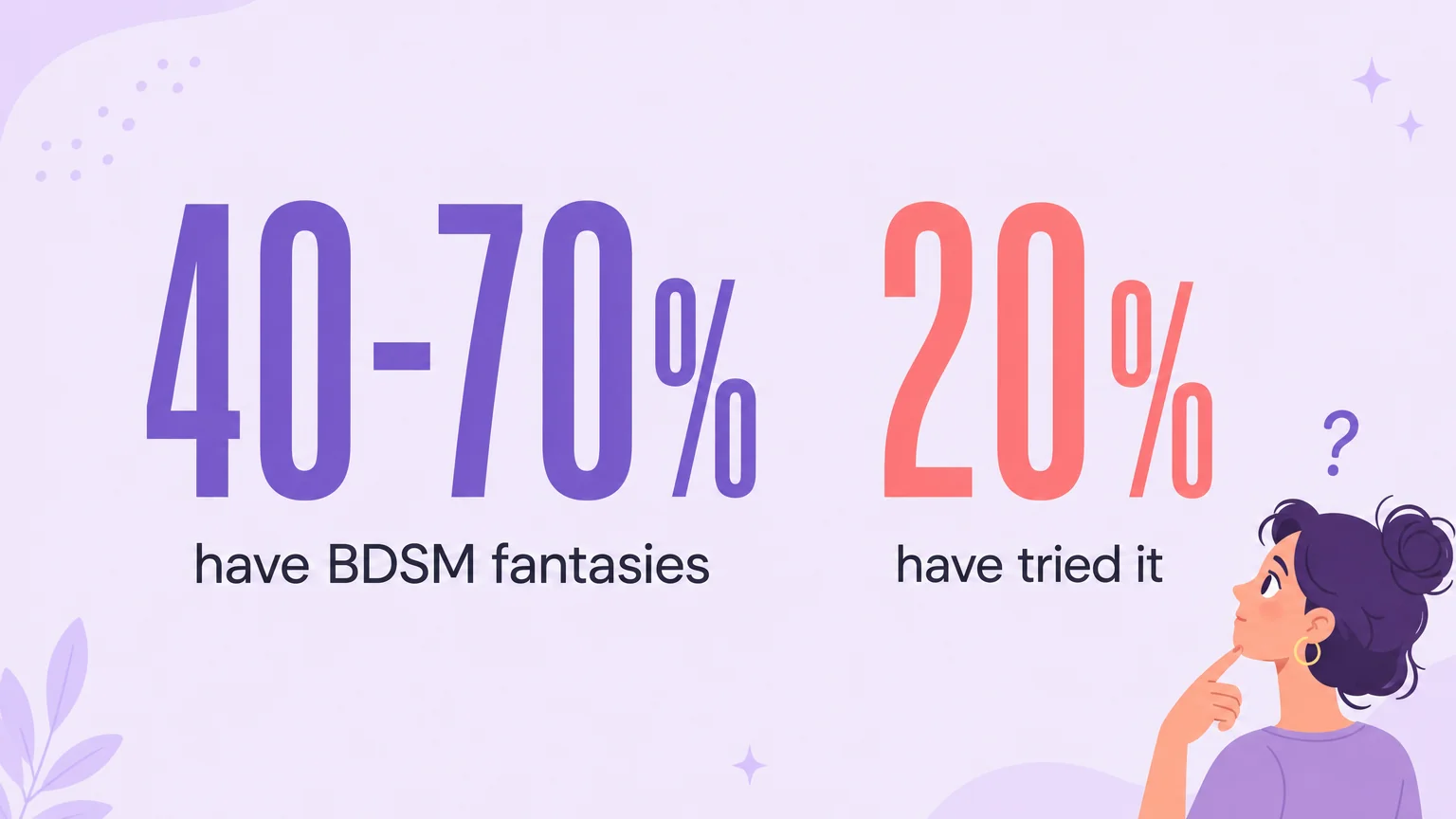
People who negotiate, use safewords, and show up for aftercare aren’t boring. They read as attentive and trustworthy, the kind of partners everyone wants to play with. And wanting rules isn’t fringe. Roughly 40 to 70 percent of adults report BDSM-related fantasies, so the desire to explore sits squarely in the mainstream of human curiosity. Wanting a clear set of rules isn’t cautious. It’s the sign of someone who plans to play well and often.
If you already know what BDSM is and want the governing rules of the road, this is your list. If you need the basics first, start with our guide to what is BDSM, then come back here.
1. Consent Is Ongoing and Reversible
Consent is not a box you tick at the door. It’s a door that stays open the whole time you’re playing, and either of you can walk back through it whenever you need to. This is the one rule every other bdsm rule on this list exists to protect.
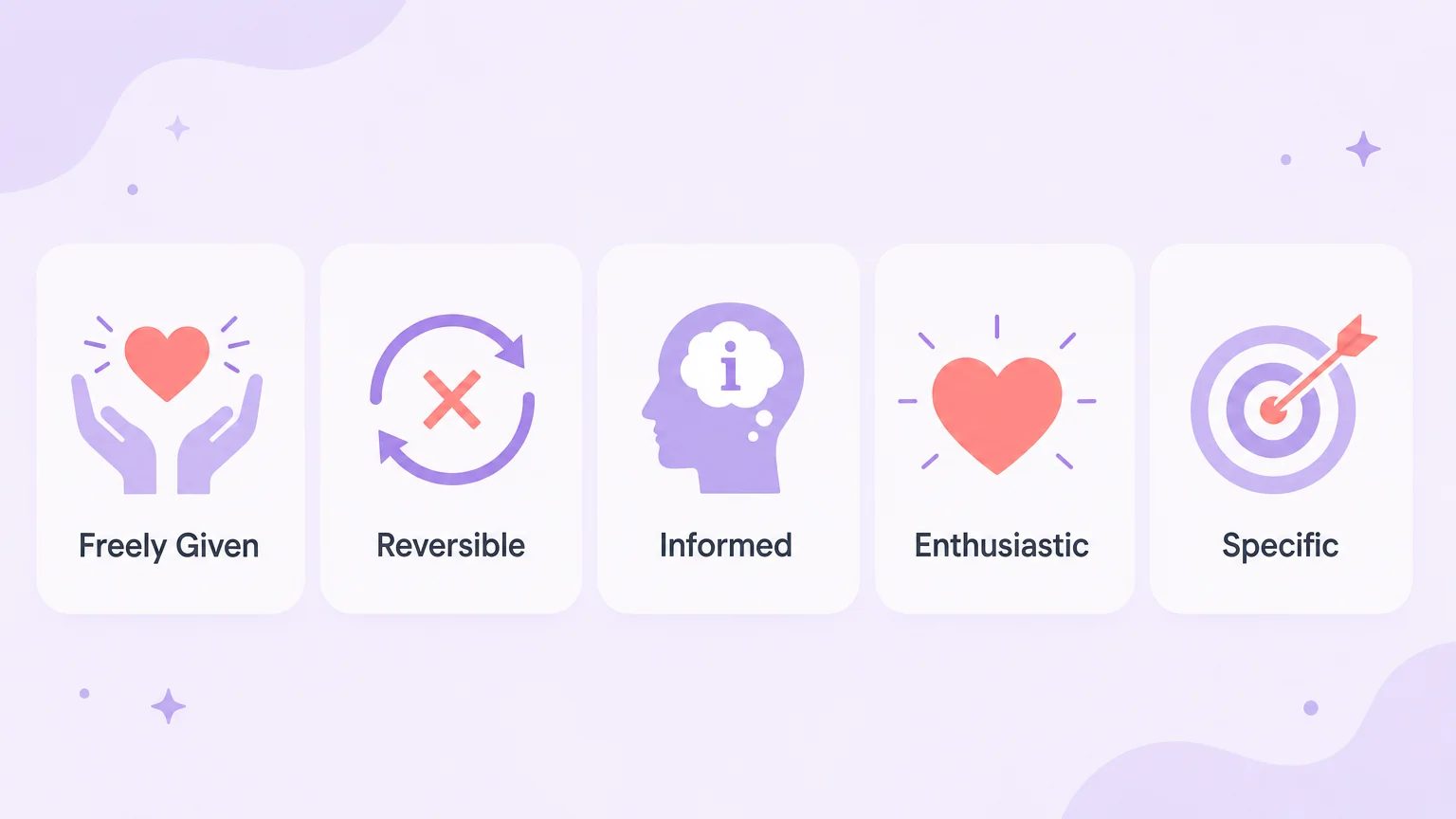
The cleanest way to hold it is the FRIES model, adapted from Planned Parenthood and mapped straight onto kink. Consent is Freely given: no pressure, no guilt, no “well you did it before.” It’s Reversible: you can change your mind at any moment, mid-scene, even with a partner you’ve played with for years. It’s Informed: both of you understand what’s about to happen, including the risks. It’s Enthusiastic: not a shrug or a sigh, but a genuine yes. And it’s Specific: a yes to one act is not a blanket yes to another.
Of the five, Reversible is the one that tends to get lost. People treat a single yes as a contract, as if revoking it mid-play is a failure or a betrayal. It isn’t. Using a safeword is a strength. It’s the moment you trusted your partner enough to tell the truth in real time. The entire scene runs better when both of you know a stop is always available, because that’s the only thing that lets either of you go all in.
There’s a line that belongs here, and it’s worth saying out loud: if it’s not an enthusiastic yes from everyone in the room, it’s a hard no. That applies to both of you equally. The dominant can revoke consent just as fast as the submissive. The role doesn’t change the rule.
Consent is not something one of you gives and the other one collects. You both give it, and you both guard it. Everything that follows, the safety framework, the negotiation, the safewords, exists to keep this one real. The rule scales with the fantasy: as sex therapist Dr. Misty puts it, the hotter the fantasy, the more rigorous the ethics need to be. Structure isn’t the opposite of intensity; it’s what makes intensity safe enough to want. Mutual, ongoing consent is the line that separates kink from harm, legally and ethically. It’s the whole game.
2. Choose Your Safety Framework: SSC, RACK, or PRICK
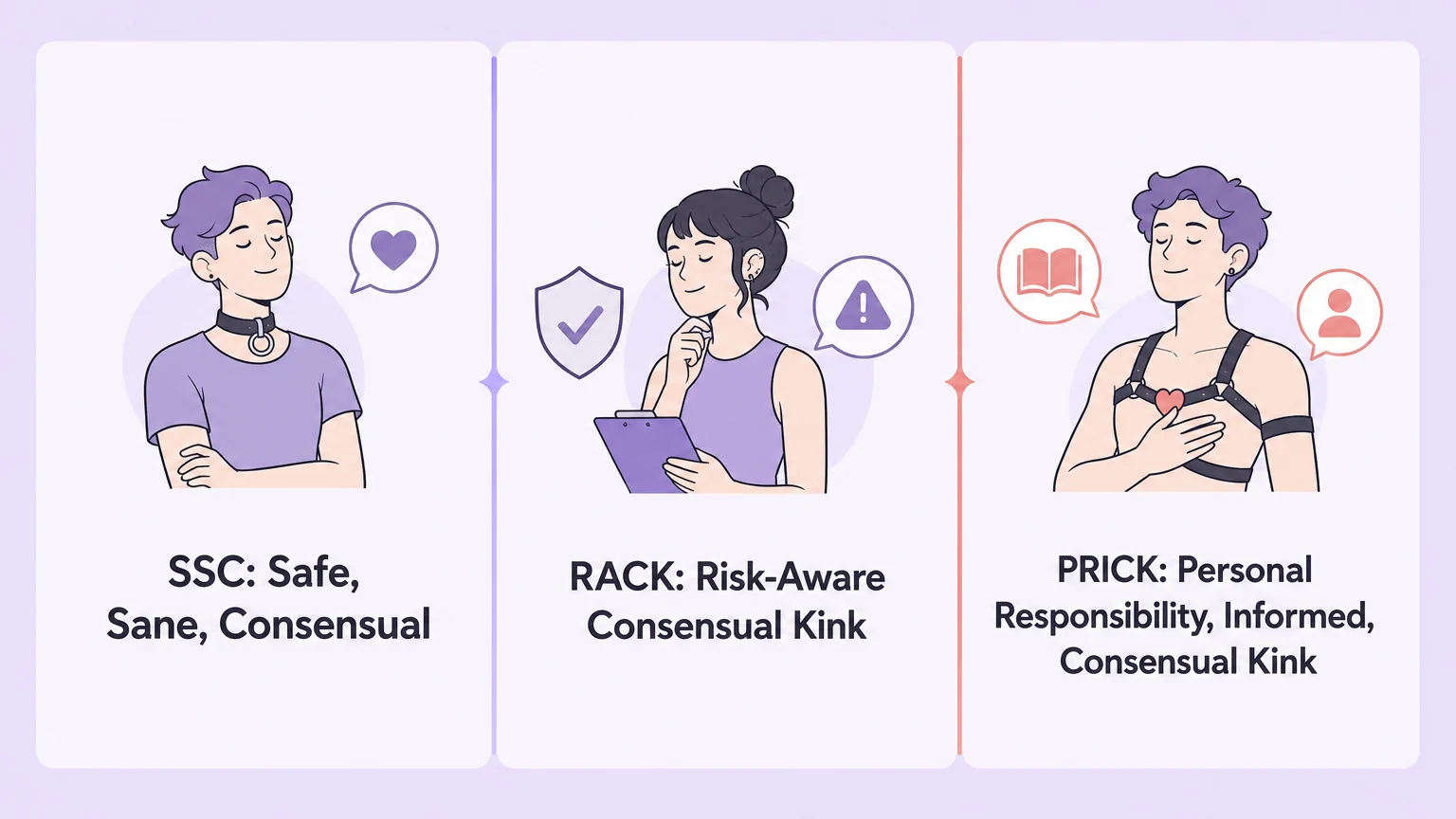
Once you’ve put consent at the center, you need a shared language for talking about risk. That’s what a safety framework gives you, and there are three of them. Most people only ever hear about two. The third is the one built for edge play.
SSC has been around since the 1980s: Safe, Sane, and Consensual. It holds that your play should be as safe as you can make it, that you should both be of sound mind, and that everyone consents. It’s the reassuring baseline, and it’s still the most common shorthand you’ll hear.
RACK grew out of a fair objection to that framing: no act is ever truly risk-free, and calling something “safe” can be its own kind of dishonesty. Risk-Aware Consensual Kink asks instead whether both of you fully accept the risks you’re about to take. Its advocates argue that openly talking through even the low-probability risks is the only way consent can be genuinely informed.
PRICK is the third one almost nobody explains, and it matters most when the stakes are higher. Personal Responsibility, Informed, Consensual Kink puts the weight on each of you owning your own risks. The key word is Informed: you can’t genuinely consent to something you don’t understand, so understanding the risks is part of consent itself.
On the practical side of things, the difference comes down to one question each. SSC asks, is this safe and sane? RACK asks, do we both accept the risks? PRICK asks, do we each own the risks?
You don’t have to pledge allegiance to one forever. Plenty of couples lean SSC for lighter play and shift to RACK or PRICK when they explore more intense scenes. The point of any of these bdsm rules isn’t the acronym. It’s that you and your partner agree on a shared language before anything starts, so nobody’s guessing.
3. Negotiate Every Scene Before It Starts

“Negotiation” sounds like a boardroom, and that’s exactly why people avoid it. But here’s the thing the people who do this well know. Pleasure coach Lisa Opel puts it plainly: “They’re not contracts, they’re conversations,” and the best ones are led with curiosity and playfulness, not a clipboard. This is one of those bdsm rules that reads like paperwork before you try it and feels like freedom once you’re inside it.
Before you talk to your partner, do a little homework with yourself. Make a yes, maybe, no list. Yes is what you want, maybe is what you’d consider, no is off the table for now. This alone does something quietly powerful: it forces you to get clear on your own desire before you ask for anything.
Then bring the five W’s: who, what, where, when, why. Notice the last one matters most. Instead of opening with a clinical list of acts, lead with the emotional why. Say you want to try restraint and a blindfold. Don’t just announce it. Say what’s underneath it: “I trust you, and I think I could actually let go if I couldn’t reach for control.” That’s the part your partner can hear and meet.
Here’s that example in practice. You state the desire, you give the reason, then you co-create what it means together. What does restraint look like to each of you? How tight, for how long, and what’s the fastest way out? You close by agreeing on aftercare before anything starts, so the whole scene is framed in safety.
And one reminder that belongs right here: desire doesn’t require an apology. Naming what you want isn’t a burden you’re placing on your partner. It’s a gift. The people who play best are the ones who learned to say the thing out loud.
A scene with no negotiation, no safeword, and no aftercare isn’t spontaneous. It’s the hallmark of inexperience, and it’s how people get hurt. If you need the vocabulary to name what you want, our BDSM terms glossary will hand you the language.
And remember: negotiation is something you and your partner do together, not something one of you grants the other.
4. Name Your Hard Limits and Soft Limits Out Loud
Having limits isn’t a sign you’re new. It’s a sign you know yourself. And if you don’t have them sorted yet, you’re in good company: in one community survey, only about 38 percent of people fully understood what limits were when they first got involved.
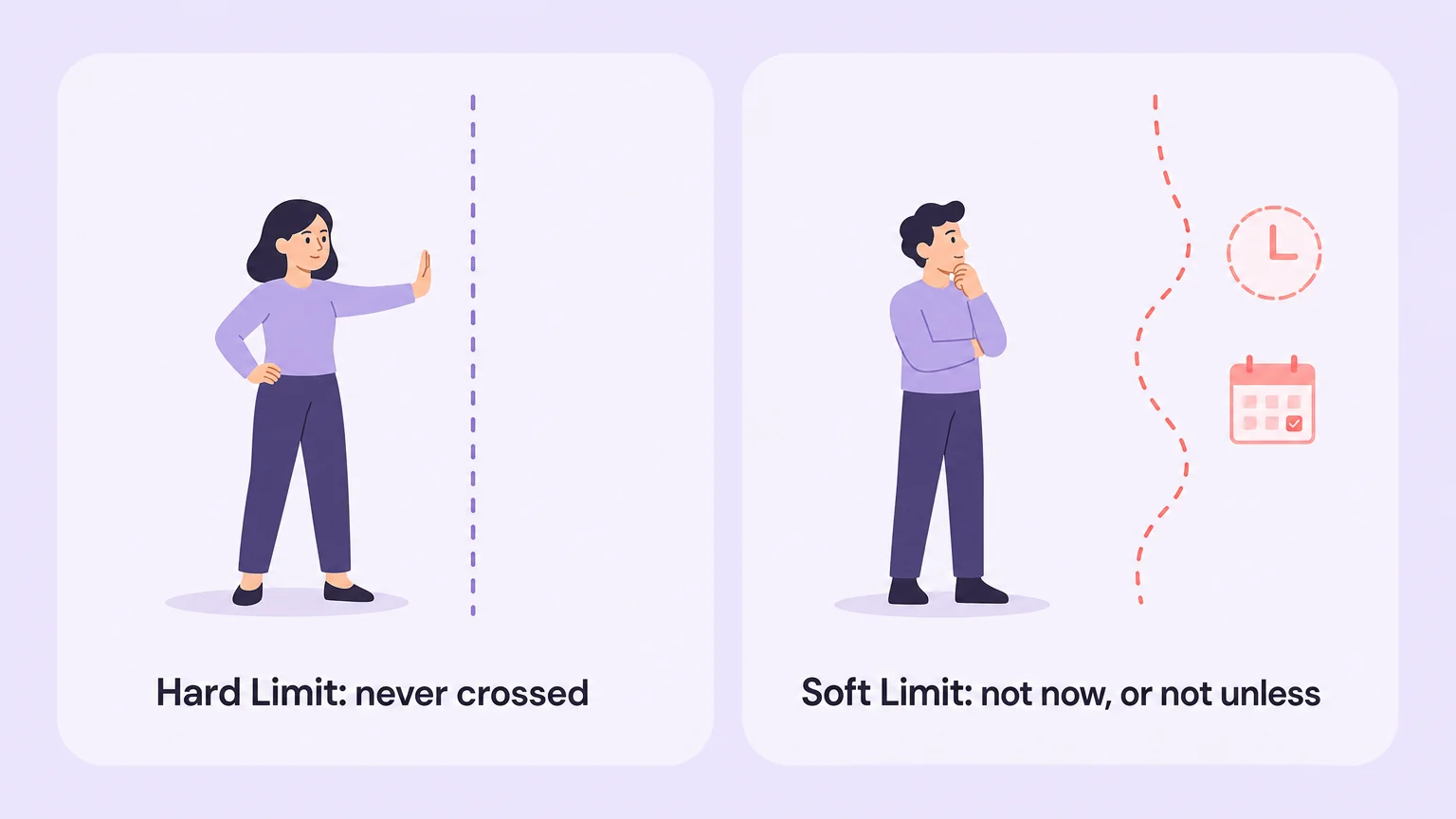
So let’s define the two cleanly. A hard limit is an absolute boundary. It never gets crossed, no matter the mood, and violating one is often enough to end a scene or a relationship on the spot. A soft limit is something you’re hesitant about, or something you’d only consider under specific negotiated circumstances. It’s not a no. It’s a not right now, or a not unless.
Hard limits sound different for everyone, but the ones people name most often include scat, blood play, permanent marks, fisting, and knife or needle play. Yours will be your own. The important thing is that you both say them out loud before you play, not discover them by accident mid-scene.
One flag worth knowing: a partner who claims to have “no limits” is usually telling you they haven’t thought this through. Nobody has no limits. Someone who says they do is either inexperienced or expecting you to guess their boundaries in the dark. Neither is a safe place to stand.
But here’s where it gets interesting: limits move. They ebb and flow with trust. A face-slapping hard limit can soften into a soft limit a year later, and a soft limit can firm back up into a hard one. What they don’t do is shift mid-scene. Any change to a limit happens in a conversation with your clothes on, after the scene is over, never in the middle of one.
Both of you set limits here, not just the partner on the receiving end. The dominant has just as much right to say “that’s a no for me.” These are the bdsm rules that turn vague feelings into clear lines, and clear lines are what make you safe to play with.
5. Agree on a Safeword, Plus a Nonverbal Backup
A safeword only works if you can say it, and under stress or with a gag in, a lot of people can’t. That’s the gap between knowing what a safeword is and actually having one that works when speech is off the table.
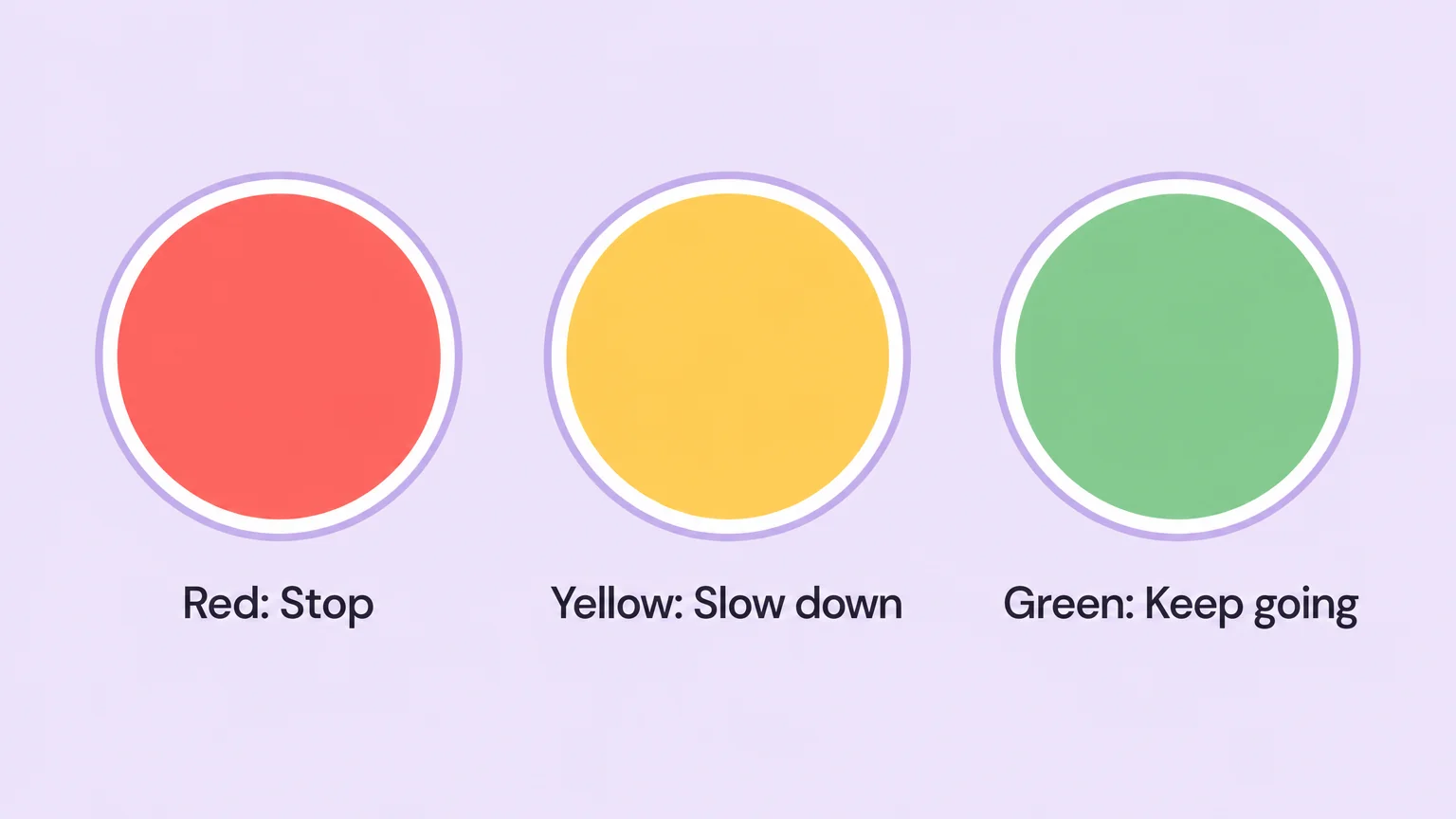
Start with the traffic-light system, the universal baseline. Green means keep going. Yellow means slow down or check in, we’re approaching a limit. Red means stop now. Three words, one shared meaning, and the beauty is that Yellow lets either of you pause without calling the whole thing off. And one thing about green: green lights only require green lights from both of you. If either of you is yellow or red, the scene isn’t green.
The next layer is simple: build the backup, because this is the bdsm rule that keeps protecting you when words fail. When you’re gagged, in restrictive bondage, or just go quiet under intensity, you need a physical signal. Drop a held object, like a ball, keys, or a scarf. Use a squeeze pattern: two squeezes to slow down, three to stop. Tap three times on your partner or the bed. Or keep a clicker or bell in your free hand for a sound that can’t be mistaken for anything else.
The design rules are simple, and they matter. Keep the signal distinct from your pleasure sounds and the roleplay. Match it to the position: hand signals fail in arm bondage, foot taps fail in suspension, so pick what actually works for how you’re playing. Practice it a few times before you start so it becomes automatic. And keep one hand free or holding the drop object, so the channel is always open.
Your partner has a job here too: stay positioned to see or feel the signal at all times, and respond instantly, no questions, no negotiation. And remember this runs both ways. The dominant needs an off-ramp as much as the submissive does. Either of you can tap out, and that’s exactly how it should work.
6. Play Sober, Every Time
This is the shortest rule on the list and the one people skip most often, because a drink or two feels like it helps the nerves. It doesn’t. It just moves the risk somewhere you can’t see it. Sober play is one of those bdsm rules with no exceptions, no loopholes, and no version of it that gets better with a buzz.
BDSM demands clear judgment from both of you, which means drugs and alcohol stay off the table before and during a scene. Not a glass of wine to loosen up, not a shared joint to set the mood. Sober is the baseline, every time.
Here’s the logic, and it’s not a lecture. You cannot give informed or reversible consent when your judgment is altered, so the entire foundation this list is built on goes wobbly the moment either of you is impaired. On the other side of the room, a dominant who’s had a drink can’t read a body the way they need to, and can’t respond to a safeword they’re too foggy to register.
Sober negotiation is one of the recognized green flags of a safe dynamic, the kind of thing experienced practitioners look for. But you don’t need that to see the point. If you need a drink to try this, wait until you don’t. The scene will still be there, and you’ll both be present for it.
7. Check In Before, During, and After
A safeword only helps if the person can bring themselves to use it, and plenty of people freeze or go quiet instead. Consent is the principle. Checking in is the practice, and this is where the principle either holds or quietly breaks.
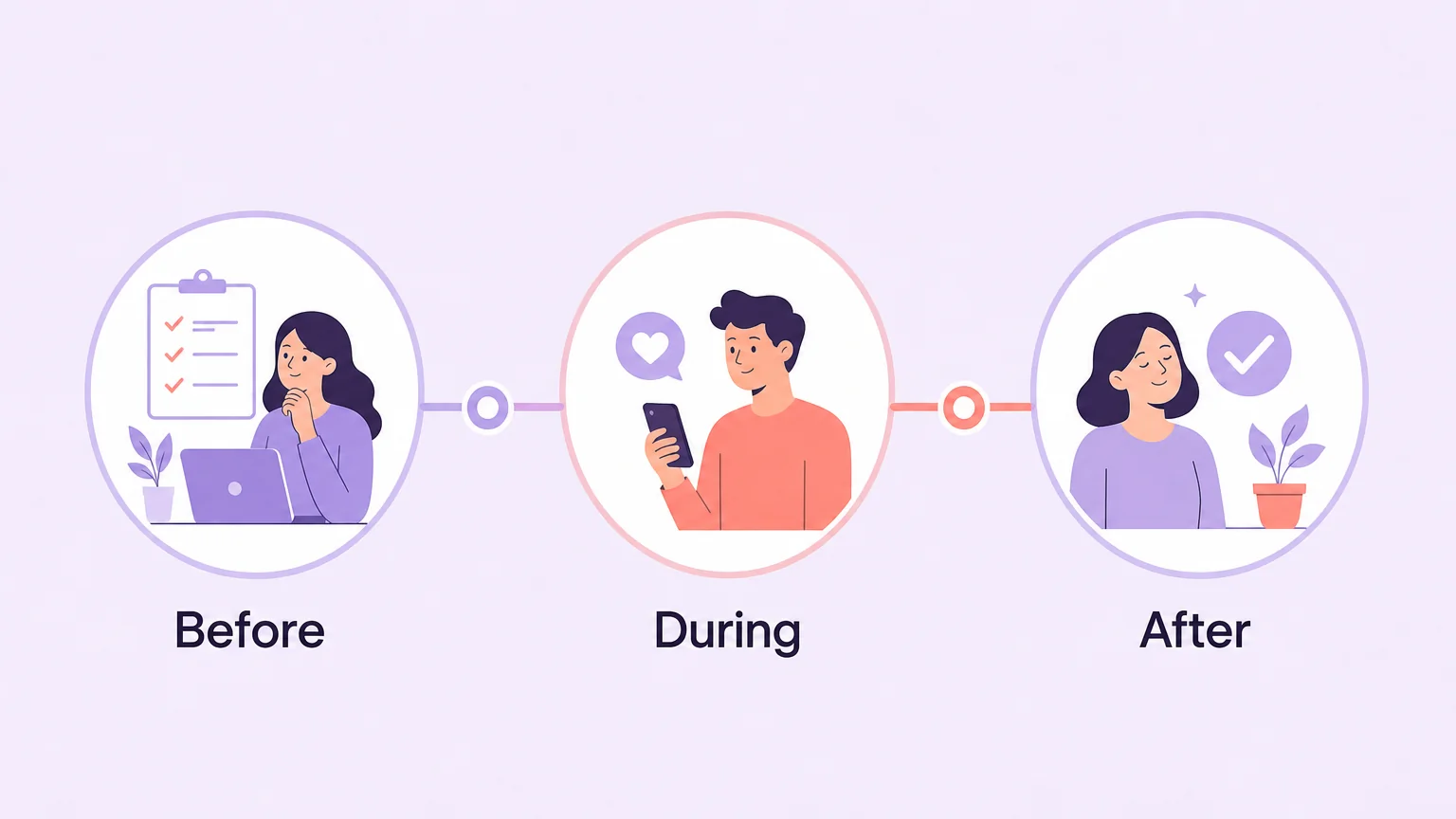
Think of it in three layers. Before: a capacity check. Are you both present, rested, and sober? Or did someone walk in carrying a rough day they haven’t set down? If you’re not both here, wait.
During: watch for the quiet signals. Freeze, fawn, and dissociation are nervous-system states where someone has stopped being able to meaningfully consent, even if no safeword ever comes out of their mouth. As Dr. Misty frames it, these are the states where consent can’t be maintained, which is why the person in charge has to be the one to catch them.
A partner who goes still, goes distant, or starts performing compliance instead of being present is sending you a signal, just not the one you practiced. The dominant or top has a real responsibility here: read the other person and stop, even without a safeword. That’s not optional.
After: the debrief, ideally within a day or two. What worked, what felt off, what you’d adjust. Keep it to two questions: one thing to keep, one thing to change. Two minutes on the couch the next morning beats a formal debrief that never happens, and it’s how the scene keeps getting better.
And these bdsm rules run both ways. The dominant needs check-ins too. A top can hit their own limit, feel off, or need to stop, and that deserves the same grace as anyone else tapping out.
Check-ins are how you and your partner stay in the same scene together. They’re not interruptions. They’re the connective tissue.
8. Vet a New Partner Before You Play
Meeting someone on an app is not vetting them. A matched profile is a first impression, not a reference, and the couple who treats it like one is the couple most likely to get burned. If you and your partner are opening your dynamic to a third, or if you’re a single meeting someone new, this rule is the one that keeps a fun idea from turning into a bad story.
The protocol is concrete, and none of it is optional. Meet first in public during the day, at a cafe or a bar, never a private home or a hotel room. Do a vanilla meetup before any play, a meal or a walk where you just get to know the person outside of kink. Talk as equals first. A video call before you meet in person verifies identity and lets you see how they carry themselves, and playing at a public event or munch before any private scene lets you watch how they negotiate with other people.
Then ask the questions that matter. What’s their experience? What are their hard and soft limits? How do they feel about safewords and aftercare? Do their existing partners know and consent to them playing? Do they understand SSC, RACK, or PRICK? How do they handle being told no? How they answer tells you more than their profile ever could.
Two layers most people skip, and they’re the two that matter most. First, ask for references from past play partners, and check their standing in the community. A person who refuses to give references, or who avoids the local scene entirely, is raising a flag worth paying attention to. Second, set up a safe call: a trusted friend who knows where you are, checks in at an agreed time, and has an action plan if you go quiet.
The reason people skip all of this is called frenzy. It’s that rush of finally getting the thing you’ve wanted, and it makes red flags look pink and pink flags look invisible. New submissives especially will wave off their own instincts out of a need to please, which is exactly how people get hurt.
So slow it down. Vetting is something you and your partner do together, never one of you alone. These bdsm rules protect the people who follow them, and the ones most in danger are the ones who decide the excitement is worth skipping a step.
9. Know Where Kink Ends and Abuse Begins
The line between kink and abuse is thinner than it looks, and it’s almost never about what you do. It’s about whether you can say no. A flogger in the hands of someone who honors a safeword is play. A raised voice from someone who gets angry when you object is not. Same room, opposite realities.
The dividing line is the same consent this whole list is built on: informed, specific, ongoing, enthusiastic, and reversible. If all five are present, it’s kink. If any one of them is missing, something is wrong.
Here are the red flags to walk away from, no second chances. Rushing the dynamic, wanting to jump to full power exchange before you’ve even negotiated. Demanding titles or obedience outside of a negotiated scene. Dismissing safewords as something “for beginners.” Avoiding negotiation because it “kills the mood.” Using their experience or status to silence your concerns. Isolating you from the community or your friends. And the loudest one of all: getting angry when you revoke consent.
But here’s the single clearest test, and it cuts through every rationalization. Would they punish you for stopping? If the answer is yes, that’s not kink. That’s abuse. A real partner treats your no as information, not as an insult. Watch what happens the moment you use your safeword. Someone who sighs, sulks, or goes cold just told you the scene was never really yours to stop. Someone who immediately checks in, unties you, and asks what you need just proved they can be trusted with your body.
The clinical world has its own way of telling them apart, and it’s worth knowing. Consensual markings tend to be symmetric and on fleshy areas like hips and buttocks. Abuse marks tend to show up on bony or sensitive areas like the spine, the face, or the flank. And a person in a healthy dynamic doesn’t carry the fear, shame, or avoidance you see in an abuse survivor.
On the other side, the green flags are just as concrete. Someone who accepts a no gracefully, views safewords as healthy, and negotiates sober is safe. If you’re new and eager to please, read that sentence twice. Your desire to be good is exactly what an abuser will use against you, and trusting your own discomfort matters more than their confidence.
These are the bdsm rules that protect you from the people who use the language of kink to hide control.
10. Prepare for the Physical Side of Play
The most common beginner mistake isn’t a safeword slip. It’s reaching for restraints with nothing in the room to cut them off with. If a rope goes too tight or a position goes wrong, seconds matter, and “I’ll untie it in a minute” is not a plan.
So here’s the prep list, and it’s short. Keep EMT or surgical scissors within arm’s reach for any rope or restraint, so you can cut someone free in seconds without hesitating. Have water and snacks nearby, because intense play is physical work and bodies crash fast. And if you’re using shared toys, know the hygiene basics: clean them, or cover them, before anything touches anyone. Never leave someone alone while they’re tied; step away, and you untie them first. And name any shoulder, knee, or back that complains before the ropes come out.
If you’re playing privately with someone new, add the safe call from the vetting rule as a physical-safety tool too. A trusted friend who knows where you are and checks in is the difference between a bad night and a bad night with a lifeline.
The bdsm rules on this list are mostly about the space between your ears. This one is about the room around your bodies. Preparing it isn’t paranoia. It’s how you show your partner their safety was on your mind before the scene even started, and that’s a form of respect no amount of dirty talk can replace.
11. Make Aftercare a Two-Way Responsibility

The crash most people never expect isn’t during the scene. It’s a day or two later, and it hits dominants just as hard as submissives. You finish an incredible night, you float for a day, and then it drops.
That’s what drop is, and it’s not a failure of your dynamic. During play, adrenaline and endorphins spike. When they fall, they fall hard, and the result can look and feel like depression: fatigue, tearfulness, irritability, chills, trouble concentrating. It usually sets in 24 to 72 hours after the scene, and while the acute part may last minutes to hours, the milder symptoms can linger for a day or two.
Now the myth this rule exists to correct: it’s not only the submissive who needs looking after. Dom drop, sometimes called top drop, is just as real and just as valid. Dominants ride the same chemical rollercoaster, and the drop after a scene where you held someone’s trust in your hands can cut especially deep. It’s not weakness. It’s biology.
So aftercare is mutual, and it’s something you give each other, not something one person receives. Immediately after: comfort, verbal reassurance, gentle touch, warmth, water, food. Dark chocolate is a small, real comfort that nudges oxytocin back online for some people. Hydrate before the scene too, because a body that starts hydrated drops softer than one that starts dry. In the days that follow, stay in contact, because talking to the person you played with, or to a trusted friend, measurably reduces the drop. And debrief within a day or two, so the experience gets integrated instead of left to curdle.
If symptoms last beyond about a week, that’s your cue to reach out to a professional. Drop is normal. Suffering alone isn’t.
These bdsm rules come full circle here, because aftercare is consent’s afterimage, the proof that the person mattered more than the scene. And here’s the payoff that changes how you think about all of it: aftercare isn’t the chore at the end of a scene, it’s foreplay for the next one. The debrief is what sets up what you’ll try next. For the full ritual, see our aftercare guide.
12. Revisit Your Rules as You Grow
The best rulebook is the one you’re still editing, because the entire point is that your limits and desires change as you do. Set these once and walk away, and you’ll outgrow your own safety in a few months without noticing.
So make revision a practice, not a one-time event. After each scene, in your debrief, ask the same three questions: what worked, what felt off, and did any limit move? Then adjust together. A soft limit can firm up, a hard limit can soften, and the only way you’ll catch it is if you keep asking.
Here’s the part no universal list can do for you. You should write your own shared rules. This list is the architecture, but your dynamic has specifics only the two of you know: how you signal, what you call each other, how private you keep it. Write it down. It turns a feeling into an agreement, and an agreement is something you can both point to and amend. Keep it somewhere you can both open and edit, a shared note or a locked doc. When a limit moves, update it there instead of trusting memory. A rule that lives only in one head is a rule that gets argued about later.
On the practical side of things, decide how private this stays, and say it out loud. For many couples, privacy is itself one of the rules. Who can know? What gets shared, and where? Agreeing on that up front is a gift you give each other, not a confession.
These bdsm rules exist to let you go further together, not to hold you back. If you’re ready to put them into a first scene, the first-scene guide walks you through it step by step. And if you want to go deeper into a D/s dynamic, the training guide picks up where this list leaves off.
The point of every rule here is the same: a structure solid enough that you can both stop thinking about safety and start feeling it.
Frequently Asked Questions
What are the rules of BDSM in one line?
Consent, communication, and care. Those three bdsm rules carry everything else, which is just detail: negotiate every scene, name your hard and soft limits, agree on a safeword and a nonverbal backup, play sober, vet new partners, and show up for aftercare. If all of that is in place, the rest is creativity.
What’s the difference between a hard limit and a soft limit?
A hard limit is an absolute boundary that never gets crossed. A soft limit is something you’re hesitant about, or would only consent to under specific negotiated circumstances. Soft limits can shift as trust grows, but they never change mid-scene.
What’s the difference between BDSM and abuse?
Consent. If the consent is informed, ongoing, enthusiastic, and reversible, it’s kink. If a partner gets angry when you stop, dismisses safewords, or isolates you, that’s abuse. The clearest test: would they punish you for saying no? If yes, it’s not kink.
How do I choose a safeword?
Use the traffic-light system: green to keep going, yellow to slow down or check in, red to stop. Pair it with a nonverbal signal, like dropping a held object or a squeeze pattern, for the moments you can’t speak.
How common is BDSM actually?
More common than the quiet around it suggests. Roughly 40 to 70 percent of adults report BDSM-related fantasies, while around 20 percent have actually engaged in BDSM behavior. Wanting to explore is normal, and you’re in very good company.
What’s the difference between SSC, RACK, and PRICK?
Three consent frameworks in one evolution. SSC (Safe, Sane, Consensual) emphasizes safety and sound mind. RACK (Risk-Aware Consensual Kink) accepts that no act is truly risk-free, so you both agree to the risks. PRICK (Personal Responsibility, Informed, Consensual Kink) puts each of you in charge of understanding and owning your own risks. Pick by how intense your play gets.