
More people want a dom and sub dynamic than you would guess. In a survey of 4,175 Americans, 93% of men and 96% of women reported at least one BDSM fantasy. Power exchange is not a fringe interest. It is one of the most common desires people simply do not talk about.
So what does the dom and sub meaning actually come down to, and is a dom and sub relationship healthy? The short answer: yes, when it is built on consent, negotiation, and trust. This guide maps the dominant and submissive roles and their many flavors, the shapes a dynamic can take, how to negotiate limits and safewords, and what aftercare really involves. It also shows how a power-exchange dynamic can live happily alongside open relationships, swinging, and dating. You will also find the questions that help you name your own flavor.
Whether you are exploring with a partner or you are single and curious, you are not starting from a problem. You are starting from a question. Let’s answer it.
What Does Dom and Sub Mean? The Dom/Sub Definition, Explained
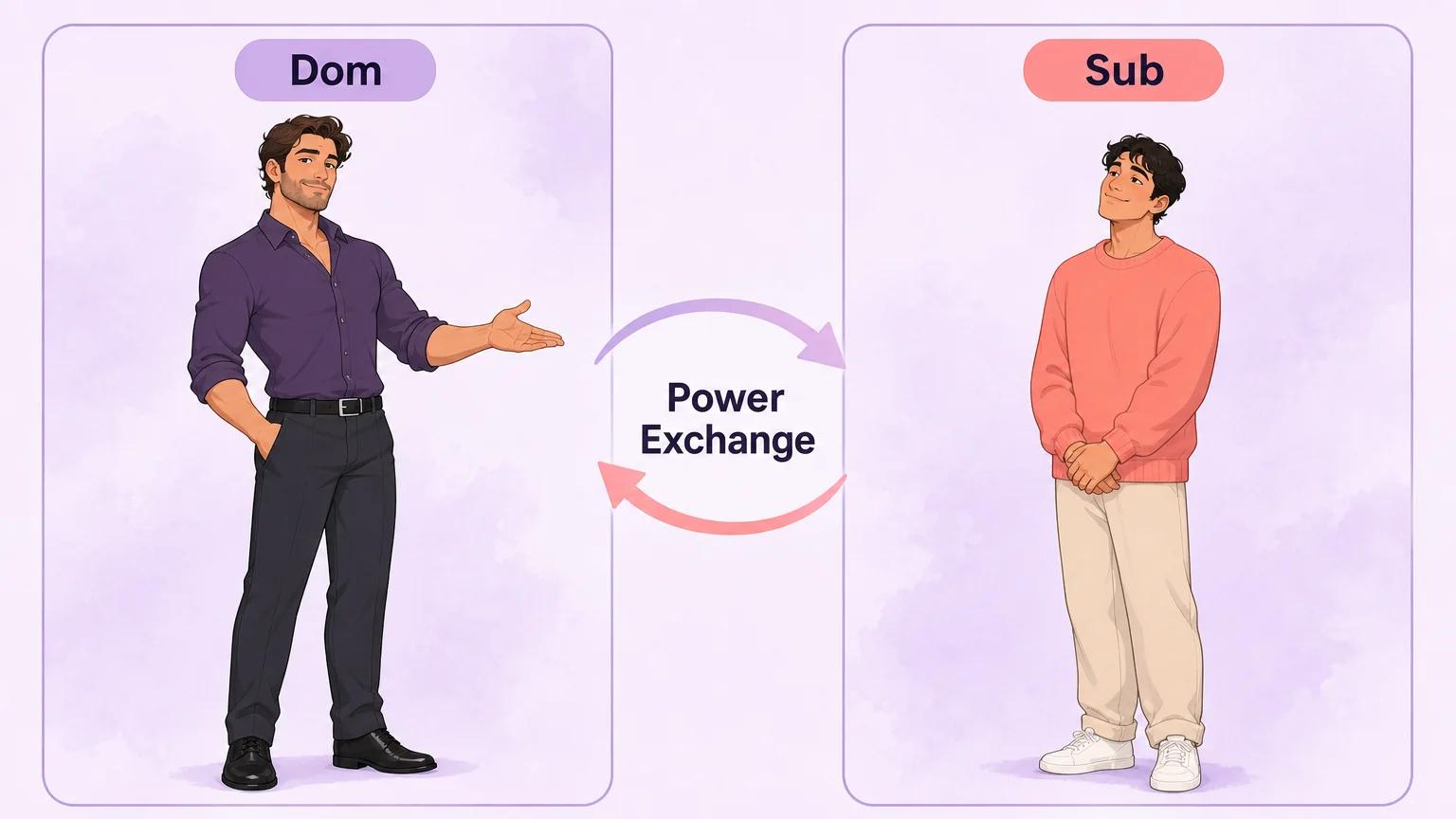
Dom and sub are short for dominant and submissive, and together they form the “DS” in BDSM: bondage and discipline, dominance and submission, sadism and masochism. In a scene, the sub hands themselves over and lets the dom control what happens, within limits they agree on first.
Three things matter about that definition.
A submissive is not powerless. The sub sets the boundaries and limits up front and can end a scene at any time with a safeword. Often the sub runs the scene more than it looks: they set the limits and name what they want.
A dominant is not a free pass, and not automatically a sadist. D/s runs on complete consent, healthy discussion, and trust. The dominant is expected to respect limits and provide aftercare. The idea that dominant means controlling and aggressive without consent is wrong.
Dom/sub is not the same as top/bottom
These pairs get confused, and they are different. A bottom is the passive, receiving partner in a scene. A sub specifically submits within a power-exchange dynamic. A service top takes the active role for the partner’s benefit without wanting control. The mirror image is a dominant bottom: the receiving partner who still holds the power. The service top comes back in the dominants section below.
Done well, D/s creates clarity, builds trust fast, and can regulate the nervous system. Communication becomes part of the arousal. Submission is strongest when it comes from a place of strength, not a loss of self.
In a 2018 study of committed BDSM practitioners, participants scored in the non-distressed range on relationship adjustment. A power-exchange relationship is not a healthy relationship’s opposite. It can be a healthy relationship’s shape.
What Is a Dominant? Dom Types From Gentle Doms to Sadists
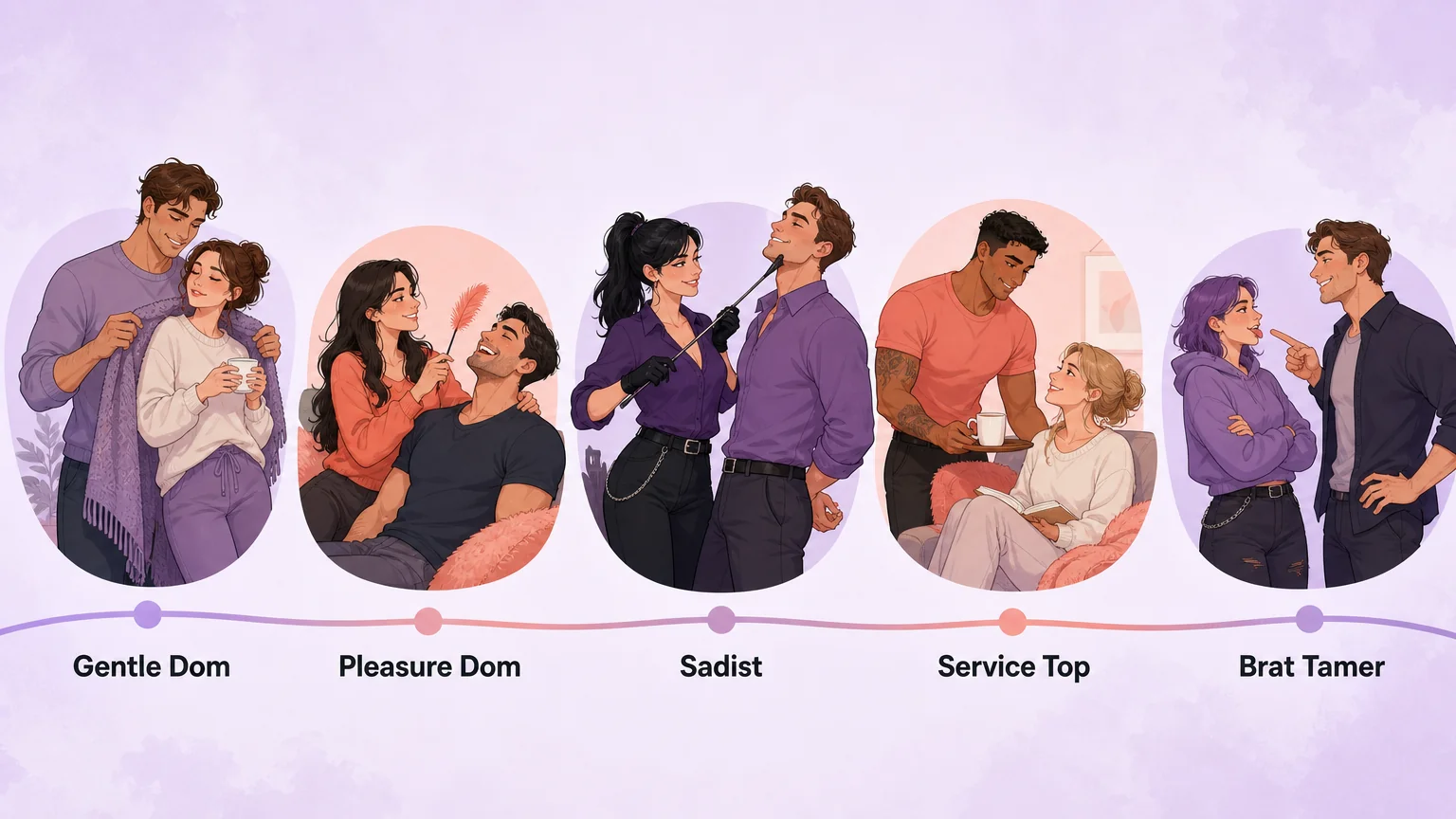
The most common misconception about dominance is that it equals sadism or aggression. It does not. Dominance in a dom and sub dynamic is a spectrum, and most of it has nothing to do with pain. Here are the flavors you are most likely to meet.
Gentle or soft dom. Nurturing and praise-forward. “Fast to praise but very slow to punish.” The physical play is not always gentle, but the psychology always is.
Pleasure dom. Control expressed through pleasure: giving it, pacing it, edging it, withholding it, sometimes forcing it. Not a service top, because a service top follows the sub’s lead while a pleasure dom directs everything. This is the most craved and most misunderstood dominance there is. One submissive spent years in strict, punishment-heavy dynamics and never registered her pleasure dom’s control as dominance at first. She was being led the whole time and never saw it happen.
Sadist. A sadist’s defining trait is pleasure from consensual pain, not from control. Sensual and sweet sadists exist. Sadism has a high affinity with dominance, but the two are not the same thing.
Service top. Performs dominant actions as a service to the partner’s desires. That is the definition-section term, coming home.
Brat tamer and rigger. A brat tamer pairs with a brat and channels playful defiance into structure. A rigger is the rope-and-restraint dominant, a natural match for a rope bunny.
Here is the note every first-time dom needs: dominance is built, not born. You are allowed to be nervous. Study pacing and observation. If strict protocol is not yours, do not force yourself into a box that is not yours. A nervous dom who cares is already a dom.
What Is a Submissive? Sub Types From Service Subs to Brats
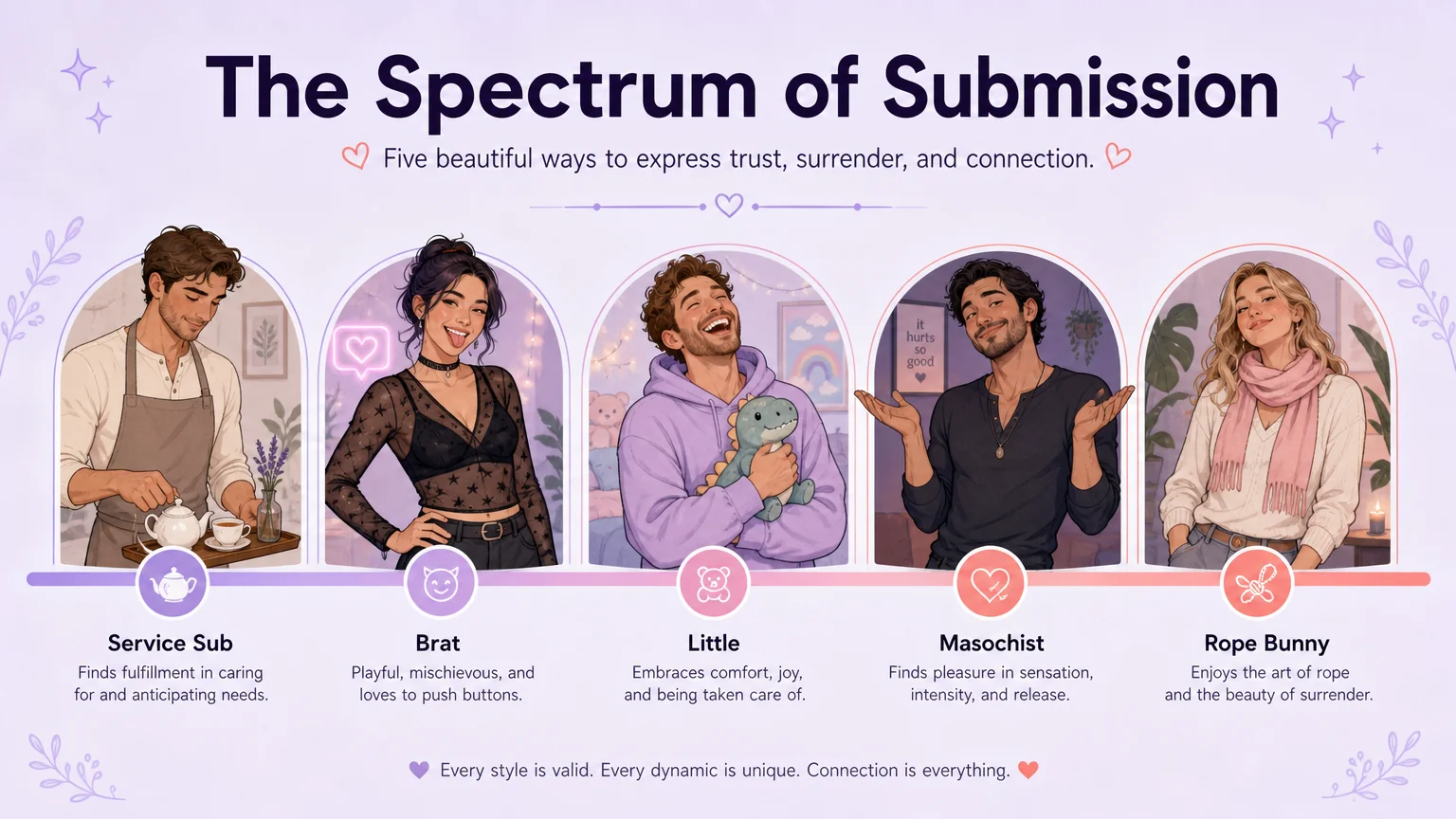
Submission is not passivity, and it is not weakness. The person being led often holds the real control, because they set the limits and can end the scene at any time. Within that, submissives come in many flavors. As one community writer put it, different submissives speak a different dialect of the same language.
Service sub. Serves the dominant’s needs through tasks and rituals: making coffee, kneeling, handling the small daily things that keep the dynamic alive.
Brat. Playfully defies to provoke a reaction, usually paired with a brat tamer who channels the energy.
Little. Slips into a younger headspace, cared for by a caregiver.
Masochist. Finds pleasure in pain and impact play.
Rope bunny. Loves being tied. Surrender framed as “still, framed, exposed, safe… a forced surrender.”
As one community member put it, “Submission is a gift we give to a deserving Dom; it can and should be taken away if he has not earned our submission.” The strongest submission comes from a place of strength.
Many subs have almost walked away from the lifestyle, not because they lacked desire, but because they lacked the word for what they wanted. Asked to describe it, nearly every one of them described a pleasure dom. If you feel the pull but cannot name your flavor yet, that does not mean you are not a sub. It means you have not met the right vocabulary.
To close the loop from the definition: in a dom and sub dynamic, a bottom is the passive receiving partner, a sub submits within power exchange, and the two do not always overlap.
Types of Dom/Sub Relationships: From Bedroom-Only to 24/7
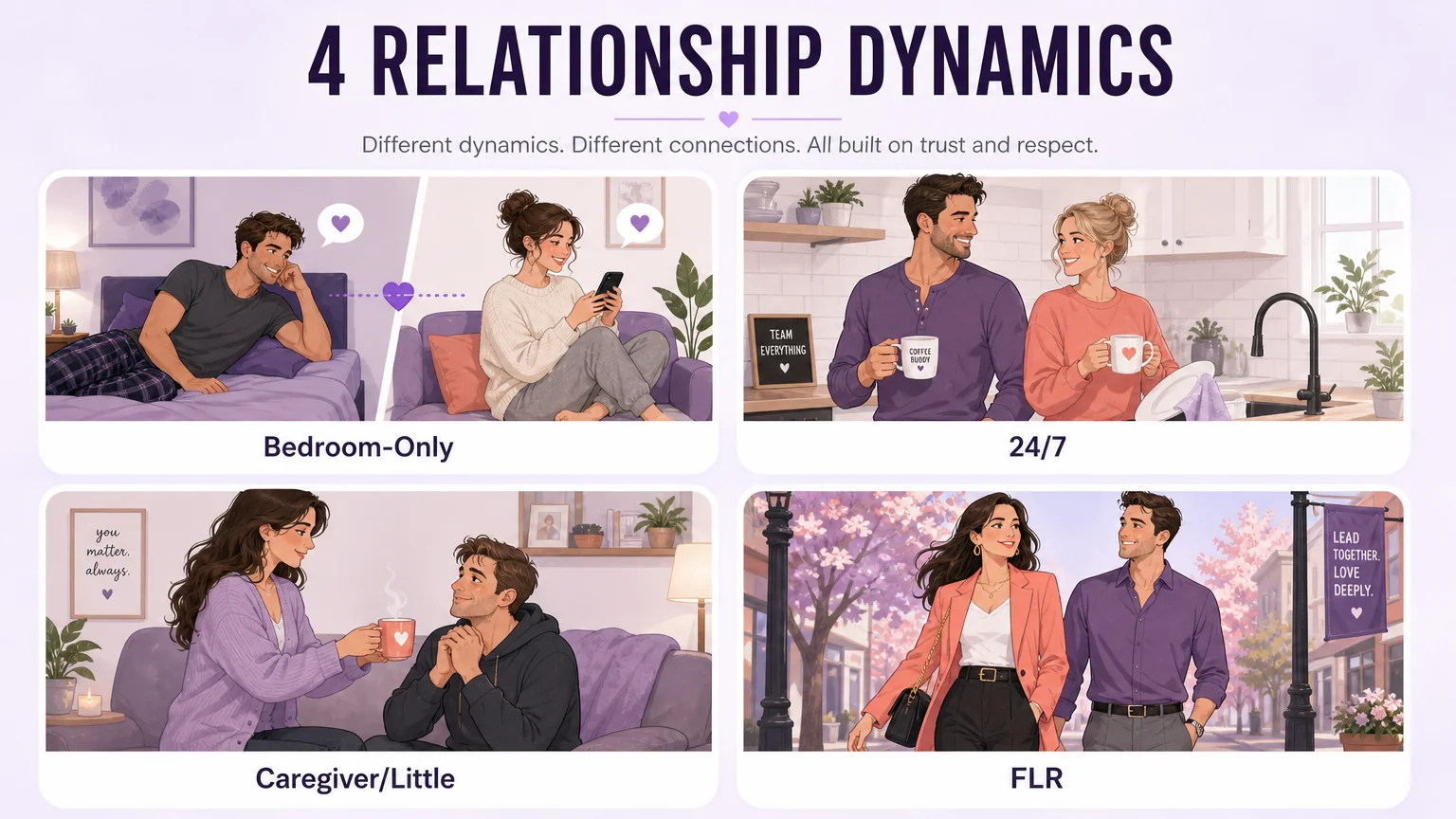
Dom and sub dynamics come in as many shapes as the people in them. Here is the map.
Scene-based and structured dynamics
Bedroom-only D/s. Power exchange stays inside scenes. Outside the bedroom, you are equals ordering takeout. The most common shape, and a perfectly complete one.
Master/servant. Service-focused and structured, built around tasks and rituals rather than scenes.
Training dynamics. Ongoing instruction toward a goal, with the dom guiding and the sub progressing.
Keyholder and chastity. The dom controls the sub’s sexual access, and often the release.
Bondage-style D/s. Rope and restraint at the center, with the rigger leading.
Continuous dynamics and female-led relationships
24/7 and lifestyle D/s. The dynamic runs around the clock, through bills, jobs, stress, illness, and grief. It is also heavily romanticized. As one practitioner put it, “Sometimes life gets in the way and it’s very difficult to keep things going.” The reality is far less theatrical and far more demanding than the fantasy. Caregiver/little often runs continuously too.
FLR and femdom. In a female-led relationship, the woman takes the dominant role and the man willingly submits. FLRs tend to be continuous rather than scene-based, extending into decision-making, finances, domestic life, and sexuality. They range from low-control, where she is the primary decision-maker, to total power exchange. “Domme” is the common spelling for a femme-presenting dominant. One dominant woman describes the shift this way: watching a man go from “I’m just curious” to fully owned without a raised voice. Sex therapists add that dominant women benefit from vocabulary for female-led dominance beyond the bedroom.
How to Know if You’re a Dom or Sub: A Self-Discovery Guide
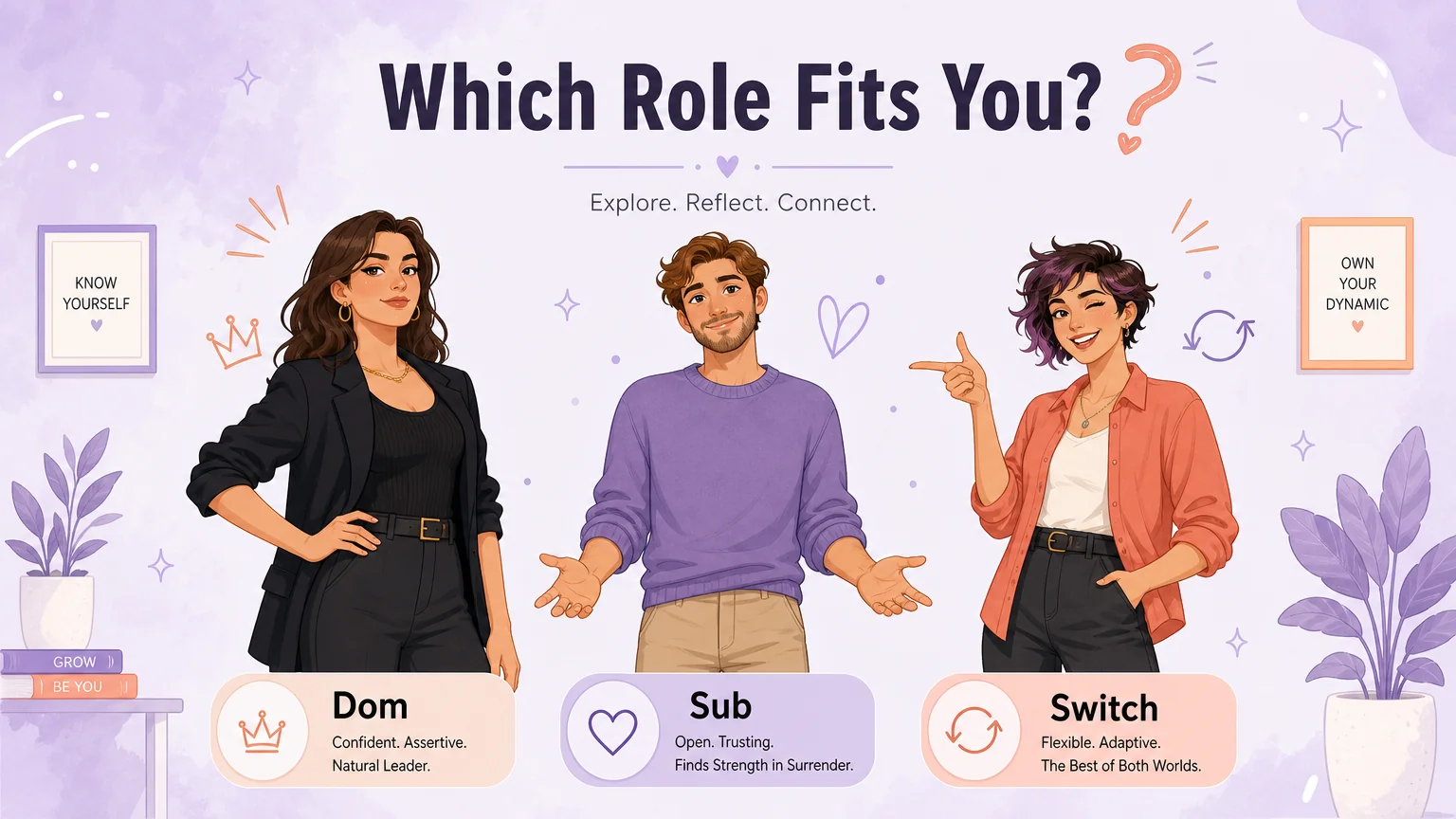
Skip the online quizzes. Discovering your dom and sub role is quieter than that. Sit with these five questions like journaling prompts, and let the answers accumulate.
Look at your fantasies. Who is in charge in your imagination, and how often does that scene return? Nearly everyone has at least one BDSM fantasy, 93% of men and 96% of women by one survey. A recurring fantasy is a starting signal, not a diagnosis.
Notice how you relate to control. Do you crave direction, someone to hand the wheel to? Or do you crave responsibility for another person’s experience?
Explore what makes you feel safe. Safety is a clue, not a contradiction. Submission is strongest when it comes from a place of strength.
Experiment in small, negotiated steps. A trial scene with a clear plan and an aftercare plan tells you more than a month of imagining. The negotiation section below shows you how.
Understand your emotional motivation, and allow fluidity. Name what the role gives you: service, protection, surrender, being completely known. Remember switches are common. In a Chilean study of 543 practitioners, there were no satisfaction differences across dominant, submissive, and switch roles. Role can evolve, and so can you.
If you do not have the word for your flavor yet, that is not a failure. Plenty of people who are clearly submissive took years to name it. This is discovery, not a verdict.
How to Negotiate a Dom/Sub Dynamic: Limits, Safewords, and Safe Signals
One rule above all. Consent is the line that separates a dom and sub dynamic from abuse, built before any play. Asking to play before boundaries are set is a red flag. Until an agreement is reached, both partners hold equal rights.
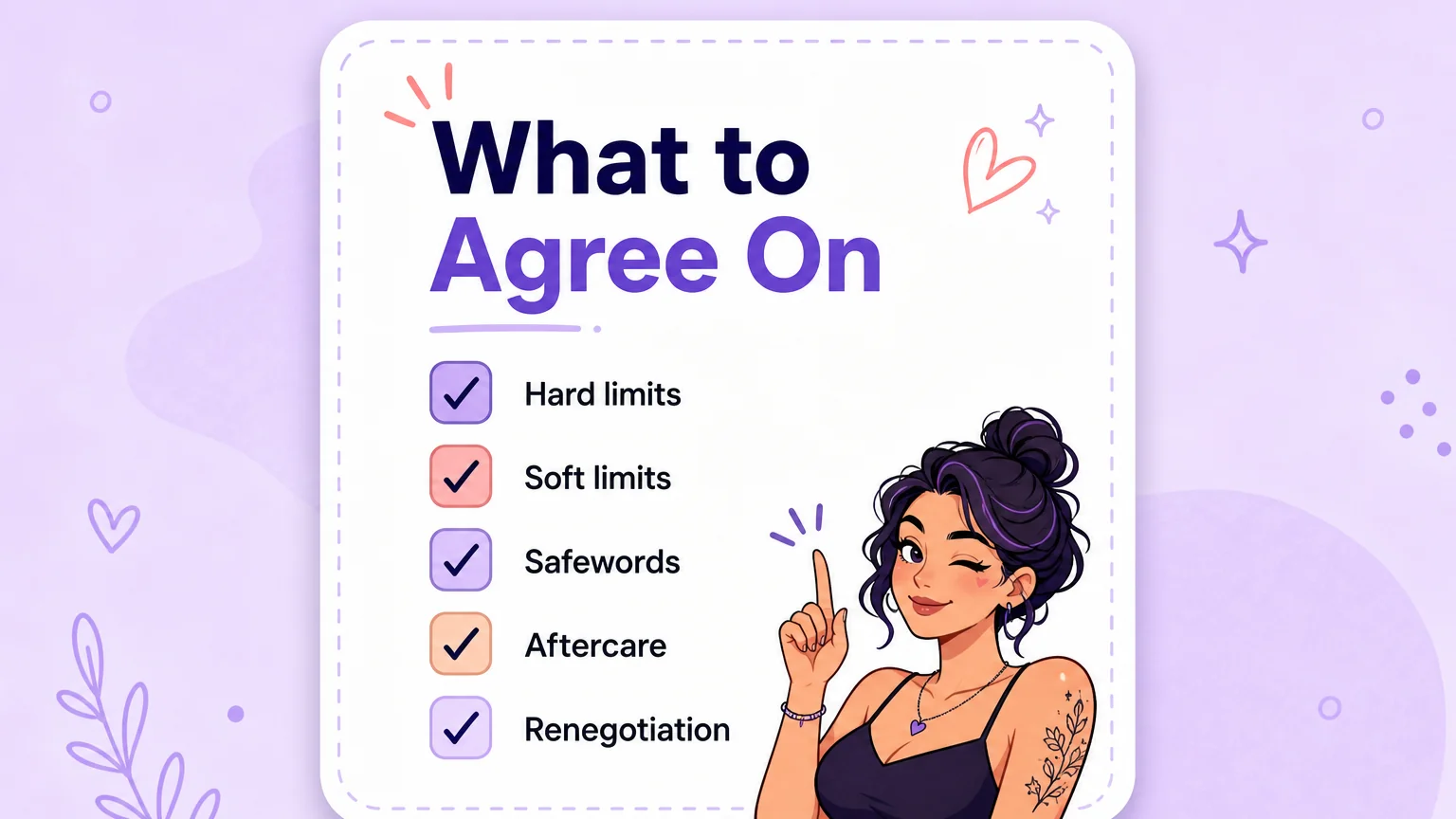
Here is what to agree on:
- What the roles mean to each of you.
- Scope: bedroom-only or 24/7, monogamous or non-monogamous, who knows about it.
- Hard limits (off-limits) and soft limits (maybe-with-caution), across physical, emotional, medical, privacy, and relationship boundaries.
- Emotional triggers and how to handle overwhelm.
- The scene plan: activities, intensity, photos, marks, time.
- Communication style and how check-ins happen.
- Aftercare needs, stated out loud, never assumed.
- A renegotiation schedule: not a one-time event.
Consent must be informed, enthusiastic, ongoing, and revocable at any time. Research links sexual compliance (consensual but unwanted activity) to lower wellbeing and satisfaction. A pressured yes is not a green light.
Safewords and non-verbal safe signals
The Traffic Light system is the common starting point. Red means stop immediately. Yellow means slow down and check in. Green means keep going. Or any word outside your usual vocabulary.
When the mouth is gagged or the hands are bound, agree on signals first. Three taps for stop. Hand-squeeze patterns, two for slow and three for stop. Dropping a held object. Finger counts. Blink patterns. Signals must survive your bondage: hand signals fail if hands are bound, blinking fails blindfolded. Keep them distinct from pleasure sounds and pair them with a verbal safeword as backup. They carry the same immediate stop power, and ignoring them is a consent violation.
How the kink community thinks about risk
Three frameworks are common. SSC: Safe, Sane, Consensual. RACK: Risk-Aware Consensual Kink, which accepts that not all play is risk-free. PRICK: Personal Responsibility, Informed, Consensual Kink. The last two do not pretend everything is safe, only that it is informed and consensual. If it is not an enthusiastic yes from everyone in the room, it is a hard no.
Sub Drop and Dom Drop: Why They Happen and How Aftercare Works

In a dom and sub dynamic, the crash after an intense scene is not a sign that something went wrong. It is your nervous system returning to baseline.
Intense play floods the system with adrenaline, norepinephrine, dopamine, serotonin, and oxytocin, sometimes cortisol too. That cocktail fuels the altered state people call subspace or domspace, a runner’s high of the erotic nervous system. Sub drop is the biological and psychological comedown when those levels fall back to baseline. Think of it as the hangover.
What it feels like varies: mood swings, exhaustion, anxiety, self-doubt, physical sensitivity, a need for reassurance, feeling disconnected, trouble focusing, guilt, or a need for solitude. There is no fixed timeframe, and drop can hit hours after a scene. Treat it as a planned phase, not a surprise. If it feels overwhelming or lasts more than a few days, talk to a kink-aware therapist.
The aftercare plan is simple and concrete: physical comfort (a weighted blanket, warm fluids, soft touch), a quiet space, food and hydration, and a next-day check-in text, even a brief one. Well-managed aftercare strengthens the bond between partners. Just as you would not hand the keys to someone who has been drinking, a dom makes sure the sub is in the right headspace to return to the ordinary world before the scene ends.
Doms drop too. Dom drop is real and often quieter; it creeps up after intense scenes, and a dom carries the same vulnerability as the sub. A dom has a responsibility to help the sub come back down, and to arrange their own recovery: rest, decompression, releasing absorbed energy. Baby doms should provide aftercare to themselves as well.
Hold the reframe from kink educator Queen Amethyst: if your sub drops hard, it is not failure, it is information for next time. Sub drop is proof you played intensely. Good dynamics build aftercare into the ritual, not as an afterthought.
Dom/Sub Dynamics and Non-Monogamy: Power Exchange in ENM and Swinging
The two things people assume cannot coexist, a dom and sub dynamic and an open relationship, often do.
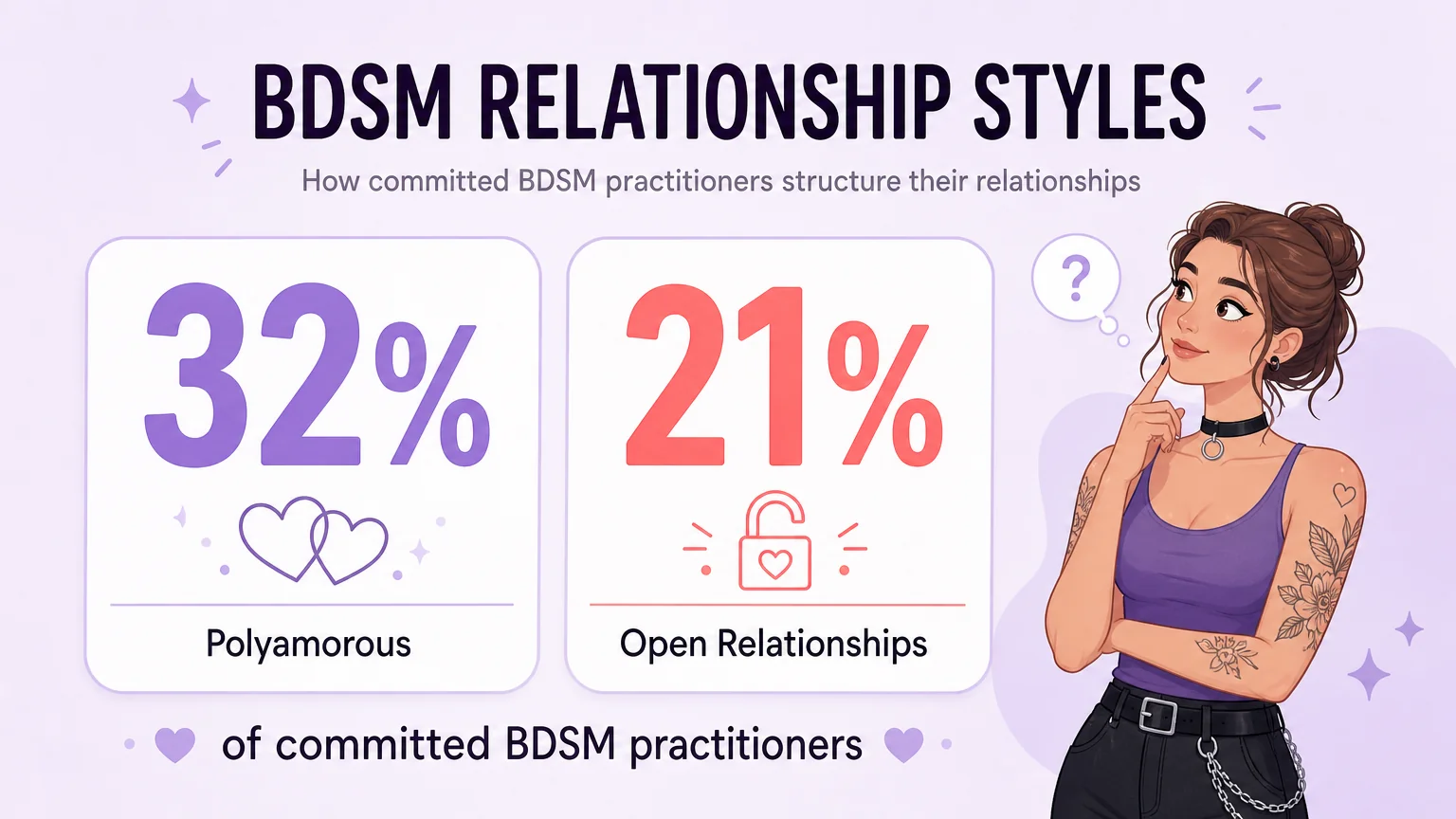
Start with the data. In a 2018 study of 163 committed BDSM practitioners, 32% were polyamorous and 21% were in open relationships. Non-monogamy was not associated with lower satisfaction, and the same group scored in the non-distressed range on relationship adjustment. Power exchange is not a monogamous thing. It is a negotiated thing.
The agreements are what make it work. Negotiation should cover whether the dynamic applies only to a nesting partner or extends to other partners, who knows about the dynamic, hierarchy, scheduling, and whether protocols travel into scenes with other partners. Write it down. Ambiguity is where resentment grows.
Jealousy is a real hazard, so name it without shame. Even with careful agreements, the emotional fallout of jealousy or perceived neglect shows up. One person in a 24/7 dynamic described a nesting partner as all-consuming, and a promising new connection got cut off entirely. Treat jealousy like a dashboard light. It tells you where your emotional engine needs attention, not that you must stop the car.
Can a dynamic span multiple partners? A multi-partner total power exchange can exist, and it is built on written agreements. The documented version that drew wide attention had no safewords and no limits, and the community sharply criticized it as irresponsible. Treat that as a contested extreme, not a model. Limits are not the obstacle to multi-partner D/s. Agreements are what make it work, and they are what keep every partner safe.
How to Find a Dom or Sub: Vetting, Red Flags, and Online Dynamics
Finding a dom and sub partner is not about the most dramatic profile. It is about the safest first conversation.
Know yourself first. Set your hard and soft limits before you talk to anyone. Predators thrive in ambiguity.
Read profiles like a detective. Green flags: clear offers and seeks, respectful history. Red flags: demanding immediate submission or vagueness like “just ask” and “I’ll do whatever you want.”
Set an early micro-no, such as keeping chat on the app. Hold one small boundary, watch the reaction. Pushback on a small boundary predicts disrespect of bigger ones.
Require a voice or video call first to discuss negotiation, aftercare, and what happens when a scene goes wrong. Ask for references on how past partners handled a safeword. Meet first at a public vanilla munch, tell a friend where you are, arrange your own transport. A real Dom will dig into your soul like an archaeologist, not rush you like a fast-food order.
Red flags: when it is no longer D/s
These are not quirks. They are exits. Someone who rushes titles, collars, ownership, or moving in within weeks. Who demands training or instant submission from a stranger. Who dismisses safety with “limits are for beginners” or “if you trusted me you would not need a safeword.” Who refuses to negotiate or punishes boundary-setting. Who isolates you from community, blames every ex, or asks for money early. Walk away.
Online and long-distance D/s
Safewords apply exactly as in person, across screens. Tone and body language are stripped away, so adapt with video signals: hand signals, a dropped ball, a squeaky toy. Type out the safeword system and check-in intervals, share a Yes/No/Maybe list in Google Docs. Manage time zones and lag: if no reply in 15 minutes, the scene is paused. The submissive always holds full authority over consent.
FetLife is where munches and references live. Remote toys bridge distance play. Respect and vetting cut both ways. As a single, you are an empowered agent.
The Bottom Line: Your Dynamic, Your Rules
A dom and sub dynamic is a consent-based power exchange. There is no one correct role and no one correct shape. There is only the shape your team negotiates, revisits, and revises. Negotiation and aftercare are the price of admission, not optional extras.
Desire does not require an apology. Great relationships do not outgrow adventure; they build a bigger container for it. Whatever flavor you land on, gentle or firm, close or long-distance, the starting point is the same: talk first, play second, and take care of each other after.
If this article has you curious about who you would explore this with, 3Fun is where adventurous, boundary-respecting couples and singles find each other. It is a first step into a like-minded space, nothing more and nothing rushed. Start at 3Fun.
Dom/Sub FAQ: Your Most-Asked Questions, Answered
Is a dom/sub relationship healthy?
Yes, when it is consensual, negotiated, and built on trust. Peer-reviewed research shows BDSM practitioners in committed relationships score in the non-distressed range on relationship adjustment, with no higher rates of relationship or mental-health problems. The operative word is negotiated. When consent, limits, and aftercare are built in, a dom and sub dynamic is not a threat to a healthy relationship. It can be the relationship’s shape.
What does it mean to be a sub?
A submissive hands over control within agreed limits, but is not powerless. The sub sets the limits up front, can end a scene at any time with a safeword, and often holds the real control in the room. The strongest submission comes from strength, not loss of self; it is a chosen gift that can always be taken back.
How do you know if you’re a dom or sub?
Look at your fantasies and notice who is in charge in them. Ask how you relate to control, whether you crave being led or crave responsibility for another person’s experience. Sit with what makes you feel safe, since safety is a clue, not a contradiction. Experiment in small, negotiated steps. Allow fluidity: switches are common, and the role can evolve. There is no deadline and no verdict.
Is being submissive the same as being a bottom?
No. Bottom describes who is passive or receiving in a scene. Sub describes a power-exchange role, someone handing over control within agreed limits. The two do not always overlap. A service top is the mirror image: active in the scene, but acting for the partner’s benefit rather than from a desire to dominate. Different labels, measuring different things.
Do doms need aftercare too?
Yes. Dom drop is real, often quieter than sub drop, and it creeps up after intense scenes. Doms carry the same vulnerability as subs and need their own recovery: rest, decompression, and releasing absorbed energy. Baby doms should provide aftercare to themselves as well. Aftercare is a both-ways ritual, built into the dynamic rather than an afterthought, and it strengthens the bond for both partners.