
Every triad that lasts negotiates a set of throuple relationship rules. About time and touch and money. About what happens when things change. And about what happens when they end.
These are the negotiable frameworks that separate triads that work from triads that implode, named by the therapists who specialize in polyamory and the triads who have done the work. Not as a one-time conversation you survive. As a living practice you build together.
Here are the 10 agreements every triad actually needs.
1. Agreements, Not Rules: Why the Word You Choose Changes Everything
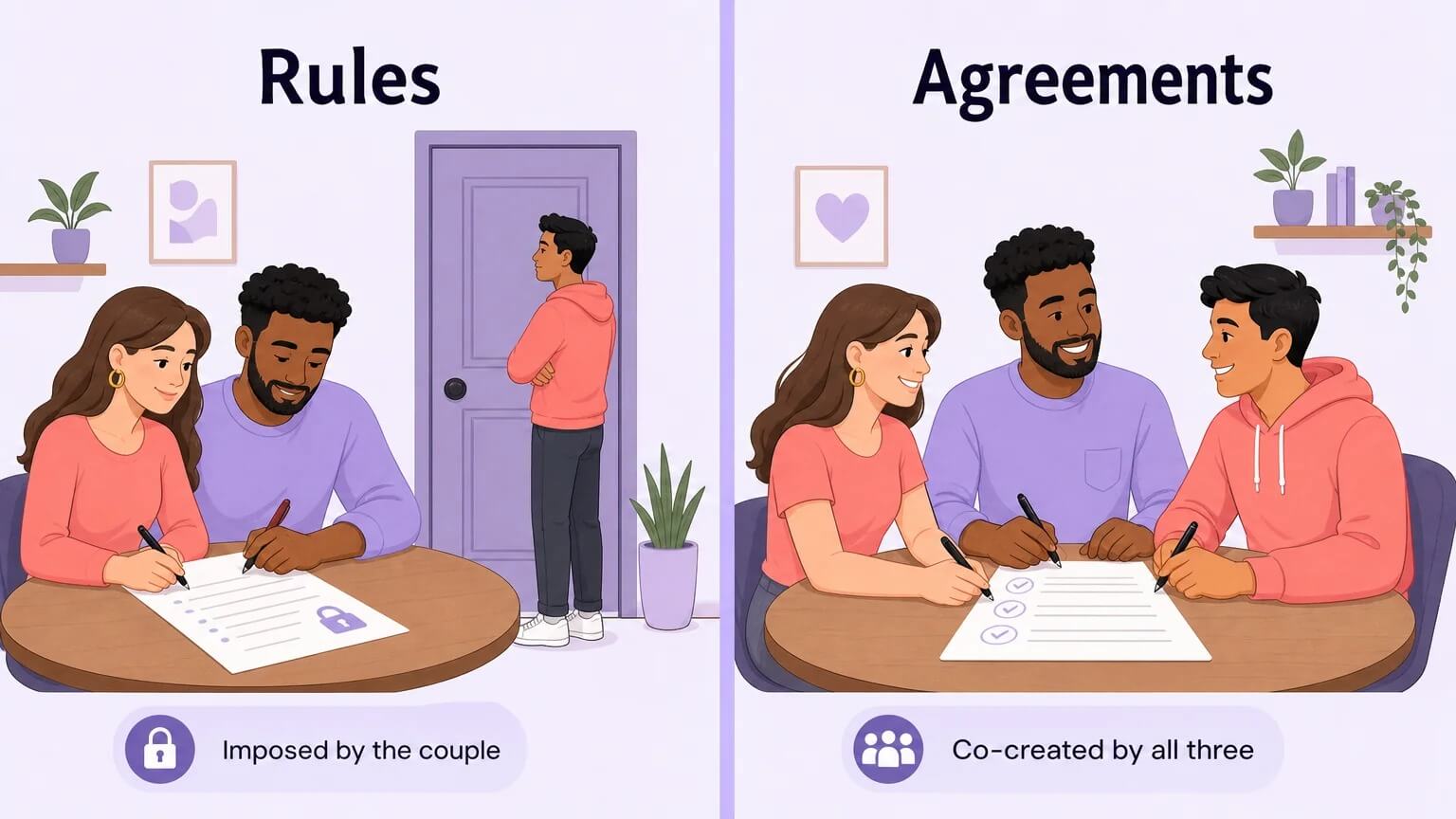
One popular guide for throuples opens by announcing there are no set rules for a three-way relationship. That is bad advice.
The question is not whether structure exists. It is who writes it, and who gets a vote. Rules are imposed, typically by the original couple, to protect the original dyad, without the third person in the room. Agreements are co-created by all three people whose lives they govern, revisable when circumstances change, and grounded in mutual buy-in rather than compliance.
Nick Fager, LMFT, of Expansive Therapy names the dynamic: the original couple’s rules are almost always designed to “preserve the relationship,” which is “extremely disempowering to the third person.” Martha Kauppi, LMFT, says consent requires “the deep skills needed to honestly express feelings, preferences, and beliefs, and to receive that honesty without shutting down.” That skill set only works with agreements, never with rules.
The simplest test: Was the third person in the room when this boundary was created? Did they have equal say in shaping it? Can they call for a revision without fear of being voted off the island? If any answer is no, you are looking at a rule wearing an agreement’s nametag.
?️ The Conversation Starter
“We have been talking about what we want this to look like, just the two of us. That was step one. Step two is bringing you into the conversation as an equal voice. We would like to sit down together and build the agreements from scratch, with all three of us at the table. Nothing is set until you weigh in. Will you do that with us?”
Rules protect the original relationship. Agreements protect all three people. Every section that follows rests on this distinction.
2. The Four Relationships Inside Your Triad (and Why Each One Needs Its Own Oxygen)
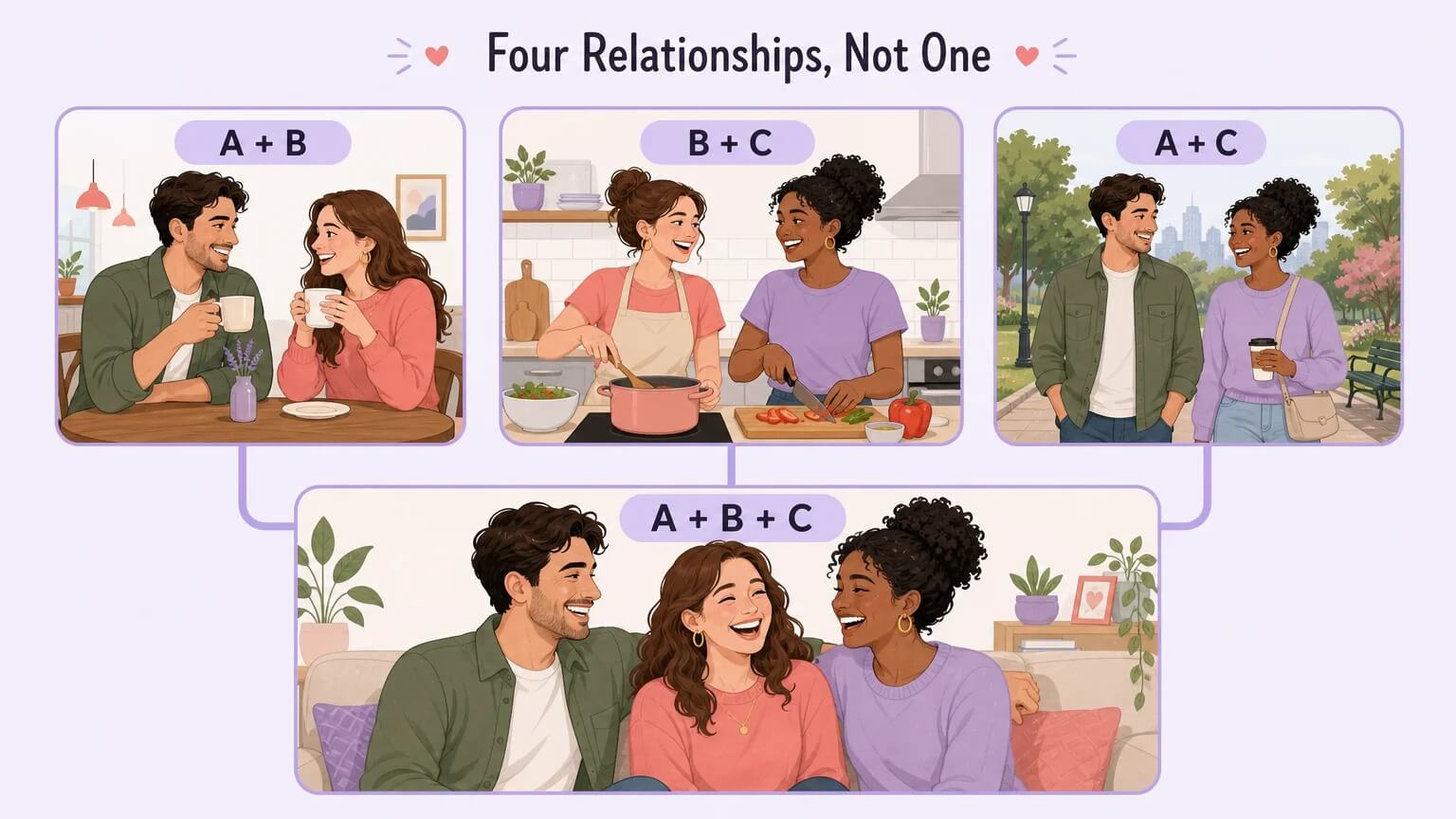
You did not form one new relationship. You formed four.
Most people entering a triad think of it as a single three-person relationship. The math is different, and ignoring it is why most triads fail. Dr. Liz Powell, PsyD, says it plainly: “It is four different relationships. The three individual relationships and one group relationship.” Each dyad (A and B, B and C, A and C) needs scheduled alone time. The group needs its own rituals. And every person needs solo time to process.
A real-world throuple profiled in the media operates with precisely this structure: specific nights designated for each dyad, plus Sunday date night as a trio. This is not cold scheduling. It is oxygen distribution.
A concrete weekly rhythm could look like this: one dedicated dyad date per pair per week (three nights), one group date or shared experience (one night), and three nights for rest, friends, solo life. Adjust the ratio to fit your lives. The principle stands: each of the four relationships gets named time on the calendar, not scraps left over after the week has already happened.
You can also use this as a diagnostic. If you can name which of your four relationships is currently strongest and which is currently starving, you are ahead of most triads at month three. Feed all four, or watch the hungriest one take the other three with it.
3. Renegotiating Everything: The Couple-to-Triad Transition Agreements
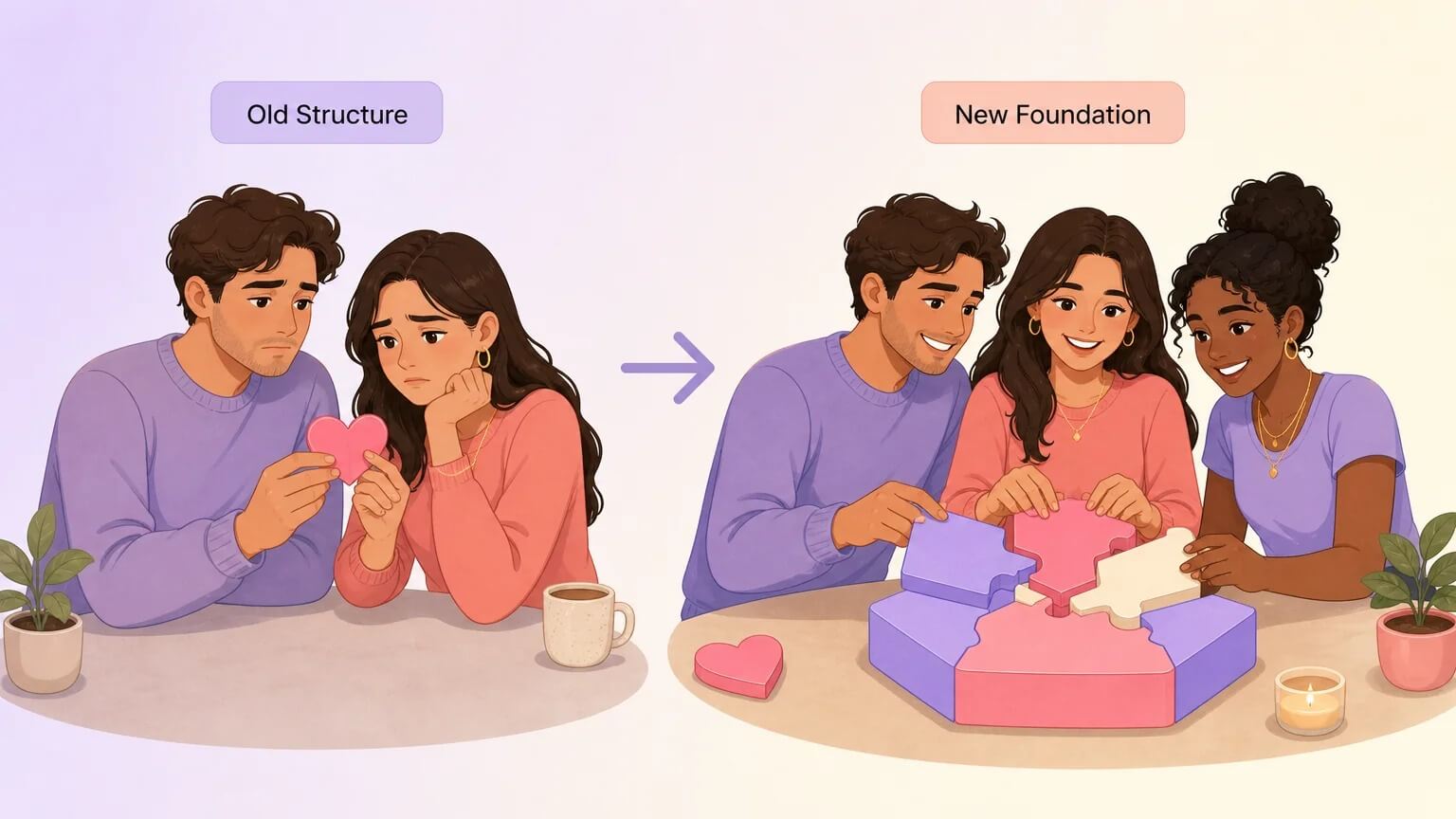
Dr. Liz Powell asks the question most couples skip: “Your current relationship will completely undergo a shift. Are you willing for that to happen?”
The transition from couple to triad is not adding a person. It is dismantling the old structure and building a new one with three equal architects. If you are not willing to let the original relationship die in its current form, you are not ready for a triad. You are looking for a guest star in your couple’s story.
Expansive Therapy offers a seven-question pre-transition framework covering emotional foundation, life capacity, goal alignment, upfront agreements, hierarchy, failure tolerance, and disclosure. Work through all seven before you involve a third person.
The self-work phase is the one couples skip because it is less exciting than downloading apps. It is also the one that determines whether you build an ethical triad or reproduce couple privilege with a new face.
?️ The Conversation Starter
“Before we open this up to anyone else, I want us to be honest with each other about seven things. One: are we solid enough for this? Two: do we actually have the time? Three: what do we each want, and where do we disagree? Four: what can we agree on now, knowing a third person will help us rewrite it? Five: are we aiming for equal partners, or is there going to be a hierarchy? Six: if this fails, can we handle that without destroying each other? Seven: who in our lives will support us, and who will not? Let us answer all seven before we take another step.”
If you cannot answer all seven questions honestly and together, you are not ready to open. That is not a judgment. That is a gift to the person you have not met yet.
4. The Check-In Cadence: Your Weekly Non-Negotiable Agreement
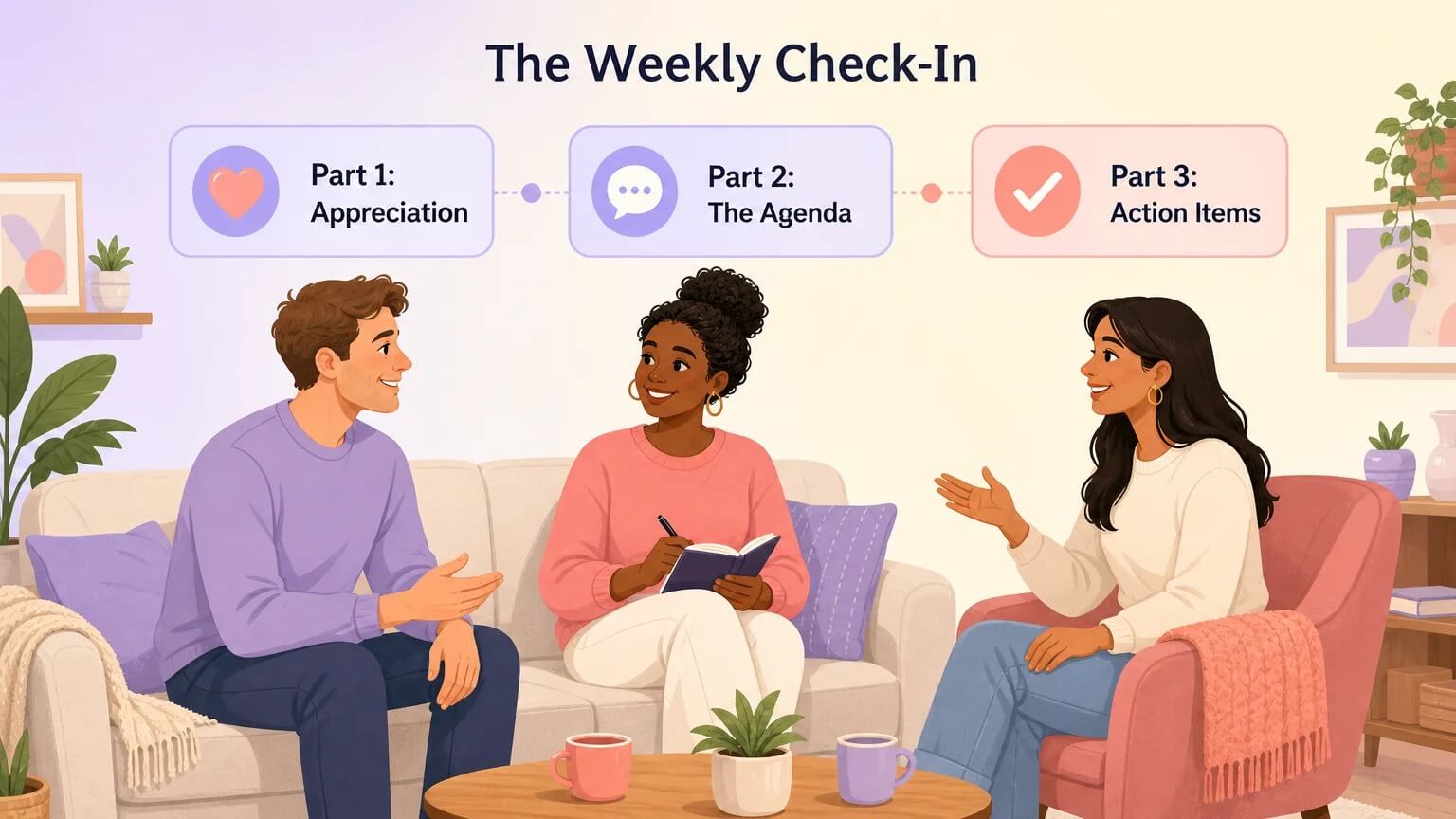
The single highest-leverage agreement you will make in your triad is not about sex or sleeping arrangements. It is about a standing meeting on your calendar.
Therapist Lateef Taylor recommends “establishing a weekly check-in meeting where all parties are present.” Not a date night. Not a processing session that bleeds into sex. A structured, sober, sit-down conversation with a specific format. The Couples Institute calls this proactive maintenance: “You do not want to wait for things to come up before you talk about them.”
Triads tend to communicate reactively, when something breaks. A structured weekly cadence catches friction before it becomes crisis.
The format: Part one, Appreciation Round, five minutes. Each person names one specific thing someone else did that week that they valued. Part two, the Agenda, twenty to thirty minutes. Pre-submitted topics, one at a time, no interruption, solution-focused. Part three, Action Items, five minutes. Each person leaves with one concrete thing they will do differently this week.
The guardrails: no alcohol, no phones, not in bed, not right before sex. This is a meeting, not a prelude.
?️ The Conversation Starter
“I would like us to try a weekly check-in. Thirty minutes, same time each week, phones down. We start by each naming something we appreciated. Then we work through anything that needs attention. We end with one action item each. Can we pilot this for three weeks and then decide together whether it works?”
The triads that do this report fewer explosions. The triads that skip it report more. This is not complicated. It is just disciplined.
5. Jealousy Is a Dashboard Light, Not a Stop Sign

Jealousy will visit your triad. Probably this week. That is not a prediction of failure. It is a prediction that three humans with beating hearts and attachment histories are in the room together.
Therapist Nick Fager calls jealousy information: “When worked through effectively, jealousy can actually be a way to deepen the relationship by revealing past wounds and values.” The goal is not to eliminate jealousy. That is impossible. The goal is to build a protocol for what happens when it arrives so it does not become triangulation or silent resentment.
Step one: name it internally before you act. “I am feeling jealous right now, and I do not yet know why.” Step two: identify the root. Feeling left out? An unmet need? An old attachment wound? A legitimate grievance about unequal treatment? Step three: communicate directly to the relevant person, not through the third partner. Triangulation, venting to partner A about partner B, isolates the person being discussed and overburdens one partner as an involuntary mediator. Step four: make a specific request. “I need a dedicated date night this week,” not “You need to pay more attention to me.”
Compersion, the joy at witnessing your partner’s joy with someone else, is aspirational. It is “never a permanent state,” as Fager notes, and it cannot be demanded. Jealousy is not evidence that your triad is broken. It is evidence that someone needs something they are not getting. Name the need. Do not punish the feeling.
6. Who Sleeps Where? The Daily Logistics Agreements Nobody Writes About

You have probably noticed it at every hotel check-in: two bathrobes, two welcome drinks, a king bed built for two. The entire world is designed for couples, and your triad will bump into that design every single day.
The visible agreements, about sex and boundaries and jealousy, get all the airtime. The invisible ones, about sleeping arrangements, whose family you visit for Christmas, who appears on whose Instagram, who gets the plus-one at the work gala, are the ones that create the most daily friction and get the least discussion.
On the sleeping front: rotating schedules prevent a primary sleeping bond from forming. Alaskan king beds accommodate three and remove the negotiation. Separate bedrooms preserve autonomy. Some triads combine approaches: shared bed on weekends, rotating dyad nights during the week, solo nights when someone needs space.
Outside your bedroom, Nick Fager names life events where the triad is not recognized. Deciding which partner attends a wedding or funeral “carries quite a bit of emotional weight.” Social media adds questions: who is visible, who is tagged, what happens when a curious colleague starts connecting dots. Travel means learning to book Airbnbs with king beds or two hotel rooms instead of a single hotel reservation.
You do not need to solve all of these before your first date. You do need to name them as things that will need solving, ideally before the hotel clerk hands two people a welcome drink while the third stands there.
7. Money in Threes: Financial Agreements That Keep Resentment Off the Balance Sheet
Nobody opens a throuple dating app thinking about spreadsheet formulas. But the financial agreements you negotiate, or fail to, will determine whether your triad feels like a partnership or a hierarchy with a wallet.
Money amplifies power. In a triad where an original couple shares a mortgage, a joint account, and a decade of financial entanglement, the third person starts at a disadvantage. Without clear agreements, financial decisions default to the couple.
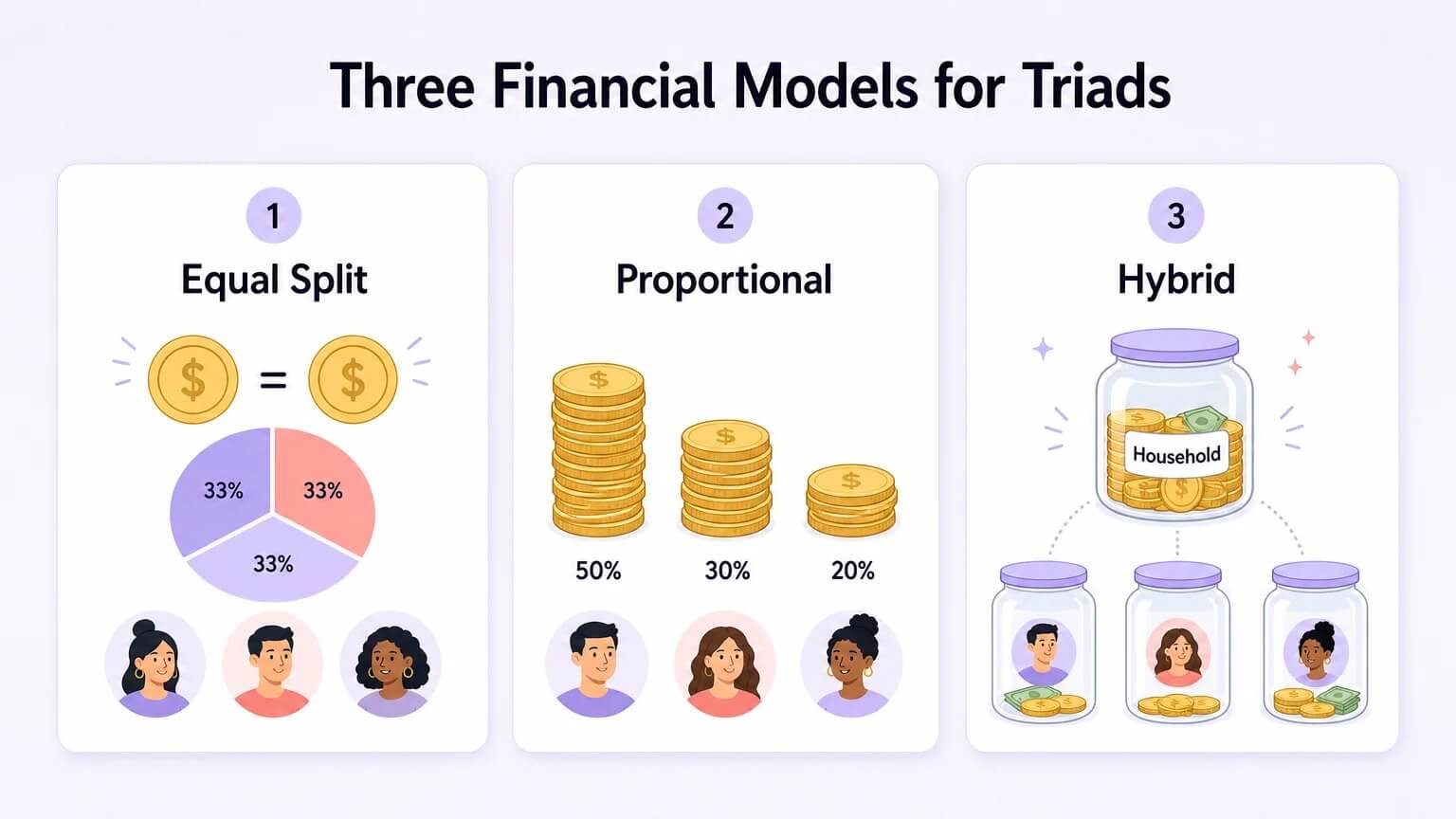
Laura Boyle’s book Monogamy? In this Economy? and FindPoly.com outline three models. Equal split: works when incomes are similar. Proportional: each person pays a percentage of income to shared expenses, fairer when incomes differ. Hybrid: a shared household account for triad costs plus individual accounts for personal spending. The principle from FindPoly: “Treat partners like roommates first when it comes to chores and finances. Separate the logistical problem from the emotional one.”
Three non-negotiables. Every person maintains their own bank account. No one is financially dependent on the triad to survive. A freedom fund, three to six months of expenses, exists from day one of cohabitation so any partner can leave without financial entrapment.
?️ The Conversation Starter
“I care about this relationship enough to want the financial side to be predictable and fair. Can we sit down and build something that protects all three of us? I am thinking proportional contributions to a shared household account, plus our own individual accounts for personal spending. And I want us to talk about a freedom fund so none of us ever feels trapped by money. Can we map this out together?”
Financial agreements are not romantic. Neither is resentment about who paid for groceries. Pick your discomfort.
8. The Third Person’s Bill of Rights: What Singles Joining a Couple Should Demand
If you are the single person considering joining a couple, or the couple hoping to welcome one, there is a power imbalance baked into the structure. Pretending it does not exist does not make you ethical. Naming it and actively dismantling it does.
Couple privilege, as defined by SHIPS Psychology, is the “subconsciously or consciously assumed privileges over other relationships.” It shows up predictably: the couple making agreements without the third present, expecting equal love at equal speed, retaining veto power, treating the third as an accessory rather than a co-equal partner.
Javiera Dastres, Senior Psychologist at SHIPS Psychology, calls the alternative “between-care”: caring for someone “not only during moments of intimacy and connection” but in the spaces between.
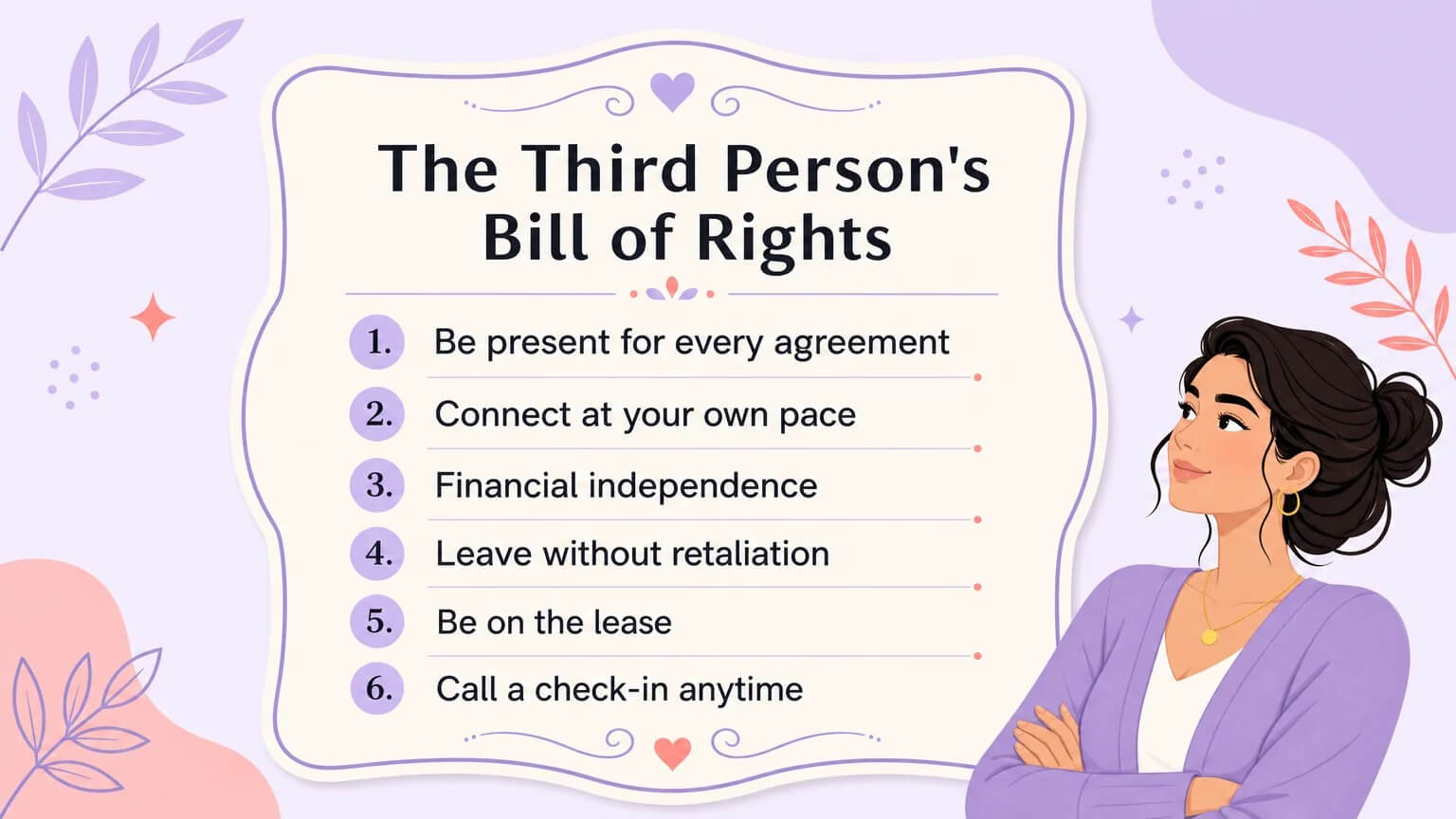
What a single joining a couple should demand. One: the right to be present for every agreement that affects you. Two: the right to connect with each partner at a different pace and intensity. Three: financial independence and a freedom fund from day one. Four: the right to leave without retaliation. Five: the right to be on the lease, not a guest with a toothbrush. Six: the right to call a check-in, propose a revision, and voice dissatisfaction without being labeled the difficult one.
Red flags: “we” language that erases your individual standing, pre-set frameworks you did not help write, pressure to love both equally, no alone time with each partner, the original couple’s problems bleeding into triad space. These are not growing pains. They are structural warnings.
A couple who cannot answer honestly about how they handle disagreement is not ready for you. A couple who can, and who welcomes the question, might be.
9. Living Documents: Why Your Month-One Agreements Will Break by Month Six
The agreements you make in month one, giddy, generous, eager to prove how chill you are, will not be the agreements you need in month six. That is not a failure. That is how humans work.
Nick Fager puts it clearly: “Attractions fade and shift, we age, our priorities shift. Agreements need to be revisited, and with three people there are a lot of implications to consider with each shift.” Martha Kauppi warns about boundary creep: agreements erode through small exceptions that become new defaults. Consent requires ongoing maintenance, not a one-time signature.
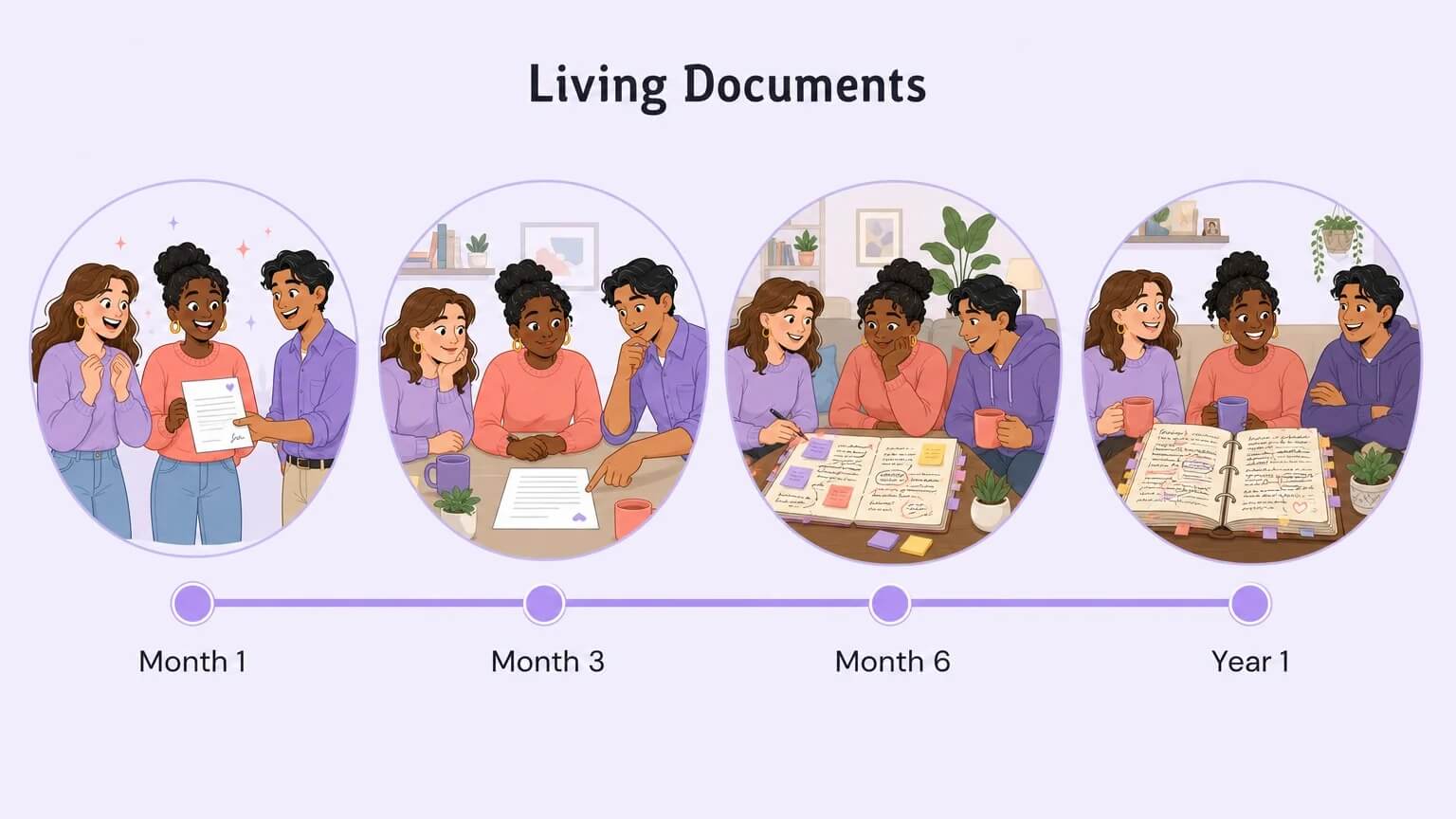
Month one: initial agreements about sex, time, and disclosure. Everyone is on their best behavior. Month three: first renegotiation. The honeymoon has settled, real preferences emerge, someone feels a dyad is undernourished. Month six: structural review. Sleeping arrangements, financial model, and holiday strategy have been tested by a real holiday. Year one: identity-level review. Is this triad still what everyone wants? Has it evolved toward a V-shape?
Schedule quarterly state-of-the-triad conversations, separate from weekly check-ins, focused on the big-picture agreements rather than weekly friction. The weekly handles operations. The quarterly asks: are we still the right people, in the right structure, under the right agreements?
The triad that treats its agreements as a fixed constitution will eventually be governed by a document nobody agreed to anymore. The triad that treats them as an ongoing conversation stays current with who its members actually are, not who they were when they met.
10. The Exit Agreement: Planning the Ending at the Beginning
The most loving agreement you will make in your triad is the one that governs how it ends.
Most triads form without any discussion of dissolution. When things unravel, the original couple retreats to their dyad. The third is discarded. An exit agreement prevents this.
Expansive Therapy’s seventh pre-transition question gets at this directly: “Are we okay if it does not work out?” The polyamory community emphasizes a critical principle: if the triad dissolves into a V-shape, nobody gets discarded. The package deal approach, date both of us or neither, means one dyadic breakup ends the entire triad. The person with the least power loses everything.
Three dissolution models, discussed before anyone moves in. Return to dyad: the original couple stays together, the third leaves with resources intact. Evolution to V-shape: one dyad becomes platonic, two remain romantic. Full separation: all three go separate ways with a pre-agreed plan.
The freedom fund handles the money. The exit agreement handles the heart. Both must be in place before cohabitation.
?️ The Conversation Starter
“I want to build something lasting with both of you. Part of that is agreeing, now, when we all care about each other, what a good ending looks like. If this shifts into a V, nobody gets discarded. If it dissolves entirely, everyone lands safely. Can we write that together while we are all on the same side?”
The couple who skips the exit plan because this is forever is the couple most likely to hurt someone when forever turns out to be eighteen months. The couple who writes the exit plan together, with the third at the table, might actually earn forever.
FAQ: Questions About Throuple Agreements
What is the difference between a throuple and a threesome?
A threesome is a sexual encounter. A throuple is a committed romantic relationship between three people. The agreements needed for a one-night encounter are categorically different from those needed for a shared life.
Can a throuple be closed?
Yes. Some triads practice polyfidelity, meaning the three partners are exclusive to each other. The key: this decision must be made by all three, not imposed by the original couple. A closed triad works when everyone had equal say in closing it.
What happens if one dyad within the triad breaks up?
This is why the exit agreement in section ten matters. Options: evolve into a V-shape where two relationships remain romantic and one becomes platonic, or the dyad that ended can lead to full dissolution. Agreeing upfront that a dyadic breakup does not automatically end the other relationships is the ethical baseline.
Do we need a therapist who specializes in polyamory?
Strongly recommended. A poly-aware therapist serves three functions: preparation before opening, mediation during conflict, and navigation through life events and dissolution. Amiti Grozdon, M.Ed., LPC, of Sagebrush Counseling recommends therapy before opening up, not after crises emerge. A therapist unfamiliar with ENM may pathologize your relationship structure rather than help with the actual issues.
How do you handle it when one person wants to open the triad further and the others do not?
Same framework as any agreement: co-created, not imposed. The person wanting openness makes their case. The others respond honestly. If consensus is impossible, the triad has a structural incompatibility that needs addressing. No one gets outvoted on a decision this foundational.
Is this arrangement legal? Can three people get married?
No jurisdiction currently recognizes three-person marriage. Triads use legal workarounds: cohabitation agreements, powers of attorney, wills, medical directives, and LLCs or trusts for shared assets. Proactive legal planning is not optional if you are building a shared life together.