
Someone has asked you to lead them, or you have decided to, and now you are reading a wall of instructions about what to do to a person and almost nothing about how to do it without hurting them.
That gap is the hard part of submissive training. The premise is sound: a structure of agreed rules, tasks and rituals one person runs and another consents to, built to develop a specific capacity in a specific person rather than to break anyone down. A Dominant holds the authority; a sub yields it. That arrangement is your dynamic.
Safety is not the ending. It is the method. The safeword, the scope, the ceiling, the aftercare and drop plans are what you are being trusted with. They are not the soft part you reach at the end.
The order runs: check yourself, negotiate, set the scope and the ceiling, decide what you train and what you leave alone, then the four things that keep it from going wrong, then how it fits around your life, then how to tell a demanding dynamic from a harmful one. Skip to the tasks and you skip what makes them safe. Every step carries the words or the script.
Step 1: Before You Train Anyone: Run This Check on Yourself
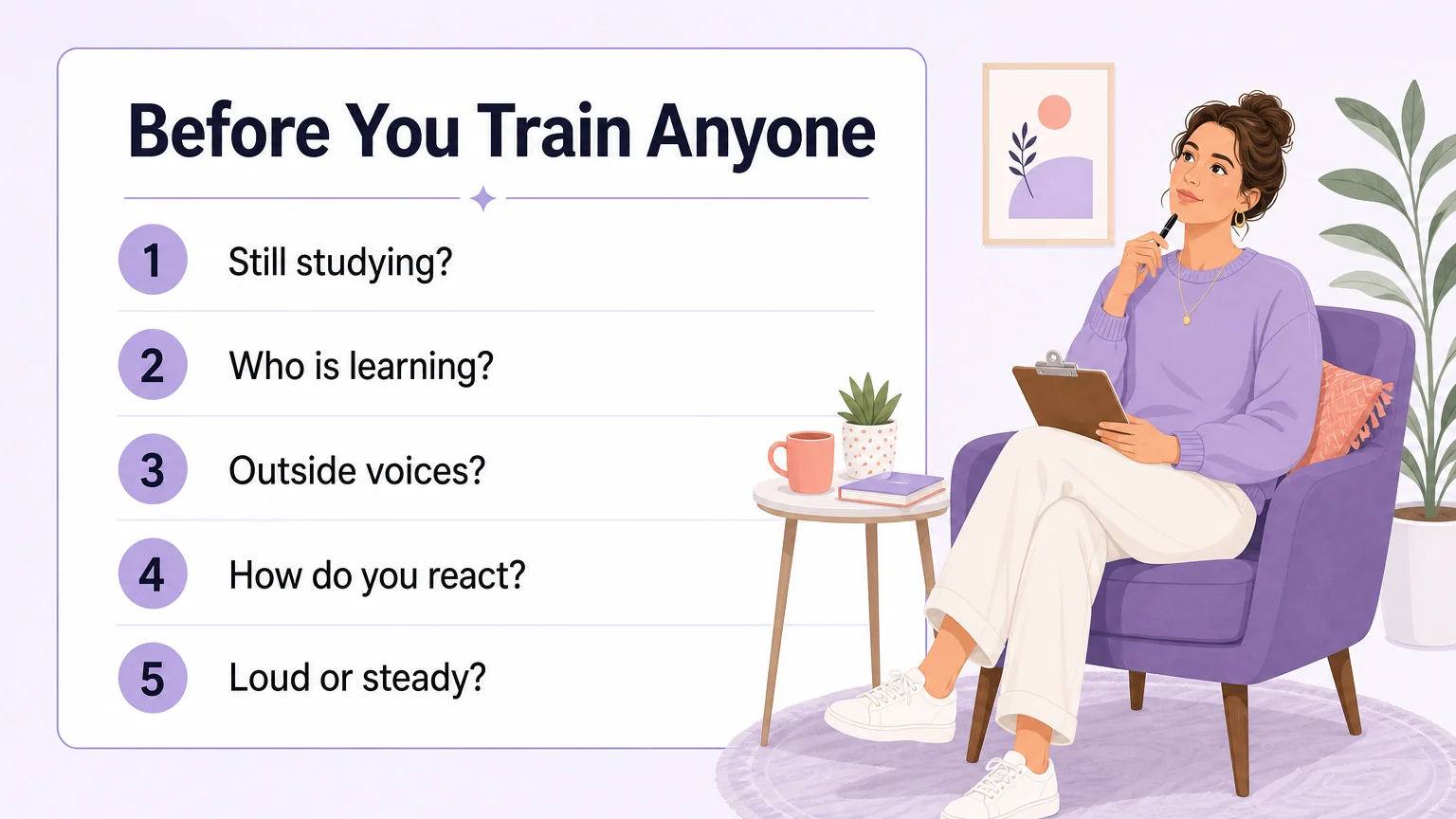
Goal: confirm you are fit to run this.
Training is something you do with someone, not to them. Start with your own fitness, because the person being trained is measuring you throughout.
Run five questions:
- When did you last deliberately study something about being a Dominant, rather than skimming a post on the way past?
- Are you delegating the education to your sub? That is bottoming from the top, and the tell is a sub in the classes while you are not.
- Do you ever hear a perspective from outside your own dynamic?
- What did your body do the last time someone questioned your practice?
- Is volume, meaning loudness or stubbornness, doing the work steadiness should be doing?
Being loud or angry or stubborn does not make you more dominant. It makes you harder to live with. Real dominance is steadiness and self-control.
Point the audit at the request. Anyone who has pitched you on training has used one of these:
A true submissive does not question.
Your limits are just fear.
You need to prove yourself.
Safewords are for beginners.
If you trusted me, you would do it.
I know what is best for you.
The legitimate version sounds like this:
- Prior negotiation.
- Willingness to be vetted, including references.
- Answers to questions, freely given.
- No rush, and no isolation.
- Hard limits treated as complete sentences.
- A stated ceiling on escalation.
The commercial tell: someone selling training to a newcomer with no background they can name and no patience for being corrected. Anybody with ethics welcomes vetting.
Declining is a complete answer. Referring someone to education you do not have is the competent move. Then watch your reaction when your sub pushes back. Defensiveness is information.
Milestone: you know whether to say yes.
Step 2: Negotiate Training as a Procedure, Not a Vibe
Goal: end this step holding one page you both wrote.
Set the conditions. Negotiate calm and sober, well before any play, so arousal is not doing the deciding. Length is not the measure of seriousness. Established partners can do this in five minutes; a new dynamic needs a fuller session.
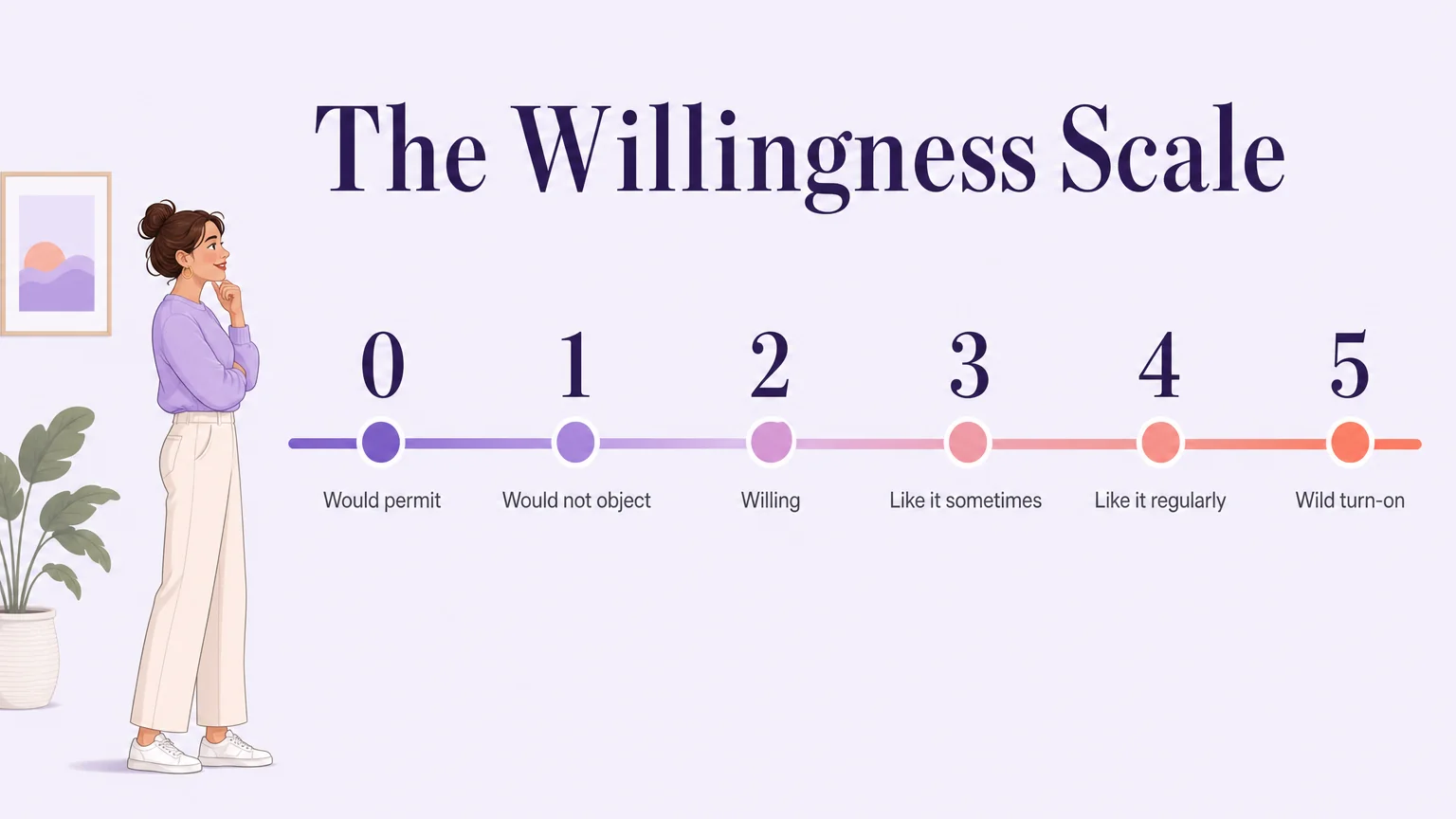
Fill it in privately first. Each person completes the checklist or the willingness scale alone, then you compare. That fixes the hardest problem here: surfacing a limit the other person has not thought of, without either of you having to ask out loud. In the same conversation, say whether a hard limit is off the table permanently or open to revisiting later.
Read the scale properly. A 0 is a soft limit rather than a no, which is why restraint attaches to it rather than enthusiasm. A 5 is a permission, not a standing order. Any static list goes stale, so set the review date here.
Separate hard from soft, out loud. A hard limit is absolute; crossing one ends the scene, a bounded occasion where the kink happens, and triggers a review. A soft limit is something someone is nervous about or willing to explore under conditions, and it needs caution and check-ins. Pushing a hard limit, even as a joke, has shown you something. Limits reach past acts, into emotional, medical, trauma-related and privacy territory.
Choose a structure and write your own page. Opt-in permits nothing unless it is listed. Opt-out permits anything unlisted, which risks a limit nobody named. Opt-in is heavier and only works if the list is easy to amend. For a new dynamic, choose opt-in.
Your own limits and capacity go on that worksheet, and the role does not remove your obligation to self-control. Know the sentence that starts it: we need to discuss something.
Read this out loud together.
🛠️ The Conversation Starter
We are calm, sober, and nothing is happening.
Fill in your list privately first, then we compare.
The scale: 0 means you would permit it if I really wanted it. 1 means you would not object if asked. 2 means willing with no special appeal. 3 means you usually like it occasionally. 4 means you like it regularly. 5 means a wild turn-on as often as possible.
Hard limits are off the table and crossing one ends the scene. Soft limits get caution, gradual exploration and check-ins.
Here are my own limits and my own capacity, on the same page as yours.
Here is when this is on and when it is off.
Here is our safeword and our nonverbal signal.
Here is the date of our next review.
Milestone: a written list, a shared scale, a review date.
Starting a new dynamic is the slow part, because it depends on finding someone who will have this conversation properly. On 3Fun, couples and open-minded singles put what they want and what they will not do in their profile, so most of it is settled before you meet.
Step 3: Set the Scope Dial and Lock the Escalation Ceiling

Goal: bound where this dynamic operates and how far it escalates.
Set the scope dial. The agreement defines when the dynamic is on: a time window, a room, pre-scheduled scenes, or a weekend. Outside those windows you go back to being equals.
Scene-level runs the authority inside one occasion and sets it down after, and it is a real version rather than a beginner setting. Contextual runs parts of daily life on protocol, a repeated rule or ritual. Full-time is integrated into life.
Write the window as a sentence you can both copy: “This is on from Friday evening until Sunday morning, and off at all other times.”
Name scope creep. Authority rarely expands in one decision. It expands through small yeses until someone is far from where they agreed to be. The fix is a scheduled review, not vigilance.
Name the framework. SSC, safe, sane and consensual, sets three conditions: keep it safe, keep it sane, keep it consensual. Practitioners moved to RACK because “sane” implies a judgment about which desires are acceptable. RACK, risk-aware consensual kink, is what replaced it.
Lock the escalation ceiling. If each check-in is where a consequence gets a little more severe, there is no end point and no principle, and nobody decided that. RACK supplies the first bound: nothing is completely safe, not even crossing the street, so the scale is safer and less safe rather than safe and unsafe. Mountain climbing is the analogy: the risk is part of the appeal, reduced through technique and practice rather than nerve. The second bound is the one you can act on: a ceiling is a number agreed in advance, in calm conditions, written down, never improvised while somebody is frustrated.
Pace the build. A gradual rise and a gradual decline produce far less of a crash than a spike, a wave on the beach rather than a cliff. Step 8 plans for the sustained arc, where someone is held in a heightened state for weeks.
If you have not written down what is in scope, do it now. If you have, check that the ceiling line carries a number.
Milestone: one window sentence and one ceiling line.
Step 4: Decide What You Are Training and What You Are Not
Goal: build a rule set you can hold.
Draw the line first. You are training skills, rituals and habits, not a personality, and that is the line between a dynamic and a project. Ask the person you are training to explain why a rule exists rather than what it is. If they cannot, that is a you problem.
Justify every protocol. A protocol has to be built rather than inherited. Consider kneeling at the door to greet you. In a house with small children who would ask, it is unworkable, so the fix keeps the function, a reconnection ritual at the end of the working day, and changes the form.
Apply this filter before you say anything out loud. Will you hold it on a tired night in a bad work week? If the answer is maybe, do not say it.
Cap the count. Add no rule until the existing ones hold. Inconsistent expectations produce anxious submissives, not confident ones.
Run the loop weekly, in the same slot. Ask four questions in order: what has been going well; what to keep; what to improve; and what has not been working that you want to stop. Then ask how the week felt, not whether the tasks got done, because resentment builds under a surface that looks fine and arrives as a blow-up. Keep yourself honest in the same slot: if the rules changed three times last month, ask whose behavior the sub is responding to.
Say what you are not training. Not a preference, a temperament, a sensory need or a history. Service submission may be one target among several. If a protocol exists so a person stops being who they are, that is not training.
If your rule list has never been tested against a bad week, this step is yours.
Milestone: a short rule list, each rule with a reason.
Step 5: Correct Without Making Punishment Your Default
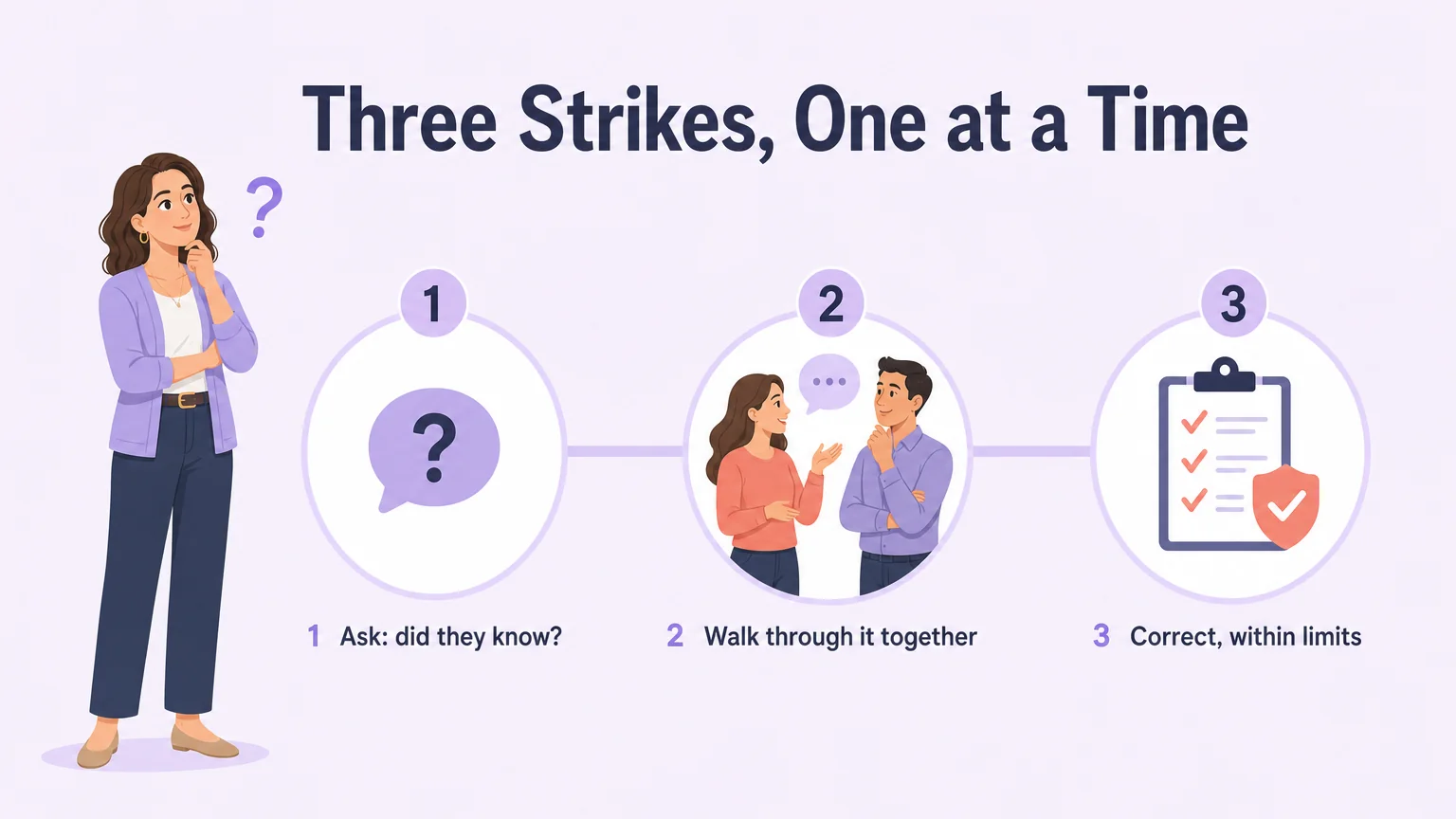
Goal: know what to do the first time something is missed.
Diagnose before you correct. If the person did not know the expectation, that is a communication failure rather than disobedience, and it belongs to you. Picture it: a Dominant texts from work, decides the reply is slow, drives home and delivers a punishment spanking for a reply window never discussed. The repair was a ten-minute window plus an exception protocol.
Use three strikes, one at a time. Strike one treats the miss as information and asks whether the expectation was understood. Reach for nothing. Strike two is walking through it out loud together, checking comprehension rather than repeating it louder. Strike three attracts correction, and only inside agreed limits.
Skip straight to consequences on the first miss and you teach that mistakes are dangerous, so the person starts hiding them.
Get the vocabulary right, then drop it. Reinforcement, including negative reinforcement, always increases a behavior. Punishment always decreases one. Negative means a stimulus is removed, not that the experience was bad. The seatbelt chime stops when you buckle.
Impact play or deprivation applied after a non-compliance to reduce it is punishment, and calling that negative reinforcement that decreases unfavorable actions is a punishment claim wearing a science label. Physical punishment especially teaches fear of the person delivering it.
Read submission against shutdown. Obedience out of fear and submission by choice look identical from the outside: the same postures, the same silence, the same yes sir on cue. What separates them is whether they can explain why a rule exists, whether correction produces learning or flinching, and whether they can predict what they will be told they got wrong.
One submissive followed every rule and was anxious the whole time. Silence is not a yes. Treat a person who has gone quiet as unverified, and check state rather than consent.
Lead with praise instead. Notice what you want more of, including small wins that feel too minor to mention, and find which form of praise lands for this person. Notice only the dramatic version and you train the behavior you will later be frustrated by.
Punishment as your default register builds compliance and not trust, and compliance is the cheaper of the two.
Milestone: a correction sequence that starts with a question.
Step 6: Make the Safeword a Mechanism, Not a Formality
Goal: know what you owe when the word is used.
Choose the word properly. A safeword is the agreed word that slows or stops things. Pick something that would not naturally be said during a scene, and agree it in advance. Do not use stop, because stop gets used playfully.
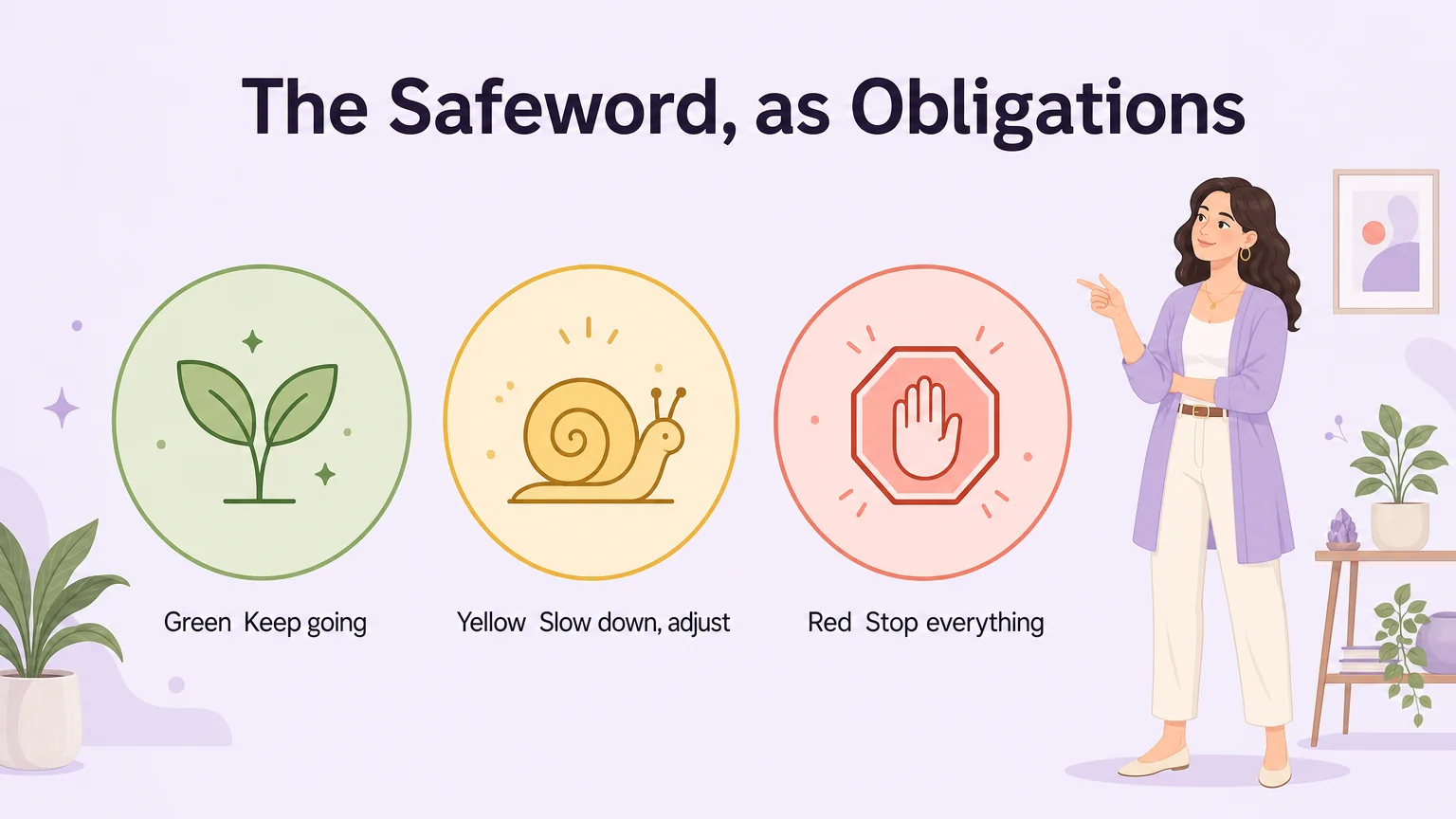
Learn the traffic lights as obligations.
- Green means everything is fine and you continue, and can authorize pushing harder if you agreed that in advance.
- Yellow means slow down and adjust before continuing, not end. It exists so a correction can happen without breaking the scene.
- Red means stop everything immediately, with no questions and no argument.
Know what red commits you to. Halt instantly. Address and repair whatever is wrong. Then move straight into aftercare for both people. Respecting the safeword is how the authority was granted, and it can be revoked at any time, including by that word.
Your reaction teaches a person whether to use the word again. Disappointment on your face is a training signal, and the wrong one.
Cover everything that prevents speech. Anything that gags, restrains or overwhelms needs a nonverbal signal agreed in advance: a hand signal, a bell, a blink. You are also responsible for noticing distress when no signal has been given, and for noticing when a person has lost the capacity to use the word they agreed on. That is deep consent: the read on whether this person can safeword at all, which is different from whether they said it.
Safeword yourself when you need to. You hold the word too, and using it is not a failure of the role. Step 8 assumes you may need it.
Run the traffic light once in a low-stakes moment, before it is needed, so both of you know what it feels like to say and to hear. An untested mechanism is a word you are hoping works.
Milestone: an agreed word, a nonverbal signal, one rehearsal.
Step 7: Build Aftercare Into the Program, Not Onto the End of It
Goal: negotiate recovery before you need it.
Aftercare is the care that follows intensity. Treat it as part of the scene, and negotiate it as seriously as the activity.
Ask these in advance. What gestures help you feel supported afterward. How long do you usually need. Any boundaries or topics to leave alone. Any sensory things that comfort you.
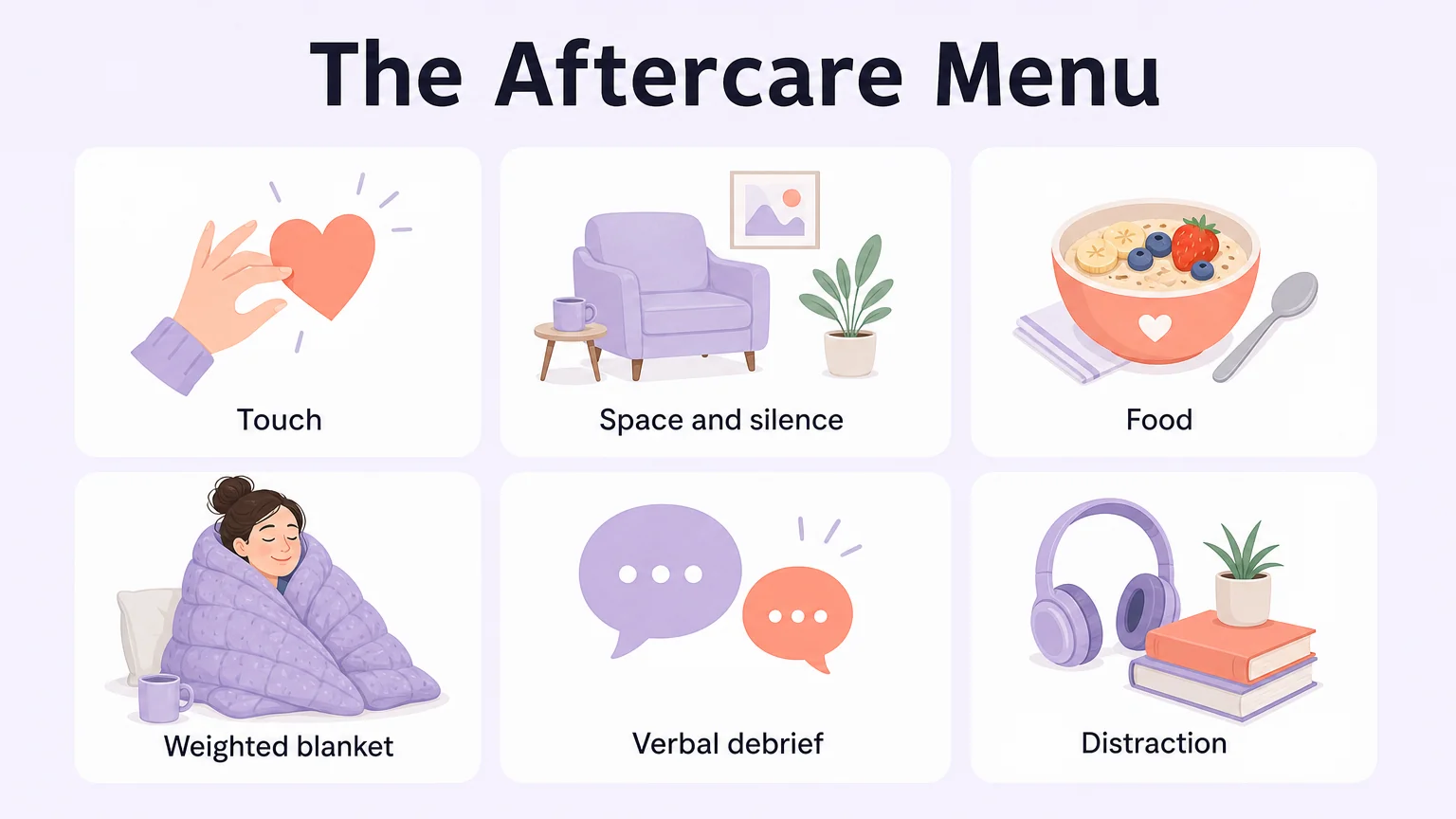
Then offer a menu rather than defaulting to touch, because the variants are not interchangeable:
- Physical touch and skin-to-skin contact, the version most people picture.
- Silence and space, because touch or talk after intensity can overwhelm.
- Food, because blood sugar drops after a hard scene.
- A weighted blanket or deep pressure, which signals safety.
- A verbal debrief, which is reflection and belongs later.
- Distraction, such as a familiar ritual or something funny.
The basics apply across all of them: warmth, hydration, food, tending marks and a blanket, because body temperature falls after a scene and mood goes unstable with it. Ask what this person’s nervous system needs, not what aftercare is supposed to look like.
Take the no-touch case seriously. One person describes wanting no touch, no water, no food and no talking after a scene, and being uncomfortable when affection is pushed on them. Their reasons are sensory: contact and conversation are extra load on a system already running hot. Their aftercare is being left alone, with a check-in days later.
The fix is the question, not the package. One caution: a complete absence of aftercare deserves suspicion, because it may be dissociation or freeze rather than solitude. If so, secure basic physical safety and a check-in tomorrow.
Separate recovery from debrief. Aftercare is recovery. Debriefing is reflection. Give reassurance for the first few hours and do not run the analysis, because asking whether it was okay on repeat is a debrief wearing reassurance’s clothes.
Schedule the conversation separately, later that night or the next morning. Frame feedback as experience rather than accusation: “that sensation became overwhelming faster than I expected,” not “I did not like how you did that.” A scene can look perfect and still hide one sensation the person did not enjoy. Ask how are you feeling rather than what do you need, because the first allows an answer and the second demands a clarity the person may not have.
Plan the days after, and cover yourself. Next-day and day-two contact is part of aftercare, because drop arrives later and gets misread as a bad day. Dr. Misty Gibson, an AASECT-certified sex therapist, frames aftercare as nervous system repair rather than a courtesy. You spent the evening giving care, so you need hydration, food, being touched rather than only touching, and a decompression window.
Milestone: a named menu, agreed in advance, with a debrief slot.
Step 8: Plan for Drop Across the Days That Follow

Goal: plan for the crash, including your own.
Drop is the comedown that follows intensity: a predictable response, not evidence anything went wrong. Gibson’s line is plainer: drop is proof the nervous system is still on the ride. What drop is has its own explainer; this covers what training changes. Subspace, the altered state some submissives sink into during a scene, shares the chemistry and the landing.
Understand what a sustained arc does. A single scene produces one spike and one comedown. A program holds someone in a heightened state for weeks, so the crash scales with the run, not any one evening, and can arrive when nothing dramatic has happened. Check-ins belong on the days after the intensity, and the person needs warning that it is coming.
Write the plan now, in first person. Three statements, read aloud:
I tend to crash emotionally about 24 hours after intense scenes. When that happens, I need reassurance that I am not broken, and maybe some check-in texts.
I sometimes get top drop and feel guilty even when everything was consensual. If that happens, I might need you to tell me explicitly that you are okay and that I did not hurt you.
I get physically depleted after bottoming, and I am probably going to need to sleep and eat and not be social for a while.
For the delayed crash, use the text that names it and asks for nothing:
Hey, I am hitting some drop today. Nothing you did wrong. Just my nervous system doing its thing. I will be okay, but I wanted you to know.
Symptoms generally set in within 24 to 72 hours.
Take top drop seriously. It is the same crash landing on the Dominant instead, and tops need more support because they do not expect it and have no framework for it. The shape: guilt about consensual intensity, anxiety about whether the other person is fine, compulsive checking, loneliness even with them in the room, self-doubt, and an energy crash. What helps: reassurance before it is asked for, contact without force, no debrief in the first few hours, and letting yourself be held rather than only holding. The narrative that the person in charge should shake it off is why this goes untreated.
Know when it is not drop. These five mean harm:
- Feeling genuinely violated, or that consent was crossed.
- An injury that was never negotiated or intended.
- Dissociation that does not ease with care.
- A partner who dismisses the distress or refuses support.
- The realization that boundaries were pushed or ignored.
Drop responds to care and passes. Harm has to be addressed rather than comforted. Negative feelings usually settle within hours to a day, and if they have not cleared in a week, bring in someone qualified.
Schedule the day-two and day-three check-ins now, before the program starts.
Milestone: three scripts, a drop text, two calendar entries.
Step 9: Training When There Is a Third Person: Whose Protocol Governs

Goal: settle how this fits around other people.
The program is running, the aftercare and drop plans are in place, and now the question is fit.
Start with the collision. Poly agreements typically require transparency about what is happening with other partners. Kink agreements routinely require privacy about scenes. One person stands in both, and cannot satisfy one without breaching the other unless the conflict gets an explicit exception. That reframes the question from who decides into what was never agreed.
Write down the territory neither agreement covers. Three questions, on paper: who scenes with whom; whether any scene type is exclusive to one partner; and how a new training dynamic affects arrangements that already existed. A training dynamic can also be exclusive in its D/s dimension while open sexually.
Give metamours standing without giving them a veto. A metamour is your partner’s other partner. The working position is that a metamour can raise a specific discomfort, the usual example being a collar worn in shared space, and does not hold a veto.
Practitioners genuinely split: one position holds that nobody outside the relationship has any standing, another that the hinge should weigh a partner’s feelings heavily. The practical resolution beats both. Negotiate the program’s footprint on shared time and space directly.
Disclose hierarchy rather than declaring it. A designation that changes someone else’s standing is agreed, not announced. The failure case is a secondary partner who never consented to being secondary and found out by discovering it. This goes wrong during early infatuation, when scope expands and promises get made that do not survive.
Here is the part most people get backwards. One Dominant with several submissives is usually easier, because coordination lives with the person holding the authority. One submissive serving two Dominants is harder, because two structures have to be reconciled by the person with the least power to change either.
Milestone: three written answers, and a position on who has a voice.
3Fun is built for exactly this: more than two people, with the terms stated rather than assumed and nobody finding out their place by accident.
Step 10: Know When to Stop: Harm, Coercion, and the Abuse Line
Goal: hold a test that works from inside.
Why the obvious advice fails. It is hard to judge a dynamic from the inside, and the instinct to trust your gut is least reliable when the stakes are highest, because instincts reorganize around keeping the relationship. So the test cannot depend on how you feel about your partner.
Use the primary test. The credit belongs to Stefani Goerlich, whose book A Roomful of Leopards works through telling intimate partner violence apart from consensual kink. The differentiator is whether the person receiving can say stop and have it respected. Even in round-the-clock total power exchange, practitioners describe boundaries the Dominant cannot cross.
A person in a consensual dynamic can pause, renegotiate or walk away at any point. A person in a coercive one typically cannot.
The framing that explains why: we share power when we give control over to the top, and abusers steal it, because they do not ask and they do not negotiate. The failure shows the first time the stop signal is tested, not after months.
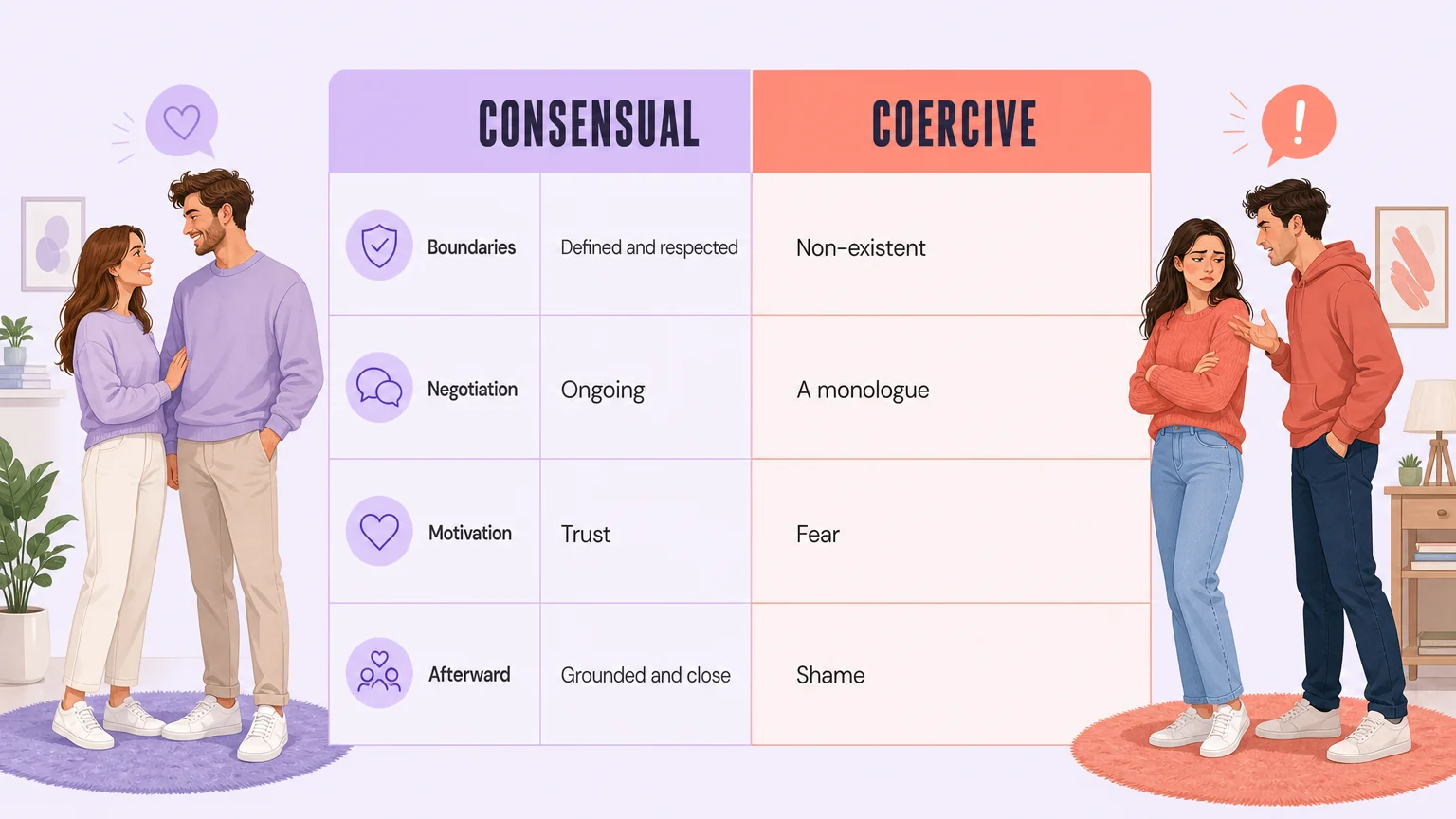
Compare the six markers.
| Marker | Consensual training | Coercive control |
|---|---|---|
| Boundaries | Explicitly defined, instantly respected | Non-existent or theoretical |
| Negotiation | Ongoing and collaborative | A monologue disguised as a dialogue |
| Motivation | Pleasure seeking and trust | Fear avoidance and survival |
| Internal state | Present and engaged | Dissociated and retreated |
| Afterward | Grounded and close | Shame and emptiness |
| Resources | Shared and managed equitably | Leveraged to make leaving impossible |
The difference is between power that is handed over and power that is taken, and taking does not involve asking.
Watch the adjustability. A dynamic that stops being adjustable is at risk of becoming abusive even if it began consensually, because consent is a live condition, not a one-time signature. This test is also hardest to apply from inside a trauma bond, which is exactly when it is needed, so the answer is a person outside the dynamic who can hold the question with you. Do not rely on appearance either, because consensual training and abuse can produce the same bruises. Consent and intent are the whole difference.
Know how training ends. Five ways: release, a re-teach, a time-out to reaffirm the agreement, a renegotiation, or the end of the dynamic. Every one is an exercise of the agreement rather than a breach of it, which matters because ending is what people treat as failure.
This step in one sentence: a Dominant saying a hard limit will not stay hard for long, because it is going to be worked on.
Fear of a consequence for having a boundary is not training. It is control, and if you recognized your own dynamic here, you know what the next conversation is.
Milestone: a test you can apply on a bad day, and a person outside the dynamic.
Frequently Asked Questions About Submissive Training
How long does submissive training take?
No reliable figure exists. The timeline is set by what you are training, how often you practice, and how quickly you renegotiate, not by a calendar. Treat any specific number you are handed as an assertion rather than evidence. The 24 to 72 hour drop window in Step 8 is the only timing figure here with a source behind it.
Can you train yourself to be submissive?
Yes. Build self-imposed structure: a routine or reward system standing in for what a Dominant would supply. Then create accountability without one, through a kink-aware friend, a public commitment, or a workbook built for self-accountability, such as The Submissive Activity Book. Two failure modes to watch: escalating past your own limits with nobody to notice, and measuring your worth by someone’s approval.
What are some good submissive rules to start with?
Fewer than you want, and only ones you can explain the reason for. Start with three or four unglamorous things: a reply window with an exception protocol, a fixed-time check-in, a ritual that marks the end of the working day, and one rule about your own care rather than service. If you are not sure you will hold it on a bad week, do not set it.
What are some examples of submissive kinks?
The range is wider than a list of acts. Service and devotion. Protocol and ritual. Sensation. Restraint. Being directed. The mental states of surrender and focused attention. Limits and interests also span emotional, psychological, privacy and relationship territory. Find your own answers with the willingness scale in Step 2.
Why is submission a turn on?
For many people the appeal is the relief of not deciding, being wanted specifically for what you give, and the intensity of a state that is hard to reach any other way. Surrender here is an active choice rather than a diminished one. The reason varies by person, and the useful work is finding your own.
Are there programs or apps that can help?
No product is required. Claims that measurement is mandatory come from someone selling the measurement layer, and the habit-formation timescales behind them are unevidenced. What has support is negotiation, check-ins, consistency and aftercare, none of which need an app. A tracker can help a long-distance dynamic. It is a tool, not a requirement.
Is submissive training the same as slave training?
No, and the line is not authoritatively defined anywhere. Most of the confusion comes from an older, largely extinct tradition of formal etiquette training, with a written contract, speaking permissions, eye-contact rules and a trainer-and-charge relationship. That is structurally different from the training described here, because it is not built around the charge’s limits.
Can a male submissive be trained the same way?
Yes, and gender is a poor organizing variable. Training is designed around an individual’s limits, goals and nervous system rather than a template, and on that test gender tells you far less than the person’s response to structure. A protocol that steadies one person may humiliate another.
What is the difference between submissive training and abuse?
The test is whether the person can say stop and have it respected, and whether invoking a boundary brings a halt or retaliation. Two markers follow fastest: who holds the resources, and whether the hierarchy is adjustable. Appearance proves nothing, because both can produce the same bruises. Step 10 carries the full comparison.