There are 257 submissive names below, sorted into thirteen registers, each with a one-line note so you can tell a sweet name from a heavy one before you say it out loud.
Naming is the cheapest piece of kit in a dynamic. It costs nothing, it can be changed tomorrow, and it does more work than most people expect.
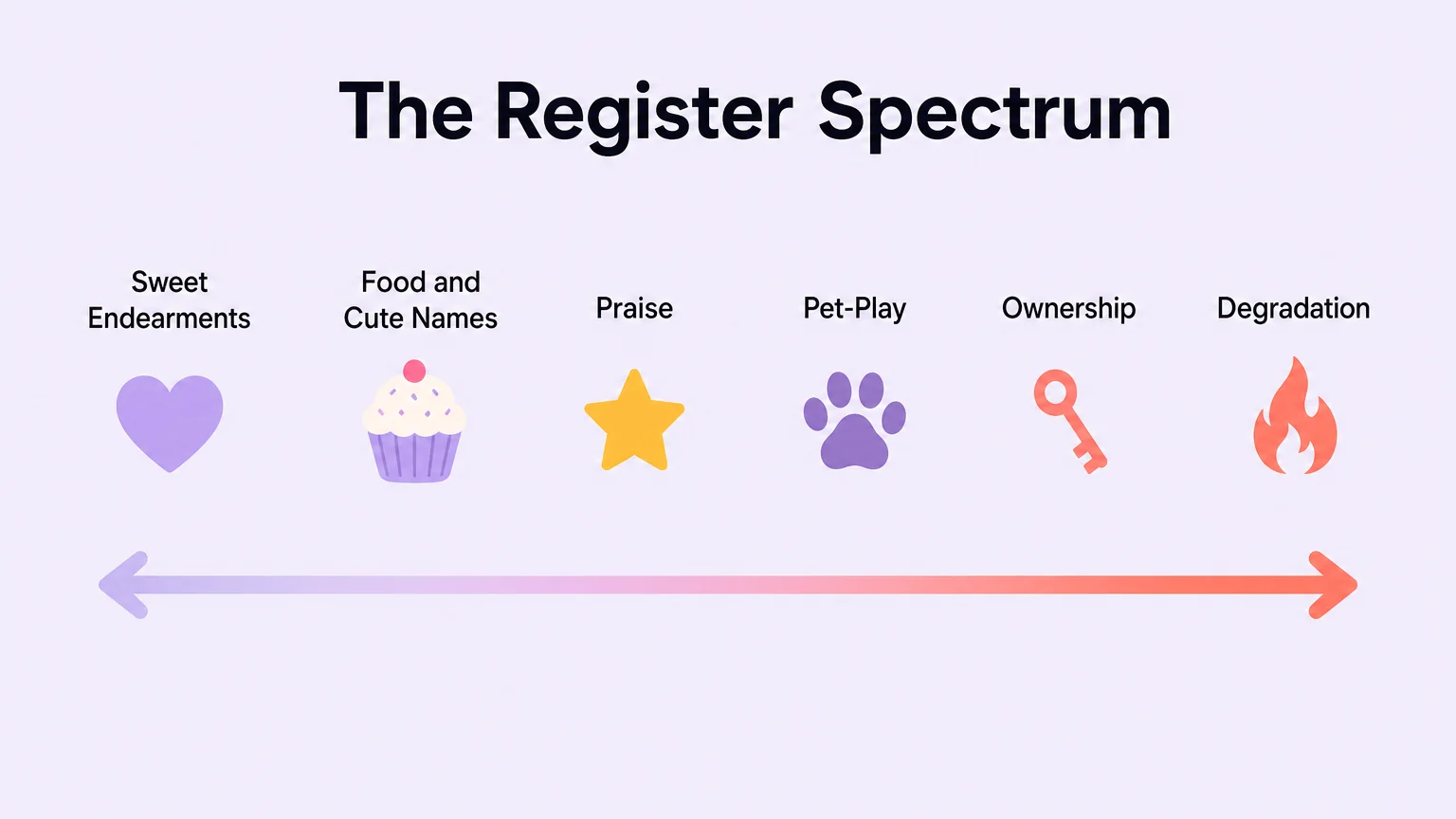
Use this list by register rather than from the top. It runs from everyday endearments that carry no kink charge, through food names, baby-talk, praise, pet play, bratting, ageplay and ownership, and out to the degradation register at the heaviest end. Scan for the headspace you want and read that section.
One thing to know before you pick any of them: a name is agreed, not announced.
How to Choose a Submissive Name
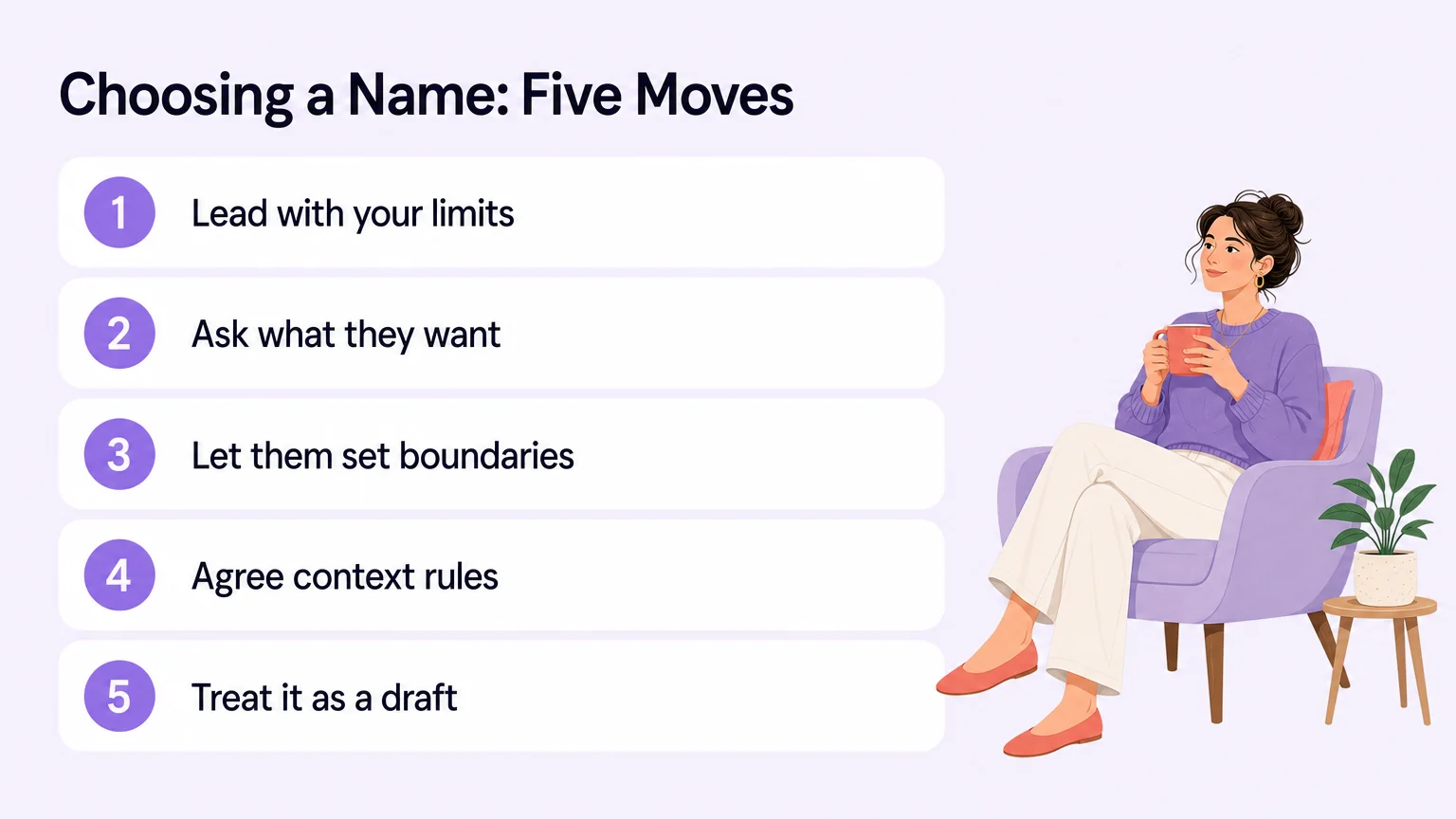
Nobody hands you a script for this, and the awkwardness of raising it is the reason most couples end up with a name neither of them chose. There are five moves worth making, and then two mechanics that matter more than they sound.
Lead with your own limits. Say what you are not willing to call someone before you ask anything. If degradation is off the table for you, say so first, so your partner is not sitting there guessing at your position and reading your silence as disapproval. It costs nothing and removes most of the tension.
Ask what they want to be called. If they do not know, tell them what you would most like to call them and let them react to something concrete. And say plainly that if nothing fits, they do not need a special name at all. Their own name, an inside joke, or a plain honey are all valid, and the dynamic does not run on vocabulary.
Have them name their own boundaries. Do not read a list of slurs aloud and ask which ones are fine. For some people, hearing the word said at all is the harm, so the sub volunteers their limits rather than the Dominant probing for them. Ask separately about the names they want, not only the ones they refuse. A list with no yes column is useless.
Set context rules. The same word in scene and out of scene can be fine in one place and a serious problem in the other. Ask what happens in front of friends, and agree a substitute before you need one rather than improvising while somebody is standing there.
Treat the first list as a draft. Feelings about words change with mood, partner, and life events. Have the Dominant say the candidates out loud, ideally during a session, because that is the fastest way to learn which ones are wrong. Several weeks of experimenting is normal.
Two mechanics, one line each. For a male sub, the possessive prefix does more work than the noun, which section 10 goes into. For a nonbinary sub, the fix is swapping the noun for a role noun rather than neutralizing the grammar, which section 11 covers.
And one last thing, because it is the whole argument of this list. The best names are usually the ones that come out of your own story rather than off a list, which is what section 13 is for.
1. Sweet and Everyday Endearments
Start here. Of all the submissive names on the page, these take the least negotiation. Several carry no D/s charge whatsoever, which is exactly why this is the right place to begin, and why most of them survive being said in front of people who are not in the lifestyle.
- Darling – An ordinary romantic endearment: fine to start with, poor to stop at.
- Honey – Ordinary and warm, and a safe fallback when nothing special fits.
- Love – Bare, simple, and hard to overplay, which is most of its appeal.
- Sweetheart – The classic romantic register, and soft enough for a middle headspace.
- Sweetie – Warm, ordinary, and easy to say in front of anyone at all.
- Dear – Plain affection, and one of the things a mother calls a son.
- Dearie – The softer, older form of dear. Domestic and unhurried.
- Boo – Light and playful, and nearly impossible to say with any weight.
- Beloved – Heavier and more formal than the rest of this section.
- Babe – The reliable public substitute for when the wrong person is listening.
- Cutie – An adjective doing a name’s job, and it works on any gender.
- Beautiful – A statement rather than a nickname, and a heavy compliment to carry.
- Adorable – Another adjective as a name: affectionate, and slightly teasing.
- My Heart – The plain possessive with the feeling stated outright.
- Lovey – Baby-talk adjacent, and completely unbothered about being so.
- Honeybunch – Old-fashioned and sweet, and almost impossible to say angrily.
- Honey Bee – Honey with a little more buzz, and it survives shortening.
- Sunshine – Bright and warm, and one of the softest things in this section.
- Angel – Sweet and slightly reverent. Also works in the ageplay register, where it appears as Little Angel.
- Dove – Gentle and quiet, with a softness that reads almost ceremonial.
- Pearl – A pretty noun rather than a kink term. Romantic, and a little formal.
- Blossom – A pretty noun: soft, floral, and unambiguously affectionate.
- Stella – A pretty noun with a bit of sparkle to it.
- Starlight – The most romantic of the pretty nouns, and the most wistful.
- Daisy – Bright, simple, and friendly rather than charged with anything.
- Nymph – A pretty noun with a classical, slightly wild edge to it.
- Damsel – Storybook and a little helpless, which is rather the point.
- Belle – Pretty and polite, with a southern drawl if you want one.
- Tootsie – Playful, old-Hollywood, and impossible to take seriously.
2. Sweet-Treat and Food Names
What makes a food name land? The submissive name says the sub is something to be consumed, which makes it warm and a little bit objectifying at the same time. It is the softest way to have a sub be a thing rather than a person without going anywhere near degradation.
- Sugar – Built from a private joke: the sub becomes something he should not have.
- Cupcake – Sweet, silly, and the sort of name that invites a bite.
- Pumpkin – Warm and autumnal, affectionate without tipping into romantic.
- Snack – The sharpest one here. It says exactly what the name is for.
- Pudding – Soft, sweet, and a little bit ridiculous, in the nicest way.
- Dumpling – Warm, round, and fond. Food as pure affection.
- Cookie – Sweet and homely, and it doubles as a perfectly ordinary pet name.
- Candy – Bright and sugary, and about as unserious as this list gets.
- Peanut – Small and affectionate, with a built-in tease about size.
- Marshmallow – Soft to the point of collapse, which is the whole joke.
- Caramel – Rich, slow, and slightly sticky in implication.
- Toffee – Sweeter and harder-edged than caramel, and a bit chewy.
- Brownie – Cozy and homemade, with no kink charge at all.
- Honeybun – Sweet and old-fashioned, and it lands softer than honey alone.
- Sugarplum – The most theatrical of the sweets. It wants to be said slowly.
- Peach – Soft and pretty, and it is also slang for something else entirely.
- Peaches – The same word with the possessive on, which is the only difference.
- Tenderloin – Half of a pair with the Dominant’s own name, so the pairing is the point.
3. Cute, Cuddly and Baby-Talk Names
The compound forms and the baby-talk forms carry maximum affection and no authority at all. That combination makes them the safest submissive names in the list, and the ones most often used outside a scene entirely, in aftercare or on a Tuesday.
- Snugglebug – Pure cuddle intent, with no power in it anywhere.
- Cuddles – A name for aftercare more than for scene.
- Cuddlebug – Cuddles with a little more creature in it, and no less warmth.
- Lovebug – Affection stated plainly, and impossible to say coldly.
- Boo Bear – Baby-talk doubled up, and completely unembarrassed about it.
- Snookie – Soft and silly, in the register of a nickname from childhood.
- Button – Small and cute, and the sort of thing said while pinching a cheek.
- Cutie Pie – Baby-talk at full volume, sweet rather than diminishing.
- Cherub – Slightly reverent, with a painterly feel to it.
- Ladybug – A gentle creature name that never reads as pet play.
- Buttercup – Sweet and a bit old-fashioned, and it survives being shortened.
- Sweet Pea – Small, green, and tender. Softness without any baby-talk.
- Poppy – Bright and small, with a little pop of color in it.
- Muffin – Warm and bakery-soft, and very hard to say sternly.
- Doll – One sub runs it as its own register: soft times as against other times.
- Dollie – The diminutive of the same word, so it reads younger and softer.
- Baby Doll – Leans into ageplay, and the line between it and Babygirl is thin.
4. Praise Names: Good Girl, Good Boy and the Rest
Because praise attaches to behavior rather than the person, submissive names of this kind are the safest register on the page: getting it wrong costs almost nothing. Good Girl is the most overused phrase in the section; Good Boy is under-used rather than worn out.
- Good Girl – The default, and the most overused phrase in the section.
- Good Boy – Affirming for some transmasculine subs, and a possible trigger for people with certain histories.
- My Good Boy – The possessive applied to praise: the prefix does the work.
- Pretty Boy – The strongest affirming term for a male sub.
- Stud – Blunt masculine praise, with no diminishment.
- Good Pet – Crosses into pet play, and ends scenes well.
- Good Little One – Praise with the noun swapped, keeping it ungendered.
- Atta Girl – Praise as a cheer, best after something hard.
- My Good Kitty – Praise, possession and a pet-play noun at once.
- Well Done – A phrase rather than a noun, flat enough for public use.
- Pet – The most-recommended low-risk default, and a slot not a word.
- Little One – A core diminutive, and one of the safest starts.
- Yes Chef – Service praise, and a public-safe code for yes sir.
- Sub – The plain role noun, and proof a name is optional.
Prince, Boy and the babied set are in section 10.
5. Pet-Play Names: Pick the Animal Before the Name
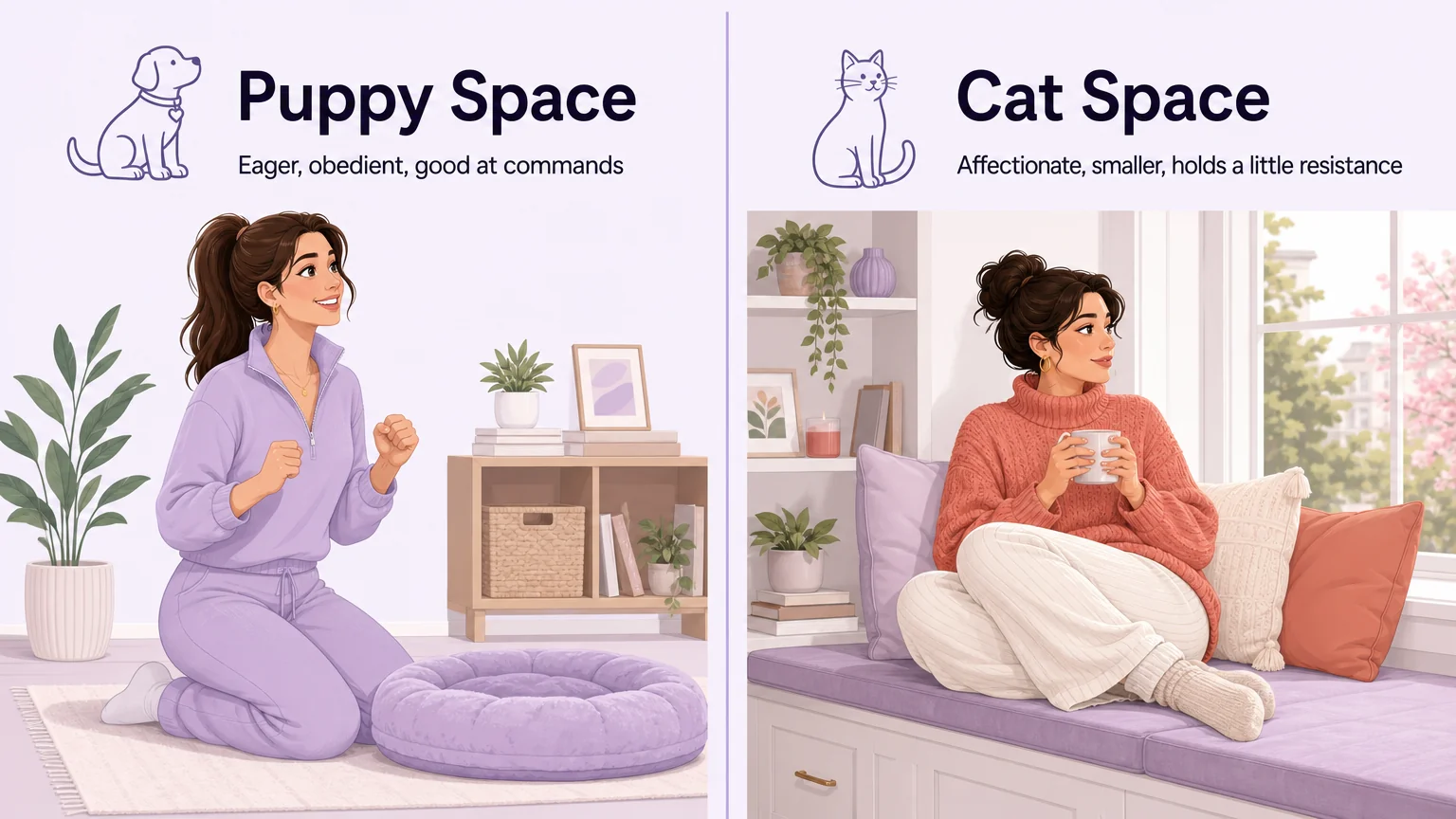
Pick the species first and the word second: in pet play, the submissive name follows the animal, because the animal carries the headspace with it. Puppy space is eager, obedient, and good at commands. Cat space is more affectionate, feels smaller, and holds a little resistance. This is also a hard limit for plenty of submissives, so agree the species before you try the name.
- Kitten – Soft and playful. The beginner-friendly default, and one of the most common pet names in the scene.
- Kitty – The softer form of Kitten, and one some subs keep for years.
- Puppy – Eager to obey and do tricks, which makes it a service headspace.
- Pup – The short form, and pet play rather than a neutral fallback.
- Doggo – A goofy, affectionate dog nickname with no protocol in it.
- Pupperoni – The silliest name on the page, and proud of it.
- Bunny – One sub used it mostly in aftercare and everyday life.
- Songbird – For a headspace that fits neither cat nor dog.
- Owlet – Small, watchful, and nocturnal. A bird rather than a pet.
- Fledgling – New, dependent, and still growing into it.
- Bumble – Clumsy, fuzzy, and endearing, and it comes with a sting.
- Cricket – Tiny, chirpy, and hard to take seriously.
- Fox – Clever and a little sly, with more teeth than the cat names.
- Kitsune – The folklore fox, so it carries mischief and magic.
- Dragon – Hoarding, possessive, and not remotely domesticated.
- Dinosaur – Proof the animal pool is not limited to anything domestic.
- Jaguar – One practitioner’s answer to Kitten: meaner, bigger, and in charge of her own jungle.
- Rabbit – A one-off with private meaning behind it.
- Rope Bunny – Not an animal headspace. A submissive who loves bondage and rope work.
- Cerberus – The guard dog of the underworld, so the reading comes with teeth.
- Hellpuppy – Devoted and obedient, with the obedience turned past comfortable.
- Fawn – Leggy, startled, and gentle. Softness with a prey animal’s edge.
- Lamb – Docile and sweet, with a sacrificial undertone if you want one.
- Panda – Round, slow, and entirely uninterested in being useful.
- Little Fawn – Fawn with the diminutive attached, so it reads younger.
- Little Lamb – Lamb with the diminutive attached, which makes it softer still.
- Beast – The heavier end here, and it reads as primal rather than cute.
- Creature – Less a label than a state, and usually a scene word.
- Kit – A young fox, and it doubles as a primal register.
- Mutt – Scruffy and mongrel, and degrading if you lean on it.
- Pony – A pet sub-type first and a name second, and it comes with gear.
- Cub – One of the few nouns that bridges pet play and ageplay.
The male-coded pet names, Tom-Kitten, Spot, Rex, Bud, Prey Animal, Little Weasel and Prized Stallion, are in section 10. The degrading ones, Piggy, Dumb Dumb, Horny Little Dog and Slutty Kitten, are in section 9.
6. Brat and Primal Names
Nothing in this register rewards submission. The submissive names that follow invite resistance instead, for the sub who needs to be compelled into it, and they are states rather than labels, usually scene-bound, so nobody is a brat at the supermarket.
- Brat – A sub-type and a name at once, and the flat delivery is the move.
- Rascal – Cheeky and small-scale, with affection under the scolding.
- Minx – Names the provocation directly, with a smirk attached.
- Tease – The most literal name here: it says exactly what the sub does.
- Vixen – The flirtation end of the section, sharp and knowing.
- Pixie – Soft and playful, and it doubles as an ordinary endearment.
- Sassy – An adjective as a name, and it sets the tone before anything happens.
- Foxy – Flirtation with a bit of bite, and it survives in public.
- Cherry – Sweet, and the one most likely to pass as an ordinary endearment.
- Kittycat – Kitten with the brat turned up, all attention-seeking.
- Tigress – Bigger and more dangerous than the other cat names.
- Imp – The smallest and most affectionate thing you can call a troublemaker.
- Rogue – A playful archetype rather than a term of address.
- Trickster – Same as Rogue: something you are described as, not called.
- Mischief Maker – A description rather than a call, best said with a sigh.
Fairy, Goblin, Void-Creature and Chaos Pixie read as nonhuman identity rather than bratting and sit in section 11.
7. Little, Middle and Ageplay Names
For warmth with nothing degrading in it, read this register: little and middle submissive names are the ones most likely to double as a name used outside the dynamic entirely. The split that matters: little-space names are child-coded, while middle-space names are playful rather than babyish and often take the form of a title.
- Baby – Ordinary or heavy ageplay depending on context, so check which you mean.
- Babygirl – One of the most common in practice, and beginner-friendly.
- Little – A standalone title, and also the name of a whole sub-type.
- Little Girl – One nonbinary sub reported enjoying this one in-scene, deliberately.
- Little Star – The softest end of the section, with no age charge at all.
- Little Angel – Sweet and cherubic, and the ageplay reading of Angel.
- Little Love – Affection with the diminutive, and no ageplay charge.
- Little Subbie – One sub’s self-description after hearing it said aloud.
- Sweet Girl – Common and warm, and one of the most-used in practice.
- Kiddo – Everyday and affectionate, and one of the few that works for middles.
- Miss – A middle-space title rather than a diminutive: older and more formal.
- Missy – Miss made playful, which is exactly the middle-space register.
- little miss – The lowercase form, and it reads younger than Miss.
- little lady – A middle-space title with a mock-formal edge to it.
- Girlie – Soft and a little teasing, sitting close to everyday speech.
- Girl – The everyday one that gets said in public by accident.
- Princess – The biggest split in the section: one sub melts, another finds it patronizing.
The masculine half of this register, including Prince, Little Boy, Babyboy, Boi and little mister, is in section 10.
8. Ownership and Service Names
Position beats vocabulary: my anything outperforms a better-chosen sub name, because the possessive does more work than the noun. A role name is different, because it carries an obligation, which is why some subs want one and some will not touch it.
- Mine – The claim in one word, saying nothing about the sub.
- Property – Ownership stated flatly. The prefix makes it land, not the noun.
- Possession – Closer to a legal claim than a nickname.
- Slave – An ownership noun and a sub-type, and heavy to wear.
- Maid – A service role, at home in the household more than the bedroom.
- Thrall – An aspirational archetype. Beginners here say they have no limits.
- Trainee – Wants instruction and feedback, so naming is about precision.
- Service Sub – Describes the work rather than the person.
- My Jewel / My Prize / My Treasure – One move in three words. The possessive is the point.
- My Pride and Joy – The possessive register at its most openly fond.
- My [Thing] – The template rather than a name. Put anything in the bracket.
- Teacher’s Pet – Roleplay-derived: a teacher Dominant gets a Teacher’s Pet.
- Beta – Subordinate pack status, implying a hierarchy not a dynamic.
- Servant – Service stated plainly, closer to a job than an endearment.
- Puppeteer – Roleplay-derived and control-flavoured, so it sits closer to the dominant side than most names here.
- Sissy – A feminisation name. Outside the scene it is a slur aimed at effeminate and gay men; inside, reclaimed role vocabulary needing explicit negotiation.
- Sissymaid – A feminisation and service compound with the same history: a slur outside the scene, reclaimed role vocabulary inside it, and agreed before it is ever used.
The four Gorean forms sit with the borrowed titles in section 12.
9. Degradation and Objectification Names: Opt-In Only
Opt in first, word by word, before any of these is ever said out loud. The heaviest submissive names on the page belong inside scenes rather than everyday conversation, and unlike everything else here they are not try-it-and-adjust. In many dynamics they are affectionate rather than harsh, which is exactly why the negotiation matters and why assuming either way is wrong.
- Plaything – Objectifying but gender-neutral, so it works where gendered nouns do not.
- Toy – Objectifying and neutral by nature, so it works in ownership or degradation registers.
- Object – Bare objectification, with nothing of a person left in the word.
- Hole – Reduces the sub to a function, and it is gender-neutral by nature.
- It – A pronoun rather than a noun, and the coldest thing on this page.
- Fucktoy – Blunt and objectifying, and often treated as a possession.
- Footstool – Furniture rather than a person. The objectification is entirely literal.
- Slut – Negotiated word by word, and affectionate in many dynamics: only ever a slut for him.
- Whore – Paired with slut throughout, and the same negotiation applies before it is said.
- Dirty Slut – The adjective makes it land, and praise afterward lands harder still.
- My Slut – The possessive doing the work on a degrading noun.
- Cockwhore – Filed under humiliation, and it needs the same agreement as the rest.
- Cumwhore – Blunt and specific, and it follows the same negotiation rule.
- Cum Slut – The same word order reversed, and no softer for it.
- Cumdumpster – The most reductive noun here, and it says what it means.
- Cunt – A blunt body noun used as a name, and the one most likely to land wrong.
- Bitch – Goes flat inside a session in minutes, which is why layering it works better.
- Bad Bitch – One Dominant’s name for a sub in a training stage, mapped to a persona.
- Useless Bitch – The worked example: affectionate in scene, relationship-ending outside it.
- Needy Little Bitch – Stacking adjectives so a degrading name does not go stale.
- Man-Whore – The male-coded version of the same noun, with the same negotiation requirement.
- Useless – Inside a scene it reads as affection. Outside one it is an insult.
- Trash – Dismissive and flat, with nothing affectionate left on the surface.
- Doormat – Contemptuous rather than sexual, and blunt about what the sub is for.
- Worm – Low and crawling, and about as far down the register as it goes.
- Easy – Reported as part of one male sub’s accepted vocabulary, and it is a mild one.
- Small – Rejected outright by one Domme, because her sub was well built.
- This One – A third-person protocol, separately negotiated rather than a Gorean rule.
- This Slave – The same third-person move, and some run it all day with one fixed name.
- Piggy / Pig – Sits exactly on the line between pet play and degradation.
- Dumb Dumb – Affectionate dog-name silliness, with a degrading edge underneath it.
- Horny Little Dog – One of the few degrading names reported to work for a male sub.
- Bootlicker – Contemptuous and service-flavoured, and it reads as an insult first.
- Slutty Kitten – Often a first-Dominant name, and some subs find it never transfers.
- Good Little Thing – Neutral and dehumanising at once, which is exactly why it gets used.
10. Names for Male Submissives
Good Girl turns up everywhere; the male equivalent is rare enough to be worth noting. Submissive names for men are overwhelmingly feminine-coded, and two mechanics matter. The possessive does more work than the noun, and a feminine name on a male sub is sometimes a deliberate lessening, not an oversight.
- Buddy – Warm and ordinary, one of the things a mother calls a son.
- Prince – The masculine counterpart to Princess, and the softer half.
- Mister – A title worn by a submissive, which is the joke.
- Boy – The dominant male-sub form, standalone and inside half the others.
- Boi – The deliberate spelling, signalling a queer or softer masculine read.
- little mister – The masculine counterpart to little miss.
- Babyboy – The male baby register, in its simplest form.
- Little Boy – The core male-sub noun, recurring in nearly every account.
- Little Prince – Tried affectionately on one gender-variable sub, who rejected it.
- Little Man – The babied register, warm rather than diminishing.
- Little Guy – The same register, a bit lighter and more casual.
- Little Tyke – Babied, but for a boy who is a handful.
- Little Bear – The only animal word in the babied male set.
- Tom-Kitten – The male of the Kitten form, and the only male-marked cat noun.
- Spot – A dog’s name used on a man, which is the joke.
- Rex – Same move: the classic dog name, delivered deadpan.
- Bud – The third of the dog names, and the most ordinary.
- Prey Animal – A role rather than a species, and the hunted half.
- Little Weasel – Found by accident after a bite, which is how names arrive.
- Prized Stallion – A tall compliment from a private story, not a diminishment.
- Jorah – A borrowed fictional first name, taken from shared media.
- Ferdinand – An old-fashioned given name doing a pet name’s work.
Good Boy and Pretty Boy are in section 4, kajirus and kajiri in section 12, and Man-Whore, Easy, Small, Piggy, Dumb Dumb and Horny Little Dog in section 9.
11. Gender-Neutral and Nonbinary Names: Swap the Noun
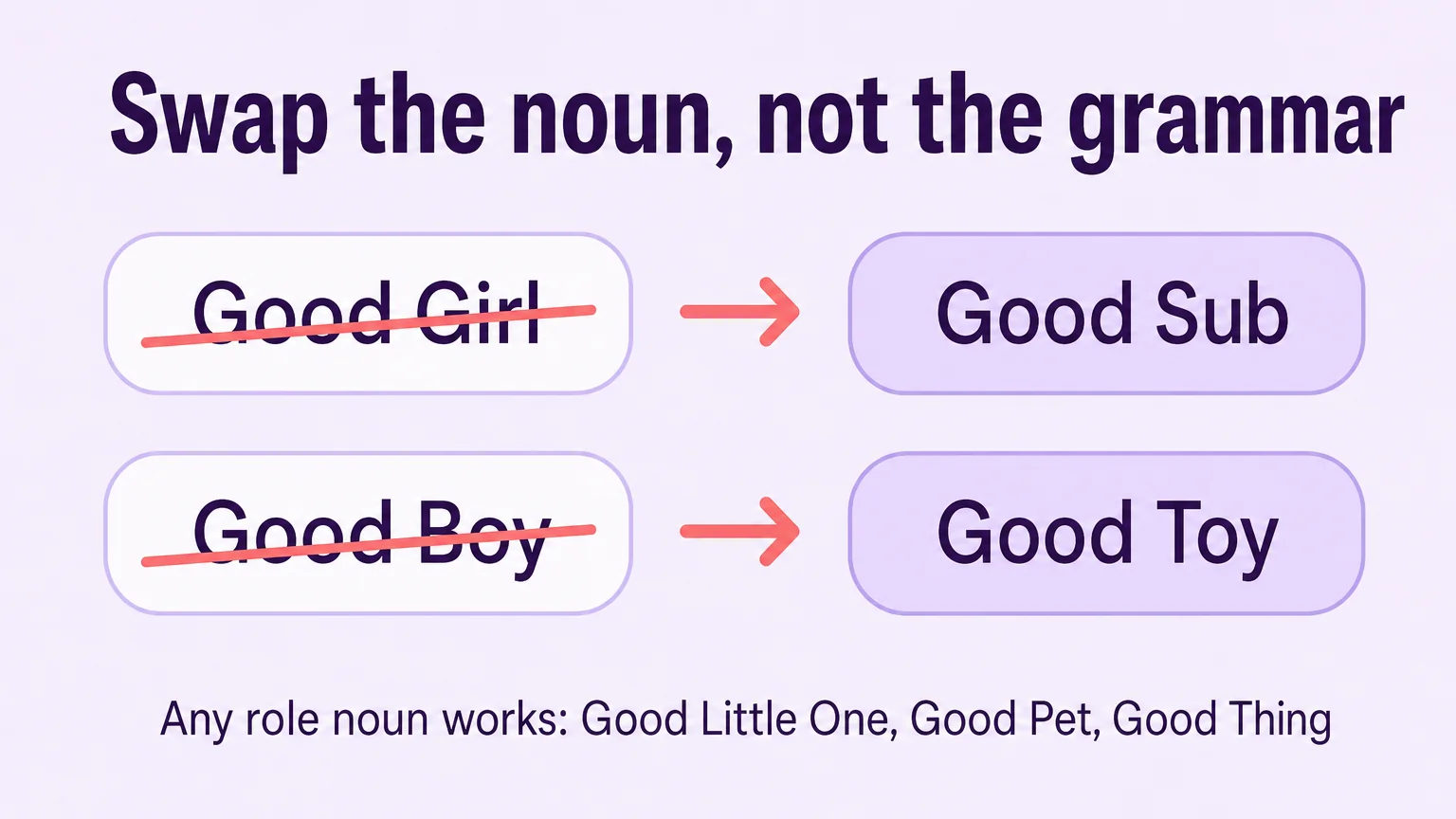
No neutral version of Good Girl or Good Boy sounds like anything, which is why gender-neutral submissive names swap the noun rather than neutralizing the grammar. Use a role noun, a personal noun the sub already owns, or a descriptor unique to them. Ask rather than assume: the gendering is often theirs to choose, including a term that contradicts their everyday gender.
- Good Sub – The plain role swap, and the cleanest neutral praise.
- Good Slave – The same move with a heavier noun.
- Good Little – Neutral without naming a gender, and dehumanising.
- Good Toy – Objectifying in origin, for subs who want that.
- Good Plaything – The same register, grouped with Good Toy.
- Good Thing – Neutral and a little reductive, which is the point.
- Good Bean – A personal noun, so it must already be the sub’s.
- Good Human – The same move, and it only works if already theirs.
- Good Zee – A personal noun, so it shows the pattern, not a name.
- Good Little Sassy Pants – A unique descriptor, and a pattern to copy.
- Good Lovely Anal Sub – The same move, and an example not a suggestion.
- My Love / My Sweet – Praise carried on tone alone, with no noun.
- Pretty / Soft / Delicate – A descriptor set rather than a name.
- Fairy – A nonhuman route that sidesteps gender, if claimed.
- Goblin – The same route, playful and neutral at once.
- Void-Creature – The strongest nonhuman route, and never assigned.
- Chaos Pixie – Nonhuman and chaotic, and it has to be theirs.
The gendered pair is in section 4, and agreeing a deliberately wrong name is covered in How to Choose a Submissive Name.
12. Borrowed Titles and Names From Another Language
Two mechanics travel with any borrowed submissive name. In some languages the grammar performs the subordination on its own, so a diminutive suffix on a small animal or a flower makes the word itself submissive. And borrowed titles come with provenance, so know what you are borrowing before you use it.
- Mi Amor – Spanish, romantic, and it survives being overheard by strangers.
- Amore – Italian, the same romantic register with a slightly grander sound.
- Mon Petit – French, and it works as a term of address whatever the gender.
- Kätzchen – German for kitten, and the -chen ending does the subordinating on its own.
- Häschen – German for bunny, formed the same way, same ending, same work.
- Röschen – German for little rose, and again the suffix is the mechanism.
- Blümchen – German for little flower, formed like the rest of the set.
- Fräulein – A dated German form of address with a slightly diminishing charge.
- Sub_von_xy – The submissive half of a paired handle, settled by who registered first.
- Kajira – The female singular, from John Norman’s Gor novels, adopted by a real community.
- Kajirae – The feminine plural, and novel-accurate practice has them using I and me freely, so it is not a second option for one person.
- Kajirus – The male singular, and the form most people get wrong.
- Kajiri – The plural for males or a mixed group, not the feminine plural.
- Lieutenant – A borrowed rank, common in service and protocol dynamics.
13. Names You Make Up: Private Stories, Scene Handles and Public Codes

Your own story beats the list every time, because specificity is what makes a name fit, and that is where the best submissive names come from. A scene name is the handle you use at munches and on kink platforms, so your legal identity stays out of it. It travels to 3Fun too, where the profile does the introducing. A public-safe code is the substitute you agree in advance for when the wrong person is listening. A handle should suggest the role rather than claim the title.
- Smashochist – A handle that passes the test: it shortens to Smash.
- SensualAva – A plain scene name that gives nothing away.
- A Hand Squeeze – A non-verbal signal, for when speech is not safe.
- Deliberate Silence – One couple’s strongest warning is the Dominant’s silence.
- Fruit Safe-Word Callback – A food word doubling as the safe word.
- His Real Name, Said Flatly – The Dominant’s real name in public, as a brat move.
- ThickDickSir909 – The anti-pattern. A title in your handle forces strangers to use it.
- Starbuck – One sub’s scene name, carried alongside Lieutenant, Kitten and Doll.
- Phantom – Elusive and unowned, and it sits nearer the switch register than the submissive one.
- Zephyr – Adjacent rather than submissive: it comes from a switch register.
Slips happen, and the recovery is agreed in advance rather than improvised.
FAQ
What is a good name for a sub?
It depends on how you want them to feel when you say it: cherished, demeaned, close, or beneath you. You pick the name from that feeling rather than from a ranking. The low-risk defaults are pet, good girl, good boy, little one and kitten. Sections 4 and 5 have the full sets.
What are some sub names to start with?
Pet, kitten, puppy, bunny, little one, princess, babygirl, doll, toy, brat, darling, angel, property, slave. The category matters more than the individual item, because the same word lands completely differently depending on the dynamic. The section map in the intro is the fastest way to find the register you want.
Who picks the name, the Dom or the sub?
Roughly half of first-person accounts say the Dominant picked. Several say it emerged over time, a few chose it themselves, and almost nobody ran a formal process. The practical version: the sub does not need to choose, but they need a veto, and the ones they like should be visible to the Dominant. How to Choose a Submissive Name covers the mechanics.
How do we test a name before we commit?
Have the Dominant say the candidates out loud, ideally during a session. That is when people learn instantly which ones are wrong. Several weeks of experimenting is normal, so treat the first list as a draft rather than a decision. How to Choose a Submissive Name has the rest.
Can we use names like slut or whore affectionately?
Yes, and in many dynamics they are affectionate rather than harsh. They still have to be agreed word by word and scoped to scenes, and they are not try-it-and-adjust the way a sweet name is. The sub should volunteer the boundary rather than the Dominant proposing slurs one at a time. Section 9 covers the register, and in a multi-partner dynamic that conversation usually extends to which terms are a couple’s own rather than shareable.
What if a name stops working?
Changeability is normal and worth pre-agreeing, so raising it is not an insult. Separate the two causes: the name is contaminated by an association, usually an ex or a bad memory, or it never fitted in the first place. A change in the dynamic, such as a shift into a caregiver register, usually needs new words. How to Choose a Submissive Name covers the reset.
What if we cannot agree on anything?
A sub does not need a special name. Their own name, an inside joke, or an ordinary sweet name all work, and the dynamic does not run on vocabulary. Sections 1 and 13 cover both ends of that, the everyday names and the ones you invent.
Should I put a name or honorific in my profile or my scene handle?
No on the honorific. Claiming a title in your own handle forces strangers to use one they never negotiated. A handle that suggests the role is the better answer, and it should survive being shortened and shouted across a room. Section 13 has the test and the examples. On a profile instead of a handle, 3Fun has an About Us field for saying it in your own words.