Curiosity about power in the bedroom rarely announces itself politely. It shows up as a half-remembered scene, a partner’s offhand comment, or a quiet thought you’ve never said out loud. If sensual domination has crossed your mind, you’re in good company: if you’ve ever tied a scarf over your partner’s eyes, whispered “not yet” to hold them on the edge, or felt a shiver at being told exactly what to do, you’ve already practiced a version of it. It’s a softer, pleasure-first style of power exchange built on praise, anticipation, and reward rather than pain or punishment.
This guide walks you and your partner from the first conversation to your first scene, at your own pace, with zero judgment. Either of you can lead, and the roles can swap as often as you like. By the end you’ll know what it is, why wanting it is completely normal, how to bring it up without the awkwardness, what a first scene looks like, and how to take care of each other after.
What Sensual Domination Actually Is
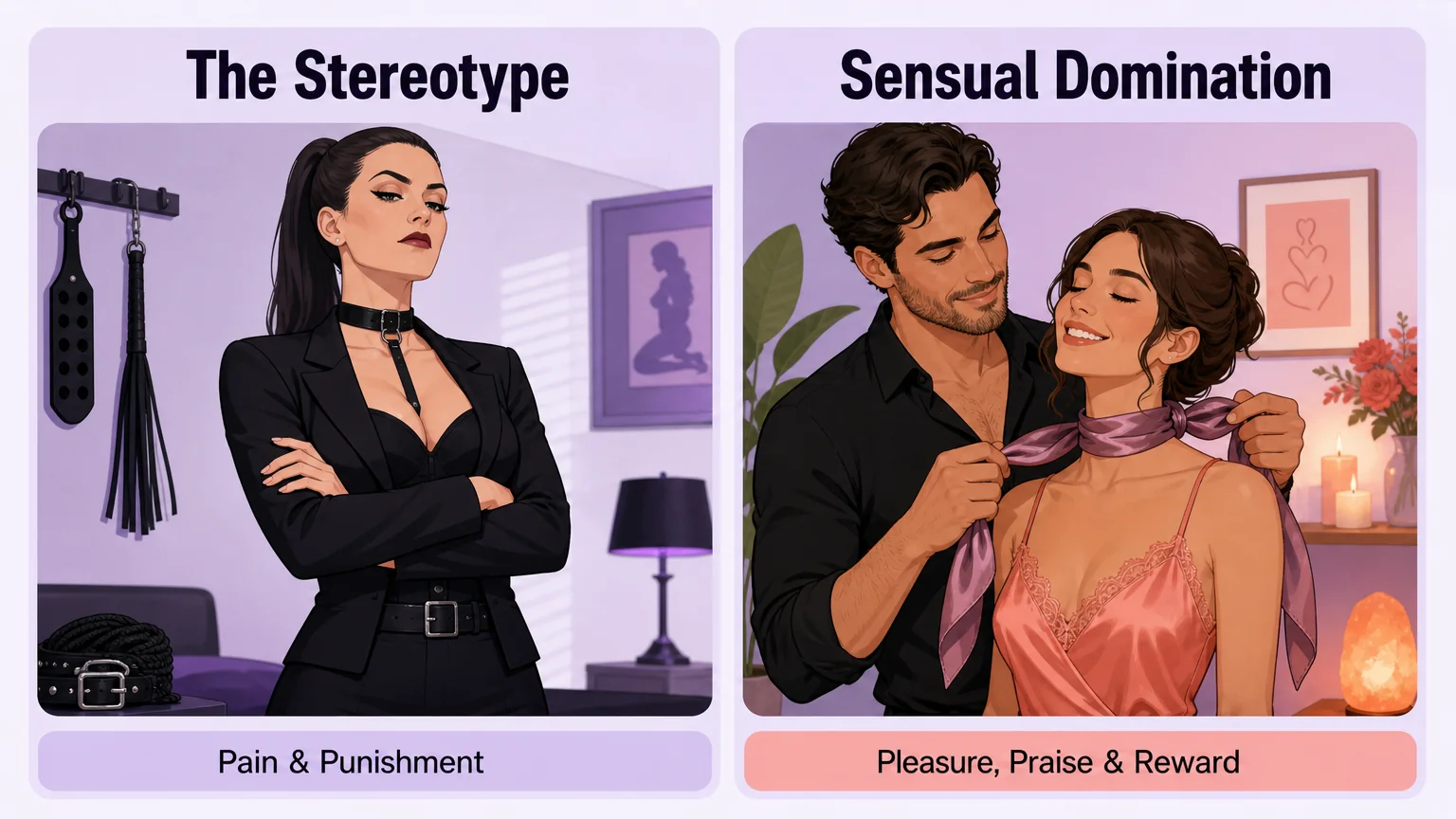
Here’s the reveal that surprises most beginners: you’ve probably already done this. A blindfold during intimacy. Letting one partner set the pace. Saying “wait” when you don’t really want them to stop. That’s sensual domination in its mildest form, and the mechanics are already in your hands. What turns it from a happy accident into a practice is intention.
Sensual domination is a softer style of power play that runs on pleasure, praise, and reward. Where harder BDSM often centers on intensity, discipline, or humiliation, this version trades those for heightened sensation and a gentle hand on the wheel. Pain is optional, and it isn’t the point here. It sits on a continuum that runs from biting a lover to something far more intense, and much of sensual domination involves no physical intensity at all.
The power is more psychological than physical, held in attention rather than force. It’s the difference between commanding and coaxing, between control that demands and control that invites.
The engine is tease and anticipation. Control arrives through lingering strokes that stop just shy of where your partner wants you, through whispered commands, and through pauses that let arousal climb until the next sensation lands harder than the one before. Delaying gratification is the whole trick. It turns a touch into a promise, and a promise into a reason to stay fully present.
That’s why a feather can out-arouse a grip, and a whispered instruction lands louder than a shout.
Here’s what a praise-anchored moment feels like before you spend a cent. Your partner’s eyes are covered and the room goes quiet. You lean in and say, “You’ve been so good. You deserve to be rewarded,” as the blindfold settles.
No pain, no performance, no script. Just attention, control, and the pleasure of watching pleasure build. That moment, and a thousand like it, is sensual domination.
Is Sensual Domination Normal? The Science Says Yes
Let’s answer the question you’re too polite to ask out loud: am I weird for wanting this? No. And the research is happy to back you up.
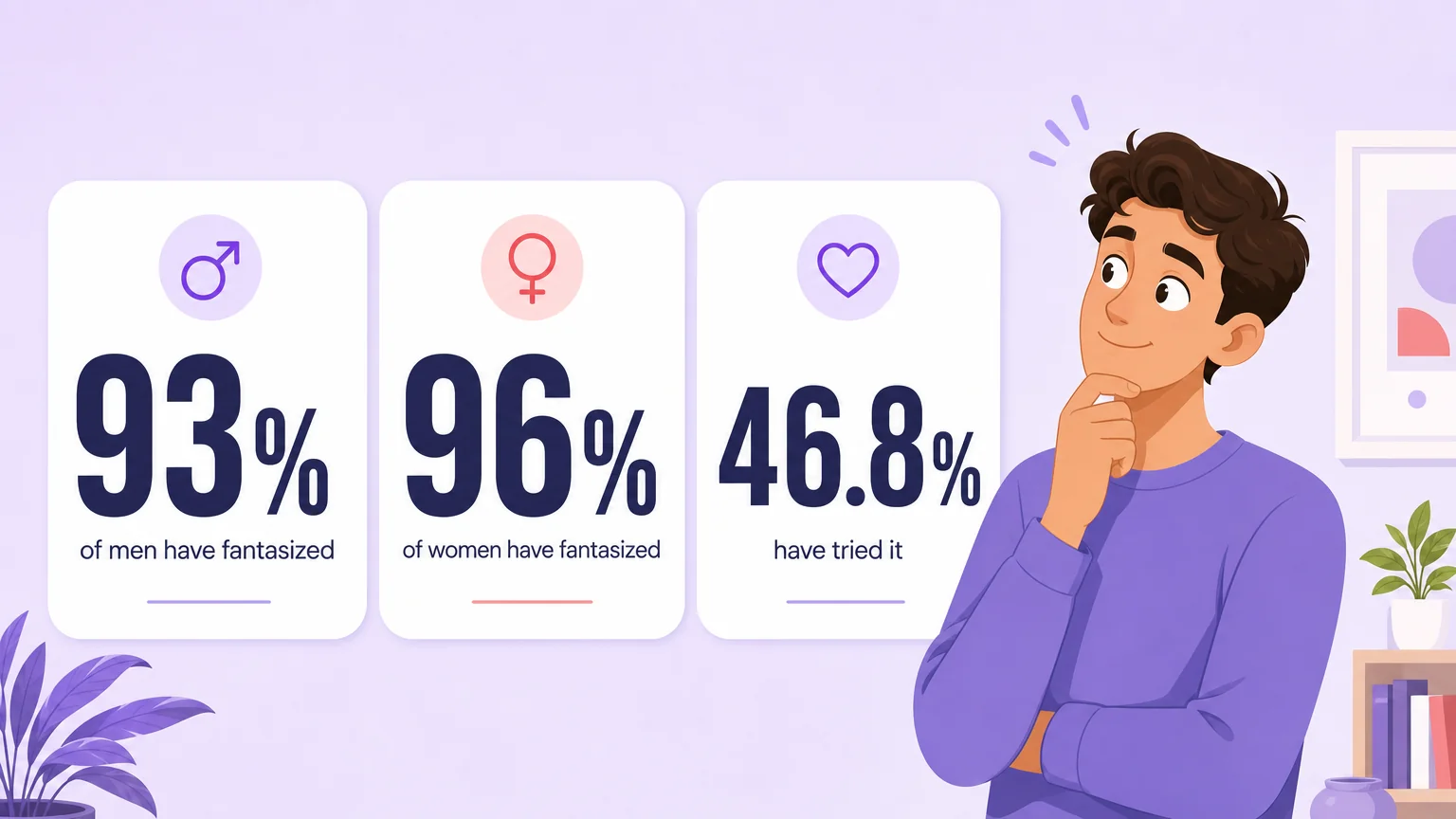
In a US study of 4,175 adults, BDSM was the most common sexual fantasy. Ninety-three percent of men and 96% of women had fantasized about it at least once. Fantasy isn’t practice, but practice is common too. A representative population study in Belgium found that 46.8% of people had performed at least one BDSM-related activity, and 12.5% did so regularly.
Across a broader review of the research, kink-related fantasies showed up in 40 to 70% of both men and women. Whatever your version of this interest looks like, other people are already living it.
The well-being picture is the part most people don’t expect. A Dutch study of 902 SM practitioners found them less neurotic, more open, more securely attached, and scoring higher on both emotional and physical well-being than people who don’t practice.
Across studies, kink correlates with better mental health, not worse. Practitioners aren’t running from something. They’re running toward something.
The psychology explains why. Submission is a chosen surrender inside clearly negotiated boundaries, and the submissive often takes as much or more from the scene than the dominant. For a lot of people, it’s a relief from constant decision-making, a way to feel deeply held and seen because the boundaries are explicit and respected.
In a culture that asks us to be in control all day, surrendering control for an hour, inside boundaries we set ourselves, can feel like the rarest kind of rest. The state people describe during intense play, sub-space, resembles meditation: elevated concentration, reduced mental chatter, full presence in the moment.
So the feeling you’re carrying is common and well-documented, a normal part of how human desire works. You can trust it.
Sensual Domination Myths: No, It Isn’t About Pain
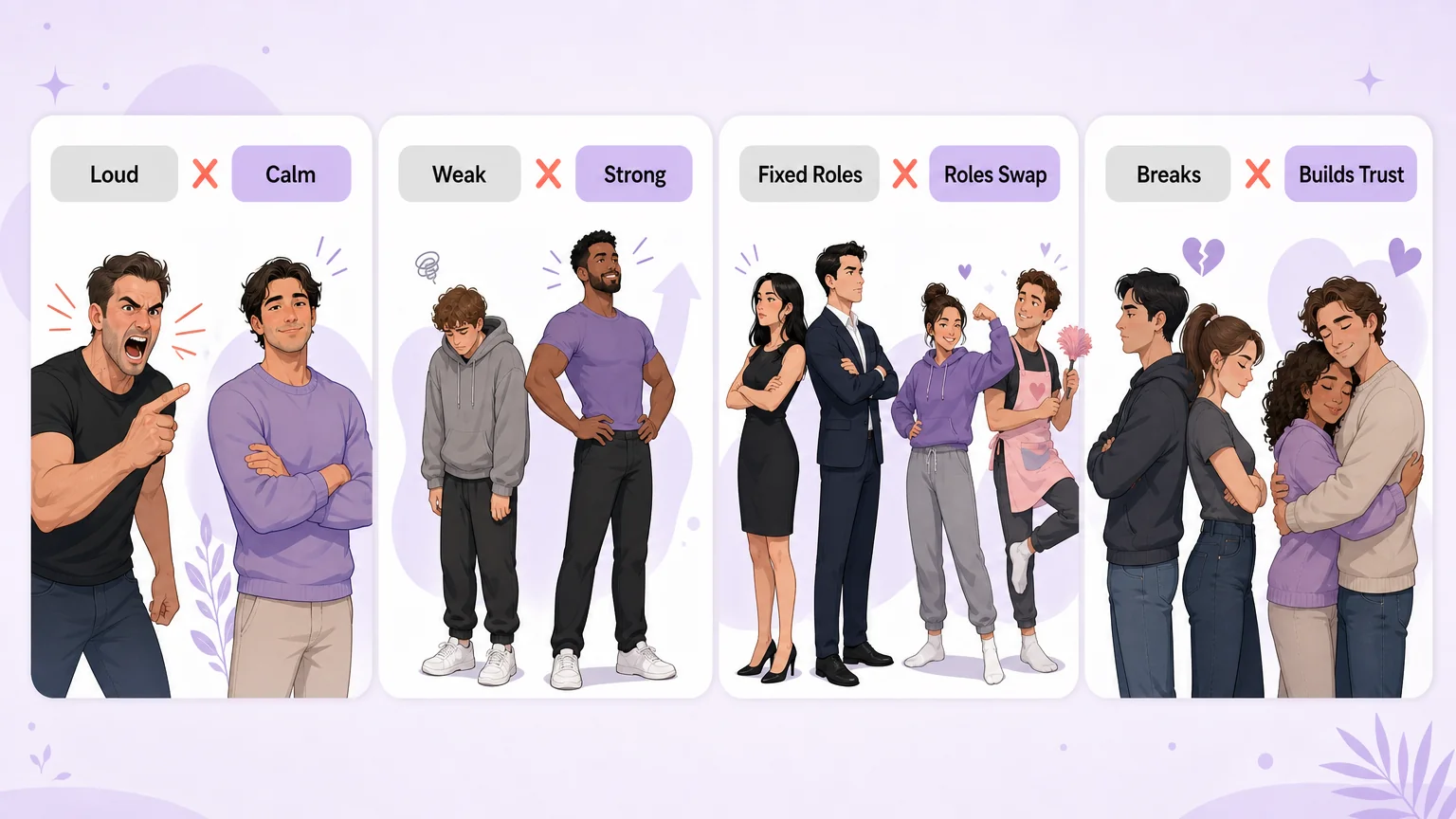
Most beginners don’t get stopped by lack of interest. They get stopped by four quiet fears. Let’s name them, because once they’re named, they mostly dissolve.
Fear one: domination has to be loud and harsh. It doesn’t. One experienced dominant was once told he “wasn’t Dom enough” for refusing to be an asshole.
Practitioners who do this for a living describe something closer to a calm authority that settles over you gradually, a quiet pressure, a slow burn. That loud brand is meant to be in your face, but it isn’t the only brand. Sensual, nurturing, quiet, addictive power and control are just as real. Physical stimulation runs on a continuum, and much of sensual domination involves no physical intensity at all.
Fear two: wanting to submit means you’re weak. It’s the opposite. Submission is a chosen surrender inside boundaries you negotiated, and the person bottoming often steers the scene more than the person topping.
Sexologist Amanda Pasciucco puts it bluntly: a boundary without a consequence is just a complaint. Holding your own line mid-scene, when it would be far easier to let it slide, takes real strength. Power exchange is not the same thing as powerlessness.
Fear three: only men dominate, and only women submit. False. In one sample, just 16% of people were exclusively dominant or submissive.
The vast majority switch, and research describes BDSM roles as effectively de-gendered. In many circles the man is the submissive and the woman leads. Either of you can take either role, and the roles can swap as often as the mood does.
Fear four: trying this will damage the relationship. A scene has a clear container: a negotiated start, an agreed end, and a return to equals afterward. The emotional drop some people feel after play is a normal physiological event, not evidence that something is broken.
Couples who explore this report closer connection and sharper communication, not cracks in the foundation. The negotiation skills this practice demands tend to make everything else in the relationship easier, not harder. You’ll know the difference between a container and a crack quickly, because a container always has a door.
How to Bring Up Sensual Domination With Your Partner

The hard part of sensual domination isn’t the scene. It’s saying the words. Your mouth goes dry and you’re convinced one wrong sentence will make your partner look at you like a stranger. You’re not wrong that it’s a big conversation. You’re wrong that there’s no script. There is, and it’s short.
Beat one: set up the moment. Choose a calm, private, non-sexual time. Cooking, a walk, the couch. Give a heads-up first, so the conversation doesn’t ambush them.
Open with curiosity and vulnerability, not an announcement: “Can I run something by you? I’ve been thinking about something I might be curious to try.” Name the feeling underneath, not just the mechanics: “I think I’m curious what it would feel like to give up control a bit.” Use I-statements. Frame it as shared exploration for both of you, not a fix for you.
Invite, don’t announce. Tell them they don’t have to answer right now. Then ask about their interests too, because they may have a kink of their own waiting in the wings.
Beat two: make it concrete without the vocabulary pressure. Nobody wants to fumble for words at the kitchen table. A Yes/No/Maybe list lets both of you say yes, hard no, or “I like this, but with a change” without inventing language. Sharing an article or a scene description works the same way, a bridge you both walk across.
Start low-stakes before any scene. The point is to begin somewhere small and build, not to launch into a full scene on night one. Expect a little awkwardness, and let humor carry it. One honest “okay, that sounded way more intense than I meant it to” does more than a paragraph of careful apology.
Beat three: the open-relationship layer. If you’re in an open or non-monogamous setup, this conversation often involves more than two people, so talk through how kink fits alongside your other connections.
Here’s the good news: the skills you already use in ethical non-monogamy, open and judgment-free communication, explicit agreements, harm reduction, are exactly the skills kink runs on. Yes/No/Maybe lists work in multi-partner contexts too. You’ve already built the muscle.
If that conversation opens a door you both want to walk through with others, the next step is finding people who actually want the same thing. 3Fun is a space built for that: couples and open-minded singles, meeting people who share their interests, on their own terms.
And what if they say no? A no is valid. Kink is a spectrum, not an identity, and this isn’t a test you pass or fail. Reassure them their boundary matters as much as yours, and don’t pressure or re-litigate. The goal is alignment, and you can still get there together.
Sensual Domination for Beginners: Your Starter Toolkit
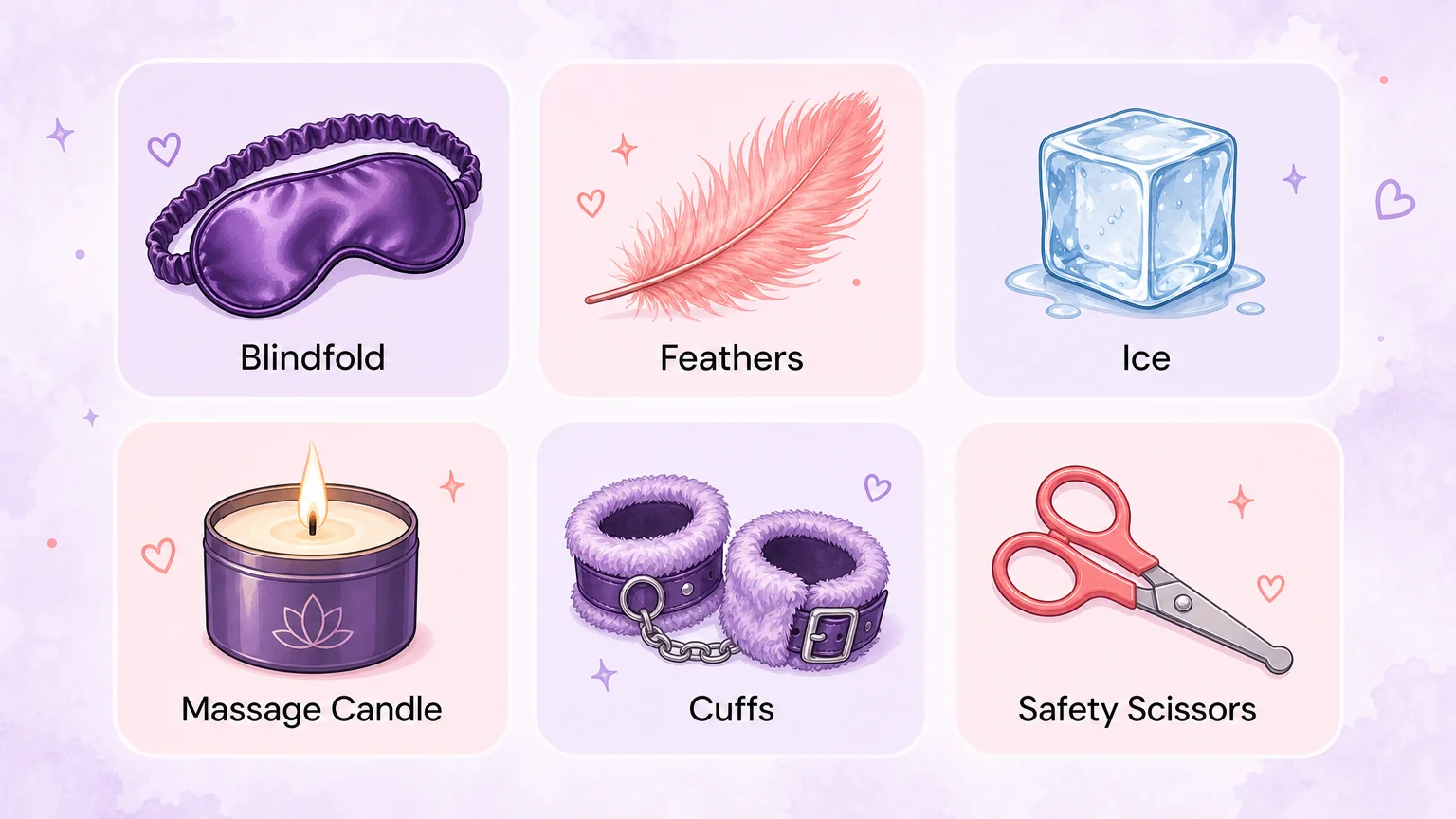
You don’t need a dungeon to begin. Five everyday tools plus one non-negotiable safety item are the entire sensual domination starter kit, and you can assemble it tonight.
Blindfold. The easiest entry point into the whole practice, and the tool most likely to stay in the rotation. Removing sight heightens anticipation and sharpens every other sense. Keep removal easy, and keep sessions short if disorientation hits.
Feathers or textured tools. The safest, gentlest option in the kit, and perfect for the slow linger strokes that build anticipation. You can’t get this wrong. Save intensity for later; this is about the tease.
Ice. Cheap, instantly available, and the closest thing to a free starter move. It’s an effortless tease-and-edge sensation. Keep it moving, never hold prolonged contact on one spot, and have towels handy for the melt.
Massage candle. A low-temperature soy or paraffin candle melts into warm oil. Test it on your wrist or inner forearm first, and drip from six to eight inches above the skin, where it lands cooler. Never use household or beeswax candles, and keep wax off the face, eyes, hair, and genitals. Check for a soy allergy before you buy.
Light restraints. Choose fuzzy cuffs over rope for a first time. They release easily and forgive beginner mistakes. Never tighten over joints or nerves, never leave a restrained partner unattended, and agree on a nonverbal safeword, three taps, before you start.
And the one item you never skip: safety scissors or EMS shears within arm’s reach at all times. They cut rope, cuffs, or fabric in an instant, and they’re useless if they’re in another room.
What not to buy: household candles, anything that cuts off circulation, and restraints without a quick release. If a tool can’t come off fast, it doesn’t belong in your first scene. That’s the whole kit. Grab what fits your comfort, and leave the rest for later.
Your First Sensual Domination Scene, Step by Step
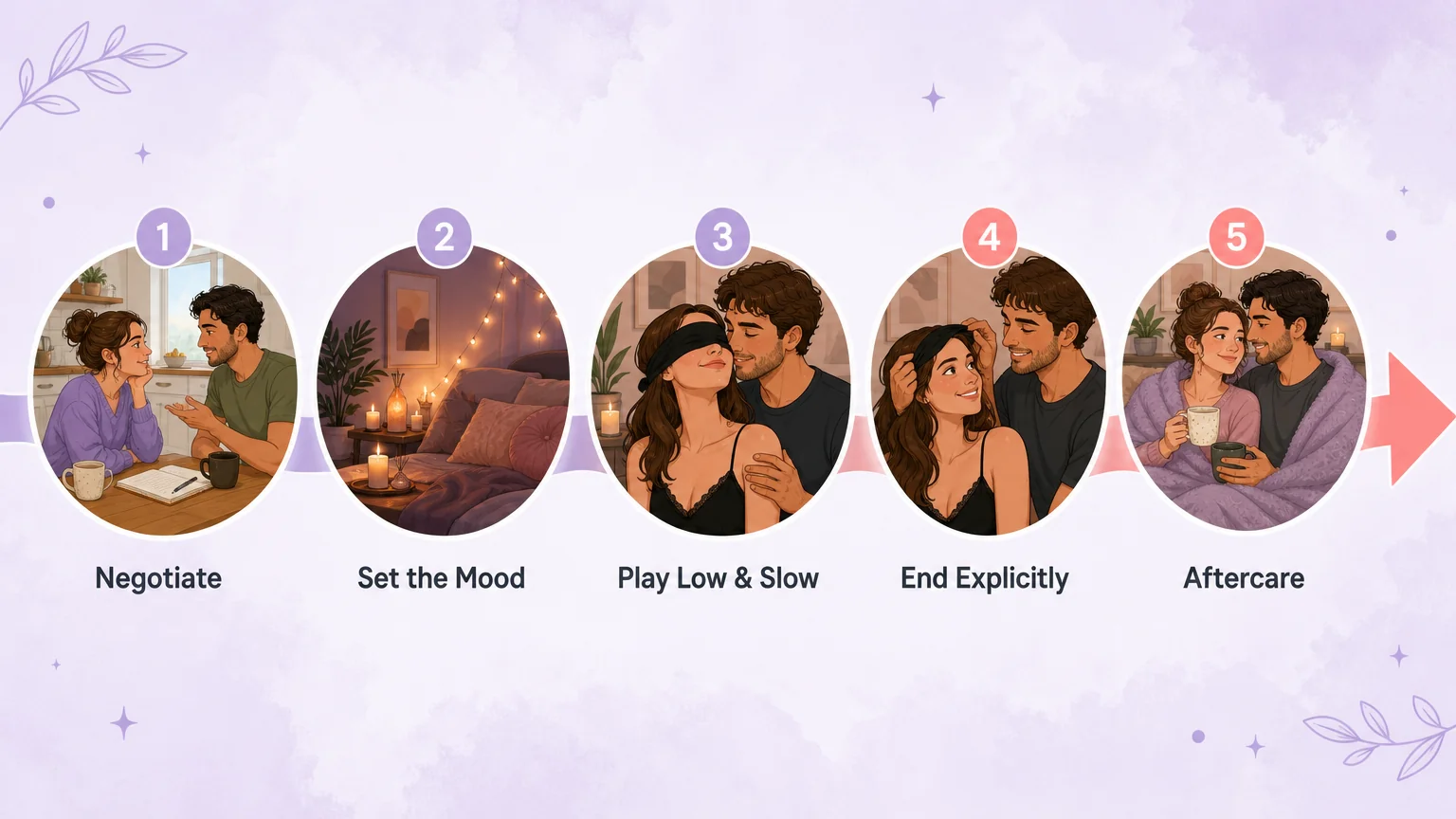
You don’t need to be good at this to have a first scene. You need structure. Structure is what makes a scene feel safe and satisfying, and it’s something anyone can follow. Five beats, and even a thirty-minute first try can feel complete.
Beat one: negotiate. Before any touch, agree on the goal, what you each want, hard and soft limits, which tools you’ll use, whether sex is on the table, safewords, health triggers, and aftercare needs. It sounds like a meeting. It plays like foreplay.
Negotiation is one of the sexiest parts of kink because it’s the moment you both say what you want out loud. If a third or additional partner is in the room, negotiation extends to everyone. Agreement among all is the rule.
Beat two: set the mood. Dim the lights, queue music, put every implement within reach so nothing gets hunted for mid-scene. A prepared space keeps you in the dynamic instead of rummaging through a drawer, and it tells your partner this matters enough to be done properly.
Beat three: play low and slow. For sensual domination, pacing is everything. Open with a small ritual or the blindfold to establish the dynamic, then weave in in-scene check-ins: “Do you like that? Tell me how it feels.” Use the tease-and-edge rhythm, lingering strokes just shy of erogenous zones, whispered commands, pauses that let the next touch land harder.
Beat four: end explicitly. Drop the intensity on purpose, take the cuffs off, and close the container. A scene that fizzles out feels unfinished. A scene that ends on purpose feels complete, and both of you get to carry that finish line home.
Beat five: aftercare. Water, snacks, blankets, gentle touch, verbal reassurance. It matters so much it has its own section below, so we won’t shortchange it here.
A borrowed example: Bondassage. The receiver is gently restrained and blindfolded while the giver alternates massage strokes with feathers, ice, and varied textures, then closes with praise and aftercare. It’s a complete first scene with a clear start and finish.
Agree on your safewords before you begin. Green means keep going, yellow means slow down and check in, red means stop everything and move to aftercare. Add a nonverbal tap, three times, for when speech isn’t available.
Praise Kink: The Heart of Sensual Domination

Strip away the tools and the lighting, and sensual domination runs on one engine: praise. A praise kink is when verbal affirmation during intimacy feels erotically charged, not merely nice. It’s the difference between hearing that you look nice and feeling your skin heat up at it. And it’s one of the simplest kinks in existence to explore, which makes it the safest first step on this whole journey.
Praise is processed through the brain’s dopamine reward-and-motivation circuitry. When your partner hears “that’s so good,” the brain reads it as a reward stimulus, and that surge heightens arousal, focus, and emotional bonding, with oxytocin running through the social-bonding circuit.
It’s not that you want a compliment. It’s that the compliment rewires the moment.
The trick is that it works for the giver too. Giving praise produces its own dopamine and oxytocin hit, and for people who never saw safe examples of power growing up, holding a partner’s pleasure can make power feel safe and cathartic instead of cold. Power becomes rewarding power. That’s why praise kink strengthens both partners, not just the one receiving it.
The hunger behind it is ordinary. Kink educator Alla Mephistopheles points out that a lot of men don’t get enough compliments, and that the male fear at the bottom of much of this is being ignored and forgotten. Praise is being seen, and being seen is the whole game.
Practice it with a few small rules. Praise from a place of truth, because inauthentic praise doesn’t land. Pair the words with touch on the part you’re complimenting.
Use it at every stage, foreplay through aftercare. Time it strategically near orgasm. Bring it outside the bedroom.
A text from another room, “I can’t stop thinking about how good you look today,” is the lowest-stakes start in the whole practice, and the best rehearsal for everything else.
Aftercare Basics: The Step Beginners Shouldn’t Skip

You’ve probably already had this scene without knowing it. The play was great. Then, an hour later or the next day, one of you goes quiet, or tearful, or inexplicably hollow, and you both wonder what just went wrong.
Nothing went wrong. That’s the drop, and it’s a chemical event, not a relationship problem.
An intense scene floods the body with adrenaline, cortisol, endorphins, oxytocin, and dopamine, a cocktail comparable to a runner’s high. Without aftercare, that shift down can feel like a crash. With it, it feels like a landing.
Sub drop can look like tearfulness, anxiety, sudden fatigue, or quiet sadness, arriving immediately or a day or two later. Dom drop is the underreported twin: deflated confidence, second-guessing, guilt, usually two to three days out. The dominant needs care too, even when the scene was gentle, and often before they know to ask for it.
The checklist has four parts. Physical: water, food for low blood sugar, blankets, a shower, gear removal, wound care if anything got scraped. Emotional: talk, reassure, reinforce that they did a good job. Sensory: low-stimulation touch, quiet, temperature control. Practical: an aftercare kit with first aid, lotion, water, and snacks.
Timing matters. Revert to equals within a few hours, first names, normal voice, no lingering role. Then schedule a 24 to 72 hour check-in, because drop is often delayed and needs a second pass.
And the scripts. For the sub: “You did great. I’m here with you.” For dom drop: “You’re not a bad person. I’m okay. I enjoyed it.” Needs are individual, some people want touch, others need space, and quality beats the checkbox: holding someone while you dissect your phone is aftercare in name only.
Nearly 46% of women report post-sex tearfulness or anxiety after ordinary intimacy. Aftercare isn’t a kink-only skill. Every couple should own it before the scene ever starts, because it’s how you take care of each other after any closeness. Whether it’s a thirty-minute scene or a quiet morning after regular sex, the landing is what makes the flight worth taking.
Sensual Domination FAQ: Your Questions, Answered
Straight answers to the questions that come up most when sensual domination is new to a relationship.
Is sensual domination the same as BDSM pain play?
No. Sensual domination is the pleasure side of power play, built on praise, reward, and anticipation rather than pain or humiliation. Pain is optional and sits on a continuum. Much of sensual domination involves no physical intensity at all, and that’s the point.
Am I weird for wanting to be dominated?
No. In a US study of 4,175 adults, BDSM was the most common sexual fantasy, with 93% of men and 96% of women reporting it at least once. A separate population sample found 46.8% had performed a BDSM-related activity. This is common desire, not a quirk.
Do we really need a safeword for a gentle scene?
Yes. Even gentle play can hit a trigger. Green means keep going, yellow means slow down and check in, red means stop everything and start aftercare. Add a nonverbal tap, three times, for when speech isn’t easy. A small habit that protects a big trust.
What if my partner says no?
Respect it. A no is valid, and kink is a spectrum rather than an all-or-nothing identity. Reassure them their boundary matters as much as yours, and don’t pressure or re-litigate. The goal is alignment, and a no today can become a maybe later.
Do we need aftercare if the scene was light?
Aftercare needs track the person, not the scene’s intensity. Some people need it even after mild play, and nearly half of women report post-sex tearfulness or anxiety after ordinary intimacy. Water, a few words of reassurance, and a gentle landing are never wasted.