The hardest part of learning how to find a dom is rarely the search itself. It’s the quiet fear underneath it: the search seems to offer two endings, staying alone or getting taken advantage of by someone who calls himself a dominant and is just collecting targets.
Neither ending has to be yours. In a 2013 study of 902 BDSM practitioners, they reported higher subjective well-being than people outside the lifestyle. A 2018 study of committed BDSM couples found their relationship-distress scores matched vanilla couples. The lifestyle was never the risk, and neither was your desire. An unvetted partner is.
There is no magic app that hands you a compatible Dominant, and anyone promising one is selling something. But the community has a repeatable route, and you can walk it in seven steps, each one handing you the next tool: know what you want, pick your channels, write a profile, vet every candidate, read the flags, meet safely, and negotiate the dynamic.
One principle threads through all of it, and you will meet it in every step: meet people as people first, and the right dom appears on the other side of that work.
Step 1: Know What You Want Before You Start Looking
If you are wondering how to find a dom and coming up empty, the problem is probably not the search. It is the missing tool that every other step in this guide depends on: your limits list.
Start in the counterintuitive place. What you want is not a giant catalog of activities. It is an emotional tone. Ask yourself which mood you’re after before you name any act: sensual, intense, playful, or strict. A dynamic that feels like a slow, worshipful evening is a different search than one built on sharp, demanding scenes. The mood decides the acts, not the other way around, and only you can name it. Get the tone clear first, and everything downstream gets easier.
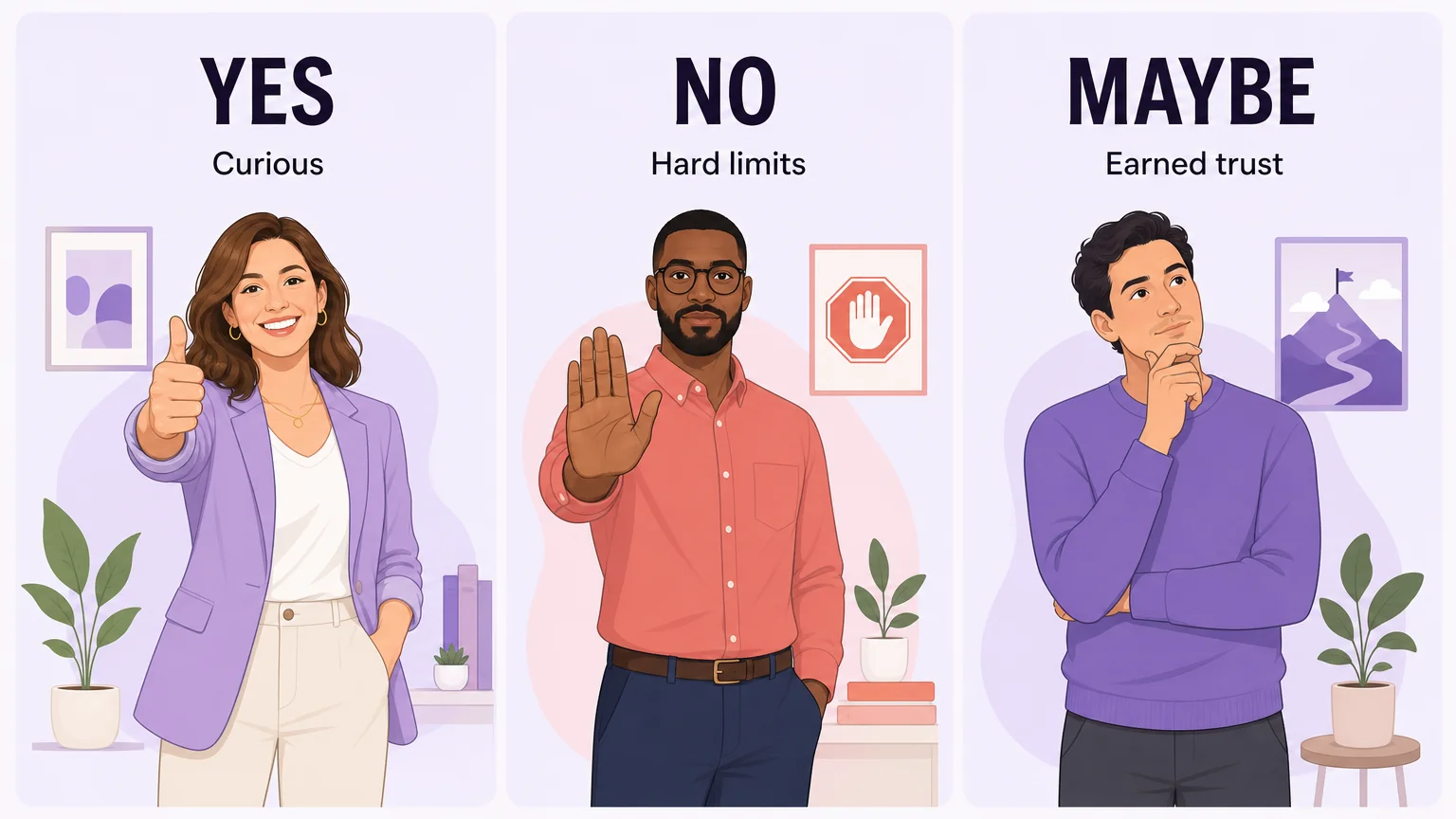
Now build your list as a living document with three columns. YES for what you’re curious about. NO for hard limits. MAYBE for things you’d only revisit with earned trust. Write beyond activities, too: health and STI status, triggers, medications, pain tolerance, aftercare needs, and how you want intimacy handled. Update the list as you learn. It is meant to change with you, not to pin you in place.
Here is the part most new submissives need to hear: saying no does not make you less submissive. Your NO column is the safety tool that lets you actually let go. Many beginners confuse endurance with strength and tolerate harm because they never realized a boundary was even an option. That confusion is exactly what this list protects against.
By now you have a working YES / NO / MAYBE list, and you can answer one sentence: what you are looking for, and what you will not compromise on.
Step 2: Choose Your Channels: Where Real Doms Actually Are
Your goal here is a shortlist of two channels: one community channel for learning and one app channel for seeking.
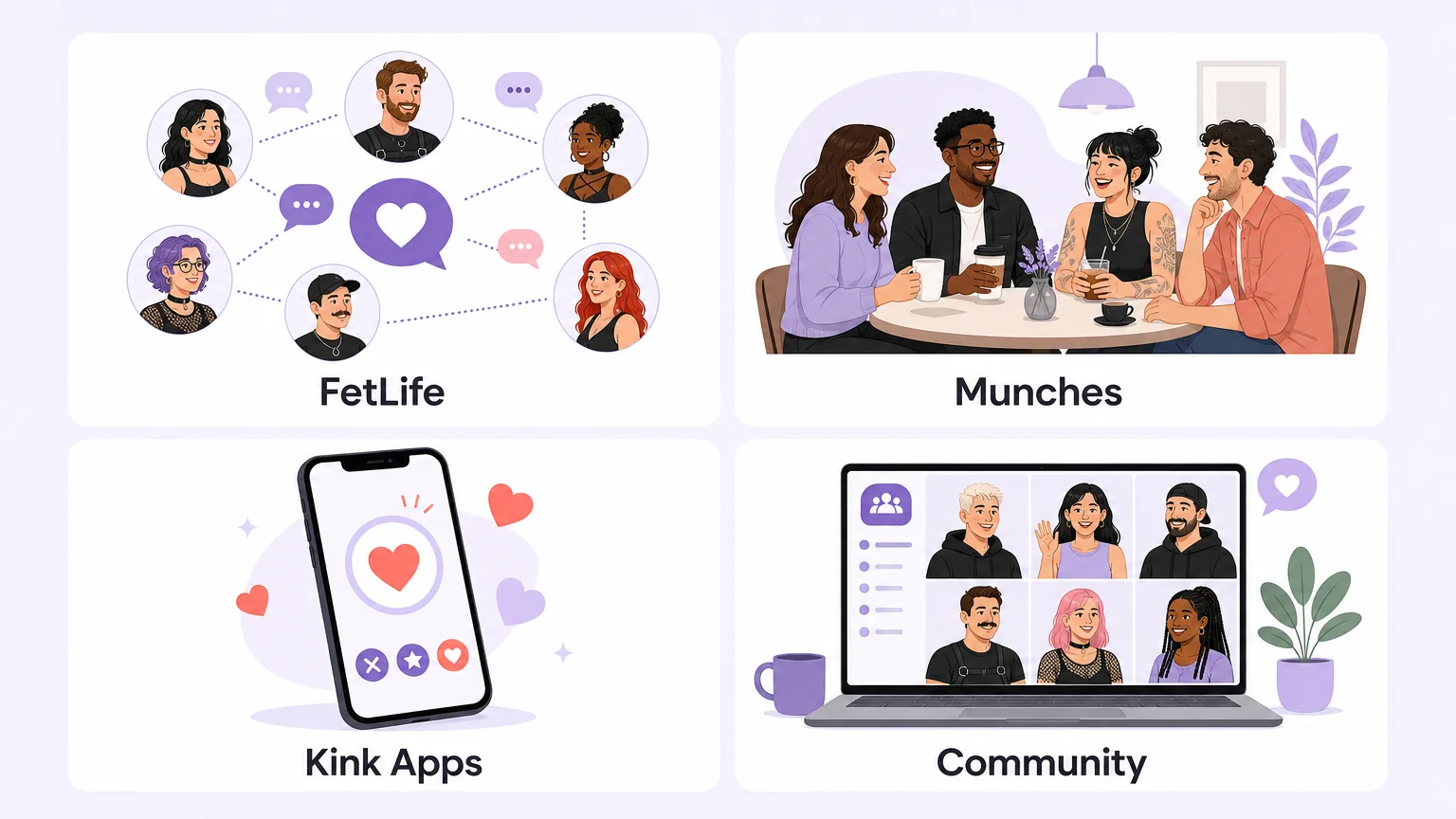
There is no magic app, but there are five real channels, and each one is for a different job. For anyone learning how to find a dom, match the channel to what you want and you skip weeks of wasted swiping.
FetLife is the community basecamp. It is free, with more than three million users, and it is the default place to find local groups, munches, and educators. It is not built for dating, which means lower pressure but a slower path to a partner. Spend your first weeks reading groups and attending events before you message anyone. The profile history, group activity, and event attendance there do part of your vetting for you.
Munches are the in-person on-ramp: public, nonsexual gatherings at a cafe, restaurant, or bar where you pay your own tab and dress casual to business-casual. Newbie munches welcome beginners, and TNG munches are for the under-35 crowd. No play, no toys, no fetish wear. People arrive over the first half hour, chat, and leave when they finish talking, and everyone is there to connect, not to perform.
Kink-friendly apps are for direct seeking. 3Fun is the lifestyle option: an app built for couples and open-minded singles exploring ethical non-monogamy, where privacy is engineered in from the start and you can name your dynamic without the side-eye. KinkD stands out for photo verification that cuts down catfish. OkCupid works if you live somewhere smaller and want a big pool to filter. The mainstream pool means you filter more, but it also means a genuine match is likelier to live near you. Skip Whiplr for now: the free tier is tightly capped and recent reviews flag a dated interface and a small user base.
Moderated Discords and local community pages are age-verified online spaces where you can start talking to people before any in-person step.
Two rules save you time. Play parties and dungeons come later, once you have community trust. And professional doms, including findom, are a paid service, a different search entirely from finding a lifestyle partner.
By now you have shortlisted one community channel and one app channel, and you can say why each one fits you.
Step 3: Write a Profile That Attracts the Right Dom

Your goal: a profile that does the first round of screening before a single message arrives.
The single biggest mistake in learning how to find a dom is a bio that reads “sub looking for dom.” It is an invitation to the wrong people. Predators scan for exactly that label and jump into DMs giving orders before they have even asked your last name. Healthy doms want to know you as a person first, and a label-first profile tells them you are not ready to be seen.
Build it in this order. Lead with who you are: your interests, your values, your life outside kink, so a dom reads a person, not a vacancy. Focus on what you offer rather than what you demand. State specific, honest preferences and hard limits, and never write the words “no limits,” which reads as a red flag to experienced doms.
Signal without broadcasting. Recognized shorthand like FLR, “left of the slash,” or “kink-friendly” reaches doms who know the vocabulary without spelling out every detail to everyone who scrolls by. Experienced doms use the same shorthand, so it acts as a filter in both directions.
Then the practical passes. At least two clear, recent photos, no blur, no heavy filters, no group shots that hide you. Pick one that shows your face clearly, and one that shows your life, your hobby, your dog. Clean spelling, because grammar signals effort and stability.
One more reason to polish it: dominant women receive a flood of lazy one-liners and “let me serve you” openers every day. A thoughtful, whole-person profile gets noticed immediately, and it makes the effort feel worth it. It is the difference between being seen and being scanned.
A profile like this is exactly what 3Fun is built for: a space where the whole person, limits and all, is the point, and the right people can find you.
By now your profile shows the whole person and the shape of what you want, in a way that makes fakes self-deselect before they ever message.
Step 4: Vet Every Candidate: The Questions to Ask a Dom
Your goal: run a complete vetting conversation before you meet anyone in person.
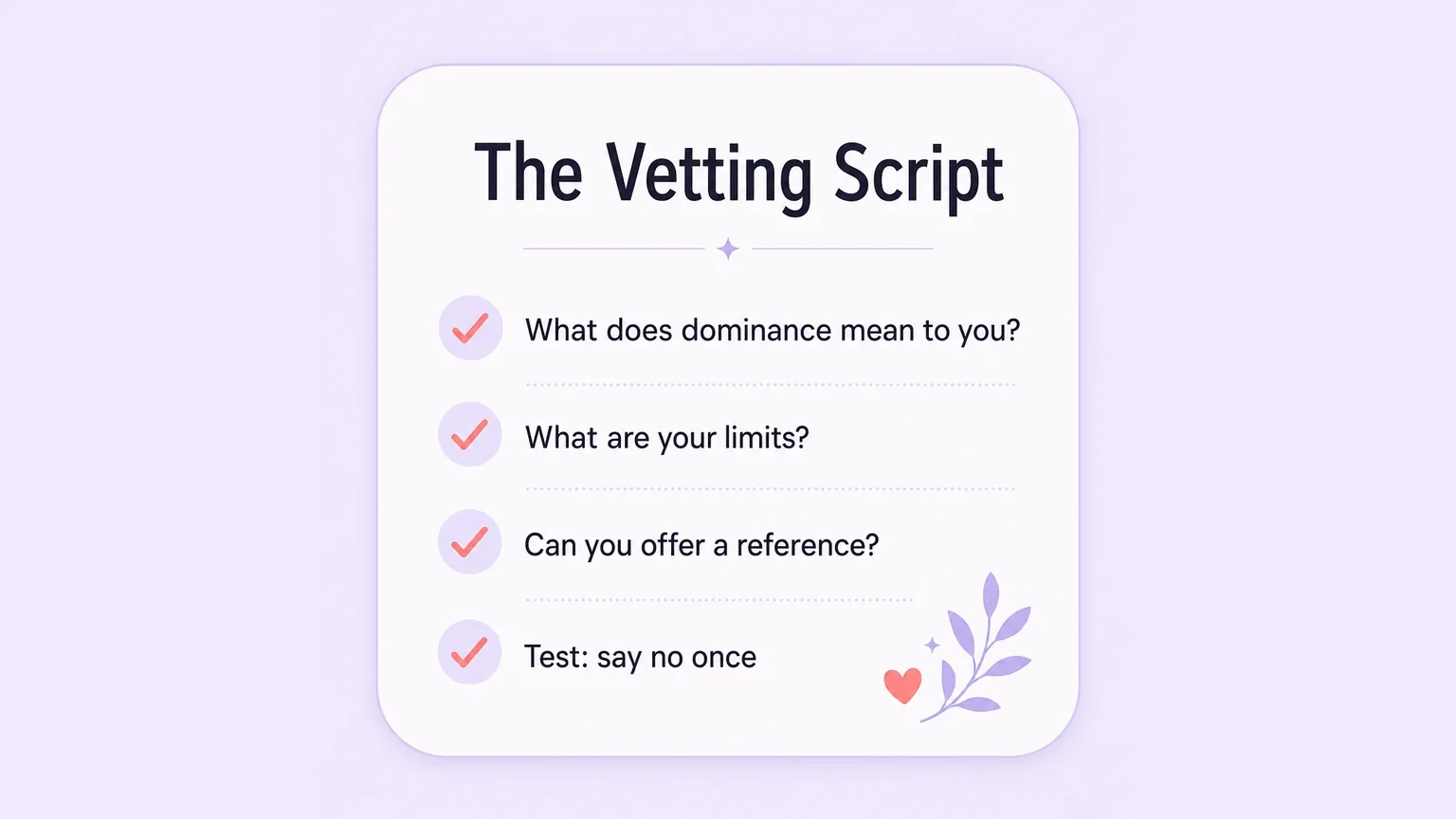
Set the frame first. This is the interview for the one role you only give to one person, and how to find a dom you can trust comes down to three stages: a talking stage, a question script, and one test. They are auditioning for you, not the other way around.
Start with a talking stage online or by phone. Keep your own identity semi-private at first. Do not let kink get deep until the person behind the title checks out. Ask about their week, their work, what they care about, how they spend their time.
A dom who rushes past these questions is not interested in you as a person. This stage exists so you can feel whether they are curious about you or just performing.
Then run the kink questions, in this order, before you share your own kinks:
- What does BDSM and dominance mean to them?
- How long have they been in the community, and which munches, groups, or events do they actually attend?
- Why do they want a submissive?
- What are their limits? A dom with no limits is a red flag.
- What were their previous dynamics, why did they end, and what did they learn?
- Can they offer a reference from a past partner or community member? A refusal is its own answer.
Then the two dealbreakers. First, their stance on consent and safewords. The only acceptable answer is yes, they believe in both. No one gets to tell you that consent disappears after submission.
Second, their aftercare routine. If they cannot describe one, you have learned everything you need. Ask both before anything physical, and treat evasive answers as answers.
Ask how they learned their skills. Did they take classes, study anatomy, learn emergency procedures? Confidence is not competence, and 50 Shades of Grey is not a handbook.
Through all of it, treat them like a person. Ask questions about them, do not assume titles, and never lead with “serve me.”
Finish with the single most revealing test. Deliver one small, polite “no”: decline a photo, push a meeting back, hold a boundary, and watch what happens. A real dom accepts it, asks a respectful question, and gives you space. A fake one sulks, argues, shames, or tries to wear you down.
By now you have run the script with a candidate, and their answers, references, and reaction to a “no” have passed.
Step 5: Spot the Fake Doms: Red Flags vs Green Flags
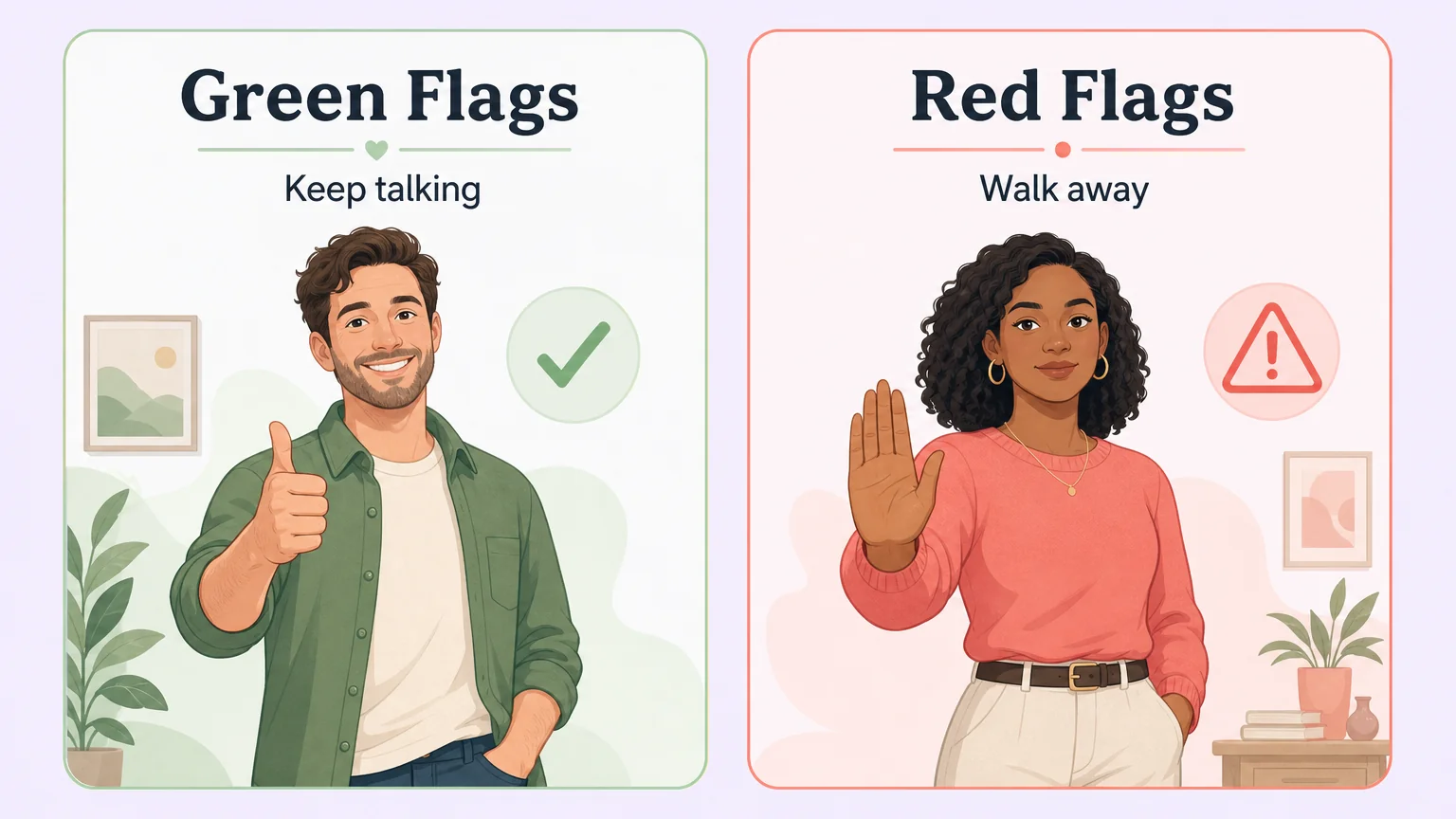
You have done the work of learning how to find a dom. Now you sort the candidates, and the goal is to do it in one conversation. Every candidate lands in one of two piles: keep talking, or walk away.
Here is the one-line test that separates them all: fake doms want access, real doms want informed, embodied consent. One centers the ego. The other centers your nervous system. Keep that sentence on your phone, and screen everyone against it.
Green flags to require. They ask about your boundaries before your kinks. They have limits of their own and treat yours as a gift, not an obstacle. They can describe their aftercare routine without hesitating. They are connected to the community and can name people who will vouch for them. They respect a “no” and give you space. And they behave with kindness toward people who can offer them nothing, because that is who they are without the authority.
Red flags to walk away from. They describe dominance as what they want to do to you, never who you are and what you want. They rush you toward submission, titles, photos, or sex before basic questions are answered. They claim to have no limits, or want a submissive with none. They try to isolate you from the community with lines like “I don’t do munches, it’s just us.” They go blank when you ask about aftercare. They demand trust immediately and treat your caution as a personal insult.
Recognize the opener, too. When the first message is an order instead of a question, the exit is simple: “I’d rather get to know someone before I take orders.” If that is met with pressure instead of respect, block and move on. You do not owe a stranger a negotiation. You owe yourself the exit.
By now you have named at least one red flag you screen for and one green flag you require before you will meet anyone.
Step 6: Meet Safely: The First-Meet Protocol for a New Dom
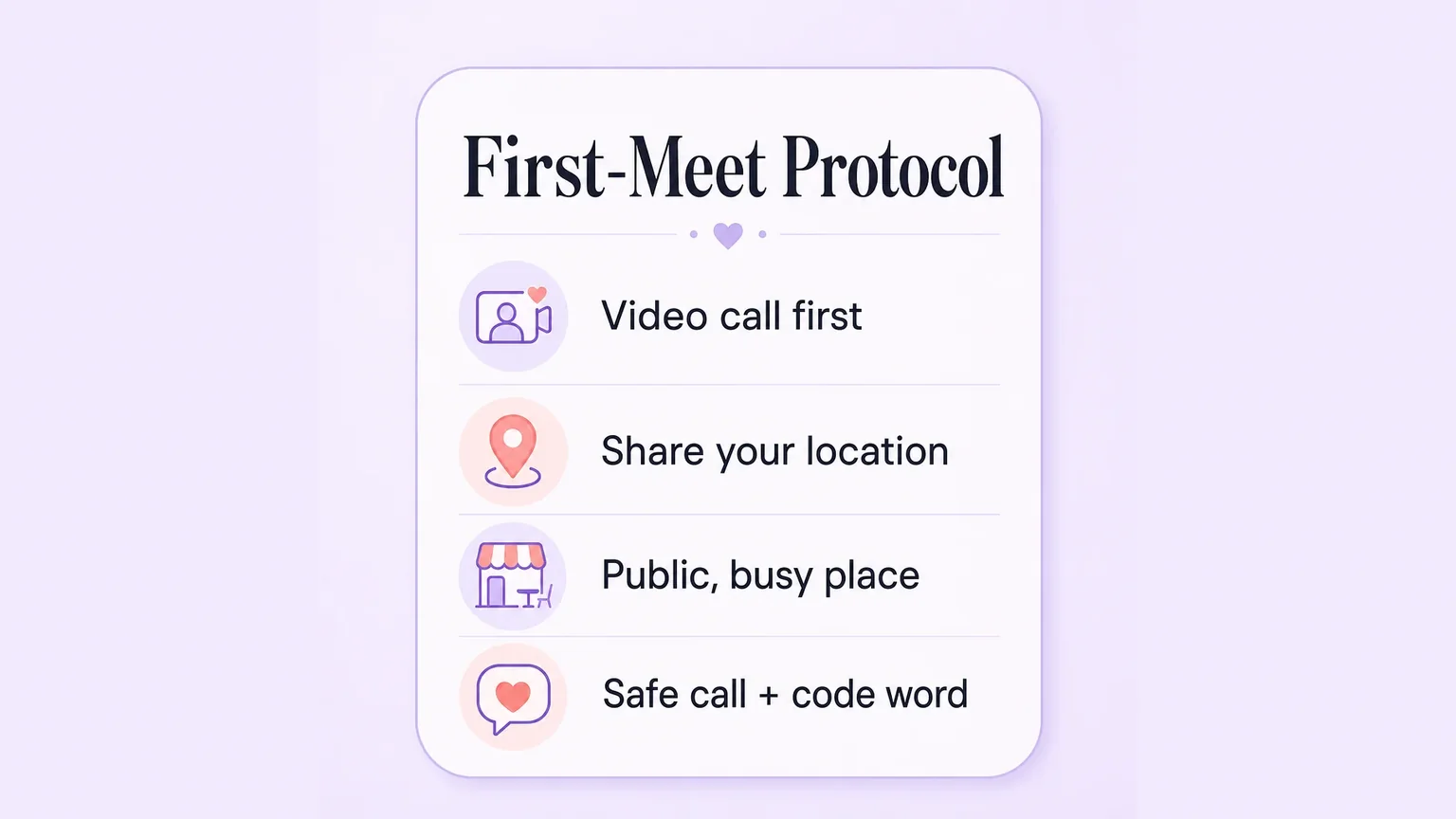
Your goal: walk into the first meeting with a safety system already running. This is the moment the process of learning how to find a dom moves from online to in person.
Set the tone first. Meeting in public is not being paranoid. It is the community norm and part of vetting, and a dom who objects to it is telling you something. Listen to that.
Before the meet, run three checks. Video call first, so you can see body language and confirm they match the person you have been talking to. If play might come later, verify STI testing within the last six months. And send a trusted friend the dom’s photo and name plus your location, so someone you love knows exactly where you are. Do all three before you agree to anything in person.
At the meet, choose a public, well-lit, busy place: a cafe or a bar. Never a hotel. Never their place. Never yours. Keep the conversation about the person, not a scene. If you feel off, the meet is over.
During the meet, run your safe call. A friend checks in at a set time using a pre-arranged code word, one signal for “I am okay” and one for “come get me.” That single word is the difference between a check-in and a rescue.
Three rules save you. No play on the first date, unless it is a public dungeon event with people around. Do not travel to another state or a remote location to meet someone you just met. And you can leave at any moment, for any reason. A good dom respects a “no” at every stage, including mid-coffee.
By now you have met in person, kept it vanilla and public, run your safe call, and your read on the person matches the person you vetted online.
Step 7: Negotiate the Dynamic: Safewords, Limits, and Aftercare
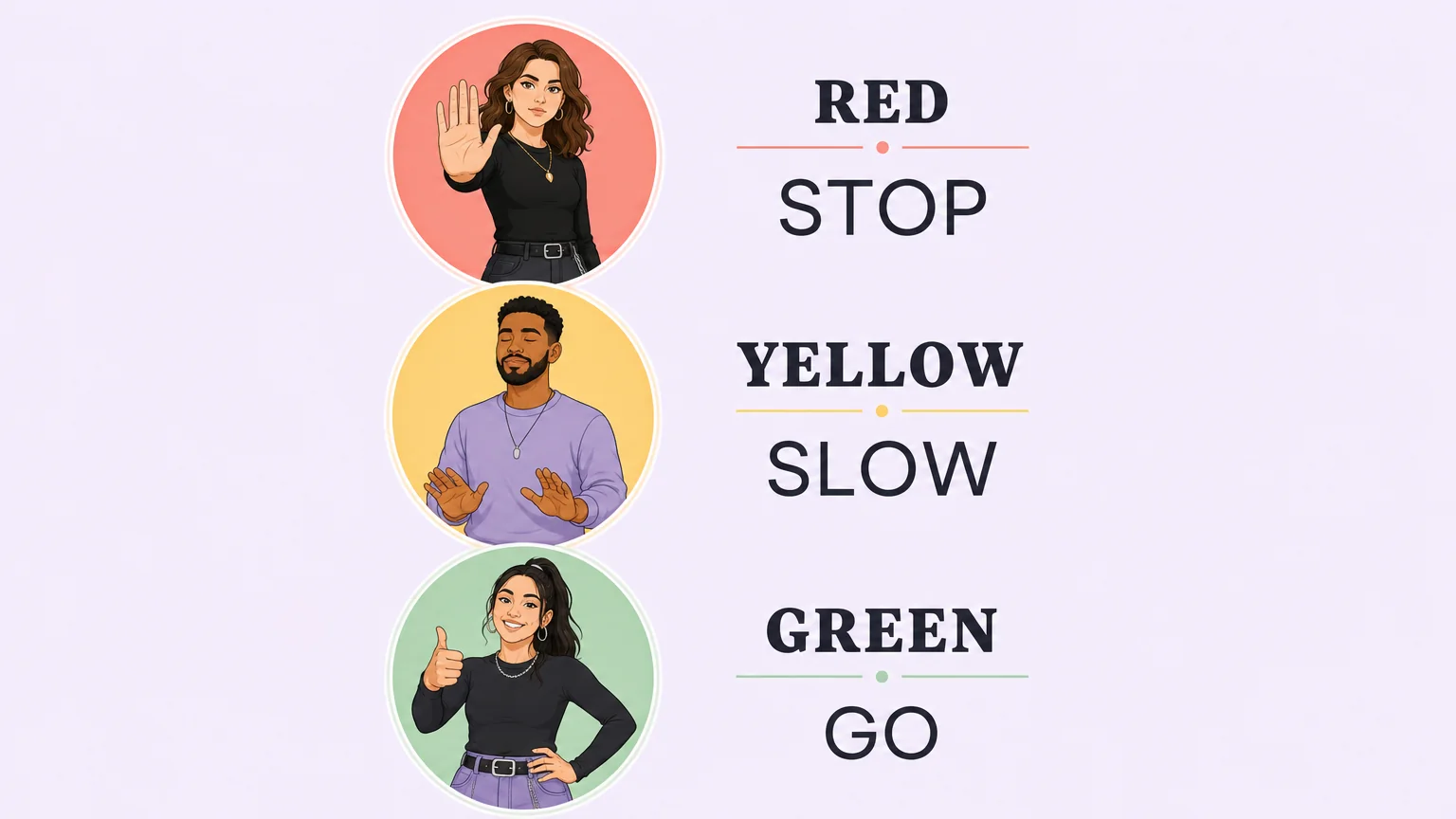
Your goal: negotiate your first scene, and the ongoing dynamic, before anything physical happens. The search that taught you how to find a dom ends here.
Start with the reframe that makes everything else safe: a scene is co-created through conversation, consent, and trust. It is not something that happens to you. Negotiation happens long before the first touch, and it is non-negotiable.
Run this checklist, in order. The type of play you are curious about. Your hard limits and softer boundaries. The safeword or pause system, where the traffic-light system of red, yellow, and green is the community norm and you set it before any touch. Whether sexual touch, sex, or orgasm is part of this scene. And your aftercare needs.
Then agree on the scene structure, not just the activities. The mood you want: sensual, intense, playful, or strict, the same tone question from Step 1. The tools or activities you will stick to. And the stop points, like “pause when I say yellow.”
One rule protects you here: a first scene is not the time to push limits or prove anything. Pick one or two YES-list items from your Step 1 list and leave the MAYBE column for a relationship that has earned it.
Learn the safety language. Numbness, tingling, sharp pain, dizziness, or emotional overwhelm are all reasons to speak up, and a safeword is information, not failure. There is a difference between negotiated discomfort and potential injury, and you are the only one who can feel which is happening.
Negotiate aftercare before play begins, and treat it as part of responsible play, not a reward. Closeness, reassurance, hydration, warmth, quiet, or space: decide together what you need. And know that subdrop, the sadness, fatigue, or emptiness that can show up hours or days later, is a normal nervous-system response, not a sign something went wrong.
Close the loop with an ongoing check-in. After each scene, talk about what felt good, what felt uncomfortable, what surprised you, and what to change next time.
By now, before anything physical, you and your dom have agreed on limits, a safeword, and aftercare, and you can say exactly what your first scene will and will not include.
FAQ
Is there one app that finds you a dom?
No single app can teach you how to find a dom, and anyone promising one is selling something. The strongest mix is FetLife for community, munches in person, and a kink-friendly app like KinkD for seeking. Meet people as people first, and the right dynamic follows the relationship. See Step 2 above for the full channel breakdown.
Do I have to go to munches?
No. Apps and online communities work, and many dynamics start entirely online. But a munch is the safest on-ramp because it is public, nonsexual, and full of people there to socialize, not to play. Newbie and TNG (under-35) munches are built for beginners, and you can leave whenever you want. A munch is also where you learn which doms are known, respected, and vouched for.
Can a submissive man find a dominant woman?
Yes. Be honest about your experience, because dominant women can afford to be choosy and they spot lies quickly. Write a whole-person profile, skip the one-line openers, and look at munches, community groups, and online spaces alongside any professional options. The demand is there; the approach is what separates you from the crowd.
How fast should things progress?
Slow, deliberately. The healthy sequence is a talking stage, a vanilla public meet, then negotiation before any play. Anyone pushing you to skip those steps is showing you a red flag, however charming the pressure feels. Trust that moves slowly is trust you can build on. Let the dynamic unfold at the pace your body and trust can keep up with.
What is a safeword and do I need one on a first scene?
Yes, you need one. The traffic-light system, red to stop, yellow to slow, green to go, is the community norm, and you agree on it before any touch. A safeword is information, not failure. A dom who refuses to agree to one is a red flag. If someone treats your safeword as an insult, walk away.
Is it okay to be new?
Yes, and the community is built for you. There are newbie munches, novice groups, and classes for beginners. Honest inexperience reads better than faked expertise, because experienced doms spot the lies. The people who matter will meet you exactly where you are. An unvetted partner is.