
Kitchen table polyamory gets held up as the gold standard in polyamorous relationship, and parallel polyamory catches side-eye. But there is a third door: garden party polyamory.
The idea of weekly dinners with your partner’s other partners makes your stomach tighten. Yet never meeting the people who matter to the person who matters to you feels cold, like pretending entire relationships do not exist. Garden party polyamory lives in the space between those two extremes. It is not a compromise. It is a deliberate, sustainable choice for people who want community without forced intimacy.
The pressure to pick a side is real. Minka Guides puts it plainly: kitchen table polyamory is often described as the “right” or healthiest way to do polyamory, pressuring metamours into closeness that never felt natural. Meanwhile, parallel polyamory “gets a bad rap,” even when both metamours genuinely prefer distance.
You do not have to choose between suffocating closeness and cold silence. Garden party polyamory is not polyamory lite. It is polyamory built for people who know the difference between being friendly and being friends.
What follows is what it actually looks like, how it works in practice, and what to do when it gets hard.
What Garden Party Polyamory Actually Is (And Where It Lives on the Metamour Spectrum)
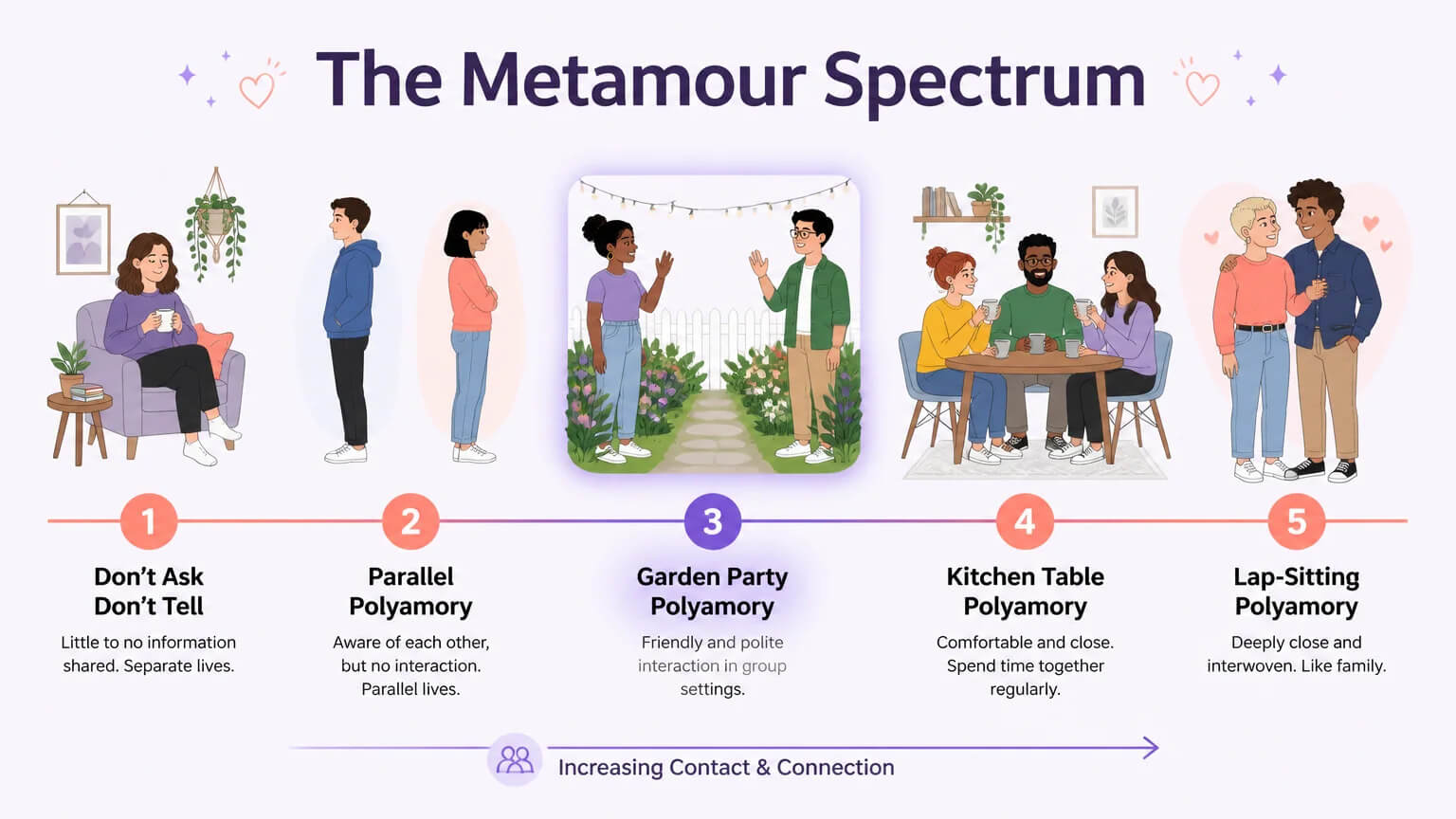
There are five distinct ways metamours relate to each other, and most people only know about two of them.
Garden party polyamory (GPP) is the relationship style where metamours are friendly and can comfortably share space at special events without forming independent close relationships. Think birthdays, holidays, summer barbecues. You show up. You are warm. You do not exchange keys or plan one-on-one brunches.
It lives on a spectrum defined by therapist Sander T. Jones, LCSW. From least to most contact, the five types are:
Don’t Ask Don’t Tell. You never meet your partner’s other partners and prefer not to hear about them.
Parallel Polyamory. You may have met other partners once, but you do not share space. Communication goes through the hinge exclusively.
Garden Party Polyamory. You meet at milestone events, are cordial, celebrate together, then go home to separate lives.
Kitchen Table Polyamory. Metamours form independent friendships, share meals, hang out without the hinge. The polycule feels like a chosen family.
Lap-Sitting Polyamory. Metamours are physically and emotionally intimate with each other. The lines between friendship, romance, and community blur.
One principle governs the entire spectrum, and Jones states it cleanly: “The bond between two metas can only be as close as the wants of the person who desires the least amount of closeness.” The ceiling is set by the person who wants less, not the person who wants more.
The term “garden party polyamory” emerged from online polyamory forums around 2021, popularized by writer Laura Boyle at Ready For Polyamory. It is also called “birthday party polyamory,” a phrase some prefer because it sidesteps the class baggage Boyle herself critiques in the original term.
The label matters less than the idea. Zachary Zane gives the working definition: “You are on amicable enough terms with your metamour that you can be in the same space with them and not feel jealous, upset, or threatened. You’re close enough, but not too close.”
Garden Party vs Kitchen Table vs Parallel: What Each One Actually Feels Like
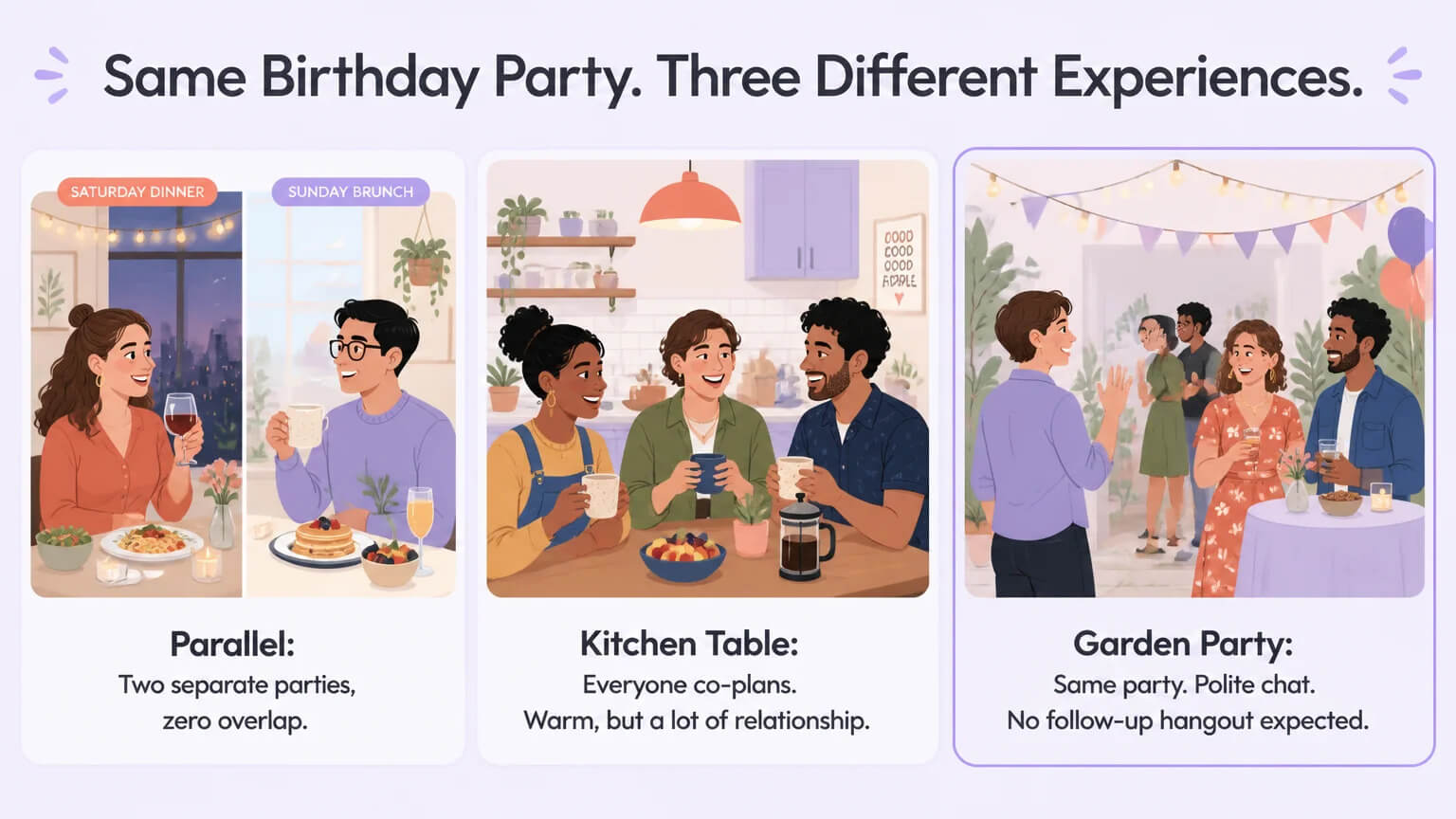
Same birthday party. Same people. Three completely different experiences.
Alex dates both Jordan and Sam. Alex’s birthday is coming up. Here is how it plays out under each style.
Parallel. Jordan attends the Saturday dinner. Sam comes to Sunday brunch. Alex coordinates two separate celebrations, two sets of emotional energy, zero overlap. Jordan and Sam know the other exists but would not recognize each other at a grocery store. It works. It is also exhausting.
Kitchen Table. Jordan and Sam co-plan the party. They group-text about cake preferences and playlist curation. At the party, they sit together, trade inside jokes about Alex’s coffee addiction, and make plans to grab drinks next week, just the two of them. It is warm. It is also a lot of relationship to maintain with someone you did not choose.
Garden Party. Jordan and Sam both show up. They chat politely by the drink table. They laugh at the same toast. They might even team up to embarrass Alex with a shared story. After the party, Sam texts Jordan: “Great meeting you! Love the sneakers.” Jordan hearts the message. Neither expects a follow-up hangout. Everyone leaves feeling respected, not drained.
The difference is not how much anyone cares. It is how much relationship you are expected to maintain with people you did not choose.
Minka Guides offers a useful lens: think of metamour relationships like work colleagues. Some become closest friends. Some are enjoyable at office parties. Some you only chat with at the holiday gathering. “This is why expectations don’t work when it comes to creating bonds with others. We’re all unique, with individual approaches and differing capacities for connection.”
Garden party simply says: you do not have to be best friends to be good people.
For Couples: Your First Garden Party, Step by Step
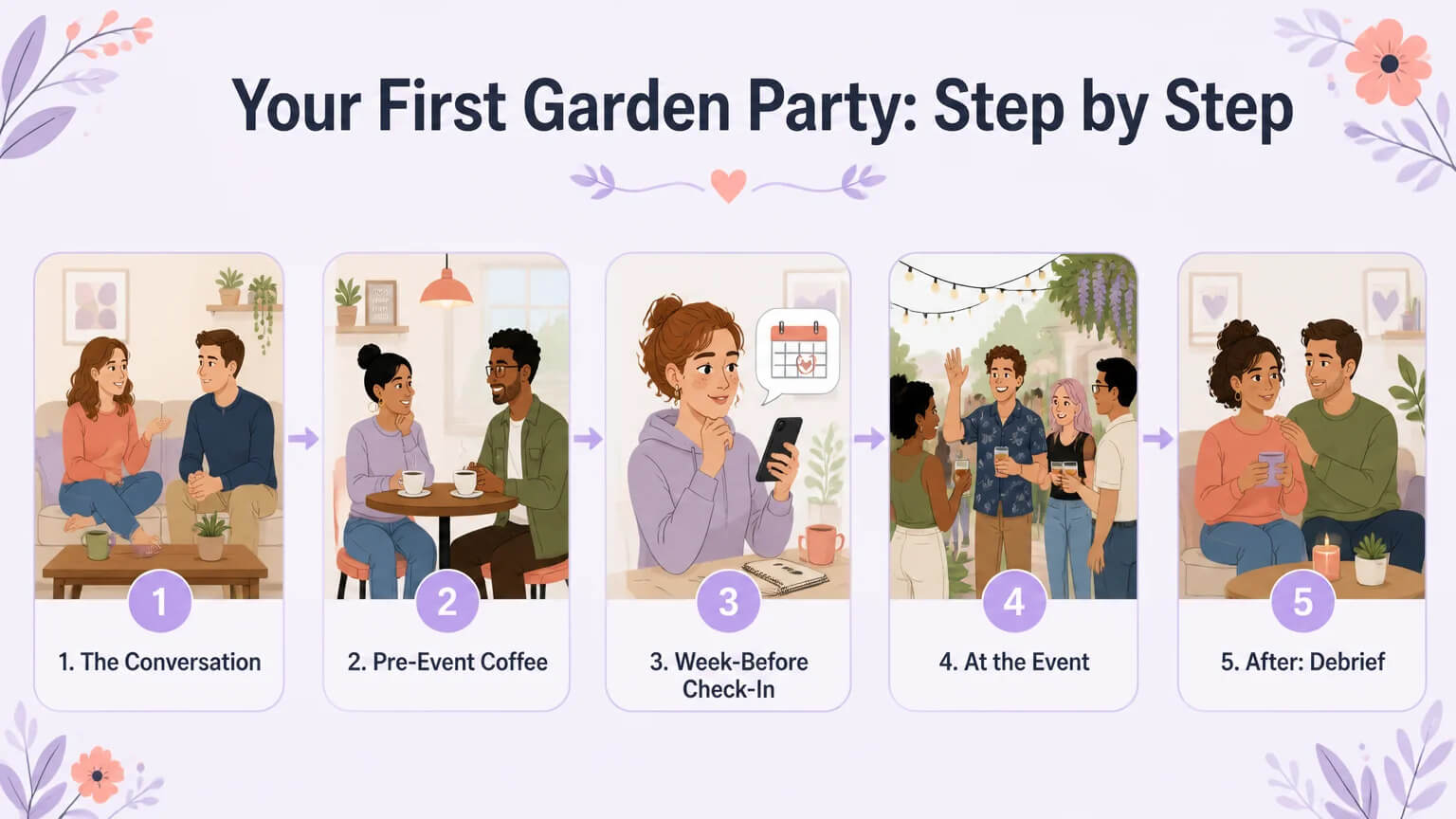
You have agreed garden party polyamory sounds right. Now your partner’s birthday is in three weeks, and both of you will be in the same room for the first time. What now?
The Conversation
Name it explicitly. Try this: “I have been reading about garden party polyamory. It is a middle ground where metamours are friendly at events but do not need to be close friends. I think this might fit us.” Walk through the spectrum so your partner understands where GPP sits. Share why it appeals: lower emotional labor, respect for autonomy, still allows shared celebrations. Then ask: “How does that feel to you? What would your ideal metamour dynamic look like?” Agree on a trial period.
The Pre-Event Ritual
Never make an important event the first meeting. Minka Guides recommends reaching out a few weeks beforehand: “Hey, I would love to grab coffee before Taylor’s birthday so we are not meeting for the first time at the party.” Thirty minutes over coffee is plenty.
The Week-Before Check-In
A few days before, send a quick message: “How are you feeling about Saturday? Anything you want to align on?” If someone needs a signal system, agree on one. The goal is clarity, not control.
At the Event
Let engagement happen naturally. Some metamours will mingle. Some will hang back. Both are fine. Do not force warmth. A genuine “good to see you” means more than an awkward hug. If you need a breather, take one.
After
A simple text the next day: “Great seeing you!” Debrief with your partner one to two days later. What felt good? What felt hard? What would we do differently next time?
This framework works especially well for introvert-extrovert dynamics. One meta wants community, the other needs space. GPP honors both. Neither is wrong.
The Boundary Playbook: Agreements, Scripts, and Guardrails That Actually Hold
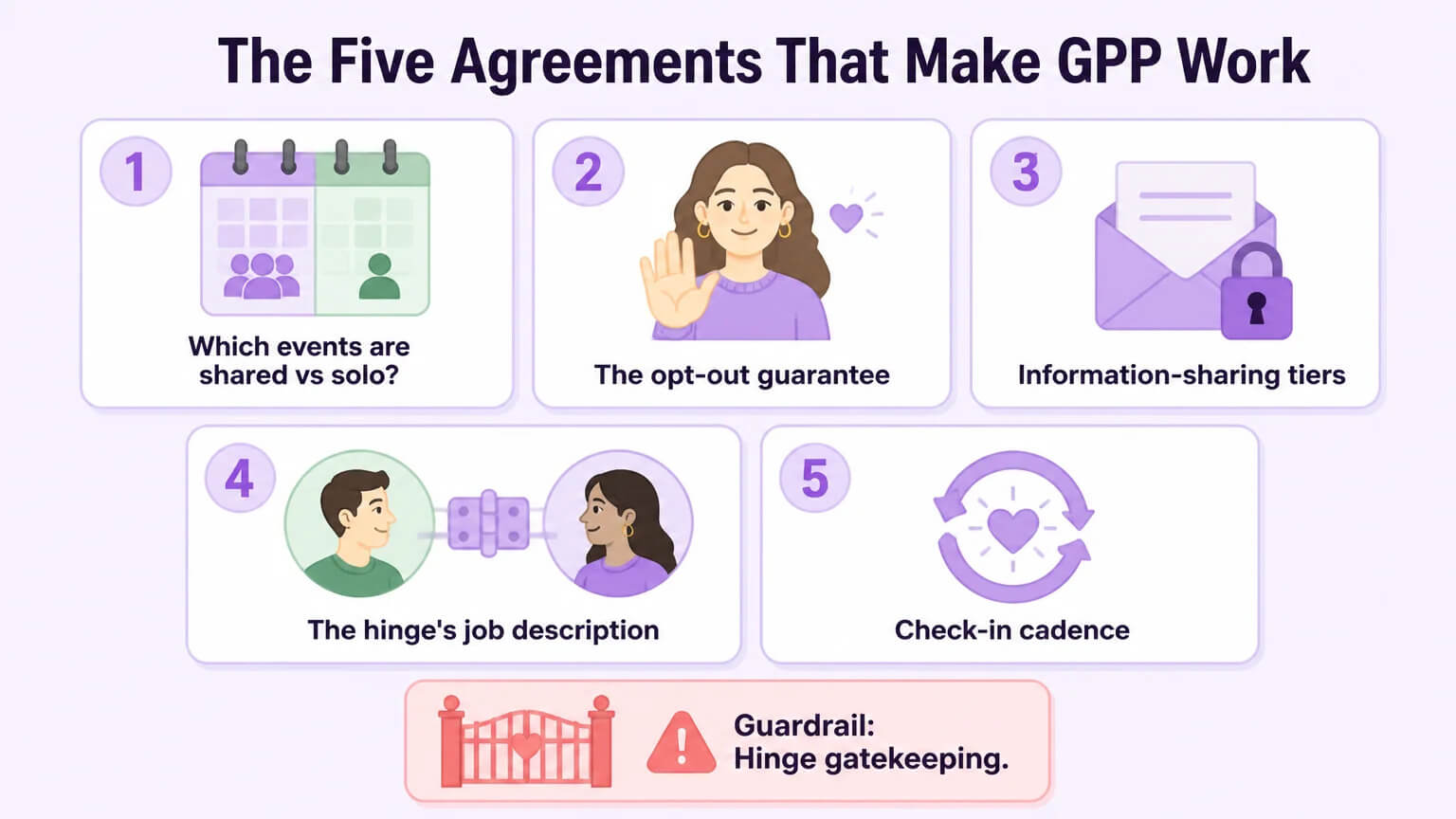
Most GPP advice stops at “communicate.” That is like telling someone to “cook” without listing ingredients, measurements, or heat.
Here is the distinction that matters: agreements versus rules. Rules are imposed (“you cannot,” “you must”). Agreements are co-created (“we agree that,” “we both want”). Rules control. Agreements protect. In a GPP dynamic, agreements are what hold autonomy in place.
Five agreements that make GPP work:
One: Define which events are shared and which are solo
Birthdays? Yes. Holidays? Maybe. Casual weekends? Probably not. “We will figure it out as we go” creates mismatched expectations.
Two: The opt-out guarantee
Anyone can bow out of any event, no questions asked. If showing up costs someone their peace, they stay home. No guilt, no penalty.
Three: Information-sharing tiers
“Need to know” covers scheduling, safety, sexual health. “Nice to know” covers emotional dynamics. Decide where the line lives, and revisit quarterly.
Four: The hinge’s job description
The hinge manages scheduling and conflict flow. Metas do not process relationship issues with each other. If something is hard between metas, the hinge carries the message. Every relationship stays clean.
Five: The check-in cadence
Monthly or quarterly, revisit what is working. These are maintenance, not crisis meetings. Small adjustments compound.
The guardrail: hinge gatekeeping. A hinge who limits a metamour’s access under the guise of “GPP boundaries” is practicing control, not garden party polyamory. Sander T. Jones is explicit: metamour relationships must be defined by the metas themselves. If a meta is blocked from an event because “that is not how we do GPP,” the hinge has overstepped. The agreement belongs to everyone, not just the person in the middle.
Try this check-in script: “On a scale of one to ten, how comfortable are you with how we are handling shared events right now? What would move your number up by one?” Simple. Concrete. Actionable.
The Singles Perspective: Finding Your Place at the Party Without Getting Fenced In
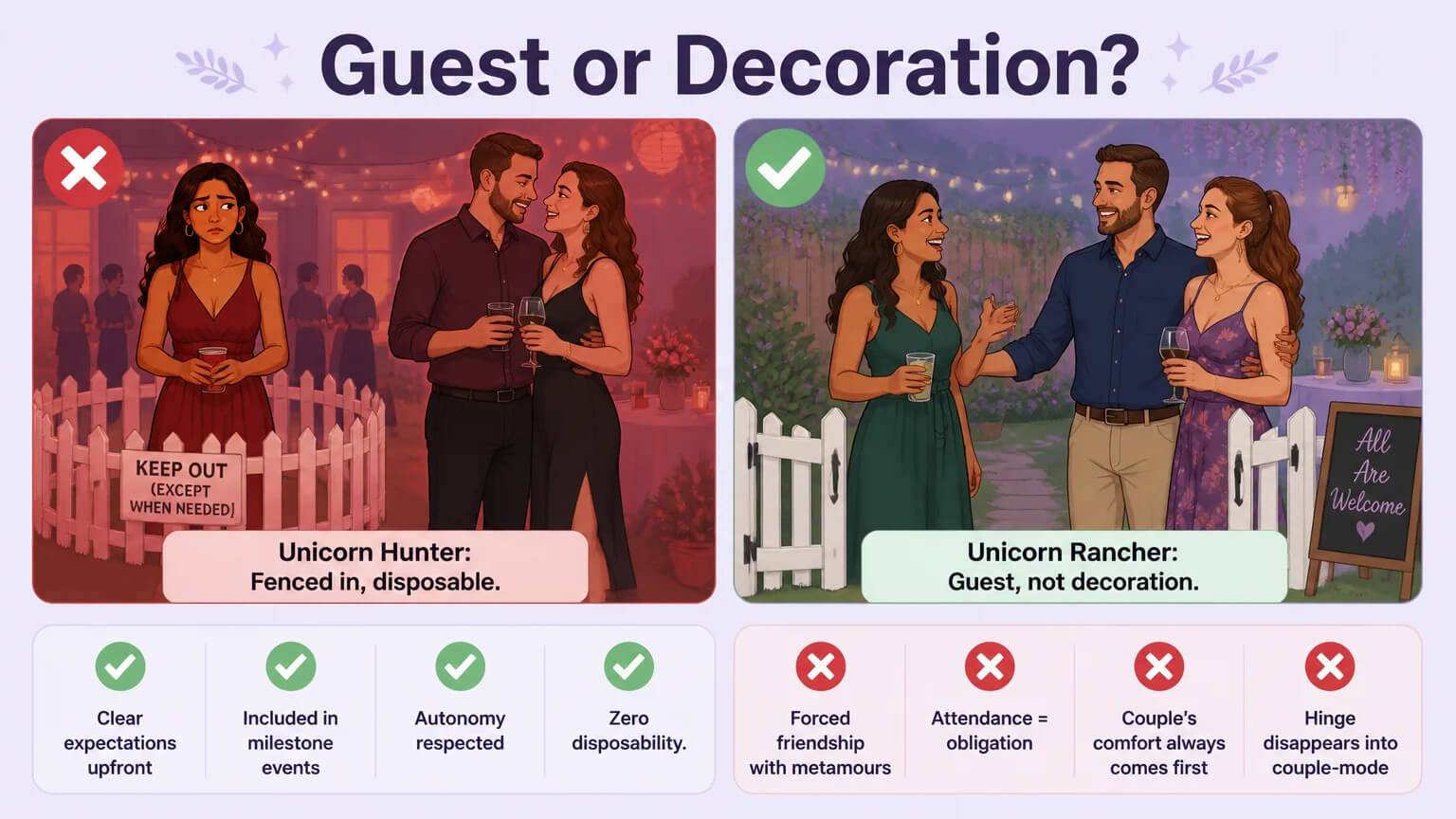
You are dating someone wonderful. They are partnered. You get invited to the birthday party. You are excited, and also wondering: am I a guest here, or a decoration?
Page Turner, author of “A Geek’s Guide to Unicorn Ranching,” draws the line sharply: “Being a unicorn is fantastic, yet terrifying. You’re universally pursued, but you never know whether it’s because someone wants to cut off your horn, kill you and mount your head on the wall, or keep you at their ranch and spoil you.”
The difference between unicorn hunters and unicorn ranchers is the difference between being treated as a feature and being treated as a person. Hunters treat the single person as an accessory to the couple’s adventure. Ranchers, in Turner’s framework, “create a unicorn sanctuary. Grow grass, plant flowers. Tend it. Leave the gate open.” And then the part that matters: “When they show up, of their own accord, in this magical refuge you have created, whatever you do, don’t fence them in.”
Here is what respectful inclusion looks like from the single’s perspective.
Green flags: The couple has discussed their offer before inviting you in. They introduce you at events as “someone we care about,” not “our third.” Your autonomy is not up for negotiation. You can decline any event without losing access to the relationship.
Red flags: You are expected to become instant friends with metamours. Attendance is treated as an obligation. The couple’s comfort consistently outweighs yours. The hinge disappears into couple-mode the moment things get socially complex.
Apps like 3Fun and Feeld let you state your preferences upfront. Signal “garden party dynamic preferred” before the first message. That saves everyone time.
The test of a healthy GPP dynamic is not how well the couple feels about it. It is whether the single person in it feels like a guest or a decoration. If it is not an enthusiastic “yes” from everyone in the room, it is a hard “no.”
Jealousy at Shared Events: What It Actually Looks Like and How to Handle It in Real Time
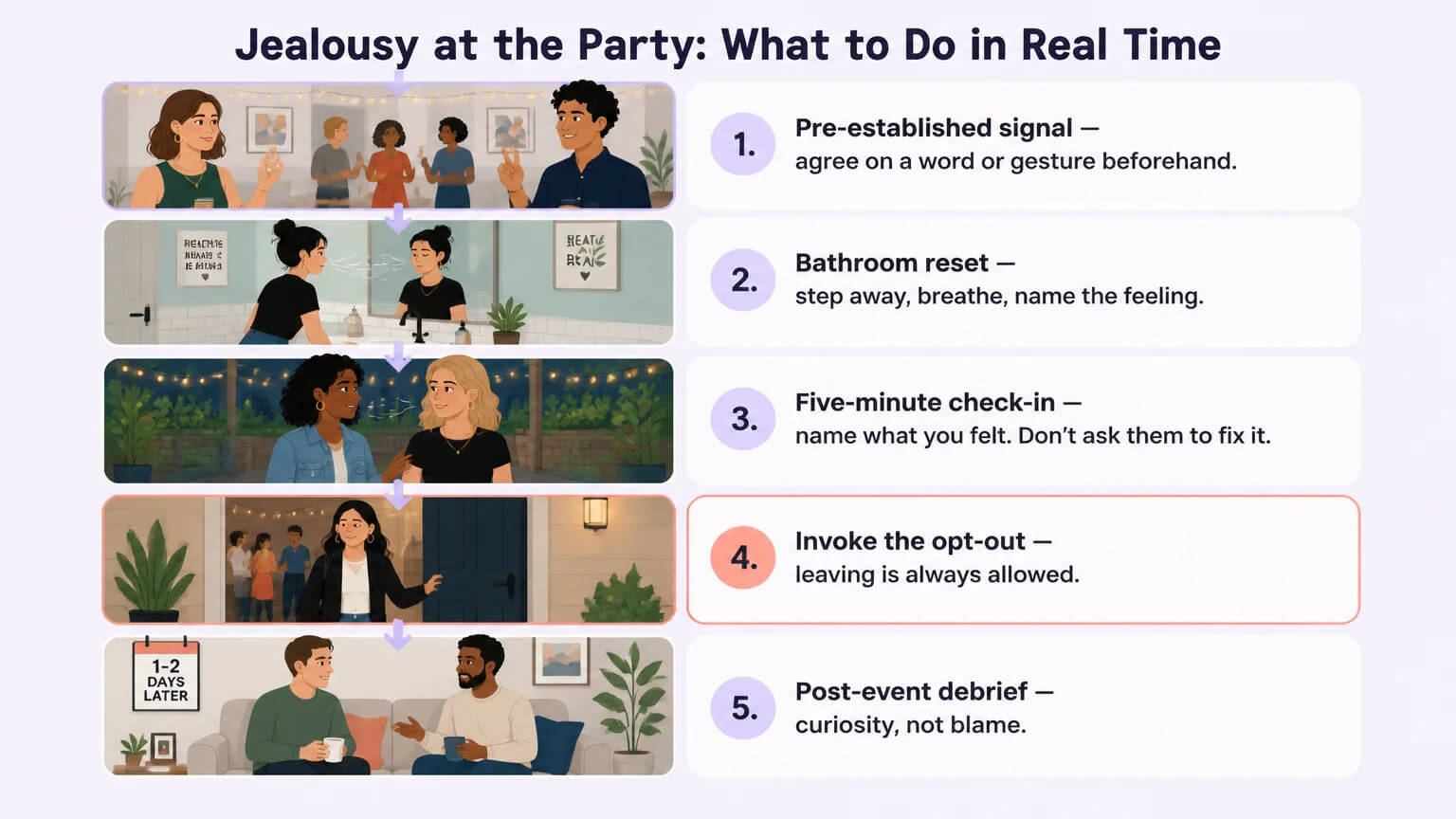
You are at the party. Your partner is across the room, laughing at something your metamour just said. The same laugh you thought was yours. Your chest tightens. Now what?
First: this is normal. Not a sign you are bad at polyamory. Just a human body reacting to a situation it has not been trained for.
Emily Martinez, LMFT, a therapist at Modern Intimacy, offers a reframe worth sitting with: do not shy away from jealousy. Do not shame it. “Lean into it. Use jealousy as a tool to become aware of your underlying anxieties and approach jealousy with a sense of curiosity.” The tightening in your chest is not weakness. It is data.
Here is what to do with that data in real time.
Have a pre-established signal
Before the event, agree on a word or gesture that means “I need a moment.” Your partner sees it, excuses themselves, checks in. Two minutes. No scene.
Take a bathroom reset
Step away. Splash cold water on your face. Breathe for sixty seconds. Identify the emotion, accept it without judgment, tune into the physical sensation. You are not running away. You are regulating.
Use the five-minute check-in
Find your partner. Say: “I am feeling activated. Can we step outside for five minutes?” Name what you felt. Do not ask them to fix it. Just be witnessed.
Invoke the opt-out
If the jealousy is overwhelming, leave. The opt-out agreement exists precisely for this moment. No guilt. No apology tour.
Post-event: debrief one to two days later
Do not process the night of. Then ask: “What came up for you at the party? Here is what came up for me.” Curiosity, not blame.
Desire does not require an apology. Neither does the discomfort that sometimes rides alongside it. The most attractive thing you can bring into the lifestyle is clarity about what you are feeling and the skill to regulate it without making it someone else’s emergency.
When the Garden Changes: How GPP Evolves, Shifts, and Sometimes Breaks
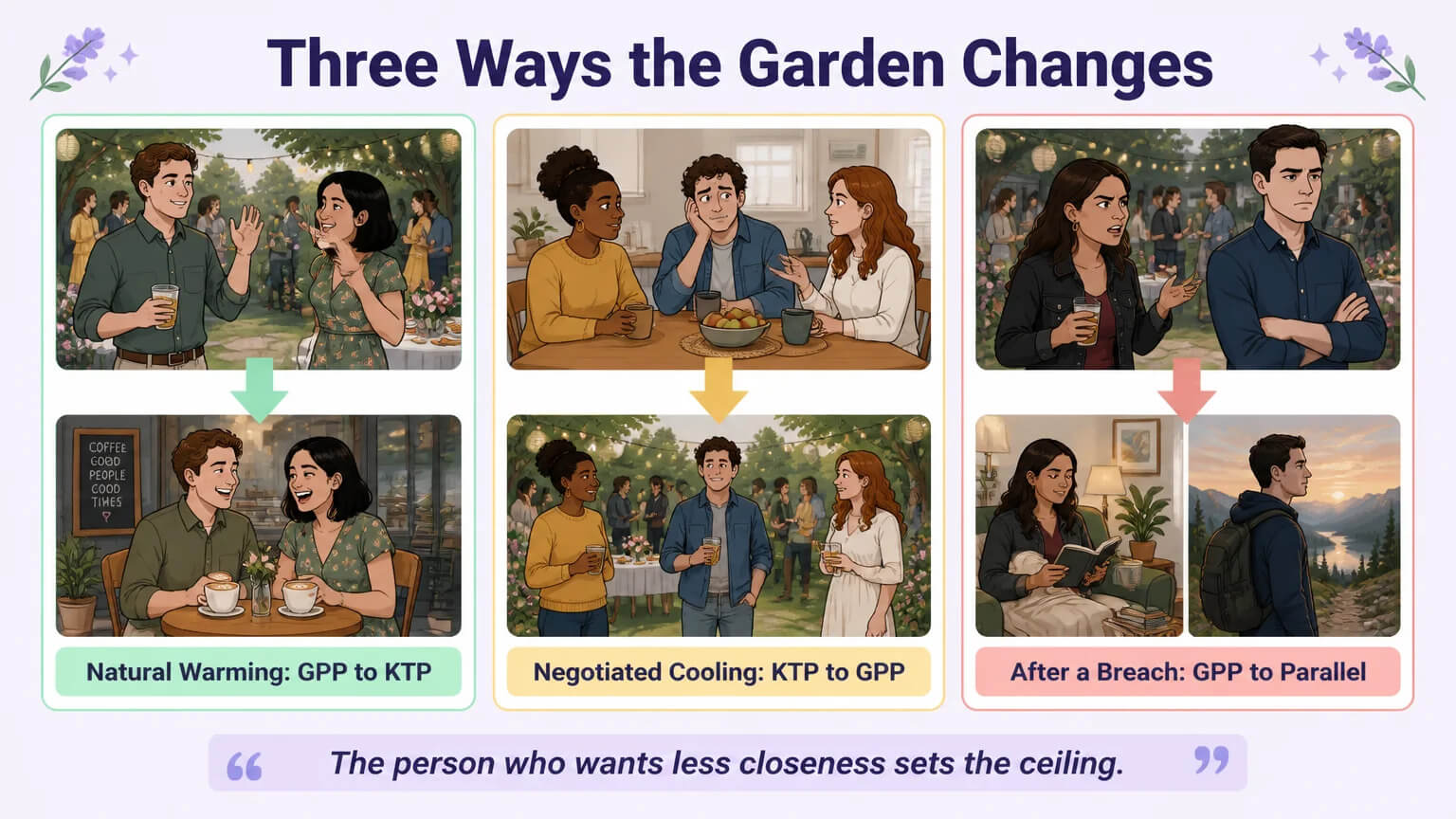
Here is something nobody tells you: the metamour style you choose today is probably not the one you will have in two years.
People change. Polycules reorganize. Comfort zones expand and contract. GPP is not a permanent label. It is a living arrangement that bends with the people inside it.
There are three ways this usually goes.
GPP to KTP: Natural Warming
Two metamours who started with polite birthday-party small talk discover they actually enjoy each other. Coffee becomes dinner, dinner becomes genuine friendship. This is the easiest path because nobody is being asked to give anything up. The relationship grows because both people want it to.
KTP to GPP: Negotiated Cooling
This one is harder. One meta wants less closeness than they used to. Life got busier, the dynamic shifted, the kitchen table stopped feeling good. The transition can feel like rejection to the person who wanted more. Axioms of Love notes: “Shifting from kitchen table polyamory to garden party polyamory can be challenging. The transition may create feelings of loss or rejection.” The hinge must hold space for grief while protecting the boundary. It can be done with care. It cannot be done without honesty.
GPP to Parallel: After a Breach
Something broke. Trust was damaged. A metamour overstepped. The cordiality that held GPP together collapsed. Returning to parallel is not failure. It is self-protection. Sometimes the garden gate needs to close for a season, or indefinitely.
The ceiling principle holds across all three paths: the bond between two metas can only be as close as the person who desires the least closeness. When that person’s comfort level shifts, the whole arrangement shifts with it. That is not instability. That is responsiveness.
Evolution is not a sign that you got it wrong the first time. It is a sign that you are paying attention. The healthiest polycules change honestly.
Is Garden Party Polyamory Right for You? A Decision Framework
You have read this far. Here is the only question that matters now: is it actually right for you?
GPP suits you if:
You want to celebrate important moments with your partner without managing complex metamour dynamics at every gathering. You value autonomy and prefer relationships that breathe independently. You are new to polyamory and want an entry point that does not demand full family-style integration overnight. You or your metamour are introverted and weekly polycule dinners sound exhausting, not enriching. You simply do not have the bandwidth to nurture additional close friendships with people you did not choose.
GPP might frustrate you if:
You genuinely want deep, independent friendships with your metamours and feel unfulfilled without them. You prefer your relationships to feel like one integrated community rather than a constellation of separate connections. Your partner’s desire for GPP feels less like a preference and more like a way to keep you at a distance.
If you land in the “suits you” column, Ryn Pfeuffer recommends treating GPP as a test-the-waters period. Give it three months. Plan two or three low-stakes events: a group picnic, a game night, a casual coffee where metas overlap briefly. Antonius at Axioms of Love emphasizes starting with low-pressure activities “where metamours can connect without feeling obligated to engage deeply.” Treat it as an experiment, not a permanent installation.
After three months, ask: Did shared events feel sustainable or draining? Did anyone feel pressured into more closeness than they wanted? Did anyone feel fenced out of connection they genuinely desired? Adjust from there.
Garden party polyamory is not a waiting room for kitchen table. It is not polyamory lite. It is a legitimate, sustainable destination for people who want community without forced intimacy. You are not doing polyamory wrong because you do not want to share breakfast with your metamour every Sunday. You are doing it your way, on purpose.
FAQ
What is the difference between garden party polyamory and kitchen table polyamory?
KTP means metamours form close independent friendships. GPP keeps interactions cordial and event-bounded. In KTP, metas pursue independent relationships with each other; in GPP, they do not.
Is garden party polyamory just “polyamory lite” or less committed?
No. GPP is a structural preference, not a lesser commitment. The commitment is to respect and autonomy, not forced intimacy.
Can garden party polyamory evolve into kitchen table over time?
Yes, and it often does organically. But GPP should not be treated as “KTP-in-training.”
What if my partner wants KTP but I want GPP?
The meta who wants less closeness sets the ceiling. Compromise: attend a few shared events per year while keeping relationships parallel otherwise. Polyamory-informed coaching can help.
How do I handle jealousy at shared events in a GPP dynamic?
Meet metamours beforehand. Have a signal with your partner. Debrief afterward. Opting out is always allowed.
What does garden party polyamory look like for singles?
Singles in GPP attend milestone events without pressure to befriend metamours. Respectful couples offer clear expectations, respect for autonomy, and zero disposability.
How many times a year do garden party metamours actually interact?
Typically two to six times per year: birthdays, major holidays, a summer BBQ. Quality over frequency: cordial, surface-level, event-bounded.