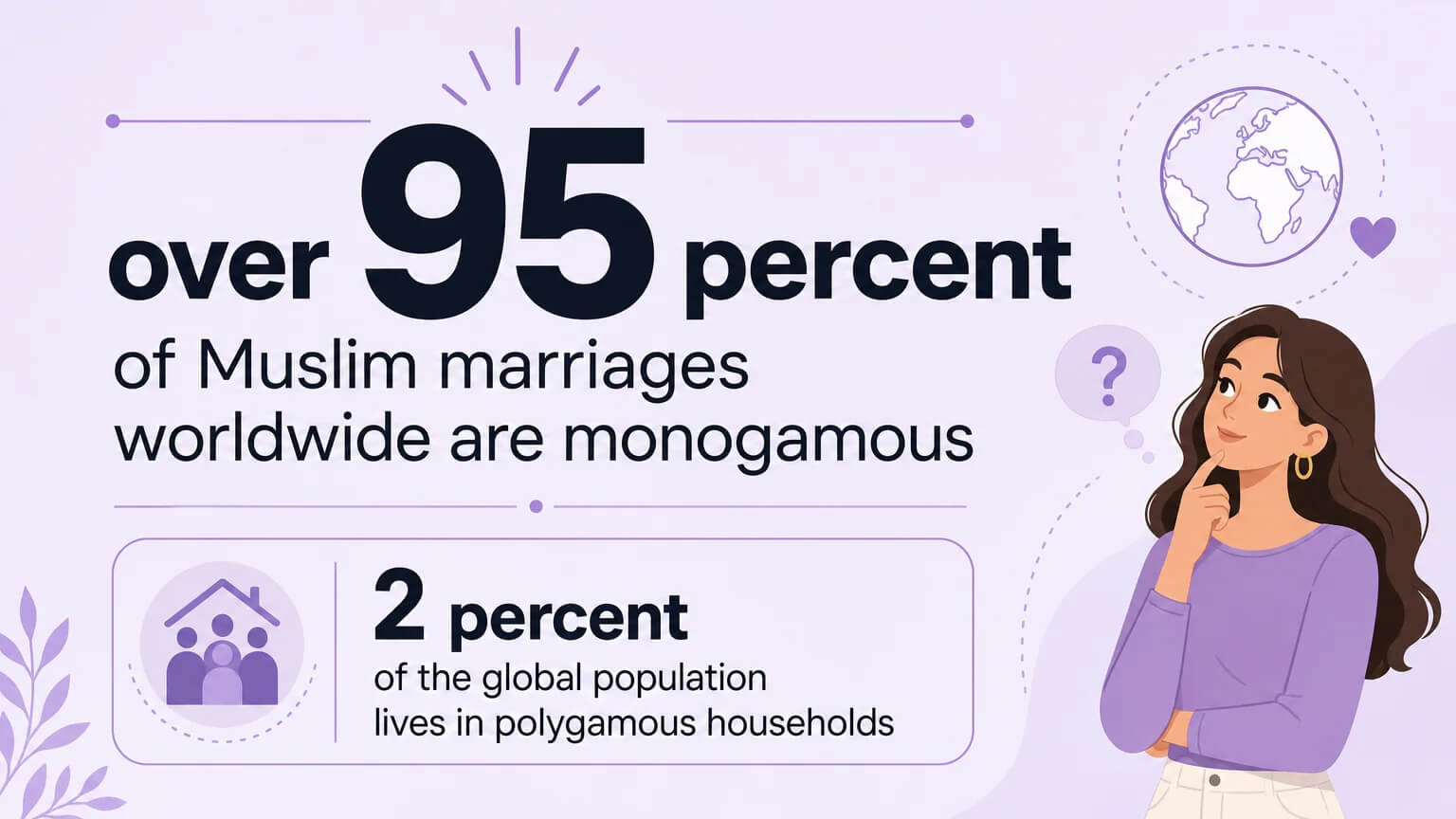
Roughly 2% of the global population lives in polygamous households today, approximately 160 million people, concentrated in the West and Central African “polygamy belt” and parts of the Middle East. Yet when most people hear the phrase what religion allows polygamy, they picture a Fundamentalist Mormon compound or an abstract stereotype about Islam. Neither image captures the full picture.
Polygamy shows up in the Hebrew Bible and South African constitutional law. It appears in ancient Hindu kingdoms and modern Tibetan villages. The boundary between religious polygamy and contemporary ethical non-monogamy is blurrier than either community usually acknowledges.
This article walks through every major religion’s position: what their scriptures say, how those teachings changed over time, and where things stand today. If you are researching out of personal curiosity or trying to understand your own relationship philosophy, start with the facts.
Polygamy, Polygyny, Polyandry, and Polyamory: The Terms You Need First
People toss these terms around as if they are interchangeable. They are not, and using the wrong one creates confusion before any real conversation begins.
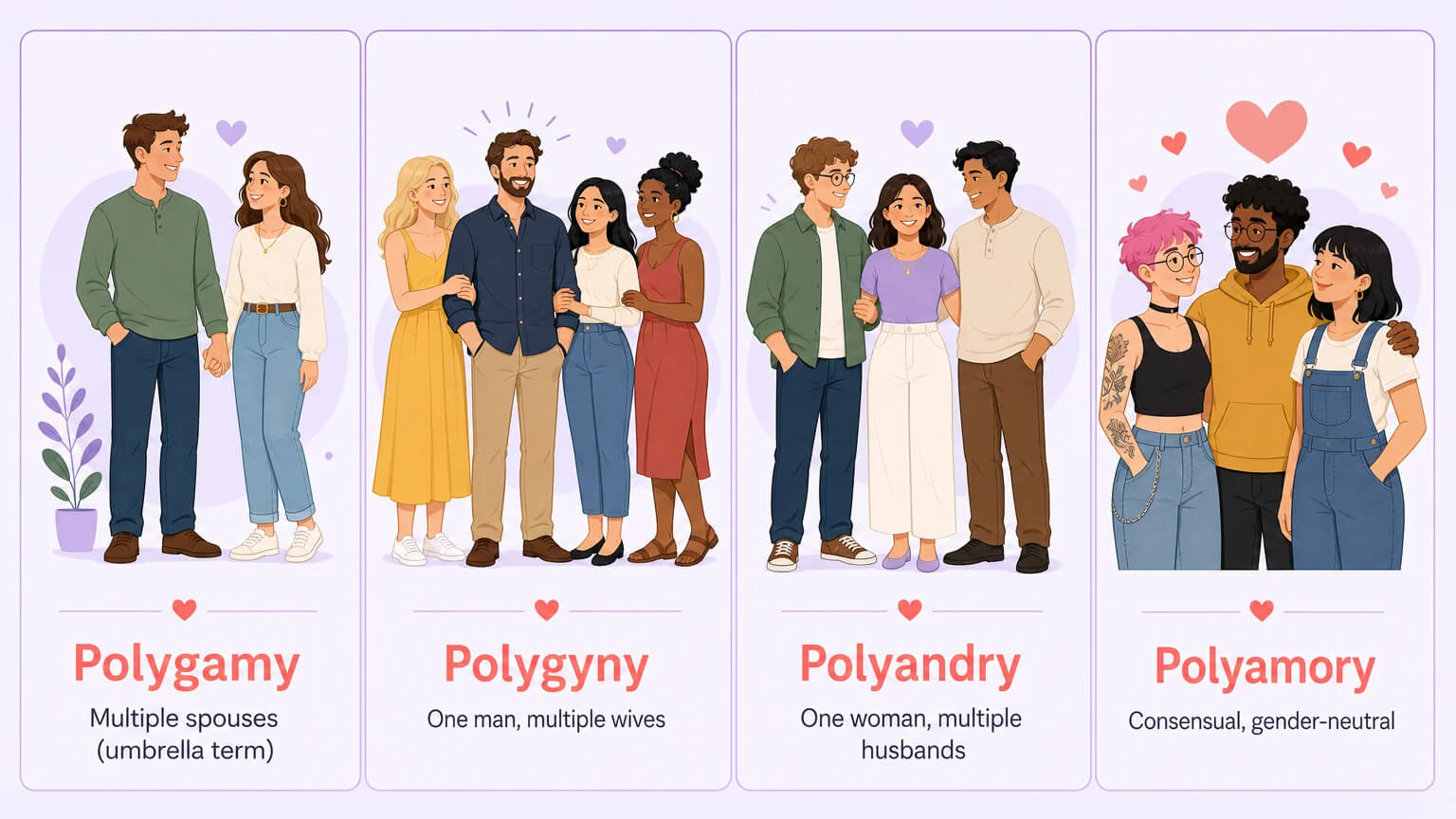
Polygamy is the umbrella term: marriage to multiple spouses in any gender configuration. It describes a legal or religious institution, not a relationship philosophy.
Polygyny is the specific form where one man has multiple wives. This is what nearly every religious tradition that permits polygamy actually practices, and it is the most common form globally.
Polyandry is one woman with multiple husbands. It is rare. The best-known examples come from Tibetan Buddhist Himalayan communities where brothers share one wife (fraternal polyandry) to prevent farmland from being divided into non-viable plots across generations. This is an economic survival strategy rather than a religious mandate.
Polyamory is the secular, gender-neutral practice of multiple consensual romantic relationships. There is no religious framework and no legal multiple marriages. The ethics center on honesty, transparency, and ongoing consent rather than scripture or tradition.
Polygamy is an institution. Polyamory is a philosophy. Both involve multiple partners, but almost everything else about them is different. Someone describing a husband with two wives is talking about polygyny. Someone in a secular triad is practicing polyamory. When a friend says “we opened our marriage,” they are describing polyamory. The words point to different worlds.
Now, here is how every major religion approaches polygamy.
1. Islam: The Only Major Religion That Still Explicitly Permits Polygamy
Islam is the religion most commonly associated with polygamy, and there is a reason for that. It is the only major world religion whose core scripture still actively permits and regulates the practice.
But Islam did not invent polygamy. It restricted it.
Before Islam, Arabian men married unlimited wives with zero obligations. When a man named Ghilan bin Salama accepted Islam with 10 wives, the Prophet Muhammad told him: “Keep four and separate from the rest” (narrated in Tirmidhi and Abu Dawud). Islam did not add polygamy. It cut it down and attached conditions.
Quran 4:3 is the verse everyone cites: “Marry women of your choice, two, or three, or four; but if you fear that you shall not be able to deal justly with them, then only one.”
The cap is four. The justice requirement is not optional. Quran 4:129 adds tension: “You will never be able to be just between wives, even if you strive to do so.” Some scholars read this as effectively encouraging monogamy. The permission exists, but the bar is set high enough that fulfilling it may be impossible.
Census data from across the Muslim world confirms that the vast majority of Muslim marriages are and always have been monogamous. Polygamy in Islam is a specific exception addressing war widows, orphans, and infertility. It is not the default family structure, and it never has been.
Islam explicitly forbids polyandry. Quran 4:24 states a woman cannot marry a man who is already married. Islamic scholars cite paternity clarity and lineage as the rationale, though critics note this reasoning is patriarchal and rooted in pre-DNA logic.
The political dimension remains contested. In June 2026, NCP MLA Sana Malik defended polygamy under Muslim Personal Law on the floor of the Maharashtra Assembly, arguing the Indian Constitution protects religious practice. The debate went viral. The conversation is not settled.
Islam’s relationship with polygamy is more restrictive than most outsiders assume and more debated than most insiders admit.
2. Mormonism: Banned on Earth, Still Practiced in the Afterlife
Ask a mainstream LDS member if Mormons practice polygamy and the answer is a clear no. The Church excommunicates members who practice earthly plural marriage.
The doctrine, however, never fully died.
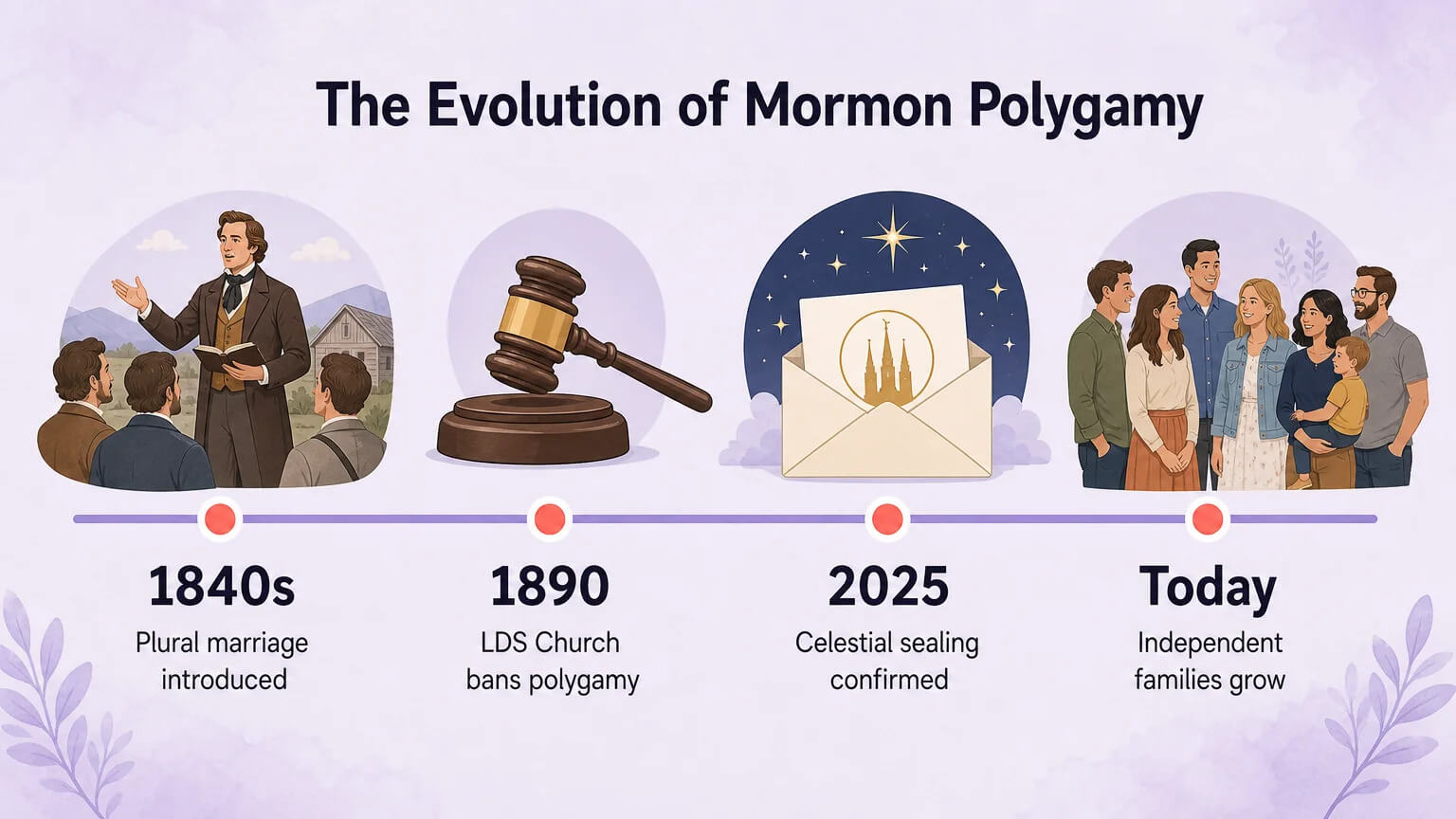
Joseph Smith introduced plural marriage in the 1840s. The LDS Church banned it in 1890 under intense federal pressure: the Edmunds Act (1882) and Edmunds-Tucker Act (1887) disincorporated the church, seized assets, and imprisoned practitioners. Utah statehood was contingent on the ban. This was political surrender, not theological reversal.
Celestial polygamy persists. In March 2025, the LDS First Presidency confirmed in a letter that the church still processes sealing clearances for men to be sealed to multiple women in the afterlife. The official LDS Handbook explicitly allows a man to be sealed to another woman after a wife’s death or divorce.
As one ex-Mormon put it: “I really believed there was a non-trivial chance that I would end up as a sister wife in heaven. This is not folklore.”
On the fundamentalist side, the landscape has shifted. The FLDS, led by Warren Jeffs from prison, has an estimated 6,000 to 10,000 remaining members. The Southern Poverty Law Center designates it as a hate group. The Order (Kingston Group) operates separately; former investigators describe it as “organized crime,” with multiple members convicted in a $1 billion biofuel tax fraud scheme in 2023.
Per researcher Cristina Rosetti of Utah Tech, the fastest-growing segment is independent polygamous families belonging to no organized group. These decentralized households are less authoritarian and harder to track.
The public case study is the Brown family of TLC’s Sister Wives. Fourteen seasons documented a modern fundamentalist plural marriage collapsing into heartbreak, custody disputes, and bitter separations by 2023. What began as an attempt to normalize polygamy ended as a record of everything that can go wrong.
Belle Decker, married to Warren Jeffs at 18 and conditioned from childhood to be a “mother in Zion,” took roughly ten attempts to escape. Her testimony: arranged marriages and polygamy were the same system. “If you go through the prophet, that is the only way to be pure.”
Mormon polygamy is simultaneously banned, practiced, and evolving. The earthly prohibition is real. The celestial doctrine is alive. The next chapter will not look like the last one.
3. Judaism: Biblical Patriarchs Had Many Wives, but That Ended 1,000 Years Ago
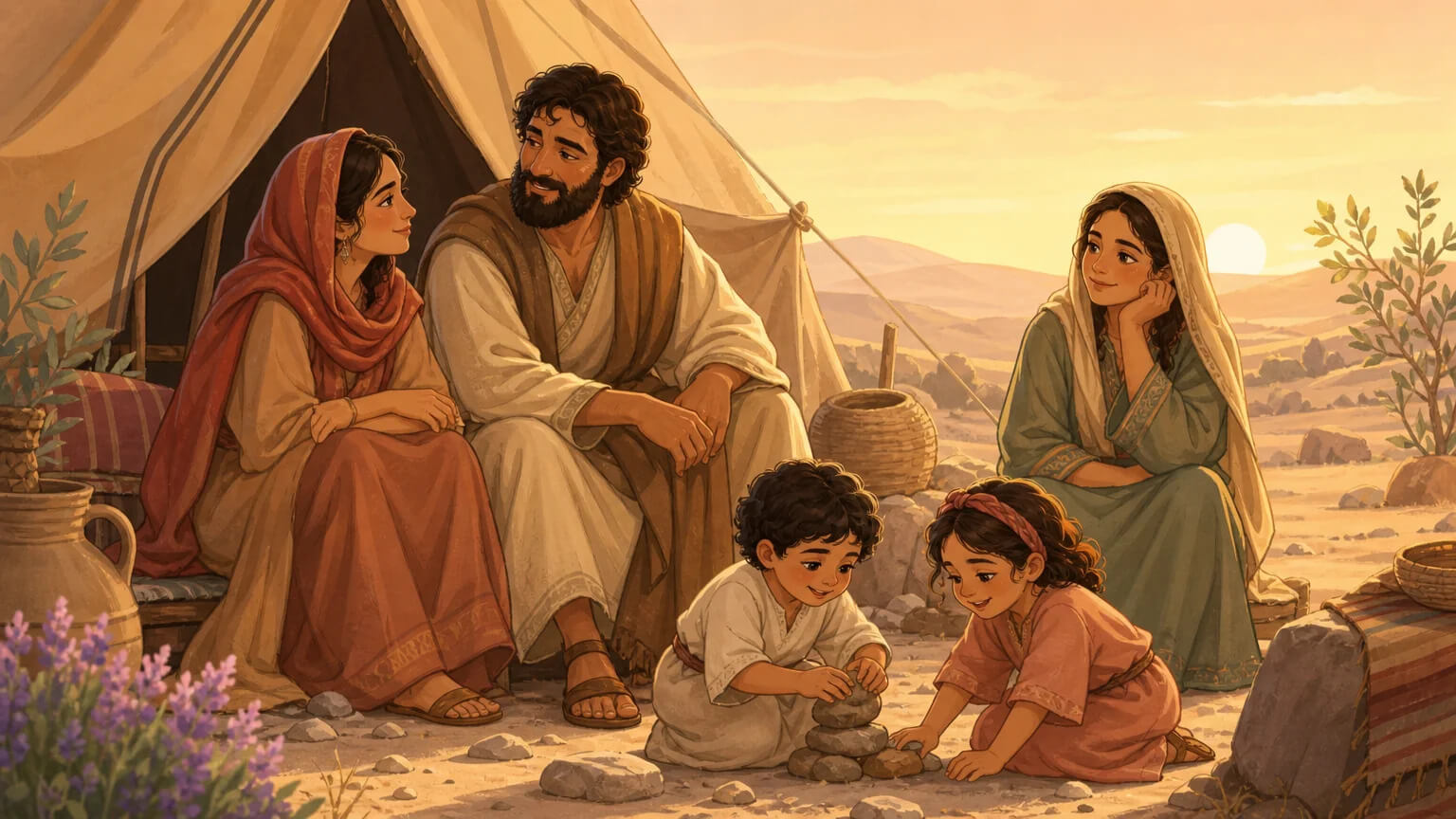
You cannot read the Hebrew Bible without encountering polygamy.
Abraham had Sarah and Hagar. Jacob had Leah and Rachel, plus their handmaids. King David had multiple wives. Solomon reportedly had 700 wives and 300 concubines.
The Torah does not prohibit polygamy. It regulates it. Deuteronomy 21:15-17 provides inheritance laws for children from multiple wives. Exodus 21:10 regulates their fair treatment. The text manages polygamy as a reality, not a sin.
Then came Rabbi Gershom ben Judah. Around 1000 CE, he issued a takkanah, a rabbinic decree, banning polygamy for Ashkenazi Jews. The ban was time-limited to roughly 1,000 years, which technically expired around 2000 CE. No mainstream Jewish community has revived the practice.
The detail most articles miss: the ban applied to Ashkenazi (European) Jews. Sephardic and Mizrahi Jews in the Middle East, North Africa, and Yemen continued polygamous practice into the mid-20th century. Geographic custom split where scripture did not.
Today, polygamy is effectively not practiced in any mainstream Jewish community. The State of Israel generally prohibits it, though some exceptions exist for existing polygamous families who immigrate.
Unlike Islam, which still permits polygamy, and Christianity, which developed a theological case against it, Judaism’s path was pragmatic. Rabbinic legislation solved what scripture left open. No divine command. Just a wise rabbi and a thousand-year clock.
4. Christianity: The Surprising History of a Religion That Did Not Always Require One Wife
Most readers assume Christianity has always been monogamous. The evidence says otherwise.
Augustine of Hippo, the 4th-century Church Father, admitted polygamy “cannot be called a sin.” That is worth pausing over: one of Christianity’s most influential theologians did not consider it inherently immoral.
The Old Testament, shared with Judaism, records over 40 polygamous unions: Abraham, Jacob, David, Solomon. The text provides laws for polygamous households without ever calling the practice sinful.
The New Testament shifted toward monogamy through passages like 1 Timothy 3:2, which requires bishops to be the “husband of one wife.” Biblical scholar Rico Cortes notes this applies to church leadership, not universally to all believers. Jesus’ teaching on marriage in Matthew 19:4-6, “the two shall become one flesh,” is interpreted as establishing monogamy as God’s design. It does not directly forbid polygamy.
So what happened? Three forces converged.
Roman law came first. Rome recognized only monogamous legal marriages. Concubines and mistresses were tolerated, but multiple legal wives were not. The fledgling church absorbed Roman norms by osmosis, not through doctrine.
Timing came second. Marriage was not formalized as a church sacrament until the 12th and 13th centuries, at the Senate of Verona in 1184 and the Second Council of Lyon in 1274. Before that, marriage was largely a private, secular affair. By the time the church institutionalized marriage, monogamy was already the cultural default.
Colonialism was the third force. Christian missionaries in Africa actively worked to end polygamous practices. The “Christianity equals monogamy” association feels timeless, but it is historically recent.
The tension persists. African Christian communities where cultural polygamy predates Christian conversion navigate a conflict most Western Christians never encounter. Mainstream Christianity today universally teaches monogamy. But the claim that the Bible explicitly forbids polygamy does not hold up to textual scrutiny.
Christianity’s monogamy is Roman law absorbed into church tradition, not a clear biblical prohibition. The history is messier, and more interesting, than the doctrine suggests.
5. Hinduism and Buddhism: Ancient Acceptance, Modern Legal Bans
Hinduism’s ancient texts treated polygamy as normal. Hindu kings and deities like Krishna are depicted with multiple wives. The Mahabharata shows some acceptance of polyandry in certain contexts, most famously Draupadi married to the five Pandava brothers.
Modern India tells a different story. The Hindu Marriage Act of 1955 legally forbids polygamy for Hindus. The gap between ancient acceptance and modern law creates its own tensions.
Here is a data point that tends to surprise people: Indian census data has sometimes shown polygamy rates among Hindus exceeding those among Muslims, despite Islam being the religion most associated with polygamy in Indian political discourse. Culture, economics, and geography often override theology. The simple narrative does not survive contact with the numbers.
Buddhism takes a characteristically measured position. The Buddha’s guidance on marriage focused on mutual respect and ethical conduct rather than partner count. Buddhism neither endorses nor prohibits polygamy in its core teachings.
The most distinctive Buddhist contribution to the conversation is fraternal polyandry in Tibetan Buddhist Himalayan communities. In Nepal’s remote villages, brothers share one wife not out of desire but to prevent farmland from being divided into economically non-viable plots across generations. Land stays intact, resources stay pooled, and the family lineage continues. This is geography driving relationship structure, not doctrine.
Modern legal and cultural norms have largely eclipsed historical polygamous practices in both traditions. The Tibetan polyandry exception proves that sometimes survival logic overrides everything else.
6. African Traditional Religions: Where Most of the World’s Polygamous Households Actually Are
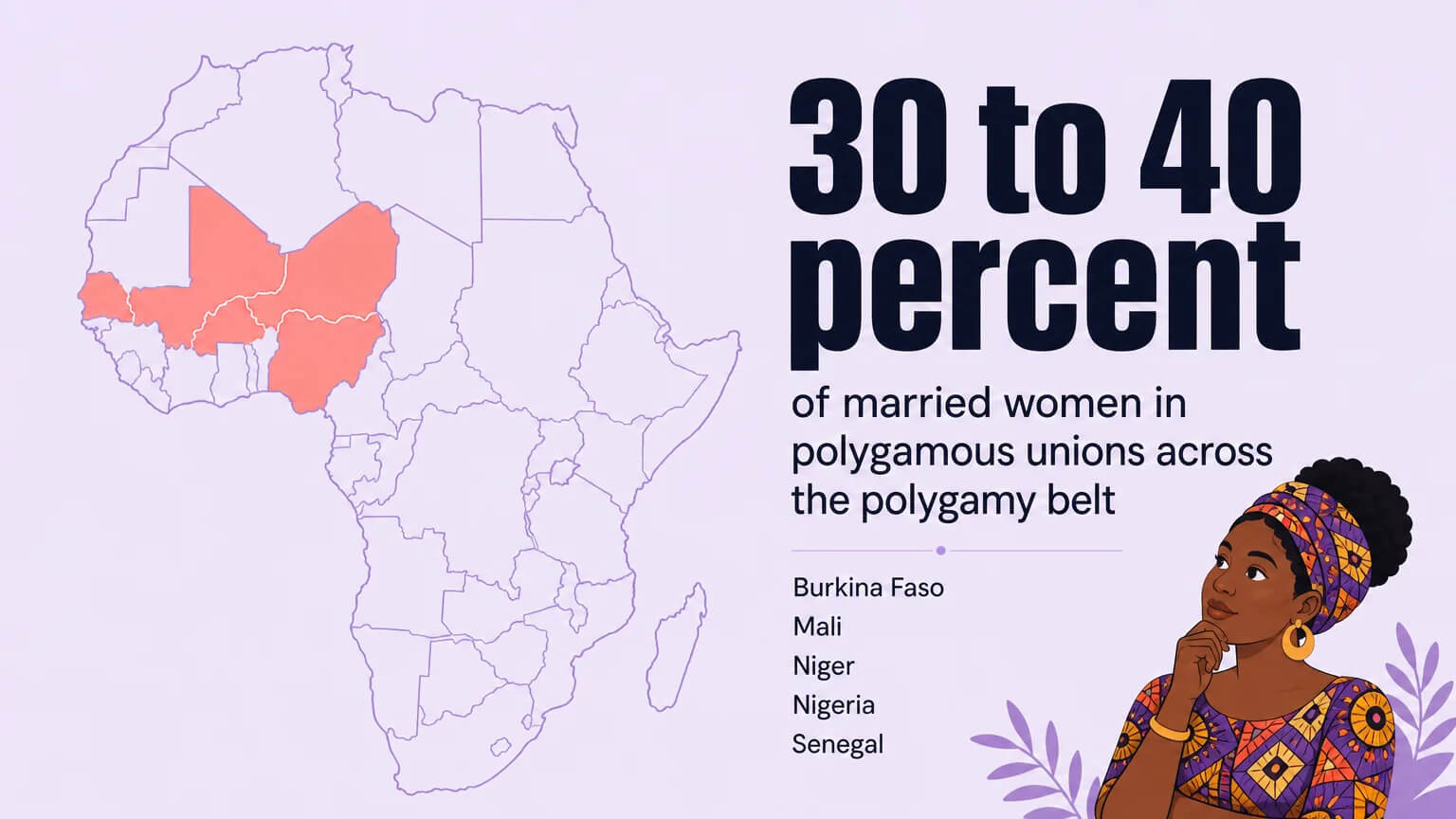
If you want to understand where polygamy is most practiced today, look at a map of West and Central Africa.
The “polygamy belt” stretches across Burkina Faso, Mali, Niger, Nigeria, Senegal, and beyond. This is where the 2% global polygamy statistic concentrates. In some of these countries, 30 to 40% of married women are in polygamous unions. This is normal family structure for millions of people.
South Africa offers the most legally sophisticated example. The Recognition of Customary Marriages Act of 1998 legally recognizes polygamous marriages conducted under customary law. A Zulu customary polygamous marriage involves consent of all existing spouses, family involvement in negotiations, lobola (bride wealth, traditionally cattle, now often cash), and proper cultural rituals.
A 2024 Bloemfontein High Court case upheld a valid customary marriage based on Zulu procedures even without formal registration. Courts actively enforce these traditions.
Former President Jacob Zuma, a Zulu traditionalist, publicly had four wives, making South Africa one of the few countries where a head of state’s polygamy was a cultural norm rather than a scandal. The colonial-era lobola standard was 10 plus 1 cows: ten for the family, one for the mother.
African customary polygamy is cultural and ancestral, not scriptural. It predates Christianity and Islam in the region, though it now coexists with both. A person might be Christian, Muslim, or follow a traditional religion, and still practice polygamy under customary law.
Skipping African traditional religions in a survey of polygamy is like writing about Christianity and skipping the Vatican. This is where the practice is most demographically significant.
7. Sikhism: The Religion That Said No to Polygamy on Principle

Every other major religion either permitted, regulated, or evolved away from polygamy. Sikhism is different: it rejected polygamy from its founding as a philosophical position.
The Rehat Maryada, the Sikh Code of Conduct, states in Article XVIII, section p: “Generally, no Sikh should marry a second wife if the first wife is alive.” That is the legal rule. The foundation runs deeper.
Guru Amar Das, the third Sikh Guru, defined marriage in the Guru Granth Sahib (Ang 1165) as “ek jot du-ay moortee,” one light in two bodies. This is not a prohibition. It is a definition. If marriage is inherently an exclusive spiritual union, polygamy becomes a category error rather than a forbidden act.
The Sikh Gurus developed this position in 15th and 16th century India, where polygamy was common among both Hindu rulers and Muslim nobility. They consciously rejected it, making monogamy part of their broader project of elevating women’s status and establishing marriage as an equal spiritual partnership.
Today, mainstream Sikhism worldwide maintains this monogamy stance. Every other religion’s polygamy story involves permission, regulation, or gradual evolution away from the practice. Sikhism’s story is about saying no on principle, from day one, and never wavering.
Religious Polygamy vs. Modern Ethical Non-Monogamy: Where They Overlap and Where They Split
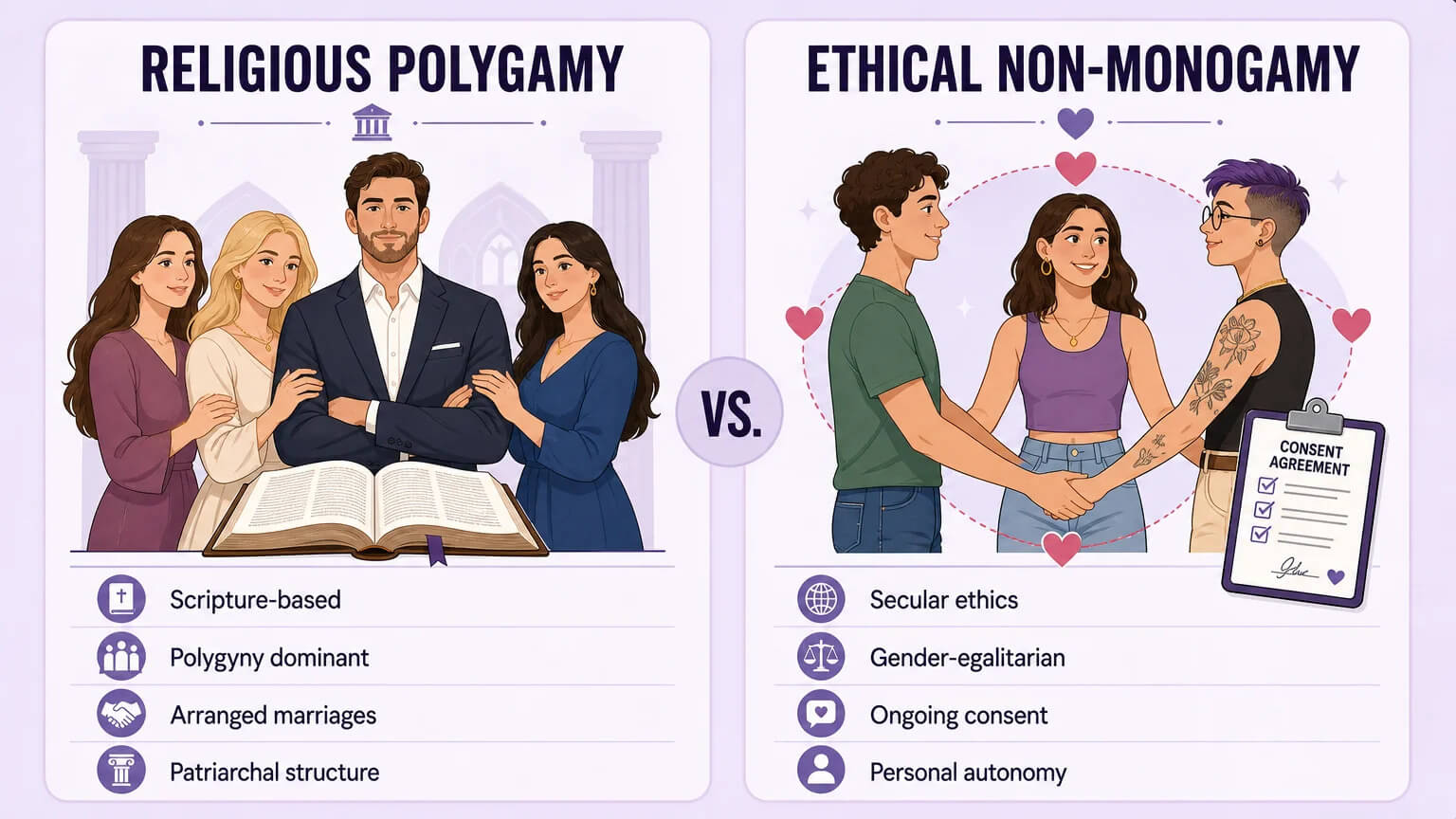
Both involve multiple partners. That is roughly where the similarity ends.
Consent architecture is where the two diverge most sharply. Religious polygamy is overwhelmingly polygyny: one man, multiple women. Arranged marriages are common. In the FLDS, the prophet assigned wives to husbands. In some traditional African arrangements, women had limited or no choice in partner selection. Modern ethical non-monogamy centers informed, ongoing, enthusiastic consent from all parties. Partner count, configuration, and boundaries are negotiated rather than decreed.
Gender dynamics tell a parallel story. Religious polygamy is patriarchal by design. Men can have multiple wives. Women cannot have multiple husbands. The rare Tibetan polyandry exception is economic, not religious. ENM is gender-egalitarian. Women, men, and nonbinary people all participate as equal agents.
The relationship philosophy differs at the foundation. Religious polygamy is marriage-based and rooted in scripture or tradition. ENM is relationship-based and rooted in personal autonomy. Honesty, transparency, communication, and ongoing consent replace religious authority.
There is an overlap zone worth acknowledging. Some modern polyamorous people come from religious backgrounds and reframe their practice as reclaiming multi-partner relationships on egalitarian terms. Some religious polygamous communities are quietly evolving. Independent fundamentalist Mormon families, per Cristina Rosetti, are decentralized, less authoritarian, and sometimes more consensual than the headline-grabbing FLDS model.
The split between the two camps is real and often deliberate. Polyamorists actively distance themselves from religious polygamy. The 1856 US Republican Party platform called polygamy and slavery “twin relics of barbarism.” Modern ENM communities work to shed that association by emphasizing that their practice is about freely chosen love, not male-dominated household structures.
Approximately 4 to 5% of Americans practice some form of consensual non-monogamy. That is roughly double the global polygamous household rate. Understanding where you sit on this spectrum and why is more useful than arguing about labels.
Religious polygamy asks what is permitted. ENM asks what is negotiated. Those are two different questions.
FAQ
Is polygamy legal anywhere today?
Yes. Polygamy is legal or tolerated in most Muslim-majority countries including Saudi Arabia, UAE, Pakistan, Indonesia, Egypt, and Qatar, though Turkey and Tunisia have banned it. South Africa legally recognizes polygamous customary marriages. Multiple West and Central African nations permit it under customary or religious law. It is illegal in most Western countries. Approximately 2% of the global population lives in polygamous households.
Do Mormons still practice polygamy?
The mainstream LDS Church does not permit earthly polygamy and excommunicates members who practice it. However, the doctrine of celestial, or afterlife, polygamy persists: men can be sealed to multiple women for eternity after a wife’s death or divorce, confirmed by 2025 First Presidency letters. Fundamentalist offshoots including the FLDS, AUB, and independent families continue earthly polygamy outside the mainstream church.
Why did Islam allow polygamy?
Islam did not invent polygamy. It regulated a pre-existing Arabian practice where men could marry unlimited wives with no obligations. Quran 4:3 capped it at four and made equal treatment a binding condition. Historically, polygamy served as a social welfare mechanism, providing economic support and legal protection for war widows and orphans in a society where women lacked independent means.
What is the difference between polygamy and polyamory?
Polygamy is marriage to multiple spouses, overwhelmingly religious, patriarchal (polygyny), and rooted in scripture or tradition. Polyamory is secular, gender-egalitarian, consent-based, and centered on multiple romantic relationships rather than legal marriage. The two share a surface similarity, multiple partners, but diverge sharply on ethics, structure, and power dynamics.
Does the Bible say polygamy is a sin?
No. The Bible never explicitly calls polygamy a sin. The Old Testament records over 40 polygamous unions and provides laws regulating the practice in Deuteronomy 21:15-17. The New Testament establishes monogamy as ideal for church leadership, 1 Timothy 3:2 requires bishops to be the “husband of one wife,” but does not issue a universal prohibition. Christianity’s monogamy stance developed through centuries of Roman cultural absorption and church institutionalization, not a single biblical command.
Where is polygamy most common today?
The West and Central African “polygamy belt” including Burkina Faso, Mali, Niger, Nigeria, and Senegal has the highest concentration of polygamous households globally. In some of these countries, 30 to 40% of married women are in polygamous unions. This is driven by a combination of African traditional religion, customary law, and cultural practice that predates both Christianity and Islam in the region.