“I’ve always wanted a gay best friend.” The woman saying it means it as a compliment. It lands like a job posting. Somewhere inside the sentence is a role with a description, a set of duties, and an applicant who has not been asked whether he wants the position.
That gap, between the warmth of the intention and the strangeness of the offer, is the whole question of why girls have gay friends. The pull is partly manufactured, sold to young women by television and magazines for decades, and partly something more ordinary and better documented: a male friendship with no pursuit in it. Both are true at once. The useful move is telling them apart.
Separating them means taking the friendship seriously, giving the man on the receiving end of the phrase his own account, and marking where the evidence runs out well before the confidence around it does.
The Gay Best Friend Was Sold, Not Found: From the Hays Code to Teen Vogue
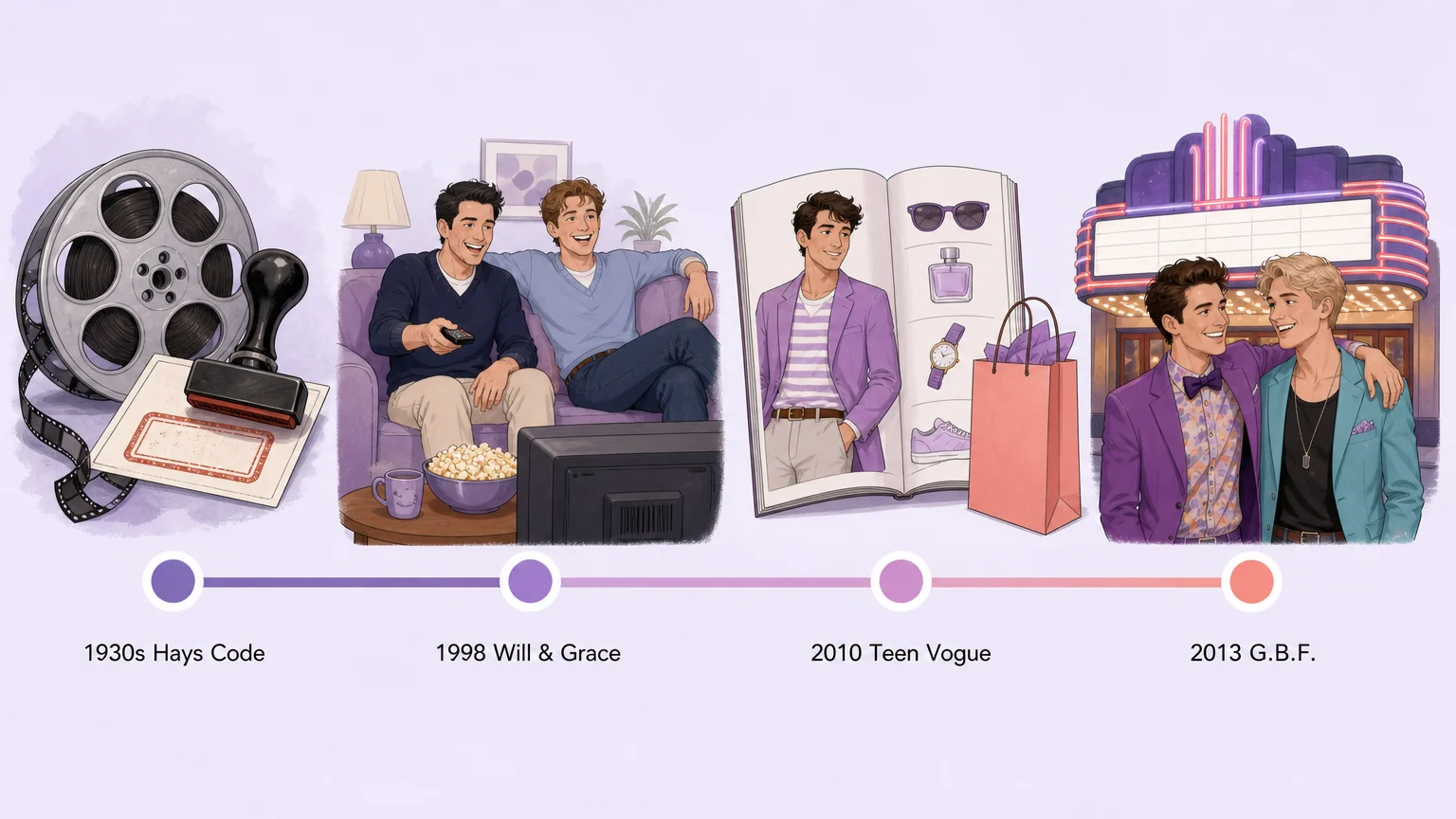
In July 2010, Teen Vogue listed the gay best friend as a “must-have item,” beside a tie-dyed top and neon bracelets. A person does not land on a shopping list unless somebody has decided he can be bought.
The type is older than the show everyone credits. It descends from the sissy character, a stock comic figure. The Hays Code, Hollywood’s moral rules from the 1930s, treated homosexuality as deviancy and pushed the sissy into villainy.
The modern gay best friend is a partial return to the non-villainous version: flamboyant, well-groomed, safely non-sexual. Sympathetic prototypes predate the 1990s, in Next Stop, Greenwich Village, Cabaret and The Woman in Red. The appetite was trained long before any living reader chose it.
Will & Grace, from 1998, is what most people mean by the beginning. Its innovation was structural: the story balanced between a gay male lead and a straight female lead rather than parking one as a sidekick orbiting the other. It also ran the flamboyant version beside them in Jack and Karen, letting Will stay presentable while Jack carried the camp. The compromise that made the role mainstream is the one that keeps it narrow.
A 2011 analysis in Georgetown’s Gnovis Journal reads the identity across seven shows and films, finding five things that construct it: socioeconomic status, the body, personal relationships, behavior, and a lack of agency. Every principal gay-best-friend character in those texts was Caucasian, affluent and slender. The role has a race, a class and a body type, which is the first sign a type is doing the choosing.
Then there is the friendship with a salary attached. The same analysis finds these characters cut off from family, from straight men and from other gay men, leaving the female friend as nearly their whole social world.
There is a power differential too. Jack depends on Karen’s money, and Nigel, Marc and Sean are all gay best friend to their employer, their compliance reading as self-policing rather than coercion. A friendship can feel like family and still be unequal without anyone in it being a villain.
The role is a slot. In Sex and the City, when Carrie befriends another gay man, Stanford informs him she is spoken for, and the man apologizes, as though a woman could hold only one such friendship. G.B.F., a 2013 film, has popular girls competing for an openly gay classmate as a social advantage and pushing him to come out publicly as a pawn. One seat, many applicants, and the person in it is interchangeable.
Then the logic leaves fiction. A WikiHow guide titled “How to Find Your Gay Best Friend.” An inflatable gay best friend, advertised for 6.99 pounds.
What all of it produces is containment. The gay character is visible again, but mainly in a form that is safe, stylish and non-sexual. That is the inheritance any woman asking why she has a gay friend is working with.
Why Women Befriend Gay Men: The Researched Reasons and the Stereotype-Driven Ones
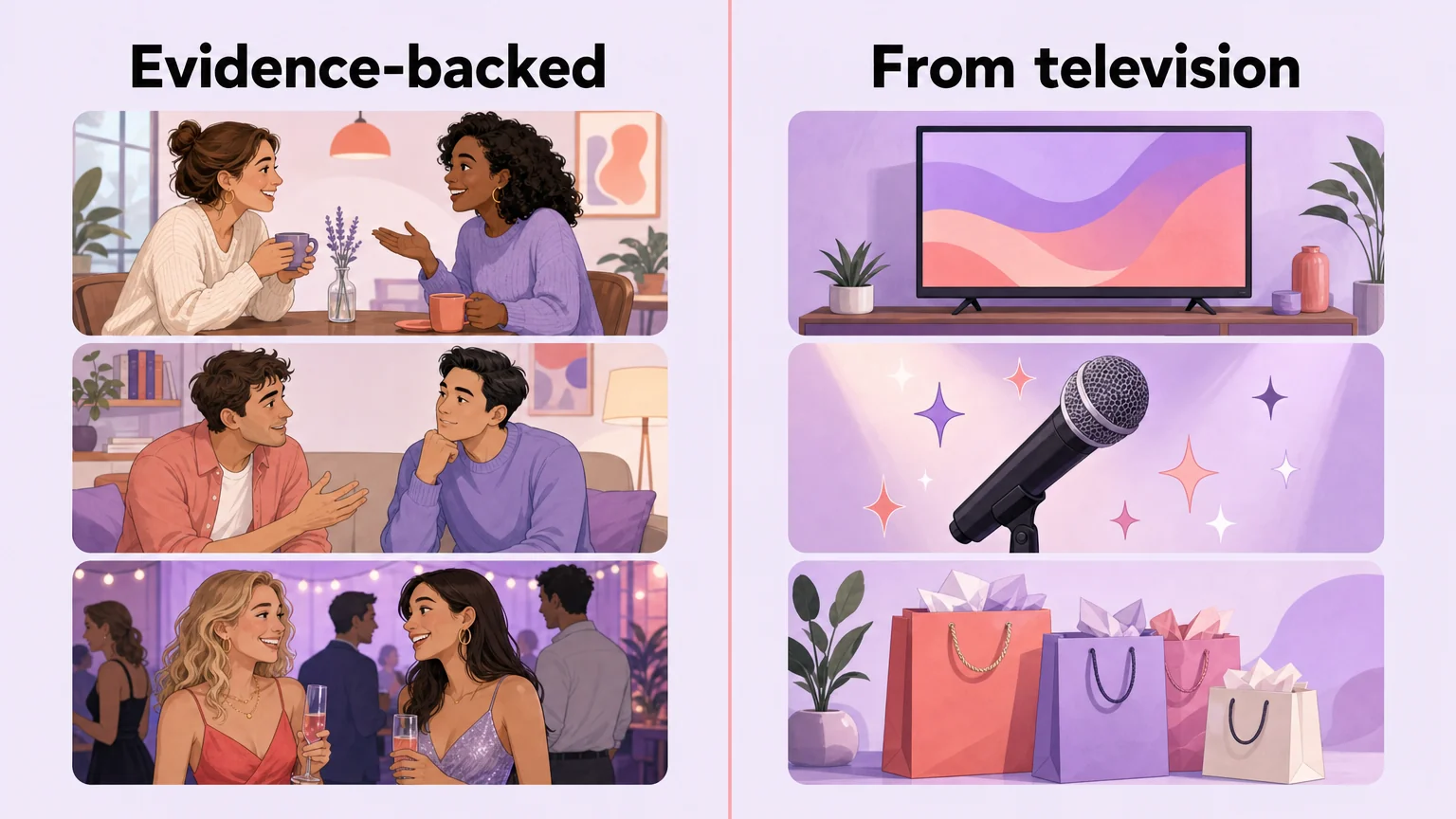
Some reasons women befriend gay men have studies behind them. Others came from a screen. The two have been blended so long that most people cannot tell which is which. Sorting them is the only way to use either.
A 2013 paper in Evolutionary Psychology reported two experiments. Straight women judged dating guidance from a gay man as more credible than identical guidance from a straight man or a straight woman. Gay men judged the same guidance from a straight woman as more credible than from a lesbian or another gay man. The exchange runs both ways, which is what makes it a friendship rather than a service counter.
A 2017 paper in Archives of Sexual Behavior reported four studies and narrowed the claim. The trust advantage held for advice about mating and did not extend to career advice, and a gay man was rated more sincere in situations involving sexual or competitive deception. And when mating competition was made to feel salient, women’s trust in gay men rose along with their willingness to befriend them. That is a much narrower claim than “women trust gay men.”
A 2018 paper in Psychological Science ran two studies in which women first pictured a conversation with a man, then had one. After learning he was gay, they reported more comfort and showed more intimate engagement, explained by less worry about his sexual intentions. The effect was strongest among women who rated themselves more attractive. What was measured matters: comfort in a first conversation, not the quality of a long friendship.
Then the threat argument. A study in Personality and Individual Differences proposes that women who absorb more sexual deception from straight men, and more competitive deception from straight women, have more to gain from a friend with no stake in either contest. In a “friend dollars” allocation task, more attractive women gave more to gay male friends. The exact figures are not reliable enough to repeat.
Sorted, the evidence is one mechanism wearing three faces: safety from pursuit, advice with no ulterior motive, and no competition for the same partners. The stereotype-driven reasons are a different set: fashion advice, sass, the shopping companion, and the signal that a woman keeps a certain kind of company. Those came from television, and the seam between the two groups should stay visible.
In China, gaymi, a play on the word for best girlfriend, describes a gay male best friend. Straight women interviewed by Sixth Tone described these friends as stylish, attentive, gentle rather than macho, safe to be physically affectionate with, and free of romantic drama, and some of those friendships double as social display. Those are interviews with unnamed women, not a study, and they suggest the appeal extends beyond mating advice.
Plenty of women want none of this. One described gay men as the only men not secretly trying to sleep with her. Another remembered that at nineteen, male attention was everywhere, and a gay friend would have been a relief.
Neither describes a preference held by women in general. Each describes one person.
Where the Gay Best Friend Research Is Thinner Than It Looks
Nearly every published explanation of this friendship traces to one psychologist and a small circle of co-authors. Eric Russell, working with different collaborators between 2013 and 2018, produced the experiments above, and several of the clearest explanations of them are the researchers describing their own findings rather than an outside check. No independent replication of any of it surfaced. That limits how far the findings carry; it does not erase them.
The samples are the second limit, and the smaller they get, the less a finding can carry. Most were US undergraduates, tested in lab conversations and hypothetical allocation tasks. The attractiveness finding rests on one small undergraduate sample, and the exact figures around it are not reliable enough to repeat.
What the work can say is narrow by design. It describes a tendency in first encounters and in one domain, advice about dating. It does not explain why women keep gay friends for a decade, and it does not measure affection.
The mechanism is plausible and consistent across the studies. It is still a hypothesis about a tendency, and a useful one.
What It’s Like to Be Cast as the Gay Best Friend

A gay student gets invited to dinner because two women are competing, in the host’s words, “to see which of our Sassy Gay Friends is funnier!” Later, a drunk woman he had met an hour earlier tells him, “I want more Gay Friends. Gays are the best! I hope that’s not offensive.” Both moments come from a 2013 first-person account in The Stanford Daily, and the second one is the whole problem in a single sentence: affection and insult arriving together, from someone who believes she is being kind.
The word for this is fetishization, and it does not have to be sexual. It is valuing a person as a type or a commodity rather than an individual, which is why being idolized can feel like being erased. Daniel Harding, who wrote Gay Man Talking, puts the logic of the label plainly: it means they are normal, and you are the other. The compliment and the erasure use the same words, which is why objecting to one can sound like refusing the other.
The stereotype also turns a man into a grab bag of sassy one-liners. When he opens up instead, his friend’s eyes glaze over, as if she is waiting for him to start saying “guuurl” again.
Philip Ellis described the same erasure on BBC Radio 5 Live in 2018, recalling times he was treated like a piece of furniture, with women changing in front of him because he was gay. He described becoming an accessory, like a handbag. Nobody in those moments was being cruel. They had stopped registering him as a person with a body of his own.
DyQuell Dontae describes a more complicated version. Girls were the first to defend him from bullies, and women understood him when boys did not. Some of those same friendships later made him feel like a purse, including the expectation that he would absorb their homophobic boyfriends. His test is the one worth keeping: would she march beside you when it cost her something?
It would be tidy to end there, and wrong. Some gay men value these friendships and say so, especially the protection and belonging they gave them at school. The question is not whether the role is good or bad. It is whether you were chosen or collected.
The Double Standard: Why the Same Friend Group Wants a Gay Best Friend but Not a Lesbian One
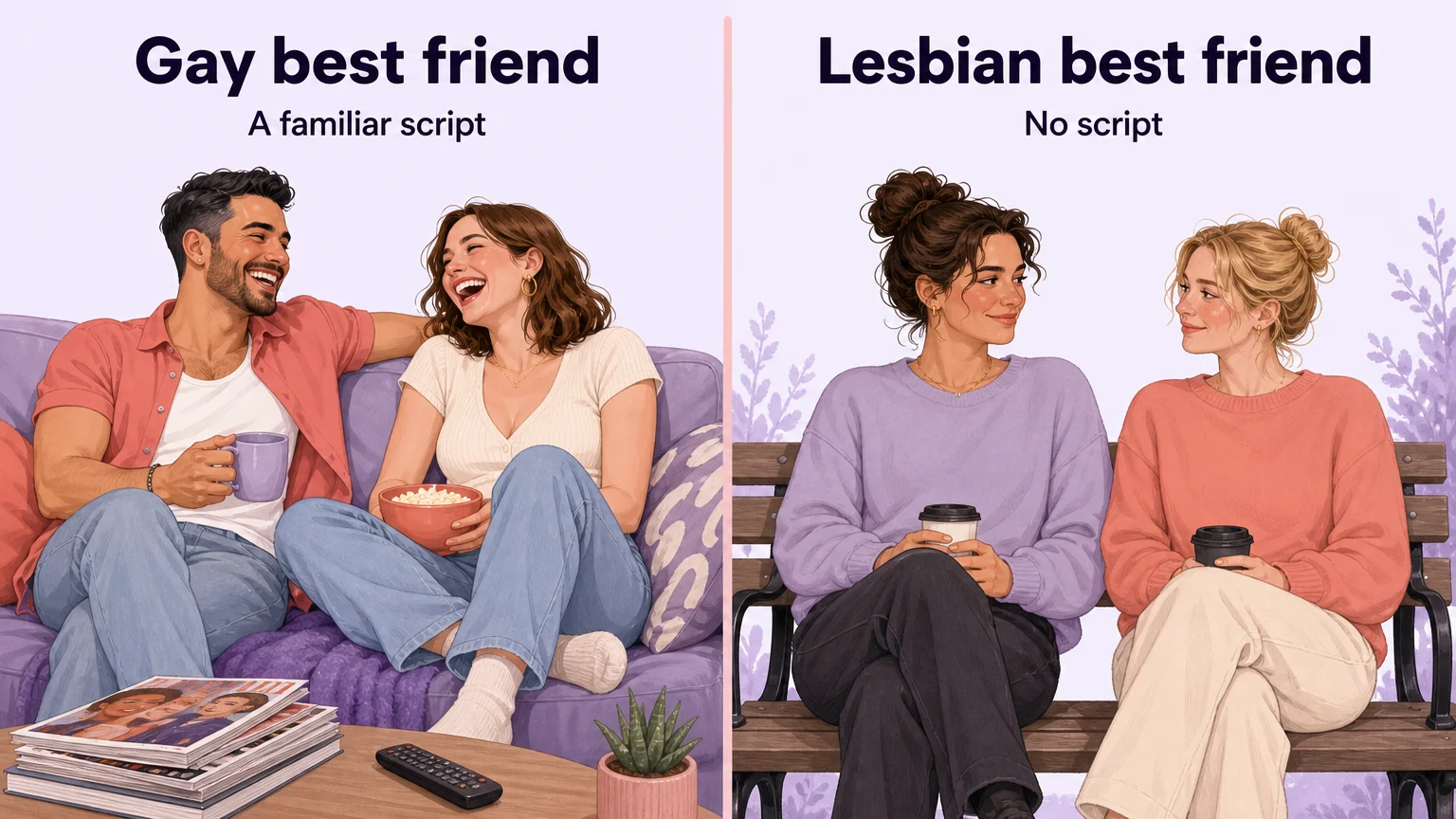
A straight woman left a comment that a gay creator read out on camera in 2025: women want a gay man, “never lesbian or bi women,” and they get uncomfortable when somebody points that out. That is one commenter’s claim, not a finding. It is also recognizable enough to sting.
The lesbian sidekick exists. She is just thinner. Bobbi in Conversations With Friends, Maggie in Younger, Susie in The Marvelous Mrs. Maisel: each is a sidekick whose own romantic life and ambitions go largely unexplored.
Reporting on GLAAD’s data put most LGBTQ characters on television under three minutes of screen time. The absence is not for lack of a template. Nobody developed one.
Lucy Chung made the case in 2025 for why the pairing never got branded the same way. The lesbian and straight man friendship has no equivalent cultural script, fewer shared spaces, and two working stereotypes against it, the straight man as toxic and the lesbian as man-hating. There is also the fact that lesbians often deliberately decenter men.
That last one is not a flaw. It is fatal to a role whose job is to evaluate men.
Which is the mechanism. The slot exists so a woman can get advice about men from a position of no competition, and that is exactly where the trust findings come from. A lesbian friend cannot fill it. Not because she is less safe or less fun, but because she is not a candidate for the job. Once you see that, a preference and a double standard turn out to have the same shape.
The same logic recycles elsewhere. The “trans best friend” follows the pattern, and one trans woman wrote that cis women can be progressive about trans people as a category and still treat her as a sex object or a stereotype. Bisexual people are usually left out of the question entirely, even by women who say they want a gay best friend. The first is one woman’s account; the second is a pattern in the complaints, not a documented finding. That is a thinner record than the one behind the gay-man and straight-woman pairing, and it should be read that way.
None of this is about who is more accepting. It is about what the role requires.
Is the Appeal About Gay Men, or About a Man Who Is Not Pursuing Her?
Take the studies at their word and the benefit of a gay male friend sits in two absences: no sexual pursuit, and no competition for the same partners. If those are the active ingredients, then a straight man who is genuinely not pursuing a woman should produce much of the same effect. The orientation may be doing less work than the culture assumes.
Some gay men make exactly this argument. They say these friendships can be born of, and then reproduce, an unhealthy distrust of other men, and that the same closeness is available in an ordinary male-female friendship without mutual attraction. That is an argument people make about their own experience. It is not evidence, and it should be read that way.
Nothing in the research tests the alternative directly. It stays a question. The state of the evidence is two plausible stories and no test that separates them.
Concede what the other side has. A shared experience of homophobia, a shared vocabulary for talking about men, a shared aesthetic culture: a straight male friend does not automatically bring any of that, and in some friendships those things may matter more than the safety does.
So test it against a relationship you have. Would the closeness survive if he were straight and simply not interested? If the answer is yes, the orientation was never the active ingredient. If the answer is no, something else is doing the work, and it is worth knowing what that is.
How to Tell a Genuine Friendship From a Tokenizing One
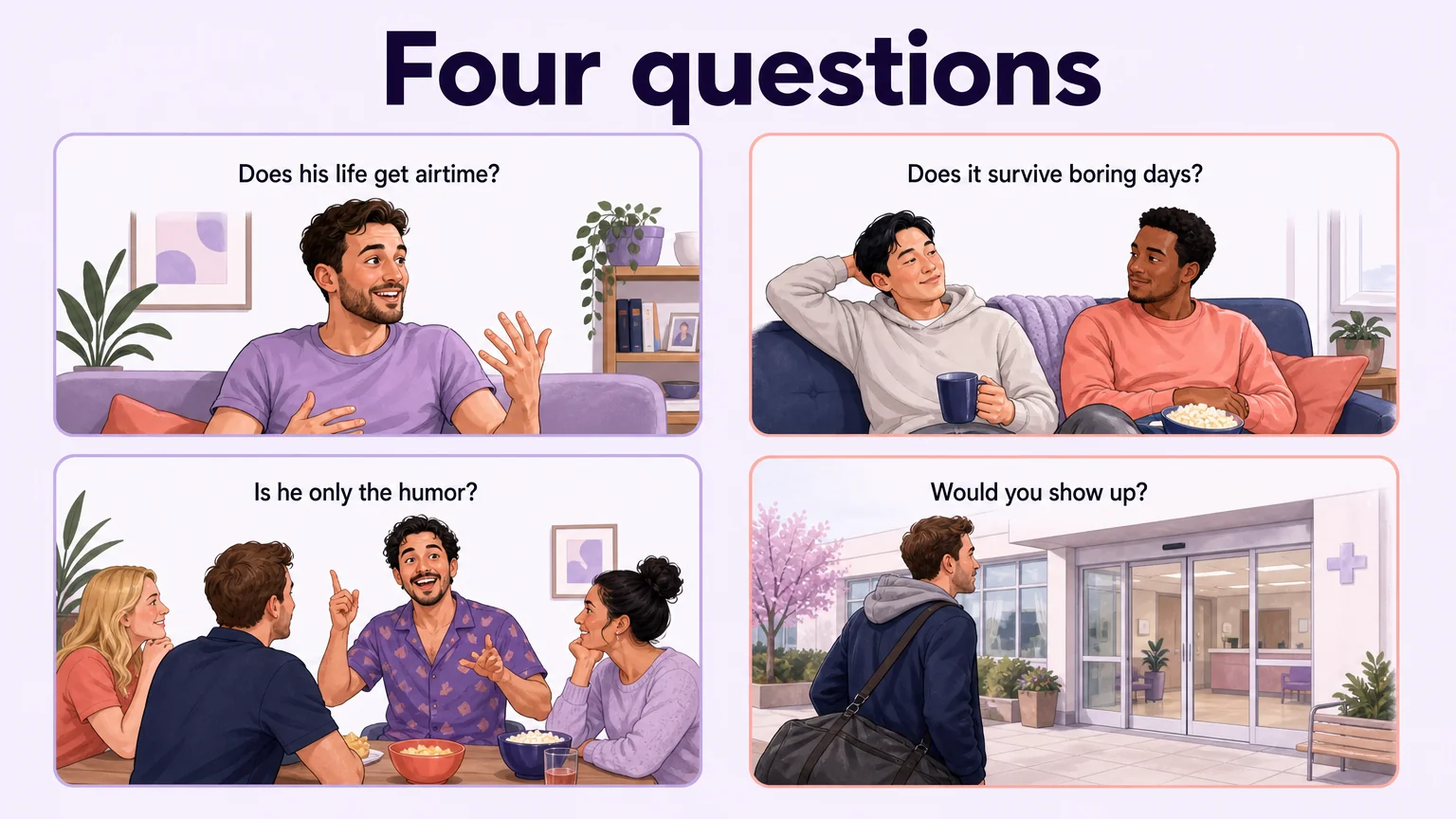
Four questions sort most of it, and none of them are about sexuality.
Does his romantic life, his work, his family and his money get airtime, or is he there to be a sounding board? Does the friendship survive him being boring, broke or needy? Is he the group’s humor supply, the person expected to perform at the table? Would you choose him for something that is not fun at all, the airport run or the hospital waiting room?
The novelist Caroline O’Donoghue wrote in 2023 about a friendship with a gay man that began in a record shop in Cork in 2009 and grew into a shared creative life, complete with a failed sitcom and matching tattoos. It also contained an admission. Part of her nineteen-year-old self never wanted him to come out, because she wanted to stay the only person who received his particular brilliance. That is her account of her own friendship, and it is the cleanest illustration that a good friendship can carry a tokenizing thread without being false.
Eric Russell’s own caveat belongs here as well. If a woman values a gay male friend only for dating advice, he has said, the friendship can become quite superficial, though early trust can act as a primer for something deeper.
For the gay reader, three distinctions carry the same weight. Being close is not the same as being used. A friend’s homophobic boyfriend is not a fee attached to the friendship. Keeping friendships with other gay men and with straight men means one woman is not your whole social world, which is also what makes it possible to notice when you are performing rather than being known.
The tell, in the end, is whether both people are subjects in the story or one of them is the audience.
When a Boyfriend Feels Threatened: Adult Boundaries in These Friendships

When a new boyfriend feels threatened, the complaint is rarely about sexuality. The two halves are worth separating.
A 2025 advice column took up the case of a woman eight weeks into dating a man who lives with a gay male friend of about ten years. The columnist named the stereotype half, the assumption that closeness proves something, and set it aside. Then she named the substantive half.
Time and emotional energy are finite. Feeling like a third wheel is a complaint about a relationship, not about anyone’s orientation.
A suspicion that a partner is lying is a serious issue on its own. So is his judgment about whether the friend has feelings for him. An ultimatum, she wrote, is the failure mode.
The trope assumes the gay friend is sexless, which is its own distortion and the reason this gets awkward. In the same case, the woman suspected unrequited feelings that the boyfriend reportedly knew about. The useful question there is about honesty and time, not about whether attraction invalidates a friendship. It does not.
The third situation is the saddest. A daytime television segment in January 2026 brought on two women who had been friends since ninth grade, close enough that one family took the other in when she was a teenager. One of them came out.
The friendship ended after the new girlfriend’s hostility and an ultimatum. The friend who was taken in still sees that family’s younger sister every week. What did the damage was the new partner’s jealousy. Not the friendship, and not the coming out.
The distinction running through all three is simple. Name the concrete thing: hours, honesty, emotional bandwidth. Not the person’s orientation.
Frequently Asked Questions
Why do girls and women want gay male friends?
The documented pull is the absence of sexual pursuit and of competition for the same partners, plus dating advice with no ulterior motive. The style and sass version came from television. Both describe a tendency, not a rule, and plenty of women want neither.
Is “gay best friend” offensive?
Many gay men say yes, because it defines a person by a role and turns a sexuality into a job title. Others use it affectionately or reclaim it. The strongest objection is not rudeness. It is sorting: one friend is normal, and the other is the other.
Do gay men actually want to be someone’s gay best friend?
Often not. The objection is to the role, not the friendship. The complaints are about being a purse, a trophy, a piece of furniture or a token, while many of the same men describe genuine closeness and protection from female friends at school.
Did Will & Grace invent the gay best friend?
No. The type descends from the sissy character and appears earlier in Next Stop, Greenwich Village, Cabaret and The Woman in Red. Will & Grace is the pivot because from 1998 it balanced the story between the gay lead and the straight lead. It popularized a template rather than inventing one.
Why a gay male friend and not a lesbian or bisexual one?
Partly branding, since one pairing has a familiar script and the other does not. Partly different stereotypes. And partly structure: the job is to advise on men from a position of no competition, which a lesbian friend does not occupy, often by choice. Bisexual and trans people are usually left out of the question entirely.
Is the relationship always platonic?
Usually, and that is the premise of the safe-bet explanation, but not guaranteed. The assumption that the gay friend is sexless is its own distortion. Where attraction exists, it is a question about honesty and boundaries, not proof that the friendship is wrong.
What happens to the friendship when the woman gets a boyfriend?
It becomes a negotiation about time, honesty and emotional bandwidth rather than about sexuality. The documented failures come from a new partner’s jealousy and from ultimatums that force a choice. The friendship survives that if the conversation stays on those terms.