
Your friend went quiet when the table turned to dating. Or they said one thing about a man’s shoulders six weeks ago, and the question of how to tell if my friend is gay has been in your head since. You are not trying to diagnose anyone. You want to stop guessing and know what to do with it.
Only your friend can answer that question, and everything below is inference, not evidence. You want to know how to know if your friend is gay without turning the friendship into an investigation. Signs are things you have noticed, and a pile of them is still not proof.
You may have a friend of any gender. You may be queer yourself. You may have a crush and be trying to separate that from the friendship. The last one is not forgotten.
Fifteen things you may have noticed, each with what it can suggest, what it cannot prove, and one practical move. The last few items turn toward your own reading, because that is where your question lives. By the end you will know what to do with the noticing, whether or not you ever learn the answer.
1. They Notice Other Men Out Loud, and Rarely Women
Signal: the unprompted detail. An actor’s jaw, a colleague’s shoulders, the barista’s arms. It is specific, physical, and comes up more than once. When women come up at all, the comment is about personality, or about nothing.
What it can suggest: they are paying attention to men in a way they do not pay attention to women. That is information about attention. It is not yet information about identity.
What it cannot prove: noticing is not orientation. A bisexual friend notices more than one gender and may only say the part that feels safe. A straight friend can run the same commentary as a joke or a comparison. A reserved person may never comment on anyone. The researchers behind the face-reading studies treat a living room as untested ground.
Practical move: notice the pattern, do not test it. No question designed to catch them out. Count only what recurs without your prompting.
Watch for the pattern, not the moment.
2. The Door Closes When Dating Comes Up

Signal: everyone at the table offers a dating story. Your friend laughs, asks someone else a question, and refills a glass. You cannot name a single person they have dated.
What it can suggest: they are managing something about this subject. That part is real. People rarely steer around a topic that costs them nothing.
What it cannot prove: a private person is not a closeted person. A recent breakup, a bad year, asexuality, a relationship they do not want to explain, or plain disinterest all produce the same silence.
Disclosure is uneven. In a 2013 Pew Research Center survey of LGBT adults, 59% had told one or both parents, 56% had told their mother, and 39% had told their father. Silence with one person is ordinary.
Practical move: make it easy to tell you. One true, casual line that leaves the door open, then drop it. Do not follow up.
A closed door is information about the door, not the room behind it.
3. Their Dates Are Always ‘They’
Signal: I am seeing someone, and then nothing. No name, no pronoun but they. You have never been told a first name, or it changes shape each time.
What it can suggest: they may be protecting one detail. Gender is the detail people most often protect, because it invites the follow-up they do not want to answer.
What it cannot prove: singular they is ordinary grammar now. Plenty of straight people use it from habit or caution, and someone seeing a non-binary person has a reason that says nothing about their own orientation. A private person and a casual thing that fizzled sound identical.
No one has measured this, so treat it as a small signal at best.
Practical move: do not fill in the blank out loud. Ask what are they like. It works for every possible answer and gives them room to say more.
4. Their Social Media Is Careful, Sparse, or Split in Two
Signal: almost nothing personal. Or a public account of landscapes and food, and a private one you have never been shown. Years of tagged photos with no partner in any of them.
What it can suggest: they curate what is visible. Someone decided what the internet gets, and you are looking at the result of that decision.
What it cannot prove: online disclosure does not track offline disclosure. Pew Research Center found in 2013 that 43% of LGBT adults had revealed their orientation on a social networking site, including about half of gay men and lesbians and 34% of bisexual adults. Most had not.
Practical move: stop reading the grid. Ask instead whether they have made room for you in the parts of their life that are not public. That is the one thing a profile cannot show.
A locked-down profile tells you they are careful, not who they are careful about.
5. A Dating App Appears and Then Vanishes
Signal: a notification at the wrong angle, a screen turned away half a second too late, an app folder you were not meant to see inside.
What it can suggest: they date, and they would rather you did not see the specifics. That is a finding about privacy, not orientation. A glimpse tells you they have a private life. Most of it is not about you.
What it cannot prove: dating apps cover friendship, community, hookups, long-term dating, and every arrangement in between. The purpose is not legible from an icon. Someone hiding an app is often hiding a casual thing, an ex, or a conversation they are embarrassed about.
Practical move: let it go. If you saw it by accident, behave as though you did not. Do not take a second look later.
Best for the reader who wants to stop speculating. Skip it if you will only keep looking.
6. They Flinch at the Joke, Even When It Is Theirs

Signal: a joke lands and their face moves before their mouth does. Or they make the joke themselves, a little too fast, and look around after.
What it can suggest: the subject costs them something. A flinch is a response to risk, and risk is worth noticing.
What it cannot prove: plenty of straight people flinch at a slur because the slur is ugly. A closeted person may laugh along, sometimes the loudest in the room. A flinch tells you about their nerves, not their dating life.
Psychiatrist Jonathan Tobkes and co-author Wesley Davidson advise avoiding slurs and gay jokes. A room that jokes has announced its position. One person described deciding against coming out to a best friend after the friend mentioned, unprompted, that her boyfriend’s boss was gay.
Practical move: be the person who does not laugh. You are not gathering evidence. You are lowering the price of telling you.
7. One Friendship Takes Up All the Oxygen
Signal: one person they see weekly, text through the day, holiday with, and describe in a tone they use for nobody else. You have wondered.
What it can suggest: that relationship matters more than friendship usually does. Sometimes it is the relationship and neither has named it out loud.
What it cannot prove: intensity is not romance. Chosen family, a friend who got them through a bad year, and a real partnership look the same from outside. If it is not romantic, treating it as one insults both of them.
A gay dating educator puts it plainly: you cannot see desire. It is disclosed, or you do not know.
Practical move: do not audit the friendship for clues. Ask about the person by name and listen to how your friend answers. If there is something to tell, it happens on their side.
Looking at the friendship tells you how much it matters. Only asking tells you what it is.
8. They Ask About Being Gay as a Hypothetical
Signal: what would you do if, do you think it is a choice, have you ever wondered about yourself. All delivered lightly, with a glance at your face.
What it can suggest: they are testing the room. The question matters less than the fact that they wanted your reaction.
What it cannot prove: curiosity is not confession. Plenty of people work out their own views this way. A straight friend may be checking whether you would be safe for someone else. A friend who already knows their answer may be checking whether you are safe for them.
A licensed sex therapist describes a small disclosure as a way to test the waters: you say something and watch the room.
Practical move: answer the test well. Say the plain, warm thing and let it drop. Do not ask why they are asking. That turns a probe into an interrogation.
9. They Are an Ally Who Knows a Little Too Much
Signal: they know the flags, the history, the terminology, the exact difference between two labels, and deploy it where nobody asked. A joke about a shared reference lands a beat before yours.
What it can suggest: sometimes that fluency comes from lived experience. Sometimes it is a way of making yourself readable to the right person.
What it cannot prove: caring and being produce the same vocabulary. A good ally who reads, a student who took one course, and a closeted person can sound identical over dinner. Knowing the words is not the same as knowing whether your friend is gay.
Sexuality coach Mark describes this as community signaling: a message sent on purpose to test whether a room is safe, not a fact that leaked.
Practical move: do not treat knowledge as a confession. Be the audience the signal was aimed at and let them decide what to say next.
Fluency is a signal they may be sending, not a fact they let slip.
10. What Is Not a Sign: Voice, Clothes, Hobbies, and Friend Group
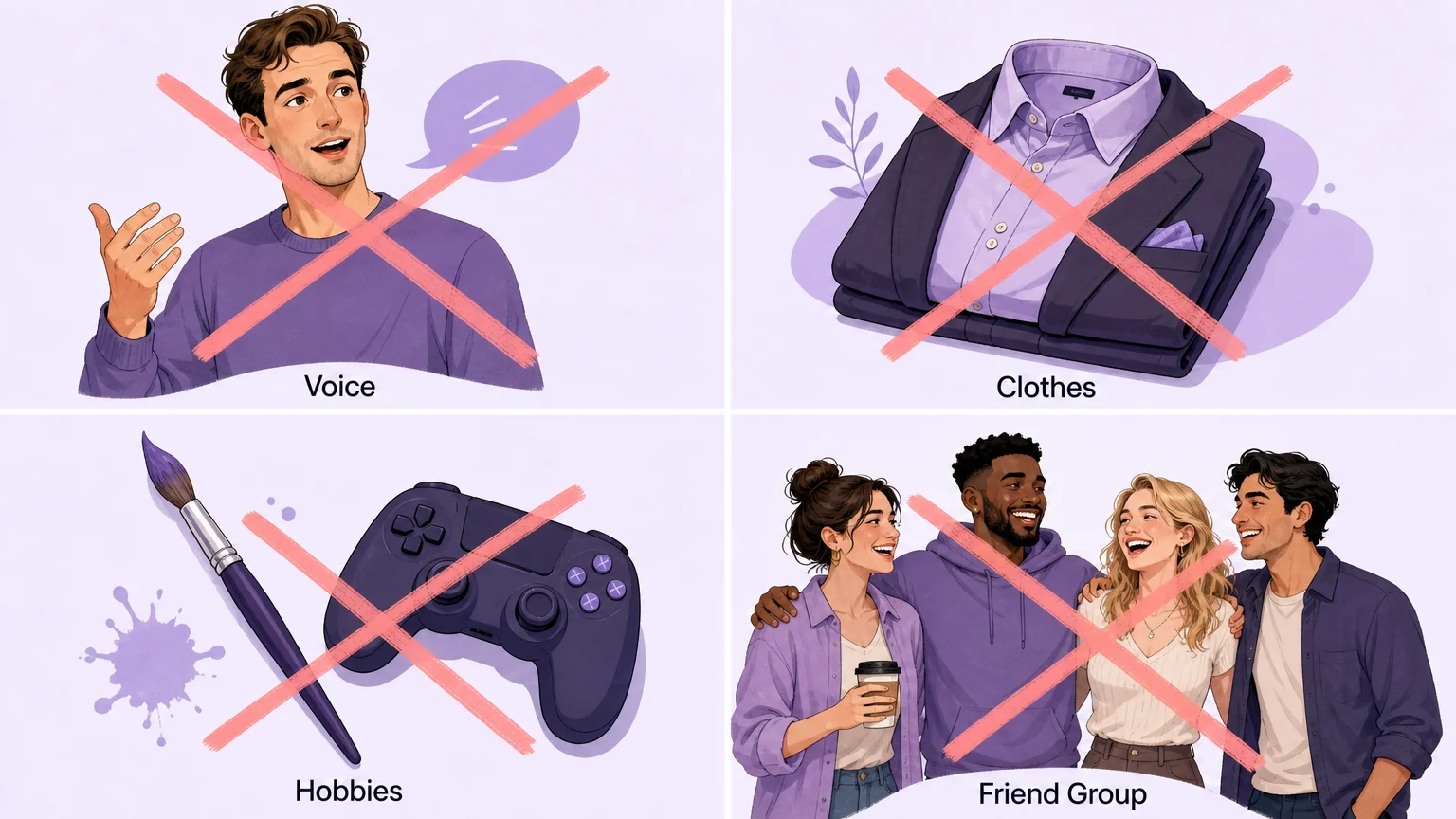
Signal: a voice, a haircut, a hobby, a friend group. The four things people reach for first.
What it can suggest: culture, taste, region, and money. Every one of these signals is learned, local, and shared by millions of people whose orientations have nothing in common.
What it cannot prove: the most-cited face-reading study had to strip hair, makeup, facial hair, eyewear, scars, and piercings from its photographs before it could run at all. Those are learned cues, not biological ones. The things you think you are reading are the things good research works to remove.
Practical move: drop all four from your evidence list. Not down-weight. Drop. There is no version of this where a voice or a hobby gets you closer to an answer.
If a clue would work on a stranger, it does not work on a friend. It was never about this friend at all.
11. What Is Not a Sign: Gaydar, Finger Length, and ‘I Just Know’
Signal: the feeling. You just know. You have always been able to tell.
What it can suggest: confidence. Certainty is a sensation, not evidence.
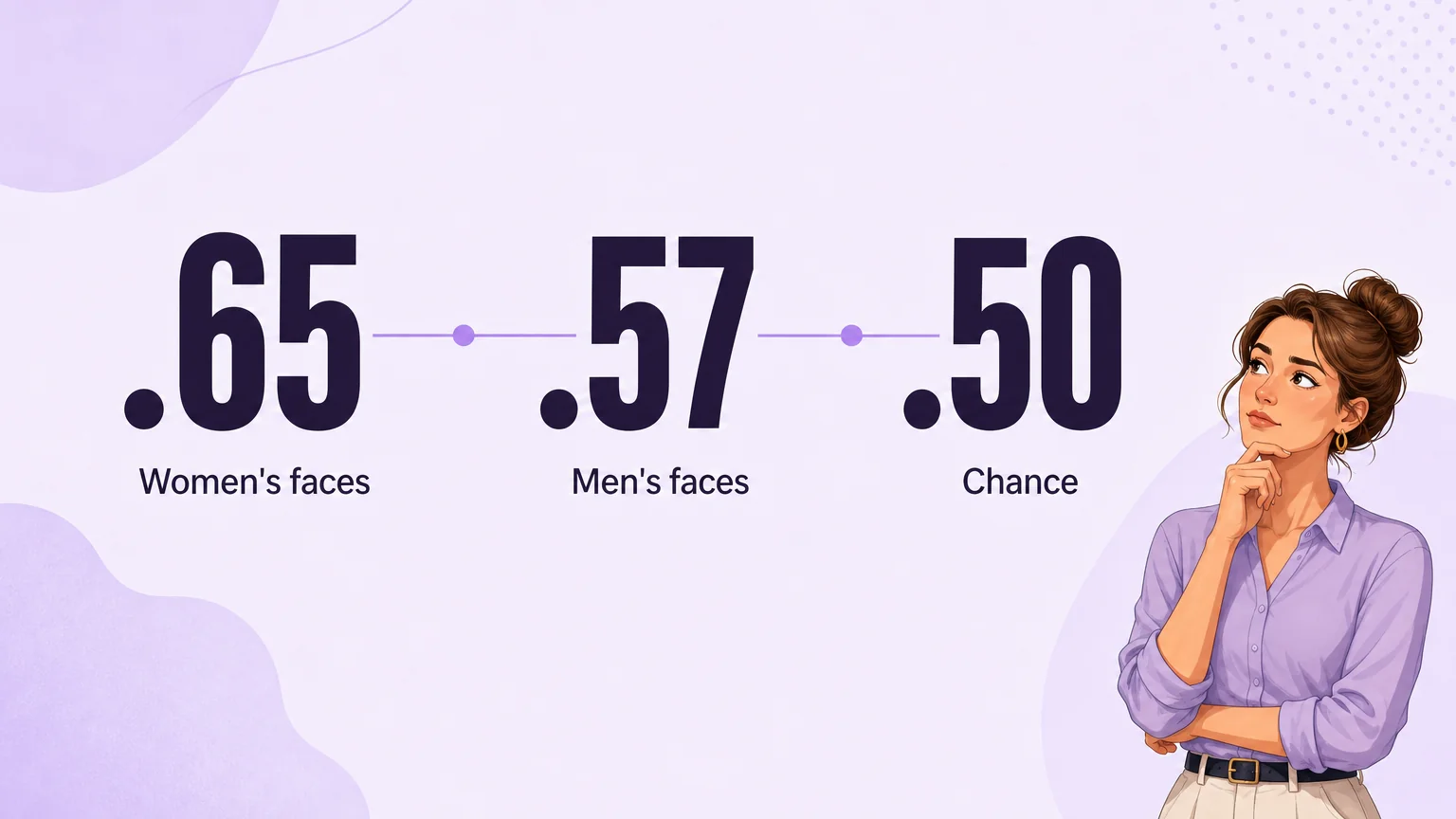
What it cannot prove: in a widely cited experiment, 129 students looked at 192 grayscale faces for 50 milliseconds and made a forced gay or straight call. Accuracy came out at .65 for women’s faces and .57 for men’s, where .50 is chance. Turn the faces upside down and men’s faces fall to .53. The researchers excluded bisexual targets and call real-life settings an open question. The strongest result is a lean on a binary question you are not asking, in a lab, not a living room.
Being gay does not come with a working gaydar, and the people who date men say so themselves. One man put it well: people assume he can tell, when he is mostly hoping every hot guy he meets is gay.
Practical move: treat your certainty as a feeling. Write it down and notice it does not get more convincing on paper.
The research does not support gaydar or finger length. It barely supports a hunch.
12. Check Whether Your Hope Is Doing the Reading
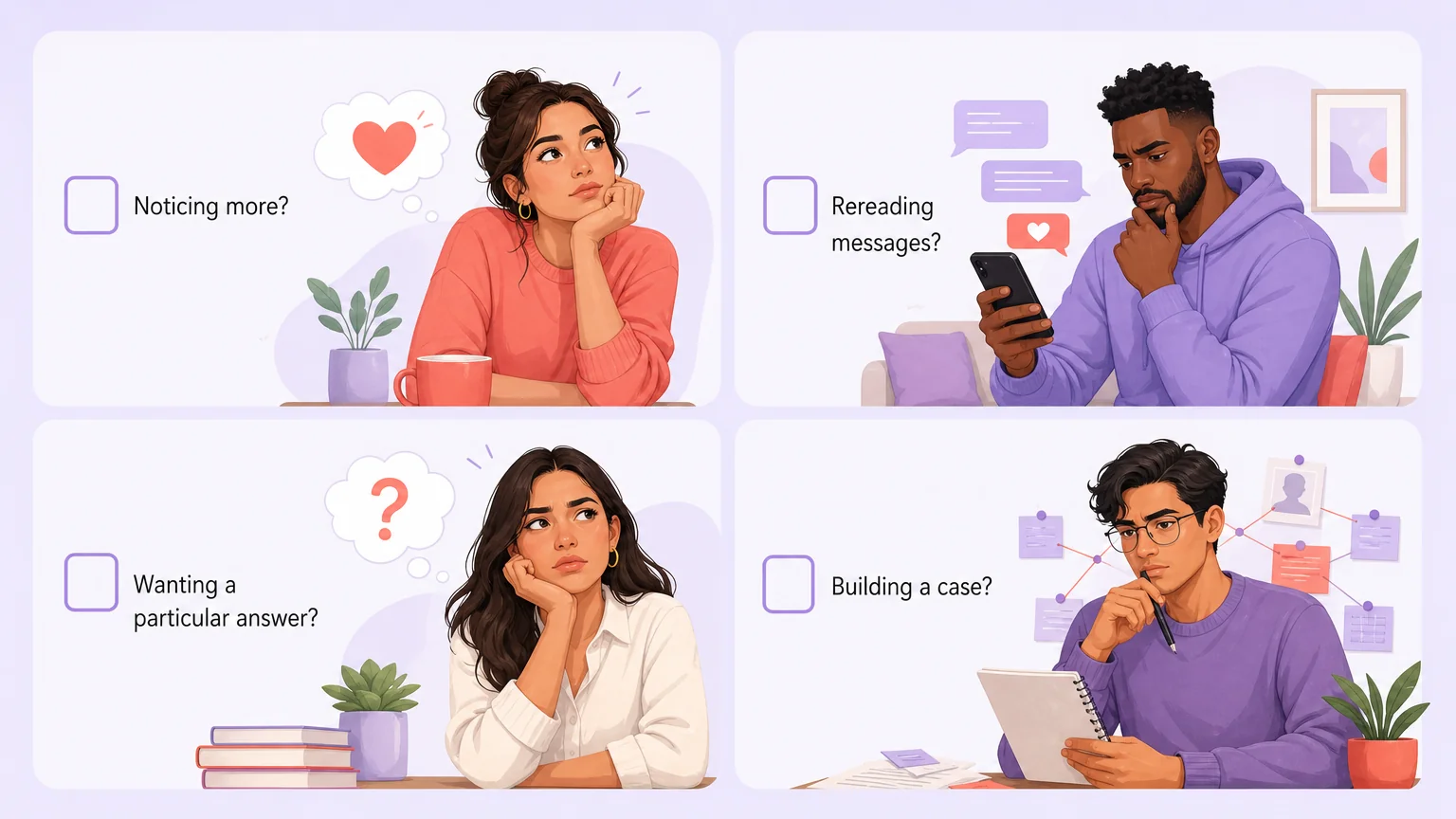
Signal: you have started noticing more, rereading messages, assembling a version of your friend you have never met. Last month’s conversation has become evidence.
What it can suggest: your motive is shaping your reading. Usually it is not malice. It is a crush, or the wish to be the one they tell.
What it cannot prove: hope does not mean you are wrong. It means your instrument is bent. Every observation gets less reliable when you badly want an answer.
A gay dating educator spent months building a relationship in his head before he knew if the man was into men. A sexuality coach asks why anyone needs the answer, and names gossip, hostility, and attraction.
Practical move: name your motive before acting. If it is a crush, read the next item first. If it is wanting to be the confidant, notice that the prize is being needed.
The question is not how to know if my friend is gay. It is what you are hoping to hear, and why.
13. ‘Is My Friend Gay’ and ‘Is My Friend Into Me’ Are Not the Same Question
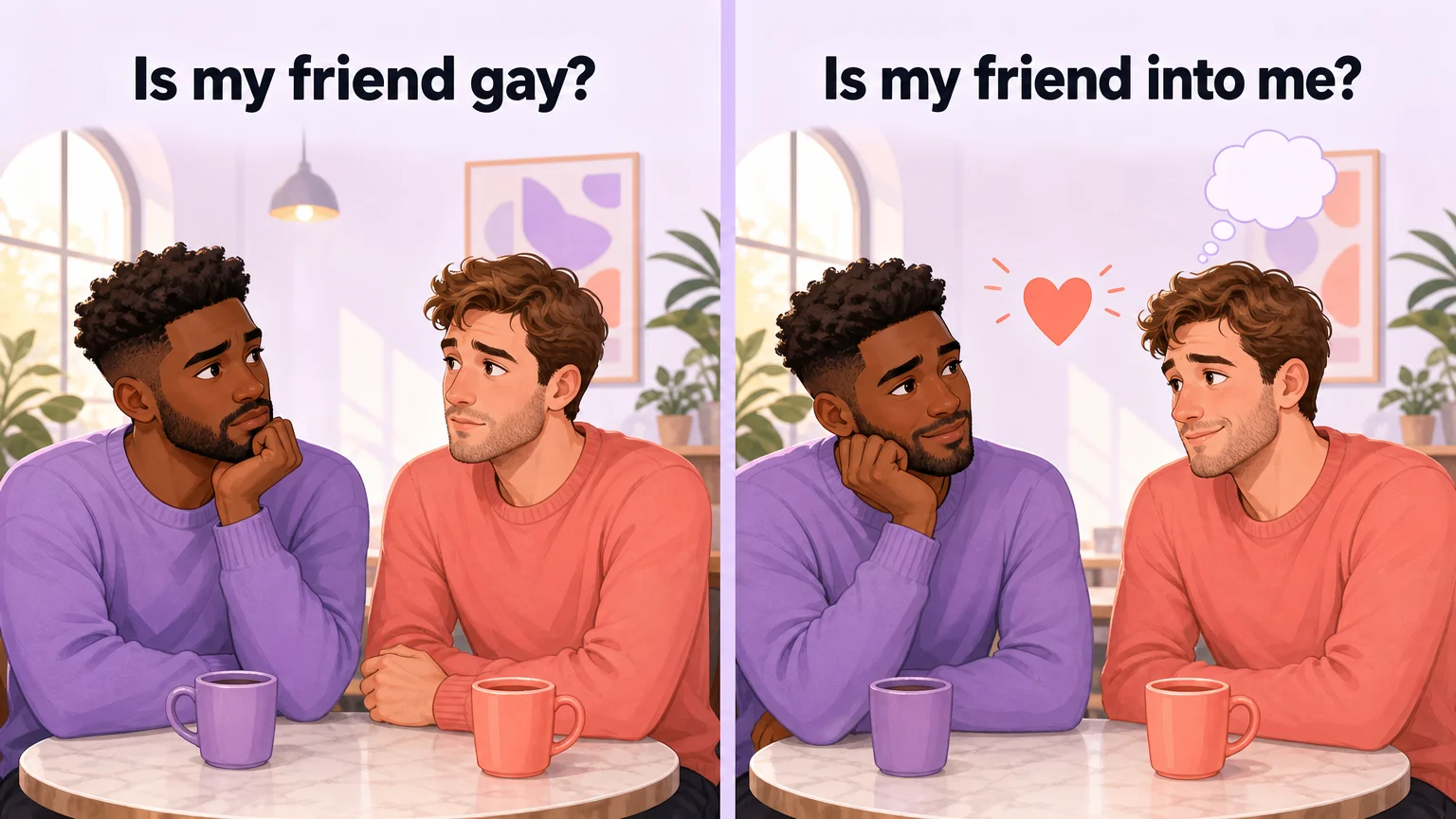
Signal: the two questions have merged. You want their orientation because you want to know your chances. Every observation is a clue about you.
What it can suggest: two answers. Yes and not interested is common. Interested and not gay is possible. The second does not follow from the first.
What it cannot prove: orientation says nothing about whether this specific person is drawn to you. Compatible people turn each other down daily, and plenty flirt across a line they would never cross on purpose.
A gay dating educator and a licensed sex therapist both separate the questions and treat the friendship as the thing to protect.
Practical move: answer the second question first. Has this person shown interest in you, specifically, in words? Not in the way they looked at you once. If the answer is I have been interpreting, that is a not yet, not a yes.
Orientation is a fact about them. Interest is a fact about the two of you, and only one is your business.
14. If You Ask, Ask Once, in Private, With No Audience
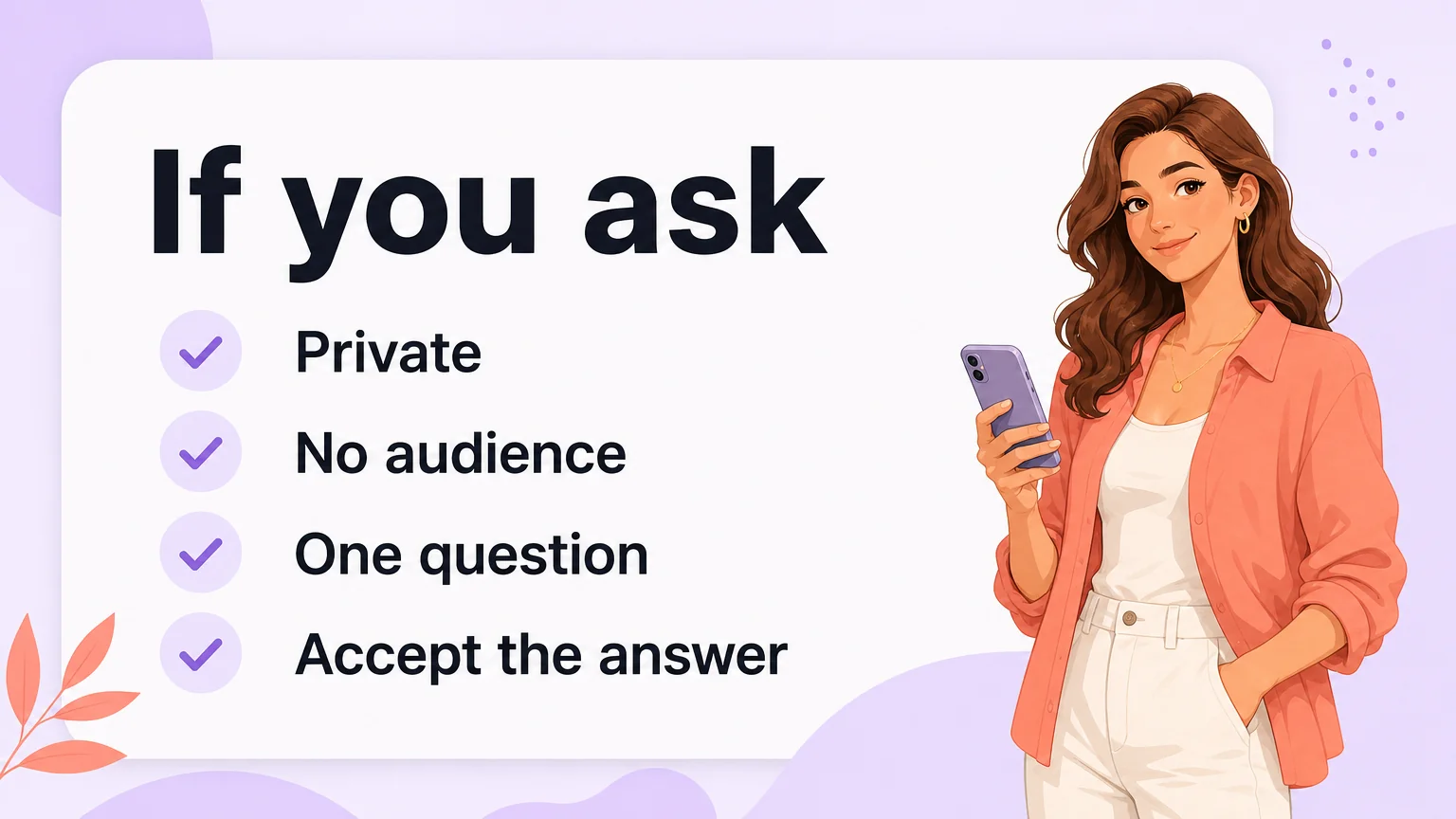
Signal: you have decided to ask. That is allowed. Professionals disagree. Psychiatrist Jonathan Tobkes, writing about families, says not to force an identity out of anyone and to build a supportive room instead. Certified sex therapist Tom Bruett says a direct conversation is fine once the person has shown they are safe.
What it can suggest: the setting decides the question. Asked in a group, the answer stops being a reply to you and becomes a public disclosure.
What it cannot prove: asking cannot change whether your friend is gay, and a disliked answer does not mean they lied. A deflection is a statement about what they want to discuss today.
Practical move: private, no audience, one question, then accept it. If you are not out to them, go first. Keep the no-ask option live. A room where the subject is safe does more than a question does.
Do this if the friendship can survive a no. Skip it if there is an answer you need to hear.
15. The Answer Is Yours to Hold, Not to Spend
Signal: it is sitting in you. You want to tell your partner, or the group chat, or the mutual friend who has also wondered. Not out of cruelty. Because sharing it would make it lighter for you.
What it can suggest: the information has a cost outside your friendship, and it lands on them rather than you. Identification is not neutral. ILGA World counts 62 UN member states that criminalize consensual same-sex sexual acts in its 2024 report, seven of which prescribe the death penalty. In a rural area, the cost is not abstract: one man interviewed in Oklahoma said that if people find out, you never know who you may lose.
What it cannot prove: your silence is the one thing they cannot check. You will never be graded on it, and that is the point.
Practical move: default to silence. Do not confirm, deny, or hint, and do not connect facts in a group chat. If they told you, ask who else knows before you mention it anywhere.
The measure of a good friend here is what you do not say.
Frequently Asked Questions About a Friend Who Might Be Gay
Can you tell if someone is gay by looking at them?
No. A widely cited experiment had 129 students judge 192 grayscale faces for 50 milliseconds. Accuracy was .65 for women’s faces and .57 for men’s, where .50 is chance. The photos had cues stripped, the researchers excluded bisexual people, and the authors call real-life settings an open question. A lean above chance is still a lean.
Should I just ask my friend directly?
Professionals split on this. Psychiatrist Jonathan Tobkes, writing about families, says not to force an identity out of anyone. Certified sex therapist Tom Bruett says a direct conversation is fine once the person has shown they are safe. They agree on the conditions: private, no audience, no pressure, and an answer you accept.
I think I saw a dating app on their phone. Is that a sign?
No. Dating apps cover friendship, community, hookups, and long-term dating, and an icon does not tell you which. Some, like 3Fun, are for LGBTQ+ daters. Plenty are not. Seeing one tells you they date and wanted it private.
What if my friend says yes?
Say thank you. It costs you nothing. The first reaction is the one that sticks, so think before you speak and keep your face calm. PFLAG’s guidance is to ask how you can support them and respect their wishes, not to plan their life.
What if they say no or dodge the question?
Treat it as an answer about what they want to discuss, not proof of anything. Not coming out is a valid choice, and a deflection deserves the same respect. Do not ask twice. Let the decline be the end of it.
Why does my bisexual friend never say anything either way?
Sometimes nothing has prompted the conversation. A 2019 Pew Research Center analysis found 19% of bisexual adults said all or most of the important people in their lives knew their orientation, against 75% of gay and lesbian adults, and 26% were out to no one. Pew does not settle on one explanation; it notes bisexual adults were less likely to see their orientation as central to their identity, and the sample was too small for subgroup breakdowns.
Is it safe to be read correctly?
Not everywhere. ILGA World counts 62 UN member states that criminalize consensual same-sex sexual acts in its 2024 report, seven of which prescribe the death penalty. The cost varies by town, family, and job, which is why a friend in a small town may guard it more tightly than one in a city. They get to decide, and that is the whole answer.