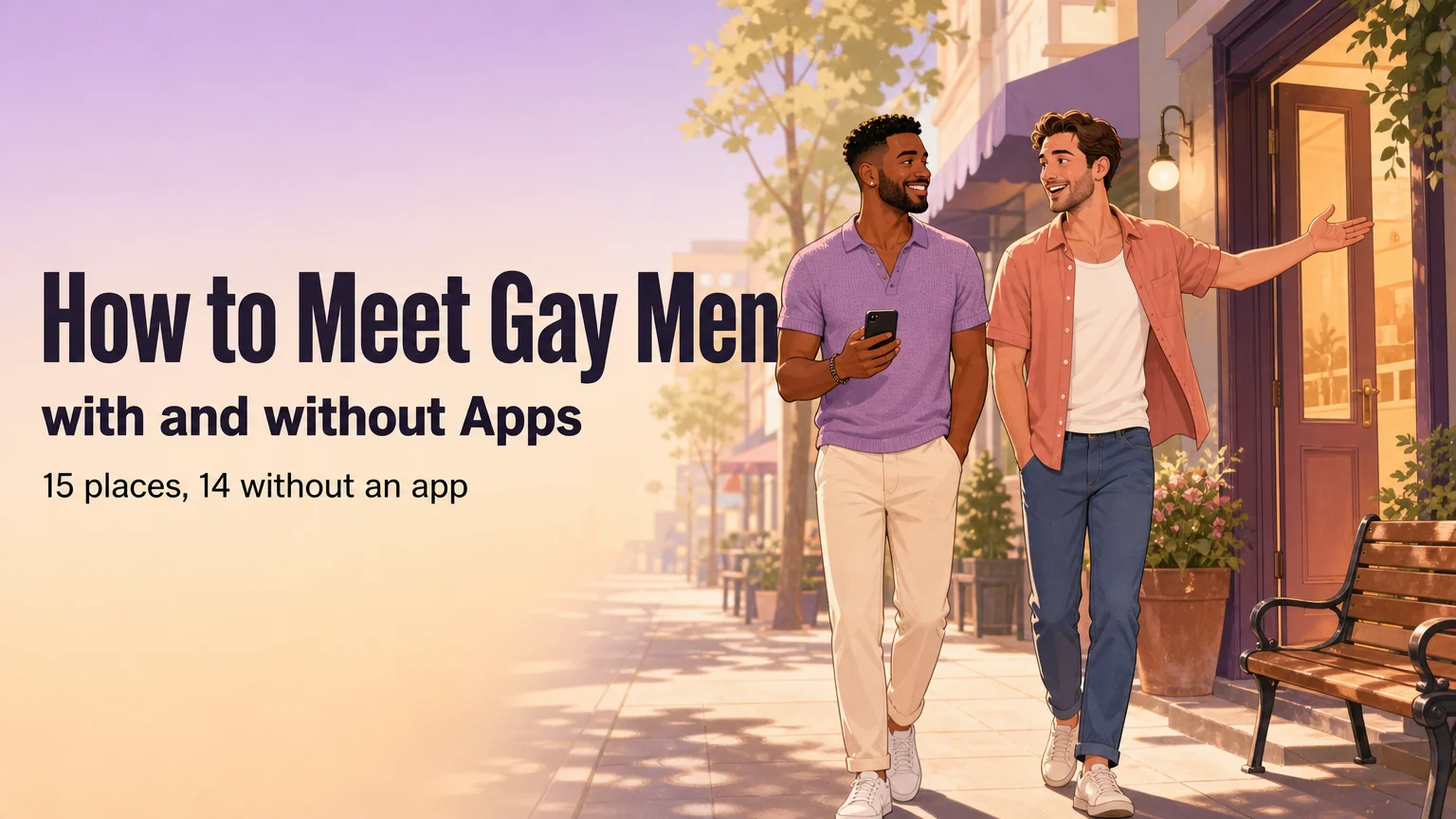
Almost everyone has a story about the app. Far fewer have a plan for how to meet gay men that does not depend on one. Pew Research Center found that 10% of partnered US adults met their current partner through a dating site or app, rising to 20% under 30, which leaves most meeting somewhere else.
Apps are not a niche habit either: 51% of LGB adults have used one, against 30% of all US adults. Both routes are ordinary, and neither is a fallback.
The offline places did not close; they stopped being scheduled. Nobody hands you a Thursday night, a team or a chorus anymore, and the introductions that once came through family and friends now have to be arranged.
What follows is fifteen places, starting with the app route most readers already have and then fourteen answers to how to meet gay guys without apps. Each item says whether it needs an app, and each comes with one way to check the place is still running before you show up.
1. The Apps: The One Place That Needs a Profile
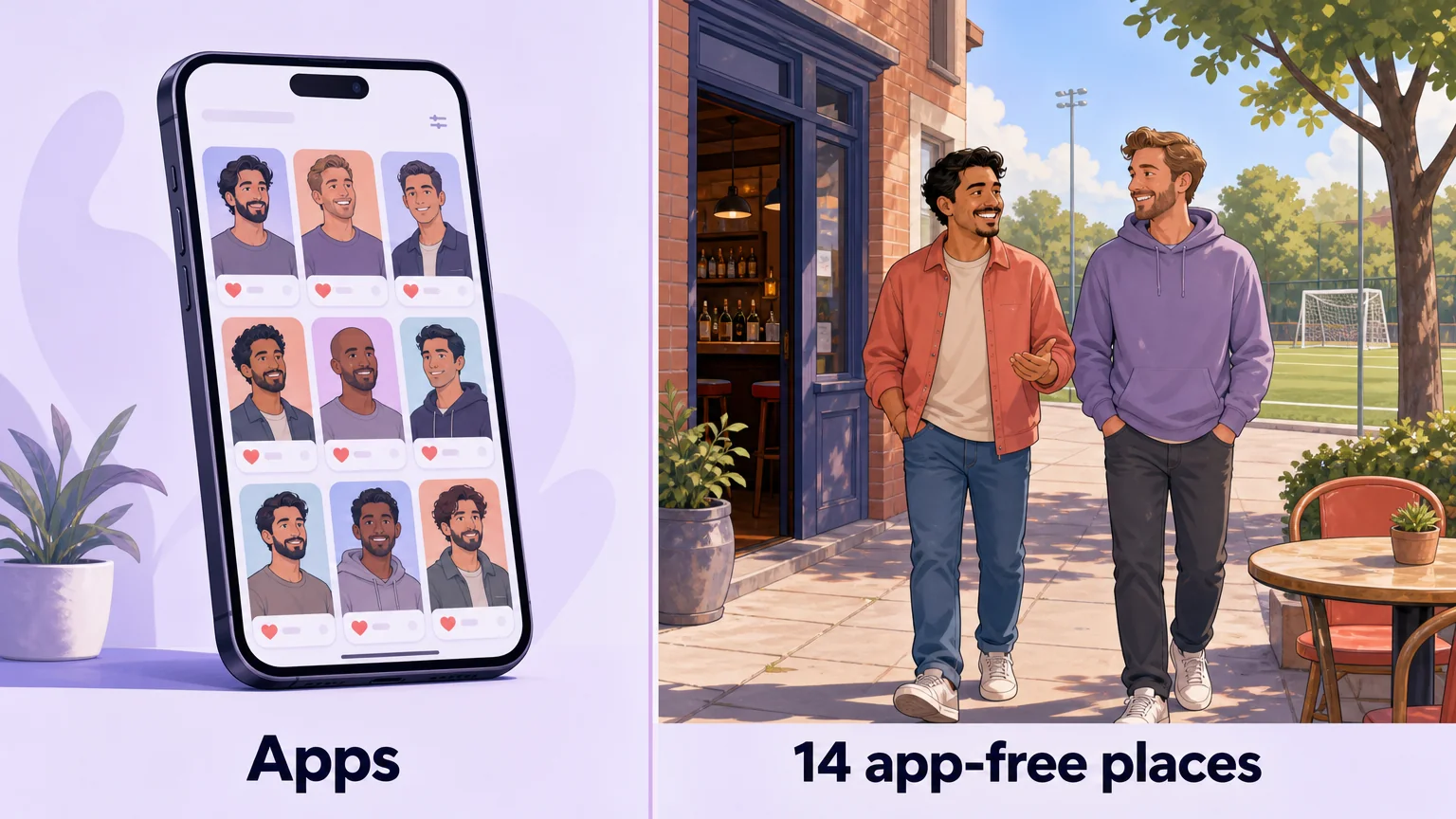
App-free: no. The only item that asks for a profile.
A dating app is the only channel here that reaches men outside your circles, and in a thin market it is the only one with volume. Alexander Cheves, a sex and relationship columnist, says it may be the only option for men in remote areas, and warns about scammers and fake profiles.
Start with 3Fun, a dating app for gay, bisexual, and queer men. Photo verification adds a badge to a profile, and the image you submit is never published. The About us field gives you room to state what you are looking for, and up to ten searchable interests give a conversation a place to start. Poke, the paid pre-match message, carries up to 140 characters, which helps when a like alone says nothing. VIP adds Incognito and Hide Distance if you need more control over who sees you.


Danny, a dating coach for gay and bisexual men, hears Grindr, Scruff, Hinge and 3Fun most often, the first two built for immediate physical connection. Treat them as the second channel, for reach, rather than the default.
His clients, from their 20s to their 50s, say they have been on hundreds of dates and still feel alone. Danny calls the design variable reward, the mechanic of a slot machine, and says nobody wins a game with no ending.
Audit your intent before you open it: lonely, bored, anxious and looking produce the same scrolling. Cut to two or three conversations, then move to an in-person meeting inside a week of a match. A two-week thread with no date attached is the signal to propose one or stop.
Ask for a video call before you meet. Tom Bruett, LMFT, CST, calls a man who never wants one a red flag, and says it happens more to older gay men.
Back up the conversation, meet somewhere public, send a friend the profile and your location, agree a code word, and arrange your own transport. Refuse any move to a quiet or isolated place, the pattern eSafety names as entrapment. The NYC Anti-Violence Project runs a confidential bilingual hotline at 212-714-1141, by call or text, with no police report required.
Keep one app rather than three, and make it the one where you can say what you want and see who is verified.
2. Gay Bars and Clubs: What to Do When You Walk In

App-free: yes. No profile, no account, no phone.
A bar holds the highest concentration of gay men in a room, and the hour changes it: 7 p.m. and midnight are different places. The age range is wider than the apps imply. Start with the smaller room that has a visible door.
Check the venue’s own calendar for the night you want. In a smaller town the nearest bar may be an hour away, so make it a monthly routine on a fixed night.
Arrive in the first hour, when the bartender is effectively the host. Order at the bar, stand rather than wedge into a corner, set a leaving time, and return the same night next week. Judge the room across three visits. Before you leave, make one specific ask: coffee on a named day.
A no from a stranger costs almost nothing: nothing was invested, and the room resets in five minutes. On an app, meaning attaches to a profile before anyone speaks, so the same no lands harder. Alexander Sterling, a gay men’s relationship commentator, says it starts to feel like evidence for an older story. File it as information about fit.
Presence is not consent and not proof of orientation. Read him first, ask once, take the answer.
A friend took one man to a gay cowboy bar in Las Vegas. A stranger offered to buy him a drink; they left without exchanging numbers. His future husband got the number from their mutual friend the next day. Almost twelve years together, ten married.
The right first room if you want to be among gay men this week rather than next season, and the wrong one if a loud room drains you.
3. LGBTQ+ Sports Leagues: One Evening a Week, Same Men, All Season
App-free: yes. Registration happens on a website, with no dating profile, no photos and no swiping.
A recreational league meets weekly for a season, usually eight to twelve weeks, and the repetition is the mechanism: the same men, the same evening, long enough for familiarity to build. Most run a social division, so all levels play. Register as an individual and you are placed with strangers.
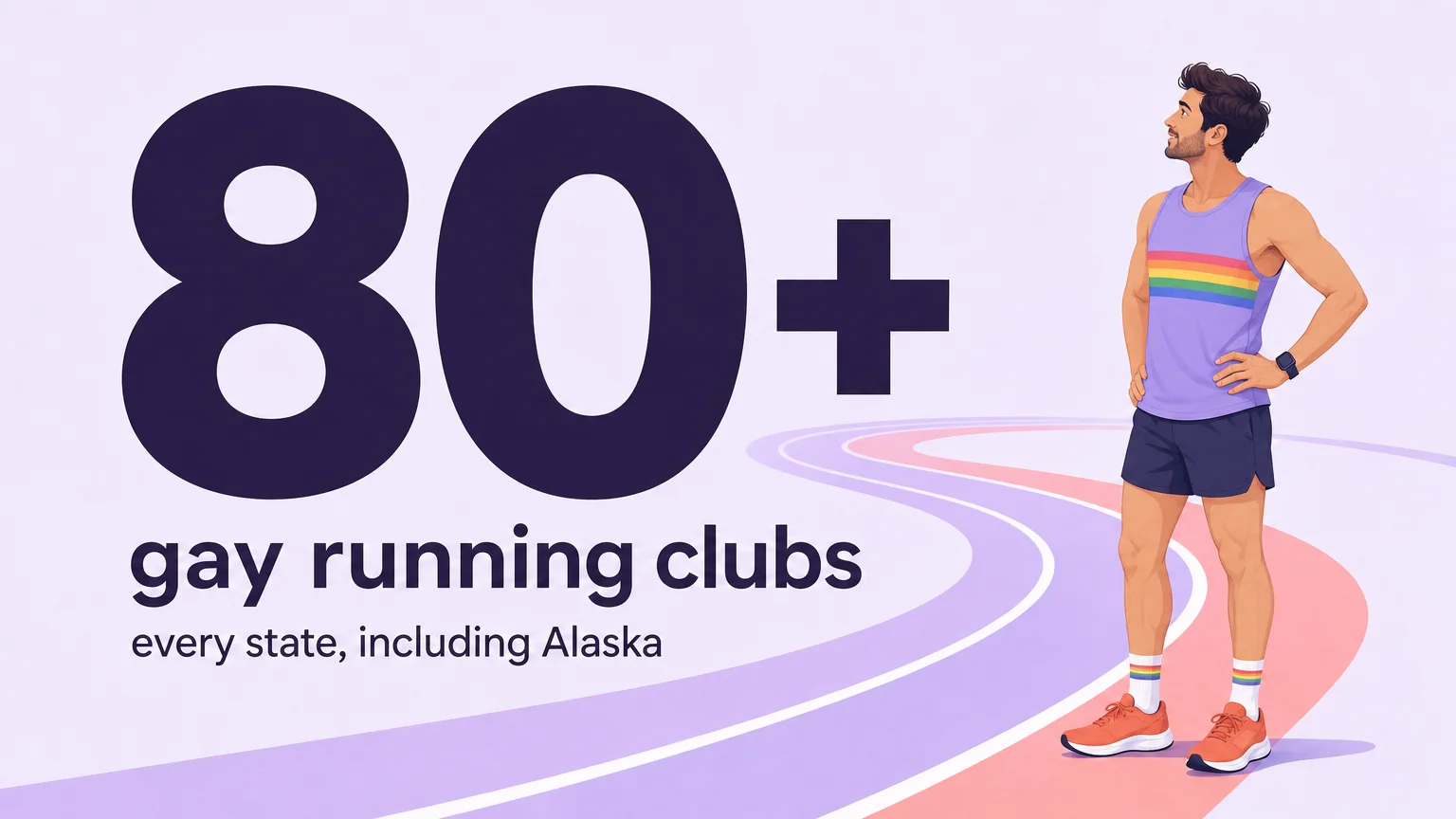
OutLoud Sports lists leagues by city. The United States Gay Sports Network lists them by region, state or sport, and one certified life coach for gay men counted more than 80 gay running clubs there, with every state represented including Alaska. That is her count, not an official figure. In a smaller city the nearest league may be a drive, and it is the best-yield drive here.
Check the current season’s dates on the organization’s own site, then ask one question: when does registration open, not when the season starts. Registration closes before the first game, and missing it costs months.
Pick a sport with downtime between turns, such as bowling, running or softball. Expect the first two sessions to be shirt pickup and logistics; one man left his new league’s t-shirt pickup early because he could not face the small talk. The group supplies proximity, not social skill. Keep going past the first month.
If you can give one evening a week for a season, start here rather than at a bar.
4. Hobby and Interest Groups: Board Games, Running, Hiking and Book Clubs
App-free: yes. A group chat is not a dating app, and the group meets in a room.
A recurring group built around an activity, from board games and running to hiking, book clubs, cooking and cycling, does not organize around identity. That widens the age range and temperaments beyond a bar, and a drop-in group charges no term fee. It is the best item here for an introvert and for a man read as straight: the activity supplies the subject. Tom Bruett, LMFT, CST, makes the case: a man who reads as straight is rarely approached, so he needs rooms where the shared interest does the introducing.
Start from the interest, then the city, rather than from the identity. Geeks Out covers gaming; library and coffee shop bulletin boards still carry notices; Meetup, Discord servers and Facebook groups cover interests with no organization attached. Message the organizer to ask whether the next session is confirmed; a page can stay up for months after a group stops meeting.
Pick the interest you would do alone on a Tuesday, and choose a session with 8 to 12 people; a 40-person meetup is a crowd, not a table. Bring one question about the activity. Game nights are the easiest entry, because a table assigns you a seat and a turn.
The slowest version is a roommate. He barely noticed the man for weeks; both were busy, and he calls himself very introverted. Over the holidays, when the third roommate left, they found a shared taste for horror films, had a movie night, and ended up together.
This is the room for company without performing a coming-out story every week. If the activity bores you, skip it: a group you attend only for the men is a group you will stop attending.
5. Gay Men’s Choruses and Performance Groups: Sing, or Help Backstage
App-free: yes. Auditions and volunteer sign-ups are forms, not profiles.
Choruses, theatre companies, dance groups and drag collectives all run on a season. A chorus is the most structured version: weekly rehearsal, a defined season, a concert at the end. Gay men’s choruses exist in cities including Seattle, Chicago, Los Angeles and Indianapolis, and the age range runs wide, with a notable share of men in their 40s, 50s and 60s. Being older is not the exception.
Look up gay men’s chorus or LGBTQ chorus in the city, then read the rehearsal season and audition policy on the organization’s own page. Non-singers have a working door: ask about front of house, risers, costumes or event help, because volunteers are at every rehearsal anyway.
Confirm the first rehearsal date, then ask the volunteer coordinator one question: does this role commit me for the whole season, or can I start with one concert cycle?
Learn three names in the first two weeks. The rehearsal break is the conversation window, at the same time every week, so you get another try without arranging anything. Say yes to the post-rehearsal drink once.
A member of the San Francisco Gay Men’s Chorus met his husband there. He noticed him at the first concert, when he had a solo and owned the stage at Davies Symphony Hall.
A league gives you a team and a season of games. A chorus gives you a season of performances, a wider age range, and a backstage role if you never want to sing.
6. Volunteer Shifts With LGBTQ+ Organizations: Work Beside Someone

App-free: yes. You sign up for a shift, not a profile.
A recurring shift gives you a role and a script: setting up, checking people in, working the kitchen. Gay for Good runs chapters across the United States, with work from yard work to cooking for shelters, and local LGBTQ centers, Pride organizations, shelters and food banks all take volunteers. Tom Bruett, LMFT, CST, notes that connection grows faster when people do something meaningful side by side than when put in a room to talk.
Check the chapter list, the local center’s volunteer page or an organization’s own sign-up page. Coverage is not universal, so the nearest chapter may be a monthly drive.
Confirm the shift dates, then ask the coordinator: do you need people for the next date? A page with last year’s dates is a page nobody has updated.
Book a recurring shift, not a one-off, and take a specific job rather than offering general help. Pick a first shift under three hours so you leave with energy left. The second shift is where people remember you, and the third is where you get invited to something else.
A shift under a queer organization’s banner is public in a way a hobby group is not. If exposure is a constraint, a general food bank or park cleanup is lower visibility and still puts you beside the same people every month: less density, less exposure.
Here you are in the room to work. A community center, later in this list, is the reverse: a room you attend for yourself, with nothing expected of you.
If you want a room where talking is optional and still useful, take a monthly shift and keep it for three months.
7. LGBTQ+ Professional Networks: A Built-In Reason to Talk
App-free: yes. Tickets and name badges, no profile.
Gay and LGBTQ chambers of commerce, professional associations and industry groups with LGBTQ caucuses run structured networking with a reason to be in the room unrelated to dating. A certified life coach for gay men described a chamber event as heavily attended by gay men who are not on the apps, dressed for work, with careers, and called it an underused route in big cities. It skews 30s to 50s, the strongest item here for readers in their 40s and 50s.
Start with the city’s gay chamber of commerce, or the national chamber’s affiliate list. Employee resource groups at work are the same channel with a shorter commute, but only if being out there fits your boundary. Check that the event appears on the chamber’s own calendar with a future date, rather than only on last year’s flyer.
Set one small goal: meet two people and ask what they do. Arrive in the first 20 minutes, before the room clusters. Follow up within 48 hours with a specific reference to the conversation, and treat it as a months-long channel rather than a single event. Romantic intent is poorly calibrated in a professional room, so do not hit on anyone; the room rewards being a person people recognize.
If you are not out at work, choose an event outside your industry.
The same reason this works at 45 is why it fails at 25 as a main strategy: it is a room for people who have something to talk about besides wanting to meet someone.
Patience is the price. The room rewards being a person people recognize, not someone working it.
8. Pride and Community Events: Use the Small Events, Not the Parade
App-free: yes. The entire point is that you show up in person.
Pride month, film festivals, block parties, drag brunches, community picnics and a center’s calendar put the highest density of gay men of the year in one place, along with the highest share of people who are also attending alone and also new.
The local Pride organization’s calendar, the LGBTQ center’s events page and the city’s official listings have the dates. Many cities hold Pride outside June, so check rather than assume. In a smaller town, the nearest city’s Pride is a planned trip worth building a weekend around.
Pick one event, not the whole festival. A parade is a crowd of thousands and a bad place to meet one person. Choose a ticketed satellite event over a free crowd, because a ticket keeps the same people in one room for two hours. Go early, leave when you are done, and put a second event on the calendar for the following month.
A coach who freezes in conversation wrote her number on a note, handed it over at a Pride parade, and walked away. He texted within days and said no one had ever done that before. The exit is part of why it worked for both of them.
Best for a reader who wants one high-density day with a legitimate reason to be in the city. Skip the main parade if you are going specifically to meet someone.
9. Affirming Faith Communities: Check the Policy Before You Invest Months
App-free: yes. A service and a coffee hour, with no profile anywhere.
The distinction that matters is affirming rather than merely welcoming, and it is written policy, not tone of voice. The ages run mixed, often older than a bar, with families and plenty of single men: one of the few rooms here where a man in his 50s is entirely ordinary.
Church Clarity grades churches as affirming, non-affirming or third way, and third way is the one to read closely, because a third-way church may welcome attendance and volunteering while barring LGBTQ people from leadership. Its own listings are sometimes wrong, so confirm with the church directly and check the current service times on the church’s site. Renovus, based in Atlanta with Zoom groups, and gaychurch.org are other routes.
Read the leadership policy before the welcome statement. Attend a service and stay for coffee hour, which is where the social life is, then join a small group, because Sunday attendance alone produces acquaintances.
Ask the pastor or the office one direct question before your second visit: can an out gay man serve on the board or lead a group?
Two atheists met at a church youth group night because friends dragged one of them along. They saw each other across the room, exchanged numbers, and have been together since 2004.
If the answer is no, decide in advance whether you are there for the service or for the people.
10. Gyms and Fitness Classes: The Same Men, Several Times a Week
App-free: yes. A class schedule is the only sign-up, and nobody checks it against a profile.
The same faces at the same hour, several times a week: that repetition is the mechanism. Group classes and roped climbing gyms are more social than a floor workout: a climbing gym creates partners by necessity, since you cannot climb without one. It is also one of the few places where a man in his 40s or 50s shares a room with men in their 20s without it being a thing.
Choose by attendance, not equipment. The gym within walking distance that you will reach three times a week beats the better one across town. Check the current class timetable, since gyms change schedules each season, and pick one class at the same time every week.
Same class, same time, same spot, booked for four weeks before you judge whether it is working, because the first two are logistics. Arrive ten minutes early, which is when people talk.
Read first. If he does not look like he wants to be approached, do not approach him. A class is a better place to talk than a locker room, and a locker room is not a pickup space.
The note works when speaking fails. A coach left a short note in a gym locker; he texted two days later and they had coffee.
A league ends. The gym gives you a schedule you can keep for years, which is why it produces the longest familiarity and the slowest results.
11. Everyday Third Places: Coffee Shops, Bookstores, Dog Parks and Libraries

App-free: yes. It is also the lowest-exposure item on the list, because nothing about being there marks you as anything.
Coffee shops, bookstores, dog parks and libraries have no queer label, no cover charge and no reason to explain yourself. The trade is density for privacy: this is the item for a reader who cannot be seen in a gay bar, and for one who wants a life not organized around being gay. Alexander Cheves, a sex and relationship columnist, points out that gay men are also at the supermarket and the gym: go be among people, because that is where we live.
Pick three within walking distance of home or work and go at the same time of day, several times a week. Check the posted hours rather than the ones you remember. Regularity is the mechanism and the venue is interchangeable, so a small town has these even when it has nothing else.
Sit where you are approachable, facing the room rather than a corner with headphones; stay 40 minutes, not three hours. Give the room one object to ask about. A book read in public is the oldest version of the signal Tom Bruett describes. Expect a low hit rate and high comfort.
Nothing here reads as a failed attempt, because nothing was an attempt.
The cafe version: one was in his first week in a new city, the other in his last week as a barista. They started as friends. He liked him, the other was not interested, then it reversed, and it took a few tries before both were interested at the same time. They married at that cafe more than twenty years later.
Choose it for privacy or a low tolerance for being watched, not for volume: it produces one conversation a month at best.
12. LGBTQ+ Community Centers and Support Groups: A Room You Attend for Yourself
App-free: yes. A calendar page and a chair in a circle, with no profile and no account.
An LGBTQ community center, or a standing support or social group that meets in one, is a room you attend for yourself, where nobody expects you to work. Groups range from drop-in socials to peer support on coming out, grief, health or a particular identity. Many are alcohol-free, which matters if a bar is not your setting, and the ages run well past 30.
Find the city’s LGBTQ community centers, then read the calendar for the current month rather than the home page. Look for a standing room with a topic and a regular time.
Ask whether the group is drop-in or fixed membership; some support groups close after the first session so the same people can build trust. Ask one more question: how many people usually attend? Six is a conversation and 40 is a lecture.
Say at the door that you are new. In a support group, listen for the first session and disclose only what you want to. What is said in the room stays in the room. Do not treat a support group as a place to meet men; if something develops, it has to respect why the room exists.
A center is public in a way a hobby group is not, so a general drop-in with a neutral name, or an online group, lowers the exposure cost. In a small town the nearest regional center may be an hour away and may be the only permanent LGBTQ room within that radius, worth a fixed monthly drive.
Come here for company without alcohol, noise or a profile; for volume, look elsewhere.
13. Classes and Courses: A Term, a Syllabus, the Same Faces
App-free: yes. Registration is a form and a fee, with no profile and no photos.
An enrolled course has a term, an instructor and a syllabus: community college continuing education, a language school, a cooking series, a pottery studio, a coding boot camp. It differs from a hobby group in three ways: everyone enrolled on purpose, the same people meet for a set number of weeks, and the work forces interaction through pair exercises and group projects. With no queer label, it is the strongest structured route for a reader who is not out.
Start with a community college continuing education catalog, parks and recreation, a cooking school, a makerspace or a language institute. Confirm the catalog is for the current term. Choose one that meets weekly and caps enrollment near 20: a lecture hall of 200 is not a room; a cohort of 15 is.
Sit in the same seat each week, learn two names in the first session, and ask one question about the material rather than about the person. Pair work does the introducing. Pick a course that meets twice a week for six to eight weeks rather than a one-day workshop.
Two men met in the same criminal law class at law school. One thought the other was gorgeous, made the first move, and they dated for three years; it was his first boyfriend. At a tech boot camp, a man was asked out in front of six strangers and was too busy looking at the food to notice.
Pick the course you would take if no one else were in it, then treat the first two sessions as the price of entry. The hobby group has no end date; a course hands you a finish line and a roster assembled on purpose.
14. Friends’ Parties and Introductions: The Room Someone Vouches You Into

App-free: yes, in the sense that matters: no dating profile, no browsing, nobody judging a photograph.
A friend’s dinner, a birthday, a housewarming, a wedding: the setting, not the venue, is the point, and the mechanism is a third person who knows both of you and can vouch for each side. Friends of friends have already been filtered for safety and often for temperament.
Tell two friends plainly that you would like to meet someone, and be specific about what you are like and what you want. Ask for one introduction rather than a general offer to keep an eye out. Confirm with the host the day before and ask who else is coming, which tells you whether the evening is worth your time. Say yes to invitations for three months, and host something small yourself, because hosting gives you a role.
At the party, work the room with the host rather than cornering one man. Tom Bruett, LMFT, CST, suggests framing introduction requests around values and temperament rather than a type, which a friend can deliver. If you are interested, ask the host for his number the next day instead of at the event: he can say no without a scene. Then use it for one specific plan.
A jacket left at a mutual friend’s house did the introducing. He met his future partner in the living room. He asked the friend to pass along his number and had a text before he left the parking lot. A sister did the same with her brother, and encouraged the two to become roommates. They have been together almost 25 years.
A therapist’s client in his late 50s, widowed after a long relationship, re-entered by staying curious and saying yes to friends’ invitations. He met a much younger man, they clicked on shared values, and neither cares about the age gap.
15. Saunas, Bathhouses and Sex-Positive Venues: Etiquette, Consent and Local Law
App-free: yes. This is the original app-free venue, and the one where a phone is least useful.
Saunas, bathhouses, sex-on-premises venues and kink events are staffed venues with hours, a front desk and house rules. A kink event should publish its rules and consent expectations before you arrive; many are ticketed and vetted. The age range runs wider than most bars, with many men in their 40s and up, and solo attendance is normal.
Find venues by city, then read the venue’s own page for hours, membership rules and ID requirements. Check the local law before you go: these venues are legal in many places and not in others, and the rules differ by country as well as by state.
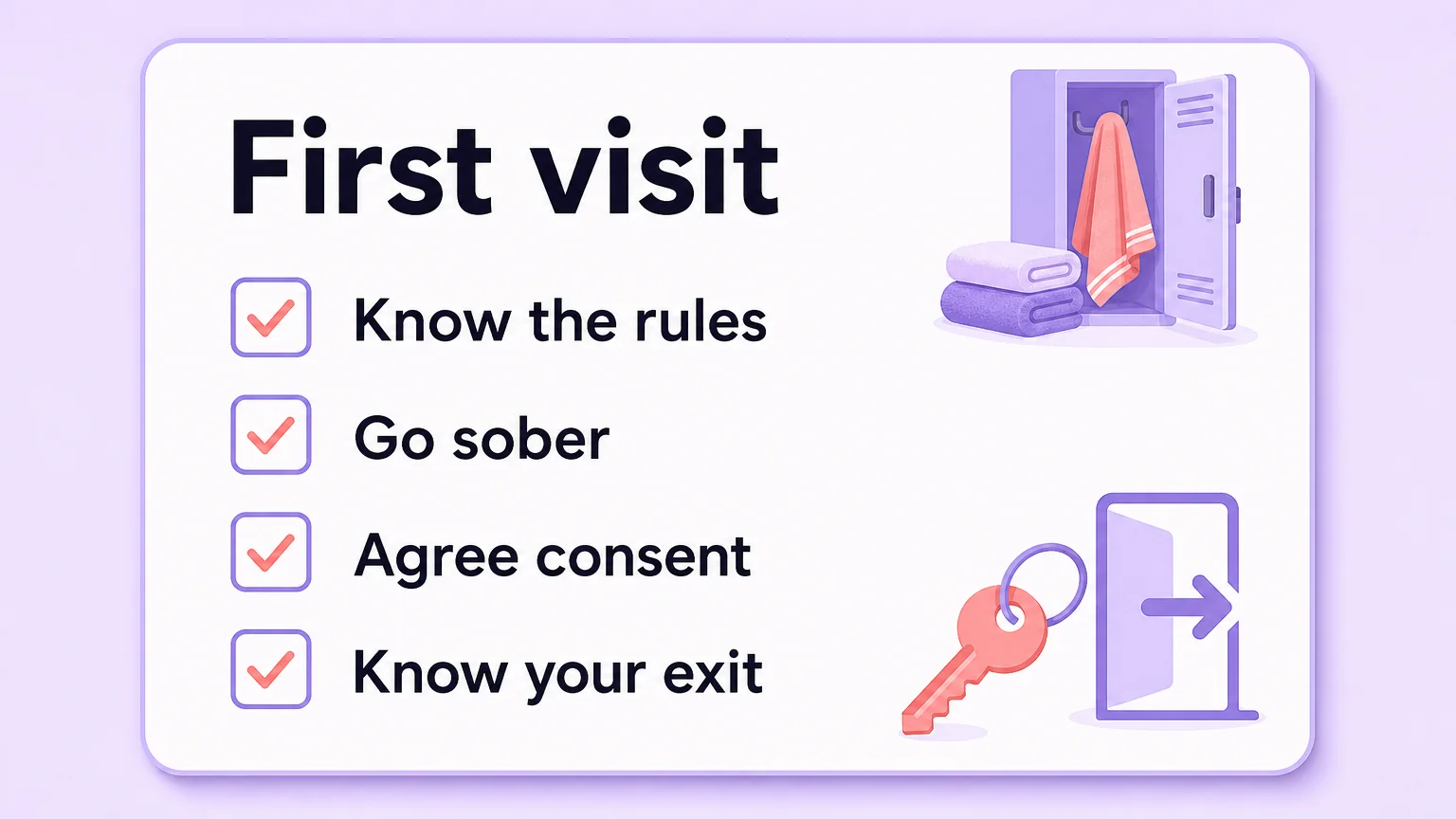
Learn the etiquette before you go. A towel and a locker, eye contact as the opening, a no honored without argument or a second attempt, and consent that is explicit and ongoing rather than assumed from being in the room. Go sober the first time, visit on a weekday afternoon when the venue is quieter, and bring a friend who knows the place if you can. Know the exit and your ride home.
This is not a bar with less talking. The social rules and purpose are different, so do not import bar behavior into a room with clearer expectations.
A staffed, legal venue has a different risk profile from a cruising area. Alexander Cheves warns that cruising in public places carries real risk of police attention, and many US jurisdictions treat public sex as an offense.
For a reader past 45, this is often the room where he is youngest rather than oldest.
Come here knowing what you want. Skip it as a first room if your nerves would blur the etiquette.
FAQ
Do I have to use apps to meet gay men?
No. Fourteen of the fifteen places here need no app or account. Apps remain useful for the one thing other rooms cannot do: reaching men outside your existing circles. Skipping them means replacing that volume with one recurring commitment you keep, and accepting a slower pace.
What if I am not out, or only out in some places?
Privacy is a practical constraint, not a flaw: you decide what each room knows. Rank places by what they reveal: a cafe or a course reveals nothing; a bar reveals a lot. Back up an app conversation to control the record. Being out with friends and not at work is a boundary, not a contradiction.
Is it safe to meet a stranger?
It can be, with preparation. You control the record, the location and your own way home, and you refuse any move to a quiet or isolated place. If something goes wrong, LGBTQ anti-violence organizations take confidential reports without a police report, which matters if you are not out.
How do I meet gay men in a small town?
The arithmetic is structural. AARP found access to LGBT senior services runs about 48% in big cities and roughly 10% in rural areas. Widen the radius, plan trips around queer events, join the nearest league or center even if it means driving, and treat long distance as a starting phase. Tom Bruett calls that phase realistic for older gay men.
I am past 40. Is it too late?
No. In AARP’s 2018 survey of 1,762 LGBT adults 45 and older, including 680 gay or same-gender-loving men, 57% of gay men that age were single and 46% lived alone. Alexander Sterling, a gay men’s relationship commentator, names the belief: love has an expiration date, so every year becomes a countdown. What changes with age is the route.
How long should I give a place before deciding it is not working?
Three visits. The first is logistics; the second is where faces register. Judge the room on whether you would keep going for the activity alone, because that carries you past a slow month. If the organizer cannot say the group is running, that is your answer.