Nearly half of adults are into something the diagnostic manuals call “anomalous.” In a 2016 study in the Journal of Sex Research, 45.6 percent of 1,040 adults reported interest in at least one sexual behavior the DSM-5 classifies under that label. Before we map the types of fetishes that exist: if you’ve ever heard a term and wondered whether you’re the only one, you’re in the statistical majority.
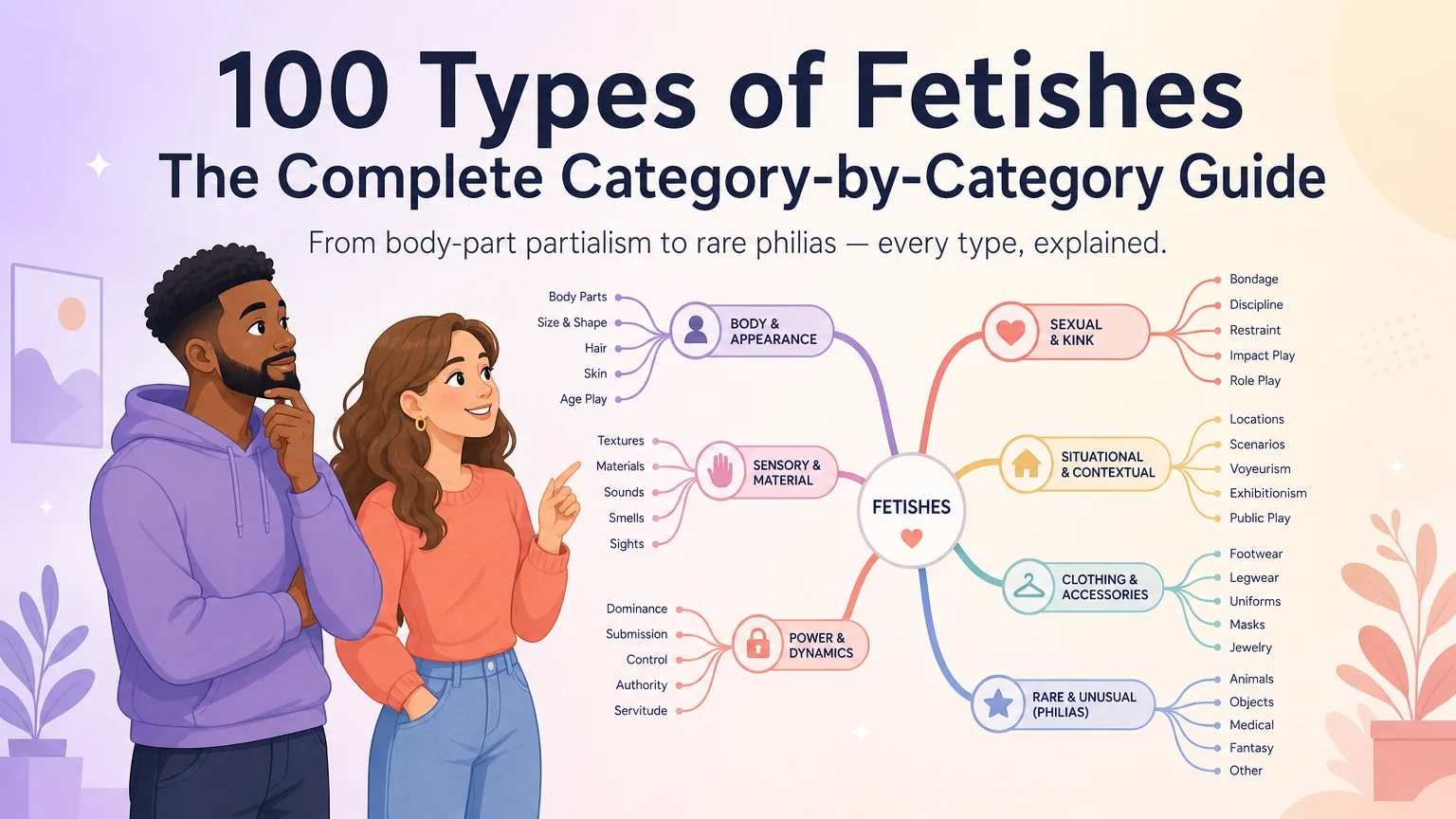
OK, here’s the map: 10 fetish categories covering more than 100 named fetishes, organized by what the attraction attaches to. A body part. A material. A sensation. A power dynamic. A scenario. The category tells you more about how a fetish works than its first letter ever could, which is why this fetish list is organized by category rather than alphabet.
1. Body-Part Fetishes (Partialism): Feet, Hands, Hair, and Beyond
One in three body-part fetish preferences is about feet. That number comes from a 2007 study in the International Journal of Impotence Research that analyzed roughly 5,000 people across 381 online fetish communities, and feet outscored every other part of the body at 33 percent. The leading explanation is literal brain wiring. The region of the somatosensory cortex that processes sensation from the feet sits directly beside the region that handles the genitals, and neuroscientist V.S. Ramachandran proposed that signals between the two neighbors can cross. A tickle becomes a turn-on.
The clinical name for this whole category is partialism: an intense attraction to a specific non-genital body part. It’s the most recognizable of all the fetish categories, and it carries a strange historical footnote. Research discussed in Jesse Bering’s book “Perv” found that foot fetishism measurably rose during major disease epidemics and receded once those diseases were controlled, a possible unconscious shift toward “safer” body parts. The mechanism is debated, but the pattern captures something real about desire: it adapts to what feels safe.
In practice, partialism is rarely just contact. Sex therapist Jessica Renard, who works inside kink communities, describes foot fetishists who care deeply about pedicure rituals and polish colors and not at all about shoes. The attraction usually comes with its own choreography. A pedicure can be more charged than a touch.
The named entries:
- Foot fetish (podophilia): attraction to feet, the heavyweight of this category. It also ranks in our guide to the most common fetishes, so we won’t re-run its numbers here.
- Hand fetish (quirofilia): arousal from hands, fingers, and gestures.
- Hair fetish (trichophilia): attraction to hair, its texture and length, or the acts of brushing and washing it.
- Armpit fetish (maschalagnia): arousal from armpits, their look or their scent.
- Navel fetish (alvinophilia): attraction focused on the belly button.
- Nose fetish (nasophilia): arousal centered on noses.
- Butt fetish (pygophilia): attraction to the buttocks specifically, beyond garden-variety appreciation.
- Nail fetish (onychophilia): arousal from fingernails or toenails, often tied to grooming and polish.
- Freckle and mole attraction: a fixation on specific skin markings.
- Leg and thigh fetish (crurophilia): attraction to legs as the main event.
If a body part is your thing, the takeaway is that specificity is normal. Most partialists want the attraction expressed one precise way, and naming that way to a partner is the whole conversation. The specificity is the intimacy.
2. Power and Control Fetishes: Dominance, Submission, and Exchange
In a power-exchange dynamic, who holds the power? Not who you’d guess. As one kink educator puts it, the sub is the one who holds most of the power, because everything hinges on enthusiastic, ongoing consent. The person kneeling can end the entire scene with a single word. That inversion is the key to this whole category.
Power and control fetishes are the psychological arm of BDSM: obedience, worship, surrender, command. The physical-sensation arm gets its own section later, and so does restraint, because BDSM is an umbrella rather than a single fetish. And it’s a crowded umbrella. In Justin Lehmiller’s survey of 4,175 Americans, 93 percent of men and 96 percent of women reported at least one BDSM fantasy, and discipline fantasies alone ran around 50 percent.
Four words unlock the vocabulary: a scene is the encounter, a safe word stops everything instantly, a switch enjoys both roles, and aftercare is the emotional and physical wind-down afterward. It’s not about violence. It’s about intention, trust, and play.
The named entries:
- Dominance and submission (D/s): the core exchange, one partner leads and the other consensually yields.
- Switching: arousal from moving between dominant and submissive roles.
- Discipline: rules, punishments, and rewards as erotic structure.
- Humiliation play: consensual erotic degradation, verbal or situational.
- Praise kink: the mirror image, arousal from approval and being told you’re good.
- Financial domination (findom): arousal from giving or controlling money as a power act.
- Cuckolding and hotwifing: arousal from a partner being with someone else, flavored humiliating or celebratory.
- Consensual non-consent (CNC): fully scripted resistance play negotiated in advance.
- Orgasm control: edging, denial, and permission-based climax.
- Chastity play and keyholding: locking arousal away, with one partner literally holding the key.
- Erotic hypnosis: trance-based power exchange; professional “hypnodoms” run extensive intake before ever getting into someone’s head.
- Protocol play: formal rules of address, posture, and service.
- Interrogation play: resistance-and-questioning scenarios.
One safety line, because CNC and humiliation are negotiation-heavy: scripts agreed in advance, safe words non-negotiable, aftercare expected.
The kink-versus-fetish line applies neatly here. Enjoying D/s scenes is a preference. Needing the power exchange present for arousal at all is where it becomes a true fetish.
3. Material and Fabric Fetishes: Leather, Latex, Nylon, and More
In 1966, psychologist Stanley Rachman gave three men a boot fetish in a laboratory. He repeatedly paired a slide of black knee-length boots with erotic images, between 24 and 65 pairings, until the boots alone triggered measurable arousal. The response even generalized to similar shoes, then faded once the pairings stopped. A 1968 replication added a control condition that ruled out coincidence. Fetishes, at least sometimes, are learned.
Materials are the textbook case of fetishism in the strict clinical sense, which historically means attraction to objects and fabrics. Formation is multi-cause rather than one neat story: conditioning like Rachman’s, reinforcement through fantasy, and what researchers call biological preparedness. It’s probably no accident that the most common fetish materials, black, shiny, and smooth, share visual properties with aroused skin. Whatever the mechanism, the interest is widespread: fetish objects like leather, shoes, and pantyhose draw fantasy interest from 43 percent of men and 36 percent of women in Lehmiller’s data.
The named entries:
- Leather fetish: the classic, often encoding themes of power and toughness.
- Latex and rubber fetish: arousal from skin-tight, glossy second-skin materials.
- Nylon and stocking fetish: attraction to hosiery, its sheen and texture.
- Silk and satin fetish: arousal from smooth, flowing fabrics.
- Furry fetish: attraction to the sensation or look of fur.
- PVC and vinyl fetish: high-shine synthetic materials as the draw.
- Underwear fetishism: arousal from lingerie or underwear itself, worn or observed.
- Shoe fetishism (retifism) and boot fetishism: the object cousins of podophilia from category one.
- Glove fetish: hands sheathed in leather, latex, or satin.
- Uniform fetishism: arousal from what a uniform signals, authority, service, or role.
- Zentai: full-body enclosure suits, where total coverage is the point.
- Specific-garment attractions: denim, hoodies, or any single item that carries the charge.
The verdict on this category comes from psychotherapist Michael Pizzulo: decode the theme, not the object. The material is rarely random. It usually encodes power, enclosure, or sensation, and understanding your theme is more useful than cataloguing your wardrobe.
4. Sensation and Pain Play: Impact, Temperature, and Edge Play
If you’ve ever worried that enjoying pain means something is broken, the data points the other way. In the 2016 Joyal and Carpentier study, interest in masochism, reported by 19 percent of men and 28 percent of women, was associated with higher sexual satisfaction, especially among women. The people exploring intense sensation were not the damaged ones. They were often the most satisfied ones.
There’s a neurological reason. Pain and pleasure pathways overlap in the brain, and consensual sensation play triggers an endorphin release that AASECT-certified sex therapist Dr. Amanda Pasciucco describes as a runner’s high with intimacy.
This is also the category where the kink community did its most serious thinking about safety, and the frameworks have a history. SSC (Safe, Sane, Consensual) was coined in the early 1980s by New York’s gay S/M activist community to draw a public line between BDSM and abuse. RACK (Risk-Aware Consensual Kink), coined by Gary Switch in 1999, grew from the frank admission that nothing is ever 100 percent safe, so every participant should know the specific risks and consent with that knowledge. PRICK (Personal Responsibility, Informed, Consensual Kink) adds explicit ownership of outcomes. The shared floor across all three: enthusiastic, informed, revocable consent.
The named entries:
- Impact play: spanking, paddling, flogging, and whips, the broad church of striking.
- Masochism and sadism (algolagnia): arousal from receiving or giving pain within negotiated limits.
- Temperature play: wax drips and ice as contrast sensations.
- Electrostimulation (e-stim): purpose-built devices delivering controlled current.
- Tickling (knismolagnia): arousal from tickling or being tickled.
- Abrasion play: textures dragged across skin for sensation.
- Breath play (asphyxiophilia): arousal from restricted breathing.
- Figging: ginger root used for slow-building heat.
- Wartenberg wheel play: a pinwheel of spikes delivering intense sensation with minimal harm potential.
Safety, concretely: breath play carries genuine risk of injury or death and has no fully safe technique. It’s the canonical RACK-not-SSC activity, and that deserves a plain statement. For impact play, avoid the kidneys, spine, and neck, and stick to padded muscle.
Best entry points, ranked by risk floor: temperature and tickling sit lowest, impact with soft implements comes next, and breath play is expert territory only.
5. Bondage and Restraint: Rope, Restriction, and Sensory Deprivation
The single easiest upgrade in existence costs a few dollars and requires zero skill: a blindfold. Take away sight and every other sensation gets louder, anticipation does half the work, and the physical risk is close to nil. It’s the gentle on-ramp to a category 75 percent of Lehmiller’s survey respondents had fantasized about, which makes bondage the single most fantasized-about fetish act in the dataset.
Restraint runs on a spectrum, and skill requirements scale with intensity. At one end, a silk scarf and a pair of soft cuffs. In the middle, rope craft. At the far end, suspension work that responsible practitioners treat like rock climbing: studied, drilled, never improvised.
Shibari, the Japanese rope tradition, has grown into a genuine art form with technique standards and a global community. For some people the restriction itself is the turn-on. Enclosure, immobility, and helplessness are sensations in their own right, the physical cousin of the surrender we covered in the power-exchange section.
The named entries:
- Bondage: cuffs, ties, and spreader bars, restraint in its broadest form.
- Shibari (kinbaku): artful Japanese rope bondage, aesthetic and sensation together.
- Suspension bondage: the body partly or fully lifted by rope, advanced skill required.
- Sleep-sack bondage: full-body enclosure in a fitted bag.
- Mummification: immobilizing wrap, head to toe.
- Gags: restricting speech as an act of control.
- Blindfolds and sensory deprivation: removing senses to amplify the rest.
- Forniphilia: human furniture. Practitioners serve as tables, lamps, even chandeliers. Serving as a footstool now and then is a preference; for a true forniphile, it’s woven into daily life.
- Claustrophilia: arousal from confined, enclosed spaces.
Safety, concretely: rope and cuffs compress nerves, so numbness or tingling means release immediately. Never leave a restrained partner alone, and keep safety shears within reach.
Start with the blindfold, learn the vocabulary from the power-exchange section, and treat rope as a craft you study rather than improvise.
6. Watching and Being Watched: Voyeurism, Exhibitionism, and Public Play
The most common atypical sexual interest isn’t an exotic one. It’s watching. In the Joyal and Carpentier study, 35 percent of adults reported voyeuristic interest, the highest of any category tested, and among men in Lehmiller’s survey, voyeuristic fantasy reaches 73 percent. The urge to see, and to be seen, sits close to the center of human sexuality.
Which makes the consent line the entire story of this category. Consensual voyeurism and exhibitionism, a partner who wants to be watched, a club with clear rules, homemade content made together, all of that is healthy fetish play. Involving people who haven’t consented is not fetish play. It’s precisely the thing that turns a paraphilia into a disorder under the DSM-5, and a crime under the law. Same impulse, opposite ethics, and the difference is one question: did everyone say yes?
The data shows a consistent gender pattern: voyeuristic fantasy runs 73 percent in men versus 48 percent in women, exhibitionism 47 versus 36.
The named entries:
- Voyeurism: arousal from watching others undress or have sex, with their knowledge and consent.
- Exhibitionism: arousal from being watched by people who want to watch.
- Public play (agoraphilia): the thrill of semi-public settings.
- Dogging: arranged outdoor play with invited observers.
- Katoptronophilia: arousal from mirrors, watching yourselves.
- Homemade erotic filming: creating your own content together, camera as third presence.
- Vicarphilia: arousal from hearing about other people’s experiences in vivid detail.
One practical note: public settings always contain potential non-consenting bystanders, which is exactly the problem lifestyle clubs, events, and private-property venues exist to solve.
The watching impulse is near-universal. The entire ethics of the category lives in one question: has everyone who can see or be seen said yes?
7. Roleplay and Scenario Fetishes: Age Play, Pet Play, and Persona Shifts
Why would a grown adult want to be a puppy for an evening? The answer says less about dogs than about what full permission to stop being yourself feels like. Roleplay fetishes are persona play, and the persona encodes the theme, to borrow Michael Pizzulo’s framing from the materials section: surrender, care, transformation, escape from the managing, deciding, performing self.
The scenario is a container. Rules, roles, and headspace make it safe to hand over control, to be taken care of, or to become someone else entirely for an hour. That’s also why this category attracts more public mockery than any other, and why the mockery misses. All of it is adults consensually pretending, which is also the definition of theater. Nobody heckles a community production of Macbeth for containing a fake king.
The named entries:
- Age play: consensually acting older or younger, including ABDL (adult baby/diaper lover) at the far end.
- Pet play: taking on puppy, kitten, or pony personas, often with gear and handler dynamics.
- Furry play: anthropomorphic animal personas. The community draws its own line between hobby suiting and sexualized use; a tail keychain is not a collar.
- Medical play: exams, instruments, and clinical authority as the scene.
- Authority-figure scenarios: teacher, boss, officer, interrogator, borrowed power.
- Cross-dressing (transvestic fetishism): arousal from wearing another gender’s clothing, one of the eight paraphilias named in the DSM-5.
- Sissification: feminization as power exchange.
- Breeding and pregnancy fetishism (maiesiophilia): as Gigi Engle, 3Fun’s resident intimacy expert, explains it, the breeding kink “is rooted in the fantasy of getting pregnant, but not the desire of raising a baby.” The charge is the risk and the claiming, not the childcare.
- Gerontophilia: attraction to elderly partners.
- Fantasy-species and monster roleplay: costumes, personas, and imagination doing the heavy lifting.
One safety line: age play and any CNC-adjacent scenario need explicit negotiation of what stays fantasy.
The quick comparison from earlier still holds. An occasional scenario is a preference. Needing the persona for arousal is a fetish. Neither is a diagnosis, because the DSM line is distress and consent, full stop.
8. Body Fluids and Functions: Watersports, Lactation, and Messy Play
This is the category people are least likely to say out loud, and the silence is the problem. Roughly one in three men and one in seven women report urine-play fantasies in Lehmiller’s data. That means the “unspeakable” interest is sitting quietly in a very large number of bedrooms, unspoken mostly because everyone assumes they’re the only one.
The mechanics are straightforward. Fluids register as intimate precisely because they’re barrier-free and taboo; the transgression is the engine. The DSM-5 does list urophilia and coprophilia among its “other specified” paraphilias, and listed does not mean disordered. The same test governs everything in this article: distress and consent, nothing else.
The named entries:
- Urophilia (watersports, golden showers): arousal from urine or urination.
- Coprophilia: arousal involving feces. Rare, clinically recognized, and subject to the same consent-and-distress test as everything else here.
- Klismaphilia: arousal from enemas.
- Salirophilia: arousal from soiling or messing a partner, dirt, mud, or ruined clothing included.
- Lactation play (erotic lactation): arousal from breast milk or nursing dynamics.
- Spit and saliva play: arousal from spitting or being spat on.
- Blood play: edge play involving blood. This one carries hard requirements: current STI testing, barriers, and real technique, or not at all.
- Eproctophilia: arousal from flatulence. Genuinely documented, and no, you’re not the only one.
Safety, concretely: fluids are real transmission routes. Broken skin is the no-go across the board, urine is low-risk on intact skin, and anything involving blood needs testing and barriers before it needs anything else.
The two-word protocol for this whole category is negotiate specifics. Exactly what, exactly where, exactly how cleanup works. Partners can hear almost anything when it arrives as a plan instead of a surprise.
9. Situational and Environmental Fetishes: Sleep, Mess, and Setting
Some fetishes only exist under specific conditions, and one of them literally requires a person to be asleep, or to convincingly pretend to be. Somnophilia is arousal connected to a sleeping partner. On its face, that sounds like a consent dead end. The kink community solved it with an elegant piece of matchmaking: somnophiles pair with dormaphiles, people aroused by feigning sleep, and everything gets negotiated in advance. A desire that would be impossible in the real world becomes structured, consensual play.
That’s the signature of this whole category. The turn-on isn’t a body part or an object but a state, a setting, or a situation, and the path to exploring it runs through negotiation and community. Complementary pairing is the quiet superpower of niche fetish communities: for many scenario-based desires, there’s someone whose fetish is the other half of yours. One therapist’s thought experiment pairs a clown fetishist with a balloon fetishist, a match made somewhere interesting, latex allergies permitting.
The named entries:
- Somnophilia and dormaphilia: the sleeping-and-feigning pair described above.
- Sploshing (wet and messy play, WAM): arousal from food, mud, paint, or slime on skin.
- Feederism (feedism): arousal around feeding, eating, and weight dynamics. Like every attraction to a body type, the line between desiring a person and reducing them to a trait is drawn by how you treat them.
- Balloon fetishism (looners): arousal involving balloons, inflating, popping, or not popping. Gigi Engle notes that balloon play “doesn’t always center sexual excitement or release” and calls the fetish “incredibly expansive,” with sensory and nostalgic layers alongside the erotic ones.
- Actirasty: arousal from exposure to the sun.
- Nebulophilia: arousal from fog.
- Dendrophilia: arousal connected to trees, a bridge into the rare territory of the next section.
This category is best for people whose answer to “what turns you on” is a scene, not a feature. The practical move is finding the community where your scenario has a name and, quite possibly, a counterpart.
10. Rare and Unusual Philias: Statues, Ghosts, and the Long Tail of Desire
Most individual fetishes occur in about 1 percent of the population or less. That sounds isolating until you run the math the way therapists who work with rare fetishes do: even a fraction of a percent still translates to hundreds of thousands of people who share that exact thing. Rare has never meant alone.
It has never meant disordered, either. The DSM test is distress and consent, never obscurity, so the entries below sit on the same ethical footing as everything in the previous nine sections. And the formation science travels with us. Jesse Bering’s “Perv” recounts a krotomophile, a person attracted to amputees, who traced the attraction to a single childhood moment under a table when a visitor arrived wearing a leg cast. Arousal met image, and they bonded. It’s Rachman’s boot experiment from the materials section, run once, by accident, in a living room.
The named entries:
- Objectum sexuality: deep attraction to specific objects or structures, sometimes described as romantic rather than purely sexual.
- Agalmatophilia: attraction to statues and mannequins, from the Greek agalma, “statue,” often entwined with themes of stillness.
- Spectrophilia: arousal involving ghosts or spirit encounters.
- Robot fetishism (technosexuality): attraction to robots or robotic transformation.
- Stygiophilia: arousal from the idea of hellfire and damnation.
- Melolagnia: arousal from music.
- Metrophilia: arousal from poetry.
- Hybristophilia: attraction to people who have committed crimes, the “true-crime crush” taken to its clinical name.
- Teratophilia: attraction to monstrous or unusual appearance.
- Krotomophilia: attraction to amputees, as in the case above.
- Oculolinctus: arousal from licking eyeballs. It exists, and it comes with a genuine hygiene caution: eyes infect easily.
- Dendrophilia: the tree attraction we bridged in on, fully at home in this company.
Community exists for nearly every entry on this list, and complementary matching, the somnophile-dormaphile principle from the last section, is how rare-fetish holders find partners. The long tail is the strongest proof of this article’s thesis: human desire is wildly specific, mostly harmless, and never as solitary as it feels. If yours is on this list, there’s a community where it’s Tuesday.
Fetish FAQs: Normal, Origins, and How to Talk About It
Is having a fetish normal?
Yes, statistically. In a representative sample of 1,040 adults, 45.6 percent held at least one sexual interest the DSM-5 labels “anomalous,” and fewer than 10 percent felt any distress about it. Lehmiller’s survey found 97 percent of Americans have sexual fantasies. A 2018 survey found one in three admit to a specific fetish. Atypical interest is, by the numbers, typical. Clinicians only treat it as a problem when it causes distress or involves non-consent.
What’s the difference between a kink, a fetish, and a paraphilia?
A kink is a preference that enhances sex; it’s optional. A fetish is an interest in something not inherently sexual that may be required for full arousal: all fetishes are kinks, not all kinks are fetishes. A paraphilia is the clinical umbrella term for intense, persistent atypical interest, and it is not a disorder.
A paraphilic disorder requires the interest to persist six-plus months and cause significant distress or impairment, or involve non-consenting people. Getting the label right matters, because calling a fetish a kink underplays its necessity.
Where do fetishes come from?
Multiple mechanisms, and researchers admit the full story is unknown. Classical conditioning can build one: Rachman’s 1966 experiment created boot arousal in a lab. Other contributors include reinforcement through fantasy, the brain-map adjacency of feet and genitals, possible genetic factors, and sensitive developmental windows around ages 6 to 12 and puberty.
Rachman’s lab-made arousal faded when the pairings stopped, but lifelong fetishes usually integrate rather than vanish. The healthy goal is the fetish on the menu, not the entire menu.
Do fetishes come from trauma?
No, not by default. Some fetishes do trace to difficult experiences, and fetish exploration can even be reparative; therapist Jessica Renard describes clients replaying moments where they had no voice and rewriting them with full control, on their own terms. But trauma should never be the starting assumption about yourself or a partner. Most fetishes form through ordinary developmental bonding between arousal and an object or scenario, not through harm. Curiosity is a better first lens than diagnosis.
When does a fetish become a problem?
Under the DSM-5, only when it persists six months or more and causes clinically significant distress or impairment, or involves non-consenting people or harm. Otherwise it’s a non-pathological variation of human sexuality, full stop.
The practical version: if your fetish is hijacking your sexuality, crowding out everything else, or causing persistent distress, a kink-aware therapist is the move. Social disapproval doesn’t count as distress, and rarity doesn’t count as pathology.
How do I tell my partner about my fetish?
Lead with confidence, not confession: 51 percent of people wait a month or more into a relationship, and the ones who deliver it like bad news tend to get it received that way. Pick a private moment, name it plainly, remove all pressure to participate, and normalize it with the numbers, since one in three people carry a specific fetish.
Real outcomes range from a relieved “that’s it?” to acceptance without participation. Both are fine. Then ask about theirs.