
A man sends a stranger $200, gets a two-word reply, and calls it the best part of his week. He is not being robbed. He is not confused about what he is buying. He is practicing findom, and the money is not really what he is after.
Reported interest in the term reportedly rose roughly 5,000% in a single year, which says less about how many people practice it than about how many have met the word and still cannot define it. Here is the plain-English version: what the dynamic is, the vocabulary you will meet, how a healthy version works, and where it tips into abuse or a plain scam.
This is for three readers: the curious, the person whose partner raised it, and the person quietly worried about someone they love.
Start with the definition, because nearly all of the confusion lives there.
What Financial Domination Really Is, and What It Isn’t
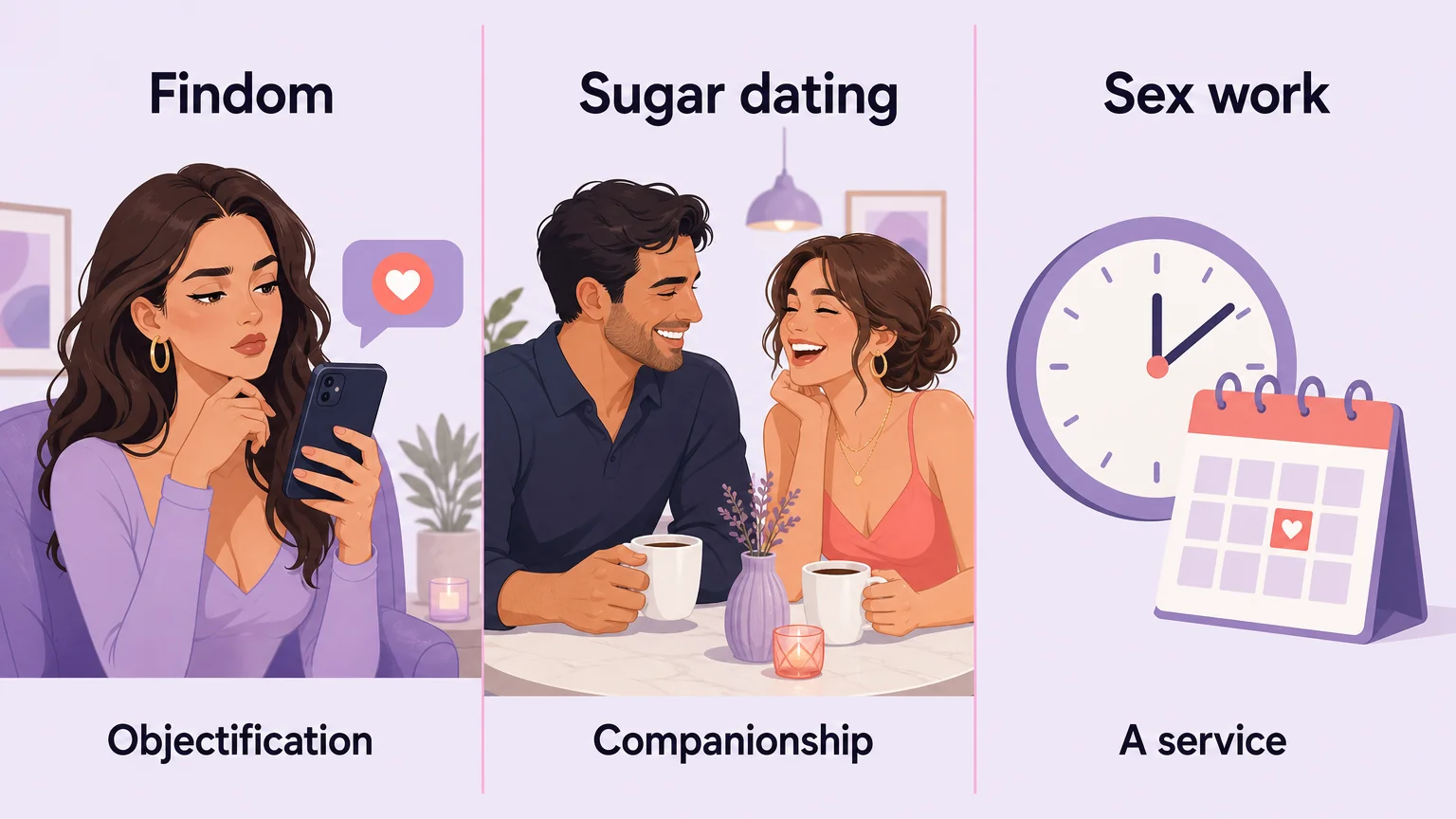
The person paying is not buying attention, company, or a service. He is paying for the acknowledgement that he is a resource and nothing more, and that is what he wants.
The word is a portmanteau of “financial” and “domination.” Findom is a kink centered on the exchange of money and financial power for psychological or sexual gratification. The dominant receives the tributes. The submissive’s payoff comes from giving, from being financially controlled, from serving and worshiping.
What the dominant does not provide is where newcomers go wrong. Sex therapist Dr. Kate Balestrieri puts it plainly: “Unlike sex work, the dominant does not typically provide any sexual acts, companionship or any conventional services in exchange for the money.”
Practitioners disagree about the label anyway. One dominant in a Channel 4 documentary states flatly, “It is sex work… a lot of people try to say that it’s not.”
Sugar dating runs the other way. In a sugar arrangement the payer receives companionship. In findom he receives the inverse: the explicit acknowledgement, in Balestrieri’s words, that he is “a tool, an ATM, a human wallet.”
Most findom happens online, as distance domination rather than in person, and it is a spectrum rather than one practice. Psychologist Dr. Sarah Ashton frames it that way, and the peer-reviewed study of the subject (McCracken and Brooks-Gordon, Sexuality Research and Social Policy, 2021) places findom on a continuum from BDSM lifestyle practice to legitimate commercial labor, with boundaries negotiated rather than assumed. The modes run from pure tribute to budget control, humiliation-adjacent play, and content-adjacent work.
Three arrangements, three payoffs
- Findom: the payer receives objectification. No sexual service, and it happens almost entirely online.
- Sugar dating: the payer receives companionship. Social, and often in person.
- Sex work: the payer receives a sexual service. The service is the transaction.
Findom Terms Decoded: Findomme, Finsub, Paypig, Tribute and More
Keep this list open in another tab. The vocabulary is the first wall a newcomer hits, and a list takes it down faster than a paragraph.
- Findom / FinDomme: the dominant, the person who receives.
- Finsub: the submissive, and the neutral term.
- Paypig, money slave, human ATM: harder-edged terms for the same role.
- Cashmaster, cash piggy: older variants you will still meet.
- Tribute: a payment for the privilege of contact or service.
- Sends: the act of sending money.
- Silent send: money sent with no interaction, purely as worship. Long-term submissives describe this most often. One dominant on her oldest sub: “He sends to me basically every day.”
- Drain session: a session where the submissive is told to send until nothing is left.
- Budget control: the submissive hands over their budget, and the dominant dictates the spending.
- Rinsing: extracting money repeatedly over time.
Words like paypig, human wallet, and ATM are not insults here. Balestrieri: “Phrases like human wallet, ATM, or Pay Pig are not insults in this context. They’re affirmations of the submissive’s role. The objectification is a form of psychological masochism.” That is how two identical-looking scenes can be a healthy dynamic in one case and abuse in the other.
Rinse and drain are flagged here neutrally. What happens when either stops being a game comes later.
The Line Between a Findom Kink and Financial Abuse
If you are reading this wondering whether you, or someone you love, is being taken advantage of rather than exploring something, read this slowly.
The line is not the amount. It is who controls the submissive’s wellbeing. Balestrieri draws the distinction precisely: in kink, the dominant controls the money inside the scene, but the relationship rests on mutual care and respect for the submissive’s hard limits. In abuse, the abuser controls the entire dynamic and exploits the other person without regard for their wellbeing, “effectively destroying the person to serve their own greed.”
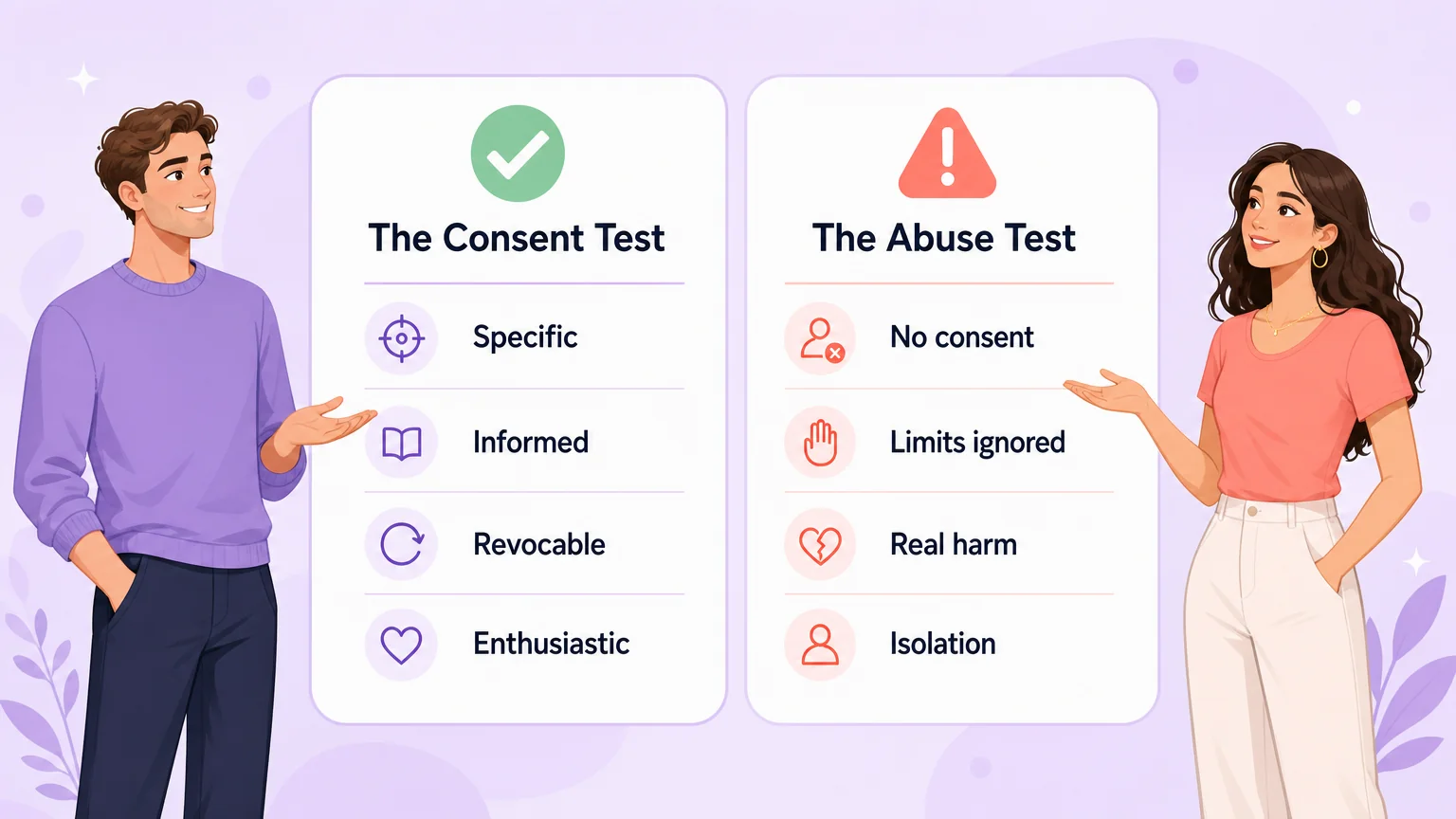
The consent test. Consent has to be specific, informed, revocable, and enthusiastic. All four, not just the first. In a money dynamic the part people forget is revocable. The submissive can use a safeword, stop a scene, or end the relationship at any time, and none of those requires permission.
The abuse test. Four markers. No meaningful consent: the person was coerced, manipulated, groomed, blackmailed, or drawn in by someone predatory. No respect for limits, with pressure lines like “if you really loved me, you’d…” and threats of exposure. Exploitation to the point of real-world harm: crippling debt, loss of housing, or an inability to pay for necessities. Isolation from friends and family.
The diagnostic. “My domme won’t let me quit” is itself the answer. A consensual dynamic permits exit at any time, without negotiation. If that sentence describes your situation, the question is settled.
What limits sound like. Language you can copy: do not contact my employer. I will not go into debt. Nothing over a set amount.
A self-audit, from either side. Whether you are sending or watching someone send, the signals are the same: a lifestyle that does not match the claimed job, frequent mentions of debt or living paycheck to paycheck, vagueness about affordability, inconsistent sending, essentials skipped to fund sends, and no financial buffer. One sign may mean nothing. Two or more together mean slow down.
The verdict. If you cannot leave without consequence, it is not a dynamic. Not a bad one, not an intense one. Not a dynamic at all.
Findom Red Flags: How to Tell a Real Dynamic From a Scam
The conversation is going well. There is a number on the screen, and something feels off.
Confirm who they are, and that they are over 18. A photo holding your username and today’s date, or a live voice note, is the baseline. If a minor is involved, stop. Then slow down, and do not send too soon.
The single most reliable tell. Pressure toward crypto, gift cards, or anything else you cannot recover is itself the scam. Those rails have no recourse built in.
The patterns. An upfront fee described as processing, verification, or an unlock, demanded before a larger sum is released; money never charges you to receive it. Unsolicited recruitment on a public timeline. A tribute demanded as a mandatory step in an opening conversation. Questions dodged with “you’re not ready.” Stolen photos and Telegram redirects.
The same fraud runs the other way. Forged payment screenshots are the standard trick aimed at dominants, so confirm the money landed in your own account before you give attention. Fake submissives demand a fee; paid mentorship groups deliver nothing. If someone offers you $5,000 for a $20 fee, it is a scam: “only scammers desperate for free attention will go to great lengths to convince you.”
Ask a platform three things. Does it verify creator identity? Subscription platforms check government ID. Is it anonymous on both sides? Throne hides both parties and records who paid. Can a payment be reversed? Peer-to-peer apps are instant and unprotected.
The complication. Some submissives get off on being deceived, or come to. One man learned his dominant was a man in another country and was sent photos of the shoes bought with his money, and still wrote that he wants a dominant of his own. The deception can be part of the thrill and still be harm.
If it is already happening. Stop paying the moment pressure appears; further payments signal willingness and escalate demands. Keep messages and records. Do not counter-threaten; that can make you liable for coercion. Get legal advice rather than handling blackmail alone.
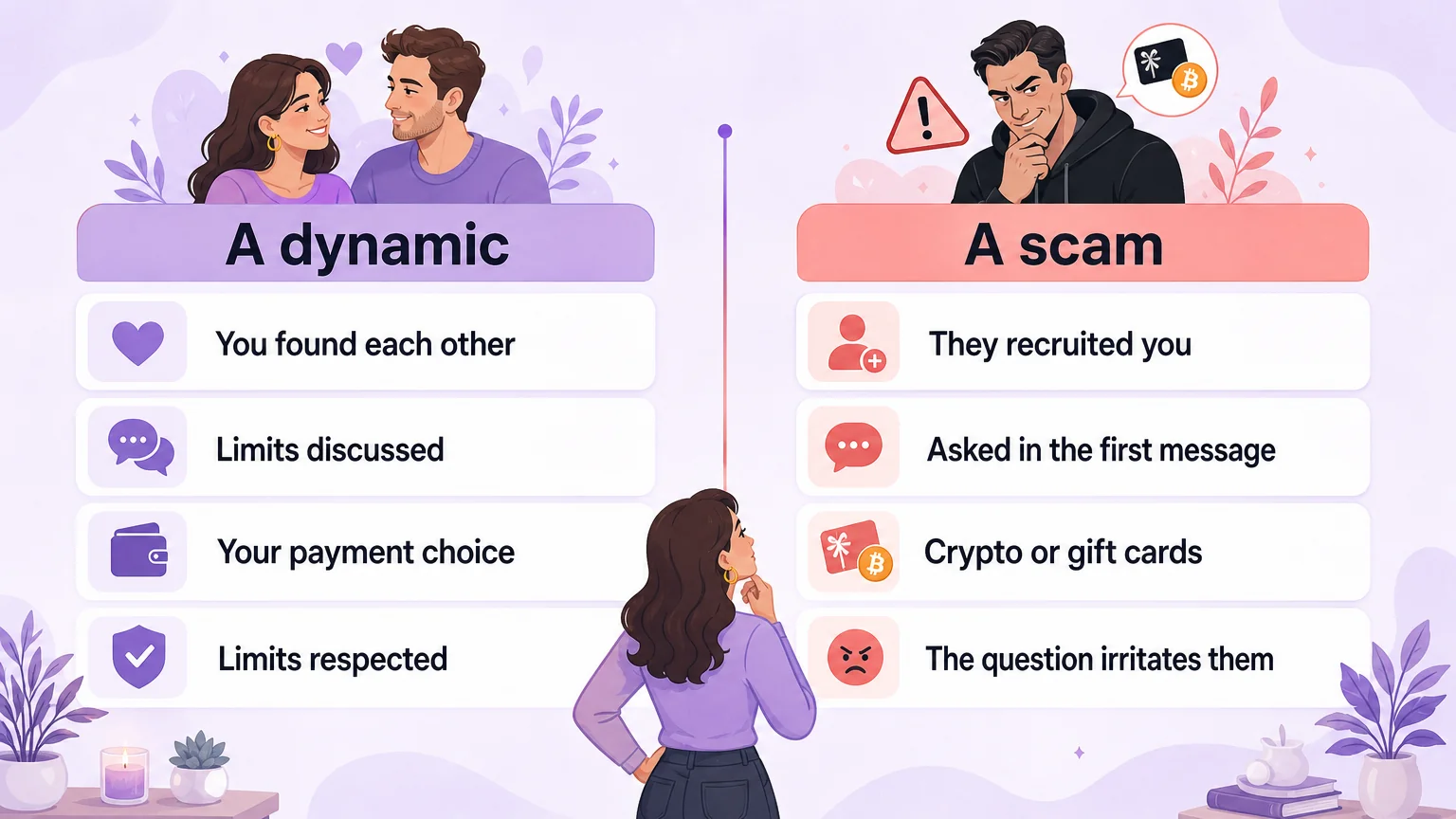
A dynamic against a scam
- Contact: you found each other / they recruited you publicly.
- First ask: after a limits talk / in the first messages.
- Payment: your choice / crypto or gift cards.
- Limits: they can name them / the question irritates them.
How to Practice Findom Safely: Budgets, Limits, Safewords and Aftercare
By the end of this section you will have a cap, a limits list, a safeword, and an aftercare plan. None takes long to write.
Set the cap before the first conversation, not during it. Say it out loud: “This is the budget I have for this kink.” The standard is affordability, not a number.
Tributes come from disposable income, never from the edge of your means, and never from anything rent, food, or transport depends on. Steady, moderate sending is healthier than one large opening send.
Write your limits down before any money moves. Copyable language: no contact with my family. No contact with my employer. No sending money that would put my housing at risk. No going into debt. Nothing over a set amount.
Two confirmations matter more than the list: that stopping is respected immediately, and that you can end the whole relationship, not just a scene, whenever you want. Negotiating limits mid-scene is not negotiating. It is pressure.
Set a safeword, then test it once on purpose. A financial dynamic has no scene to interrupt and no obvious moment to use it, so agreeing the word is not enough. Use it deliberately early, when nothing is at stake.
Choose the rail on purpose. The trade-off is how visible this payment is to the people in your life, and whether it can be reversed if the other person disappears. A card linked to his payment account is how one young submissive’s parents found out. On the other side sit the irrecoverable rails, where the money is simply gone.
Plan the aftercare. The drop after a large send is documented, and it is not a character flaw. Build the check-in habit before the low arrives rather than after it does. Agree in advance that the dynamic pauses, without penalty, if either person’s real life destabilizes.
One long-distance arrangement runs on a hard weekly tally, with both people open about what each earns and needs, and no blackmail or degradation when a payment is missed. Another dominant has his submissive move a set amount into savings every payday before any tribute, and refuses sends he judges unaffordable.
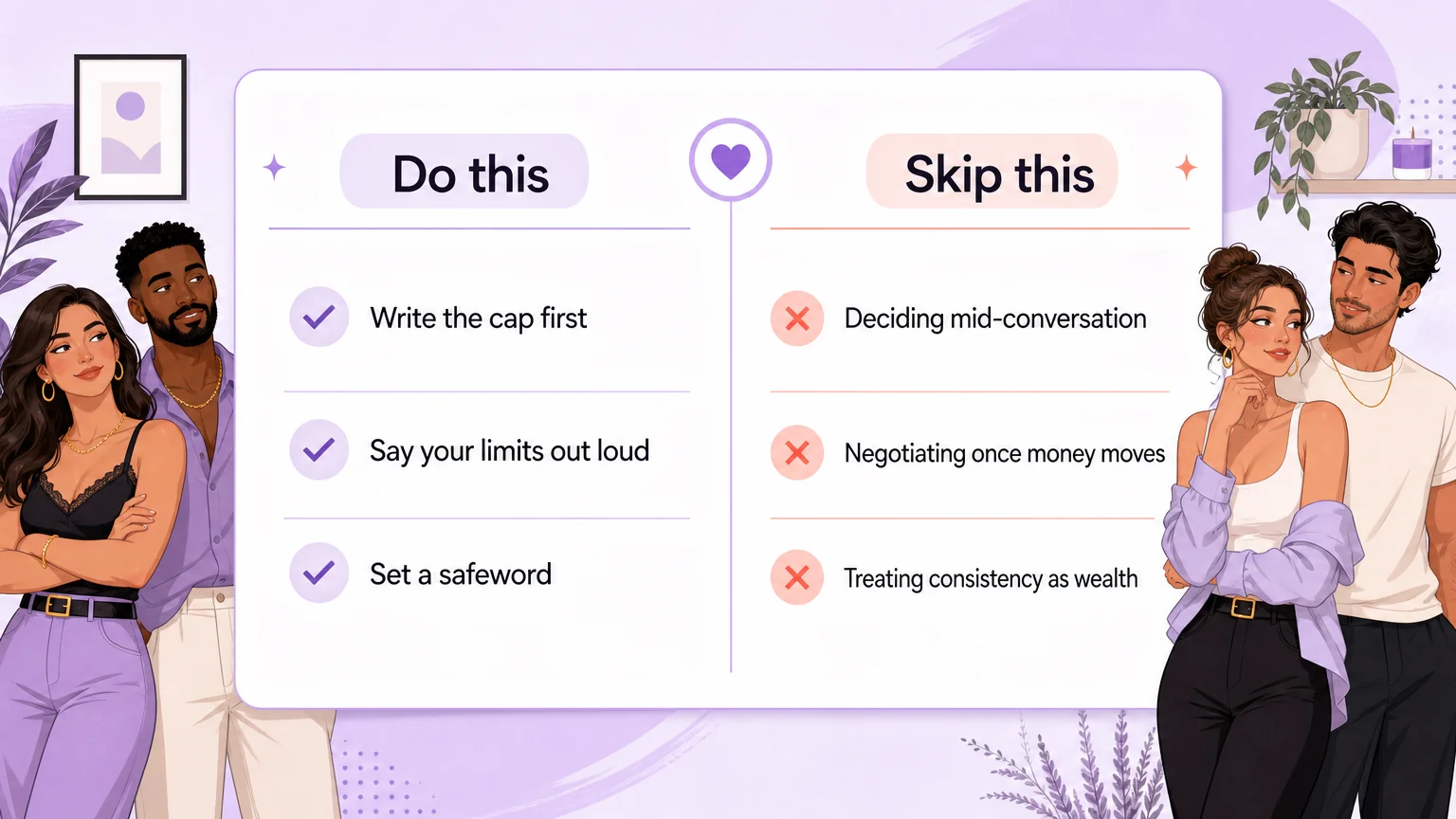
Do this: write the cap before the first conversation, say your limits in words the other person can repeat back, set a safeword and test it.
Skip this: negotiating limits once money is already moving, deciding your budget inside the conversation that is already arousing, or treating consistency as proof of wealth.
If you are the dominant. This section is written from the submissive’s side. The other half is in How to Be a Findom, which covers setting the money limit, holding it when someone pushes, and what the money means for tax and payment platforms.
Why People Do It: The Psychology of Financial Domination

Describe this arrangement to almost anyone and a second question follows the first, asked more quietly: is he unwell? No. Once you see what the submissive is getting, the behavior stops looking strange.
The eroticism is in what the money represents. The most common driver is the transfer of power and control. Balestrieri notes that a striking number of submissives carry heavy responsibility in daily life: the professionals, the executives, the family providers holding weight for other people.
The dynamic inverts the provider script. Instead of being responsible for a household, he gives his resources to someone who does not need him for survival.
The pressure to be financially prudent is immense, and this offers a sanctioned space to be irresponsible. In that space, recklessness is demanded and celebrated. Some describe it as atonement, with the dominant serving as “both the punishing and the absolving figure.” Others describe a temporary dissolution of the self.
A 21-year-old describes the draw with no apology attached: he liked “the idea of the ownership,” the sense of being devoted to someone entirely. Nothing in that needs a diagnosis.
Balestrieri says it plainly: “not all kinks come from a place of trauma. In fact, for many people there is no tie to any trauma in their past.” Where trauma does exist, submission can be a controlled reenactment, turning past powerlessness into a chosen scenario.
Why the objectification is the payoff. It is the reward rather than a side effect to be regretted, which is why a healthy dynamic and an abusive one can look identical from outside and be opposites inside.
Who practices it. The default picture, a woman dominant and a man submissive, is the default for a reason and a poor rule. There are male and non-binary dominants, female submissives, and queer and trans people throughout the scene, and the research drew on a mixed-gender participant pool. The matriarchy rhetoric that circulates widely is one flavor of the fantasy, a subculture inside findom rather than a statement of anyone’s politics.
Why the working dynamics last. Durable arrangements depend on motivation matching: each person wanting what the other is offering. The work itself involves a managed emotional performance rather than pure spontaneity. Newer dominants, with online peer support to draw on, tend to set healthier limits than the generation before them did.
The reframe for anyone still baffled. The arrangement structurally resembles some conventional marriages and becomes erotic only when it is made explicit. Once you can see that, contempt turns into curiosity.
The verdict. The appeal is entirely legible. What matters next is what happens when the mechanism turns against the person it is supposed to serve.
When Findom Goes Wrong: Addiction, Rinsing and the Risks Dommes Face
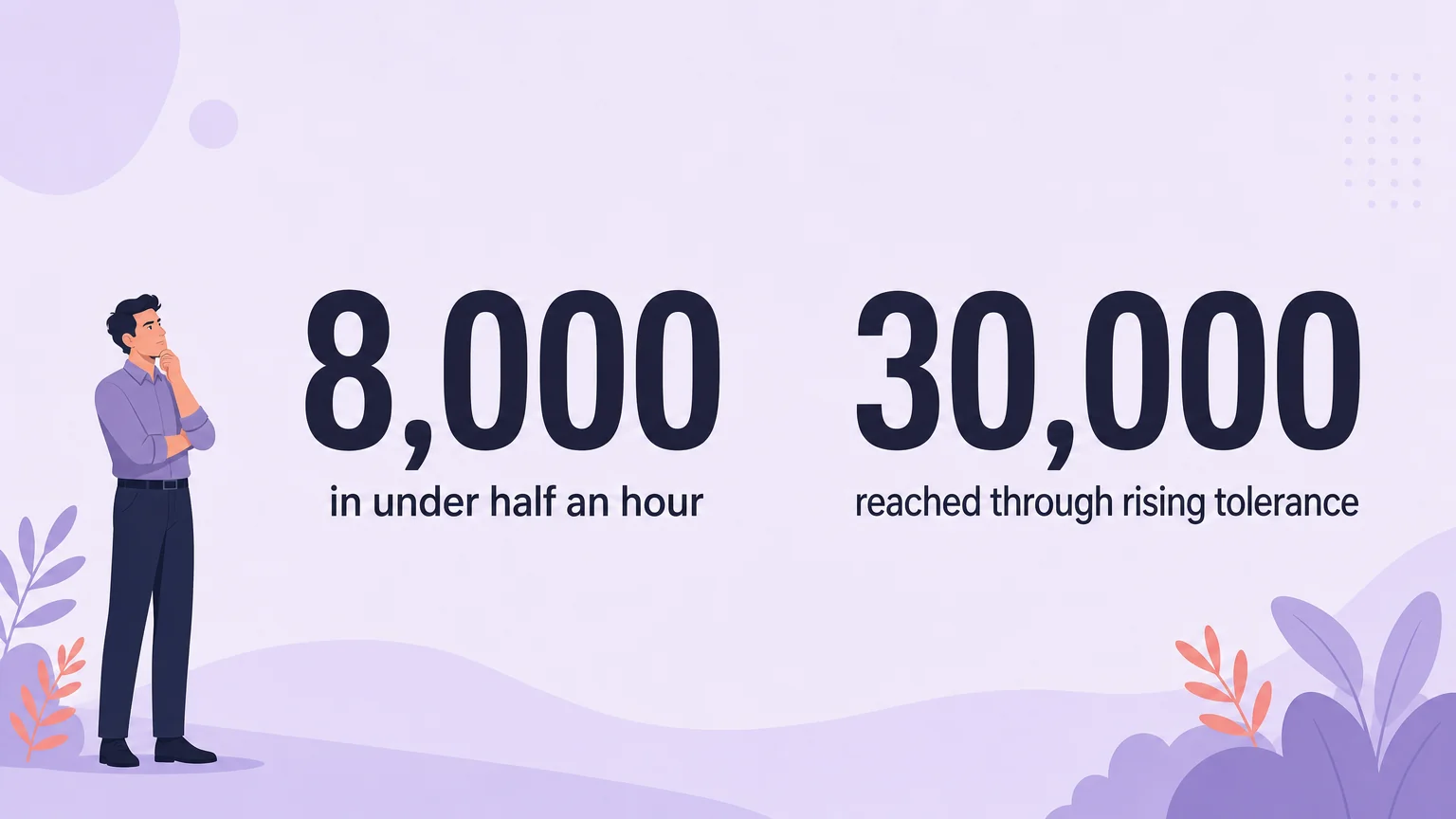
One documented session moved £8,000 in under half an hour, set by a wheel-spin multiplier that landed at 4x. The submissive had worked six weeks for it. The figure named at the start of a session is never the one at the end.
Escalation is the mechanism, not a weakness. Tolerance grows the way it does with anything that delivers a strong response: the first send is small, the response is large, and the amount needed for the same response climbs. One submissive reached roughly $30,000 with rising tolerance. Another went nine months spending nothing, then relapsed with thousands in a single episode.
Why it hides. Shame is the accelerant. One submissive concealed the spending from a live-in partner who assumed it was drugs. Another was discovered through his own payment records and told by a parent that what he was doing was “borderline prostitution.”
The secrecy protects the cycle. That is a reason to look at the pattern, not to shame anyone.
A private audit. Repeated cycles of regret followed by more spending. Payments you would not want anyone to see. Debt that exists because of sends. Failed attempts to cut down. Spending that has reached money you need. Then the question that matters: does this make your life better? Keep the money for this in an account that cannot reach rent, food, or transport.
If it is compulsive. Use blockers rather than willpower, the faculty under strain. Consider a kink-aware therapist or a debt adviser rather than peer support alone. Peer venues exist for exactly this, including the paypig support community on Reddit and the findom recovery groups, though recovery infrastructure is much thinner than the commercial kind.
The risk runs both ways. Dominants face stalking, doxxing, and harassment that follows them home. One practitioner describes a friend whose work details were found and whose employer was contacted. Another answers the risk with preparation: “I started boxing. I’ve got CCTV everywhere.”
Dominants verify submissives’ identities before any meeting and arrange a security presence nearby, disclosed in advance. They choose public meeting locations deliberately, at the cost of privacy, releasing the exact meeting point only on arrival. They keep a working identity separate from a real name, because it does get leaked.
The rule. If two or more of these describe you, stop before the next send and get help that is not another person on the internet. It is survivable, and well documented.
Is Findom Ethical? Two Honest Answers

Is this ethical? The unhelpful answer is “it depends.” The useful answer is that two people who know this practice well, and who both care about the people doing it, disagree.
Position one: the duty of care. A dominant who accepts tribute becomes responsible for the submissive’s finances. Held badly, it can push someone past their limits into severe debt. Ethical practitioners, on this view, advise against draining anyone to destitution.
Position two: autonomy. Asked whether she ever feels she drained someone too much, one answers directly: “Not really. I mean, they’re all adults. They can make their own decisions.” Her one qualification: in a long-term dynamic where destruction becomes visible, she would have a conversation. Critics read that as too late to count.
The line most people can hold. A professional dominatrix of more than two decades puts it simply: what separates this from abuse is consent, and specifically wanting it because it is a kink of yours. Her caveat keeps it fair: this practice, unlike other kink, “can be completely transactional and impersonal.”
The affordability test. One practitioner draws the line concretely: not comfortable with a submissive skipping a mortgage payment, comfortable with one who cannot afford the cinema that month, since that money was tributed. The test is not whether money was sent, but what it was taken from.
Affordability is the live version of this argument. A dominant’s income rests on other people’s spare money, described by practitioners as volatile rather than steady. That raises a question the scene has not settled: what does it mean to build an income on someone else’s discretionary spending?
The structural critique. Academic work defines findom as a consensual exchange of financial power for sexual purposes, and argues its dynamic “simultaneously reverses and reinforces gendered and racial power relations.” That research also makes a decriminalization argument.
Whose money is it? What is it taken from? Can the person paying say no without consequence?
Who is responsible for the harm if it comes
- A practitioner’s answer: the person sending is an adult making his own decisions.
- A therapist’s answer: a dominant who accepts tribute has assumed responsibility for that person’s financial wellbeing.
Findom and Your Relationship: Telling a Partner, Doing It in the Open

This is the part you have not told your partner about. Some of the people doing this call it a form of infidelity, though nothing physical ever happens. Secrecy, sexual charge, and money all land on the same person. If it comes out of a shared budget, the other person has a stake in it.
Why it reads as cheating. One submissive calls it “cheating on my partner” despite no physical contact. Another agrees it is “a form of cheating as you are getting sexual pleasure from it.” The clinical version reaches further: partners, children, and anyone relying on those resources have a stake, so the consent that counts is not only the submissive’s.
Disclosure, in practical steps. Lead with what it gives you rather than what it costs, because the first version your partner hears becomes the frame. Be accurate about the amount: the number is what a partner finds eventually, and a discovery is worse than a disclosure. State your own cap when you raise it, so your partner hears a boundary, not an open tab. Then ask what they need going forward, and be ready for “everything” or “nothing specific, but I want to be told.”
Doing it in the open. In relationships that already have agreements about outside sexual autonomy, treat the money as its own agreement: sexual autonomy and control of the household account are different permissions. Make the boundary structural rather than promised, so nothing depends on either person remembering it. Some couples do this jointly, and a partner who wants in can be. That is not an option secrecy offers.
For the baffled partner. The same reframe applies. What you are being asked to understand is a structure that already exists in ordinary households.
Most people are trying to move from hiding to finding people who share the interest without explaining it first. Create a profile on 3Fun to start with people who already understand it, whether you explore together or on your own.
If you are doing this in secret, the conversation is the safety feature you have not installed yet.
FAQ: Findom Taxes, Contracts, Ethics and Legitimacy
Do Findoms Pay Taxes?
Yes, where the money is consideration rather than a genuine gift. Tax authorities look at the substance of a transaction rather than its description, so marking a payment as a gift in an app does not make it tax-free. Money taken in exchange for tribute, contact, or content is self-employment income, and not reporting it carries exposure. Practitioner-facing business material treats tax planning as a standard concern.
Are Findom Contracts Legally Binding?
Broadly no, and never as ownership. An arrangement between consenting adults can be construed as a contract, but a contract that offends good morals is void, so one that degrades or treats a person inhumanely gets no legal protection. Voluntary payments are usually treated as irrevocable gifts, challengeable only for deception, duress, unjust enrichment, or exploitation of weakness. Written agreements are used as consent documents, and their force is social rather than legal.
Is Findom Ethical?
Consent is the dividing line, and it is genuinely contested at the margins. A professional dominatrix of more than two decades makes the case for it, and a practitioner in the same documentary answers that participants are adults who can make their own decisions, which critics read as abdicating responsibility. The question that keeps it open is whether consent is ever fully free given the power asymmetry. The full argument sits in the ethics section above.
Is Findom a Legit Website or Platform?
Judge a platform on three questions rather than on what it calls itself: does it verify creator identity, does it keep both parties anonymous, and can a payment be reversed? The most reliable single test is the payment rail: pressure toward crypto, gift cards, or anything else irrecoverable is the scam signal. The criteria matter more than any platform’s reputation.
Does Findom Involve Sex?
Generally no physical sex, and usually no sexual service at all. The dominant commands, receives, and sometimes degrades; the submissive’s pleasure comes from giving rather than from anything received in return. Practitioners themselves split on the label. One dominant states flatly that it is sex work, and that those who say otherwise are wrong.
How Much Money Do Findoms Actually Make?
Several hundred to a few thousand dollars a month is the realistic range for an established dominant. Routine sends run $10 to $50, one working model runs on a $300 monthly budget, and one established figure reports $200 to $3,000 a month. The viral numbers are outliers: one documented month reached five figures, and a recorded live drain moved £8,000 in under half an hour.
The same practitioner calls the income “very hit and miss,” one day at £10, another at £10,000. Most working dominants also take content work, because pure findom pays less.