It’s 2 a.m. and you’re wide awake, circling a question you’ve never said out loud to another human being. Wanting to know how to get rid of a fetish feels urgent and unaskable at the same time. People in this exact spot tend to voice the same fear: am I stuck with a fetish for life?
You’re not stuck. There is a path, and it starts working before any therapist enters the picture.
What that path changes first is the part doing the damage: the compulsion, the secrecy, the spiral of feeling broken. Getting over an unwanted fetish starts there, and the work begins tonight.
The route, in one breath: name the problem you’re solving, stop what makes it worse, use tools that lower the charge, check whether porn built the pattern, find the right professional, bring your partner in, and know what winning looks like.
Step 1: Pinpoint Which Problem You Are Actually Solving
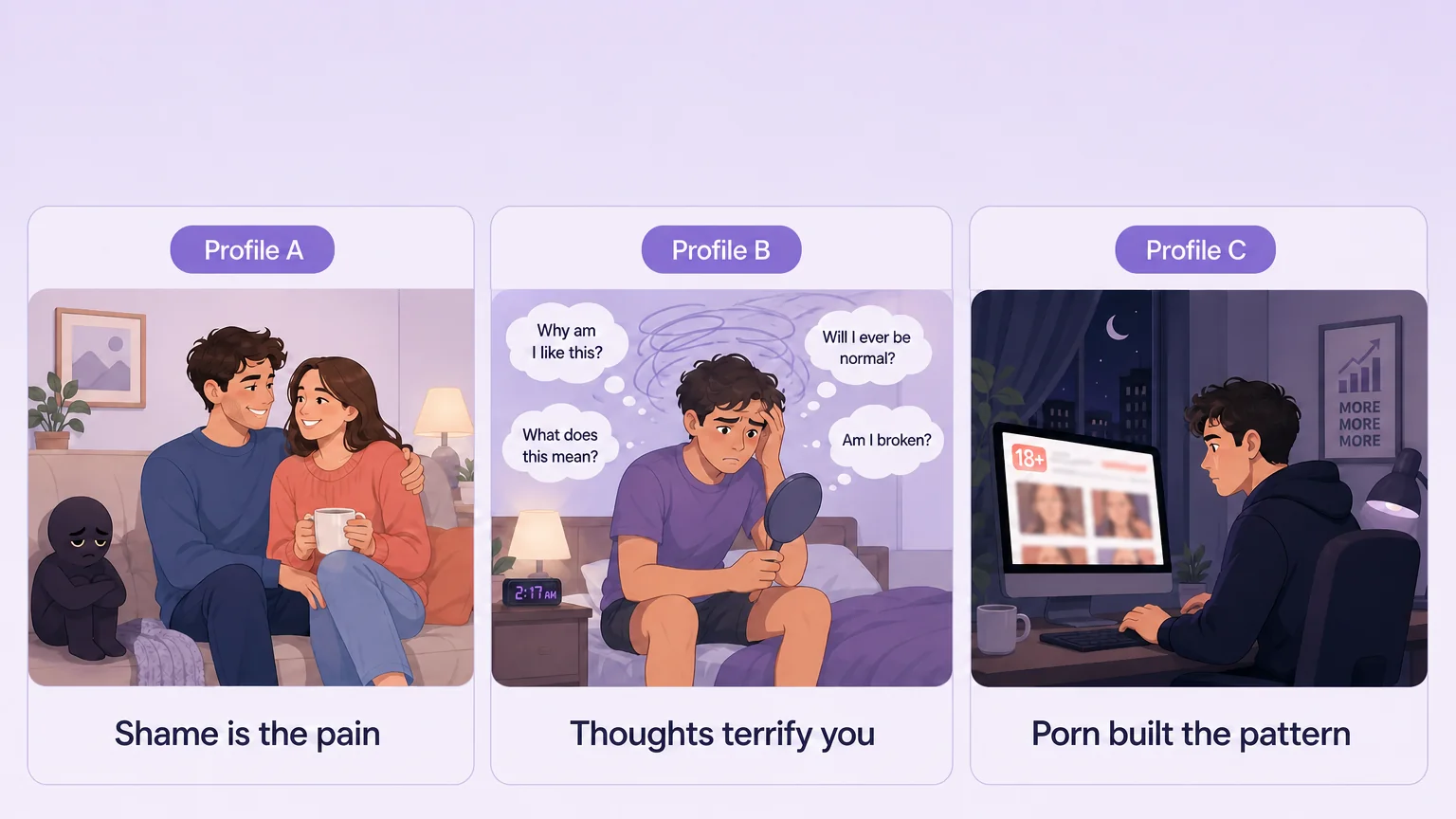
Before you fight anything, figure out what you’re fighting. Three very different problems hide behind the wish to get rid of a fetish, and treating the wrong one costs months.
Start with calibration, because shame distorts the math. When researchers surveyed 1,040 adults matched to the general population, nearly half reported interest in at least one paraphilic category, and about a third had acted on one. Fetishism proved too common to count as “statistically unusual” by the 15.9% bar researchers use, and it showed up equally in men and women.
Whatever you’re into, it has far more company than a 2 a.m. spiral suggests. The most common fetishes read like a census, not a police lineup.
Next, draw the clinical line. Having a fetish is not a disorder. The DSM-5 reserves fetishistic disorder for recurrent, intense arousal from objects or nongenital body parts that also causes clinically significant distress or impairment, sustained for six months or more. Most people with a fetish never meet those criteria.
Now the verdict. Attractions rooted in early life rarely delete on command. What responds well to help is everything that’s hurting: the distress, the compulsion, the secrecy, the escalation. And one specific pattern can genuinely reverse. That’s what the triage sorts out.
Pick your profile:
- Profile A: You enjoy the fetish. The shame and secrecy around it are the pain.
- Profile B: You get no pleasure from it. The thoughts terrify you, so you scan your body for arousal, hunt compulsively for a verdict, and chase reassurance. That pattern points to sexual-themed OCD. As OCD specialist April Kilduff puts it, intrusive thoughts are “just blips of mental activity,” not confessions.
- Profile C: The arousal pattern arrived after months or years of escalating porn use.
By the end of this step, you should have one sentence naming your profile. A routes to Steps 2, 3, and 5. B takes the same route with an ERP specialist at Step 5. C adds Step 4.
Step 2: Stop the Tactics That Make a Fetish Stronger
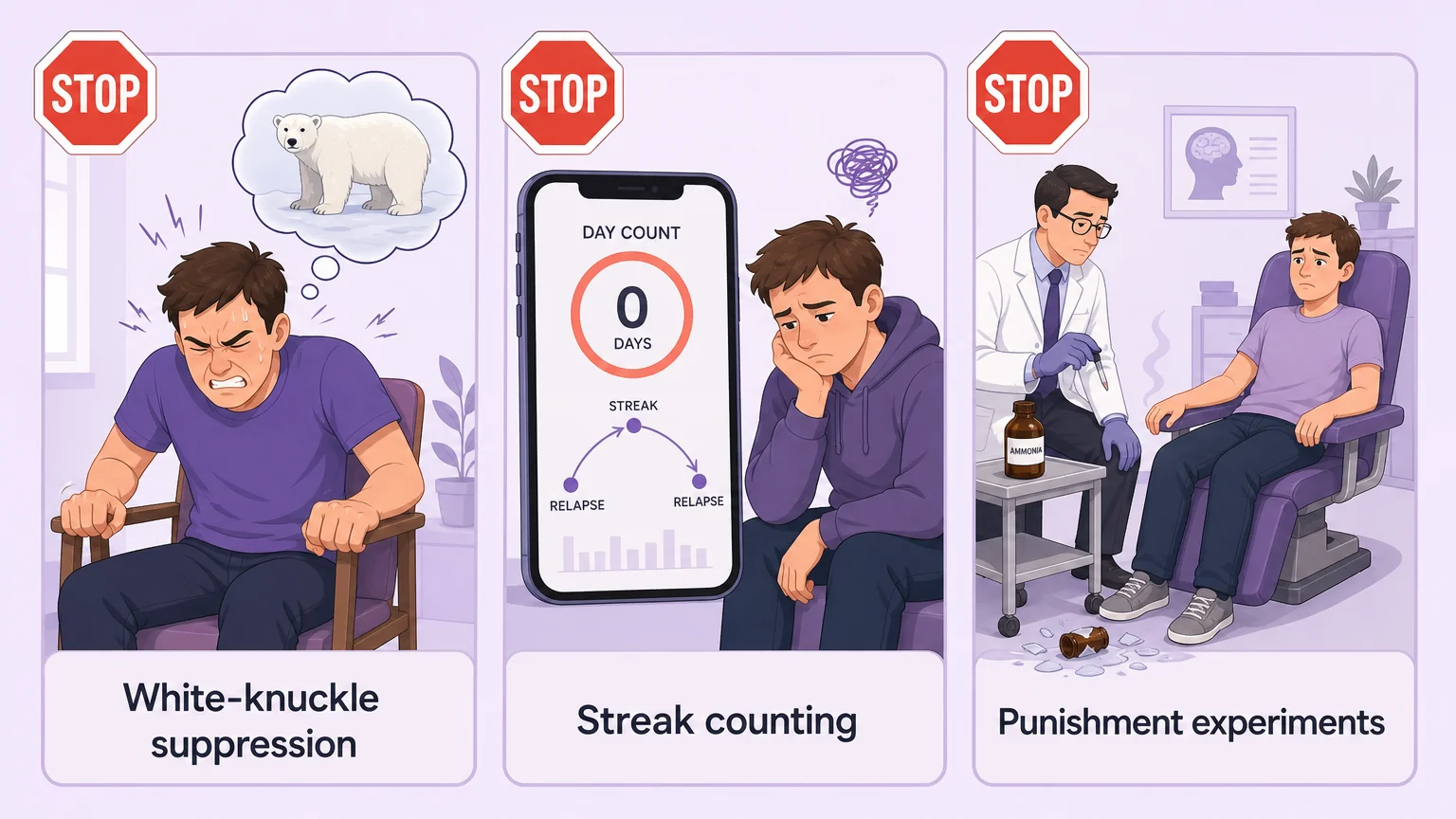
The goal here is subtraction. Before adding a single technique, stop the three strategies that feed the pattern you want gone. The harder you fight a thought, the louder it returns, and psychologists have known why since 1987.
Drop white-knuckle suppression. In psychologist Daniel Wegner’s experiments, people told not to think about a white bear went on to think about it more than people given no instruction at all. The explanation, called ironic process theory, is that suppression sets up a background monitor that keeps scanning for the forbidden thought, which keeps it primed. When you’re stressed, tired, or depleted, the monitor wins.
Later reviews found the rebound isn’t universal, so call it stacked odds rather than a guarantee. Either way, “never think about it again” is a plan built to fail you at your weakest moments.
Retire the streak. Day counters and cold-turkey challenges look like discipline, but relapse shame tends to fuel the next binge, a spiral well documented in abstinence communities. One man who spent a decade in that loop describes it as “relapse, streak, relapse, streak,” complete with cold showers and fleeing the house whenever an urge hit. The urges got managed. Nothing got changed.
Skip the punishment experiments. Old-school eradication therapy had patients sniffing ammonia at the first sign of arousal, masturbating painfully past orgasm, and rehearsing humiliating imagery. Patients gamed it; one famously broke his ammonia vials in the parking lot before sessions. Certified sex therapist Michael Aaron calls those tactics cruel and a source of harm rather than healing.
Notice the pattern. You’ve been doing the sensible-seeming thing, and the sensible-seeming thing is the trap. Instinct says fight harder to stop a fetish. The evidence says pressure feeds it. From here on, every step works with your nervous system instead of against it.
Step 3: Lower the Charge With Evidence-Based Self-Help
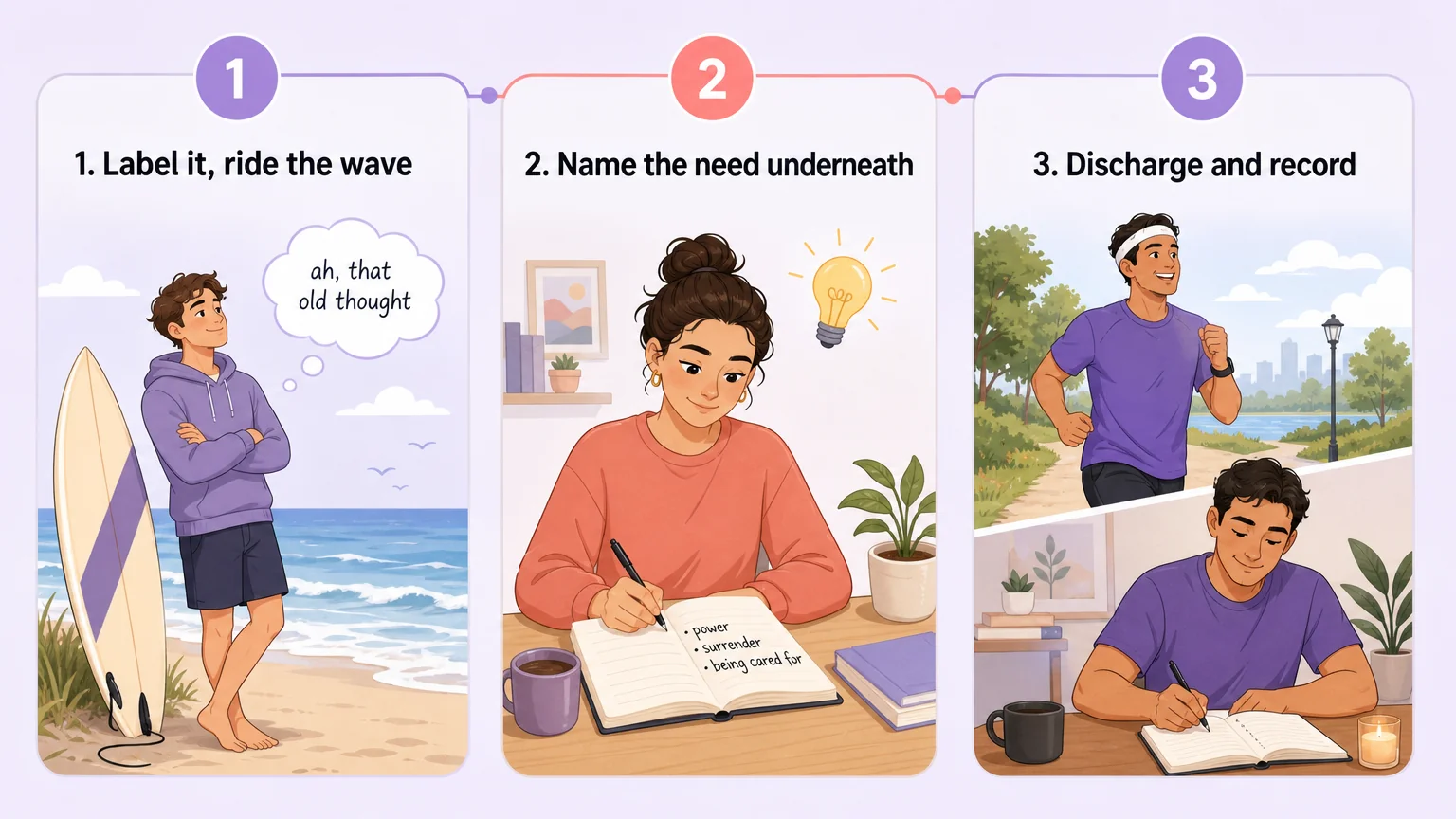
With the accelerants from Step 2 out of the way, add three moves you can run tonight, at home, for free. Each one lowers the thought’s volume without picking a fight with it.
1. Label it, expect it, ride the wave. This sequence is adapted from exposure and response prevention, or ERP, the gold-standard treatment for OCD. When the thought shows up, label it like a weird bug: “ah, there’s that old thought again.” Expect it, because a jump scare you see coming loses its punch. Then sit with the anxiety without doing anything about it. No reassurance, no body-checking, no looking things up. Anxiety behaves like a wave: fight it and it swells, let it wash over you and it recedes on its own.
2. Name the need underneath. Skip the origin-hunting; where a fetish came from is usually a distraction from what it does for you. Instead, identify the non-sexual emotion it delivers: power, surrender, being taken care of, feeling special. Recovery coach Mark Queppet argues that fetishes can trap authentic desires “in sexual holding cells,” and his fix is to meet the need directly, in daylight, with your clothes on. Fair warning: this comes from the coaching world rather than clinical research, so run it as a low-risk experiment.
3. Discharge and record. When the mental moves fail, use your body. Hard exercise burns off the charge that rumination feeds. Afterward, journal what having the thought felt like, not what the thought contained. Writing the experience drains shame; writing the content rehearses it.
The logic behind all three: acknowledging a thought without fighting or obeying it is what shrinks its frequency and charge over time. The thoughts will keep arriving for now. Track the gap between arrival and calm instead. With steady practice the gap shrinks, and that shrinking gap is the progress marker for an unwanted fetish. Don’t wait for silence to call it progress.
Step 4: Run a Porn Reset If Escalation Built the Fetish
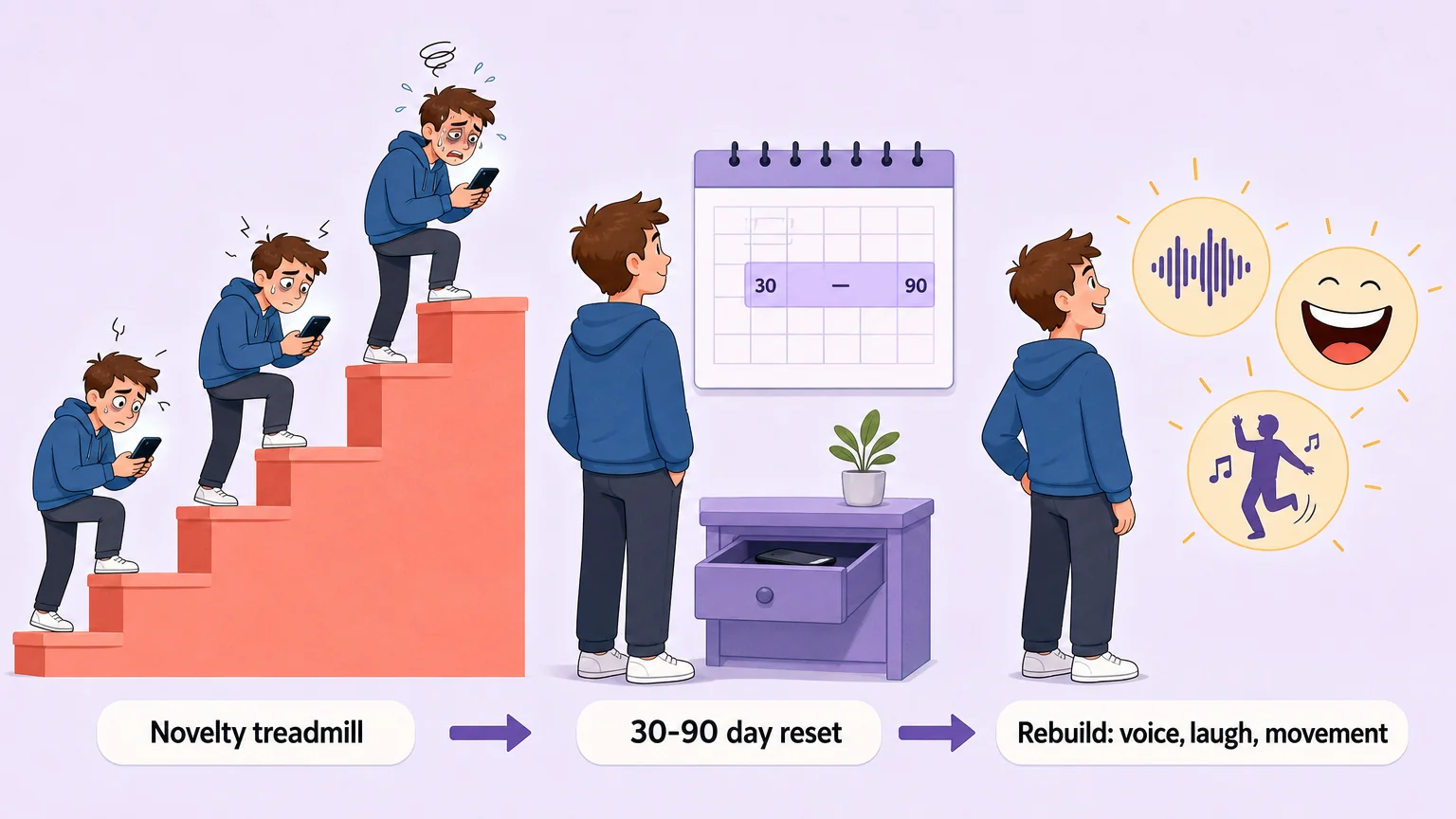
This step is for Profile C, and it’s the one place where getting rid of a fetish can mean exactly that.
Start with the lab finding that explains why. Show men the same explicit film over and over, and arousal steadily drops. Swap in a novel clip, and it snaps back. A 2016 brain-imaging study found that men with compulsive sexual behavior habituated to repeated sexual images faster than others, and the faster they habituated, the more they preferred novelty. That treadmill is how a mild preference escalates into content you never set out to seek, sometimes drifting across whole categories of fetishes along the way.
The distinction that matters comes from porn-recovery author Noah B.E. Church. Desires present since your sexual awakening are probably lifetime companions. But interests that only emerged after months or years of escalating use “do fade into the background” once the porn stops, and for some people they “can disappear entirely and even be replaced by disgust.”
Run the reset like this:
- Stop porn, and stop fantasy-rehearsing the escalated content. Both feed the pathway.
- Benchmark with the wall test: can you climax with no visuals and no fantasy at all? Until the answer is yes, your sensitivity hasn’t recovered.
- Rebuild attraction around real features of real people: a voice, a laugh, the way someone moves.
Be clear-eyed about the evidence. This is coach-reported outcomes plus a peer-reviewed mechanism, not controlled trials, so treat it as a promising experiment with a defined window. One man who quit after 15 years described the other side this way: “my legs are weak and walking is difficult, the sunlight is bright… But I am not bored anymore.”
If your fetish showed up alongside heavier porn use, run a 30-to-90-day reset before drawing any conclusions about who you are.
Step 5: Choose the Right Professional for Your Situation
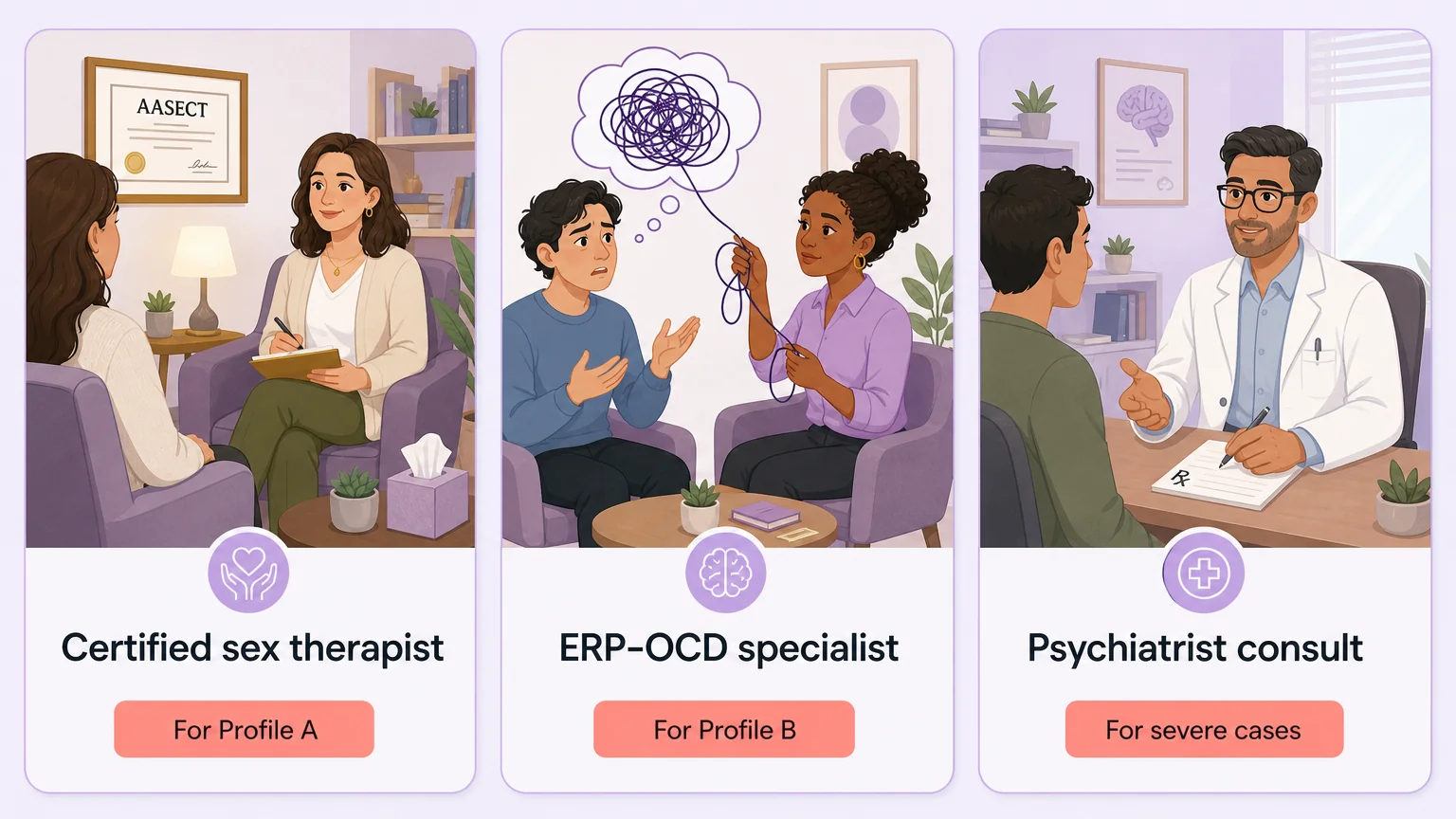
For many people the scariest part isn’t the fetish. It’s picturing a therapist’s face changing when you finally say it out loud. The fix is someone trained not to flinch: match the professional to the profile you named in Step 1.
Profile A, where shame and secrecy are the pain: book a certified sex therapist. AASECT certification sits on top of an advanced clinical degree and requires 90 hours of sexuality education, 60 hours of sex therapy training, supervised clinical work, and a formal review of the therapist’s own biases. These are people who have heard everything, by design.
Profile B, where the thoughts themselves terrify you: book an ERP-trained OCD specialist. Research reports symptom reduction in roughly 80% of people with OCD treated with ERP, sexual themes included. A generic talk therapist can accidentally become one more reassurance ritual. A specialist won’t.
If compulsivity is severe, or anxiety and depression ride along: add a psychiatrist consult. SSRIs are sometimes prescribed in these presentations, with what the medical literature describes as limited success in some patients, and no randomized trials exist for fetishistic disorder itself. That is a prescriber’s call for a specific clinical picture, never a self-help move. One more thing, since the word alone alarms people: anti-androgens are last-line medications for severe, typically forensic cases, nowhere near someone whose problem is distress.
Vetting takes 20 minutes. Filter therapist directories for “fetish-friendly,” “sex-positive,” or “OCD and ERP.” Verify credentials independently. Budget $100 to $300 per session in the U.S. and ask about sliding scales.
Then screen with a consult call, and ask how they work with unwanted fetishes. The one red flag: anyone promising to eliminate the attraction.
The common mistake is booking whoever has the first opening and sitting through months of shame-tinged treatment. Twenty minutes of filtering beats it every time.
Step 6: Tell Your Partner Before Secrecy Does More Damage Than the Fetish

One conversation. That’s the whole step, and it matters because secrecy often does more damage than the fetish itself.
Start with the gap between fear and reality. In research on disclosing sexual fantasies, 81.7% of actual partner responses were positive: acceptance, reciprocal sharing, or arousal. The people carrying the most shame predicted the harshest rejections, and those rejections mostly never came.
This is well-traveled ground, too: 69.3% of people in the study had already disclosed a fantasy to a partner. A 2025 meta-analysis in the Journal of Sex Research adds the payoff, linking sexual self-disclosure with higher sexual satisfaction, with directness doing most of the work.
Run the conversation as a team move rather than a confession:
- Pick a high-trust, non-sexual moment. Not mid-argument, not mid-foreplay.
- Lead with the feeling, not the catalog. Name the shame and what sharing it means to you before naming the thing itself.
- Frame it as an invitation your partner can decline. They get a full vote, and “not for me” is a valid ballot.
One finding deserves its own line: the conversation itself correlates with satisfaction even when nothing is ever enacted.
If your partner is distressed, that distress is workable. The clinical recommendation is couples therapy that processes their feelings and looks at your relationship as a system, especially if the fetish has become required for arousal. And if you’re the partner who found out on your own, the same data applies in reverse: the distress you’re carrying is a starting point, and it’s workable too.
The milestone is simple: the conversation happened. The talking was the treatment.
Step 7: Redefine What Getting Rid of It Actually Means
By this step, the goal has usually changed shape. That’s the win, not the consolation prize.
The fetish stops being the boss and becomes an option. The shame spiral, the secrecy, the compulsive loop: those are the things you got rid of, and they were the things wrecking your life.
The evidence backs this definition of done. Sex therapist Michael Aaron reports that once shame leaves the room, many clients describe their fetishes enhancing sex with consenting partners. Kinsey Institute researcher Justin Lehmiller, whose fantasy surveys span thousands of people, frames the evidence-based goal as overcoming distress, anxiety, and shame and learning to communicate desires, not deleting them. And in representative data, an interest in masochism tracked with higher satisfaction with one’s own sex life.
Put a face on it. A man spent years disgusted by his own pattern, worked through it in therapy, and found a partner who accepted him without ever participating in the fetish. His words: “the complex lost all of its power.”
If your values point the other way, that’s legitimate too. The redirection camp treats a fetish as a need wearing a costume and meets the need directly, the same move you practiced in Step 3. Both camps keep the same scoreboard: distress going down.
Desire doesn’t require an apology. If the distress is gone and your relationships are honest, you got rid of the thing that was hurting you.

FAQ
Can you actually get rid of a fetish?
Sometimes, depending on what built it. Attractions rooted in early life rarely disappear entirely, and no treatment has randomized-trial support for erasing them. What reliably improves is everything around the fetish: the distress, the shame, the compulsive loop, the secrecy. The one exception is a porn-escalation pattern, where an interest built through years of heavy use can genuinely fade after quitting, sometimes completely. So: yes for the suffering, sometimes for the attraction, and either outcome counts.
Is having a fetish a mental disorder?
No. The DSM-5 separates paraphilias, which are not pathological, from paraphilic disorders. Fetishistic disorder requires recurrent, intense arousal from objects or nongenital body parts, plus clinically significant distress or impairment, lasting six months or more. Most people with a fetish never meet those criteria. If your fetish causes no distress and harms no one, it stays a preference. Clinicians apply the distress test and pay little attention to the content of the turn-on.
How do I get rid of weird turn-ons?
First, recalibrate “weird.” In a representative survey of more than 1,000 adults, interest in fetishism, voyeurism, and masochism each proved too common to qualify as statistically unusual by the threshold researchers use, and fetishism was equally common in men and women. Then run the same path as any unwanted fetish: name which problem you have, drop suppression and streak-counting, practice the label-expect-ride sequence, and add a 30-to-90-day porn reset if escalation built the pattern.
Isn’t trying to remove a fetish basically conversion therapy?
For harmless fetishes, certified sex therapists say yes: attempts to eradicate an attraction are akin to reparative therapy, and historical aversion protocols caused documented harm. That fear runs deepest for LGBTQ+ people who have already been told their desires needed fixing. Treating the distress, the compulsions, or OCD about a fetish is different in kind, and legitimate. The target is the suffering, not the attraction, and any professional promising otherwise is the one to walk away from.