What a one-sided open relationship actually looks like?
Picture a couple on their couch on a Tuesday night. She scrolls a dating app while he reads beside her, one hand resting absently on her knee. She tilts the screen toward him. He glances over, shrugs with a small smile, and returns to his chapter. No tension. No fight simmering. Just two people in a relationship that does not follow the cultural script.
Most of what we hear about one-sided open relationships lands in one of two buckets: a catastrophe waiting to detonate, or a manosphere fantasy where one partner claims freedom while the other gets handed loyalty with no say. The actual experience is messier, more human, and more survivable than either caricature lets on.
Roughly 11% of relationships fall into the one-sided or partially open category, according to a 2019 study by Rogge and colleagues. That is millions of couples navigating a dynamic that most relationship advice treats as a footnote. Not this article.
You will find the research, the real stories, the negotiation tools, and an honest look at when this works, when it wobbles, and when it needs to stop. You are not a footnote. Neither is this.
Defining the Terms: Mono-poly, Unilateral, and Beyond
The language around asymmetrical openness is a mess. Mono-poly. Unilateral open relationship. One-sided open marriage. Poly under duress. Some of these terms overlap. Some describe fundamentally different things. The distinctions are not academic. They determine whether an arrangement is ethical or coercive.
A one-sided open relationship is a consensual arrangement where one partner pursues outside romantic or sexual connections while the other chooses not to. The monogamous partner’s choice may come from genuine disinterest, logistical constraints, a specific kink, or a fundamental pull toward monogamy. What matters is that the choice is real. Nobody is being worn down or gaslit into agreement.
The term you will hear most often in ENM communities is “mono-poly relationship.” An estimated 4% of adults are in an open relationship at any given time, and roughly 20% have tried some form of non-monogamy across their lifetime, according to data referenced in David Hague’s TEDxUKY talk. Within that 4%, a meaningful subset is living mono-poly.
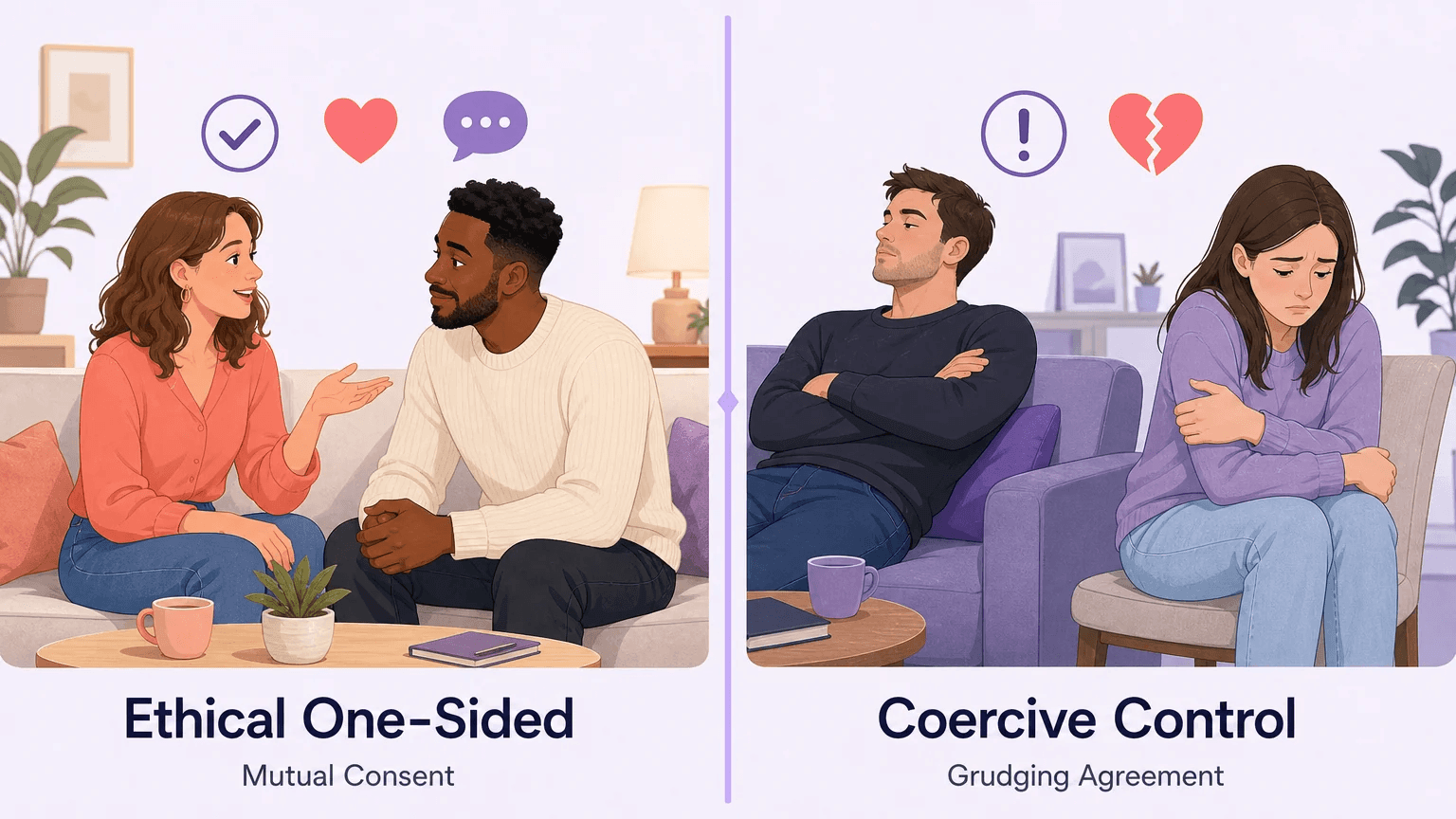
Here is the difference. Ethical one-sided openness requires mutual consent, ongoing communication, and genuine comfort for both partners. The coercive version, what manosphere figures call “one-sided monogamy” (man free, woman loyal), is control mislabeled as lifestyle. Louis Theroux’s 2025 Netflix documentary “Inside the Manosphere” showed the instability: influencer Myron Gaines stated, “I do what the fuck I want to do. She’s loyal to me. It’s monogamous on her end, open on my end.” His partner looked uncomfortable. The couple later broke up.
Polyamory educator Leanne Yau draws the line: “If your partner is telling you, I get to have my cake and eat it, but you can’t because you’re a woman, then you need to run.” If consent is not mutual, the label does not matter. It is not an open relationship. It is control.
What the Research Says About One-sided Open Relationships
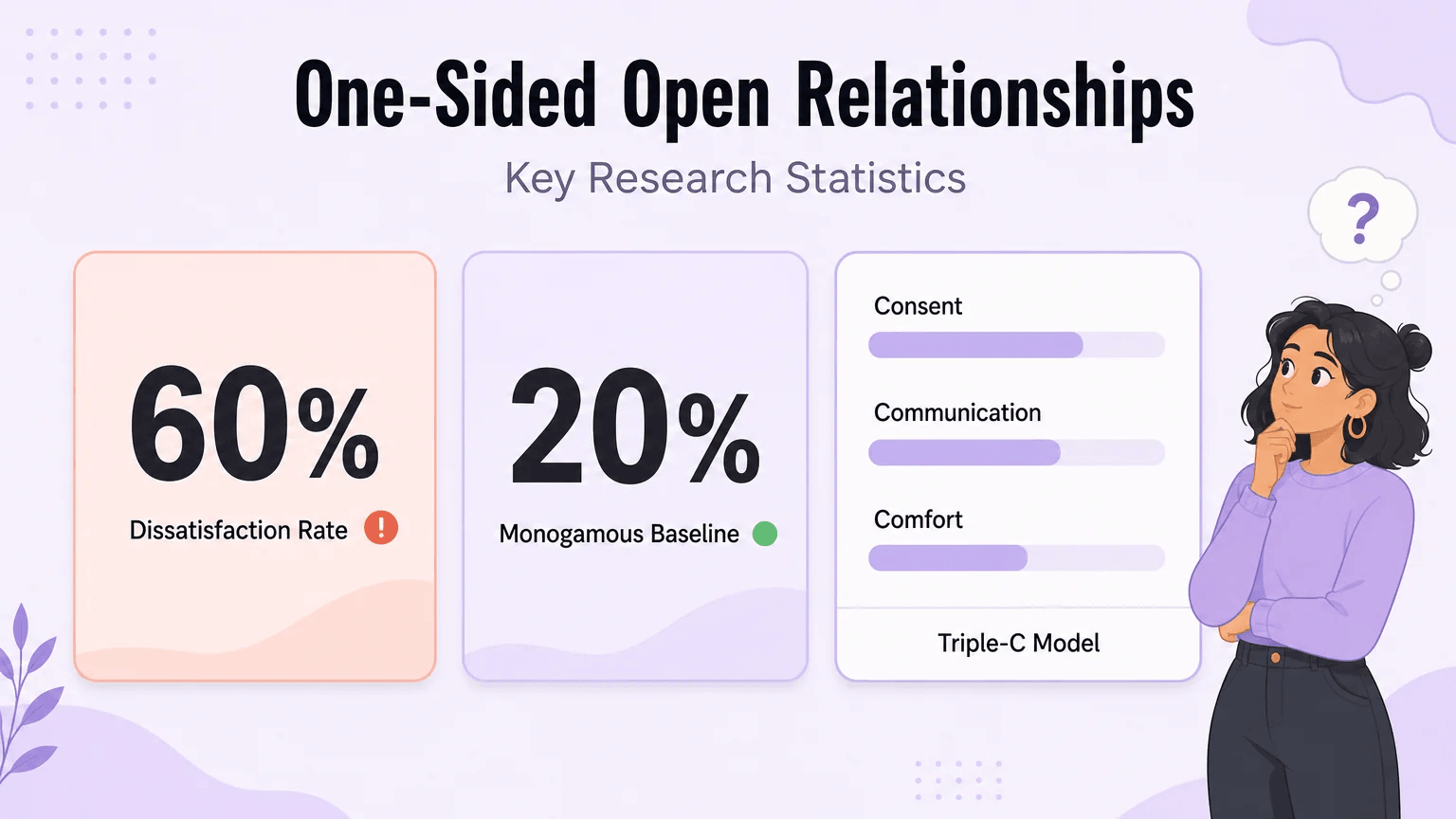
The landmark Rogge et al. (2019) study, published in the Journal of Sex Research, analyzed 1,658 respondents and identified five relationship classes. The one-sided group, roughly 11% of the sample, had the worst outcomes: highest psychological distress, highest loneliness, highest attachment avoidance, and roughly 60% significant dissatisfaction. Fully consensual CNM couples and monogamous couples both sat at about 20% dissatisfaction. That is a threefold gap.
Context matters before you close the tab. This research captures all one-sided arrangements in a single bucket: ethical mono-poly couples, poly-under-duress situations, OPP-enforced dynamics, and relationships where one partner never genuinely consented. The ethical subset, where the monogamous partner is authentically at peace, is almost certainly underrepresented in that 60% figure.
The study introduced the Triple-C Model: Consent, Communication, and Comfort. These three elements distinguish healthy CNM from dysfunctional non-monogamy. One-sided arrangements score lowest on all three for structural reasons. Consent can be grudging rather than enthusiastic. Communication is asymmetrical, with the monogamous partner often having no equivalent community to process with. Comfort is fragile, constantly tested by new partners and new situations the original agreement never anticipated.
Dr. Zhana Vrangalova offers a counterweight: open/mono arrangements can work if the monogamous person is genuinely happy. The deciding variable is not structure but whether both people are in their choice. Fully consensual CNM and monogamous couples had similarly high satisfaction in the same Rogge study. The structure is not the problem. The absence of mutual consent is.
The data tells you exactly what to watch for: consent that feels coerced, communication that goes one direction, and comfort that is performed rather than felt. Watch for the signs the Rogge study flagged: elevated loneliness, attachment avoidance, and condomless sex that sometimes signals emotional withdrawal rather than freedom. If those three pillars are solid, the arrangement can work. If they wobble, pay attention.
The Six Faces of One-sided Openness: Not All Arrangements Are Alike
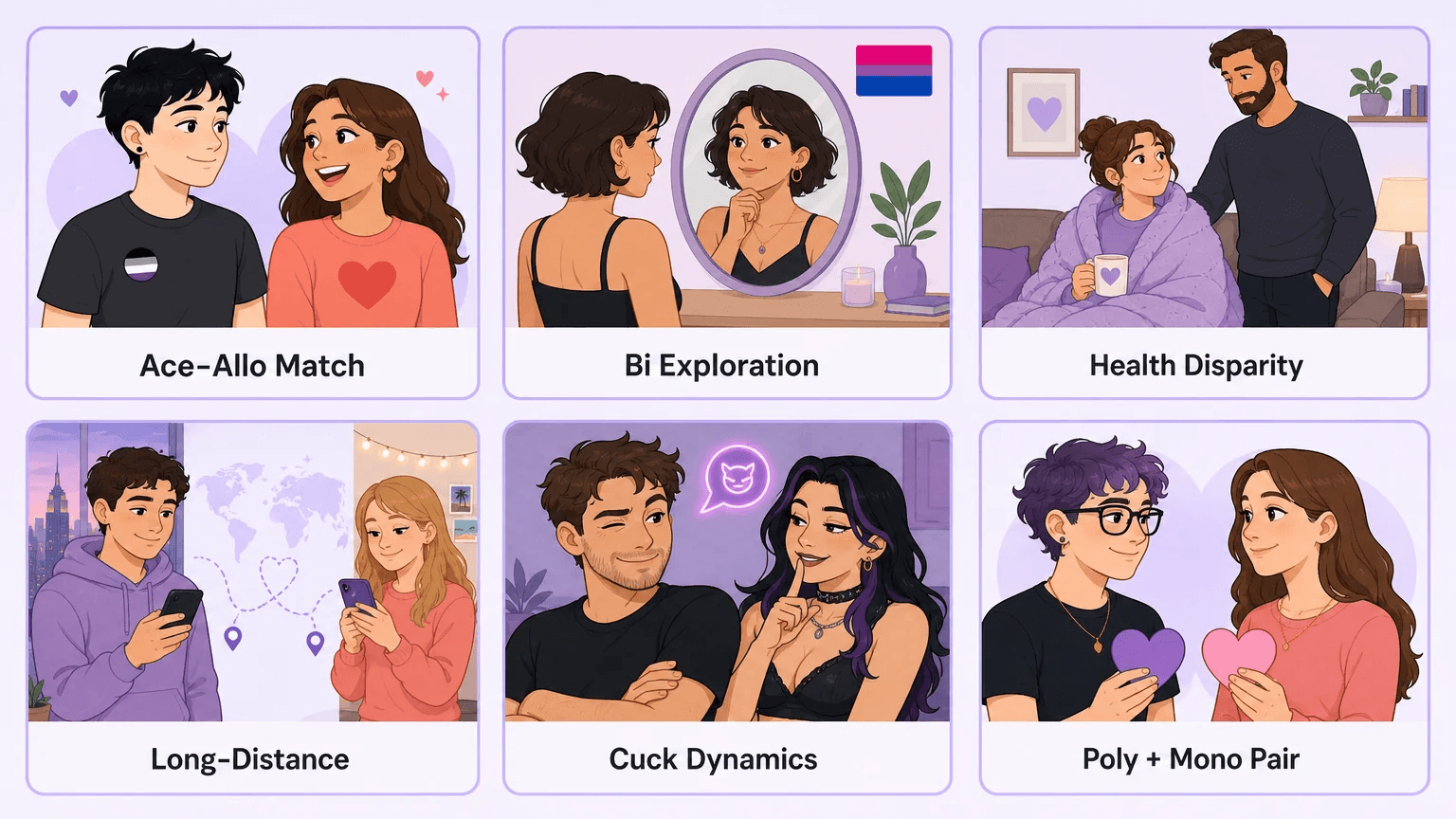
“One-sided open relationship” sounds like one thing. It is an umbrella covering at least six distinct dynamics, each with its own risk profile.
The asexual-allosexual mismatch carries the highest success rate. One partner is asexual or low-desire, relieved to outsource sex. The other needs sexual connection. The asymmetry is the solution.
Bisexual exploration in a hetero marriage follows a common script: one partner comes out years in, the other supports them dating a new gender while staying monogamous. Karla Houston’s 9-year marriage, profiled in the New York Post, is a working example. The risk: exploration can uncover feelings bigger than either partner anticipated.
Libido or health disparity turns non-monogamy into a practical accommodation. Medical conditions, menopause, or chronic illness make sex difficult for one partner. David Hague describes it in his TEDxUKy talk: “I still love this person. I want to do life with them. But we’re not as sexually compatible as we once were.”
Long-distance adaptation creates a practical one-sided opening through physical separation. Nate and Courtney of The MonoPoly Couple have navigated this for 21 years, with Nate traveling for military training while Courtney dates.
Cuckolding and cuckqueaning dynamics give the monogamous partner a built-in investment: arousal, not mere tolerance. As Dan Savage notes, the asymmetry is the point, not the problem.
Poly plus mono pairings are the hardest configuration. Neither person is wrong, yet their fundamental orientations conflict. Gottman Institute research finds 69% of relationship conflicts are perpetual and unresolvable, only manageable. This pairing demands the most rigorous communication of any type listed.
The common thread across the lowest-risk types: the monogamous partner’s choice is genuinely intrinsic rather than a reluctant concession. If your partner’s “yes” sounds more like surrender than enthusiasm, the type does not matter. The foundation is already cracked.
The Initiator’s Experience: Why Someone Asks for A One-sided Open Relationship
The person lying awake at 2 a.m., turning the idea over for weeks, terrified to say it out loud, is not a villain in their own story. They are someone trying to figure out whether honesty will bring their relationship closer or blow it apart.
The motivations fall into three broad groups. Some people are discovering a core identity: they realize they are polyamorous or bisexual, and monogamy feels less like commitment and more like a cage. This is not about being dissatisfied with their partner. It is about a self they cannot un-know.
Others are responding to a specific mismatch: a libido gap that has persisted for years, a health condition that changed the physical relationship, or a long-distance separation. They are not questioning the relationship. They are proposing a practical solution.
Then there is the gray zone: the person who is not sure which category they fall into. They feel restless but cannot name why. This is the hardest conversation because the asker does not fully understand their own motivation.
The “most moved” principle applies: the initiator has been sitting with this for months. It feels urgent. The receiving partner just got the memo five minutes ago. Rushing because you have already processed alone is a fast track to resentment. Your partner deserves the same months you had.
Ellecia Paine, a non-monogamy educator, puts the warning plainly: if your partner is doing this to make you happy but is hurting in private, this will not end well. Enthusiastic consent and reluctant agreement are not the same thing.
Frame the conversation as an invitation, not a demand. Lead with “this is not about you not being enough.” Expect it to be hard. If you cannot tolerate your partner’s initial reaction without getting defensive, you are not ready to have the conversation at all.
The Monogamous Partner’s Experience: What This Actually Feels Like
Nate, the monogamous husband behind The MonoPoly Couple, put it plainly: “My biggest struggle initially was just the feeling of insecurity. Was Courtney looking to replace me like the 2.0, 3.0, whatever it was version, the new and improved version of me?” That question gets at something real. It does not evaporate on logic. It recedes on repetition.
The emotional pattern is predictable. The initial ask lands like a gut punch, even when delivered gently. You spiral through “am I not enough?” while your partner has already moved into planning mode. The loneliness cuts deeper than the jealousy. Most friends and family would not understand, so you process alone. You watch your partner experience NRE (New Relationship Energy) while you sit at home, wondering if that excitement used to be for you.
The reluctant husband shows up repeatedly in user forums: “My wife wants to open the relationship, for her, not for me. I said yes because I didn’t want to lose her.” These men describe a quiet erosion of self-worth they do not feel allowed to name. Nate describes an additional layer: the social pressure to feel “diminished” or “less than” because “you as the man, you are somehow diminished by what your poly partner is doing.”
Dr. Nicole Irving offers a sobering clinical observation: “I’ve sat with too many people who agreed to non-monogamy out of fear.” Fear of losing someone is not the same as wanting this life. There are two paths for the monogamous partner: genuinely at peace and choosing from security, or white-knuckling through it while something essential erodes.
The question that determines everything: are you choosing this, or just not leaving? If you cannot tell the difference yet, pause. The answer will not get clearer under pressure.
Is It Fair? The Ethics of One-sided Open Relationships
Every outsider asks it. Every insider wrestles with it. How can an arrangement where one person gets freedom and the other gets fidelity be fair?
Surface-level fairness (both partners get identical privileges) is not how healthy relationships work. Relationships are about meeting needs, not keeping score. One partner may need more alone time or more career support than the other, and nobody calls those asymmetries unfair. The question is whether both partners have their needs met and their voice heard.
Dan Savage offers a two-path framework. The arrangements that work are ones where the monogamous partner has genuinely zero interest in outside connections, or ones where the monogamous partner actively gets off on the dynamic. Everything else is a negotiation, and negotiations can fail. If your partner would date others if allowed but you bar them from doing so, you do not have an ethical arrangement. You have a double standard.
The One Penis Policy (OPP) is where this becomes visible. A man insists his female partner can only date other women, not men. Polyamory educators consider this misogynistic and homophobic. It treats same-gender relationships as less real and less threatening. Leanne Yau’s boundary is sharp: “If your partner is telling you, I get to have my cake and eat it, but you can’t because you’re a woman, then you need to run.”
The counterpoint matters too. Some monogamous partners genuinely want the arrangement to be one-sided because opening on both sides would feel like too much change. Their monogamy is preferred, not imposed. That is a different ethical calculus entirely.
Apply the Triple-C test: consent, communication, comfort. Does this arrangement have full consent? Open communication? Genuine comfort, with nobody performing okay-ness while falling apart inside? If any answer is no, fairness is a real problem, and no philosophical reframing will fix it.
How to Negotiate A One-sided Open Relationship without Breaking What You Have
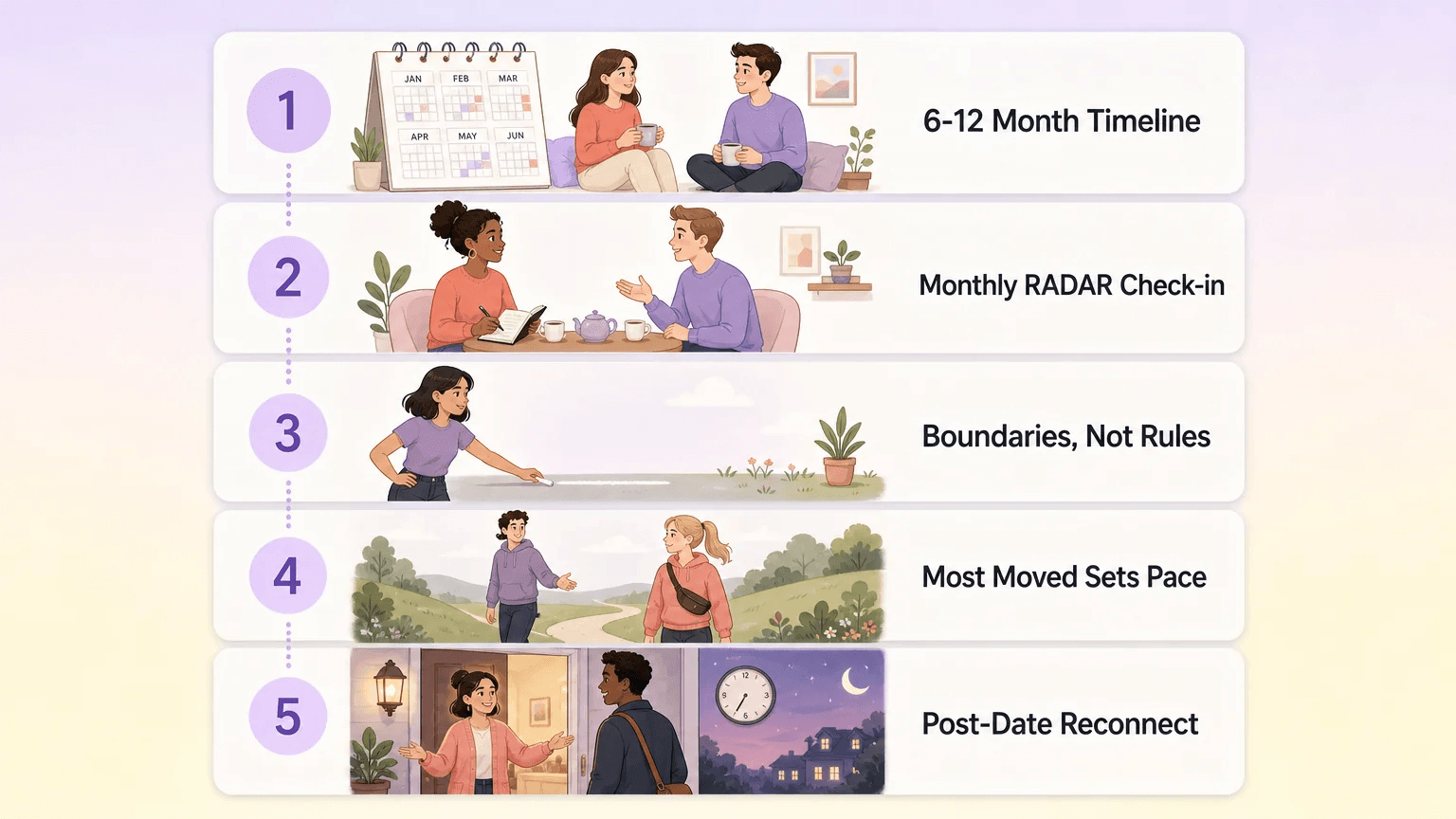
The timeline: 6 to 12 months of conversation, not a weekend decision. Openings rushed into weeks almost always fail. If that frustrates you as the initiator, sit with it. Your impatience is the red flag, not your partner’s hesitation.
The Multiamory RADAR framework, adapted for one-sided dynamics, provides structure. Once a month, you hold a structured check-in: what felt okay, what felt scary, what needs to change. Domenique Harrison, LMFT, recommends 15 minutes to an hour. Communication cannot be ad hoc when more people and dynamics are involved.
Boundaries and rules are not the same. A boundary is about your own experience: “I will not stay in a relationship where I feel like a secret.” A rule controls someone else: “You cannot see that person.” One-sided arrangements need more boundaries and fewer rules. Rules breed resentment. Boundaries create clarity.
The “most moved” principle governs pace: the most hesitant partner sets the speed. If you are the initiator and this irritates you, examine why. Your partner is doing the work you already did in your head, in real time, while fearing this might cost them the relationship.
The initial ask: “I want to talk about something hard, and I need you to know this is not about you not being enough. I am not asking for a decision tonight. Can we talk about it over time?” The post-date check-in: “What felt okay? What did not? What do you need from me right now?” The renegotiation: “I thought I would be okay with this, but I am not. Can we adjust?”
If the monogamous partner cannot say “I am doing this because I want to, not because I am afraid of losing you,” everything pauses. Without that, nothing built on it will stand.
A Day in the Life: What a Successful One-sided Open Relationship Actually Looks Like
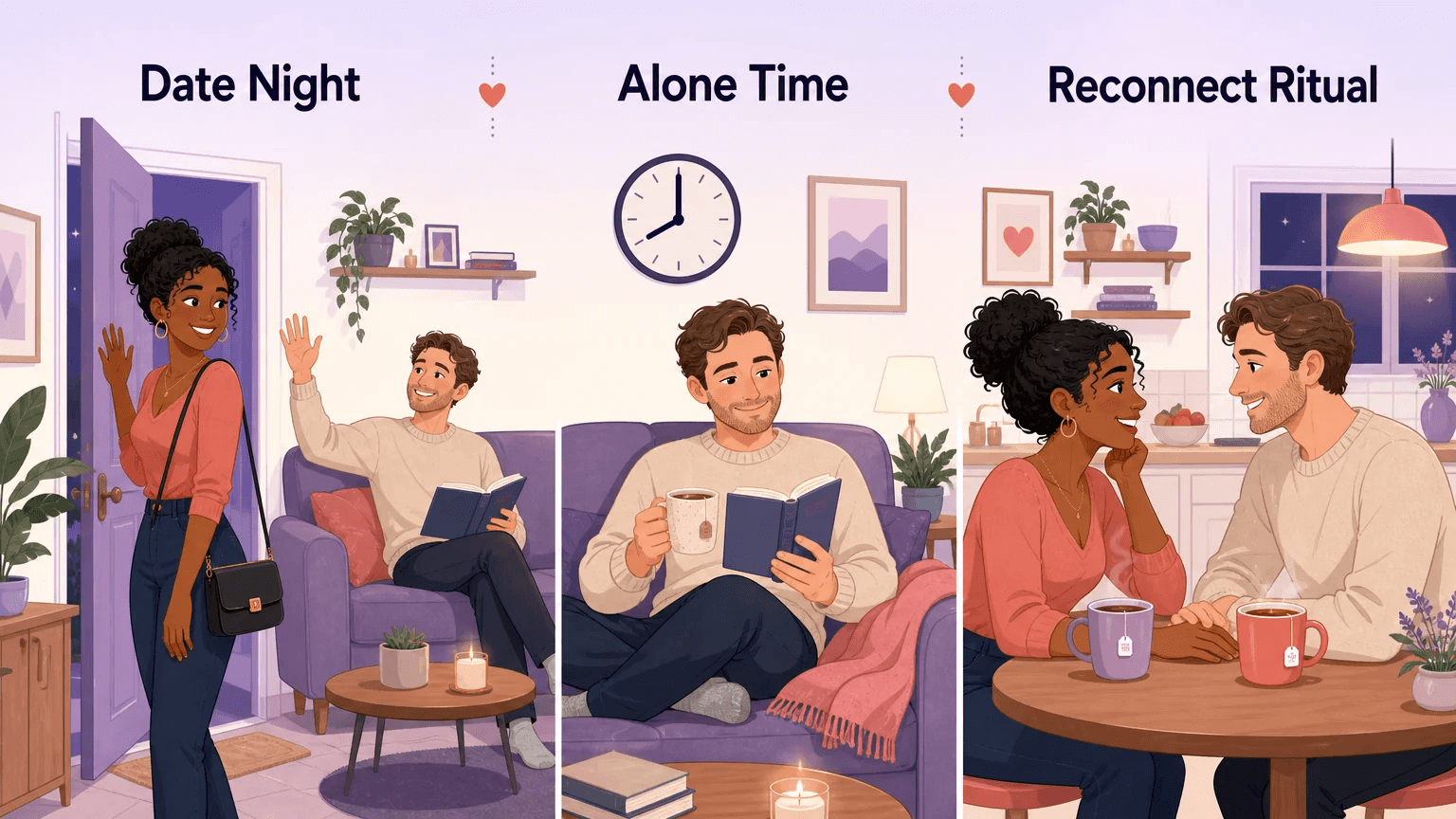
Courtney goes on a date Tuesday night. Nate uses the evening for his own pursuits, genuinely enjoying the alone time. She comes home, and they have a ritual: debrief over tea, not an interrogation but a reconnection. Some nights he feels a twinge of jealousy. He names it. She holds space for it without getting defensive. They have been married 21 years.
This is the documented reality of The MonoPoly Couple, whose monthly YouTube check-ins provide the most transparent public record of a working mono-poly marriage. Their agreements are specific: certain nights are always reserved for the primary connection, certain activities belong only to them, and certain check-in conversations happen monthly whether things are smooth or rocky.
The mechanics of their success are unglamorous: processing miscommunications when Courtney met someone “in the wild” and their protocols did not cover it, maintaining two date nights per month for their primary connection, negotiating daily check-ins across time zones during Nate’s military training. They talk about everything.
Karla Houston, profiled in the New York Post, represents a different configuration. Married nine years, she came out as bisexual in 2021. Her husband suggested she date outside the marriage; he remains monogamous by choice. She pushes back against the “cuck” label: he is not aroused by the dynamic. He simply has no interest in dating others. Jealousy “absolutely comes up because we’re human,” she says, but it gets worked through.
The couples who make this work do not spend energy defending the arrangement. They spend it checking in with each other and living a life where the open relationship is a detail, not the headline.
Red Flags, Boundaries, and When to Walk It Back
Not every experiment succeeds. Closing a relationship you opened is not failure. It is course correction. The myth that opening is a one-way door traps people in arrangements slowly dismantling them.
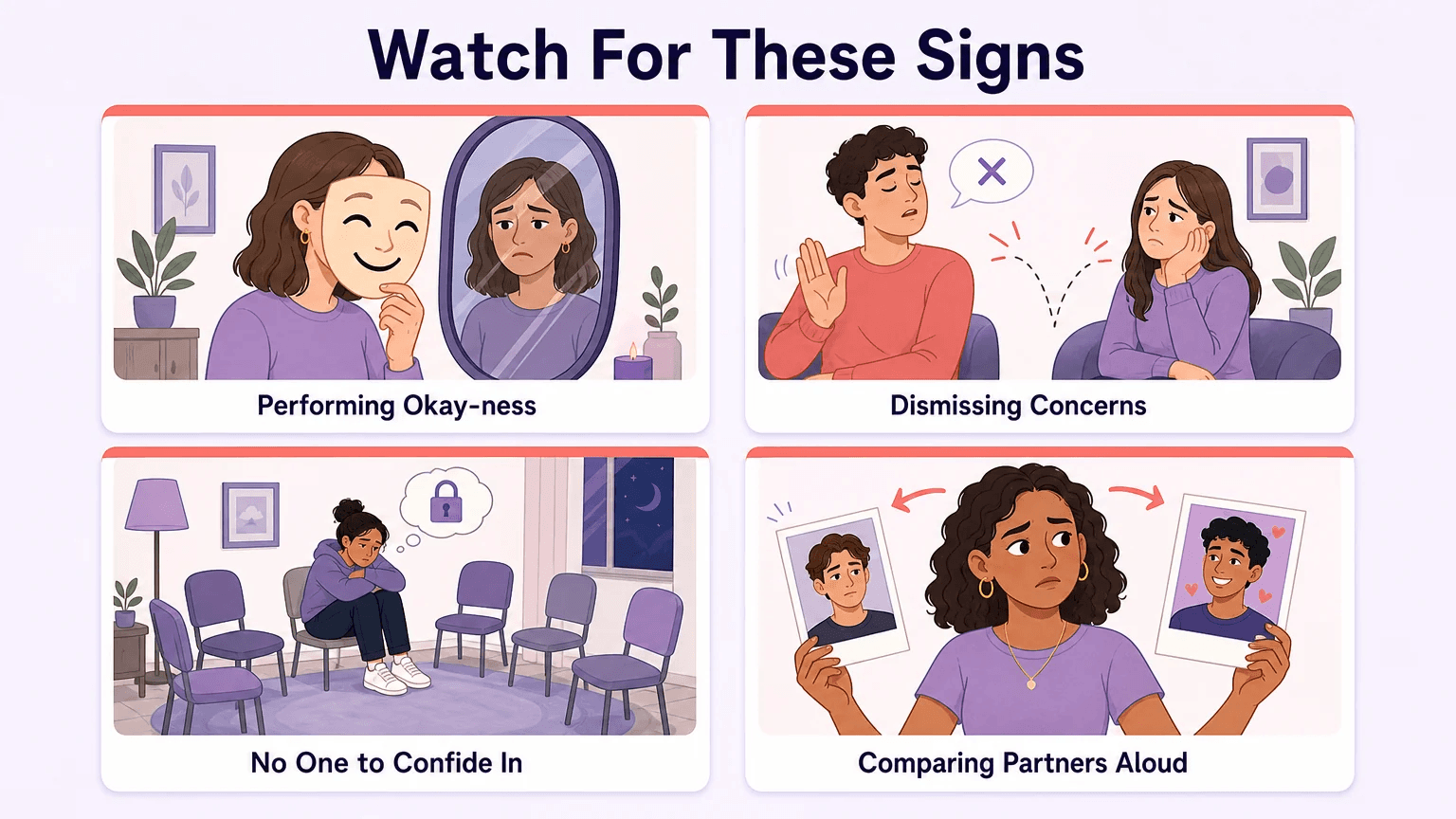
Specific red flags: the monogamous partner white-knuckles through dates and collapses afterward but reports “fine.” The exploring partner dismisses every concern as jealousy, turning a signal into a conversation-ender. Agreements stretch one small exception at a time until the original boundaries vanish. The monogamous partner has no one to confide in, no therapist, no friend who knows. The exploring partner compares primary and secondary partners out loud.
Dr. Cheryl Fraser’s boundary belongs on a post-it note: “Don’t agree to something you don’t want.” Matt Lachman, certified sex therapist, adds that people with anxious attachment are especially vulnerable to agreeing out of fear, and those agreements almost always unravel.
Bisexual exploration deserves special attention. The phrase that upends most one-sided arrangements is “it is not just sex, she caught feelings.” When exploration uncovers something bigger than anticipated, the monogamous partner is processing more than jealousy. They are processing the possibility that their partner’s identity and their relationship structure have become incompatible. This requires renegotiation from scratch.
Closing is a process, not a declaration. Tammy Nelson, PhD, emphasizes transparency matters as much for closing as for opening. You cannot return to the old monogamy. You build a new version: honest conversation about why, respectfully ending outside relationships, co-creating a new monogamy, dating each other again, and finding a therapist experienced with these transitions.
You can change your mind. Wanting to close does not make you a failure. It makes you someone who tried something hard, learned something real, and chose to protect what matters. No arrangement is worth more than the people inside it.
FAQ: One-sided Open Relationships, Answered Directly
Is a one-sided open relationship fair?
It depends on whether the monogamous partner is genuinely at peace or just tolerating the arrangement. Fairness is not about both people getting the same thing. It is about both people having their needs met and their voice heard. If your partner would explore if they could but you bar them from doing so, that is a double standard, not fairness.
Can a one-sided open relationship work long-term?
Yes, in specific circumstances: when the monogamous partner has genuinely no interest in outside connections, or when they find the dynamic specifically arousing. The MonoPoly Couple’s 21-year marriage is one data point. But the research shows this is the highest-risk configuration. It requires exceptional communication and both people being fully in their choice.
What if I agreed but now regret it?
You can change your mind. Closing a relationship is recalibration, not failure. Have the conversation directly: “I thought I could do this, but I am hurting, and I need us to pause and renegotiate.” If your partner dismisses this, the relationship has deeper problems than the open arrangement.
How do I bring up wanting a one-sided open relationship?
Frame it as an invitation to a series of conversations, not a decision. Lead with reassurance: this is not about your partner not being enough. Give your partner weeks or months, not hours. Expect the first conversation to be hard. If you cannot handle their initial reaction without getting defensive, you are not ready.
What is the difference between one-sided open and infidelity?
Consent, communication, and transparency. In a one-sided open relationship, you discuss and agree on everything. Nothing happens in secret. If your partner does not know, or would not consent if they did, it is not an open relationship. Research confirms non-consensual arrangements produce the same damage as infidelity. The difference is honesty. Without it, the label means nothing.