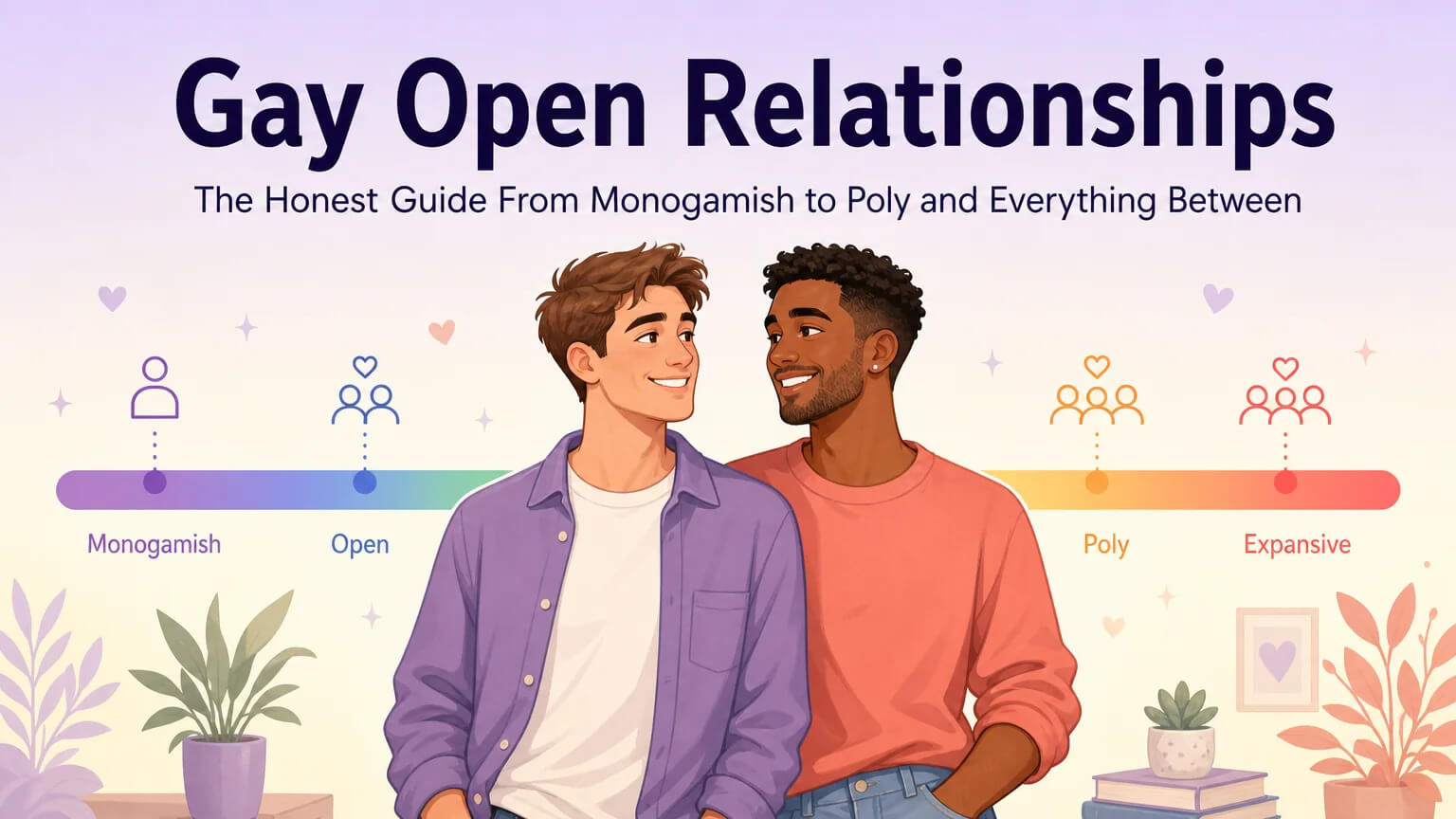
Between 40 and 50 percent of gay male couples practice some form of consensual non-monogamy. That is not a fringe stat. It is the mainstream. But the honest conversation about it — the one that covers the full spectrum of LGBTQ+ experience without hiding behind jargon or pretending whole demographics don’t exist — has been hard to find.
So here it is. Instead of the tired “open versus closed” binary, we walk through the whole range, from monogamish to polyamory and everything between. You will spot yourself somewhere on it. And wherever that is, the data says you are in good company.
What a Gay Open Relationship Actually Is
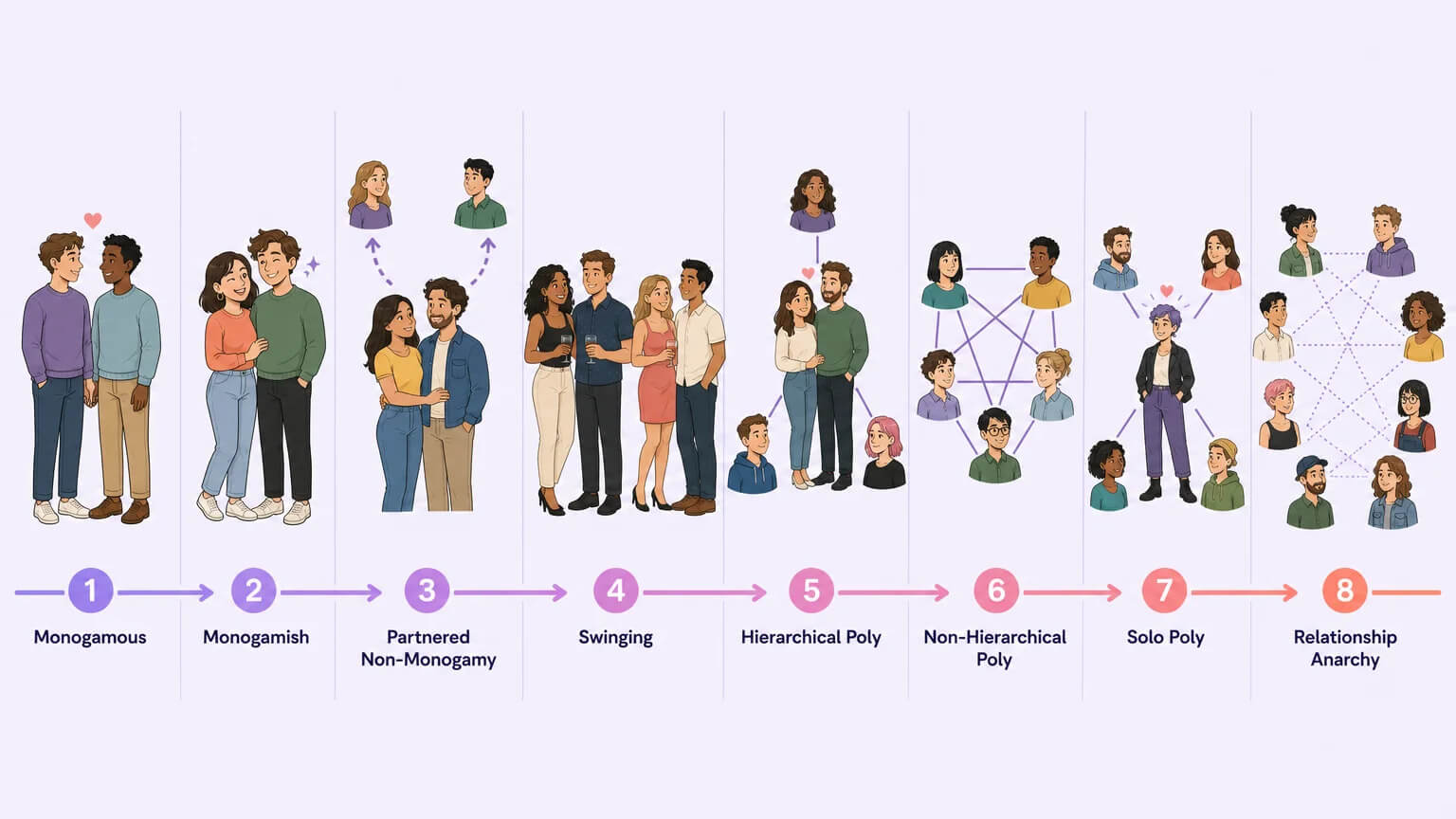
Most people picture a toggle: monogamous on one side, open on the other. The real picture is a gradient. Figuring out where you land on it is half the work.
On one end you have monogamous, full sexual and emotional exclusivity with one person. Then monogamish, the term Dan Savage coined for couples who are mostly exclusive but play together on occasion. Next is partnered non-monogamy: the couple stays the primary emotional unit, but each person has negotiated sexual freedom, together or separately. Swinging lives nearby, built around shared recreational experiences in dedicated social spaces.
Further along you hit hierarchical polyamory, where multiple loving relationships exist but one partnership holds priority. Then non-hierarchical polyamory, which treats all connections as equally valid. Solo polyamory prioritizes autonomy with no primary partner. And at the far end, relationship anarchy rejects preset categories entirely, co-creating every dynamic from scratch.
For gay men, partnered non-monogamy is the most common form of gay open relationship. The couple stays the emotional anchor. Sexual boundaries expand. The emotional core holds.
A 2024 latent class analysis of 1,528 LGBTQ+ people mapped five distinct configurations: formalized monogamy at 59 percent, free monogamy at 20 percent, formalized open relationships at 11 percent, monogamous but considering alternatives at 7 percent, and free consensual non-monogamies at 3 percent. Most couples exist somewhere between the poles.
Here is the thing that changes how you think about all of this: emotional exclusivity and sexual exclusivity sit on separate axes. A study of 250 gay men in Mexico City found that 84 percent identified as monoamorous, emotionally committed to one partner, but only 42 percent were in sexually exclusive relationships. You can be romantically devoted to one person and sexually open. That is not a contradiction. It is a design choice.
Why Gay Men Open Up, and What the Research Says
Multiple studies find no significant difference in relationship satisfaction or stability between mutually agreed monogamous and consensually non-monogamous gay couples. What tanks relationship quality is not openness. It is breaking the rules you both agreed to. Sticking to what you and your partner set matters far more than the content of the agreement itself.
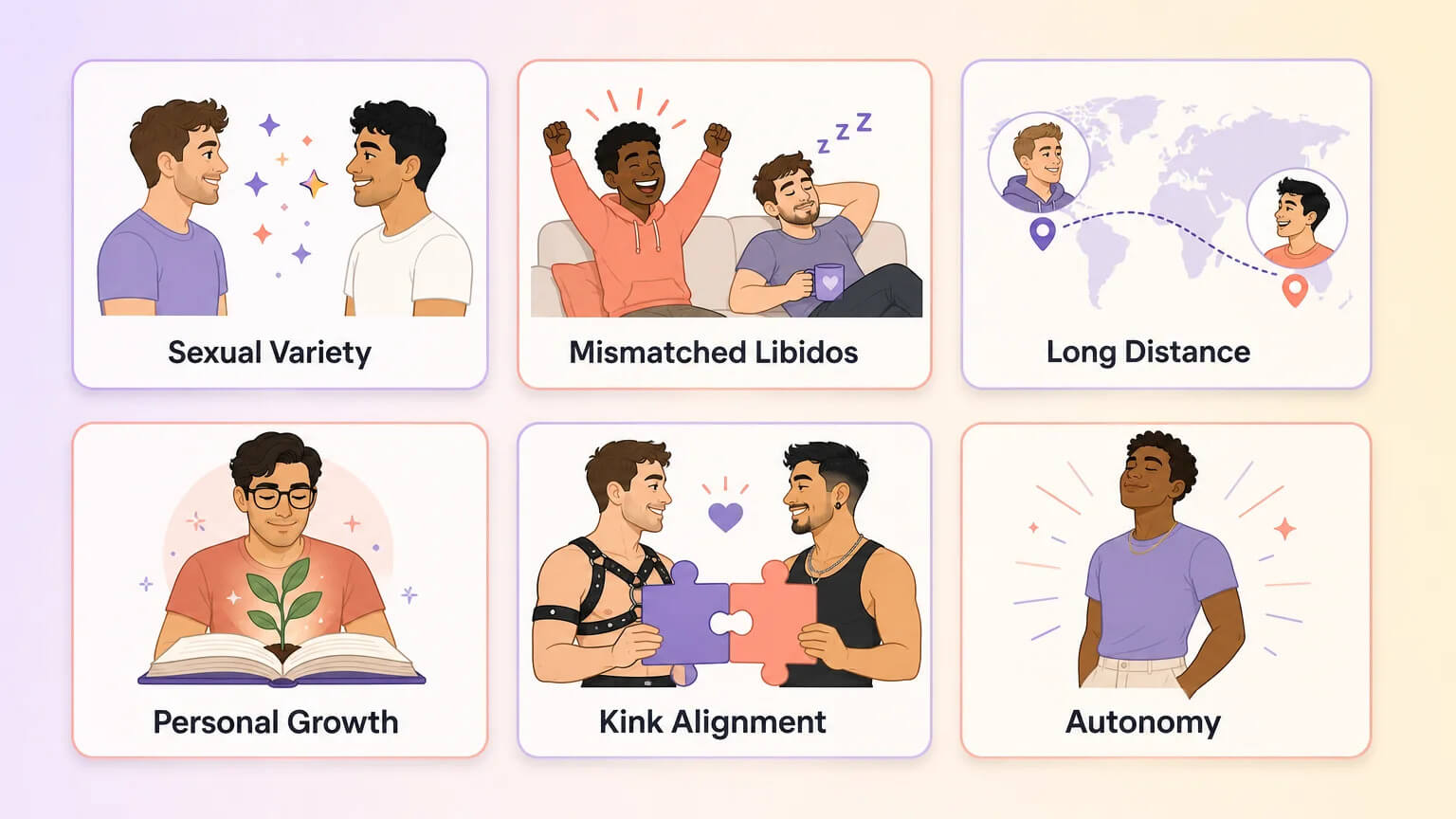
So why do couples open up? Sexual variety is the most common reason, but it rarely travels alone. Some partners have mismatched libidos, and opening prevents resentment from hardening around desire discrepancy. Others navigate long-distance stretches, where outside connections become a practical bridge instead of a crisis. Personal growth shows up in the research too: some people describe non-monogamy as aligned with their values around autonomy and self-exploration. Kink alignment drives it for others. A partner who needs something the other cannot or does not want to provide gets that need met without ending the relationship.
Some couples try opening and close again. That is not failure. That is data collection. What every therapist interviewed on this topic agrees on: opening from a place of crisis almost always fails.
Eugene Berezin, a therapist who works extensively with gay male couples, puts it bluntly: most couples do not open because they want more sex. They open because they do not know how to ask for what they actually need. If you are using non-monogamy as a coping mechanism for deeper disconnection, the arrangement amplifies every crack already there.
One more finding that deserves air: gay male couples have one of the lowest separation rates among all couple types. The stereotype that gay open relationship dynamics signal instability has it backward. When couples design their relationships honestly, the structure itself becomes a source of resilience. The conversation about what you actually want, whether or not you open, is the work.
Rules, Boundaries, and Agreements That Actually Work
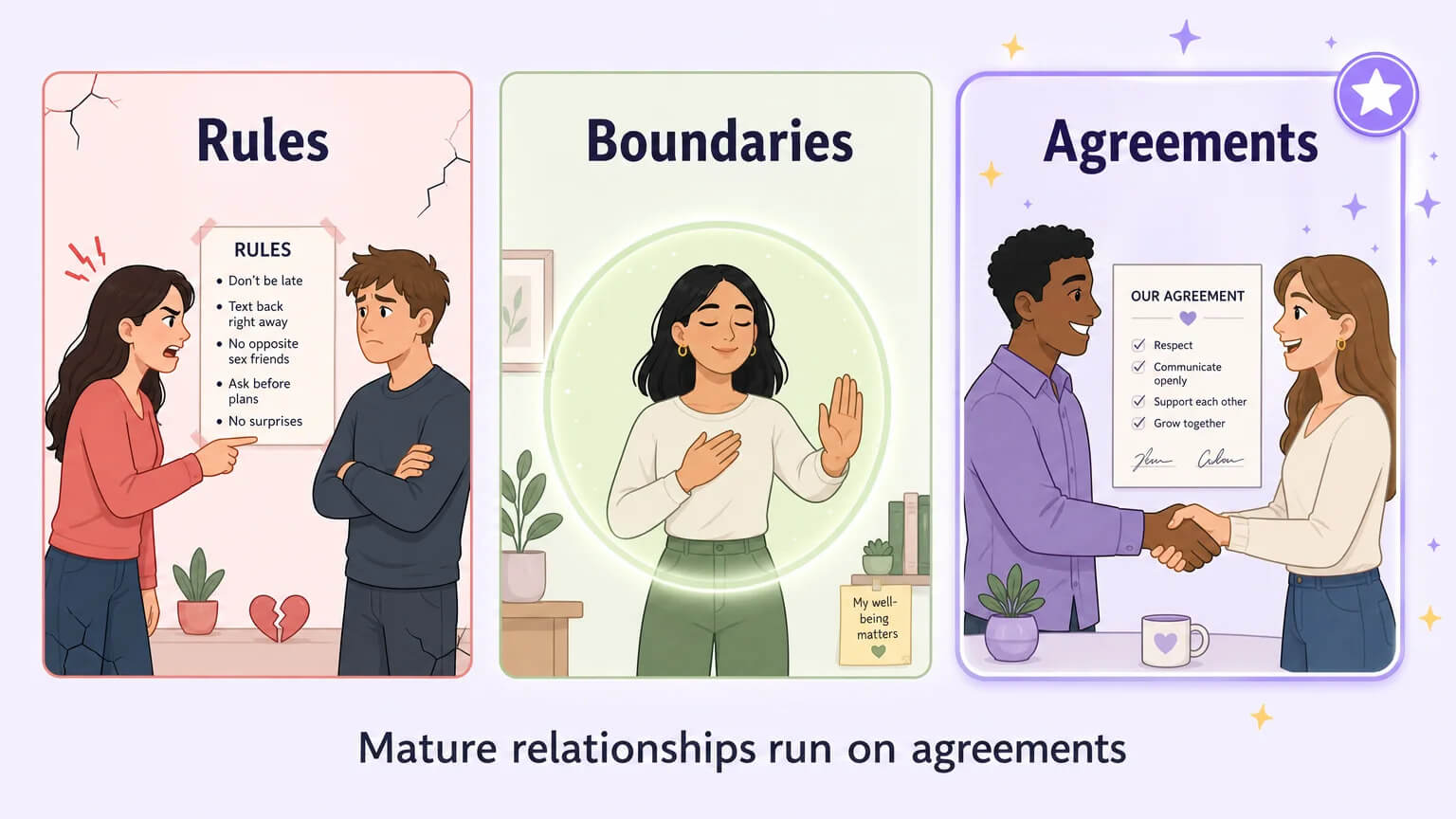
“Just communicate” is everywhere. Specific frameworks are not. Here is a distinction that changes how couples operate: rules control others and tend to be fragile, boundaries protect the self and are healthy, and agreements are co-created, negotiated, and revisable. That last category is what mature open relationships run on.
The agreement categories that matter cluster into a few buckets. Sexual health protocols cover testing cadence, PrEP adherence, condom use, and disclosure timelines. Time allocation defines how much outside time is available, what counts as protected couple time, and whether overnights are on the table. Emotional exclusivity lines clarify where romantic attachment is allowed versus off-limits, easier to name than to enforce.
Disclosure expectations range across a spectrum: tell everything, tell only what is relevant, or operate on a don’t-ask-don’t-tell basis. Don’t-ask-don’t-tell works for almost nobody long-term. It breeds secrecy, not safety. Most couples land in the middle: disclose new partners and significant developments, spare the blow-by-blow.
Veto power sounds like a sensible safeguard. In practice, it backfires often. The partner with veto power uses it as a release valve instead of doing the emotional work, and the outside person gets discarded without agency. A cleaner alternative is a “pause and discuss” agreement. Either partner can call a temporary pause on outside activity to process what is coming up, with the understanding that the goal is resolution, not indefinite suspension.
The tech layer matters because apps are infrastructure, not afterthoughts. Grindr offers volume and speed but comes with high jealousy triggers from ambient visibility. 3Fun was built for non-monogamy from the ground up, with 45 percent non-hetero users and boundary-conscious design. Beyond apps: a shared calendar prevents scheduling chaos, and a weekly twenty-minute check-in, phones down, dedicated solely to how the agreements are feeling, keeps small tensions from becoming emergencies.
Agreements are living documents. Revisit them every few weeks at first, then monthly once things stabilize. What felt right in theory may feel terrible in practice. Adjust. That is the point.
Jealousy, Compersion, and the New Relationship Energy Trap
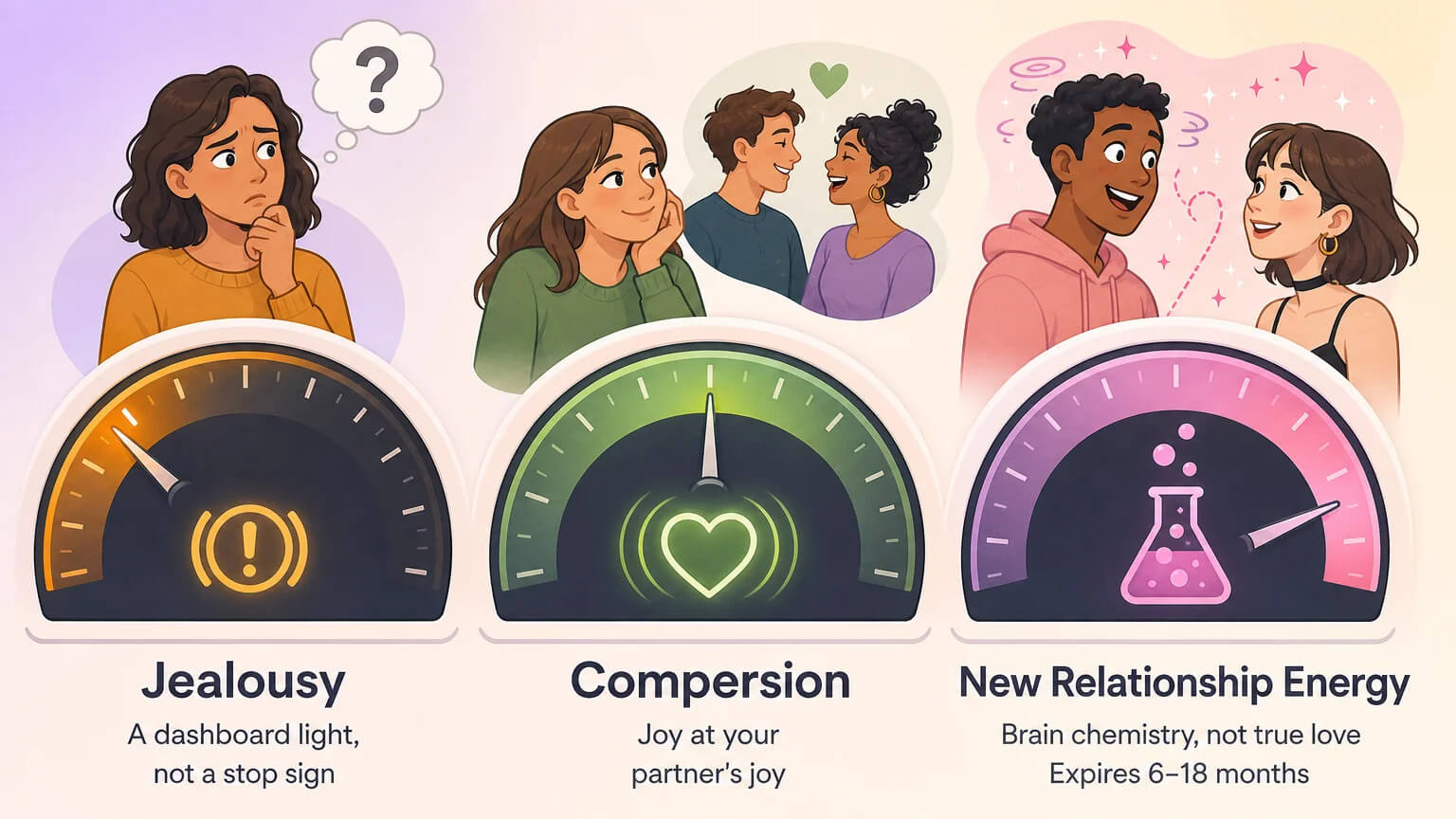
Jealousy is not a stop sign. It is a dashboard light. Something needs attention. It does not mean you are broken or bad at non-monogamy. Every long-running gay open relationship encounters jealousy. The couples who thrive are not the ones who never feel it. They are the ones who know what to do with it.
When jealousy flares, ask yourself three things. First: what am I afraid of losing? Usually the answer is not “my partner” but something specific your partner represents, security, being chosen, feeling special. Second: what need feels unmet right now? Jealousy often wears the mask of anger while the real issue is that you have not had quality time in two weeks. Your partner being on the apps late at night is not the problem. It is the billboard advertising the problem. Third: what agreement needs revisiting? The emotion might point to a gap in your current framework that neither of you noticed until now.
Compersion, the experience of joy at your partner’s joy with someone else, exists on a spectrum identified by researcher Marie Thouin. Benevolent neutrality is the baseline: “I interpret this as generally positive, even if I do not feel celebratory.” Attitudinal compersion is wholehearted cognitive support. Embodied compersion is the visceral experience of feeling your partner’s happiness in your own body. You do not need full-blown embodied compersion to practice non-monogamy. Most people never reach it consistently. What matters: compersion and jealousy frequently coexist. Feeling both at once is not hypocrisy. It is being human.
New Relationship Energy, NRE, is the biochemical cocktail of dopamine, oxytocin, and norepinephrine that floods your brain when a new connection forms. It makes the new person seem flawless and your established relationship feel predictable by comparison. It is not true love. It is brain chemistry with an expiration date, typically six to eighteen months.
The danger is not NRE itself. It is making life-altering decisions while under its influence. Cap time with new connections during the first three months. Make zero major relationship decisions while NRE is peaking: no moving in, no closing the primary relationship, no financial entanglements. Deliberately reinvest in your primary partnership through scheduled dates and non-sexual touch. The primary partner often gets stuck with logistics and chores while the new partner gets romance. That is how you build resentment, not compersion.
One partner comes home from a date visibly energized. The other feels jealousy rise alongside a quieter feeling: curiosity. They ask how it went. They hear the answer. Neither pretends the jealousy is not there, but neither lets it drive. The jealousy says “what if I am not enough.” The curiosity says “tell me more.” Both voices are real. Both get heard. That is the skill.
Sexual Health in the PrEP Era
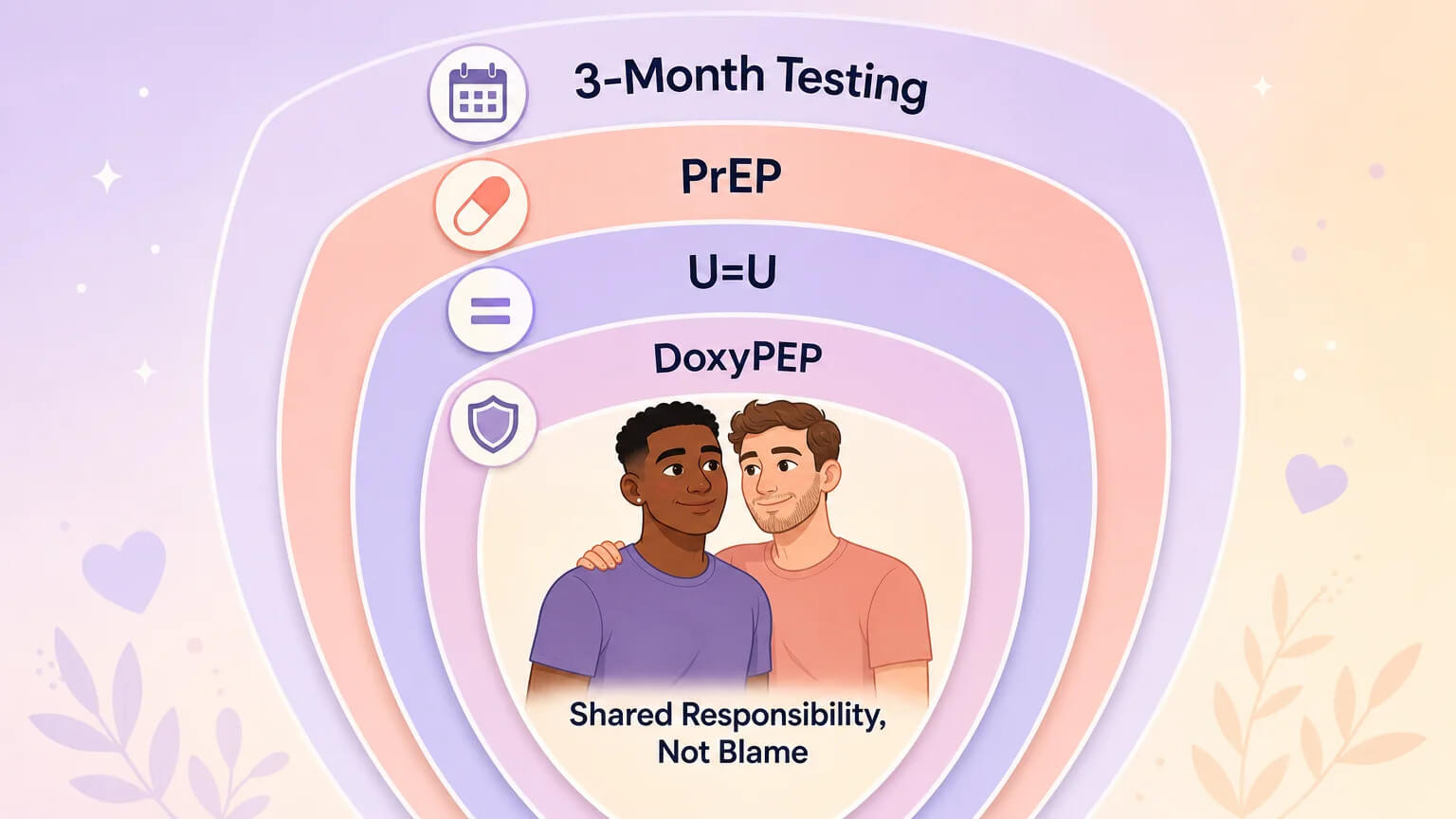
PrEP did more than prevent HIV. It decoupled sex from existential health anxiety and created space for couples to negotiate sexual boundaries without a backdrop of mortal fear. That shift is as much relational as it is medical.
A functional sexual health agreement for a gay open relationship covers several layers. Testing every three months is the standard cadence for sexually active gay and bi men with multiple partners. PrEP adherence turns HIV risk from a constant negotiation into a solved equation. U=U, undetectable equals untransmittable, works as a boundary principle: a partner living with HIV who maintains an undetectable viral load cannot transmit the virus, full stop. DoxyPEP, post-exposure prophylaxis for bacterial STIs, adds another layer of protection many couples now incorporate.
Disclosure protocols should specify when and how new sexual health information gets shared, not as accusation but as shared responsibility.
Here is the nuance that gets skipped: PrEP prevents HIV, not chlamydia, gonorrhea, or syphilis. An STI diagnosis in an open relationship is not evidence of betrayal or carelessness. It is evidence of being sexually active in a world where transmission happens. Frame sexual health as shared responsibility rather than blame assignment, and you get a couple that handles an exposure calmly instead of spiraling. An infection is a logistical event to manage, not a moral failing.
Even with biomedical prevention, sexual health anxiety can stick around. Some people carry residual fear from the pre-PrEP era. Others find that testing itself becomes a ritualized source of stress every three months. If health anxiety is interfering with your ability to enjoy the openness you have chosen, a CNM-affirming therapist can help untangle the fear from the facts.
How to Communicate and Repair When Things Go Wrong
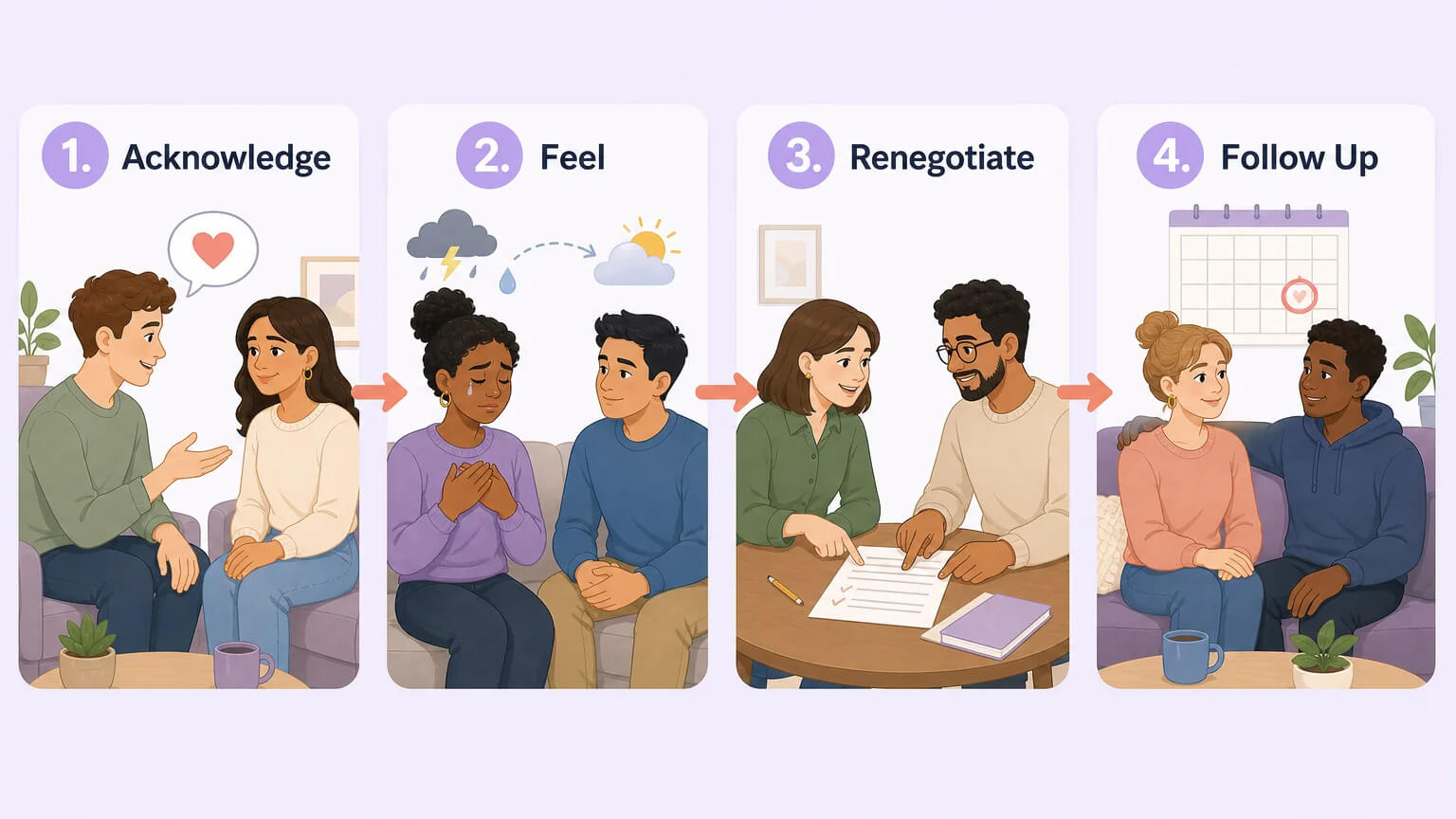
Every open relationship experiences breaches. The couples who survive them are not the ones who avoided mistakes. They are the ones who learned to repair.
When an agreement gets broken, the injury registers as more than a rule violation. It lands as an attachment injury, the emotional equivalent of a wound. The hurt partner’s brain enters a neurobiological stress response: cortisol floods the system, the amygdala activates. They are not overreacting. Their attachment system is sounding an alarm. Repair has to address the emotional wound, not just renegotiate the rule.
After a breach, look at three things. Availability: was your partner present when you needed them, or did they disappear into the new connection? Reliability: did they follow through on what they committed to? Responsiveness: did they attune to your emotional state when you expressed hurt, or did they deflect, minimize, or defend? These three questions tell you whether the breach was a one-time misstep in an otherwise secure bond or points to a deeper attachment rupture.
The repair sequence: first, the partner who breached acknowledges what happened without defensiveness. Not “I’m sorry you felt that way” but “I broke our agreement about overnights, and I understand that hurt you.” Second, the hurt partner gets space for their full emotional response without being managed, rushed, or talked out of it. Third, once the emotional temperature drops, collaboratively renegotiate the relevant agreement. The old agreement is now defunct. Draft a new one as an experiment with a scheduled review. Fourth, schedule a follow-up check-in specifically to assess how the repair is holding, separate from the initial conversation.
Professional help is not a last resort. If the breach triggered persistent hyper-vigilance, withdrawal, or obsessive thoughts, or if you cannot discuss what happened without it escalating, a CNM-affirming therapist is an investment in your relationship, not an admission of defeat.
Beyond Gay Men: The Full LGBTQ+ Picture and Coming Out Twice
This article draws heavily on gay male research because that is where the data is thickest. But non-monogamy is not exclusive to gay men. Research by Moors, Rubin, Matsick, Ziegler, and Conley found no significant differences between LGB men and women in attitudes toward consensual non-monogamy or the desire to engage in it.
The practice gap, where gay men report higher rates of actual non-monogamy, reflects community infrastructure and social scripts, not a fundamental difference in what people want. Bisexual, trans, nonbinary, and queer women practice non-monogamy in growing numbers with far less cultural scaffolding.
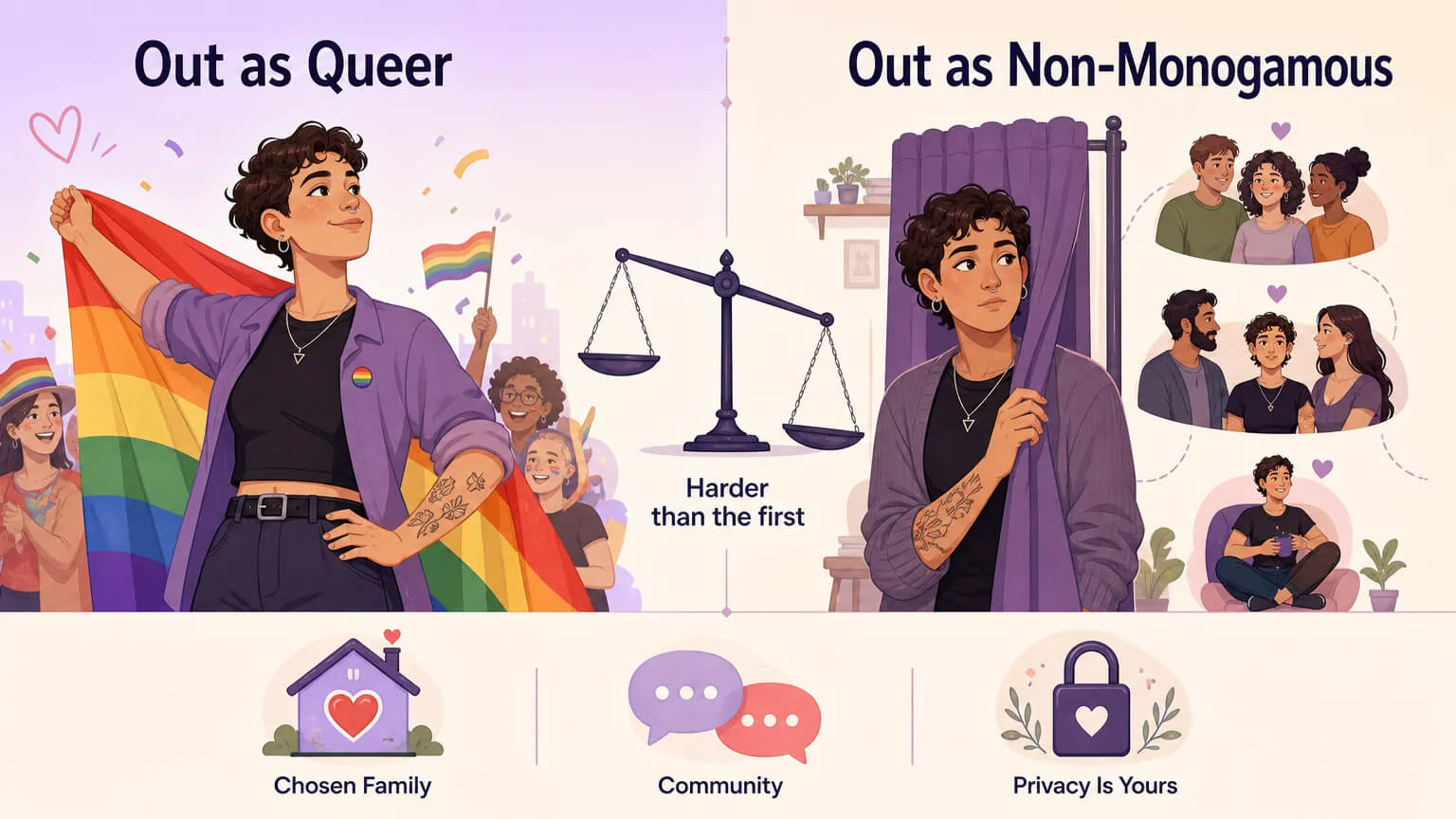
A finding that catches most people off guard: LGBTQ+ people in polyamorous and non-monogamous relationships consistently report that disclosing their relationship structure is harder than coming out as queer. There is less cultural script for “I have two partners” than for “I’m gay.” Fewer protective laws exist. Workplace discrimination based on relationship structure is legal in most jurisdictions.
Some non-monogamous LGBTQ+ people maintain two social media accounts: one publicly out as queer, and a private one for disclosing polyamory. Polyamorous parents report genuine fear of being labeled unfit and losing custody, a fear with documented precedent.
Choose your disclosures strategically. You do not owe everyone your full relational reality. Build chosen family who understand your life without requiring translation. Find community through local polyamory meetups, LGBTQ+ centers, and online forums where your gay open relationship or polyamorous structure is baseline, not noteworthy. There is no universal obligation to come out as non-monogamous. Your privacy is yours to manage. Disclose where it serves your safety and well-being, not anyone else’s comfort.
FAQ
Will opening our relationship ruin it?
Not if you start from strength, communicate relentlessly, and treat agreements as living documents you revisit regularly. Research shows satisfaction parity between mutually agreed monogamous and open couples. Opening a struggling relationship to fix it almost always backfires because openness accelerates existing dynamics instead of creating new ones. If your foundation is solid, the conversation itself strengthens it.
What if I feel jealous no matter what?
Jealousy is data, not failure. Use the three-question diagnostic: what am I afraid of losing, what need feels unmet, and what agreement needs revisiting. Persistent, debilitating jealousy may signal that non-monogamy is not right for you right now, and that is completely valid. Plenty of people discover that through trying, not through theory. You are allowed to change your mind.
How do we find other non-monogamous people?
3Fun is purpose-built for non-monogamy. OkCupid offers non-monogamy filters. Scruff blends community with connection. Local LGBTQ+ centers, polyamory meetups, and sex-positive community events give you in-person options. Lead with honesty about your relationship structure in your profile. It filters out mismatches before they happen.
Can we be open if one of us is more reluctant?
Proceed slowly and let the reluctant partner set the pace. Never open under duress. Consider starting monogamish, occasional play together with no solo activity, as a low-stakes starting point. The partner who wants more openness needs to demonstrate, through patience and consistent care, that the primary relationship is not under threat. If reluctance persists, honor it. Pressuring a partner into openness is coercion, not consent.
What about family, kids, and work?
Your disclosure strategy is yours to control. Protect your privacy where your safety, employment, or parenting rights could be at risk. Build chosen family who get it without requiring an explanation. There is no universal obligation to come out as non-monogamous, and the research confirms this second coming out is often harder than the first. Disclose where it strengthens your life, not where it complicates it unnecessarily.