
There is someone in your life who does not fit the script. Maybe they live across the country. Maybe your schedules never quite align. But when the stars cooperate and you find yourselves in the same room, it is electric. The connection does not fade during the long gaps. It does not follow the standard arc of date, relationship, move in together. It is not broken. It is just a different shape entirely. And you have never quite known what to call it.
In polyamory and ethical non-monogamy, there is a name for exactly this: a comet partner. Like a comet in the night sky, they appear periodically, intense and bright and unforgettable, then continue on their orbit until the next pass.
So what do you even call a connection like that? And more importantly, how do you do it well?
Where Did the Term Come From?
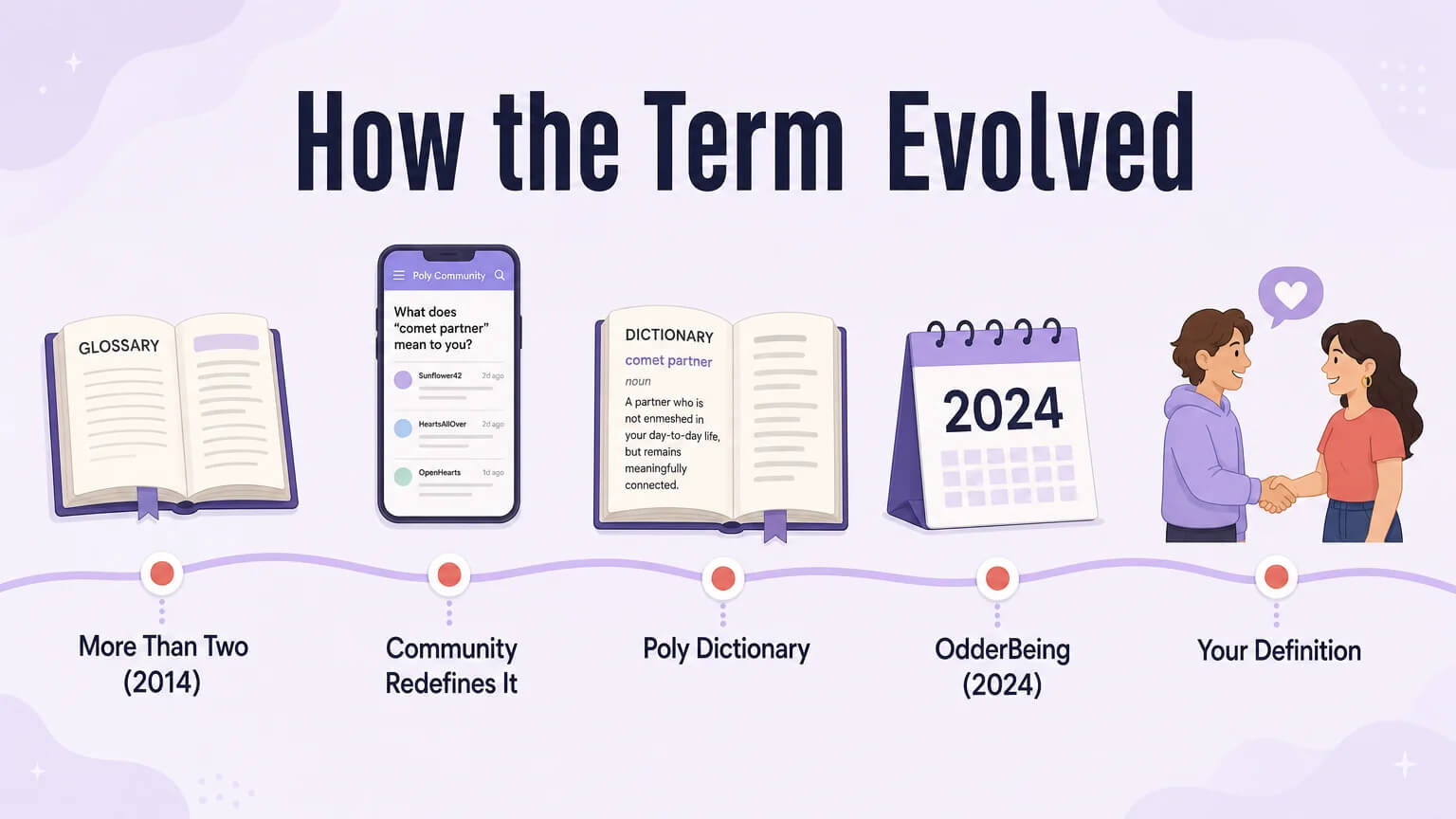
There is no single agreed-upon definition for comet partner. That is by design. The term evolved through community use and is still being refined by the people who live it.
The earliest written definition comes from the More Than Two glossary: “An occasional lover who passes through one’s life semi-regularly, but without an expectation of continuity or a romantic relationship.” Clean. Clinical. And ask the wrong person, completely wrong.
Here is how the community actually talks about it. The online polyamory world pushed back with a warmer version that has since become the most widely cited: “A person that passes through your life repeatedly who is intense and awesome, and when gone you are still in contact with that person in some way, but they are not a continuous partner.”
The Poly Dictionary grounds it in a real example: “We see each other once a year, at the conference. We’ve been doing this for the past 10 years.” The OdderBeing glossary (May 2024) defines it as “a partner that is only part of your life very occasionally (like once every several months), for instance because you live far apart.”
The real debate sits inside one word: continuity. The More Than Two definition says no. Community voices, most notably Sophia from Love Uncommon, argue that comet relationships have “continuity in bucket loads,” just in a more spacious form. The Consent Culture glossary captures it best: “someone who may not be frequently present in one’s life but who has a significant emotional connection.” That word, significant, is the hill most comet partners will die on.
The flexibility is not a weakness. The only definition that matters is the one you and your comet partner agree on.
How Comet Relationships Actually Work
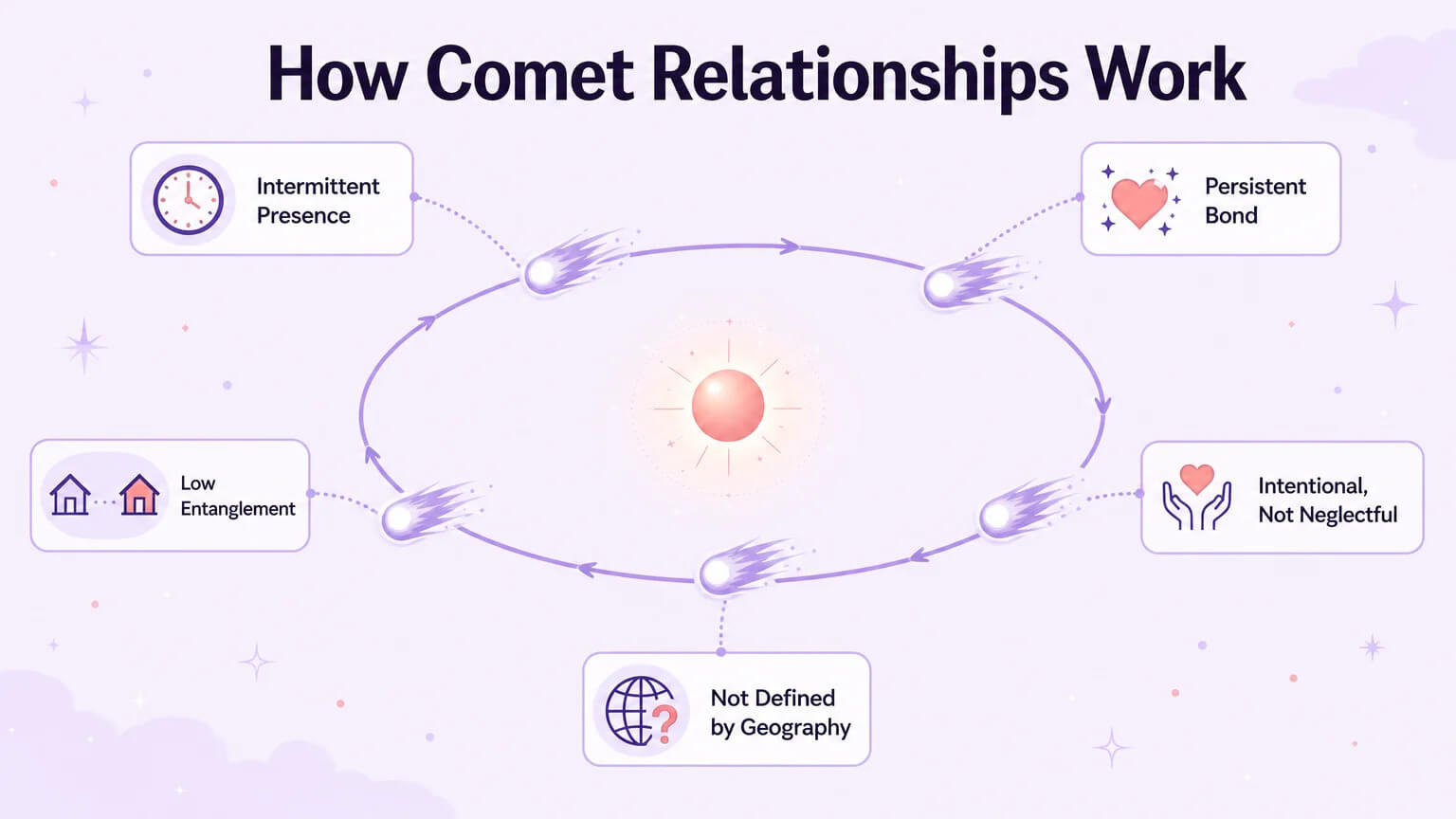
Like their astronomical namesakes, comet relationships follow elliptical orbits. Long stretches of distance, then brief passes that light up the sky. Most of the time, you are each in your own orbit: separate lives, separate cities, different daily rhythms. Then paths align and the connection blazes back to life.
A handful of characteristics show up again and again.
There is intermittent presence with a persistent bond. Weeks, months, or years can pass between meetings, yet the emotional connection holds steady. Feelings do not degrade during physical separation. You pick up where you left off.
There is low entanglement paired with high intention. No shared finances, no cohabitation, few ongoing obligations. The relationship focuses entirely on the quality of time together, which requires more explicit communication precisely because time is limited.
The gaps are spacious, not neglectful. They are the design. As Sophia from Love Uncommon puts it: “This spaciousness does not diminish the importance of these relationships, rather it is their essence.”
Geography is often a factor but not the defining one. Distance is common but not required. Two people in the same city can have a comet dynamic if their schedules rarely align.
And comets coexist comfortably with other relationships. Someone can have a nesting partner, anchor partners, and one or more comet partners simultaneously. Roy Graff, profiled in HuffPost, describes four regular partners plus multiple international comet romances, each occupying its own space.
A quick distinction worth making: a meteor (term from the KNP Podcast) is a one-time intense connection that never returns. Think the unforgettable festival weekend. A comet returns. Recurrence is the defining feature.
Take two real cases. The Poly Dictionary documents a ten-year annual conference comet: two people connecting once a year, every year, for a decade. Then there is Reese and Drew, from Attuned Therapy. Opposite U.S. coasts. Once or twice a year. Deeply in love. No pressure to escalate. No guilt about the gaps.
Comets range from highly predictable (the annual event, the holiday tradition) to entirely spontaneous, the “hey, I’m in your city this weekend” text. Both are valid. Both are comets.
Comet Partner vs. FWB, Casual, and Other ENM Labels
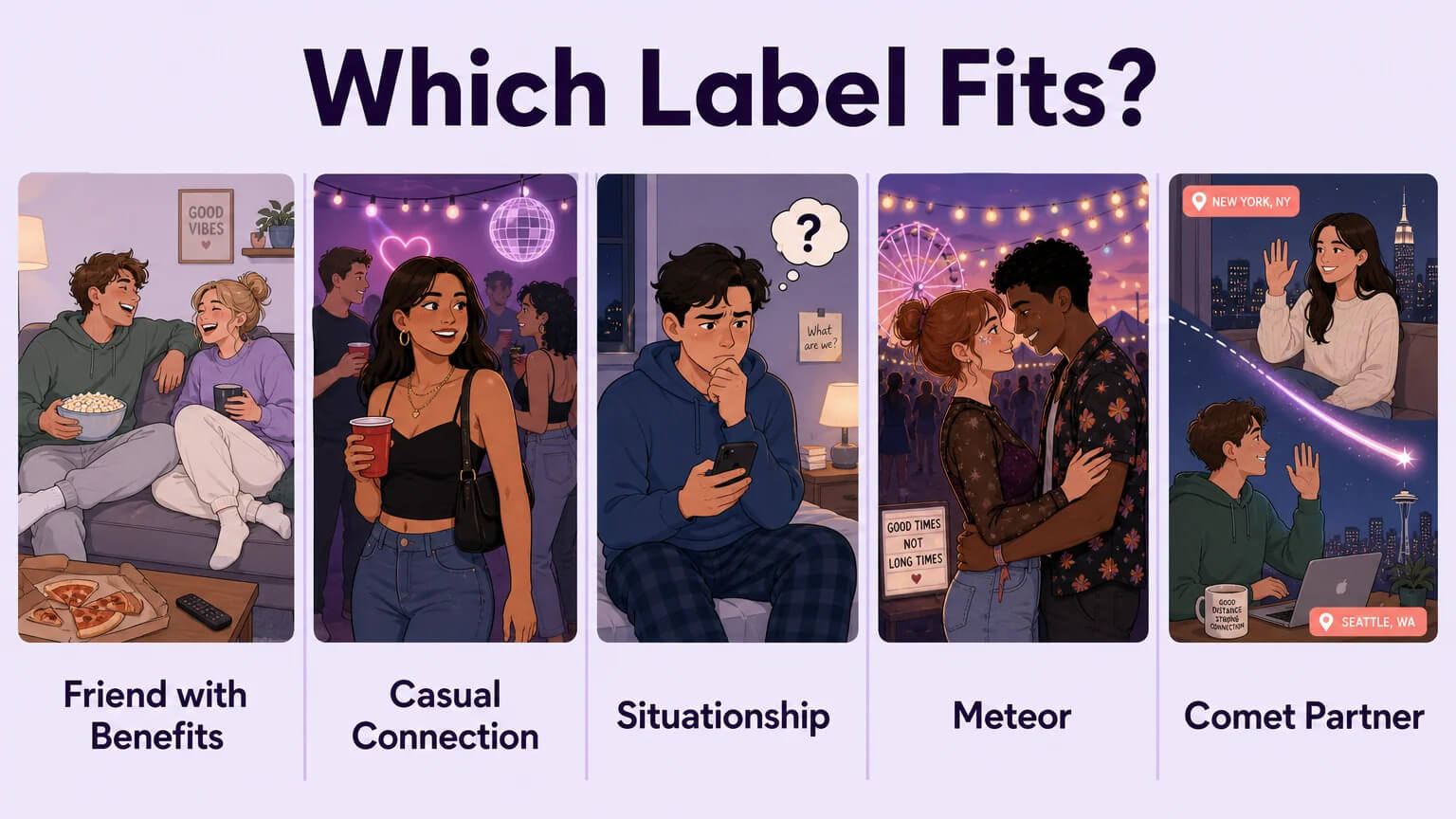
Every person new to ENM hits the same wall: you have an intermittent connection. Is it a comet? A friend with benefits? A situationship? The labels overlap, but the distinctions matter. The label shapes expectations.
A friend with benefits is friendship-based, with sex as the primary benefit. Romantic feelings are typically avoided. A comet partner can include romance. Deep feelings are common and welcomed. The comet dynamic is also more intentionally negotiated. You talk about what it is, not just what happens.
A casual connection lacks emotional continuity. You might share a night with someone and never speak again. A comet partner maintains a thread of connection between encounters. There is a “we will find each other again” assumption built into the structure.
A situationship is defined by ambiguity. Nobody has named what it is, and that ambiguity creates its particular anxiety. A comet relationship, by contrast, is explicitly discussed and mutually understood. The label provides clarity, the exact opposite of situationship uncertainty.
A meteor is a one-time intense connection that never returns. A comet returns. Recurrence is what separates the two.
Then there is solo polyamory, which trips people up because it sounds like it could be the same thing. It is not. Solo poly is an identity: a person maintains themselves as their own primary and does not seek a nesting partner. A comet partner is a relationship role describing the rhythm of a specific connection. A solo poly person might have multiple comet partners. They might also be someone else’s comet. Comet describes the relationship. Solo poly describes the person’s overall philosophy.
This is why the term stuck. A comet partner occupies a space no other label quite reaches: more emotionally invested than FWB, more intentional than a situationship, recurring unlike a meteor, romantic-compatible unlike casual, a role rather than an identity unlike solo poly.
The Pros and Cons of Comet Dynamics
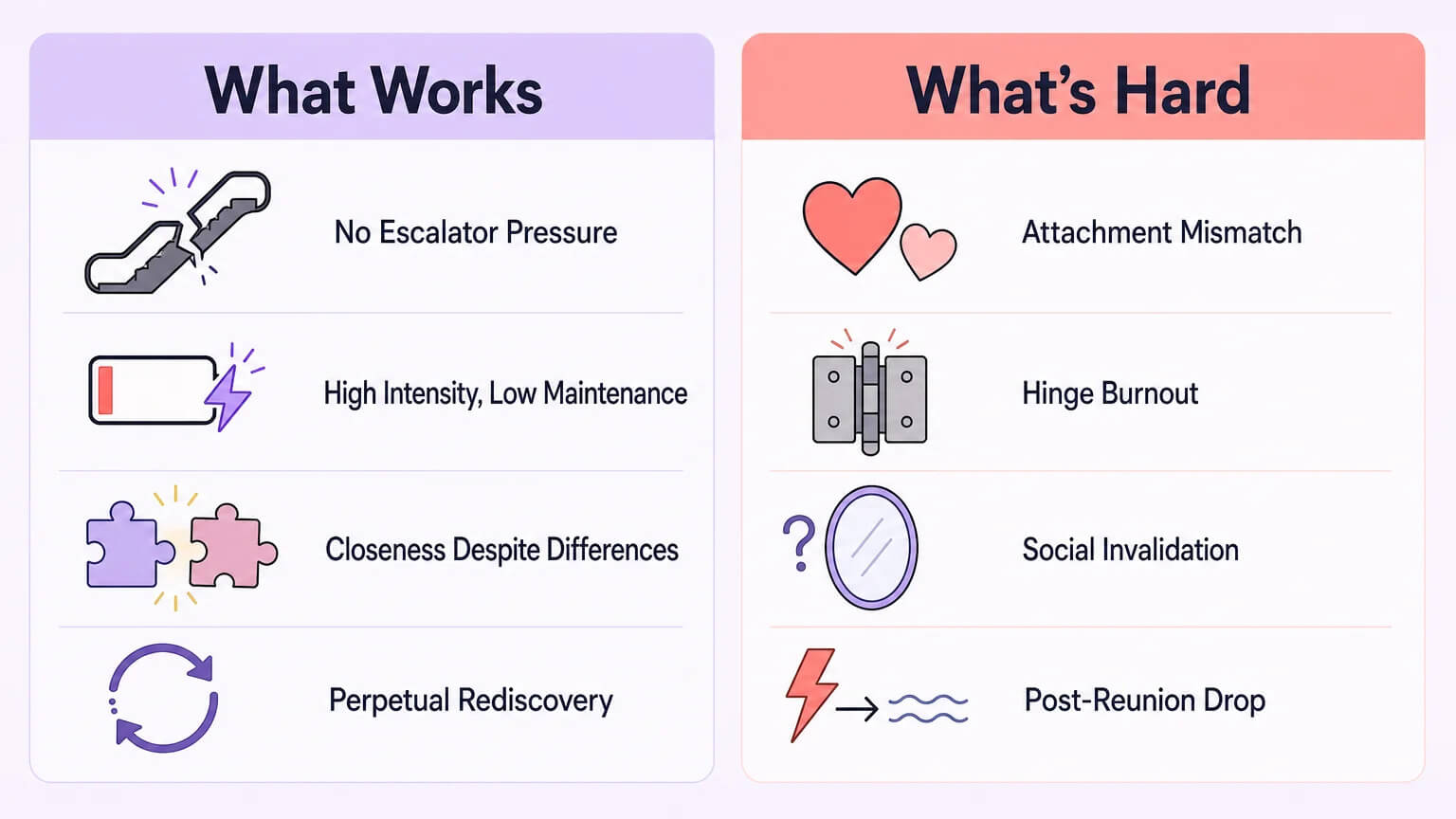
Comet relationships are not for everyone. Someone who thrives as a comet with one person might need daily contact with another. Both things can be true.
What Works
Freedom from the relationship escalator. No pressure to cohabitate, merge finances, or “progress.” The relationship is complete as it is. As Poly.Land puts it: “Relationships are custom jobs, not products stamped out on an assembly line.”
Low daily maintenance, high reunion intensity. Independence and deep connection, without the logistical overhead of a daily partnership.
Closeness despite incompatibility. You can deeply love someone whose daily life is incompatible with yours. The comet shape lets you have the connection without the collision.
Perpetual rediscovery. The KNP Podcast calls comets an “NRE hack”: continuous new relationship energy without the eventual fade. Sophia from Love Uncommon describes it as “new and old at the same time.”
Complete autonomy preserved. Both partners live fully independent lives between encounters. Love Uncommon’s author notes: “The most important healing of my life has occurred with the help of comet partners.”
What’s Hard
And then there is the other side.
Attachment mismatch. One person develops deeper feelings or wants more contact than the comet structure accommodates. Renegotiating expectations mid-orbit is the most frequent source of tension, and mismatched post-visit needs can hurt both sides.
Destabilizing existing partnerships. A nesting or primary partner may feel threatened by the “specialness” of comet time. The hinge partner, managing both a primary relationship and one or more comet dynamics, carries the emotional labor of reassuring everyone.
Hinge burnout. Managing schedules, emotional triage, and logistics across multiple relationship rhythms is cognitively expensive. Research from Yvex.de describes the hinge partner as “an exhausted relational CEO.”
Social invalidation. Comet relationships get dismissed as “not real” by mono-normative culture, and sometimes within poly communities that privilege high-entanglement dynamics. Some comet partners feel devalued, like the connection does not count because it does not look “serious” from the outside.
None of these are reasons to stay away from comet dynamics. They are reasons to go in with your eyes open. The people who make comets work are not the ones with no hard feelings. They are the ones who name the hard feelings out loud.
How to Negotiate a Comet Connection

Comet relationships need more explicit communication than entangled ones, not less. The default assumptions of daily-relationship culture do not apply.
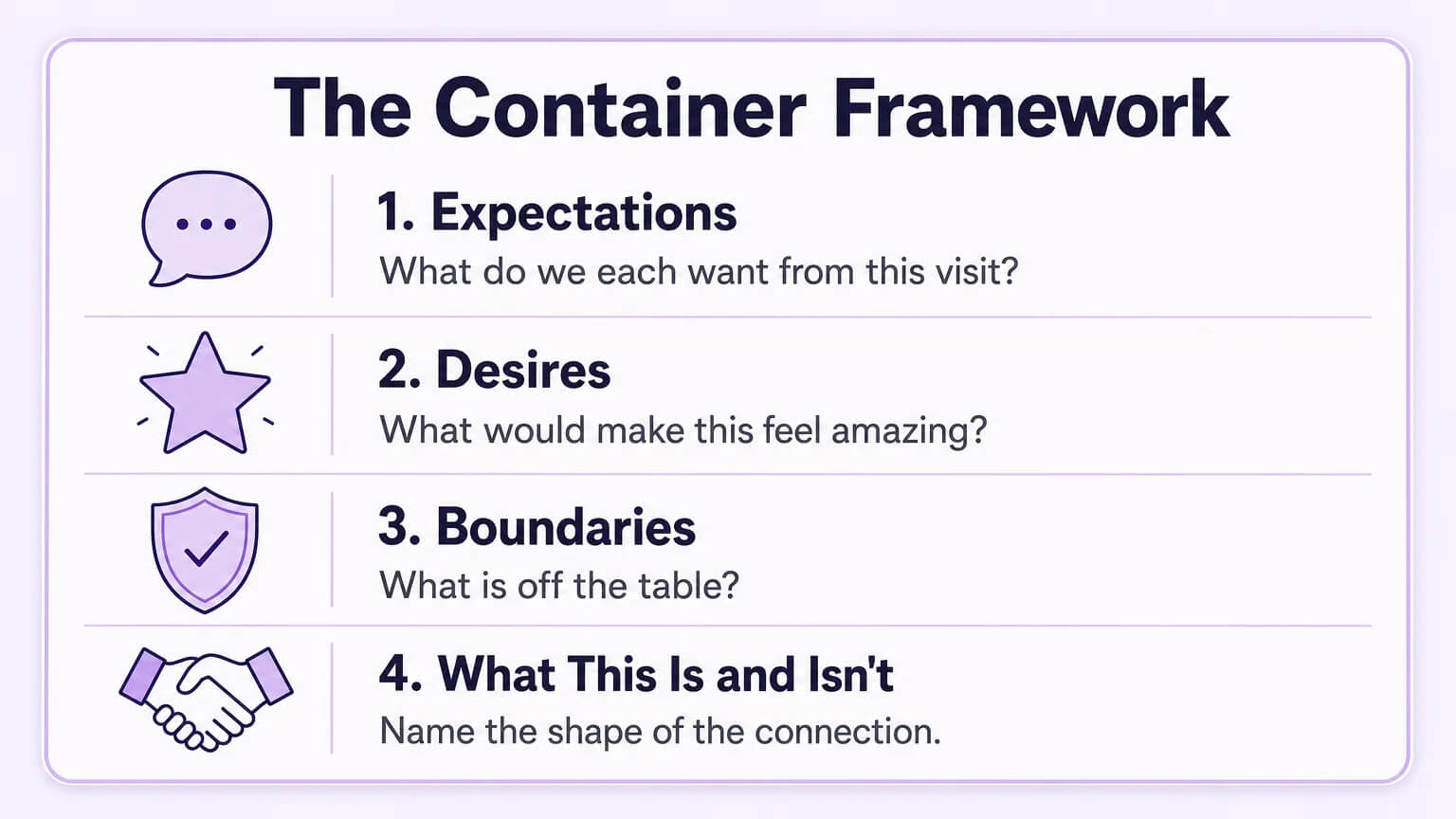
The Container Framework
Amory Wellness offers a practical approach: treat planning a comet visit like negotiating a scene. Before you are in the same room, get clear on four things.
Expectations. What do you each want from this visit? Romance? Sex? Deep conversation? Adventure? Naming it prevents the most common source of comet disappointment: you expected a romantic weekend and they expected a hiking buddy.
Desires. What would make this visit feel amazing? Be specific. “I would love to cook dinner together.” Specific desires are instructions you can act on. Vague hopes are guessing games nobody wins.
Boundaries. What is off the table? Maybe you are not available for daily texting afterward. Maybe you need your own sleeping space. Saying what is not on offer is not rejection. It is giving someone the real map instead of letting them walk into walls.
What this is and is not. The most important conversation: “This is a deep, romantic connection that happens when our paths cross. It is not a path to cohabitation. It is not a daily partnership. That is not a lesser version of a relationship. That is exactly what we are choosing.”
The Post-Visit Debrief
Do not skip this. After an intense reunion, people have wildly different needs. Some need a check-in text the next day. Some need space to process. Some want to plan the next visit immediately. Some prefer to let it happen organically. Ask directly: “After we part, what do you need from me? And what do I need from you?”
Managing Existing Partners
If you have a nesting or primary partner, bring them into the conversation before the comet arrives. Give them a heads-up. Reassure them about what the comet is and is not in your life. Ask what they need to feel secure. Do not make promises you cannot keep: “I won’t catch feelings” is not a promise anyone can honor.
The container is not about restricting the connection. It is about creating enough safety for it to burn as bright as it wants without burning down anything else.
Is a Comet Dynamic Right for You?
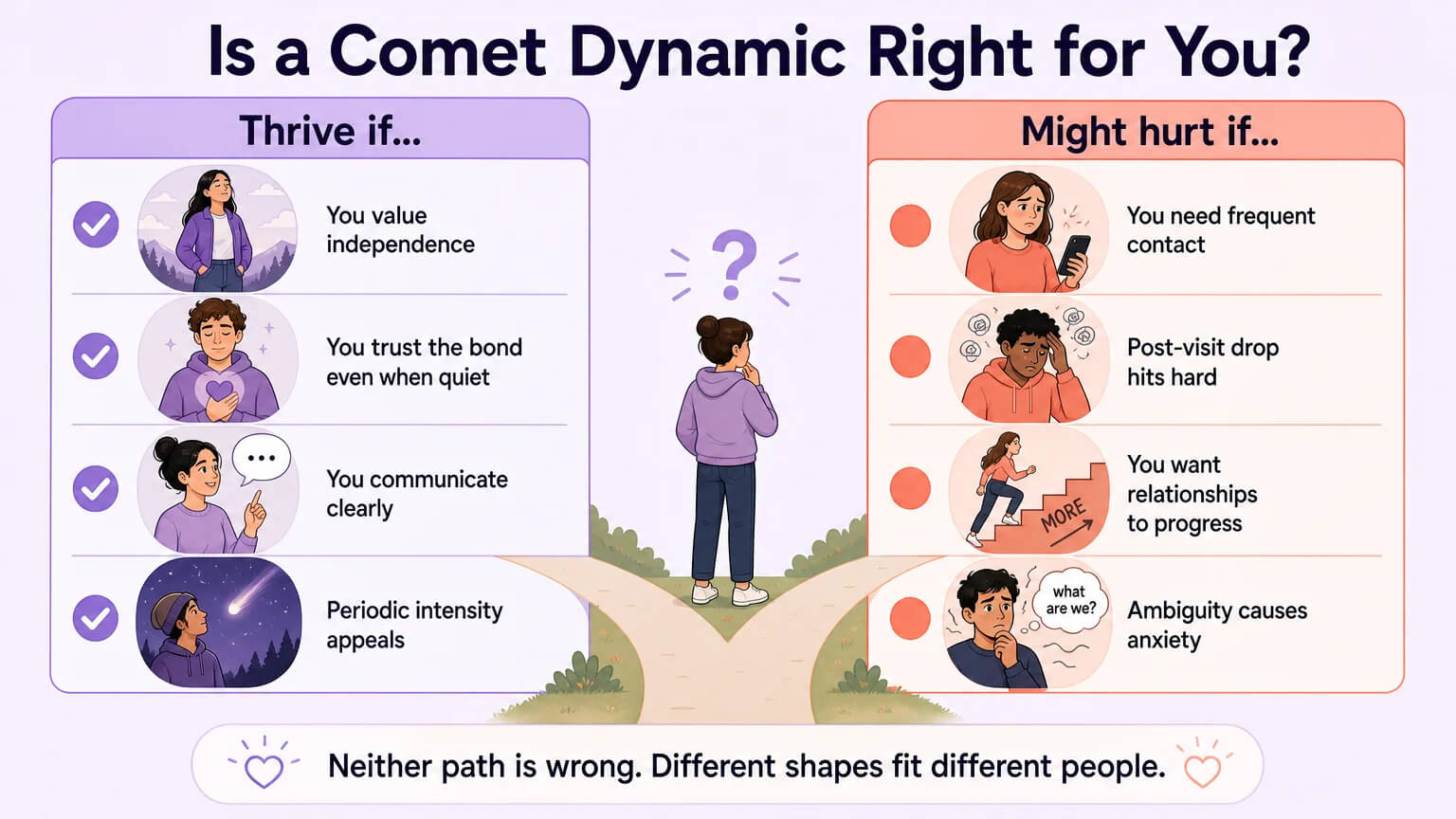
Comet dynamics are not a relationship achievement to unlock. They are a fit. And fit depends on who you are, not just what you want.
You might thrive in a comet dynamic if you value independence and have a full life you do not want to reorganize around a partner. If you can hold emotional intensity without needing daily reassurance. If you trust the bond even when it is quiet. If you communicate clearly about expectations and can handle direct conversations about what a relationship is and is not. If periodic, intense connection appeals more to you than consistent, moderate contact.
A comet dynamic might hurt if you need frequent contact to feel secure. If the post-visit drop leaves you spiraling rather than satisfied. If you tend to want relationships to “progress” toward more entanglement. If you struggle with jealousy when a partner’s attention is elsewhere. If ambiguity about “what we are” causes anxiety rather than freedom.
Neither list is a judgment. Wanting consistency does not make you needy. Thriving in comet dynamics does not make you avoidant. Different people need different relationship shapes, and knowing which shape fits you is most of what matters.
If you recognized yourself in the “thrive” column, the next step is finding people who want the same thing. Be upfront in your dating profile: say you are looking for occasional, meaningful connection without daily entanglement. Dating apps like Feeld, #open, and 3Fun have large ENM-friendly user bases where comet-style language is understood. The right person is not just someone you click with. It is someone who looks at the shape you are offering and says yes, that is exactly what I want too.
FAQ
How is a comet partner different from a friend with benefits?
FWB centers friendship and sex, typically avoiding romance. Comet partners can include deep romantic feelings and involve more explicit negotiation.
Can a comet partner become a primary partner?
Yes, if both want the same structural change and address the incompatibilities that made the comet shape work. Wanting more does not mean the comet failed. It means needs evolved.
How often do comet partners typically connect?
No standard. Some connect a few times a year, others once every few years. The pattern matters, not the frequency.
What is the difference between a comet and a meteor?
A meteor is a one-time connection. A comet returns. Recurrence is the difference.
Is a comet relationship a “real” relationship?
Yes. Depth is not measured by frequency. The relationship escalator is not the only valid shape.
What is the biggest risk in a comet dynamic?
Mismatched expectations: one person wants more contact than the structure accommodates. The fix is explicit, ongoing communication. Renegotiate before resentment builds.
How do I bring up wanting a comet dynamic with someone?
Be direct. Frame it as what you can offer: “I really value our connection. A comet dynamic could work beautifully for us: intense together, spacious apart. How does that land?” If it is not an enthusiastic yes from everyone, it is a no.