Roughly one in five Americans has tried consensual non-monogamy at some point, and 41% of adults under 30 say they are interested. Yet most couples who struggle through the transition do not fail because openness is wrong for them. They fail because they had no map.
This guide is that map.
What follows is a sequenced, practical walkthrough built from therapist expertise, real-couple experiences, and the best research on what actually works. How to have an open relationship is not a single conversation or a leap of faith. It is a learnable process that, done with care, deepens a partnership rather than fracturing it.
This isn’t a flaw in your foundation. It’s an extension of your adventure.
The guide moves through four phases. Foundation: clarify your why and assess whether your relationship is ready. Design: define what openness means and build agreements together. Launch: take real-world steps at a pace your nervous system can handle. Sustain: build rhythms that hold and know what to do when things break.
You and your partner are a team. Anyone you welcome into your dynamic is a guest in your playground. Keep both truths in your pocket.
Step 1: Understand Your “Why” Before You Say a Word
The quality of your first conversation depends on the clarity you bring into it. Most couples skip this step, jump to logistics, and land in reactive conversations.
Your goal: articulate your personal reason for wanting openness in one sentence, without mentioning anything your partner is doing wrong.
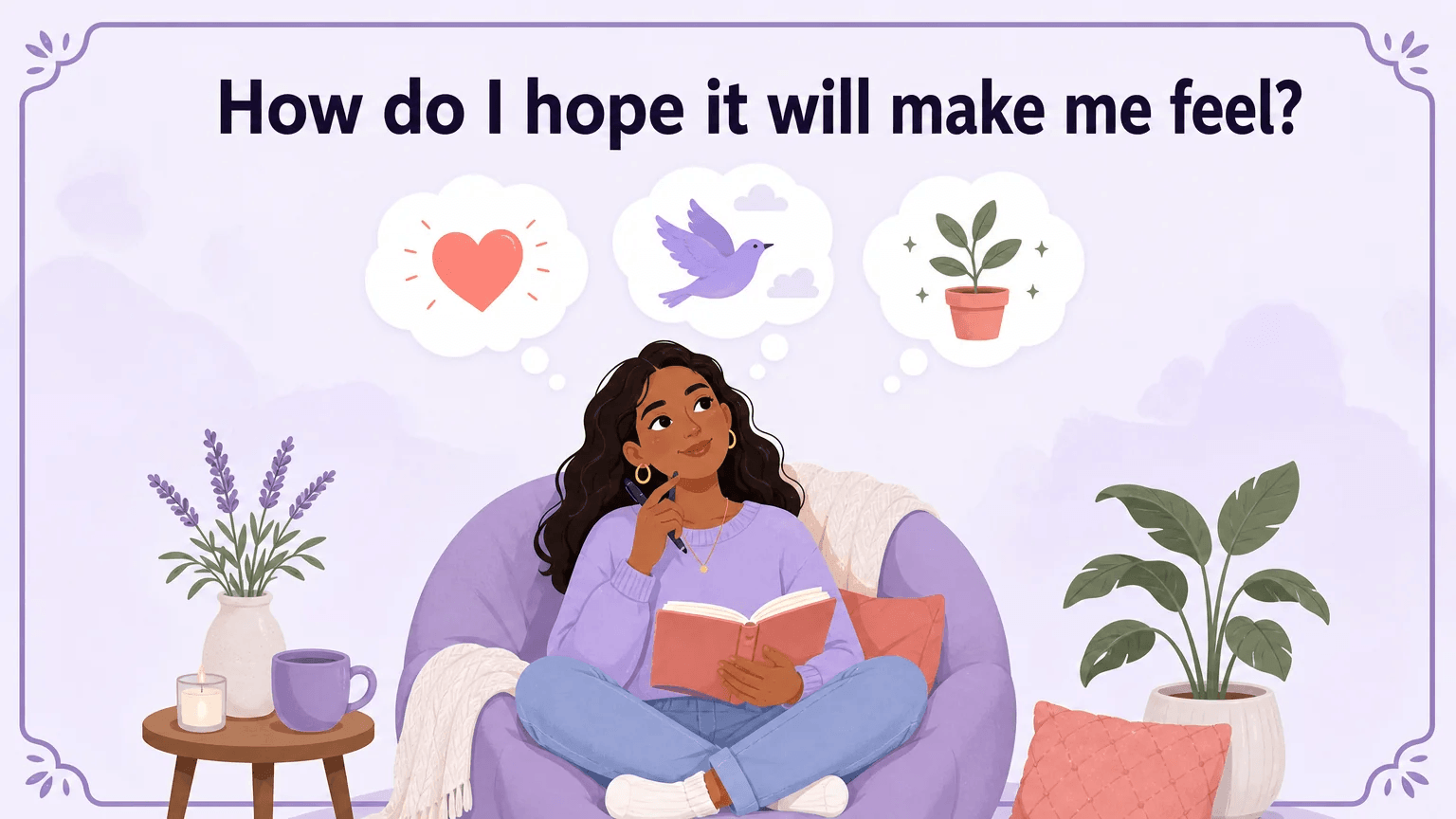
Therapist Ian Bonner recommends a reframe. Instead of “What do I want to do?”, ask “How do I hope it will make me feel?” Common answers include feeling desired again, feeling free, or expressing a part of yourself your primary partnership cannot hold. These are longings, not threats.
Therapist Kayla Crane, LMFT, offers pre-opening questions: What are your genuine reasons? How do you handle jealousy? What are your communication skills? What are your values around commitment? Answer privately, with ruthless honesty.
Now the uncomfortable part. If your primary reason is escaping a predictable bedroom or fixing a strained relationship, openness amplifies cracks, it does not heal them. Michelle Cmarik opened her marriage with zero research and no agreements after six years of unraveling. She fell in love with another man, considered leaving her family, and was closer to divorce than ever. “What I really wanted was to be loved again,” she reflected. “That need is more difficult to meet with a dating app and an open marriage.”
Desire does not require an apology, but it does require self-awareness. Write down your “why” in one sentence before speaking to your partner. If it blames your partner or reads like an escape plan, pause.
The 50 Questions to Ask Before Opening Your Relationship (2025) by Dr. Rachael Meir is a strong self-guided companion for this phase.
Milestone: You can state your personal “why” clearly, and it points toward growth, not away from a problem.
Step 2: Check Your Foundation: Is Your Relationship Ready to Open?
Wanting openness and being ready for openness are not the same thing. Conflating them causes more preventable damage than any other mistake in the process.
Think of it as building a second story. If the foundation has cracks, you are adding weight, not stability.
Trauma and attachment therapist Danielle Palomares recommends an “attachment inventory.” Understand what activates your nervous system and how you respond to perceived threats. Pre-existing pursuer-withdrawer cycles get amplified by opening up. They do not resolve.
Therapist Kayla Crane shares a sobering observation: “I’ve had many clients come into couples counseling because they thought they wanted an open relationship but later regretted the decision.” These couples are not outliers. They skipped this step.
The hardest truth: reluctant consent is not consent. If one partner is going along to keep the other from leaving, that is not an agreement. It is a slow-motion separation wearing the costume of openness. If it is not an enthusiastic “yes” from everyone, it is a hard “no.”
Milestone: Both partners can say “we are genuinely enthusiastic, not just reluctantly agreeing.” If you cannot say that yet, the next step is more conversation or professional support, not forward motion.
Step 3: Start the Conversation Without Your Partner Feeling Like They’re Not Enough
How you bring this up shapes everything that follows. The first conversation is not about decisions or logistics. It is about creating emotional safety around a vulnerable subject.
The fear that “wanting openness means my partner isn’t enough” is the biggest emotional landmine. You disarm it by how you enter the room.
Timing matters. Therapists are unanimous: conversations about openness happen when the relationship is strong, not during crisis. The worst time to bring this up is during or after a fight. When the relationship is under strain, the question lands not as an invitation but as an exit strategy.
Heights Couples Therapy in Houston recommends this sequence.
Set the stage: choose a calm moment when neither of you is exhausted. Offer a gentle heads-up: “I’d love to talk about something important with you when we’re both settled.” Then open with: “I care about you deeply and I’m committed to us. I’ve had some thoughts and curiosities about relationships that I’d like to talk about, not as a demand, just something to explore together. There’s no rush to decide anything.”
Therapist Gabriel Gonzalez, LCSW, recommends a two-minute exercise. Each partner completes: “The part of me that’s curious about opening is hoping for…” and “The part of me that’s scared is worried that…” The other reflects back what they heard without arguing, fixing, or defending. That is the whole exercise.
Expect fear. Expect surprise. Some hurt is likely. These reactions do not mean the conversation failed. They mean you touched something real.
This is the first of many conversations, not a single big talk followed by a decision.
Milestone: Both partners have shared their hopes and fears and felt genuinely heard, even if no decision has been made.
Step 4: Define What “Open” Means for Your Relationship
There is no universal definition of an open relationship. Assuming you and your partner mean the same thing without spelling it out is one of the top failure patterns therapists see.
As the Chosen Family podcast puts it: “The biggest mistake couples make is assuming they know what the other person means by ‘open relationship’ without spelling it out in painful detail. What’s allowed? What’s off-limits? What do we tell each other? Every single one of these questions needs a shared answer.”
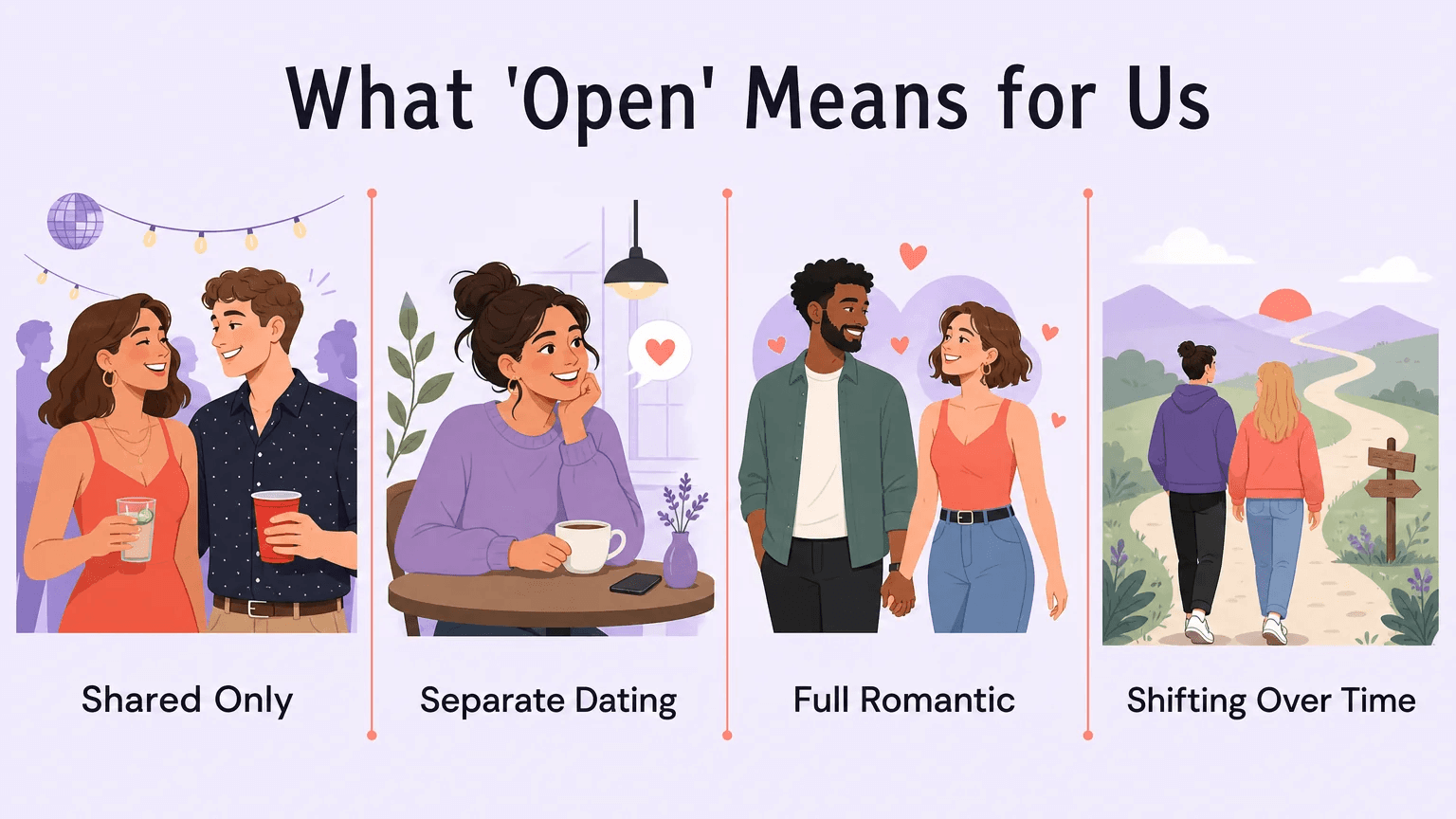
The spectrum is wide. For some couples, open means shared experiences only: threesomes, swinging, events you attend together. Other couples want separate dating without deep emotional attachment. Some want full romantic relationships alongside the primary partnership. And many land somewhere between all of these, shifting over time.
Decide your relationship model. Is your primary partnership hierarchical, taking priority over outside connections, or are you moving toward non-hierarchical polyamory? Will outside partners interact with your shared social life (kitchen-table) or exist in separate lanes (parallel)? These are decisions about how deeply outside connections integrate with your life, your home, and your time.
Your definition will change. Danielle, in an open marriage for 15 years, cycled through swinging in her 20s, dating while traveling, temporary monogamy after kids, a polyamory-adjacent phase, and now casual connections and friends-with-benefits. The structure that works today may not work after a life transition. That is not failure. It is a living relationship.
Milestone: Both partners can write a one-paragraph definition of “what open means for us right now,” and those paragraphs match on the core elements.
Step 5: Build Agreements That Protect Your Connection
Agreements are co-created frameworks that make exploration safe for both of you. They are revisable. Imposed restrictions feel like confinement.
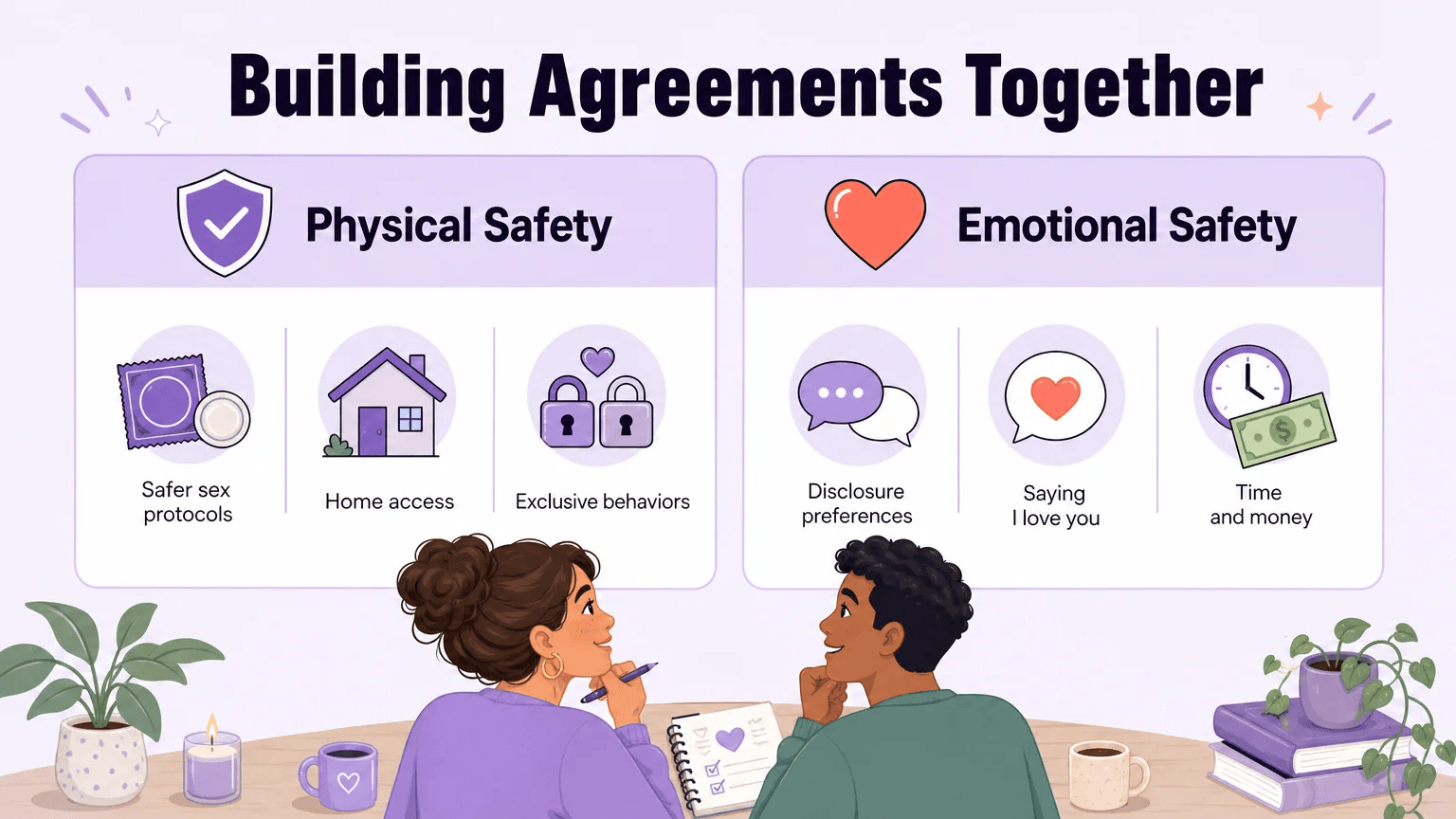
Therapist Charlotte Monk, a BACP-registered practitioner, recommends separating agreements into two categories. Physical safety covers safer sex practices, who has access to your home, and what behaviors you reserve exclusively for each other. Emotional safety covers disclosure preferences, whether saying “I love you” to others is on the table, and how time and money get allocated across connections. Monk’s framing question: “Can each of us share our deepest fears alongside our desires? Because both need space at the table.”
Now get specific. The TCA Counseling checklist walks through the categories that prevent harm: who is off-limits (coworkers, friends, exes, family members are common boundaries), disclosure preferences (full transparency, need-to-know, or don’t-ask-don’t-tell — surface any mismatch here before it becomes a wound), and time and logistics boundaries (sacred date nights, advance notice for outside dates, overnight parameters, geographical limits).
Write these down. A shared Google Doc works. A notes app entry works. The medium matters less than the shared understanding that these agreements exist and either partner can reference them.
Danielle Palomares flags a critical warning: treating agreements as permanent is one of the 10 most common mistakes couples make when opening up. Revisit them monthly for the first six months. What felt right on paper will feel different after real-world experience. That is expected.
Milestone: You have a written set of agreements covering physical safety and emotional safety. Both partners have committed to revisiting them monthly for the first six months.
Step 6: Create Your Safer Sex and Disclosure Plan
Physical safety and emotional transparency are the scaffolding that holds the entire structure upright.
The standard testing cadence for sexually active non-monogamous people is every three months. Set recurring calendar reminders. Decide your barrier protocols: what is non-negotiable, how test results are shared, what happens if a barrier fails. Frame this as protecting your primary partnership, not policing each other.
The disclosure gradient trips many couples. Full transparency means sharing who, when, and what happened. Need-to-know means sharing only what affects the primary partner’s health or safety. Don’t-ask-don’t-tell means both agree not to share and not to ask.
The therapist consensus leans toward transparency. DADT tends to create more anxiety than it prevents, because silence leaves room for imagination that rarely fills the gaps with comfort.
You also owe disclosure to outside partners. They deserve to know you are in a primary partnership before intimacy and to know your safer-sex practices. This is the ethical piece of ethical non-monogamy. As David Hague stated in his TEDx talk, “Polyamory is not about having sex with whoever you want whenever you want. It’s about creating intentional, ethical relationship structures where everyone involved knows what’s happening and has consented.”
Deepa Paul, in an open marriage for nine-plus years within a 17-year marriage, maintained firm protocols: condoms, regular STI testing, no friends or coworkers, dates only once a week and only after her child’s bedtime, never at the family home. The structure held because the agreements were clear and non-negotiable.
Milestone: You have a shared document with your testing schedule, barrier agreements, and disclosure preferences that either partner can reference at any time.
Step 7: Take the Smallest Possible First Step Into Openness
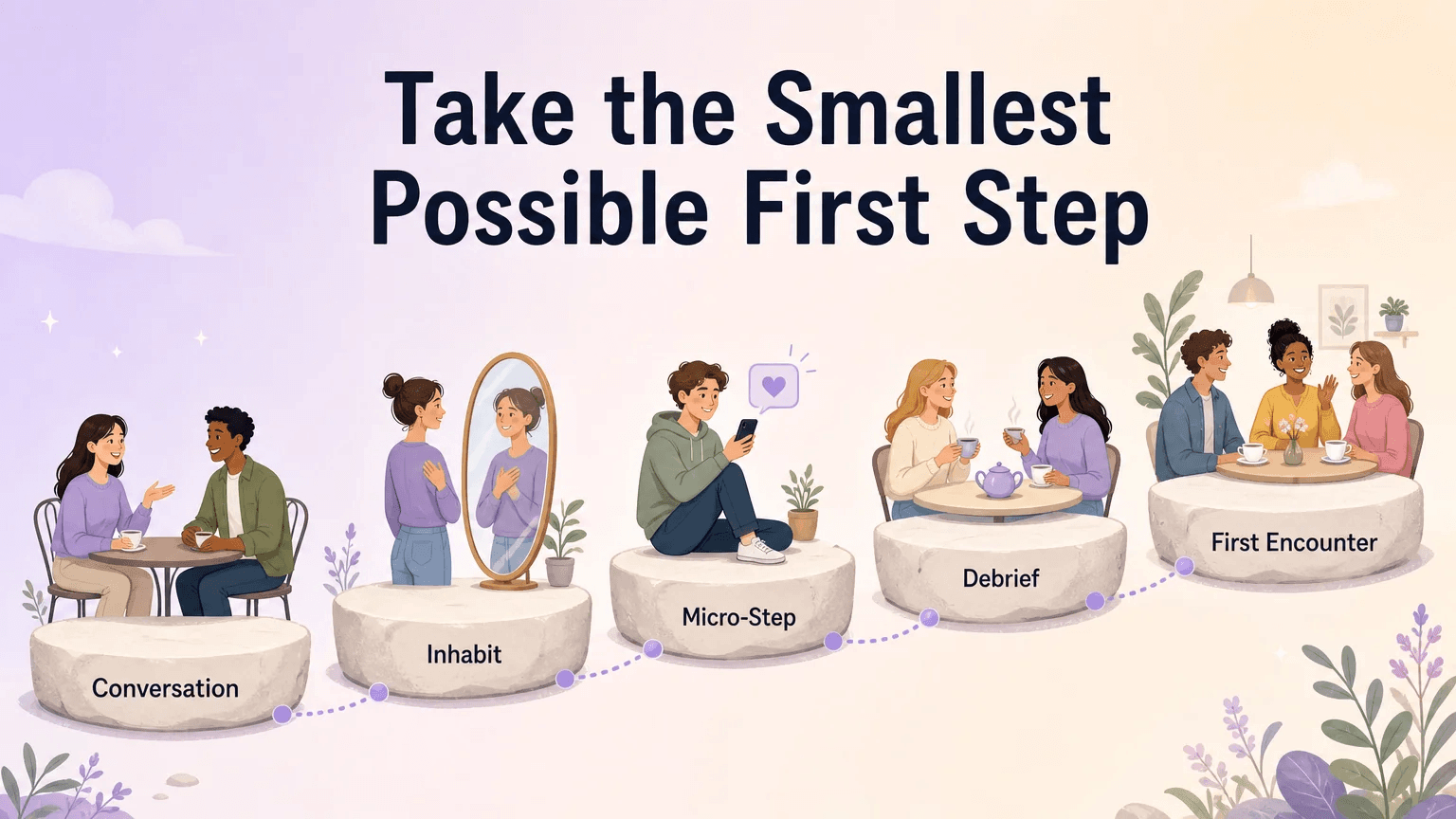
Opening a relationship is a 6- to 12-month journey, not a weekend decision. Successful couples treat it as a gradual process with low-stakes first steps. Rushing from conversation to dating apps is a reliable path to damage.
The Xtra Magazine playbook recommends “inhabiting the decision”: for two weeks after your initial conversations, act as if you are opening without actually dating. Change your app profile status. Tell a trusted friend. Get baseline STI tests. Notice how your body reacts. A tight chest, disrupted sleep, or irritability are not failure signs. They are your nervous system collecting data.
When panic rises at the thought of your partner with someone else, that is not proof the model is wrong. It is your nervous system responding to a perceived threat. Learn to sit with that sensation.
Breathe. Name the feeling. Remind yourself: “My partner is coming back. We have agreements. I am safe.”
Your first step should be almost absurdly small. Message one person on an app with no expectation of meeting. Ask a friend in an open relationship for event recommendations. The goal is exposure, not outcome.
Before any escalation, run the HALT check: Hungry, Angry, Lonely, or Tired? If yes, pause. A regulated nervous system makes better decisions.
Treat each micro-step as an experiment, debrief together, and move forward only when both bodies say yes. Most therapists recommend 6 to 12 months from first conversation to first outside encounter.
Milestone: You have taken one concrete micro-step, whether downloading an app, attending an event, or having a curiosity conversation with experienced friends, and debriefed it together.
Step 8: Navigate Your First Outside Connection as a Team
The first outside encounter is the highest-stakes moment in the entire opening process. What happens before, during, and after determines whether this becomes a bonding experience or a wound.
Before the encounter, agree on communication. Will the partner who is out text when they arrive? When they leave? What is the at-home partner’s plan for their evening? Sitting alone scrolling is a recipe for spiraling. Plan something: a friend, a project, a workout.
Name New Relationship Energy before it arrives. NRE is the dopamine-oxytocin rush of a new connection, intoxicating and temporary. It can pull focus from the primary relationship with a force that feels involuntary. Naming it in advance makes it manageable: “We know this feeling will show up. We will not let it drive.”
The person you are meeting is a guest in your playground. Treat them with the dignity of a guest, not the disposability of a toy. A real story from our research: a woman fell in love with a married couple in a 15-year open marriage. When the husband ended things abruptly during a fight, she described it as devastating: “The depth, care, and respect I brought into this was erased at the end.” The outside person has a nervous system too. They are not a prop.
During the encounter, the at-home partner’s nervous system may activate. This is normal, not a sign the model is failing. Breathe, name the feeling, remind yourself of your agreements. You are safe. Your partner is returning.
Plan the reconnection before the date. Do not ambush the returning partner with an emotional processing session at the door.
Milestone: The first outside encounter is complete and you are in the same room together, grounded, talking.
Step 9: Come Back Together: Reconnection After an Outside Encounter
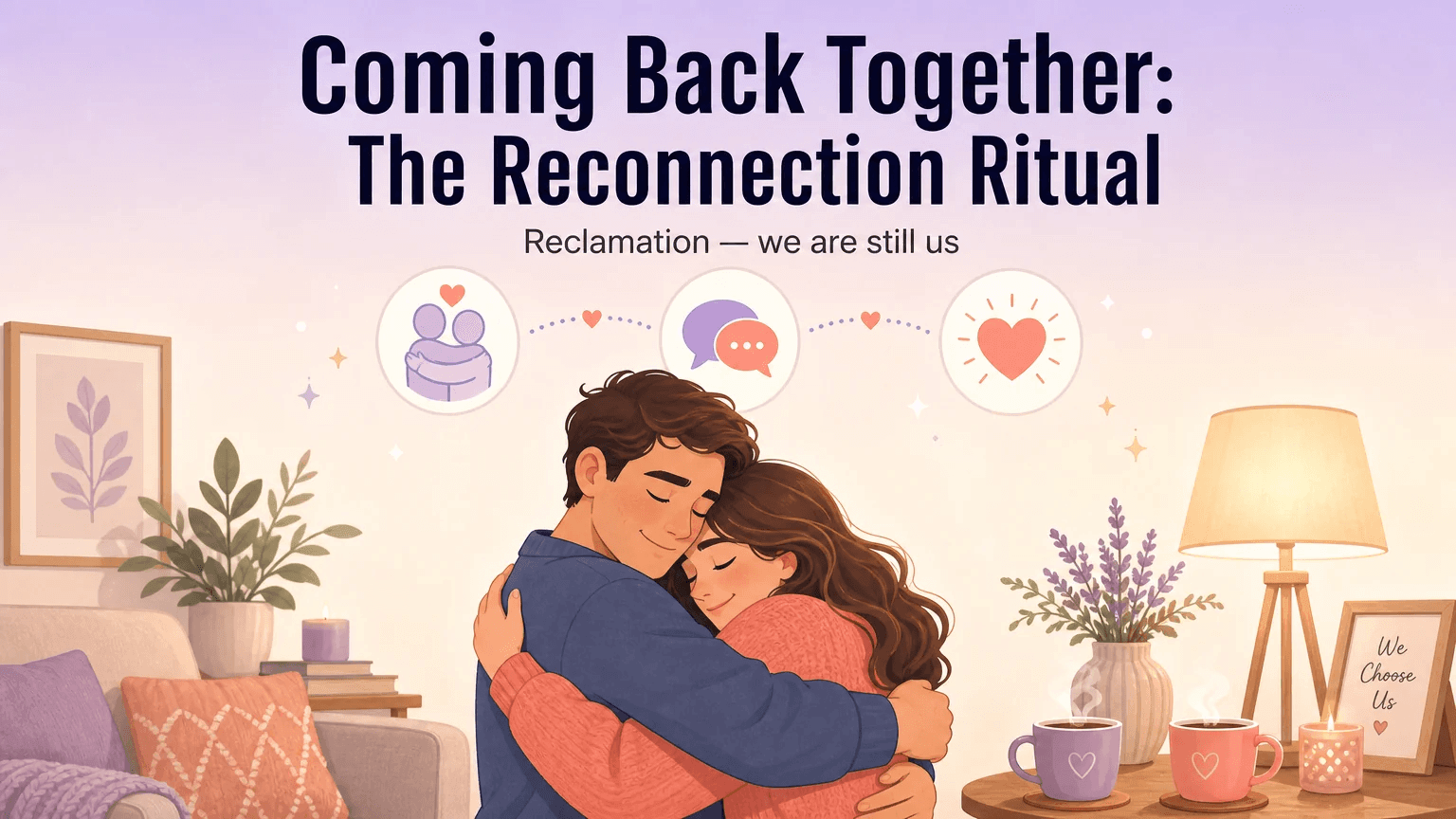
Reconnection is not optional. It is the single most important ritual in an open relationship. Without it, emotional distance accumulates silently until it becomes unbridgeable.
Therapist Tom Bruett, LMFT, calls this “reclamation”: the deliberate ritual that signals to the nervous system “we are still us.” Without it, emotional distance accumulates in the silence where reclamation should have been.
Here is the framework. Ritualize the return: a long hug, a shared meal, a walk, sex. Whatever tells your bodies “we are home.” Then debrief using the “enough to feel connected, not so much that it harms” standard. Disclosure should serve reconnection, not comparison. Re-establish physical intimacy afterward. Skin-to-skin contact co-regulates the nervous system. And the at-home partner should process hard feelings individually before bringing raw emotion to the returning partner. Do not make your partner feel punished for returning.
Nikki and Daniel’s story: “After an outside date, we’d spend the next evening together, no phones, just us. He’d tell me what I needed to hear: ‘You’re still my person. Nothing changes us.'”
Dr. Karla Mayorga, PsyD, reframes jealousy as a “check engine light.” It signals something specific needs attention, not that the relationship model should stop. Distinguish jealousy, the fear of losing what you have, from envy, wanting what someone else has. They live in different rooms and require different responses.
Jealousy typically decreases as couples gain experience and build trust through repeated safe experiences. The first outside encounter is nearly always the hardest. It gets easier not because the feelings vanish, but because you learn they are survivable.
Milestone: You have completed your first full reconnection cycle and both partners feel the partnership held, even if the feelings were intense.
Step 10: Manage the Reality Check When One Partner Gets More Attention
Asymmetry is not a sign one partner is failing at non-monogamy. It is a structural reality of the dating marketplace. In heterosexual couples, women typically receive dramatically more external interest than men. Michelle Cmarik’s husband watched her get ready for dates feeling replaced while she felt rejuvenated. This dynamic is common and survivable if you talk about it directly.
Frame the asymmetry as a numbers game, not a worthiness test. Dating markets have structural biases that have nothing to do with either partner’s desirability. The question is not “why am I getting fewer matches?” but “what am I doing with the time and energy I have?”
For the partner receiving less attention, invest the found time intentionally. Pursue hobbies, strengthen friendships, work toward personal goals. Doom-scrolling and comparing will hollow you out. A single meaningful connection can be worth more than a dozen matches that go nowhere.
For the partner receiving more attention, your job is active reassurance without being asked. Maintain reconnection rituals. Do not let New Relationship Energy from multiple connections crowd out quality time with your primary partner. Initiate check-ins. Say the words: “You are still my person.”
Comparisons between partners are damaging. Each connection is different. Different is not better or worse. Comparison corrodes the partnership from the inside, and the person doing the comparing rarely realizes how much damage it is causing until the distance has already set in.
Milestone: Both partners can discuss the asymmetry without defensiveness, and the partner receiving less attention has a concrete plan for their own fulfillment during the other’s dating time.
Step 11: Build Long-Term Rhythms That Keep Your Partnership Strong
The primary relationship is often the least tended-to in an open dynamic. It does not announce its needs with the urgency of something new. The familiar bond quietly waits, and waiting is not the same as being fine.
Establish a weekly 45-minute check-in. Format: What worked this week? What was hard? What do you need more of from me? Are any agreements feeling outdated? Do this when things are calm so the habit is solid when things are not.
Agreements evolve. Danielle’s 15-year open marriage cycled through swinging, dating while traveling, temporary monogamy after kids, and polyamory-adjacent phases. The structure that worked before children did not work with a newborn. That is not contradiction. It is a relationship that bends.
Practical realities surface. Who knows about your relationship? Friends, family, children? Zoe Grey and her partner Matt, with four children, faced social media backlash for being open while parenting. Disclosure has consequences. Navigate them as a team.
Three essential tools: 3Fun, the dating app for non-monogamous users. Polysecure by Jessica Fern, the attachment-theory book therapists recommend. Expansive Therapy, an ENM-affirming directory.
Danielle Palomares’ warning bears repeating: the primary relationship becomes the least tended-to. The new connection will always feel more compelling. Tend the familiar bond anyway. It holds everything else.
Milestone: You have a recurring check-in on the calendar and a shared understanding that agreements are a living document, not a permanent contract.
Step 12: Repair, Reset, or Close: Handling Crisis Without Losing Each Other
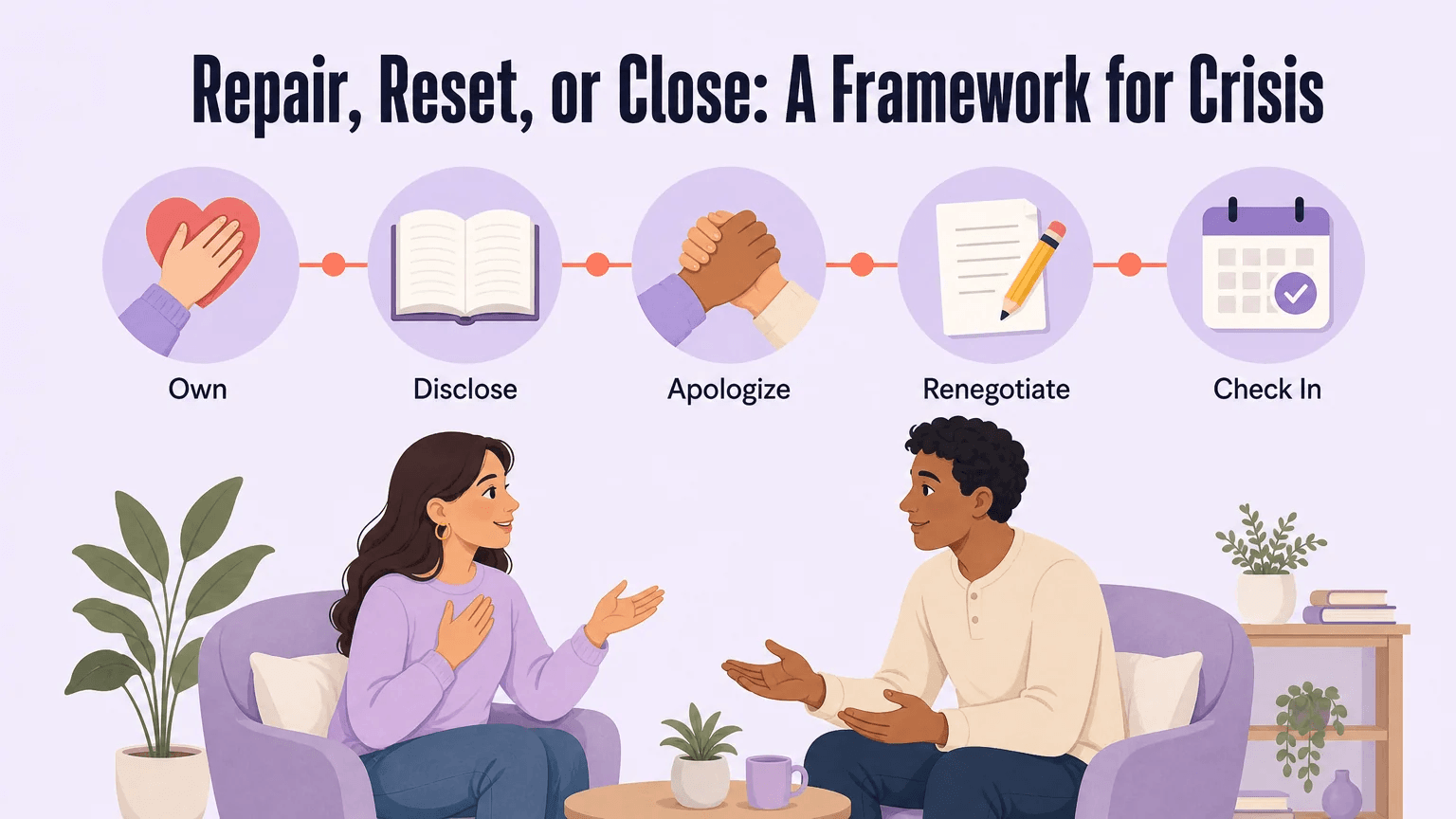
Boundary violations, emotional crises, and the need to close are not signs you failed at non-monogamy. They are part of the territory. A repair framework in place before you need it separates couples who survive from those who do not.
The repair sequence: own the breach fully, without excuses. Disclose what happened transparently. Apologize sincerely and commit to tangible behavior changes. Renegotiate relevant agreements with measurable consequences. Schedule ongoing check-ins to verify the repair is holding.
When trust has been seriously damaged, use the “reset to zero” strategy: temporarily close to monogamy while you rebuild, then renegotiate openness only when both genuinely want to.
If you decide to close permanently, do it intentionally. The hurt partner expresses what it felt like; the other sits with that pain without defensiveness. Create new experiences together to counter the loss of multiple-partner stimulation. Build a new approach to monogamy. You cannot return to how things were, because that version of monogamy led to opening in the first place. Collaborate on what intentional monogamy looks like now.
Closing is not failure. It is a responsible course correction by two people who prioritized their partnership over a structure.
Professional support matters. Emotionally Focused Therapy has a 75% success rate for couples. ENM-affirming therapists, like those in the Expansive Therapy directory, understand your relationship structure without pathologizing it.
Milestone: Both partners know repair is possible, what the steps are, and that closing is not failure. It is a course correction two people make together.
FAQ
Can an open relationship actually strengthen a primary partnership?
Yes, when the foundation is solid. Openness forces communication about jealousy, boundaries, and insecurities that monogamous couples can avoid. Many open couples report deeper connection because they cannot hide behind unspoken assumptions.
What if I have or want kids? Does an open relationship still work?
Yes, with logistical adjustments. Real couples schedule dates only after bedtime, never bring outside partners home, temporarily close during infant and toddler years, and agree on what children are told. The structure evolves across life phases.
What if one partner wants an open relationship and the other does not?
Slow down. Do not pressure and do not agree just to keep the other from leaving. Explore the “why” underneath each position. Exploring fantasies together, without acting on them, can bridge the gap. An ENM-affirming therapist is strongly recommended.
How do you tell if jealousy is normal or a sign the relationship should close?
Jealousy is normal early on. It decreases as couples gain experience and build trust that the relationship survives outside encounters. It becomes a warning sign when it persists at high intensity for months despite active reassurance, or leads to retaliatory behavior.
How long does it take to feel “normal” in an open relationship?
Most therapists suggest 6 to 12 months from first conversation to stable rhythm. The first outside encounter is typically the hardest. Distress stabilizes as couples build coping skills. The structure continues to evolve. That is not a setback. It is a relationship that is alive.