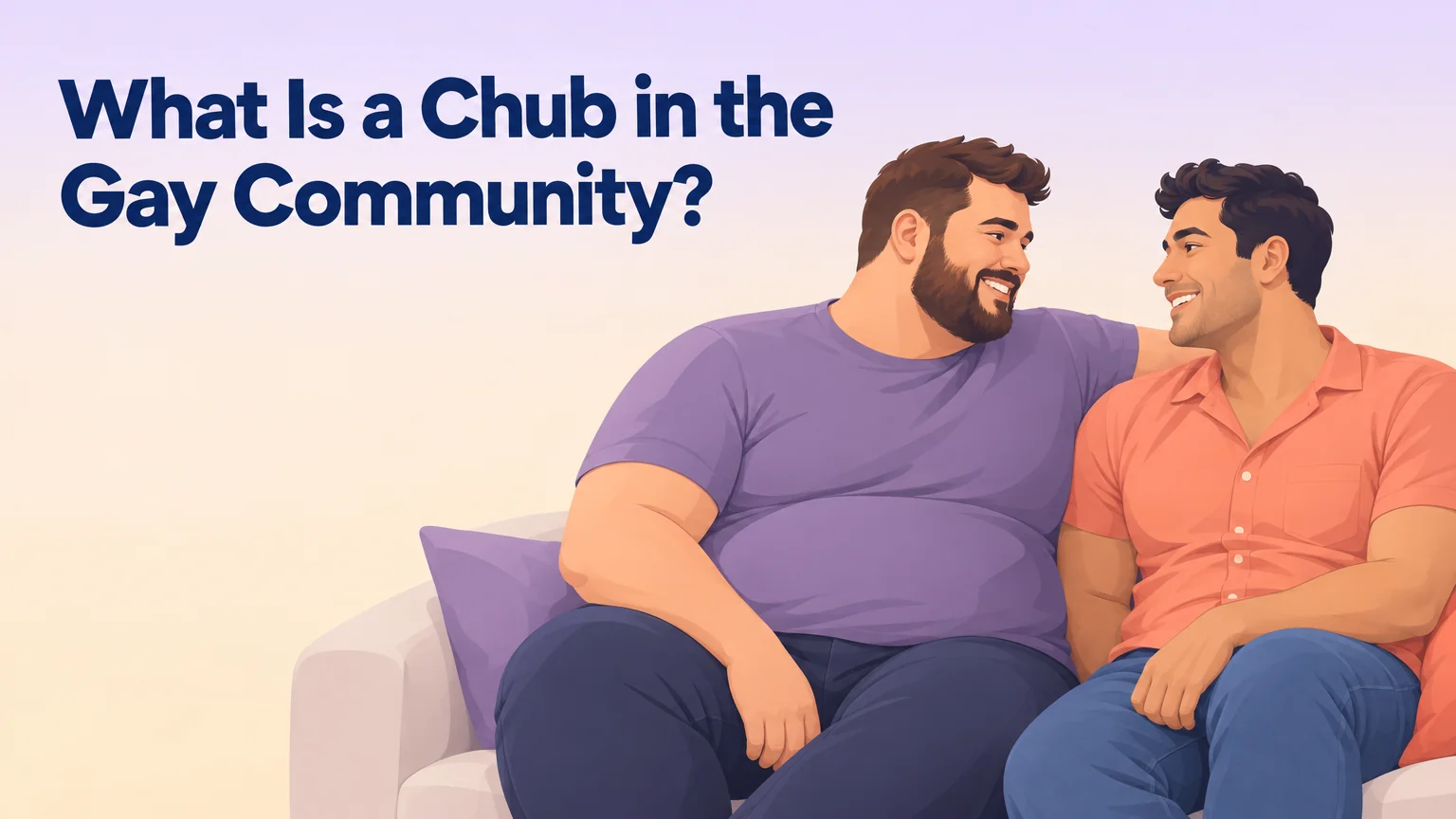
A profile says it. A friend drops it into a group chat. A category on a site quietly sorts you into it. The word is chub, and in the gay community it means something concrete: a chub is a larger or heavier gay man, described by body size and claimed as a community identity.
It works two ways at once. It is a self-description, and it is a label other people apply, sometimes warmly and sometimes not.
You may already wear the word. You may have only just met it. Either way, nobody here is being introduced to their own culture, and nobody is left to guess.
Three questions come up most. What does the word mean? Is it an insult? Where did it come from? The history turns out to be older than most people assume, and it comes in three parts: a word, a movement, and a website. Everything else gets one straight answer per question.
What Does Chub Mean? A Plain Answer
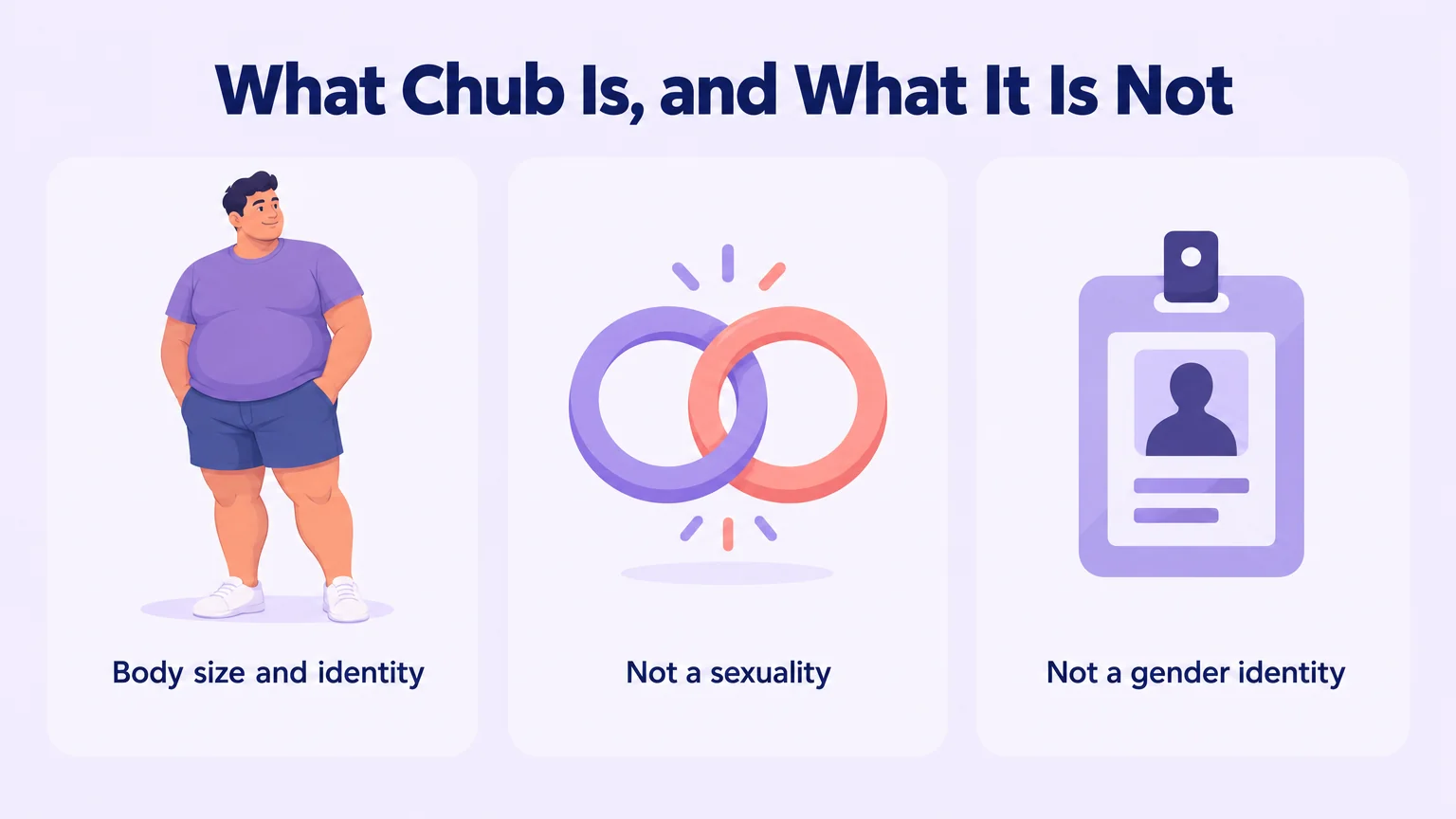
A chub is a larger or heavier gay man, and the word carries a second layer: it names a place in a subculture with its own clubs, events and conventions. Mike Sullivan, co-owner of a Chicago bear bar, puts it in one line, calling a chub “a larger bear” while noting the word is “sometimes used as a pejorative, sometimes as a self-identifier.”
What it is not matters just as much. Chub is not a sexuality, not a gender identity, and not a role in bed. It describes body size and the community that grew up around it. People mix those categories up constantly, so clear it once here.
The compound chub4chub pairs the word with itself and signals a mutual preference for the same big body type. Two men who both carry weight and both want that in a partner. That is the whole of it here.
You will meet the word in a few ordinary places: a dating or hookup profile, a porn category, a group chat, the name of a club night. In a bio it works as both a description and a filter, closer in function to a body-type tag than to anything you would announce on a first date.
One limit applies. The word is used by gay, bisexual and queer men, and the vocabulary around it grew up in men’s spaces, but the community is not a monolith. Not every big man claims the label. Some reject it outright, and the coming sections take that up.
Where Chub Comes From: The 1970s, Not the 1990s
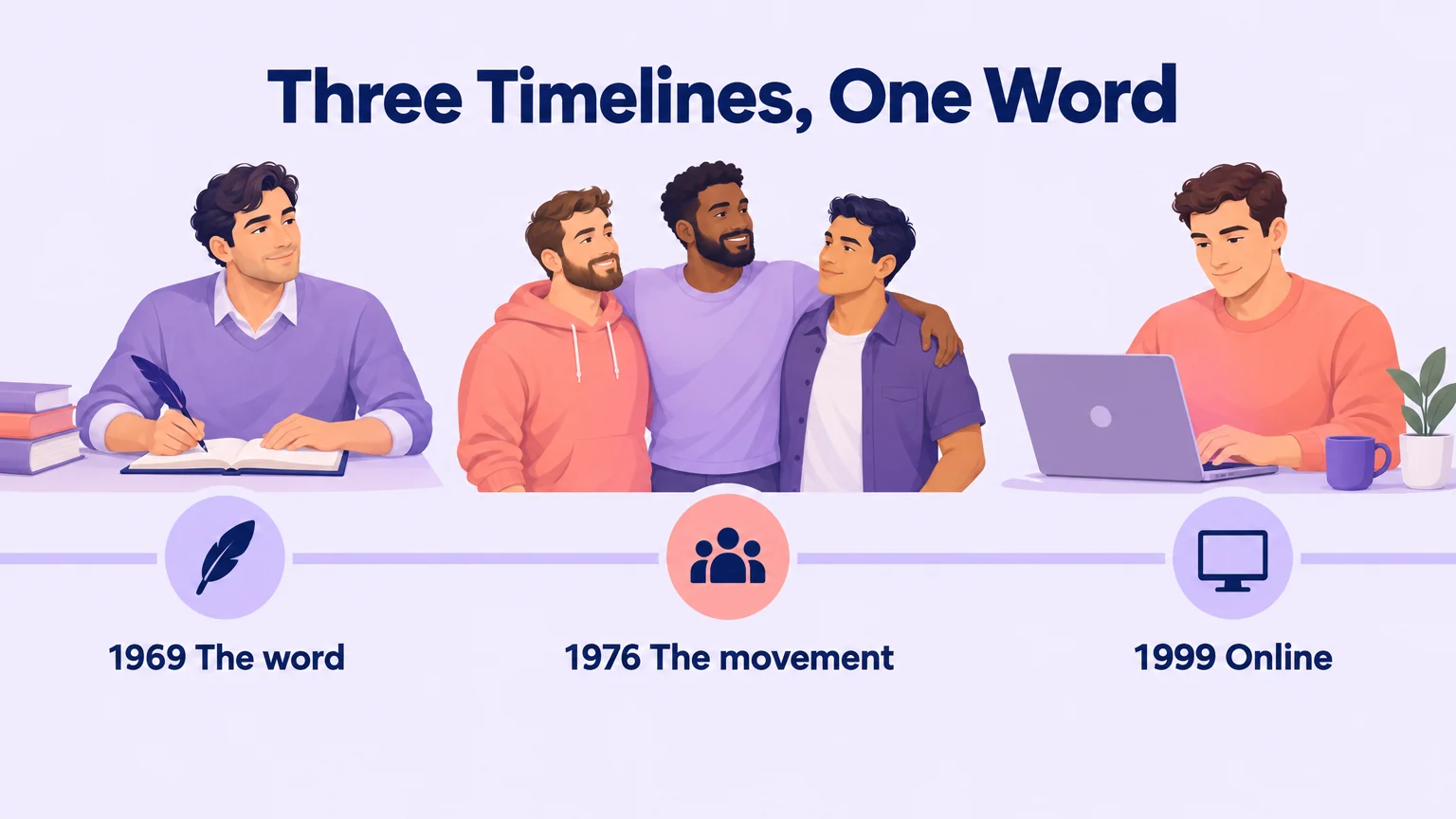
Start with a single artifact. In February 1976, an advertisement headlined “Chubbies and Chasers, Unite!” ran in the Berkeley Barb, placed by a man named Charlie Brown. A dated advertisement settles in one line what pages of argument cannot: the word, and the scene around it, were already alive before anyone wrote them down.
Timeline one: the word, and the informal scene. It is older than any of the organizations. Reed Wilgoren, who co-founded Girth & Mirth, came out into an informal telephone-and-mail network of big men and the men who wanted them in 1969, in major cities before either the organized groups or the bear movement existed. The working vocabulary then was “Chubbies” and “chubby chasers,” not yet chub.
On his first night out he was told that being big “is going to be held against you, coming out in the gay world.” That is his first-hand recollection of the period.
Timeline two: the organized movement. In 1976 the name Girth & Mirth was chosen at the group’s first meeting in San Francisco, and members rode a Girth & Mirth float in the city’s Gay Day parade. The ad came first, the name followed, and the institution followed that.
From San Francisco the next group was New York, in June 1978. Boston’s Girth & Mirth of New England came in 1985 or 1986, not 1977, which is the commonly repeated error. The first Convergence sanctioned by the Affiliated Bigmen’s Club was held in Seattle at the Mayflower Park Hotel from August 28 to September 1, 1986. Smaller, unsanctioned gatherings came before it, which is why an early convention date and a later first official one can both be true.
The club itself was renamed the Big Gay Men’s Organization in 2013, so the letters ABC and BGMO point to the same lineage.
Timeline three: the online era. It is late-1990s, and it is separate. BiggerCity, the long-running chub and chaser site, began on Labor Day 1999 after several years in development.
That last timeline is the one that gets confused with the first. Claims that chub originated in 1990s forums are really describing when the online scene arrived. The word predates the website by decades, and the community predates it by more. Three timelines, one word.
Is Chub an Insult? The Honest Answer
No, not in the way the worst anti-gay epithets are. Chub is not an attack on who someone sleeps with. The harm attached to it is about body size, and the fault line it sits on is fatphobia inside and outside the gay community, not anyone’s orientation.
None of that makes it harmless in the wrong mouth. The word genuinely travels both directions: a proud self-description on one hand, a put-down on the other. What decides it is who is speaking and whether the person described chose the word first. Call a man a chub who calls himself one and you agree with him. Call a man a chub who does not and you are sizing him up without asking.
Why these words feel ordinary rather than loaded: animal identifiers, bear, cub, otter and chub among them, began as a way to push back against the stereotype that all gay men were effeminate. Over time they stopped being private code and became a self-chosen label, part look and part personality. The backlash against them is mild.
The case for the word is that it was built on difference rather than conformity, with room for masc or fem, hairy or smooth, hard or soft. A bear ideal can read as a standard to meet. Chub reads to many as the opposite of a standard.
The counterweight is blunt. Men have been told outright to lose weight before anyone would date them. An early Girth & Mirth member walking in the Castro was called a “fat pig” from a window, turned around, found the man within reach, and asked him to repeat it to his face. Both things belong in the same account.
Chub or Bear? Why the Line Is Genuinely Blurry
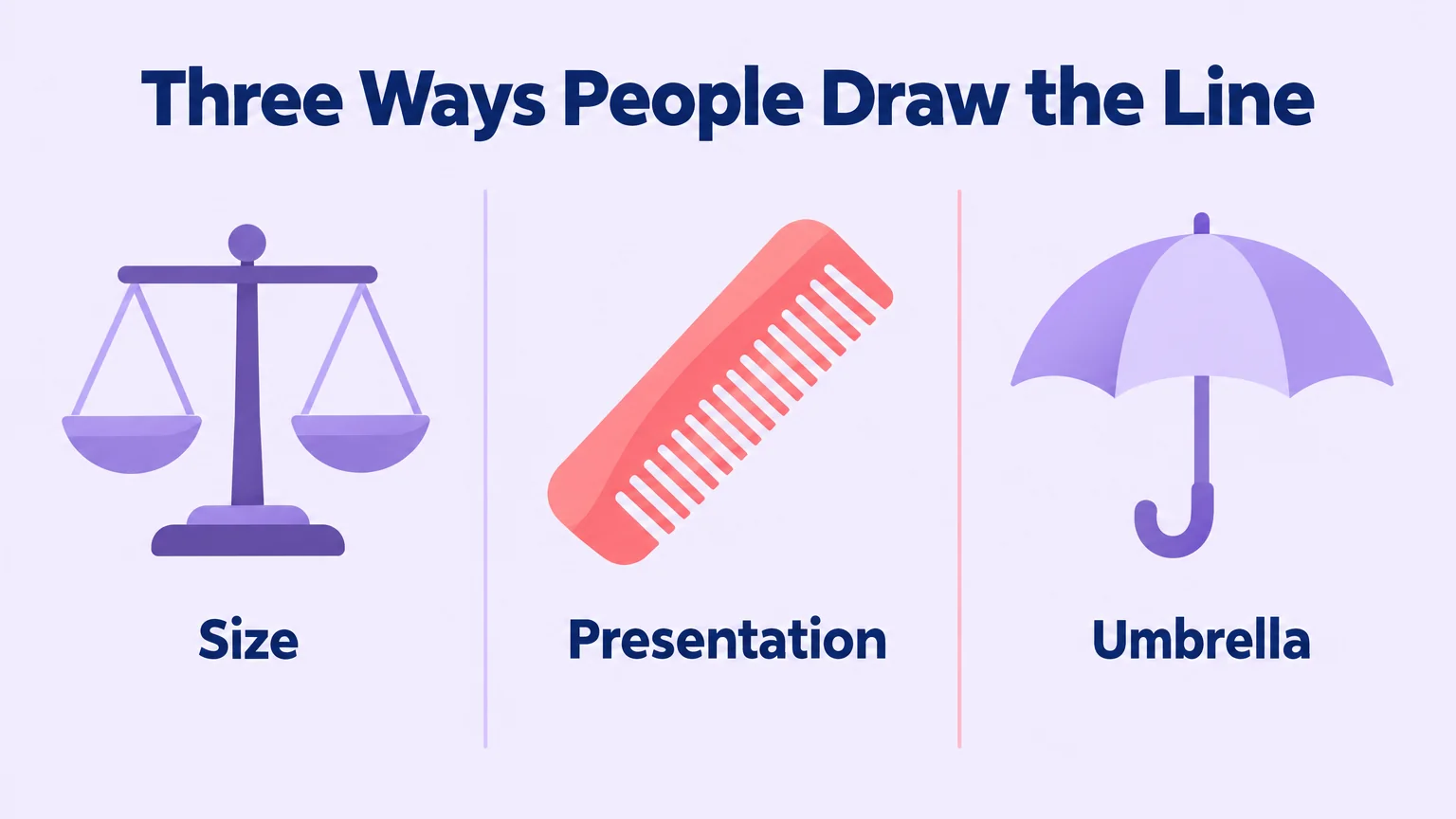
This is the question people get told two different things about, and the reason is simple: the community has not settled it. Men argue about where chub ends and bear begins. Two people can hand you opposite answers and both be repeating something they heard from someone they trust. That is a real disagreement, not a failure to look it up.
Three readings show up most often.
The size reading centers weight. Chub tracks body size, full stop, and a man can be a chub without hair or a rugged look.
The presentation reading centers appearance. Bear tracks a sturdier, hairier, more conventionally masculine look, and size is one ingredient rather than the whole definition.
The umbrella reading treats bear as the wider category that contains chubs, so a man is both at once rather than choosing.
One part of this is not in dispute, and it explains why the argument exists at all. The two scenes are parallel lineages, not one branching off the other. Girth & Mirth came first and helped seed the later bear groups, and chubby culture only intersected the bear scene in the early 1990s. Two traditions that grew up side by side will overlap without ever agreeing on a border.
So the working rule most people reach for is this: size is what chub tracks, presentation is what bear tracks, and plenty of men decline to pick. Use it as a rule of thumb, not a verdict. The surrounding terms get defined in the next two sections.
Bear, Cub, Otter, Twunk, Daddy: The Words Around Chub
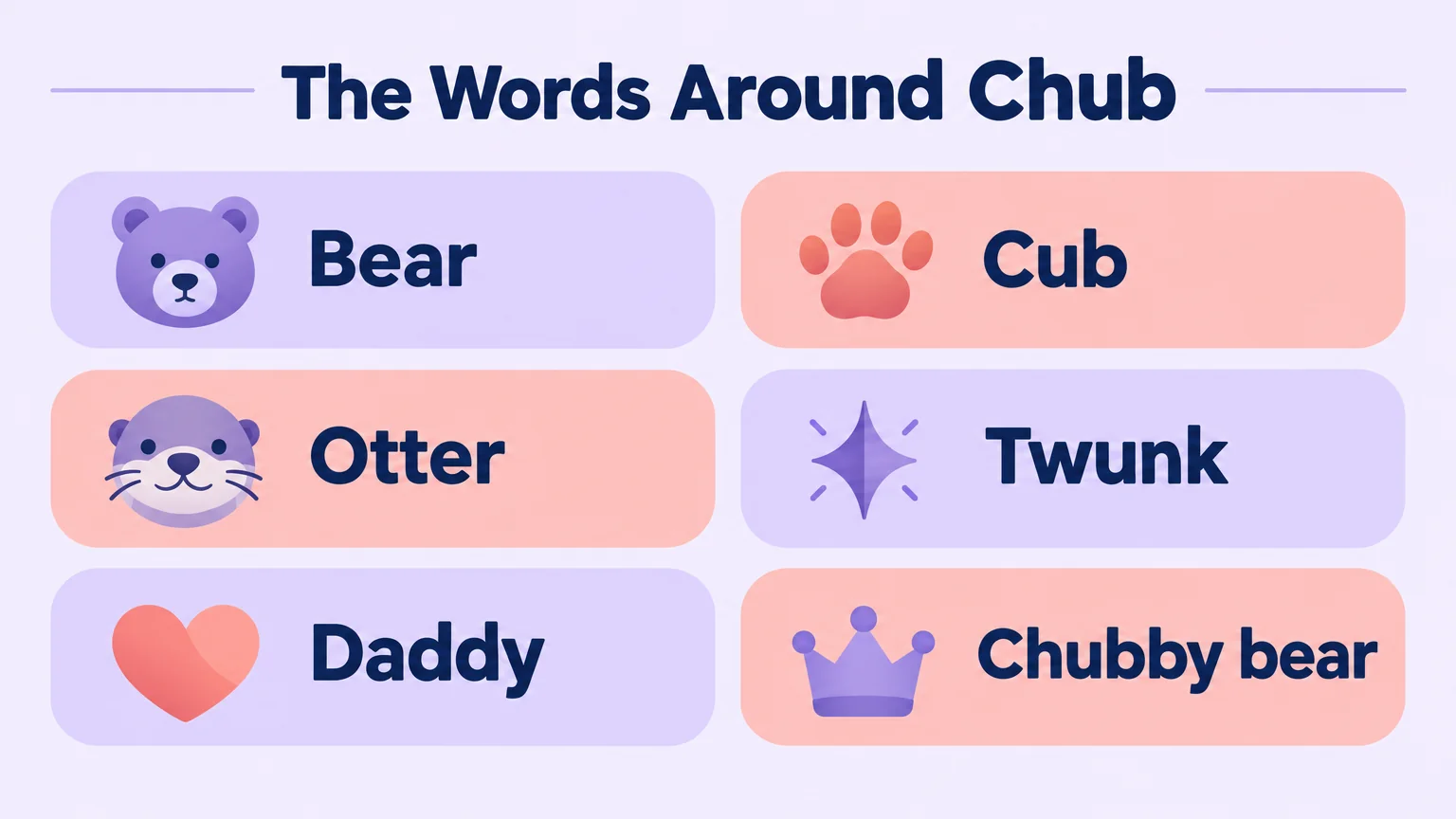
Chub does not sit alone. It belongs to a loose family of body-type words, and knowing the neighbors makes the vocabulary easier to hold. Here are working definitions, not rules.
Bear is the broader sturdier, hairier type, a bigger man with a gut to him and a reputation as a good cuddler.
Cub is the younger version of a bear, usually under 40 with the same traits.
Otter is the leaner, hairier middle ground, between a twink and a bear, close to what people now call a dad bod.
Twunk is a twink with more thickness on him.
Muscle bear is the fit, built version. Polar bear is the gray-haired one.
Daddy is the older, masculine type, hairy or not.
Not all of these terms are firm. Cub gets it worst: definitions circulating online describe it both as a younger bear and as somebody who just likes bears, and one gay creator said plainly he was confused by that. When a term carries two definitions at once, expect people to use it two ways.
There is a telling absence. The body-type words that turn up most in profiles, twink, twunk, bear, otter and daddy, often leave chub off the list. The word sits slightly apart from the vocabulary you are most likely to have run into.
The overlap term is chubby bear, which lets a man claim size and the bear framing at once. Its edge drifts, because bear has widened to take in smaller men, so what counts as a chubby bear keeps moving.
The disputed boundary between chub and bear is its own section, and this one stays on what the words mean.
Gainer, Encourager, Feeder: Words That Are Not Body Types
These words show up next to chub often enough that people read them as the same kind of label. They are not.
A chub is about body size and community identity. Gainer, encourager, feeder and feedee name a desire or a practice, not a shape. Nobody is describing how a person looks. They are describing what a person wants.
The four terms, plainly. A gainer enjoys gaining weight. An encourager, the word more common among gay men, likes helping another person gain.
Feeder and feedee are the terms more common in straight communities, and a feeder may be more directly involved, preparing or supplying food rather than cheering from the side. The useful distinction across all of them is how hands-on each person is.
The scene has its own history, short and separate. It grew out of the Girth & Mirth movement in the 1970s, ran gainer-specific newsletters by 1988, held its first event, EncourageCon, in 1992 in New Hope, Pennsylvania, and saw GainRWeb launch in 1996. Treat that as a related but separate lineage from the same era. Coming out of the same soil does not make it the same plant.
And the line that keeps the two vocabularies apart: being a chub says nothing about wanting to gain, and being part of the gaining scene does not make someone a chub. The overlap is people, not categories.
What Is a Chaser? And the Word’s Other Meaning
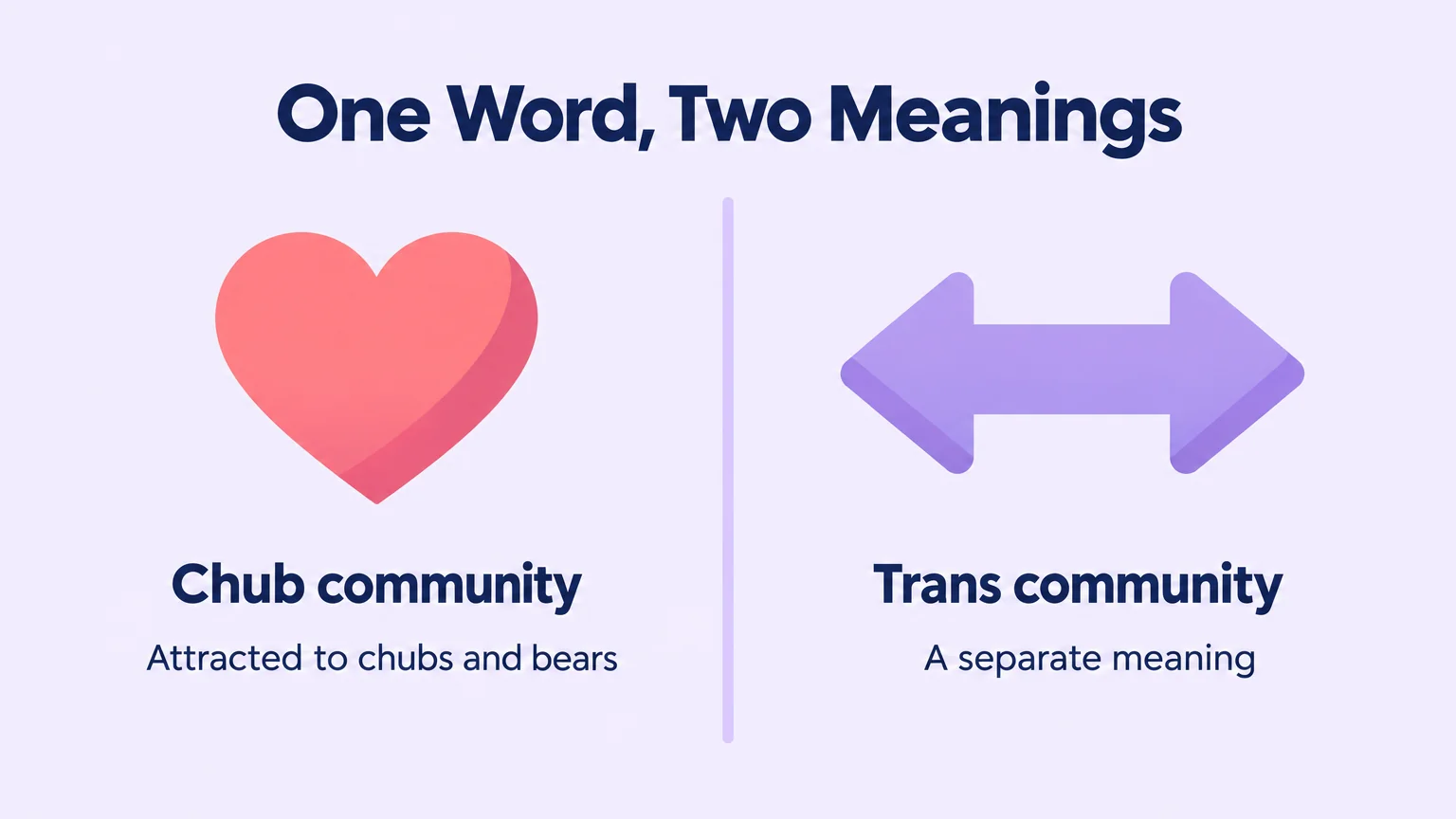
In this scene, a chaser, also called a chubby chaser or an admirer, is someone attracted to chubs or bears, typically of a smaller build. The word names the counterpart role in chub dating and at chub events, the person across the table from the chub. If a profile pairs chaser with chub, that is the pairing being advertised.
The same word also carries a completely different meaning elsewhere. In the trans community, a chaser is someone who fetishizes trans women, and that use carries its own heavy freight. The two meanings share a spelling and nothing more. Carry the wrong one across the line between contexts and you will badly misread a room.
There is a live argument here, and it is better reported than settled. The recurring charge against chasers is that the attraction is a fetish and not real appreciation, and that some are focused on size alone. Critics say it plainly. Chasers answer that the appeal runs to softness, warmth, touch and a size dynamic, that it is a genuine attraction like any other, and that the fetish charge is a way of dismissing them.
The worry cuts both ways, which is why the debate keeps returning. Chubs ask whether a chaser stays if the weight goes: if we have been dating and I lose weight, are we done? Chasers answer that they stay as long as the dynamic holds. One chaser who powerlifts put it flatly: no, we are not done if you lose weight. Others have said the same.
Chasers carry a stigma of their own, dismissed for the attraction and assumed to be fetishizing. Whether that reputation is fair is exactly what people disagree about, and it stays unsettled.
Why Big Men Still Meet Judgment Inside Gay Spaces

The evidence here comes from the largest study of the UK’s bear community, run at the University of Brighton by Dr Nick McGlynn. Published in 2022, it found that fat gay, bisexual and queer men often feel uncomfortable in mainstream LGBTQ+ spaces, because of anti-fat abuse and self-consciousness, and feel comfortable and attractive in bear spaces. That contrast is the headline.
The Bearspace project ran from 2018 to 2021, using focus groups, interviews and autoethnography, and its findings appeared alongside an article in the journal Gender, Place and Culture. That is a pattern documented over three years, not a single bad night out.
The second half of the finding is what makes it trustworthy. Fat stigma persists inside bear spaces too. A body hierarchy runs through them in which muscle bears are often felt to look down on fatter men, and there is even prejudice about having the right and the wrong kind of beard. McGlynn’s own framing is this: these spaces can be really valuable for fat guys while not being completely free from fat stigma. Body-positive intentions are not enough, he adds, if big men are not actually in the room.
The lived version of that is familiar. A man told he needed to lose weight before anyone would date him. A double standard where some openly big men complain that fitter men ignore them while never dating another big man. A dating coach’s observation that many bigger men do not miss attraction so much as dismiss it, because they do not believe they are worthy of it.
Jason Whitesel’s Fat Gay Men: Girth, Mirth, and the Politics of Stigma makes a related argument, that fat gay men carry a double stigma, judged for their bodies by the wider culture and again from inside gay life. The book’s thesis stands on its own.
None of this is a reason to expect less of a community. It is the reason the spaces exist.
Chub Life Today: Events, Apps, and How the Word Is Used
The scene is not a historical curiosity. It runs on dated, checkable events. Cannonball Bash, billed as a body-positive bear, chub and chaser weekend, ran October 29 to November 3, 2025, at the Westin Fort Lauderdale, with eight themed pool parties and a Club Chub dance night at The Eagle Wilton Manors, day passes from $60. Club Chub also runs as a recurring night in Los Angeles.
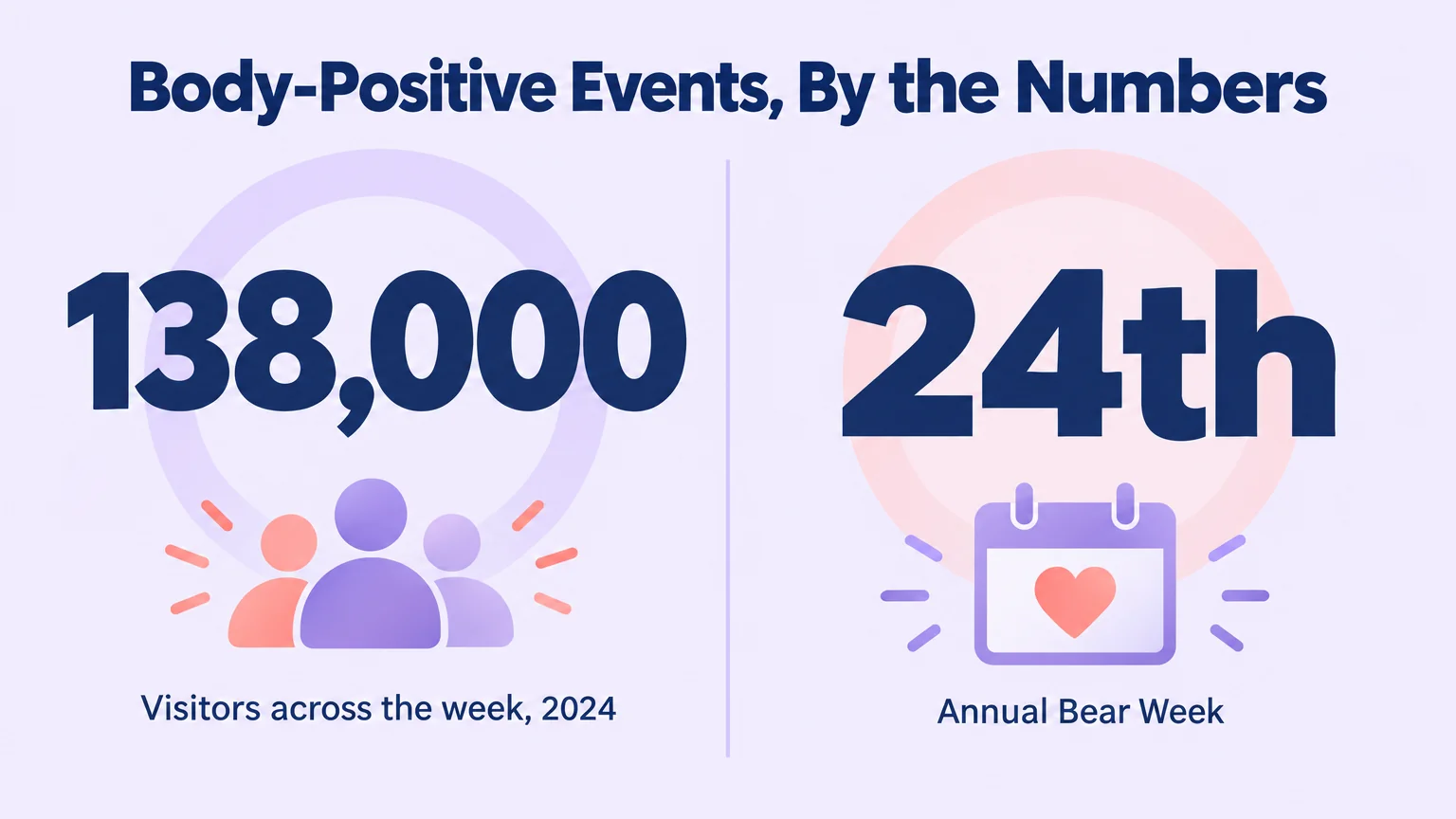
Provincetown’s 24th annual Bear Week drew nearly 138,000 visitors across the week in 2024, according to the Provincetown Office of Tourism. Robert Valin, founder of The Urban Bear, told the Boston Globe what draws people: “So much of the gay community is about body fascism, it’s the opposite here. You’re celebrated no matter what shape, size, or color you are.” The performer Big Dipper gave the reason behind such gatherings: to offer people who are not traditionally accepted by the beauty standard a place to be celebrated. It can also just be a week of fun. “It can be both things,” he said.
Online, the word works as a tag. Profiles pair chub with chaser, chub4chub, gainer and chubbybear, and the same pairings turn up in posts from many countries. The pairings signal interest fast and narrow the field. Some men who tag chub4chub call it a trap rather than a shortcut: when everyone in the field wants the same thing, it narrows further.
The long-running home for this is BiggerCity, a chub and chaser platform running since Labor Day 1999 with personals, media and an annual chub and chaser contest, adding membership tiers and an instant messenger in 2005. The same profiles live on the larger apps too, 3Fun among them.
One thing stays open. Whether Convergence still runs is not clear. The record stops short of the present and contradicts itself on the last edition, so treat its status as unconfirmed rather than assume it ended. A scene this durable is usually still going somewhere.
Chub: Frequently Asked Questions
What is a chub?
A chub is a larger or heavier gay man, and the word doubles as a self-identifier inside a subculture with its own clubs, events and conventions. It describes body size and community identity, not a sexuality, a gender identity or a role in bed.
Is chub a slur?
No, not in the way the worst anti-gay epithets are. It is used both as a proud self-description and as a put-down, and the harm attached to it is about body size, not sexuality. Whether it lands as an insult depends on who is speaking.
What is the difference between a chub and a bear?
Chub tracks weight and body size; bear tracks a sturdier, hairier, more conventionally masculine presentation. They overlap heavily, and they are separate lineages rather than one being an offshoot of the other. The boundary is argued about rather than settled.
What is a chaser?
A chaser, or chubby chaser, is someone attracted to chubs or bears, usually of a smaller build, and the word names the counterpart role in chub dating. It also means something unrelated in the trans community, where it names someone who fetishizes trans women.
Where does the word come from, the 1970s or the 1990s?
The 1970s. The vocabulary was already in use by 1969, and the organized scene dates to a 1976 advertisement that founded Girth & Mirth in San Francisco. BiggerCity, the big chub-focused dating site, did not launch until Labor Day in 1999. The word long predates the site.
Is a chaser just fetishizing bigger men?
Opinions differ sharply and the question is unresolved. Some chasers anchor the attraction in warmth, touch or a size dynamic, and say they would stay if a partner lost weight. Critics call it a fetish rather than appreciation. Both readings are held by people in the scene.
What is a gainer or a feeder, and how is that different from being a chub?
Chub is a body and identity label. Gainer, encourager, feeder and feedee belong to a related but separate gaining scene that grew out of the Girth & Mirth movement in the 1970s. Being a chub says nothing about wanting to gain.