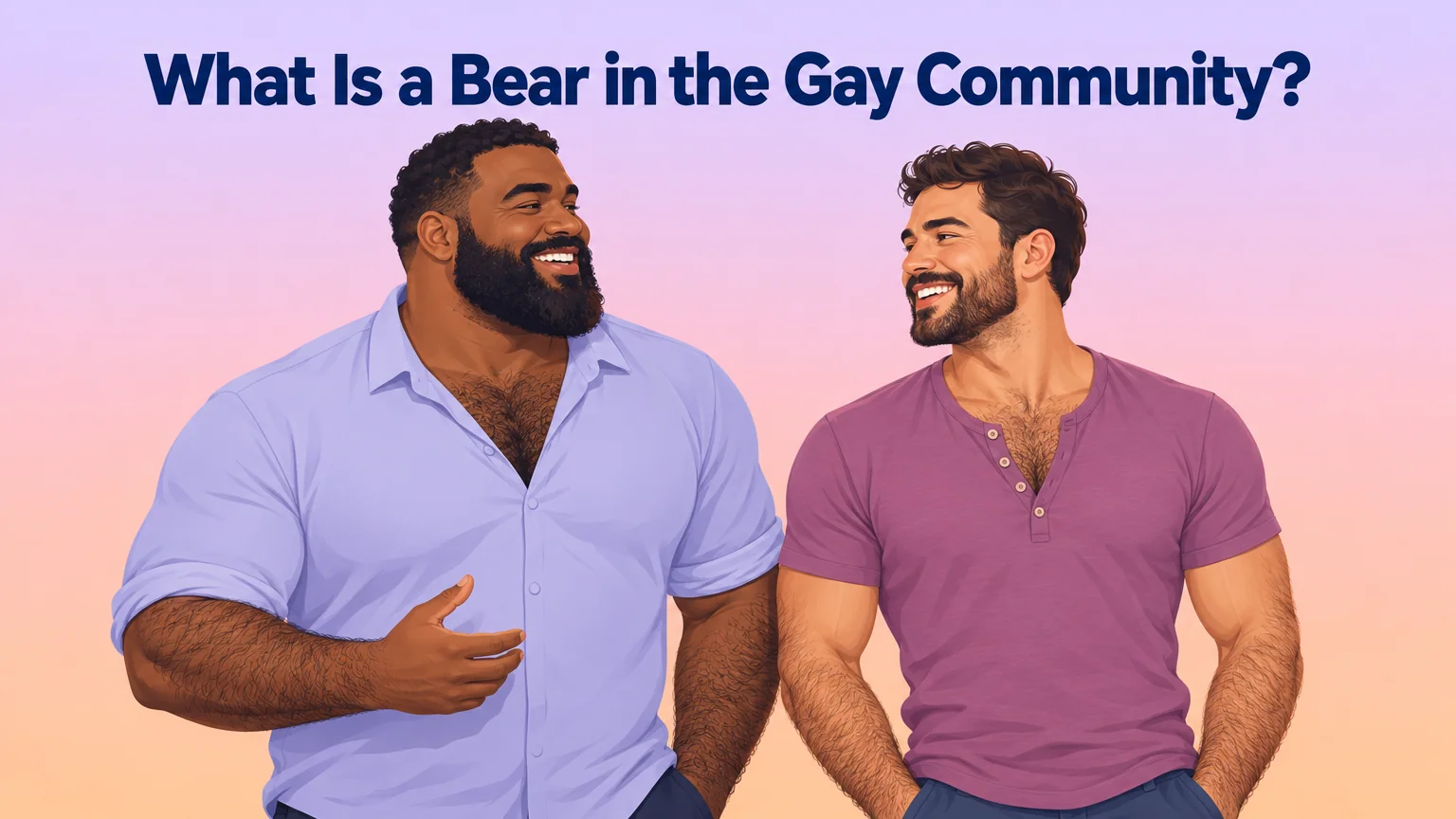
A man leans over at a bar and calls you a bear. You laugh, because you cannot tell whether it was a compliment, a category, or a door closing quietly behind you. Maybe the word reached you before you had a chance to decide whether it fit.
So here is the short answer. What is a bear in the gay community comes down to this: a bear is a gay or bisexual man who is often bigger-built, hairy or bearded, and masculine in presentation. The community’s own definition is wider than the look. The historian Les K. Wright, who has spent decades documenting the culture, calls a bear simply “a gay man who is comfortable being a man as he is being gay, and who has a good heart.”
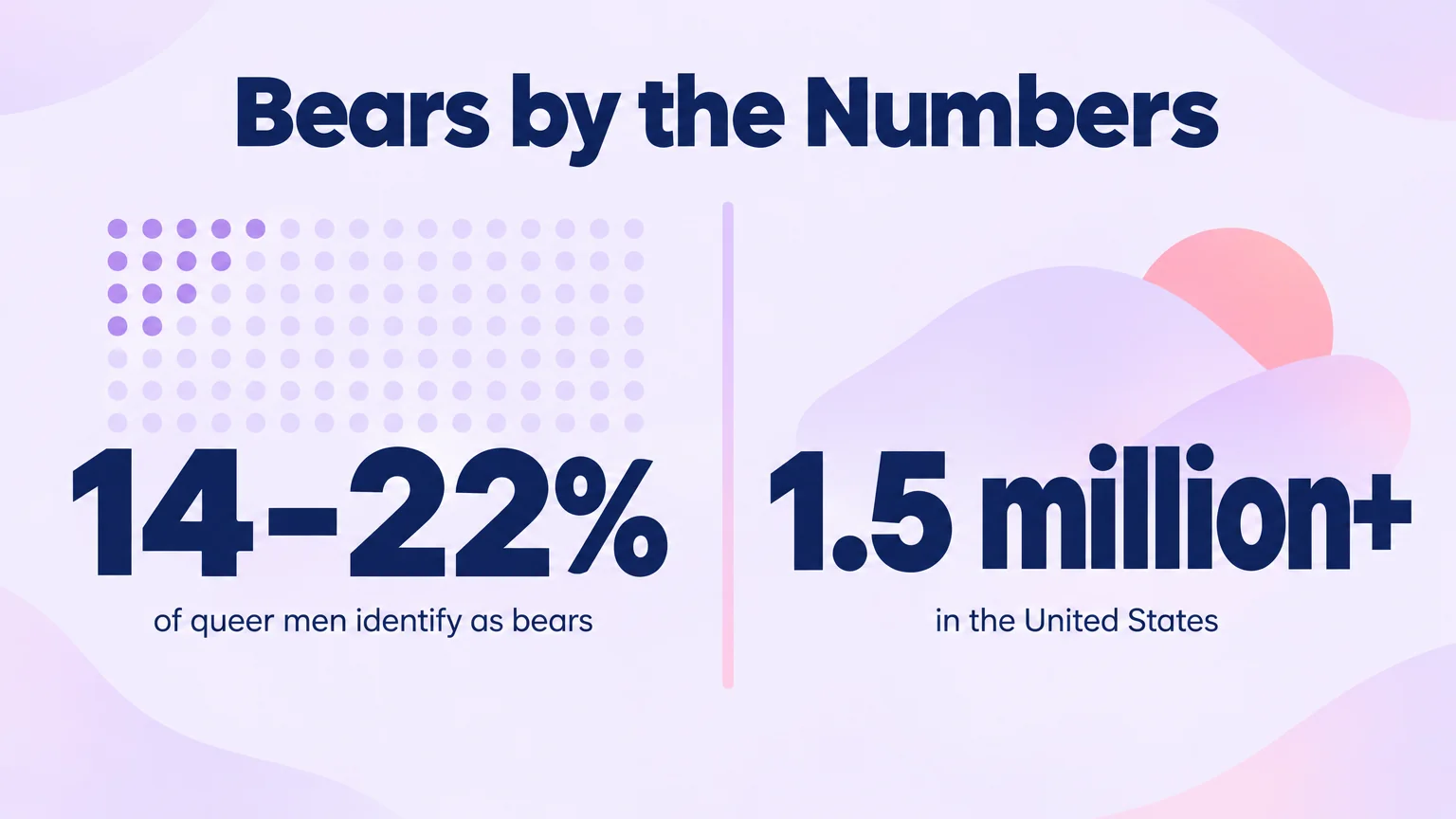
That is not a small tribe, either. Bears are estimated at 14 to 22 percent of the queer male population, more than 1.5 million men in the United States alone.
The word has a stranger history than the stereotype suggests, and the community is still arguing over who it covers.
Bear Meaning: What the Term Actually Describes
The man people picture when they say bear is broad through the chest and carries some weight, and does not appear to be at war with either. Hair shows at his collar and his wrists. That picture is specific, and it traces almost line for line to the article that put the term in print.
George Mazzei wrote “Who’s Who at the Zoo” for The Advocate on July 26, 1979. He described bears as “hunky, chunky types reminiscent of railroad engineers and former football greats,” with “larger chests and bellies than average, and notably muscular legs.”
Then the man who named the type widened his own definition. Mazzei insisted that “it’s attitude that makes the Bear,” and he wrote that some bears are “leaner and smaller.” Hair became the community’s strongest aesthetic marker, but it was never a gate. A bear put it well in Portland’s Just Out newspaper in 2000: a bear “is an individual who is either hairy or not hairy, as long as he appreciates the hairy aspect of the person he likes.”
So the term describes a body, and then it describes something a body cannot settle on its own. Wright offers the test the community runs on. “There is no ultimate authority,” he told a Georgia newspaper in 2011. “You’re a bear if a group of self-identifying bears include you, or if they take your ticket at the gate.”
This is where the bear meaning gets slippery for a newcomer, and where it also gets generous. The word covers the bearded regular down the bar and the soft-spoken bear who keeps his face bare.
That recognition is what Andre Smith reached for in a 2022 interview, asked what a bear is. He named Baloo, the bear in The Jungle Book, “friendly, loving, and chose to push the barriers of the norm with a carefree mindset about society’s view of him.” You do not measure your way into the label. You are offered it, and you decide whether to pick it up.
Where the Word Bear Came From
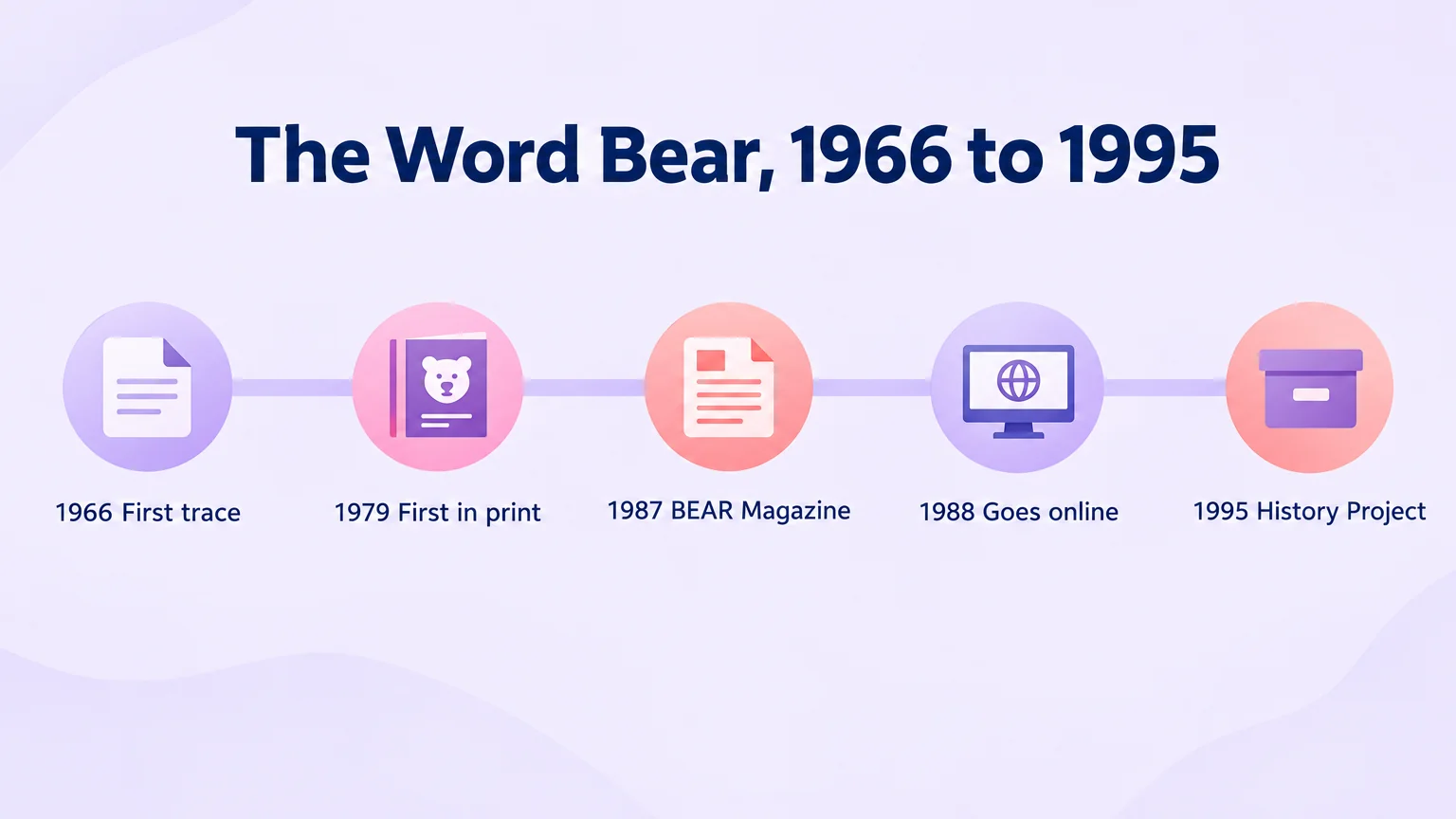
The oldest trace of the word surprises most people who use it. In 1966, the meeting minutes of a Los Angeles club called the Satyrs record the formation of a “bear club” within their own ranks. Wright traced that line, and it is the earliest documented written use of the term. The Satyrs then were a dance and social club, not the motorcycle club that later borrowed the name. The group they spun off is believed to have been the Koalas, whose newsletter was called Bear Facts.
The word reached print thirteen years later, when The Advocate published Mazzei’s “Who’s Who at the Zoo” on July 26, 1979, illustrated by Gerard Donelan.
Who owns that moment is still argued. The Advocate’s own retrospective ran under the headline “When The Advocate Invented Bears,” and the magazine conceded there was some discussion about who coined the term, with a rival claim crediting Richard Bulger of BEAR Magazine. The neatest way to put it: The Advocate invented bears “in the same way that Newsweek invented bisexuality.” It named something already alive.
From there the record is dated. Jack Fritscher, founding editor of San Francisco’s California Action Guide, became the first editor to put the gay sense of the word on a magazine cover, in November 1982, describing what bears celebrate as male “secondary sexual characteristics: facial hair, body hair, proportional size, baldness.” BEAR Magazine followed in 1987, founded by Bulger and Chris Nelson, its first issue 45 photocopied copies promoted in two zines of the era.
In 1988, Steve Dyer and Brian Gollum started the Bear Mailing List, which carried the identity onto the early internet. The vocabulary has a name of its own, bearspeak, and once ran on a coded system of letters and numbers in personal ads, noted at the time for “no negative traits.”
In 1995, Wright founded the Bear History Project, whose records now sit at Cornell University Library. When the project published The Bear Book, the Library of Congress added “bear” as a subject category. If you want the sources rather than the summary, that archive, The Bear Book, Mazzei’s article and the BEAR Magazine scans on the Internet Archive are all open to you.
Why the Bear Community Exists at All
Here is the part a definition cannot carry. The bear community did not form because a group of men liked the same look. It formed because those men were shut out, twice, and eventually built their own rooms.
Wright lays out the sequence. As AIDS made thinness read as sickness, heavier bodies became eroticized and the slender ideal collapsed. “The AIDS epidemic was raging,” he told Bear World Magazine. “Heavier bodies became eroticized, replacing the slender clone ideal.” Fear ran through the bars, and some men reasoned that gaining weight might read as health rather than risk.
But bearish men had already been excluded, and closing the doors did not change that. “Bearish men had typically been banned from bathhouses and sex clubs,” he said. “When the bathhouses were shut down, private sex groups formed, and these men continued to exclude bearish men.”
So bears stopped waiting for an invitation. They made their own rooms: private gatherings like Abrazo de Oso, or Bear Hug, plus Bulger’s BEAR magazine, which ran contact ads and nudes outside the young-and-thin canon.
The detail that carries the idea is the teddy bear. In the 1970s and 1980s, some bears tucked a little teddy into a back pocket instead of a colored hanky. The hanky code was a language of appetite, a map of what you would do and where. The teddy said something the code had no slot for: that he wanted kissing and holding and time, not a fast, anonymous exchange.
The scholar Rusty Barrett documents the practice in “The Class Menagerie.” A quiet rebellion, and it tells you what this community was protecting.
The Lone Star Saloon opened in San Francisco in 1989 and is generally credited as the first bear bar. A curator at the Stonewall National Museum and Archive, explaining why the community formed at all, put it plainly: “They weren’t twinks. They weren’t pretty. They didn’t spend all day at the gym.” The men mainstream gay life did not look at said, “We don’t care. You can come fat. You can come without doing manscaping.” A refuge built on purpose, for men who were told they had not earned the room.
Every Kind of Bear, in One Table
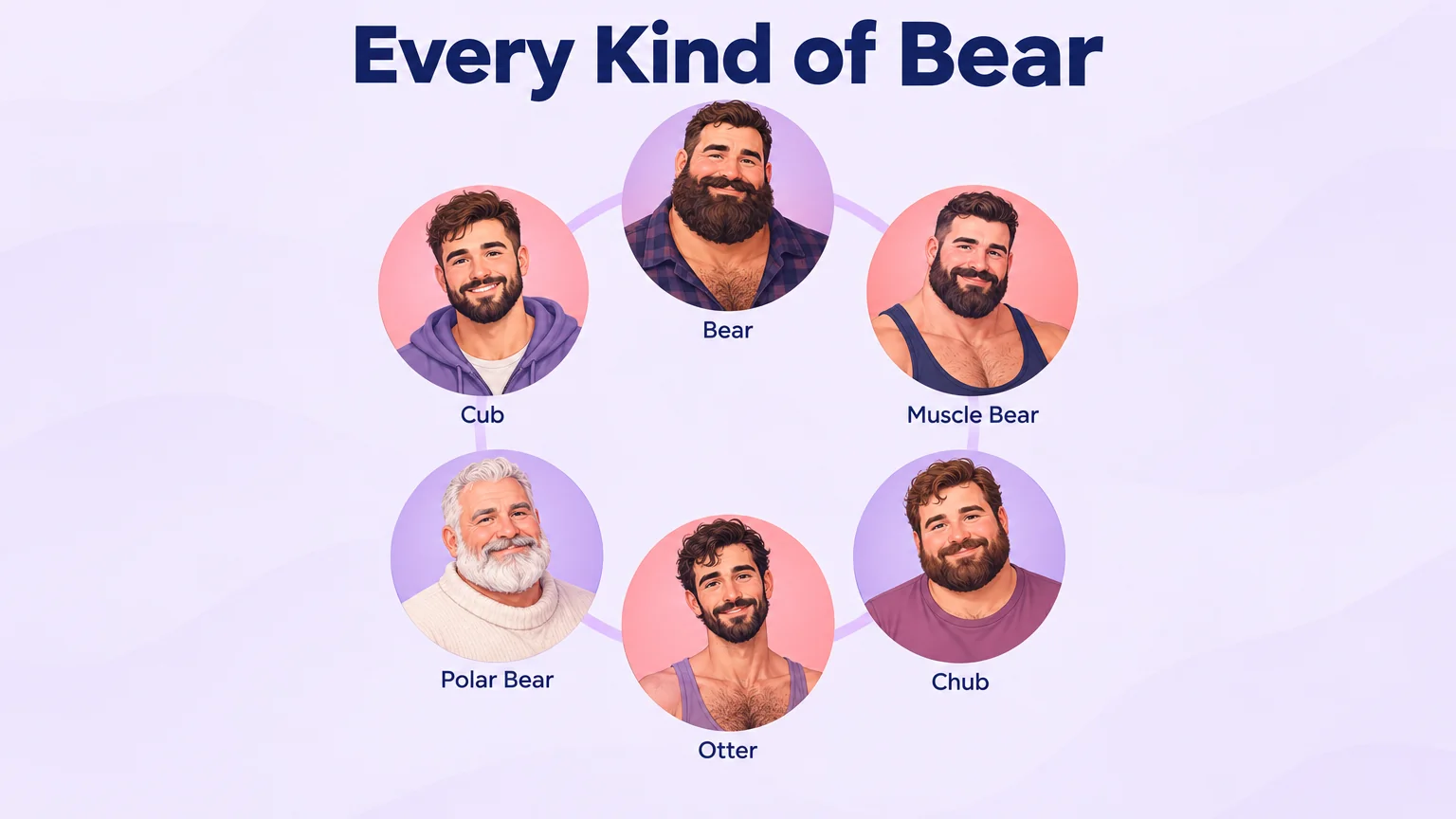
The bear family has grown a full vocabulary, and it is easier to keep straight once you see it side by side. The third column matters most: who is allowed to use the word.
| Label | What it means | Who gets to use it |
|---|---|---|
| Bear | The umbrella term every other label modifies: often bigger-built, hairy, bearded, masculine-presenting | Self-apply |
| Cub | A younger or younger-looking bear, sometimes smaller-framed | Self-apply |
| Muscle bear | A bear who is also substantially muscular | Self-apply |
| Polar bear | An older bear whose hair is mostly or entirely white or grey | Self-apply |
| Otter | Leaner or smaller but still notably hairy, between a twink and a bear | Self-apply |
| Chub | Defined by size rather than hair or temperament | Self-apply; reclaimed |
| Superchub, chubby bear | The escalated size terms, for a particularly large man | Self-apply |
| Wolf | Lean, muscular and groomed, hairy without a bear’s bulk | Self-apply |
| Panda bear | A bear of Asian or Pacific Islander descent; a panda cub is the younger version | In-group only; not for outsiders to apply to others |
| Ursula, lesbear | The sapphic equivalent, from a feminized form of “ursine” | Self-description |
| Daddy | A relational and age role rather than a body type | A role, not a body type |
| Chaser | Someone attracted to bears without identifying as one | A role, not a body type |
| Big Boy, Black Bear, Brown Bear, Oso, Grizzly | Race, region and size terms, the most contested of the set | Belongs to the people it describes |
| Trans bear | A hairy, heavy-set trans man | Self-description |
The ownership column matters more than the definition column: handing someone a label is a different act from taking one for yourself. Panda bear is the clearest case, a self-description that belongs to the men it names. The longer tail is the loose end. Terms like Black Bear, Big Boy and Oso are regional and genuinely disputed, so treat a word you hear from one man as his, not as settled vocabulary.
Most of these words were made to be claimed in public, whether that is a bar, a club, or a line on a dating profile. 3Fun is a dating app where that line is yours to write.
Bear, Cub, or Chub: The Lines Newcomers Get Wrong
Three boundaries trip up almost everyone at first.
Bear versus cub is about age and youth, not size or hair. A cub is a younger or younger-looking bear, sometimes smaller-framed. There is no official threshold, and the numbers do not agree: community ranges put a cub under 30, under 35, or loosely under 40.
Cub can signal a youthful way of moving through the world more than a number on a birth certificate, and men tend to drift from cub to bear over years rather than wake up one birthday transformed. If you are 24, hairy and big, and the rest of the term fits, then you are the exact man cub exists for. No authority is standing by to enforce the line.
Bear versus chub is about hair and weight. A bear is defined by appearance and temperament: hair, masculinity, a stocky build, an easy-going manner. A chub is defined by size, with no requirement of hair or demeanor. Most bears also call themselves chubs, but not every chub calls himself a bear, which makes chub the broader, size-first identity.
Chub is a community in its own right. Girth & Mirth, the first organized chub social group, was founded in San Francisco in 1976, and the first Convergence gathering was held in Seattle in 1986. “Chubby bear” bridges the two and blurs the line further.
Bear versus otter, briefly: an otter is leaner but still hairy, between a twink and a bear, and some men treat otter as a bear sub-variant. The definitions loosen in daily use. An otter is often described as “in between thick and skinny” and, in the same breath, “very hairy.”
And if the question is what to call a bear-shaped man without body hair, the community word is dolphin, an otter without the fur. A heavier hairless man is more likely to be called a chub or a chubby bear, and there is no dedicated word for a bear who simply shaved. All of these are self-claimed. None are assigned.
What You Can Call Yourself, and What Is Not Yours to Say
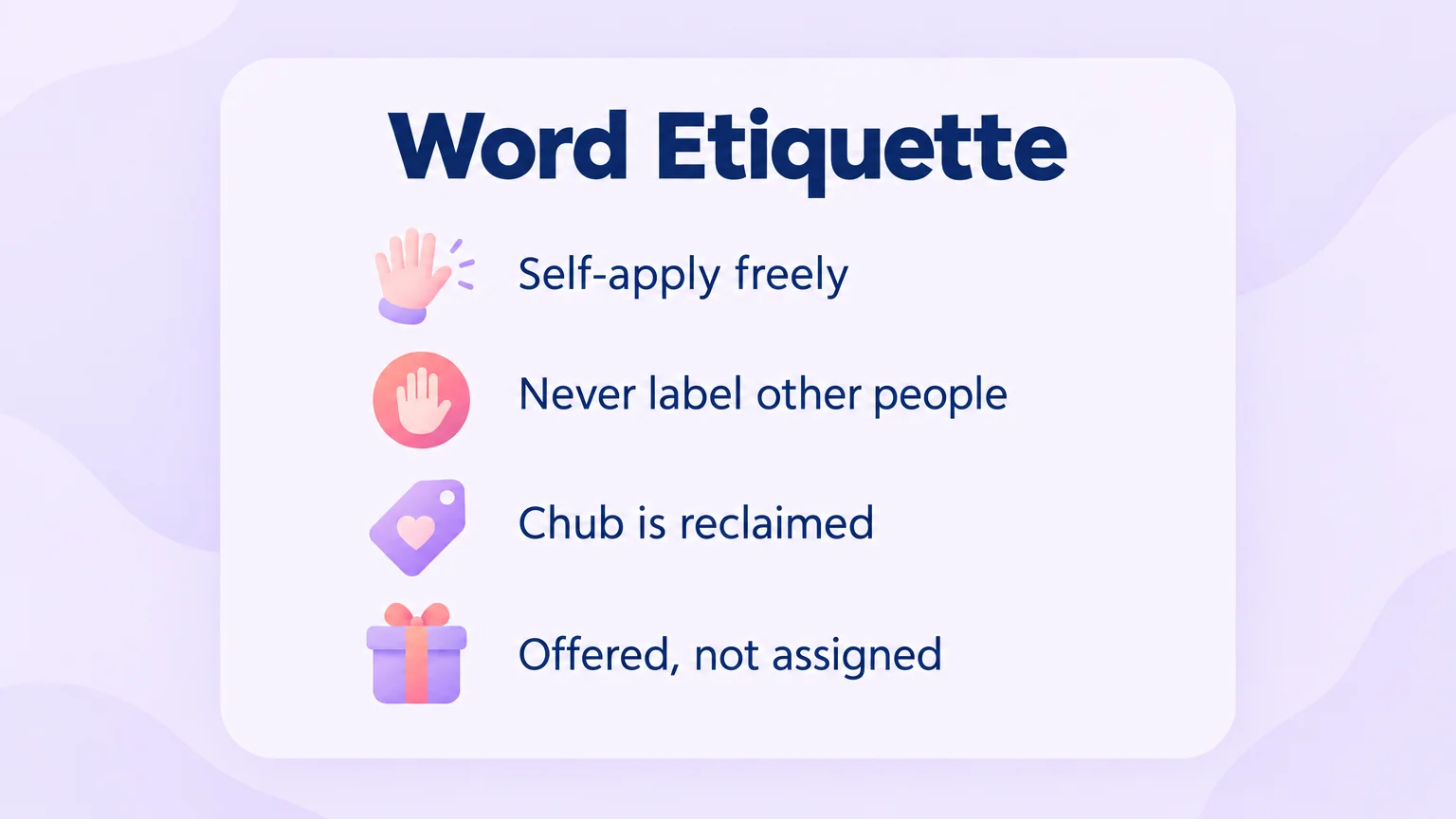
The words come with a small amount of etiquette, and it fits on one hand.
Self-apply freely. Every label in that table is a self-description. No authority confers it, and there is no test to pass. This is Wright’s gate again: the people inside recognize you, and that is the whole ceremony.
Do not label other people. This is the community’s clearest rule. It costs nothing to let a man name himself.
Panda bear is in-group, so outsiders should not apply it to others, and the same courtesy holds for Big Boy, Black Bear and Brown Bear, because those words belong to the people they describe.
A label you hand to someone else carries an assumption about his body, his age or his race. Letting him name himself avoids all three. If you are dating into the community, this is the rule that will trip you if you are careless.
Treat chub as reclaimed. It is sometimes lobbed as an insult and sometimes worn proudly, which makes it the speaker’s call and not yours to make.
Do not use any of these words as an insult, and do not assume one lands that way. The community reads the label as positive: masculine, mature, belonging. The whole movement is built on turning traits the wider world devalued, being heavier and hairier and older, into things worth wanting. So when you hear “bear” used as a jab, you are hearing a word the men it names have spent decades taking back.
Know when to stop explaining. Being a bear is not a body-type declaration. Tim Martin put the cleanest line on it in his foreword to The Bear Book in 1997: “The bear subculture goes deeper than skin and body hair.” If a man tells you he is a bear, you do not get to audit the claim.
One rule covers the rest. The label is offered, not assigned. So when someone’s label surprises you, take it at face value. The gate is the recognition of the people already inside it, not your assessment from outside.
Is This You? And Your First Time in a Bear Space
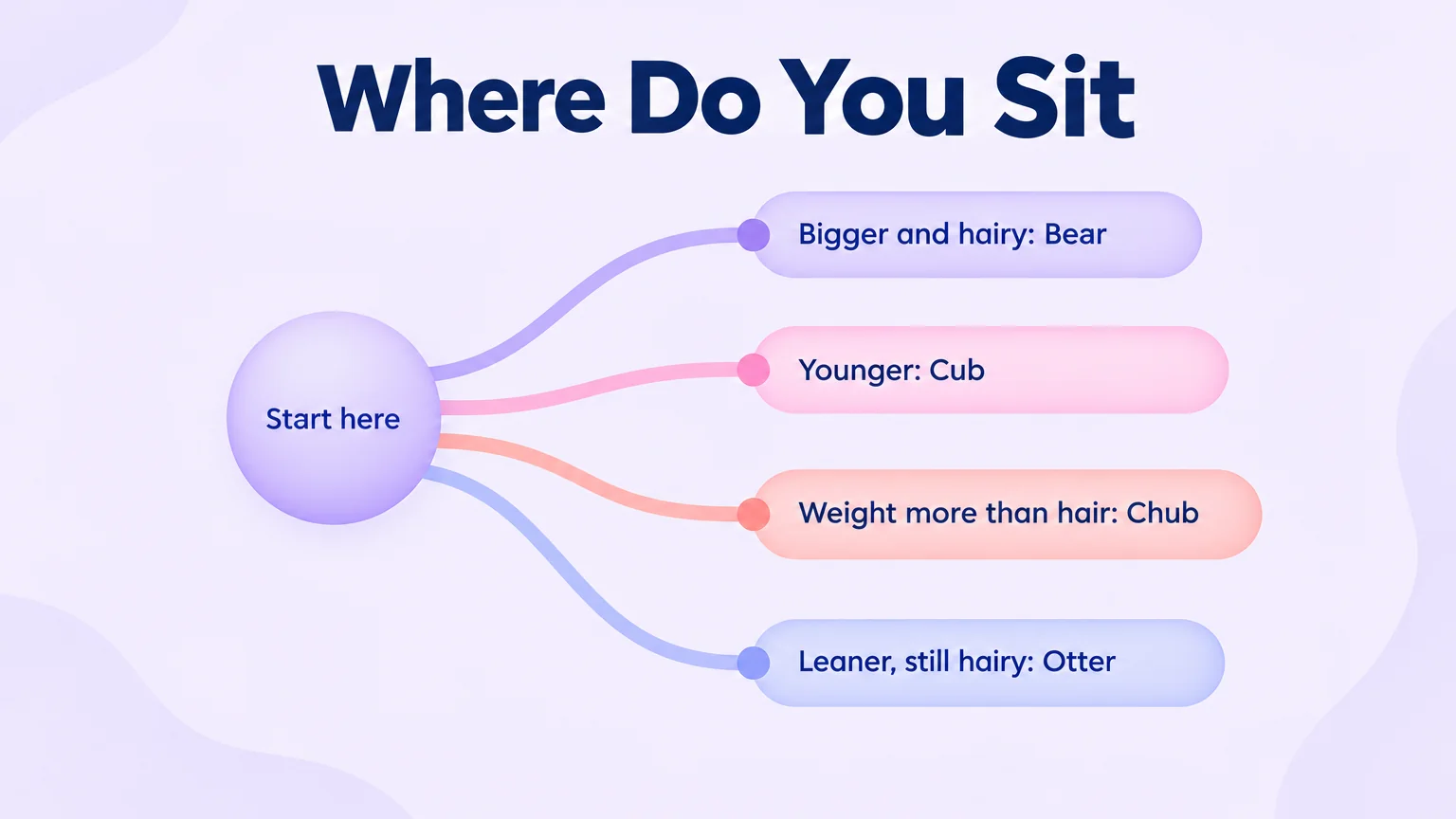
If you have read this far wondering whether the word is yours, start with Wright’s test rather than a mirror. You are a bear if a group of self-identifying bears include you. The label is conferred by self-identification and community recognition together, and it puts you first.
Then apply Wright’s own definition instead of a body checklist: a man comfortable being a man as he is being gay, who has a good heart. Check which axis you sit on. If your build comes from weight more than hair, chub may describe you more precisely. If you are young and the term otherwise fits, cub exists for you.
Then give yourself permission. You are allowed to try the label on, use a neighbor instead, or drop it and pick it up next year. The words are living shorthand, not a membership card.
Now the part where you walk in. One man, late thirties, described a local bear dance night he had only ever watched through other people’s photos. He stayed home. He was sure the regulars “all know each other and probably hang out multiple times a year.” He also named what sat underneath: “there is a sexual component to this and a desire for validation from a group of men who I find attractive.”
The men who answered had felt the same thing, and their advice was blunt. Just go. Lower the bar until your first time goal is merely showing up.
The scene, they said, is really more of a friend network than a clique, and what he had been watching was “just a slice of one’s life, not its entirety.” The nerves, one suggested, usually read to organizers as respect for the space.
A few practical notes. Pick the low-key door, a local bear club or a bear night at an existing venue rather than a flagship festival week. There is no strict dress code. Chasers, men drawn to bears without identifying as one, are explicitly part of the community, so you do not have to be a bear to belong.
And assume you are misreading the signals. A curator’s warning is worth carrying in: bears “like leather, but that doesn’t mean that they’re part of the BDSM or the S&M community.” If you assume, you are going to be wrong. Ask instead.
And if the room still feels like a lot, there is a lower door than the bar. 3Fun is a dating app where you write your own description and can talk to someone before you meet. A smaller first step than showing up, and a real one.
The Bear Flag, the Tartan, and the Bear Calendar
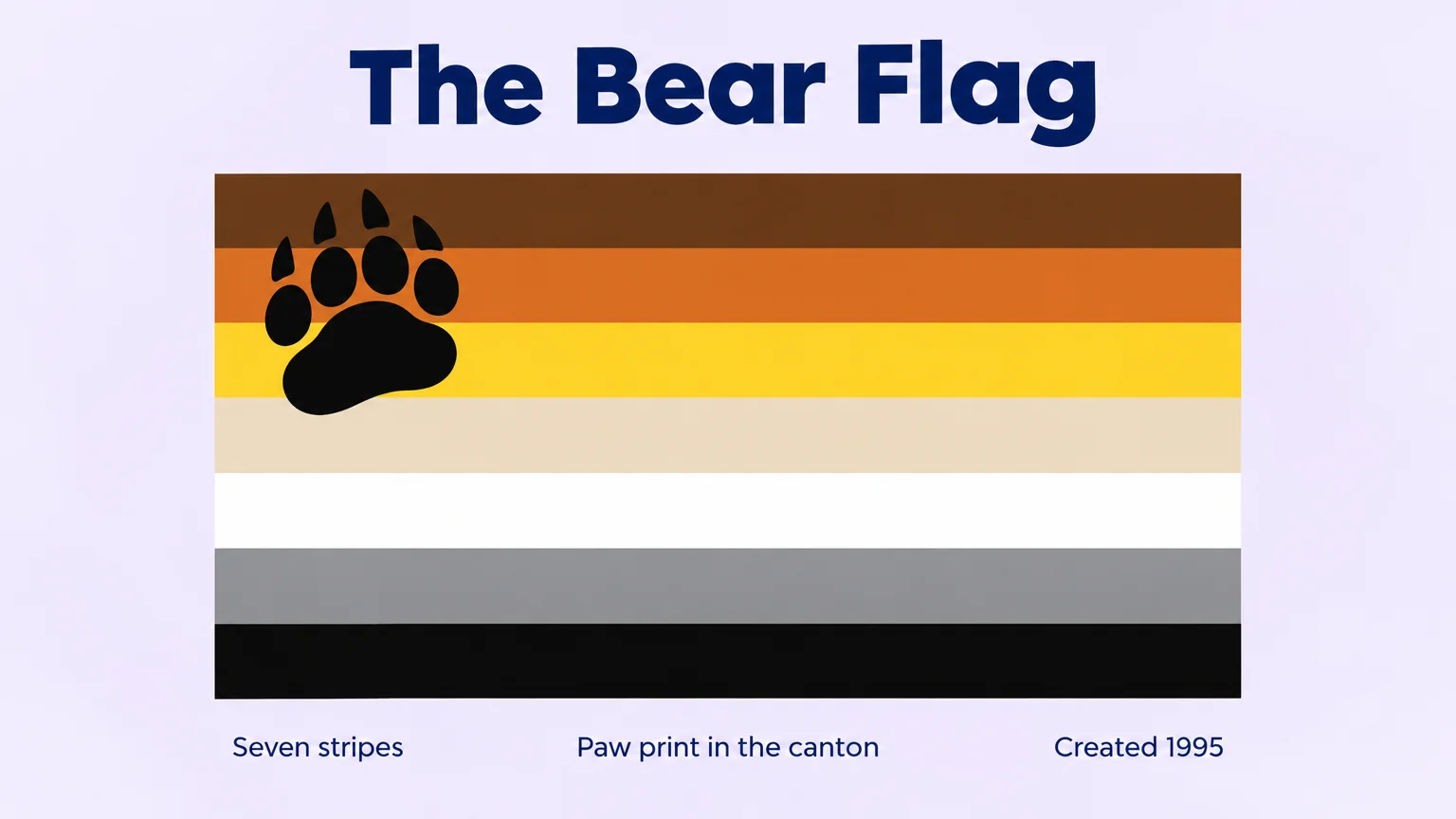
The flag has a cleaner origin than most. The International Bear Brotherhood Flag was created in 1995 by Craig Byrnes, a psychology undergraduate, for a senior project on bear culture. The graphic design was Paul Witzkoske’s, and four machine-sewn prototypes, each three feet by five, were voted on at the Chesapeake Bay Bears “Bears of Summer” event in July 1995. Witzkoske’s design won.
It carries seven horizontal stripes: dark brown, rust or orange, golden yellow, tan or cream, white, gray, and black. Byrnes explained the choice plainly: “The colors represent the fur colors and nationalities of bears throughout the world.” A black bear paw print sits in the upper-left canton. The layout is a deliberate echo of the leather pride flag, Tony De Blase’s 1989 design, which places its symbol in the same upper-left position.
Even the flag has a dispute. Witzkoske has said Byrnes’s original concept carried six stripes with a brown paw on a green canton, and that he expanded it into four seven-stripe variants. There is also an International Bear Pride tartan, registered with the Scottish Register of Tartans in 2015.
The calendar is easier to date. Provincetown Bear Week runs in mid-July and has run since 2001, among the largest bear gatherings in the world; the 2026 edition wrapped on July 18. Sitges Bears Week in Spain is Europe’s flagship, running twice a year, its main autumn edition set for September 4 to 13 in 2026, marking 25 years and drawing more than 5,000 attendees. Folsom Europe fills Berlin in mid-September.
Bearadise in Puerto Vallarta runs Bearsgiving from November 27 to 29, 2026. Bearsurrection in Fort Lauderdale, founded by Marco Antonio Sanchez, Manuel Barrios and Jim Ward, ran its inaugural event April 11 to 16, 2017. The International Bear Rendezvous was first held in San Francisco in 1992 and included the first International Mr. Bear contest.
A correction here, since the calendar can mislead. World Bear Day, on March 23, is not a gay bear event at all. It is a conservation observance for the world’s eight bear species, founded in 1992 and aligned with the International Association for Bear Research and Management. Queer media claim the date each year by wordplay, and the two have nothing to do with each other.
What the Research Says About Bear Identity
In a 2007 study in the Journal of Homosexuality, Manley, Levitt and Mosher found that bear-identified men choose their look on purpose, and that the look signals self-acceptance and maturity. A man is not just wearing a beard. He is telling you he has made peace with who he is.
In 2020, researchers surveyed 60 men in Poland’s bear community and found that heavier men reported higher self-esteem, the reverse of the usual pattern. Their explanation was the culture itself, which treats heavier and hairier as desirable. The mirror can simply flip.
The geography paper “Bears In Space” (Geography Compass, 2020) mapped bear culture across countries, finding a global scene, not a quirk of one city.
A 2022 study in Gender, Place & Culture borrowed its title from a man it interviewed: “Fat boys make you feel thinner!” The contradiction is the finding. Bear spaces can comfort a fat man and make him feel judged.
Scholars split on what bears are doing. Jack Fritscher reads them as exemplars of a self-identified traditional masculinity. Peter Hennen reads them through Judith Butler’s idea of “gender trouble,” as men who make people question their assumptions about gender. The second reading explains something the first cannot: how a man can be heavily masculine in his presentation and soft in his manner, without either being an act.
Tim Martin’s 1997 foreword to The Bear Book made the same point: “We’re not dealing with some fad here… but rather a real development in how many gay men see themselves.”
Three findings sit less easily. A 2026 study in Body Image, drawing on 644 men, found bear-identified men reported a larger thinness gap between how they looked and how they wished to look than several other groups. The community’s protection is genuine but not total.
The ideal inside the culture has also drifted back toward the standard it once fled, converging on an image researchers describe as “white, muscular, dark haired, and middle class.”
And a 2017 literature review by Quidley-Rodriguez and De Santis found bears more likely than other gay men to report lower self-esteem and riskier sexual behavior, though the 2020 Polish study found the opposite. The evidence is unsettled, and none of it cancels the relief the identity produces.
Who Belongs, and Who Is Still Arguing
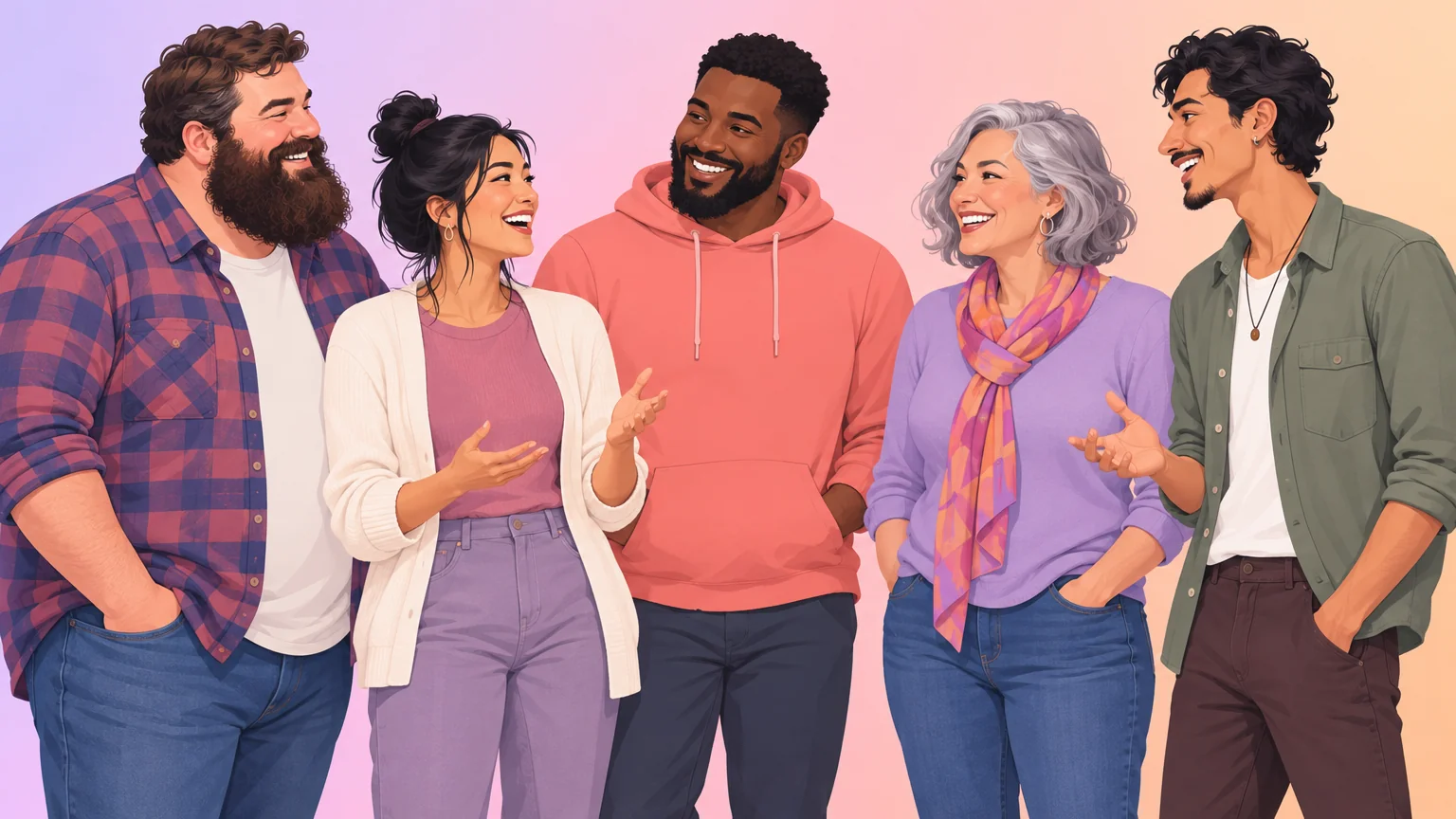
A community built to escape gatekeeping eventually grows gatekeeping of its own. The bear community is open about that argument.
The longest thread is muscle bears. Traditional bears have called gym-built, image-conscious bears “an anomaly of bear culture” and, in the same breath, “the most accomplished model of bear culture and at the same time its threat.” In Paris, traditionalists derided them as poodles. A slow split, most associated with the early 2000s.
Race is a live fault line, not a footnote. A Facebook bear group explicitly blocked Asian and African members, and many see the community’s standard of hirsuteness as favoring white men. In 2025, the author Da’Shaun L. Harrison argued that muscle bears who are not fat dominate Black chub and bear social spaces, undoing the body acceptance the community was built on.
The community’s own media says so. Bear World Magazine’s editor in chief, John Hernandez, wrote in December 2024 that the community is criticized by “bears of color, female bears and genderqueer folks for not being as welcoming to them as we proclaim to be.” Inclusivity, he argued, does not require sleeping with anyone, only welcoming people into bars, clubs, events and parties.
Effeminacy has been policed too. A man was once removed from a London bear club for wearing high heels. Bisexual men have always been part of this community, though the scholarship often erases them.
The sapphic version has a name and a thinner infrastructure. “Ursula” is a feminized form of “ursine,” and it named a lesbian bear and bear-lover email list documented by Tanya Gulliver in Xtra in 2002. The gap is resources. As one “grrrl bear,” Rob Sweeney, put it, the men “have gatherings and play parties and magazines, and we don’t.”
The modern expansion is unfinished. Bears were typically cisgender men until the late 2000s, when trans men, non-binary people and cisgender women who identify as bears gained wider recognition. In 2025, the Mr Australasia Bear competition crowned its first transgender titleholder, Jeb Maihi Brown.
The scholar Gareth Longstaff told NPR that bear culture grew out of “very much white cisgender gay male culture” and is “not a perfectly inclusive culture.” That is not a verdict of failure, just a community still growing up.
Frequently Asked Questions
What is a bear in the gay community?
A bear is a gay or bisexual man, often bigger-built, hairy or bearded. The community’s definition is wider than the look: Wright calls a bear a gay man “comfortable being a man as he is being gay, and who has a good heart.”
Where does the word “bear” come from?
Two documented points. The earliest recorded use is 1966, in the meeting minutes of a Los Angeles club called the Satyrs, which note a “bear club” within their ranks. The first print use is Mazzei’s “Who’s Who at the Zoo” in The Advocate, 1979.
What is the difference between a bear and a cub?
Age and youth, not size or hair. A cub is a younger or younger-looking bear. There is no official threshold: community ranges put a cub under 30, under 35, or loosely under 40. Cub signals a youthful attitude as much as an age, and men tend to drift from cub to bear over years rather than on a birthday.
What is the difference between a bear and a chub?
The axis is hair versus weight. A bear is defined by appearance and temperament: stocky, hairy and bearded. A chub is defined by size alone, with no requirement of hair. Most bears call themselves chubs, but not every chub calls himself a bear.
Do you have to be hairy to be a bear?
No. Hair is the strongest marker, not a gate. A bear put it best in Portland’s Just Out in 2000: a bear “is an individual who is either hairy or not hairy, as long as he appreciates the hairy aspect of the person he likes.” A hairless heavier man is more likely to be called a chub.
What is a hairless bear called?
If you mean a bear-shaped man without hair, the community term is dolphin, an otter without the fur. If the build comes from weight rather than hair, he is likely to be called a chub. A bear who shaved has no dedicated word.
What is a dolphin in gay slang?
A dolphin is a slim, athletic, smooth-bodied man, a bear or otter with the fur removed. The usual gloss is “an otter without the fur.” A blunter internet usage means a promiscuous man, so context matters. It joins otter, wolf and fox in the informal animal taxonomy.
Is “bear” only for gay men?
No. The subculture grew out of gay male culture, and bisexual men have always been part of it. Trans men, male-presenting non-binary people and cisgender women who identify as bears have gained wider recognition since the late 2000s. Whatever your orientation, the label is open to you; it simply grew out of a specifically gay male history.
What is the female equivalent of a gay bear?
“Ursula,” a feminized form of “ursine,” and historically “lesbear,” documented by Tanya Gulliver in Xtra in 2002. She described lesbian bears as butch, fat or stockily built, often above average height, and not butch-only: femmes and trans women are generally included. The infrastructure is thinner: the men have gatherings and magazines, not the women.
Is being called a bear a compliment?
In the community, yes. It is meant and taken as inclusion. Bear identity reclaims traits mainstream gay culture devalued, being heavier, hairier and older. It lands badly when applied to someone who did not ask for it, or when it arrives as a rejection.
What is the bear flag and what do the colors mean?
The International Bear Brotherhood Flag was created in 1995 by Craig Byrnes as a senior psychology project, designed by Paul Witzkoske. Seven horizontal stripes run dark brown, rust, golden yellow, tan, white, gray and black. A black paw print sits in the upper-left canton.
What is the “bear smirk”?
It nicknames a smile common in bears’ photos: a mash-up of a grin, a smirk and a cartoon “huh?” face. It is read as releasing the tension between the macho signals bears carry, like bulk and a beard, and their approachability. Wright calls it a “paradoxical masculinity.”
Can I go to a bear bar or event if I’m not a bear?
Yes. Bear bars and events are low-key and welcoming, and chasers, people attracted to bears without identifying as one, are part of the community. Aim for a local bear club or a bear night rather than a flagship week. There is no dress code.