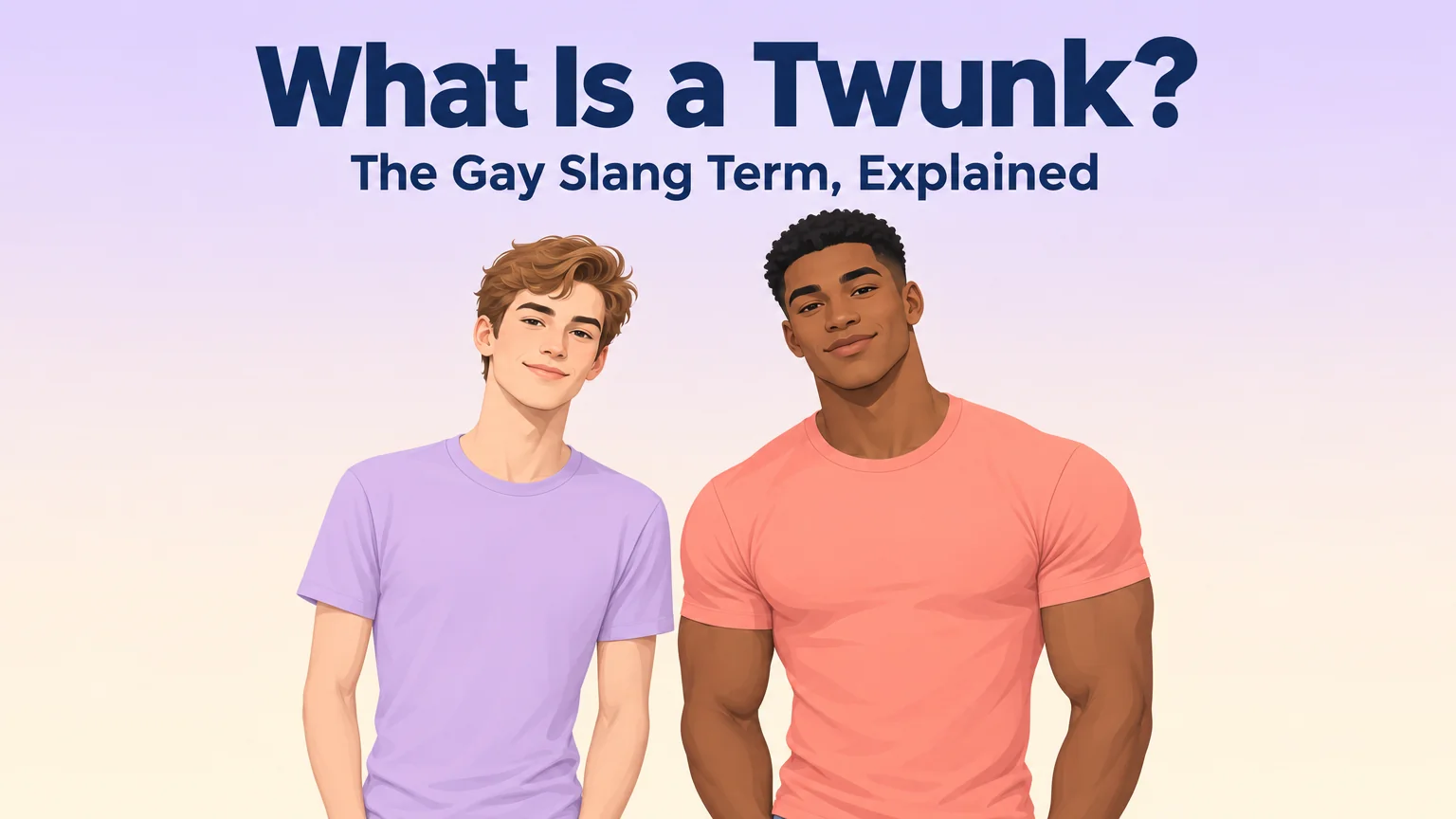
When a word turns up in a dating profile, then a group chat, then a headline, and everyone around you nods like it was always obvious, you are left asking what is a twunk. The short version: a guy who kept the twink’s face and traded up the body. Boyish and pretty, still on the slim side, but visibly muscular and gym-toned. Lean rather than bulky.
The definition is newer than it sounds. The word has meant other things, and it changed in front of the people using it.
Where the word came from, and when. Why four different ages are attached to it. What happens when the word meets a real profile, and who gets to use it.
If the definition was all you wanted, you have it. The rest is for whoever wants to know why it keeps moving.
Twunk Meaning: The Gay Term, Defined Plainly
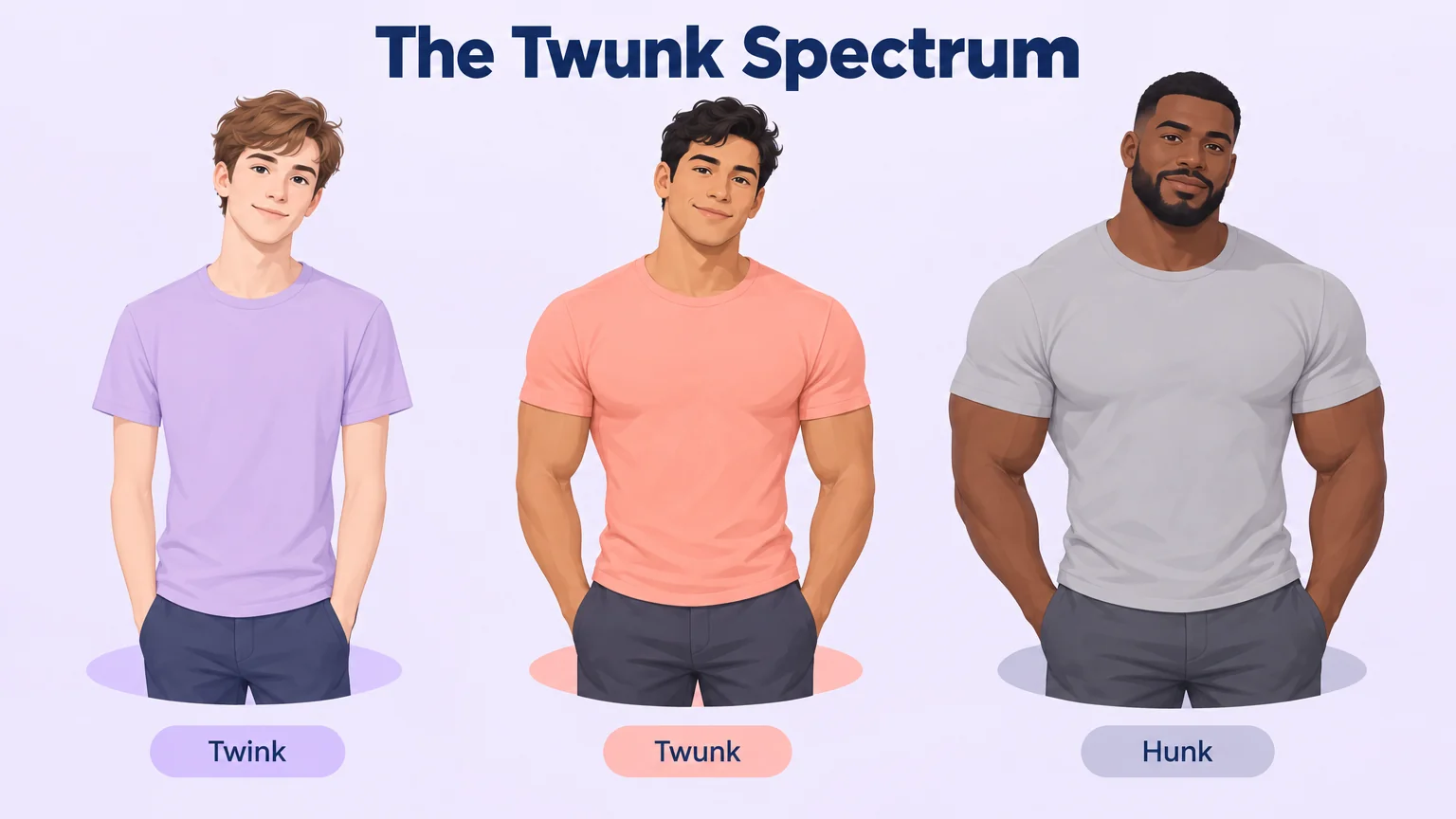
Start with the version you can use. A twunk, one of the gay body types, has a twink’s face and a hunk’s body. The face is boyish, pretty, young-looking.
The body is lean but visibly trained, closer to a swimmer’s build than a powerlifter’s. That is the whole idea, and it is not complicated.
The top-rated definition on Urban Dictionary, submitted on January 17, 2023, reads: the face of a twink, the body of a hunk. Wiktionary compresses it to “a muscular twink,” traces it to the blend of twink and hunk, and confirms “twunky.”
On one side, more muscle than a twink, whose slender build reads as untrained. On the other, less mass than a hunk or a jock. That jock overlap is real, and it is where most of the arguing starts.
The wrong definition you may be carrying is that a twunk is simply an older twink. That reading is historical and gets its own section next. In current usage, it is not the primary meaning. People disagree about this word because it changed, not because they are careless.
No two people read the same photograph the same way. The same image can draw total agreement and complete rejection. Body-type shorthand does that.
So the definition is settled enough to use. The story behind it is stranger.
The Real Origin of ‘Twunk’, and Why Its Age Keeps Changing
A common claim is that twunk first appeared on Urban Dictionary as early as 2006. Checking turns up something else: the oldest surviving gay-sense definition is dated August 9, 2009, and no 2006 submission appears on any page.
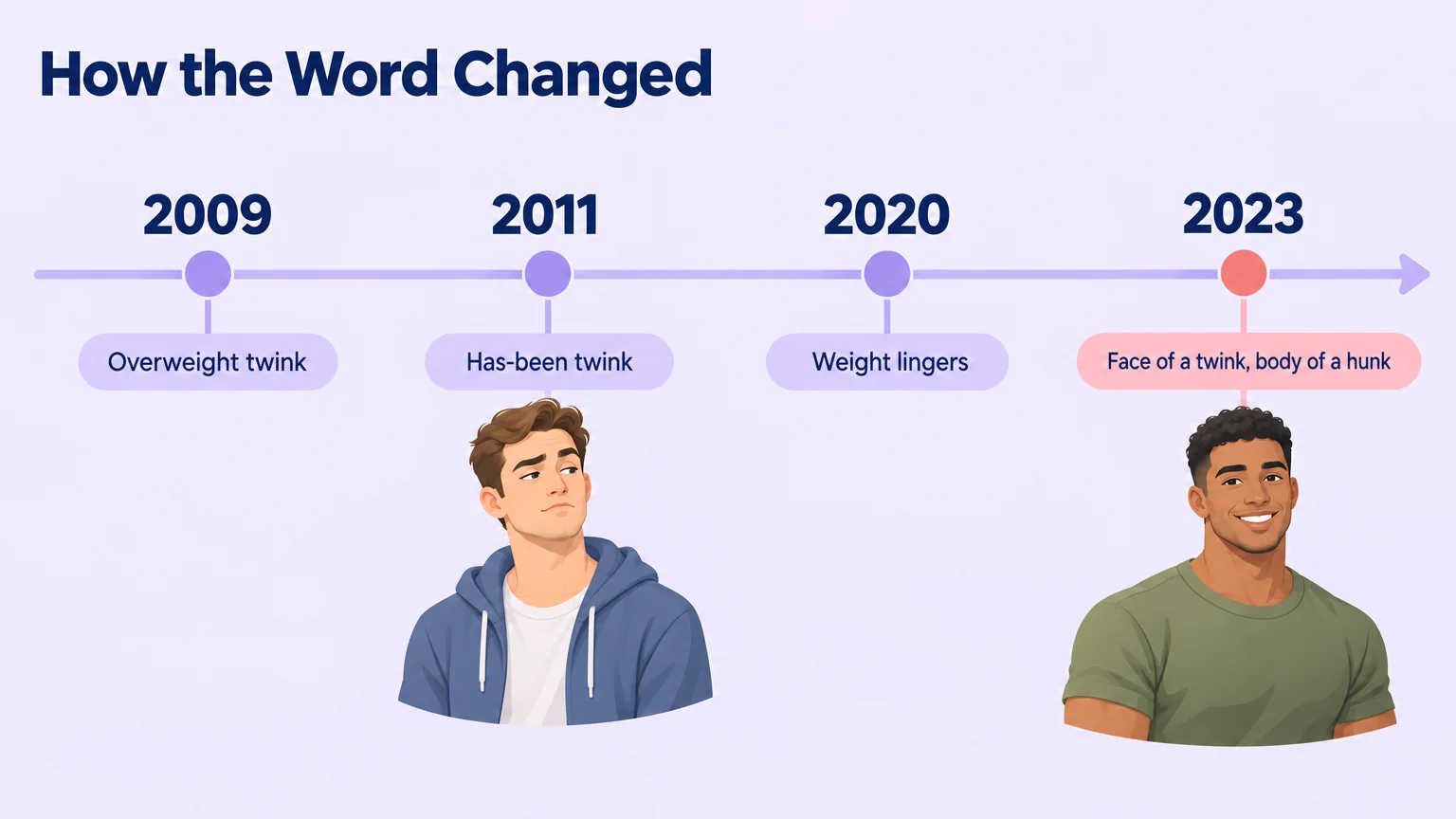
That oldest entry means the opposite of the word in use now: an overweight twink, the twink who has lost his svelte figure. The word was about weight gain first, and it was not a compliment.
A second entry, dated December 22, 2009, defines a twunk as “like a twink, but older,” and is the only entry to offer a named origin story. A greenroom conversation about gay categories ended by anointing a friend a twunk, a twink but older. The anecdote is attributed to Dan Savage by way of Playgirl, so treat it as user-submitted, not verified: still only a lead.
An entry dated October 15, 2011, shows the word used as an insult rather than a description. It glosses twunk as the past tense of twink, a has-been twink, marked negative connotation. It names a man in his late twenties or early thirties who still dresses and behaves too young. This is where the compliment-or-insult question, and the age question, begin.
The weight sense lingered as late as 2020. Then came the definition that dominates now, submitted on January 17, 2023: the face of a twink, the body of a hunk, with no age or weight condition in it. The version almost everyone uses is only a few years old.
The arc is short: mocking, then neutral to negative, then admiring, inside about fifteen years. Nothing before 2009 survives, and Wiktionary carries no dates, so the origin is unknowable at this distance, not merely unknown. That is ordinary for slang.
Twunk inherits its baggage from twink, whose record is longer. Twink’s first recorded definition appeared in 1963 in American Speech, though its origins are placed in the 1950s; Etymonline’s Douglas Harper dates that sense to 1963 and declines to choose between the Twinkie and twank.
The T.W.I.N.K. expansion, teenaged white into no kink, is a backronym. Wikipedia names it one, and Etymonline does not mention it at all.
Three origin candidates are live: the Hostess Twinkie snack cake, the older British slang twank, and clipping from twinkle. On the American Dialect Society list in February 2010, linguist Ron Butters argued clipping from twinkle is far more likely than the snack cake or the poem theory. He warned that slang is notoriously hard to etymologize and usually has more than one origin. All three candidates stay on the table.
The ladder most people repeat runs twink, then twunk. That is the newer reading. The older cycle ran twink, then twank, then an old twunk, the clearest evidence being a community account of that progression.
Twank has since been pushed out and reads as derogatory. That contest is why twunk will not settle: two words still compete for the same middle rung.
The numbers make more sense as vintages than as rivals. Wikipedia’s sourced band for twink is roughly 18 to 25. A narrower band of 18 to 22 comes from a court definition in Joe McGinniss’s 2007 book, describing a slender, boyish-looking gay man with little body hair. The 2011 sense says late twenties to early thirties.
So if someone says a twunk is around thirty, they are using the older, age-based sense. If they say there is no ceiling, they are using the modern, body-based one.
Twink death is the same idea seen from the other end. A 2026 essay in Them traces the cycle: the 2018 T Magazine declaration that we had entered the age of the twink, twink death solidifying into a defined idea by 2024, and the later fork between the wig and the weights. What exists after twinkdom is still an open question, and twunk is only one answer.
The human version: a 24-year-old describing the shift from being looked at to not being looked at, and the reply that tells him twinks evolve.
Twunk vs. Twink vs. Hunk: The Map, and Who It Leaves Off
These terms overlap, people disagree about them constantly, and being told your reading is wrong is normal. Here is the map.
| Term | What it describes | Axis | Note |
|---|---|---|---|
| Twink | Young, slim, little to no body hair | Youth | The anchor term |
| Twunk | A twink’s face, a lean trained body | Muscle | The one that moved |
| Twank | The older middle rung | Age | Widely read as derogatory |
| Hunk | Big and muscular | Size | Not gay-specific |
| Jock | Athletic, sport-coded | Sport | Where the twunk arguments start |
| Otter, cub, bear, wolf | Size and body hair | Size and hair | A separate family |
| Daddy | Age and authority | Age | Older, in charge |
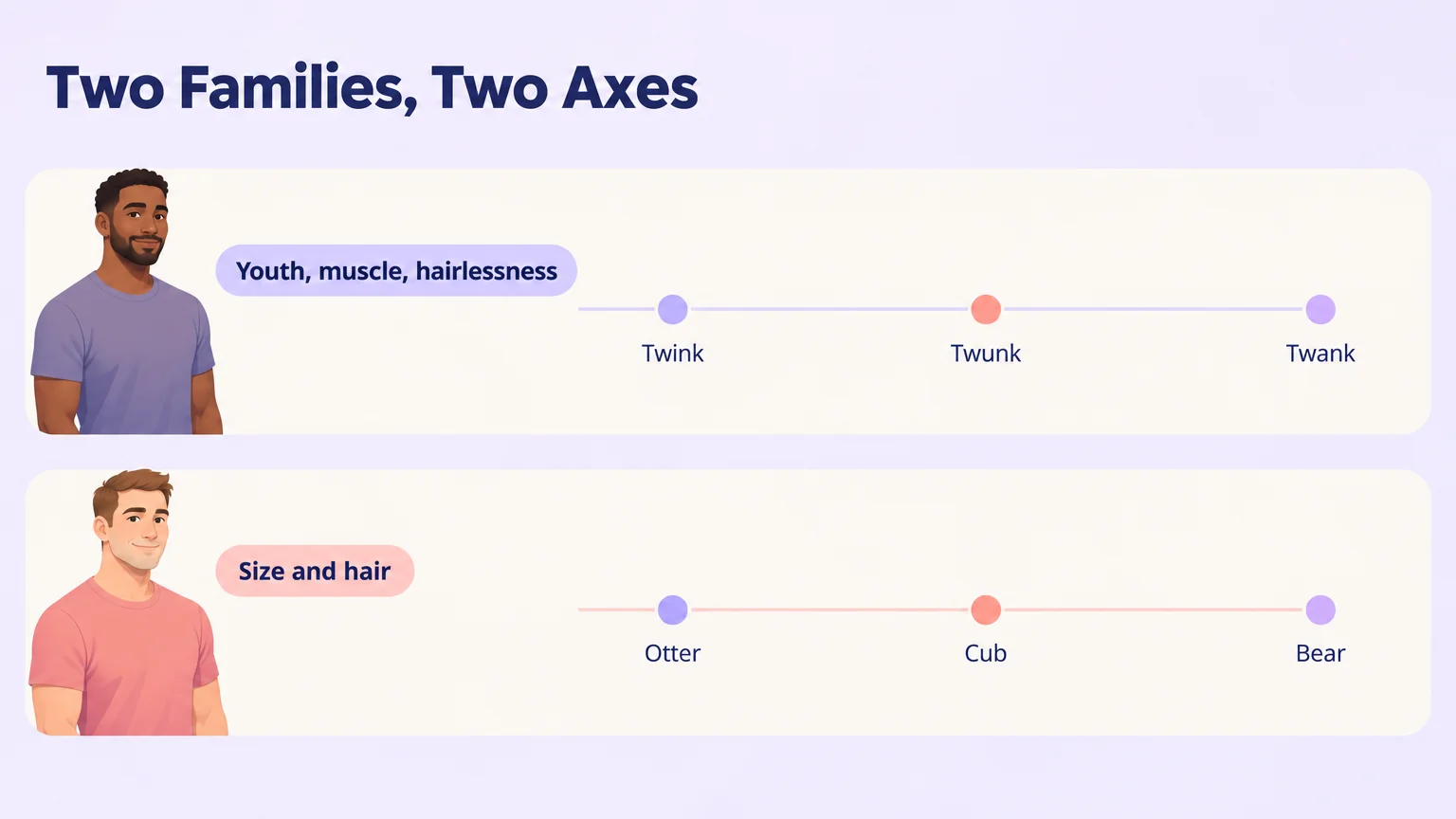
A table cannot show the thing that matters most. The twink family organizes around youth, muscle and hairlessness; the bear family around size and hair. Those different axes are why twunk and bear never compete for the same slot while twunk and twank fight over it.
Exclusion here is experienced as fact. Vogue Runway’s fashion news editor, José Criales-Unzueta, writes that the word twink has never been used to describe him: he has always been too fat, too hairy and too femme for it to apply. He was not insulted. A category this casual can still tell a person he is not in the picture.
Describing is not prescribing. Video essayist Charlie Weishaar puts the harm in the second. Many men never call themselves twinks and still receive the label, and being assigned that role brands a man with femininity, and therefore sexual passivity, whether or not either is true. The target is the assignment, not the vocabulary.
The vocabulary has a documented lineage. Much of it came out of pornography and hookup-app filters, then fed back into how men describe themselves. Grindr shipped a subculture survey that turned these labels into selectable options, moving them from conversation into a dropdown menu.
The standards do not fall evenly. They lean on youth, thinness, whiteness and hairlessness in ways that quietly narrow who qualifies, and they press on the people inside the categories too. One community exchange over a famous actor’s build shows it: the sharpest reply asks whether an acrobatic, decade-long Hollywood superhero counts as muscular.
None of this means the words are bad, or that using them is a failing. They are shorthand with edges, useful and worth holding lightly. A label can describe a body. It never decides a person.
How Twunk Works in Real Life: Profiles, Compliments, and the Gym

The definition is the easy part. Everything interesting happens when the word meets a person.
These words get used about the self before they get used about anyone else. Tom Daley went public with it in May 2022, turning 28 and asking whether that made him some twunk, and whether that was the past tense of twink.
He also finds it funny that a minority community always divides itself into more minorities, and the line lands as affectionate. In ordinary life, men ask each other to confirm the fit. A word you claim for yourself sits differently from a word you are handed.
In a bio it works as a category slot rather than a sentence, useful and reductive at once. People write twink/twunk when a single term does not fit, which is candor rather than hedging. Declaring it yourself reads as confidence; leaving it out is equally valid, and plenty do.
The practical shape: the label is optional, the specifics are not, and a profile that says what you want does more work than the category. You are the authority on your own profile.
Being labeled by someone else is where most discomfort lives. A 26-year-old asking whether he counts as a twink or a twunk, and whether he will annoy people on a given app, is using the label to work out where he belongs. That is an anxious decision, and it deserves kindness.
If a label does not fit, it is fine to say so, and it is also fine to let it go. In most current usage the word is meant warmly, itself a recent change.
Using it on someone else carries the same distinction: one is an observation, the other an assignment, and only the second can bruise. Run the read-aloud test before you send it. If it lands as a comment on somebody’s body rather than a compliment about effort, drop it. People disagree about who qualifies, so correction is normal.
The gym is the dividing line. Twink reads as something you simply are while young and slim. Twunk reads as something you built.
A twink can be effortless while a twunk requires many hours in the gym, and a former twink will tell you neither is strictly necessary. Both are true at once.
None of this is a rulebook. People date, and 3Fun is one of the places they do it. You get to decide which words you pick up, if any.
Is Twunk a Slur, and Who Gets to Use It?
Inside the community, twunk is not a slur. It is a descriptor, and the peevish use of it is the problem. The harder question is who is speaking.
The history explains why anyone asks. A 2011 entry marks the word negative connotation and glosses it as a has-been twink, so anyone who met it before roughly 2020 learned the harsher sense first.
Troye Sivan gave the sharpest line in September 2024: “If you say ‘twink’ when you meant to say ‘faggot,’ that’s still a slur. That’s, like, our word. I don’t think straight people should be using that.”
Vogue Runway’s fashion news editor, José Criales-Unzueta, offers the second test in May 2025. Even if the word is not generally a slur when queer people use it, something changes when outsiders adopt it as a lazy shorthand or a punchline. He notes that twink now means any thin white man, and any apparently gay person, and that the community let straight people in on its codes.
The precedent is dated. A May 2018 New York Times T Magazine piece applied the word to straight actors and drew a backlash. The same question is now asked about twunk, one side ruling a straight man out by definition and the other applying the term anyway.
The word does not change; the position of the speaker and their meaning does. A stranger using it for a homophobic insult, a columnist for any thin white man, and a friend about himself are three different acts. Using the word is not a betrayal, and being uneasy about it is not oversensitivity.
The etiquette the community states is short: self-identification first, do not use it as a punchline from outside, do not use it as a substitute for an actual slur, and accept that your reading of a photo may be called wrong.
Frequently Asked Questions About Twunk
What does twunk mean in gay slang?
A twunk is a guy with a twink’s face and a hunk’s body: boyish and pretty, lean and trained rather than bulky. The word is newer and less settled than it sounds: a definition written in 2009 will not match the one in use now.
What age is a twunk?
There is no agreed number. The word began as an age-based idea, an older twink, and became a body-based one, so people describe different vintages of the same term. Nobody enforces a ceiling; the label follows the body more than the birth year.
What is the difference between a twunk and a twink?
A twink is young, slim and largely hairless. A twunk kept the face and added visible muscle, so the difference is the training, not the age. That overlap is why the two get confused; the map above compares them fully.
Is a twunk the next stage after a twink, or its own category?
Genuinely unresolved. The ladder most people repeat, twink to twunk, is the newer reading. The older cycle ran twink, then twank, then an old twunk. Older and younger men describe different systems, and neither is wrong about the one they grew up with.
Is twunk an insult or a compliment?
Read as a compliment in most current usage, and that is a reversal. The earliest surviving dictionary sense made it a mocking description of an overweight twink, and a 2011 entry called it a has-been twink with negative connotation.
What is a twank?
The older term for the stage between a twink and whatever comes next, now largely avoided because it reads as derogatory. Twank is also a much older British slang word with a different meaning. Its rivalry with twunk for the same slot is why twunk refuses to settle.
Can a straight man be a twunk?
The community is genuinely split. One position holds that this is gay slang and a straight man cannot be one by definition. The other notes that people apply the term anyway. The same fight ran in 2018, when a New York Times piece applied it to straight actors.