
You are fluent over text. Your Dom says speak, and nothing comes out.
It is not a vocabulary problem. “I still find it hard to dirty talk out of fear of embarrassing myself,” one submissive says. Submissive dirty talk fails in the room for a mechanical reason.
Text is editable and un-witnessed. You can compose, read it over, and delete before you send. Speech has no delete button, and what frightens you is self-focused attention: the internal editor narrating how you sound.
Here is the claim this article rests on. The faculty that makes you self-conscious about how you sound is the same faculty that goes quiet when you drop. Confidence is not the entry fee, and depth is not something you earn first.
One rail before anything else. You cannot give consent in subspace: it impairs judgment, much like being drunk or high. Nothing here is negotiated mid-scene. Before or after, never during.
Fifteen sections follow. One explains the mechanism. Thirteen are registers, from the one that needs no script to the ones that need a negotiation. One is built for subs whose bodies and identities the standard script assumes away.
Every register gets a softer and a harder version, written for any sub, any Dom, any anatomy, any orientation.
Start at section 1 if you freeze. Jump to begging or surrender if you already speak. Read confession and degradation before you try anything intense.
1. Subspace: Why Going Deeper Makes Talking Easier
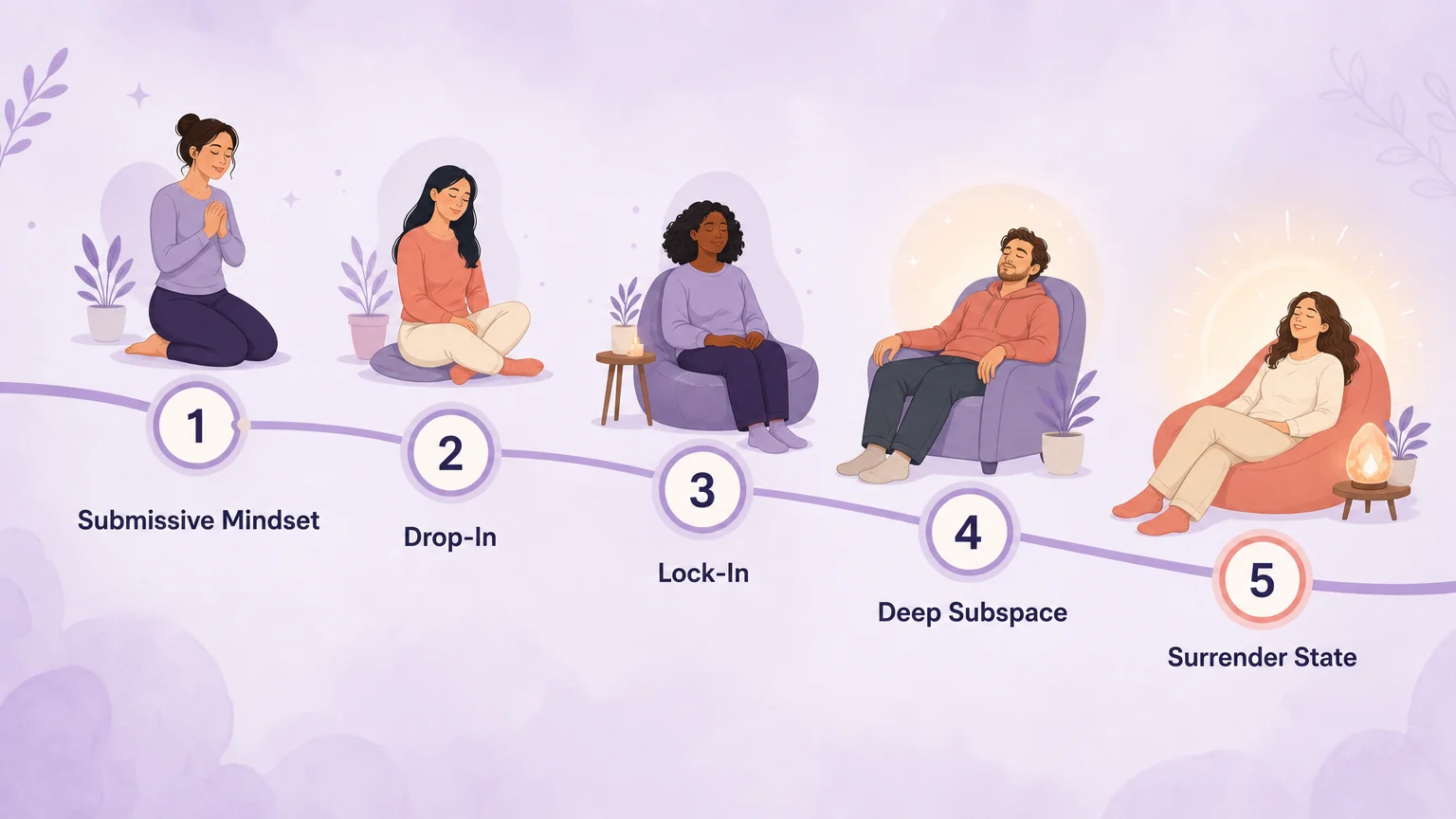
The part of your brain that worries about how you sound is the part that goes quiet when you drop.
Subspace is neurochemical, not a mood. A scene releases endorphins, adrenaline, oxytocin and dopamine, closer to a runner’s high than to calm. The prefrontal cortex, which handles rational thought and self-monitoring, quiets down, and the faculty that asks “do I sound stupid right now” goes offline.
Depth is the solution to self-consciousness, not its reward. Striving switches that cortex back on, which is why surrender can only be allowed.
Five stages: submissive mindset, drop-in, lock-in, deep subspace, surrender state. Most people have only reached stage two.
Stage one begins before the scene and is built by ritual: music played only before scenes, a phrase your Dom says the same way, kneeling, collar on. Repeat them until the cues alone produce the state. If your pre-scene ritual is “we just kind of start,” that is likely why you are not dropping as deep.
At stage four, verbal communication may be small, delayed or absent, and endorphins raise the pain threshold, so you cannot give consent there.
Ask for what helps at drop-in: slow down, whisper, a hand on your head.
Softer: “Can we do the thing first? I need the music.” / “Say it the way you always say it.” / “Put your hand on the back of my neck. That starts it.” / “Give me a minute. I am not in it yet.”
Harder: “I cannot get there tonight. Can you take it slower?” / “I dropped further than I meant to. Stay close.” / “I am not going to be able to speak soon. Do not stop.” / “Tell me to breathe. I need to hear you say it.”
The drop comes after, sometimes days later.
Pick one cue, use it before every scene, and do not change it.
2. Narration: The Register That Needs No Script
This is the lowest-stakes sentence in the article, because you are not performing. You are reporting.
Two clauses: say the physical fact, then attach a compliment or a desire. There is nothing to memorize.
Specificity is the difference between landing and sounding flat. “You’re so hot” is a rating; naming what about the body or the moment is working is a description.
Delivery carries more than content does. “You’re so wet” and “Oh, you’re so wet” are the same words and read nothing alike, because pitch, cadence, pace, volume and where you say the line from all change it.
One sentence, three deliveries. You feel so good, whispered at the ear. You feel so good, said from between their legs. You feel so good, said with eye contact after you surface.
Softer:
- “Your hand feels so good right there.”
- “I love your hands in my hair.”
- “You are so warm.”
- “I can feel you breathing.”
- “Keep doing that. Just like that.”
Harder:
- “You look so good between my thighs.”
- “I can feel how wet I am for you.”
- “That is it. Right there. Do not move.”
- “Every time you move I lose the sentence.”
- “Do it harder. I am not going to break.”
That last line describes the state rather than the act. Narration is also the safest register to practice, since you only report what is already true.
Best for a sub who has never said a word out loud, and anyone who goes blank when a scene starts. Skip if your dynamic is silent by design, or you already speak and want escalation.
3. From Text To Spoken: Carrying The Voice You Already Have Into The Room

You have already done this hundreds of times, in a medium with a delete key. The task is moving that skill, not learning it.
Mine your message history first: what does your partner call their body? That vocabulary is pre-tested.
Then walk the staircase: text, then phone, then the room, the same sentences at every rung. The phone works because you cannot be seen on it. Never jump from zero to a hundred.
Do not do over text what you cannot do in person. Promise destruction by message and go silent in the room, and the gap reads as betrayal, not shyness.
As a text: “I want your hand in my hair and your voice in my ear.” Said out loud, the same words; only volume and distance change.
Softer, written to survive screen to speech:
- “I keep thinking about your hands on my neck.”
- “I have been thinking about you all afternoon.”
- “I want you to know I am thinking about last time.”
- “You were in my head all day.”
- “I want to be close to you tonight. That is all.”
Harder:
- “I want you to take me apart tonight.”
- “I want to be on my knees before you even say hello.”
- “I want your hand in my hair and your voice in my ear.”
- “I want you to tell me what you are going to do. Then do it.”
- “I want to be used tonight. Tell me if that is on the table.”
A no over text counts as much as one in the room.
Pick three sentences you have already sent and say them out loud.
4. Nonverbal Submission: How To Submit Without Saying A Word
Submission does not require speech, and the gestures that let you submit silently are the ones that keep you safe when you cannot speak.
Signals: three taps out, a hand-squeeze pattern, dropping a held object, snapping fingers, thumbs down, tapping a foot, humming, any of them works if you agree it in advance.
Every one is also a safeword: green means keep going, yellow means slow down and check in, red means stop. Yellow is the most valuable: you stay in while changing something.
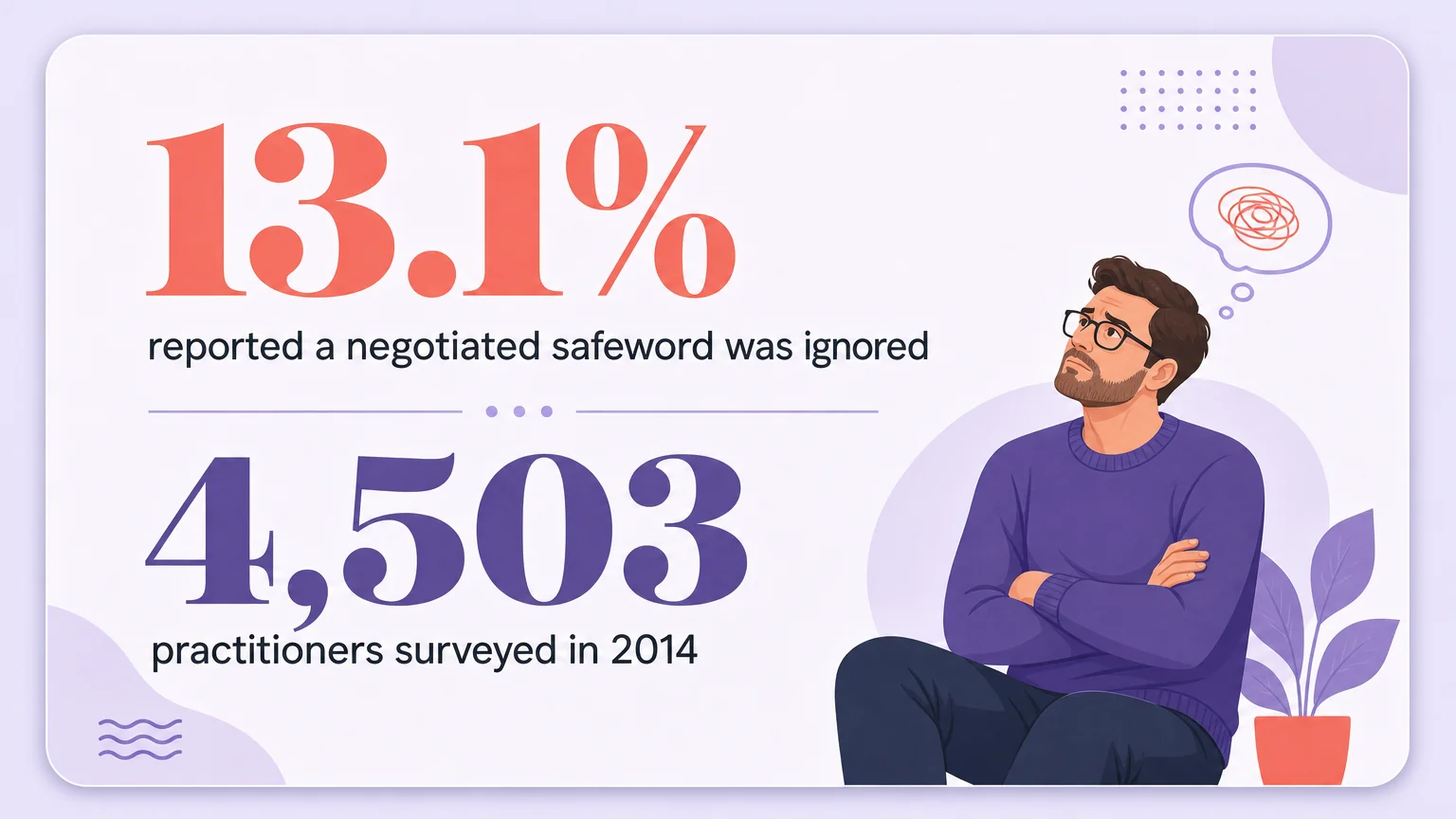
This is not optional. At depth a sub cannot advocate for themselves, and a safeword as the only safety mechanism is risky: they may not be able to reach it.
A 2014 survey of 4,503 practitioners found that 13.1% reported their pre-negotiated safeword was violated.
Practice the signals during negotiation, not the scene. An unused signal is not a signal.
Softer, the everyday signals:
- “Three taps means slow down.”
- “One squeeze of your wrist means keep going.”
- “A long squeeze and hold means I need a second.”
- “Humming means I am still with you.”
- “Two taps means yes. Harder.”
Harder, the ones that stop things:
- “If the ball drops, we stop now, no discussion.”
- “Thumbs down is yellow, not red. Change something.”
- “Snapping twice means look at me.”
- “If I go quiet and stop humming, check me. Do not wait.”
- “If I let go of your hand, that is red. Stop everything.”
Practicing in advance turns a gesture into consent, not a guess.
Best for a reader who freezes completely, any dynamic with gags or restraints, and long-distance play. Skip if your Dom has not agreed the signals.
5. Titles And Honorifics: What To Call Your Dom
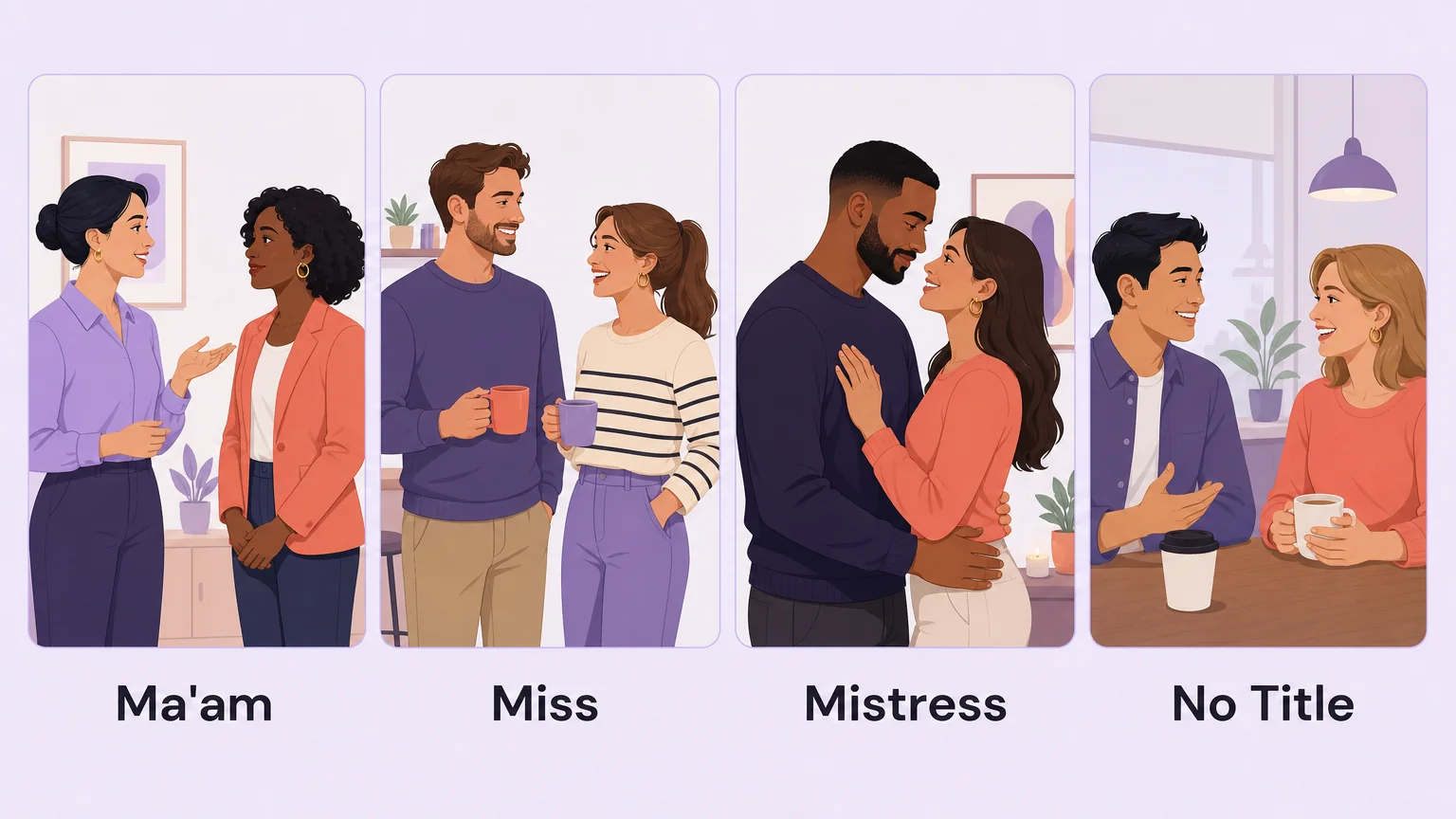
It is one word, and the fear around it is out of proportion. It is also the first negotiation.
Titles are earned and negotiated, not demanded. With someone new, ask: “How would you like to be addressed?” Defaulting to their profile name is never wrong.
The conventional map: Ma’am is a safe default for a Domme you do not know, Miss is generic, Mistress is reserved for the Domme who owns you or has collared you, and many dislike it from a sub they do not own.
Goddess, My Lady and Madam are not universal. Sir is typically for male Doms, though some female Dominants choose it.
A Dominant who insists on a specific honorific before any dynamic exists is widely read as a warning sign.
This map will not fit a Dom outside a gendered title, a title that misfires against your own gender, or a dynamic with no honorific.
Softer:
- “May I call you Ma’am?”
- “What would you like me to call you?”
- “Yes, Sir.”
- “Thank you, Ma’am.”
- “Is Ma’am all right?”
Harder:
- “Mistress.” Said with everything behind it.
- “I will call you whatever you tell me to.”
- “You are Sir. I will say it anywhere.”
- “I have been waiting all day to say it out loud.”
- “Say it again. I want to hear you name what I am.”
How your Dom handles being asked tells you more than the answer.
Pick in ten seconds.
Ma’am: the default with a Domme you do not know.
Miss: a cooler generic.
Mistress: for a Domme who owns you, not before.
No title: legitimate, and right more often than people admit.
6. When The Script Does Not Fit: Male, Queer, Trans And Nonbinary Subs

Every register ahead of this assumes a female sub, a male Dom, and a body that answers a standard script.
The same titles map holds where genders do not line up: Ma’am for a Domme you do not know, Mistress only for one who owns you, and never assume Goddess. The rule is one word: ask.
Praise is the most common misfire: praise lines skew toward “good girl,” with no male equivalent. For a trans man, a trans woman, a nonbinary sub or a male sub, that names the wrong person at the moment they are most exposed. Name the word you want.
Dysphoria is where you build the practice: agree which parts of your body get named and which are off the table. A boundary is an instruction, not an apology.
Body vocabulary should not assume anatomy: penetration is not the default. List the acts in play and the words for the parts.
Some subs switch roles across scenes. None of this stops working.
Softer:
- “What would you like me to call you?”
- “You can call me whatever feels right. I will say if it does not.”
- “Tell me what to call my body and I will use those words.”
- “I am not going to guess. I would rather ask.”
- “Those are the words for tonight. Tomorrow we can change them.”
Harder:
- “You can call me your boy.” An offer, not a request.
- “Not good girl. Good boy.”
- “My chest. My throat. My hands. Those words tonight.”
- “Do not touch me there yet. I will tell you when.”
- “You do not have to fuck me for it to count. I want your hands and your voice.”
Vocabulary is negotiated, never assumed. A Dom who will not negotiate words about your body is telling you something. So is a dating pool where you have to explain yourself from scratch every time. If you are still looking, 3Fun is where people would rather say it plainly and be answered plainly.
Write a three-word list before your next scene and hand it over.
7. Service, Obedience And Gratitude: The Polite Register
The register that sounds least like dirty talk is the one that carries the most.
Three moves. Commands become requests: please, may I, could you. Demands become offers of service, framed as pleasing them rather than satisfying yourself. Evaluations become reports: what you did and what you thought.
Reports are the underused half. Most subs can say “Yes, Sir,” but far fewer can say what they did, what they thought, or what they held back. That is the difference between a compliant sub and one their Dom cannot stop thinking about.
Gratitude is not thanks. A thank you is politeness; gratitude as a register reports what the thing did to you. “Thank you.” Against: “Thank you for letting me do that. I have been thinking about your hands on me since Tuesday.”
Softer:
- “May I get you a drink, Sir?”
- “Yes, Sir.”
- “Thank you for letting me do that.”
- “Is there anything else you need?”
- “I will wait until you tell me.”
Harder:
- “Use me.”
- “Thank you for using me.”
- “I have been thinking about serving you all day and cannot concentrate.”
- “I did what you told me to do. Do you want to know what it felt like?”
- “I touched myself thinking about you and I stopped, because I am not allowed without you.”
Doms have limits too, and a declined offer is information, not a verdict.
Request when you need permission: “May I.” Offer when you want to be useful: “Let me.” Report when you cannot think of anything to say, which is most of the first five minutes. Reach for a report; the material is whatever just happened.
8. Praise: Telling Your Dom What Is Working
“Do you like that?” asked once is fine. Asked on a loop, it reads as insecurity, and insecurity showing is the part that turns people off rather than the question itself.
The fix is a swap: replace the question with a statement. A question asks your Dom to reassure you; a statement gives them something to receive. “Do you like that?” becomes “I love that.”
Then get specific, because precision about what is working beats rating the whole person. “You’re so hot” is a rating; “It is the way you hold my jaw. Do that again” is a description.
Praise is a service rather than flattery, because it tells your Dom where to keep going: a compliment with a map attached. It registers loudly without repetition, so say it once or twice rather than on a loop.
Softer:
- “I love when you look at me like that.”
- “You are so good at that.”
- “Do not stop, please.”
- “You make it so easy to be good for you.”
- “That thing you do with your thumb. That.”
Harder:
- “Nobody has ever made me feel like this.”
- “You could do anything you wanted to me and I would thank you for it.”
- “I am going to think about this for days.”
- “I would let you do this to me in front of anyone.”
- “You have ruined me for anyone else. I hope you know that.”
Praising something does not commit you to it forever, and what you like can change between scenes.
Best for a reader whose instinct under pressure is to check in with questions, and anyone whose praise has gone generic.
9. Begging And Permission: Asking For What You Want
The register that sounds the most powerless is the one where the sub holds the most power.
Submitting and demanding are separable. Being the bottom does not mean never asking: demands can be “can I,” “do you like it when I,” “make me.”
Then the denial loop, in full, because you cannot ask for denial competently without knowing what it looks like from the other chair. The sub asks, the Dom denies, and the sub asks again with less composure.
“Can I come?” then “Please may I come?” then “No,” then “Don’t you dare,” then “Okay. Now. Come now. For me. Because I say.”
The hard case is asking for something difficult to admit wanting, especially pain. People invent a reason to justify the want so they never have to say it out loud.
Softer:
- “May I come, please?”
- “Please, Sir, may I?”
- “Can I do that for you?”
- “Please. I am close.”
- “May I keep going?”
Harder:
- “Please. I will do anything.”
- “I need it, please, I cannot hold it.”
- “Please do not stop.”
- “Do not let me come. Please. I want you to make me wait.”
- “I want you to hurt me. Can we talk about it before, and not right now?”
The safeword is the submissive’s ultimate veto, and failing to honor it is assault, not kink. Begging is play: you have not handed over the right to stop.
Asking permission: for things you need a yes on. Begging: for things you want out loud. Naming a need: for the thing you have never said, outside the scene.
10. Surrender And Belonging: The Register Of Being Owned
Surrender cannot be forced and cannot be performed. It can only be allowed, and the trying is what gets in the way, because striving reactivates the self-monitoring cortex. That is section 1’s mechanism in one sentence.
The line stops you interfering with the state; it does not create one. Saying you belong is not a report about a feeling.
Belonging lines work on structure, not feeling. They answer “what am I for” rather than “how do I feel,” which is why they land harder than declarations of affection. “This is where you belong” gives your Dom a fact. “I love you” asks them to feel something back.
Ownership is a negotiated state. You say it because you agreed to, not because it is true by default. A collar does not transfer standing consent, and neither does a name.
Softer:
- “I am yours.”
- “Wherever you want me.”
- “I am not going anywhere.”
- “Tell me what you want and I will do it.”
- “Say it back so I can hear it.”
Harder:
- “I do not want to think. Just tell me what to do.”
- “You do not have to ask. I already said yes.”
- “This is where I belong.”
- “I am not a person right now. I am yours.”
- “I would rather be here than anywhere else. Do not send me back yet.”
Notice what the list leaves out: no body, no act, no position. This is where the standard script reaches for a specific body, and belonging does not need one.
Best for a reader who can speak but is still watching themselves do it, and anyone chasing depth. Skip if you have not done the negotiation work yet.
11. Confessing Desire: Saying The Thing You Are Afraid To Want
Hinting feels safer than asking and guarantees the want goes unmet. A fantasy never said out loud is a fantasy your Dom is guessing at.
Start with the awkwardness rather than the fantasy: “I want to tell you something and I am nervous about it.”
Then hand over a script rather than a hint. One submissive handed their partner this, word for word: “Call me a whore. Spit on me. Don’t ask me if I am okay until it’s over.”
Handing over the phrases is the same act as naming your erotic triggers.
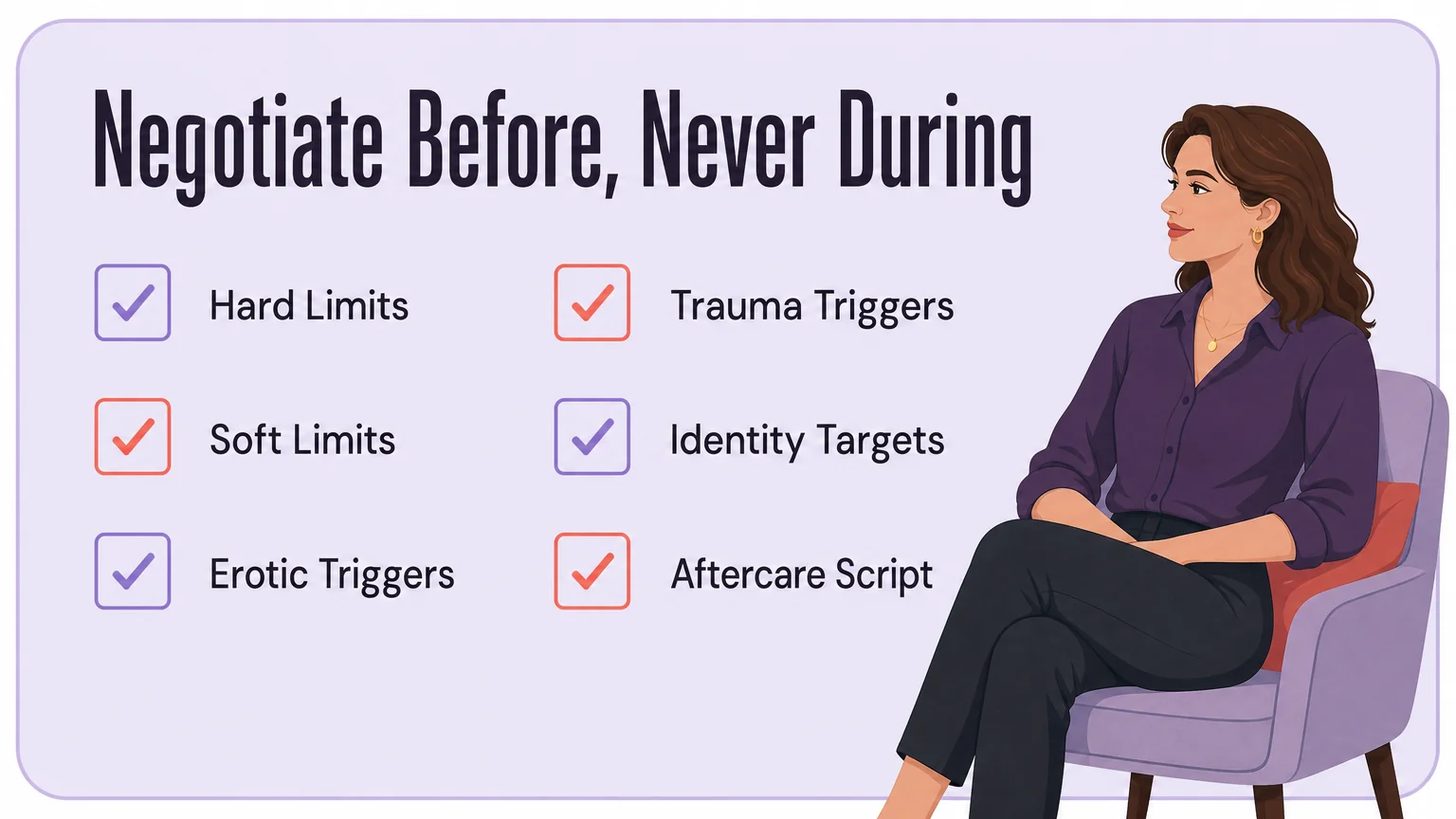
Negotiation covers erotic triggers, trauma triggers, hard limits, soft limits, identity targets, and delivery mechanism. Negotiate before, never during: you cannot give consent in subspace.
Know your own narrative first: what turns you on, what you want to hear, what you want to say.
Softer:
- “Can I tell you something I have been thinking about?”
- “I want to try something and talk about it first.”
- “I am not asking for it tonight. I want you to know.”
- “I want to tell you something and I am nervous about it.”
- “Tell me if this is too much.”
Harder:
- “I want you to hold me down and not ask me if I am okay.”
- “I want to be used. Not tonight necessarily.”
- “There is a thing I want and I have never said it. Ask me again in a minute.”
- “I wrote it down because I could not say it.”
Best for a reader who knows what they want and cannot say it. Skip if you are not yet clear on your own narrative.
12. Bratting: Defiance As A Register
Bratting is taboo inside the kink community itself, not just against vanilla norms, which is why it reads as an identity.
It plays with the expectation of compliance to get a rise, and gives a container for needs hard to voice, pain among them.
The rule map is the safety structure: core rules are honesty, trust and well-being, never brattable. Brattable rules are flavor: bedtime, water intake, journaling.
Bratting is a request in disguise: brat for humiliation and your Dom assumes a spanking, and neither of you gets what you want.
Punishment deters; funishment is play punishment inside a story where no rule was broken. For a masochist brat, a swat makes them do it more.
Softer:
- “Make me.”
- “Is that all?”
- “You can do better than that.”
- “I forgot.” Said with a smile, when you did not.
- “I will get to it. Eventually.”
Harder:
- “You are going to have to do better than that, Sir.”
- Deliberate silence when you have been told to answer.
- “Oh, was that a rule? I must have missed it.”
- “You could make me. If you wanted to.”
- “You told me to put it away. It is on the floor.”
If you freeze rather than talk back, low-verbal bratting works too: skip an honorific, be slow to obey, roll your eyes.
Doms and tops have limits too: if your Dom says do not call me names, that limit holds. Do not play with safewords in public: red is a universal signal. If an agreed boundary is ignored repeatedly, that is a consent problem, not a bratting one.
Punishment deters. Funishment plays. Core rules are never brattable. Brat rules are flavor.
13. Degradation And Humiliation: The Register That Needs A Negotiation
Consensual degradation is psychological theater: a pre-agreed script built on real trust, with the submissive an active participant who authorized it. That separates it from abuse.
It is a controlled confrontation with internalized shame, and it helps people master their fear of judgment. Wanting this is not a character flaw.
The negotiation, in full: hard limits stop the scene, soft limits are caution points, erotic triggers are the phrases you want, trauma triggers the ones to avoid, and identity targets are permitted.
Agree a word separating humiliating from hurtful, and a delivery mechanism: tone, volume, duration. Agree the post-scene affirmation script and the de-roling step in advance, where your Dom shifts from character to caregiver.
The timing rule governs all of it. You cannot negotiate in subspace: judgment and the ability to communicate limits are impaired, much like being drunk or high. It all happens before or after.
Degradation can target identity, or cast the sub as an object: a hole, a tool, a thing for the Dom’s use. Negotiate those separately.
Tone, not volume, carries this register. The same sentence lands differently low and flat than shouted.
Softer:
- “Desperate little thing.”
- “Look at you. You cannot even speak.”
- “Say it again. Louder.”
- “You would do anything I asked.”
- “Pathetic little thing.”
Harder, and none of it softened:
- “You are just a hole for me to use.”
- “You are pathetic, and you love it.”
- “Nothing but a warm mouth.”
- “Dirty little pig.” “Filthy little pig.” “Little slime puppy.” “Pathetic loser.”
- “Christ, you are so fucking pathetic.” Delivered low and flat, which is what produces the reaction.
Then the part that cannot be skipped: aftercare in the same scene, with the rehumanization script out loud. “You did exactly what I needed you to do. I respect your willingness. You are whole.” The de-roling step stops the theatrical lie from becoming a real wound.
Negotiate first, write the phrases down, run the scene, close with the script.
14. When It Lands Wrong: Pausing A Scene Without Ending It
Something you said landed wrong, or landed nowhere, and now the scene has a hole in it.
First rule: stop fully, and treat the safeword as the system working, not a failure. Used accidentally, the scene stops.
The line landed flat. “That one did not land, did it. Forget it. Come here.” Or: “Well. That killed it. Give me ten seconds, then put your hand back.”
The line landed wrong. “Stop. That was mine and not yours, and I am sorry. I need a minute.” Or: “I need to stop. Not because of you. Because of something I said.”
An accidental safeword. “I said red by accident. Can we slow down and start again from where we were?”
A limit you did not know you had. “I need to stop. It is not the scene, it is one specific thing.” Or: “Yellow. One thing, then I am fine.”
You went quiet and cannot get back. “I have lost it. I am not in the room. Can we just be here for a minute?”
The Dom’s version, because your Dom may need the words. “I am here. You are safe. What do you need?” Or: “That was a mistake. Tell me what you need me to do differently.”
The subtle signs matter more than the loud ones: sudden energy shifts, going quiet, withdrawn body language, vacant eyes. Check in rather than proceed.
Debrief after aftercare, not during, both partners clothed and grounded: “I felt overwhelmed when…” Then renegotiate the limit.
Crying and a defeated feeling are not evidence something went wrong: the crash is physical. Aftercare beats giving space.
Stop, assess, address physical needs first and emotional second, then debrief after aftercare and renegotiate.
15. Aftercare And Sub Drop: The Part Nobody Warns You About
The crash rarely lands that night. Expect it days later, usually 24 to 72 hours on.
Sub drop is the body returning to homeostasis, slowing the hormones it flooded the system with. An all-natural withdrawal, like being depressed and sick at once.
Past seven days, treat it separately and seek professional help.
Then the step most people skip: ask for explicit permission to not be okay. Saying “it is okay to feel this way” out loud does more than anything else.
Doms get it too, sometimes called The Mondays, though bottoms report it far more. The Dom backs off exactly when their sub needs them most.
Aftercare is defined by having happened, not by its content: a two-line check-in beats a plan that does not, and it is part of the scene.
Softer, from the sub:
- “I think I am dropping. Can you stay on the phone?”
- “Can you just hold me for a bit?”
- “I do not need anything. I just need you to know.”
- “I am cold and sad and neither makes sense.”
- “Tell me we are okay.”
Harder, from the sub:
- “I am not okay and I am not going to be. I do not need you to fix it. Say it is allowed.”
- “I feel like I am grieving something.”
- “It has been four days and I still do not feel like myself.”
From the Dom, the one most subs have never heard:
- “You did exactly what I needed you to do. I respect your willingness. You are whole.”
- “You are not being dramatic. This is the drop. It has a name and an end.”
Physical: cold, exhaustion, sugar cravings, soreness. Sleep, protein, electrolytes, sunlight.
Mental: confused, insecure, abandoned. Aftercare as a transition out, read others’ stories.
Emotional: lonely, sad, raw. Say “I feel sad in my body,” then ground.
The reason you went quiet is the reason it worked. The state that took your words took your self-consciousness.
Everything here assumes you have someone to say it to. If you do not yet, that is the first problem, and it is worth solving somewhere that does not make you explain yourself first. Find them on 3Fun.
Frequently Asked Questions About Submissive Dirty Talk
Do I need to be confident before I can talk dirty?
No. The causality runs the other way: if you are not confident in bed you will be hesitant with dirty talk, so waiting for confidence is a dead end. Confident people do not care whether they are good at something; they stay curious and move toward more pleasure. Awkwardness is the entry fee.
What if my partner laughs or giggles when I try?
Take it as a hit rather than a miss. A giggle usually means you made them feel something, not that they are mocking you. The only mistake is refusing to start.
Is it a problem if my dirty talk sounds repetitive?
Yes. Repetition is a commonly named turn-off: the same three phrases on a loop sound scripted. The fix is not a longer script but delivery, varied before the words, with a different location, pace and volume, and no change to your voice, since a performed sexy voice reads as fake.
Why does a word that works for one person ruin it for another?
Because vulgarity is dialect dependent. A word that reads as degrading in one place reads as crude in another, and can land differently in two countries. Ask which words turn them on and which turn them off.
Is it normal to want to be degraded?
Yes, and it has a clinical description rather than a diagnosis. It is a controlled confrontation with internalized shame, and it helps people externalize and master their fear of judgment. That is why the negotiation and the rehumanization aftercare make it safe rather than merely acceptable.