
Close to half of all adults have at least one fetish. And yet almost everyone who has one believes, at some point, that they are the only person in the world who does.
A fetish is sexual arousal tied to a specific object, body part, or behavior not typically considered sexual. So it can have many types. For some people, that object or body part is necessary to reach arousal or orgasm. For others, it is a powerful preference but not a requirement. Either way, a fetish is not a disorder, not a problem, and not evidence of damage. It is a variation in human sexuality, period.
The isolation you feel is the illusion. A representative survey found 46.4% of adults report at least one paraphilic interest. The numbers tell a different story, and so does your brain. We will look at where fetishes come from, starting with the strange journey of the word itself and ending inside your neural circuitry. We will cover how common they actually are, with data that may surprise you. And we will walk through what helps: how to talk about your desires with a partner, how to navigate mismatches, and how to tell the difference between a healthy fetish and something that needs attention. No clinical jargon. No judgment. Just what actually helps.
Where Fetishes Come From: History, Science, and Your Brain
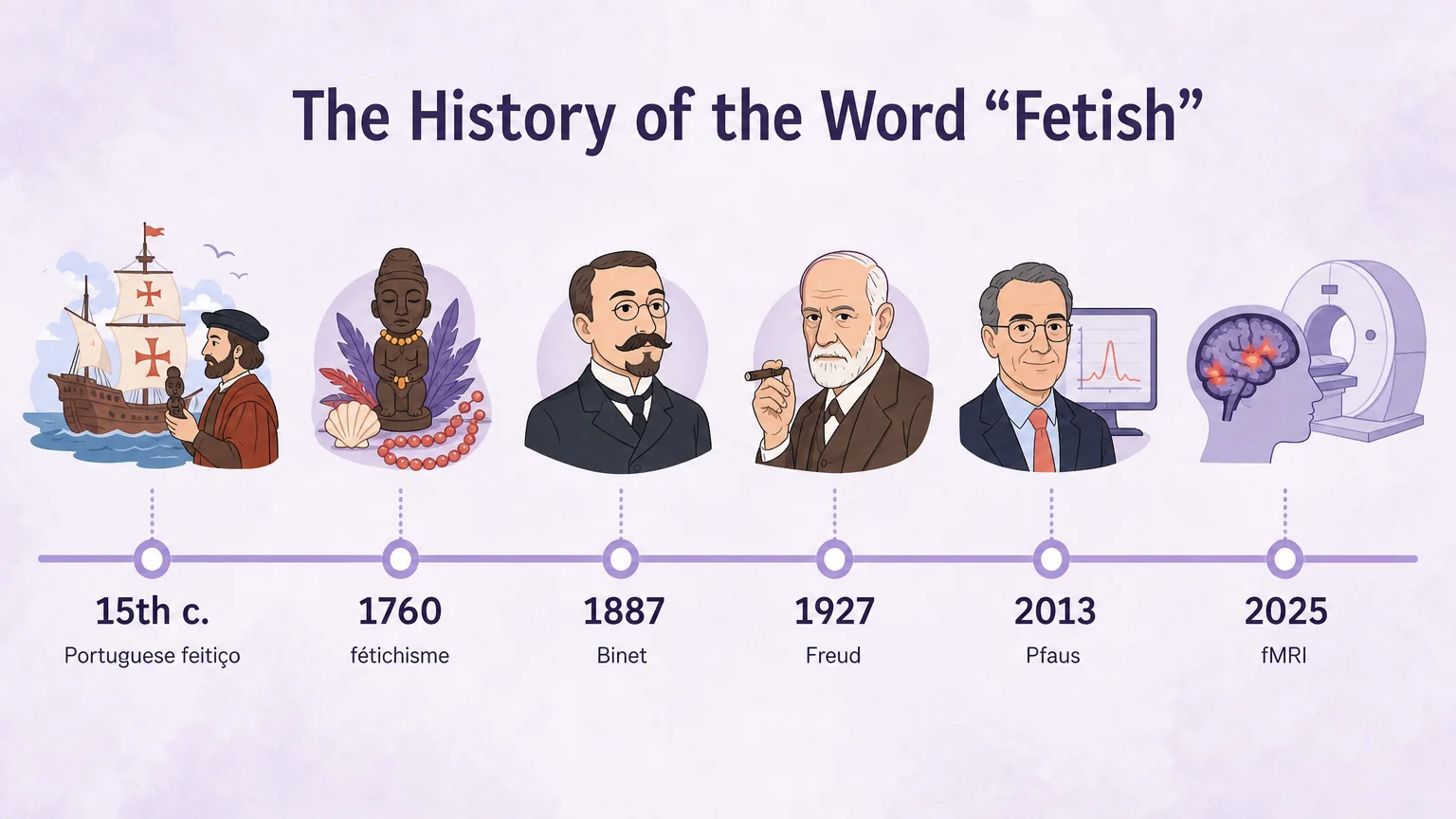
The word “fetish” started its life on 15th-century Portuguese trading ships, where sailors used feitiço to describe the charms and ritual objects they encountered along the West African coast. It would take another 400 years before the word entered the bedroom.
That journey is worth tracing. The root is the Latin facticius, meaning artificial or made by art. That became the Portuguese feitiço, meaning charm, sorcery, or allurement. By 1669, the word had crossed into French as fétiche. In 1760, Charles de Brosses introduced fétichisme as a category in the study of religion, claiming it was the earliest, most primitive stage of religious development. The word was born from Europeans misunderstanding African spiritual practices, and that colonial subtext lingered as the term migrated into psychology.
The sexual meaning arrived in 1887, when French psychologist Alfred Binet published “Du fétichisme dans l’amour,” arguing that fetishism arose from emotionally powerful childhood associations. Havelock Ellis and Richard von Krafft-Ebing codified the concept a decade later in his Psychopathia Sexualis. By 1927, Freud had given the fetish its most famous psychoanalytic formulation: a substitute for the mother’s phallus, the object the young child believes the mother possesses and cannot bear to give up. The word had traveled from Portuguese ships to Freud’s Vienna, accumulating cultural weight at every stop.
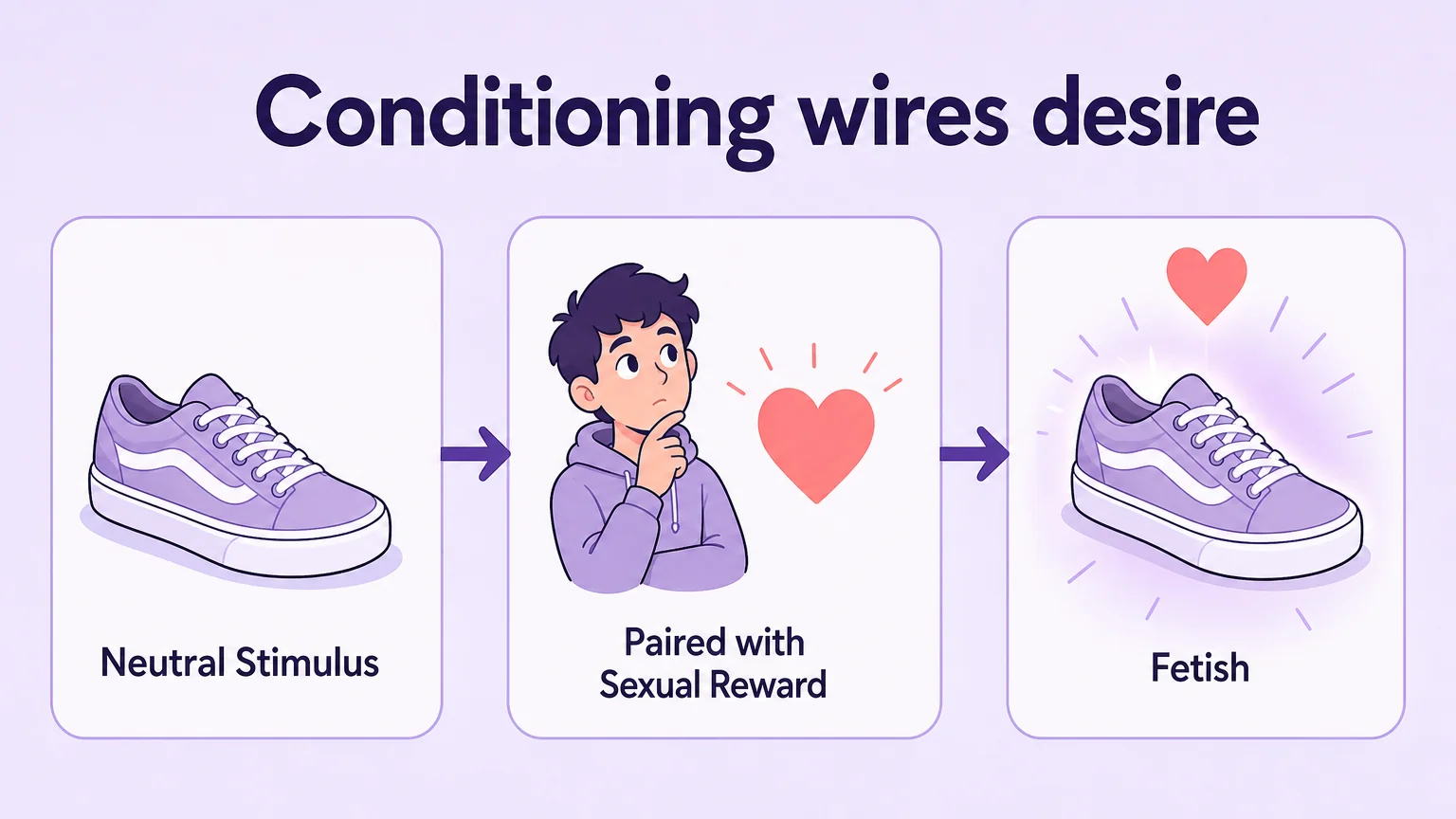
But your brain works on a much simpler, more universal principle.
The core mechanism behind fetish development is Pavlovian conditioning. Neutral stimuli, a texture, a body part, a scenario, acquire sexually arousing properties when repeatedly paired with sexual reward. This associative learning runs through dopamine signaling in the brain’s reward circuitry. It is not Freudian. It is learning theory, and it happens in every brain.
The evidence is striking. Pfaus and colleagues (2013) conditioned male rats to associate a rodent jacket with sexual reward. The rats developed a preference so strong they showed significant copulatory deficits when the jacket was removed, a direct animal model of fetish formation. Stanford Medicine researchers later identified a dedicated neural circuit in male mice, involving BNST neurons that secrete Substance P and connect to the preoptic hypothalamus, that controls libido and mating behavior. Activating this circuit triggered mating even with inanimate objects.
In humans, a 2025 fMRI study by Wojciechowski and colleagues found that men with compulsive sexual behaviors showed enhanced conditioning and disrupted extinction in the ventral striatum, dorsal anterior cingulate cortex, and anterior orbitofrontal cortex during appetitive conditioning. Sexual behavior, especially orgasm, increases dopamine in the nucleus accumbens. Repeated exposure sensitizes these mesolimbic pathways.
Here is the practical takeaway: conditioned sexual responses are highly resistant to extinction. This is why trying to “cure” a fetish through willpower alone does not work, and why acceptance-based approaches are more effective than suppression. Your brain wired this during formative experiences. Understanding that is the first step toward self-acceptance.
How Common Are Fetishes?
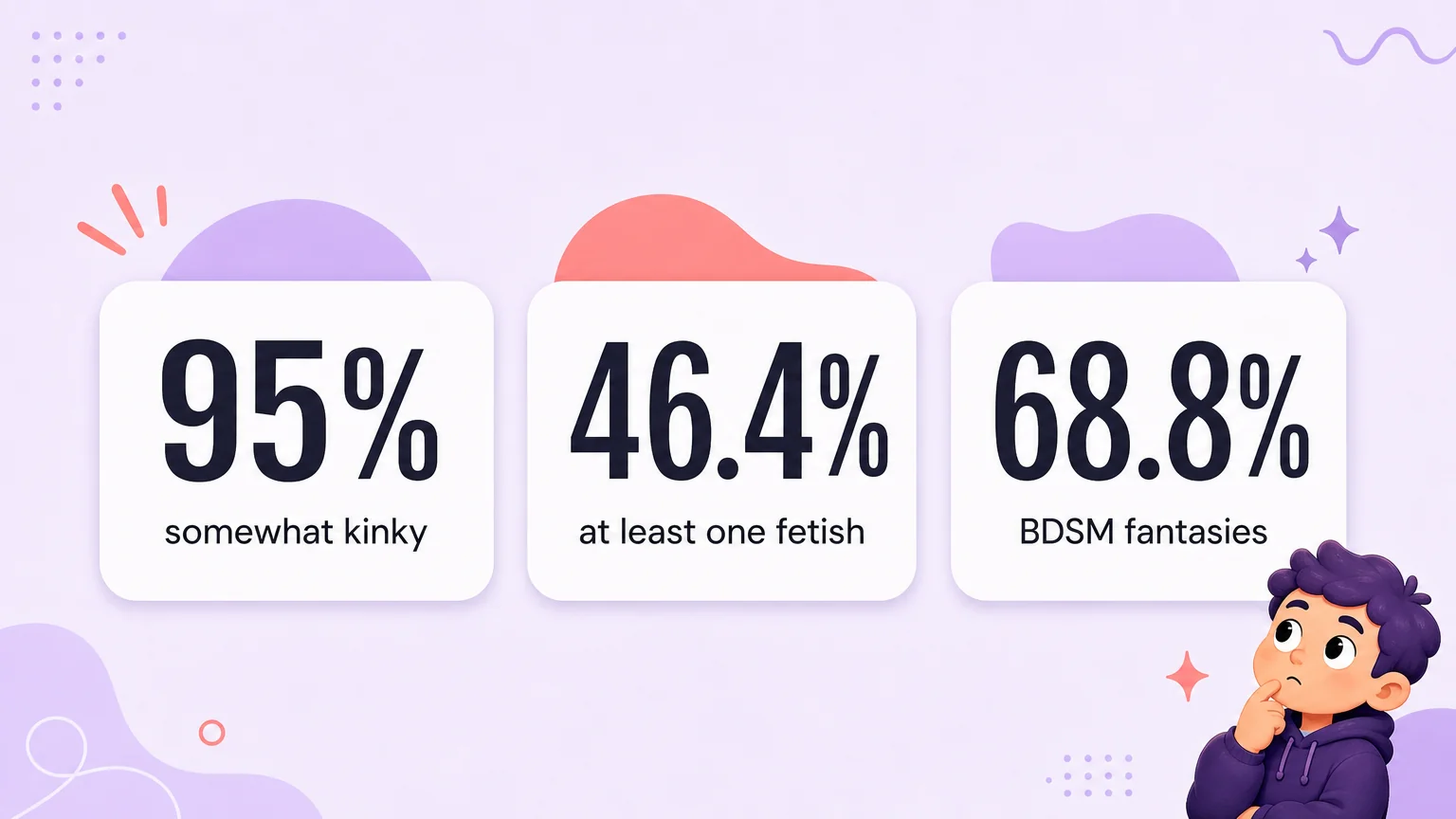
A 2024 survey of 2,000 adults found 95% of sexually active adults described themselves as at least somewhat kinky. Let that number land. Even using the stricter definition, at least one paraphilic interest, a representative Swiss study found 46.4% of adults qualify. By any measure, this is common.
The broader data is consistent. The same 2024 Flure survey placed public sex at 50%, threesomes at 49%, foot fetishes around 14%, and cuckolding around 14% among the most common interests. A separate U.S. survey by DatingAdvice in August 2024, sampling 500 Americans, found nearly half reported some form of erotic kink, fetish, or fantasy, with BDSM, swinging, and role-playing leading the list. These numbers are not from kink communities. They are from the general population. If you have a fetish, you are in the majority, not the minority.
The academic data tells the same story through a more rigorous lens. That Swiss survey, a representative sample of 1,236 adults aged 18 to 50, found 46.4% reported at least one of 13 paraphilic interests. A Belgian representative sample found 68.8% of respondents had either engaged in BDSM activities or had corresponding fantasies. These are random population samples, not convenience surveys. The academic numbers align with the survey numbers because they are measuring the same reality.
Across virtually all studies, men report higher rates of most paraphilic interests. A Czech study found 31.3% of men versus 13.6% of women reported at least one paraphilic interest. Women more frequently report masochism. This is a data point, not a judgment, and it reflects both biology and reporting gaps shaped by cultural norms around female desire.
Here is what the numbers mean for you: if roughly half the population shares some version of this, and your brain wired it through the same conditioning mechanism that shapes all human desire, the question is not “why am I like this?” but “why did no one tell me sooner?”
The Emotional Arc: Shame, Secrecy, and Self-Acceptance
It goes like this: you feel the desire, then you feel ashamed of the desire, so you push it away. Then arousal builds again, and you give in. It feels incredible, which is confusing, because afterward the shame is worse than before. If you have lived in this loop, you are not broken. You are having a normal response to a culture that told you a lie about your sexuality.
Sex therapists describe this as a push-pull dynamic: in non-erotic moments, suppression; when arousal builds, surrender; after release, intensified shame. This doesn’t mean the fetish is pathological. It means you’ve internalized external judgment. The 2024 finding that 1 in 3 adults would sign a “Sex NDA” to keep their kinks secret reinforces the point: secrecy is common because shame is common.
Trying to eliminate a fetish through force of will is ineffective. The conditioning research we covered earlier explains why: conditioned sexual responses resist extinction. Fighting your own brain creates a loop where every attempt to suppress becomes another reinforcement of the shame. The alternative is integration: making peace with the desire rather than fighting it. (If acceptance isn’t where you’re starting from, there’s a step-by-step guide that meets you where you are.)
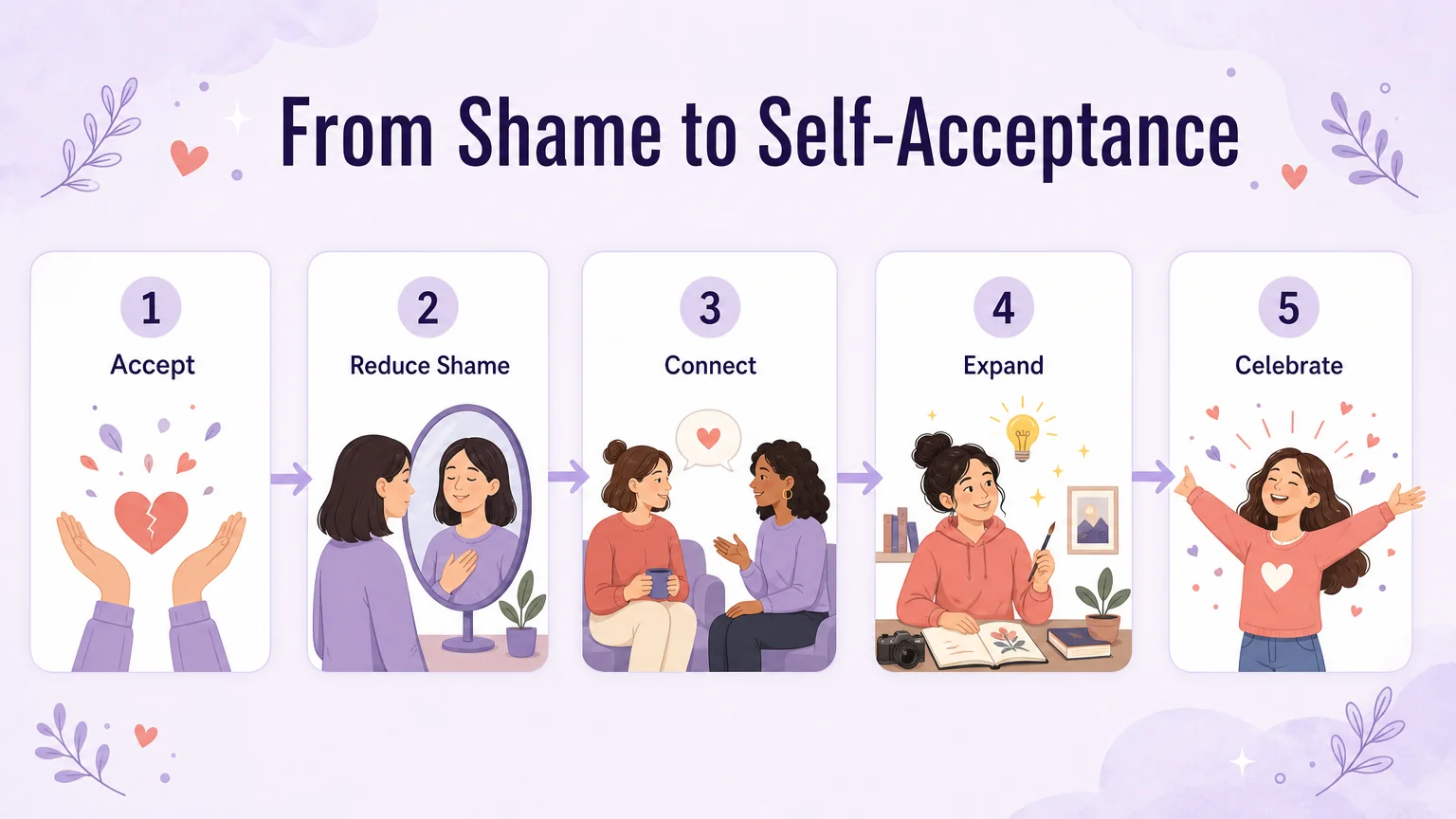
Rose and Thorn Sex Therapy outlines a five-step framework for moving from shame to self-acceptance. First, accept and grieve: acknowledge your sexuality as it is, and process the feelings that arise. Second, reduce shame by working toward neutrality rather than building resistance and avoidance. Third, connect with others, because shame is an emotion of isolation and sharing is central to recovery. If you are ready to find people who share what you are into, we have put together a guide to the fetish dating sites that actually fit your interests. Fourth, expand your erotic interests; once you stop fighting yourself, you may discover more. Fifth, celebrate: recognize the richness your unique erotic profile brings to your life and relationships.
This is not abstract. Cal Domingue’s 2024 case study in the Journal of Humanistic Psychology documents a six-year therapeutic journey where a client moved from seeing BDSM and kink as a shameful fantasy to full acceptance as part of his identity. The milestones were real: eradicating shame, achieving self-acceptance, moving beyond erotic fulfillment to identity, and experiencing the positive impact of relationship and community. Self-acceptance is not a switch you flip. It is a process you build.
If shame is impairing your ability to function, not just making you uncomfortable, therapy with a kink-aware professional can help.
How to Talk About Your Fetish With a Partner
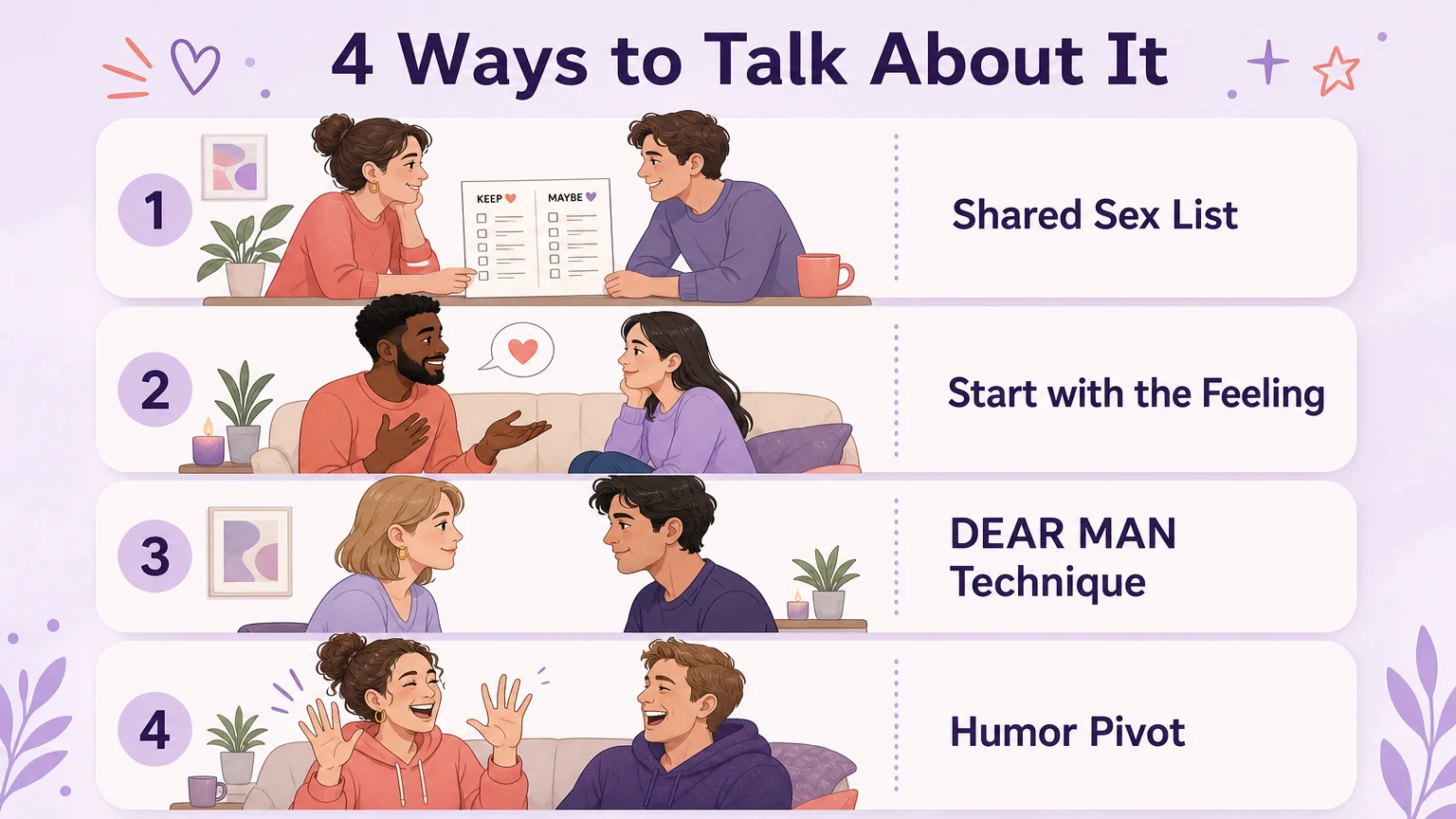
Sexologist Amanda Dames has seen what happens when people cannot talk about their desires: shame festers, distance grows, and sometimes people seek fulfillment elsewhere because they felt they could not bring their full selves to their primary relationship. The conversation you are avoiding is the one that could bring you closer.
Start by reframing what disclosure actually is. Sex therapist Dr. Joe Kort describes disclosing a fetish as “another coming out.” It carries similar fears of rejection, judgment, and humiliation. When a partner shares a fetish with you, view it as a sign of trust and closeness, not a threat to the relationship. This reframe matters before a single word is spoken.
Sex therapist Dr. Emily Jamea recommends a scaffolded approach that starts with the feeling, not the act. Instead of “I want to be tied up,” try “I get turned on by the idea of surrendering completely, being free of responsibility for a while.” Include the why. Explain what the fantasy means to you emotionally. This helps your partner understand rather than feel threatened or inadequate. Choose the right moment: never during or immediately after sex, during an argument, or when stressed. A calm, neutral time when connection feels safe.
For a more structured approach, therapists at Rouse Relational Wellness adapted the DEAR MAN technique from dialectical behavior therapy. Describe the desire and ask permission to share. Express how you feel using I-statements. Assert what you would like while respecting their comfort zone. Reinforce with thanks when they hear you out. Stay Mindful by checking in throughout. Appear confident with eye contact, even if nervous. Negotiate: acknowledge their surprise and separate the need to be heard from expecting participation.
Licensed relationship therapist Jaime Bronstein offers a lighter-touch alternative. Lead with confidence: express your love for your partner and frame the conversation as an opportunity to mix things up. Normalize it: explain that although it might sound unusual, it is not just you. Her humor pivot, share, say “just kidding,” then reveal you were serious, plants the seed gently. Always give your partner the freedom to say no without pressure.
For the lowest-pressure entry point, sexologist Sofie Roos recommends the shared sex list. Both partners independently fill out categories: things to try, curious about, hard limits, turn-ons, aftercare needs. Then compare and mark each other’s items with yes, maybe, or no. Matches become a shared roadmap. Mismatches are respected as boundaries. This method lowers the pressure of verbal confession and creates ongoing dialogue rather than a one-time reveal.
Not one of these methods is the “right” one. Pick the entry point that matches your dynamic. The only wrong move is silence.
When Desires Do Not Match
You did the hard thing. You told your partner. And they said no. Or maybe they said “I will try” but you can tell their heart is not in it. The conversation isn’t over. It just changed shape.
Desire gaps are common, not a sign the relationship is broken. Licensed sex therapist Marissa Nelson works with couples to bridge these gaps through practical communication, giving feedback without hurting your partner, and recognizing when a kink feels like a dealbreaker. Wanting different things sexually does not mean either of you is wrong.
You have more options than a binary yes or no. The spectrum starts with fantasy only: the fetish lives in imagination and dirty talk but not in physical enactment. Many couples find this is enough. Next is compromise: find the overlap between what you want and what your partner is comfortable with. A foot fetishist whose partner is not interested in foot worship might start with a foot massage during foreplay. Further along the spectrum, ethical non-monogamy can provide a structural solution when one partner has a fixed fetish requirement their primary partner cannot accommodate. This requires explicit boundary setting, continuous consent negotiation, and emotional compartmentalization.
But there is a prerequisite. Opening a relationship to explore kink is not recommended as a way to fix existing relationship problems. ENM is an amplifier: it makes strong relationships stronger and broken relationships explode. The relationship must be stable first. And your partner’s no to your fetish is valid and must be respected regardless of which option you pursue.
As kink ethics commentator Will Hartley puts it: “Vanilla is not a consolation prize. It is simply another perfectly legitimate way to enjoy sex.” Treating someone’s boundaries as evidence they are less open-minded undermines consent rather than promoting it. Your partner not being into your fetish is not a problem to solve. It is a boundary to respect. The goal is not to get your partner to participate. The goal is to find a way for both of you to feel whole.
The Line Between Healthy Fetish and Fetishistic Disorder
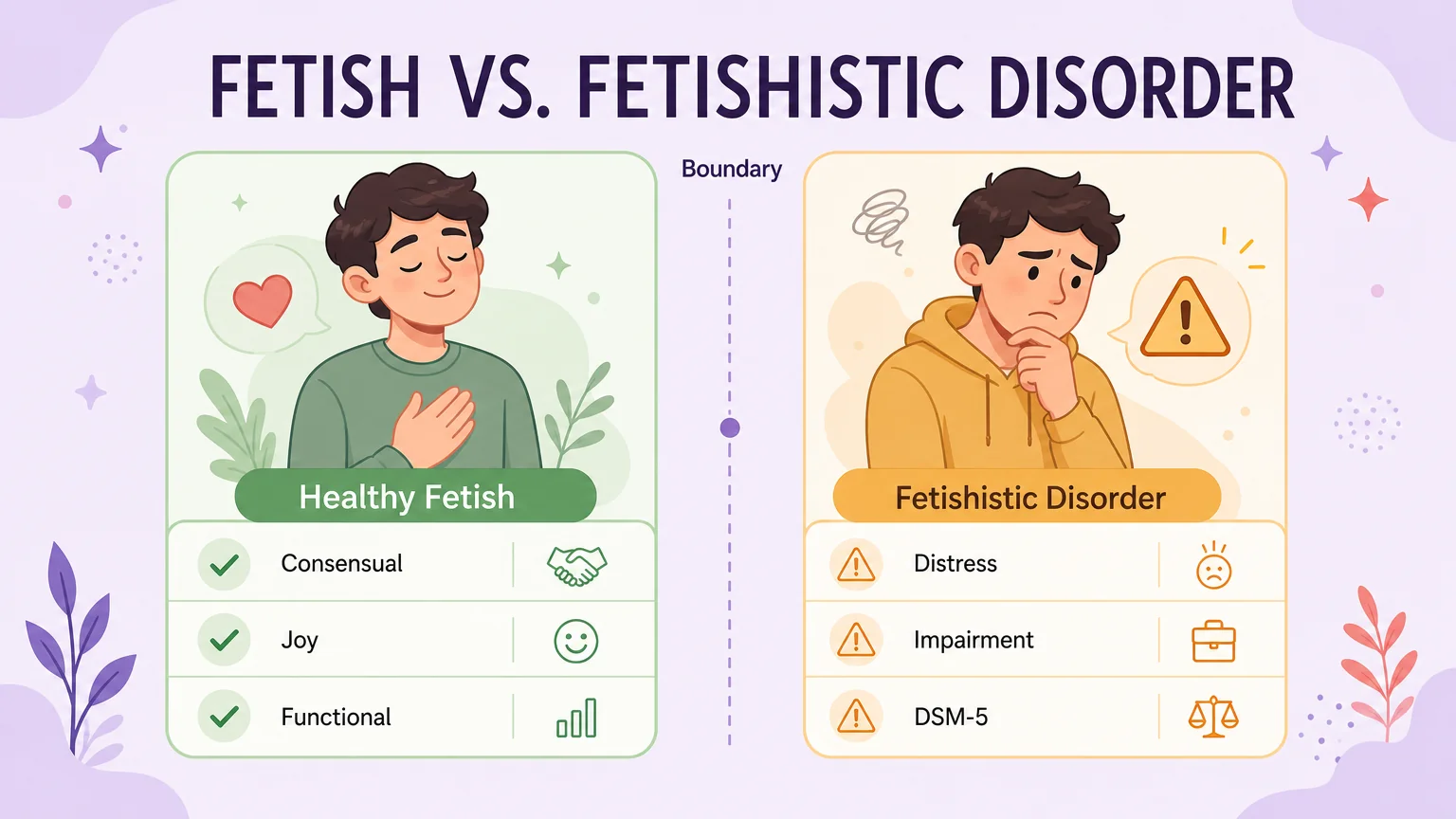
Having a fetish is not a mental health condition. The DSM-5, the manual mental health professionals use to diagnose, explicitly separates having a paraphilia, the interest itself, from having a paraphilic disorder, when that interest causes harm or dysfunction. This is the anchor fact that reframes everything.
The DSM-5 lists three requirements for fetishistic disorder, and the key word is “and.” All three must be present. Criterion A: recurrent, intense sexual arousal from nonliving objects or nongenital body parts, lasting at least six months. Criterion B: the fetish causes clinically significant distress or impairs social, occupational, or other important areas of functioning. Criterion C: the objects are not limited to clothing used for cross-dressing or devices designed for genital stimulation. Most people with fetishes meet criterion A alone. That is not a diagnosis.
The distress that turns a fetish into a disorder is not “I feel a little weird about this” or “I worry what people would think.” It is distress that meaningfully impairs your life: you cannot hold a job, you cannot maintain relationships, you engage in non-consensual behavior, or you experience severe shame that prevents normal functioning. Fetishistic disorder appears almost exclusively in males, which may reflect both biological factors and the way diagnostic criteria have been shaped by gendered assumptions.
The distress that leads to diagnosis is often a direct product of cultural shaming rather than intrinsic to the fetish itself. Many people who meet the distress criterion are distressed because society taught them to be, not because the fetish is inherently harmful. This does not make the distress less real. It means the source is external judgment internalized, and therapy can address that directly.
If you feel unable to control your behavior around the fetish, if it is interfering with work or relationships, if you are engaging in non-consensual acts, or if the shame is severe enough that you cannot function, a kink-aware therapist can help. For everyone else: your fetish is a variation in human sexuality, not a condition that needs treatment.
The Difference Between a Kink and a Fetish
You have just read about where fetishes come from, how common they are, and how to talk about them. Now the question that brings it home: is what you are experiencing a kink, or a fetish? The answer changes how you think about your own desire.
Kink is the umbrella term. It covers any non-conventional sexual interest: bondage, impact play, role-play, power exchange, sensory play. It is broad, flexible, and optional. A person with kinks can enjoy vanilla sex perfectly well. Kink is a spice, not the meal. What counts as kink depends on time, social circle, and culture. The word is relative by design.
A fetish is a specific type of kink where a particular object, body part, or stimulus is central to sexual arousal, and for some people, it is necessary. You already know the neuroscience and the prevalence. The distinction that matters now is practical. A kink enhances arousal. A fetish may be required for it. Someone with a foot kink finds feet sexy. Someone with a foot fetish may struggle to reach orgasm without foot involvement.
All fetishes are kinks, but not all kinks are fetishes. That is the clean mental model. The distinction got blurred because social media uses the words interchangeably, “fetish” sounds edgier, and porn tags use it as a catch-all. First exposure to kink terminology now comes through TikTok rather than community education, which flattens the vocabulary. People with a mild kink think they have a fetish. People with an actual fetish feel more isolated because the word has been diluted.
Two questions will help you self-categorize. Is what arouses me a thing or an action? Do I need it present to experience arousal, or does it just make things better? The answers define your communication strategy. A kink can be a fun suggestion. A fetish may need the structured conversation covered earlier. Either way, you now have the tools.
Check this guide to get the full image of differences between the fetish and the kink: Fetish vs Kink: The Distinction Nobody Explains Clearly.
FAQ
What is a fetish?
A fetish is a sexual attraction to a specific object, body part, or behavior not typically considered sexual. For some, the fetish object is necessary to achieve arousal or orgasm. It is a sexual need, not just a preference.
What is the difference between a kink and a fetish?
Kink is the umbrella term for any non-conventional sexual interest. A fetish is a specific type of kink where a particular stimulus is central to arousal and may be necessary for it. All fetishes are kinks. Not all kinks are fetishes.
Are fetishes normal?
Yes. Representative surveys place paraphilic interests between 46% and 95% of the adult population. A fetish is a variation in human sexuality, not a pathology.
Where do fetishes come from?
Neuroscience points to Pavlovian conditioning: neutral stimuli paired with sexual reward during formative experiences become permanent arousal triggers, mediated by dopamine in the brain’s reward circuitry.
How do I tell my partner about my fetish?
Pick a calm, neutral moment. Start with the feeling behind the desire, not the act. Use I-statements. Frame it as an invitation, not a demand. Separate being heard from expecting participation. Structured tools like DEAR MAN or shared sex lists help.
Can a fetish be cured?
Fetishes cannot be cured through willpower. Suppression worsens the shame cycle. The goal is integration: reducing shame, achieving self-acceptance, and finding healthy consensual ways to engage.
How do fetishes fit into non-monogamous or swinging relationships?
Ethical non-monogamy can provide a structural solution when one partner has a fixed fetish need their primary partner cannot accommodate. It requires a stable relationship, full consent, explicit boundaries, and continuous communication. ENM is not a fix for existing problems.