
It is 2 a.m. and you are Googling sentences you never thought you would type: “am I being treated unfairly in a triad,” “couple keeps making decisions without me,” “why do I feel like a guest in my own relationship.” There is a name for what you are experiencing, and this article is going to give it to you.
A unicorn is a single person, most often a bisexual woman or nonbinary person, brought into an established couple’s relationship on terms that center the couple’s needs, comfort, and stability above all else. This is not an indictment of couples who want to explore together. Wanting to explore is a sign of relational abundance, not lack. But there is a difference between being welcomed as an equal partner and being recruited to fill a role someone else wrote before you arrived.
This article is advocacy for the single person. The nine signs that follow are a diagnostic map, not a verdict. Some will land hard. Some will name something you felt but could not articulate. Use them to see your situation clearly, then decide what you want to do about it. The last section gives you scripts, questions, and exit strategies.
Let’s start with the sign that arrives earliest. It shows up before the relationship itself does.
1. You’re Being Recruited, Not Pursued
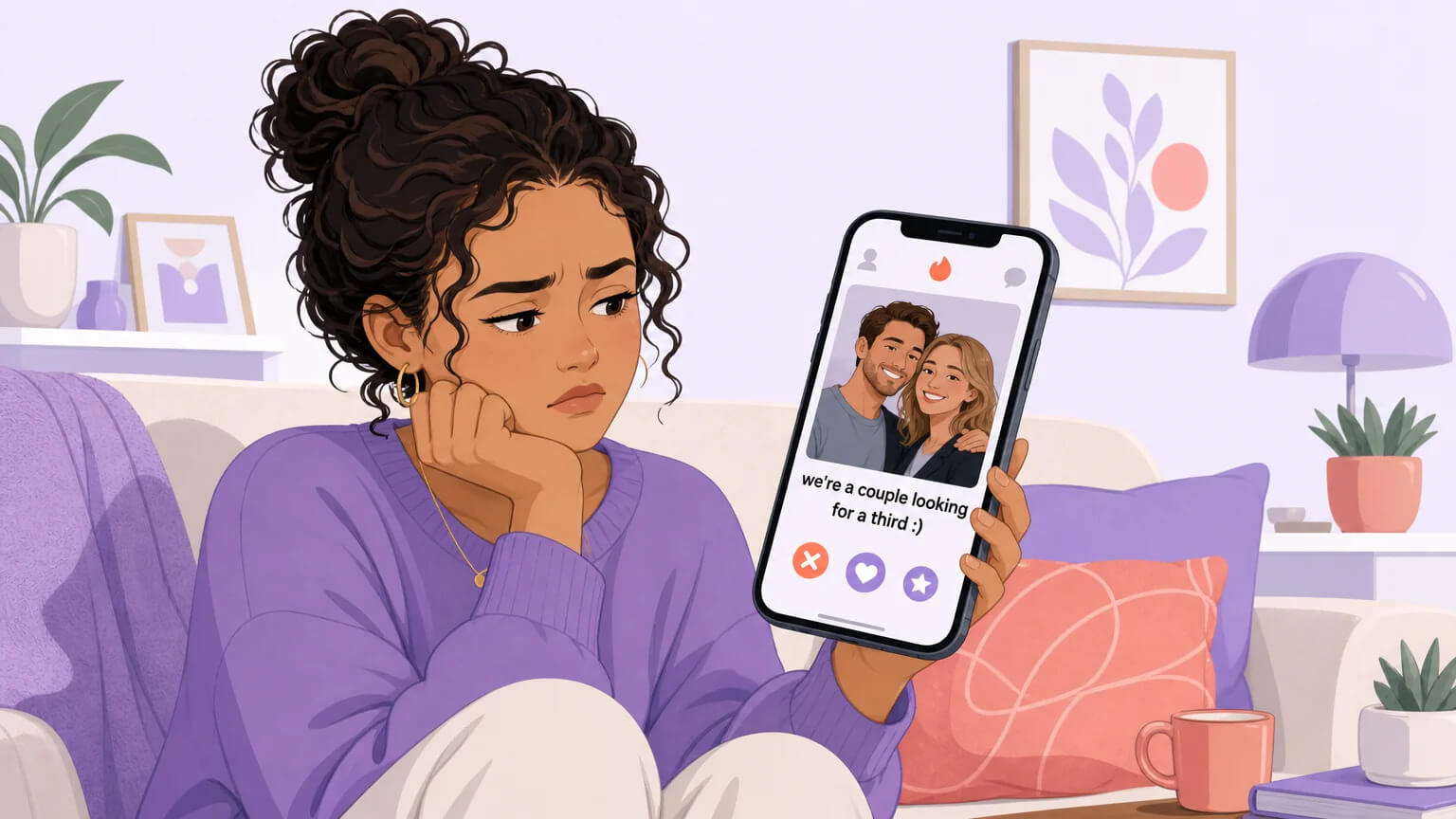
Every bisexual woman on a dating app knows this scenario. Her profile says she is single and looking, but the first message is “hey! my boyfriend and I think you’re gorgeous.” Sometimes the profile hides the partner entirely: a solo woman’s photos, a solo woman’s bio, until the conversation reaches a certain point and then the reveal lands: “so actually, we’re a couple looking for a third.”
VICE has documented this bait-and-switch extensively, calling it “toxic and actually kind of dehumanising.” Couples sometimes create profiles as a “gay woman” specifically to appear in queer feeds, treating identity categories as search filters rather than identities.
This is not an introduction. It is a sourcing operation. The distinction matters because it reveals who the arrangement is designed to serve before any relationship even begins. When someone pursues you as a person, they want to know what you want, what you are looking for, what your boundaries are. When someone recruits you as a resource, they tell you what role is available and wait to see if you will fit it.
Often, the couple has not done the emotional work of opening their relationship before starting to look for a third person. They are not seeking someone to build something new with. They are seeking someone to absorb the complexity they have not resolved between themselves. The single person becomes the human shock absorber. And the thing about shock absorbers? Nobody checks in on how they’re holding up.
Name the feeling that comes with this: you were not discovered. You were sourced. This is not about whether the couple are good people or bad people. It is about a structural position. You walked into a script someone else wrote before they ever saw your face.
When someone genuinely wants you, they ask what you want. When they are recruiting, they tell you what they need. The first question in a healthy dynamic is “What are you looking for?” It is never “Here is what we are looking for.”
2. There’s a Gender Script Running the Show
Has a couple ever told you that one partner “just isn’t comfortable” with a specific gender dynamic? That it is “just how we do things”? That it is not personal?
Now ask the question back: whose comfort is being centered in that sentence?
There is a name for this, and almost no mainstream relationship advice uses it: the One Penis Policy. The OPP is a specific arrangement where the heterosexual male partner is comfortable with his female partner being with other women, but would veto any involvement with another man. It is so common in non-monogamous dynamics involving heterosexual couples that it has earned its own acronym.
Dr. Eric Sprankle, writing in GQ, locates the OPP at “the intersection of fragile masculinity, biphobia, and transphobia.” It is not a neutral preference. It is a structural feature of couple privilege that treats certain genders as threatening and others as recreational.
The broader pattern is the fetishization of bisexual women by heterosexual couples. Bisexual women are culturally positioned as inherently available, performatively sexual, existing to fulfill a straight couple’s fantasy rather than having desires and boundaries of their own. Individual couples are not the point here. The point is a cultural script larger than any one relationship, and that script writes the bisexual woman as supporting cast in someone else’s story.
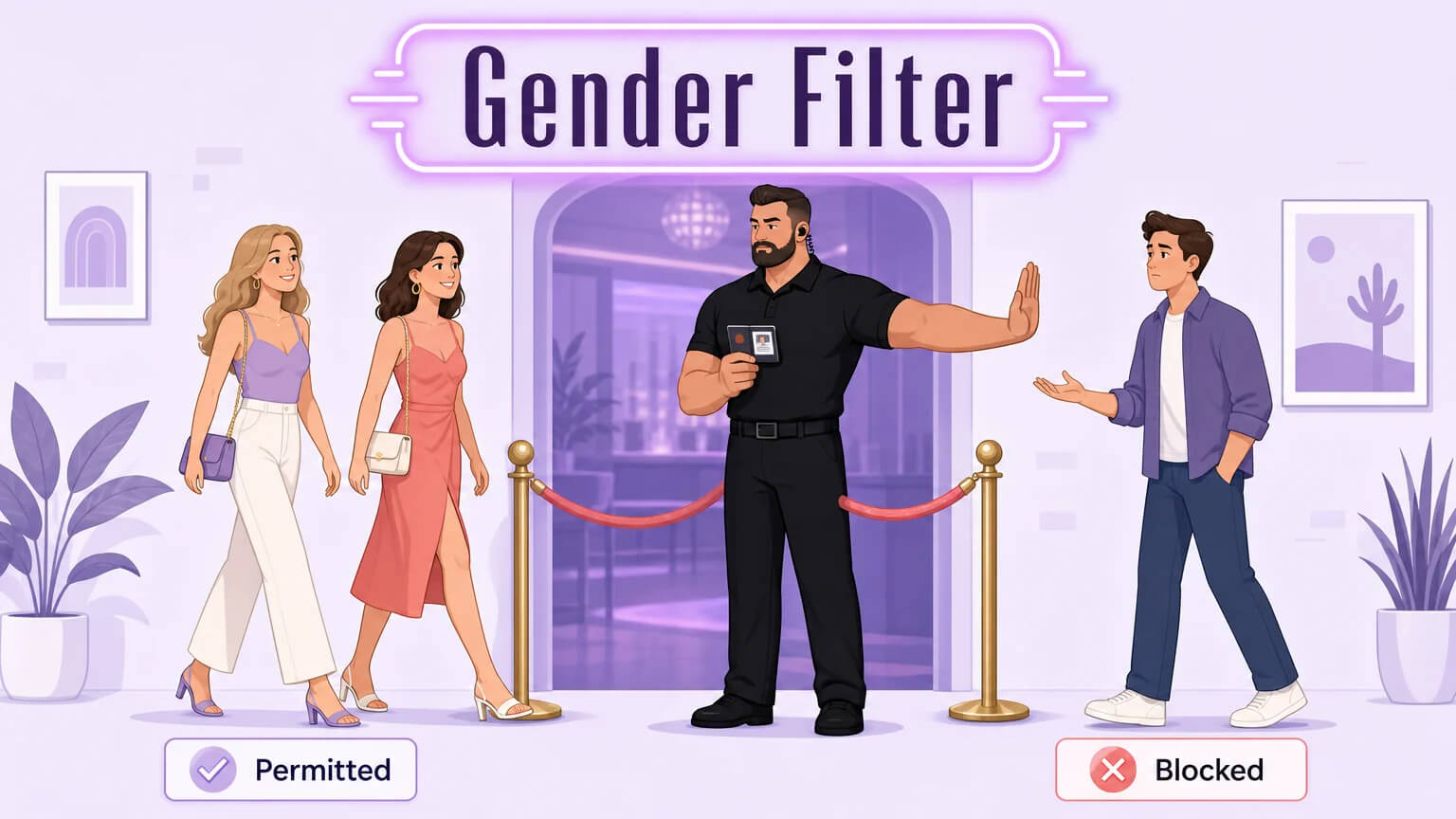
They are a guest in your playground, not a toy in your toybox. The difference between being a guest and being a toy is whether your identity is something someone appreciates or something someone consumes.
Real desire does not come with a bouncer at the gender door checking IDs. If someone’s attraction to you has to pass through another person’s gender filter before it is permitted, you are not being desired. You are being permitted. And permission can be revoked.
3. Decisions Happen in Rooms You Can’t Enter
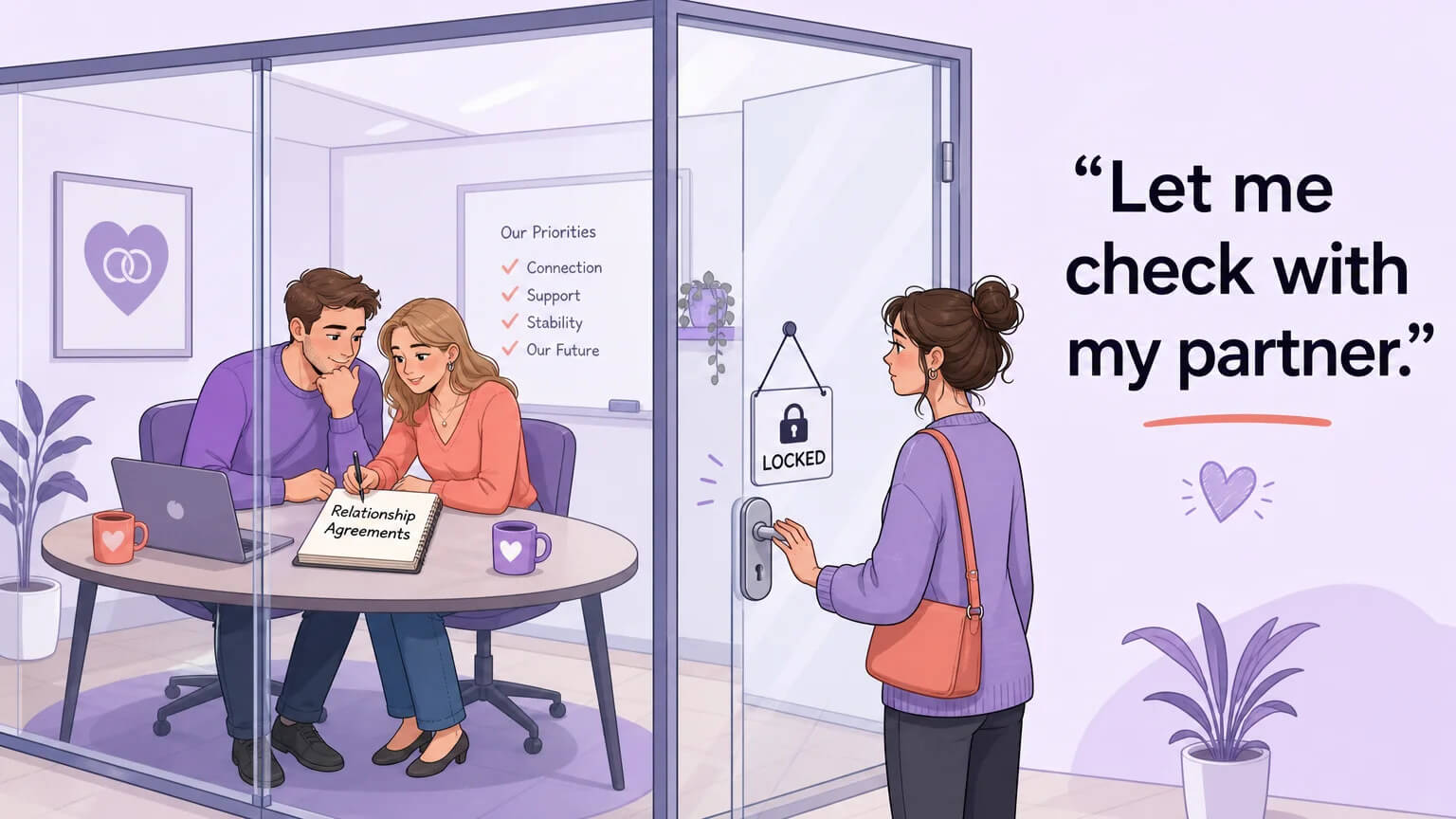
There is a conference room where decisions about your relationship get made: what the agreements are, how fast things move, what happens when someone gets uncomfortable. And you are never in that room. Sometimes you do not even know the meeting happened until the minutes get handed to you as a done deal.
The phrase you hear most often in this dynamic is “Let me check with my partner.” On its own, consulting a partner before making a decision is not a red flag. It is basic communication. But watch the pattern. If every decision requires a private deliberation between the two of them, and your input arrives after the conclusion has already been reached, you are not being consulted. You are being notified.
This structure has a name: couple privilege. The original dyad shares a home, often finances, years of history, social networks, and legal recognition. None of these things are wrong. What is wrong is pretending they do not create a power gradient, and then making decisions as though everyone is standing on level ground. As Polysingleish puts it: you cannot opt out of couple privilege any more than you can opt out of male privilege.
A 2024 study in the journal Sexualities, titled “You enjoy being a second class citizen,” documented how singles in these dynamics internalize their subordinate position. The Evolving Love Project podcast tells of a single person whose relationship ended over a conversation they were never told about.
Couple privilege is the unearned advantage of having been there first. Left unacknowledged, it operates like a silent partner in every conversation, always voting in the couple’s favor.
Equal partnership means your voice is in the room when decisions are made, not relayed through a spokesperson after the fact. If the conference room door is always closed to you, the relationship is not a triad. It is a dyad with a consulting contractor.
4. Your Bond With One of Them Gets Measured and Managed

You know exactly what this feels like. A private text exchange with one partner gets read aloud over dinner. An inside joke the two of you developed gets explained to the third person: dissected, translated, neutered. A moment that belonged to you becomes exhibit A in someone else’s relationship processing session. Your connection is not treated as a relationship. It is treated as a variable the original couple needs to manage.
The original couple’s intimacy is assumed. Sacred. Protected by years of precedent. Nobody audits their pillow talk. Nobody asks them to debrief their private jokes. But your bond with either of them? That gets measured. Monitored. Sometimes rationed. The message underneath: your closeness is a potential liability, not a feature. It needs oversight.
Some write this off as the couple being “clingy to each other.” That framing misses the structural point. The couple’s protectiveness toward each other is not about affection. It is about territoriality. They are not holding each other close. They are holding the gates. Your connection is treated as something that needs to be contained so it does not threaten the central unit.
There is a specific loneliness to realizing you cannot have a single private conversation without it being debriefed in the couple’s “processing sessions” later that night. Over time, you start self-censoring. You preemptively edit your own feelings to avoid triggering someone else’s insecurity audit.
Trust is not a test you pass by proving you are not a threat. It is the foundation someone either offers you or does not. When your intimacy needs surveillance to be “safe,” that is not trust. That is the assumption you cannot be trusted.
5. The Logistics Work, But the Emotional Math Doesn’t Add Up
You are the Tuesday night person. You are penciled into a calendar slot: dinner, the evening, maybe the night. Then you go home. The physical intimacy is generous. The sex is good, even great. But when you try to text on a Thursday morning just to say something made you think of them, the response comes back three hours later, clipped and careful. The door to the rest of their life is closed, and you have learned not to knock.
This is the logistics-emotion gap. The couple has figured out how to schedule time, how to share a bed, how to navigate the physical choreography of three bodies. What they have chosen not to build is emotional infrastructure that includes you. The physical dimension of the relationship works because the couple wanted it to work. The emotional dimension stays shallow because the couple needs it to stay shallow.
They may care about you. But the system they designed does not permit emotional investment beyond a ceiling installed before you arrived, to protect the original relationship from the perceived danger of real attachment forming elsewhere. This is not about whether they have feelings. It is about whether the structure allows those feelings to go anywhere.
Couples often frame the emotional ceiling as practicality: “We don’t want things to get complicated.” Translation: we do not want to feel the complexity of this, so you will carry the cost of keeping it simple. The single person absorbs the emotional labor of staying within the lines someone else drew.
A relationship that only works inside a designated time window is not a relationship. It is an appointment. You are a person who deserves to be woven into someone’s life, not penciled into the margins of it.
6. When Things Get Real, Their Comfort Comes First

One week it was “we both still really want this.” The next week it was “we have decided to close our relationship to work on things between us.” No conversation with Lee C. No warning. No vote. The relationship she was in had been dissolved by two people in a room she was not in. “Losing Adam too wasn’t mine,” Lee wrote. “That, more than the breakup itself, is what still haunts me.”
This is the veto, the logical endpoint of every sign that came before it. If decisions happen in rooms you cannot enter, if your bond is managed, if the emotional ceiling protects the couple, then of course the ultimate decision about whether your relationship continues also belongs to them. The veto is not a betrayal. It is the dynamic functioning exactly as designed.
Franklin Veaux’s Secondary’s Bill of Rights names rights that should be obvious: to be treated as a person rather than a disposable accessory, to have your relationship treated as real regardless of its structure, to be informed of decisions that affect you before they are finalized. That someone had to write these down tells you how often they get violated.
Poly.land author Page Turner documented the “Couple from Hell” pattern: couples who frame every crisis as “we are working on our communication” while the single person absorbs the cost of every fight, every insecurity flare, every unresolved jealousy they brought into the arrangement. The couple’s instability becomes your instability. Only you pay when it tips over.
A dynamic where one person can vote you off the island is not a partnership. It is probation. And you have been on probation since the day you arrived.
7. You’re a Guest With a Curfew, Not a Partner With a Key
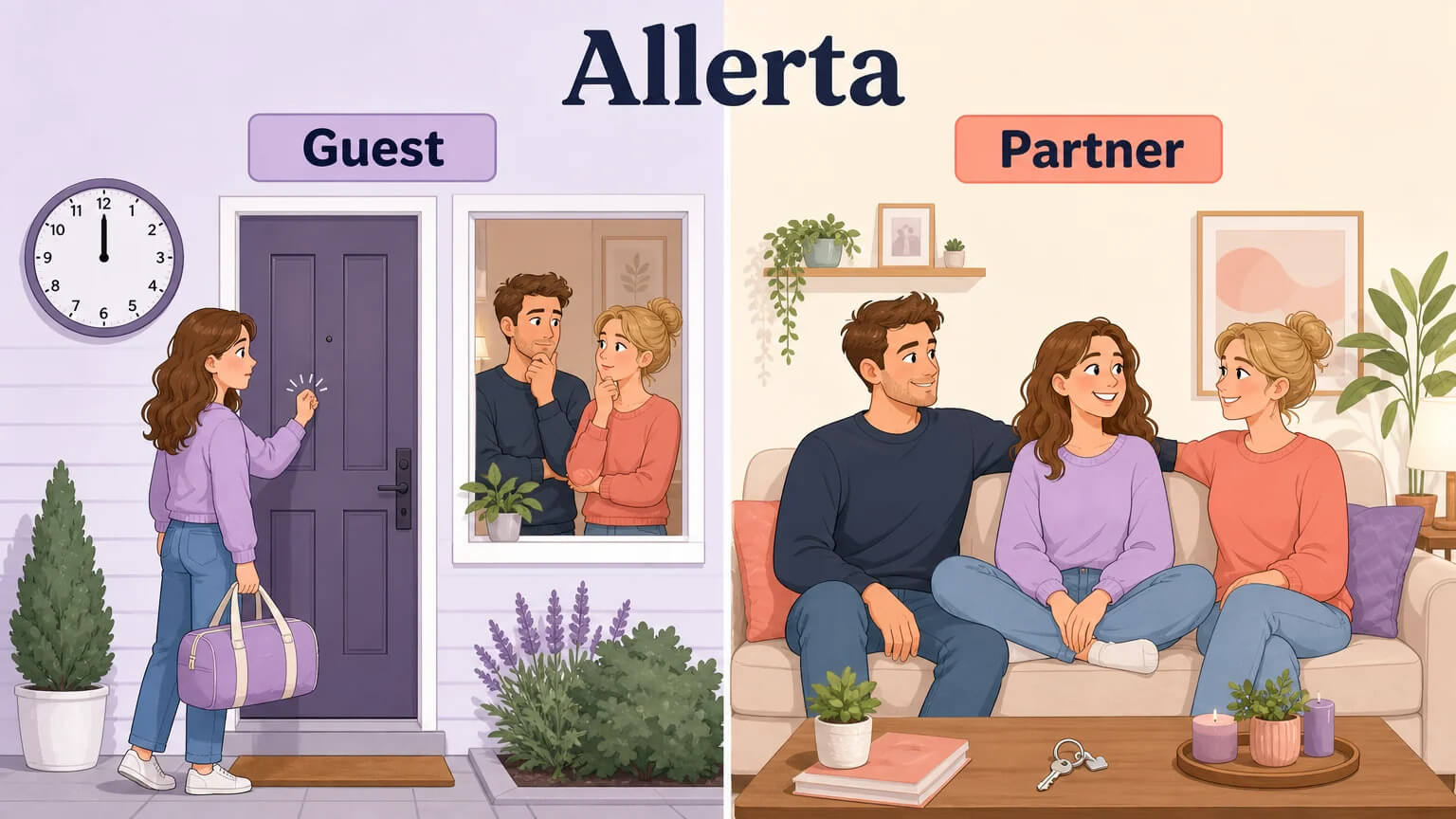
You may not know what a healthy triad looks like, because almost nobody talks about them. The internet is full of red-flag lists and nightmare stories. The happy, stable triads are quieter. You may have nothing to compare your situation against except more confusing situations. This section fixes that.
The contrast between a unicorn dynamic and an ethical triad runs across four dimensions.
First, access. In a unicorn dynamic, you are a guest: you knock, you are let in, you leave when the visit is over. You may not have a key after months. A healthy triad gives you equal access to shared spaces, calendars, and decisions. Nobody has to let you in because you already belong.
Second, visibility. In a unicorn dynamic, you are hidden. Friends may not know about you. Family almost certainly does not. You exist in a compartment. In a healthy triad, you are visible. Not a secret. Your presence at events is not something anyone manages.
Third, voice. In a unicorn dynamic, when conflict happens, the couple “processes first.” Your needs get tabled while they figure out their feelings. In a healthy triad, conflict involves everyone present. Your vote counts the same as theirs. The processing includes you.
Fourth, permanence. In a unicorn dynamic, the relationship’s lifespan is implicitly conditional. It lasts as long as it serves the original couple. In a healthy triad, the relationship is assumed to continue unless the people in it decide otherwise, together.
Chelsey Dagger, an ex-unicorn, put it this way: couples seeking a third “tend to look at the third partner as an addition to their relationship, instead of realizing that you’re creating a brand new relationship, with three people instead of two.”
They are a guest in your playground, not a toy in your toybox. In a healthy triad, you are not in someone else’s playground at all. You are co-building it.
8. Advocating for Yourself Gets You Labeled Difficult
Dr. Rachael Meir, a Stanford-trained psychologist who has been in a triad for over six years, has documented the predictable response singles get when they ask for equal treatment. They get called difficult. Needy. Asking for too much. And the most gaslighting line in the whole genre: “You knew what this was when you signed up.”
This is gaslighting dressed up as boundary-setting. The couple’s discomfort with being asked to share power gets reframed as your unreasonableness for asking. The structure stays invisible, and you become the problem for pointing at it.
Now the tools. Three conversation scripts you can adapt, not memorize.
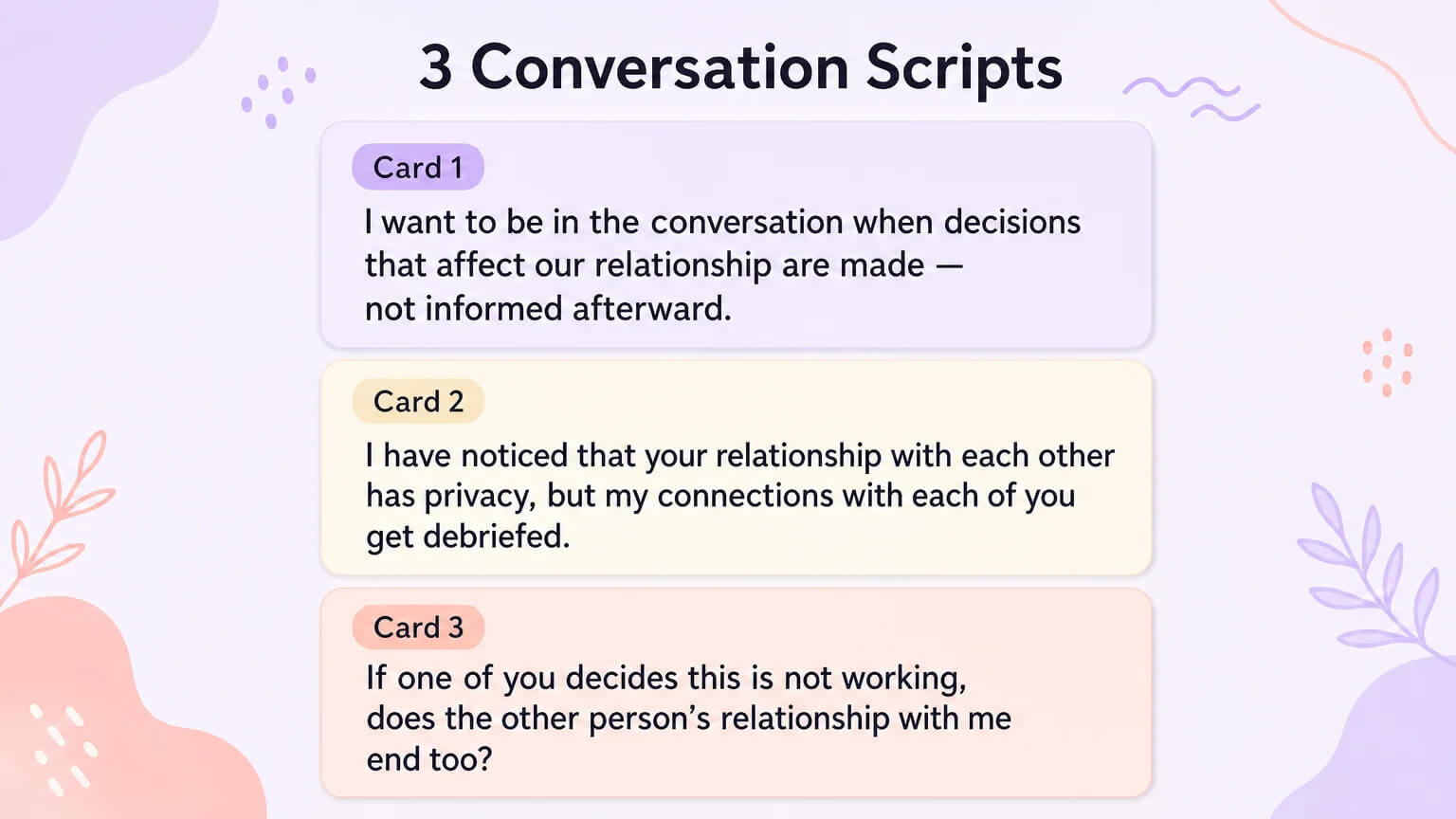
Script one, asking for equal presence in decisions: “I want to be in the conversation when decisions that affect our relationship are made, not informed afterward. Is that something you both are open to?” The answer tells you everything.
Script two, naming the asymmetry: “I have noticed that your relationship with each other has privacy, but my connections with each of you get debriefed. Can we talk about what equal privacy would look like for all three of us?”
Script three, the exit question: “If one of you decides this is not working, does the other person’s relationship with me end too?” If the answer is yes, you are not in a triad. You are in a couple’s experiment.
The package-deal question is the single most important filter you have. Dr. Elisabeth Sheff notes that unicorn-seeking couples “put the needs of the unicorn after their own couple-based concerns” and may scapegoat the single person when tension arises. The pattern is structural, not personal. You did not cause it by asking the wrong way or at the wrong time.
When someone tells you the arrangement is just personal preference, ask what would happen if your preference conflicted with theirs. If their preference always wins, it is not a preference. It is a policy. And you did not get a vote on it.
9. The Aftermath Hits Harder Than the Dynamic Did

Most advice stops at naming the dynamic. It is silent on what comes after. Even after you leave. Even after you can articulate exactly what was unfair and why. The aftermath has its own clock, and it does not care that you have intellectually processed everything.
The emotional residue is real. The self-blame: “I should have seen it sooner. The signs were all there. Why did I stay?” The grief, not just for the relationship but for the version of it you believed you were in. The particular loneliness of trying to explain to friends why you are heartbroken over a relationship they never understood. And the disorientation: after months of having your perceptions managed, minimized, or reframed by the couple, you may not fully trust your own judgment anymore.
The Weitzman thesis research collected first-person accounts from people who lived through these dynamics. One former participant put it bluntly: “I felt like their dirty little fuck toy and I didn’t like it. It affected my life today.” The accounts describe the aftermath as more disorienting than the relationship itself, because the relationship kept you busy managing its complexity. Only after it ended did the full weight of the inequality land.
Recognizing the pattern after the fact is not a failure of perception. It is the natural sequence. You cannot fully see a system while you are inside it. That clarity that lands later is not a verdict on your judgment. It is evidence you got out.
Recovery has practical dimensions: naming the pattern so your brain can flag it next time, rebuilding trust in your own instincts (they were right, they were just overruled), and understanding that walking away was not a loss. It was a recalibration.
You were not naive. You walked into a room where the furniture had been arranged before you arrived. Now you know what the room looks like. Next time, you will recognize the floor plan before you sit down.
FAQ
What exactly is a “unicorn” in polyamory?
A unicorn is a single person, most often a bisexual woman, who joins an established couple’s relationship on terms that center the couple’s needs and stability. The term describes a structural position, not a personality type. If you have landed here because something felt off and you could not name it, you already understand why the word matters. The problem is the power arrangement, never the person in it.
What is the difference between an ethical triad and a unicorn dynamic?
An ethical triad distributes power equally. All three have a voice in decisions, equal access to intimacy and privacy, and equal visibility. Dr. Rachael Meir notes that a triad contains seven relationships: the triad itself, three dyads, and three self-relationships. A unicorn dynamic concentrates power in the original couple, who control the single person’s access to emotional depth, social recognition, and relationship security. The difference is structural, not cosmetic. One is a shared home. The other is a timeshare.
Is it ever ethical for a couple to welcome a single guest into their relationship?
Yes, when the couple does the emotional work beforehand, discloses all existing agreements, and structures the dynamic for equal standing rather than guest status. Three questions cut through the noise: Does the single person have a real vote? Can their relationship with each partner develop independently? Is there a path to full belonging? Three yeses means the foundation is solid. A no anywhere means the tilt was built in before you arrived.
What questions should I ask a couple before getting involved?
Five essential vetting questions, adapted from Poly.land: What agreements exist between the two of you that affect me? What happens if I develop stronger feelings for one of you? Who knows about this arrangement? What happened with the last person you were involved with, and how did it end? If one of you wants to close the relationship, what happens to my relationship with the other? How they answer matters less than whether they have thought about these questions before you asked. A couple who has done the work will have answers. A couple who has not will look surprised you asked.
How do I leave a unicorn dynamic safely?
Tell someone outside the dynamic first: a trusted friend, not the couple. Isolation amplifies the dynamic; external perspective breaks it. End the relationship clearly, in writing if verbal communication has been dismissed or reframed in the past. Do not negotiate an exit. The pattern has already shown you whose needs get prioritized, and an exit negotiation follows the same script. Block contact if you need to. Give yourself space to feel the aftermath without having it managed by the people who created it.
How do I know if what I am experiencing is a unicorn dynamic or just normal new-relationship friction?
New-relationship friction is mutual: both sides adjust, both sides get to name what is not working. A unicorn dynamic runs one direction. You do all the adjusting. When you name what is not working, you become the problem. Here is the litmus test: if you stopped doing the emotional labor of keeping things smooth, would the dynamic survive? If the answer is no, the friction was never mutual. It was structural, and you were the only one carrying it.