
Two people, secure in what they have built, deciding the door does not have to stay closed. That is where this starts.
Finding someone who genuinely wants to walk through that door — and making sure they feel like a guest, not a transaction — takes more than a dating profile and good intentions. It takes the right conversations, in the right order, before you ever download an app.
Here is the full sequence of how to find a unicorn. What to say to your partner tonight. Where to look. How to build a profile that attracts the right people and filters out the wrong ones. What to do when someone says yes, when someone says no, and the morning after everything goes right.
Let us walk through it.
Step 1: Do the Internal Work First
Most couples who fail do not fail because they could not find someone. They fail because they found a unicorn before they were ready.
The gap between deciding to explore and actually being equipped to explore is where nearly every crash happens. A third person enters your dynamic, and suddenly every unspoken insecurity, every half-reconciled feeling, every communication pattern you have been getting away with as a couple gets stress-tested at triple speed. This work takes weeks to months. It happens before you open a single app.
Start with a jealousy audit. Name your triggers explicitly. How will you feel watching your partner kiss someone else? Receive oral sex from someone else? Experience visible pleasure with someone who is not you? There is no right answer, only the honest one. That is harder than it sounds. If you cannot say it out loud to each other, you are not ready to watch it happen in real time.
Then get your motivations on paper, separately. Each partner writes down: “Why do I want this?” Then compare. The red-flag motivations are well-known: fixing a routine relationship, one partner’s fantasy overriding the other’s comfort, gift threesomes where the encounter is presented as a surprise. If your answers look nothing alike, reconcile them before you involve anyone else. Motivation mismatch is the number one predictor of a bad outcome.
Can you discuss difficult topics without blame, right now, today? Can you express needs clearly? Can you hear “no” without retaliation? A third person will not fix communication problems. They will stand in the middle of them.
Be honest about your relationship’s current condition. As sex educator Luna Matatas told VICE: “If there is going to be drama, it was already there before I got there.” A third is not a repair tool. If your foundation has cracks, they will widen under the weight of three people’s emotions.
Do the reading. Before you create a dating profile, start with The Ethical Slut (Hardy and Easton), More Than Two (Veaux and Rickert), Polysecure (Jessica Fern), and Opening Up (Tristan Taormino). Add the Multiamory podcast. A triad, as HoustonPoly puts it, is “advanced polyamory, the 400-level college class without prerequisites.”
Open the conversation with your partner. Use language that leads with reassurance, not pressure:
“I have been thinking about something and want to share it with you honestly. I am curious about exploring a threesome together. This is not about being unsatisfied. I love our relationship. I am wondering if you have ever thought about it. Can we talk about what that might look like for us?”
This opener makes clear that your relationship is the foundation, not the problem.
Once both partners are genuinely aligned, the next question is: what exactly are you inviting someone into?

Step 2: Name Your Relationship Model
Before you type a single word into a dating app, answer one question: what exactly are you inviting someone into?
Ambiguity about what is on offer is the number one source of mismatched expectations. It wastes everyone’s time and hurts people who trusted you. Clarity is not cold. It is the most attractive thing you can bring into the lifestyle.
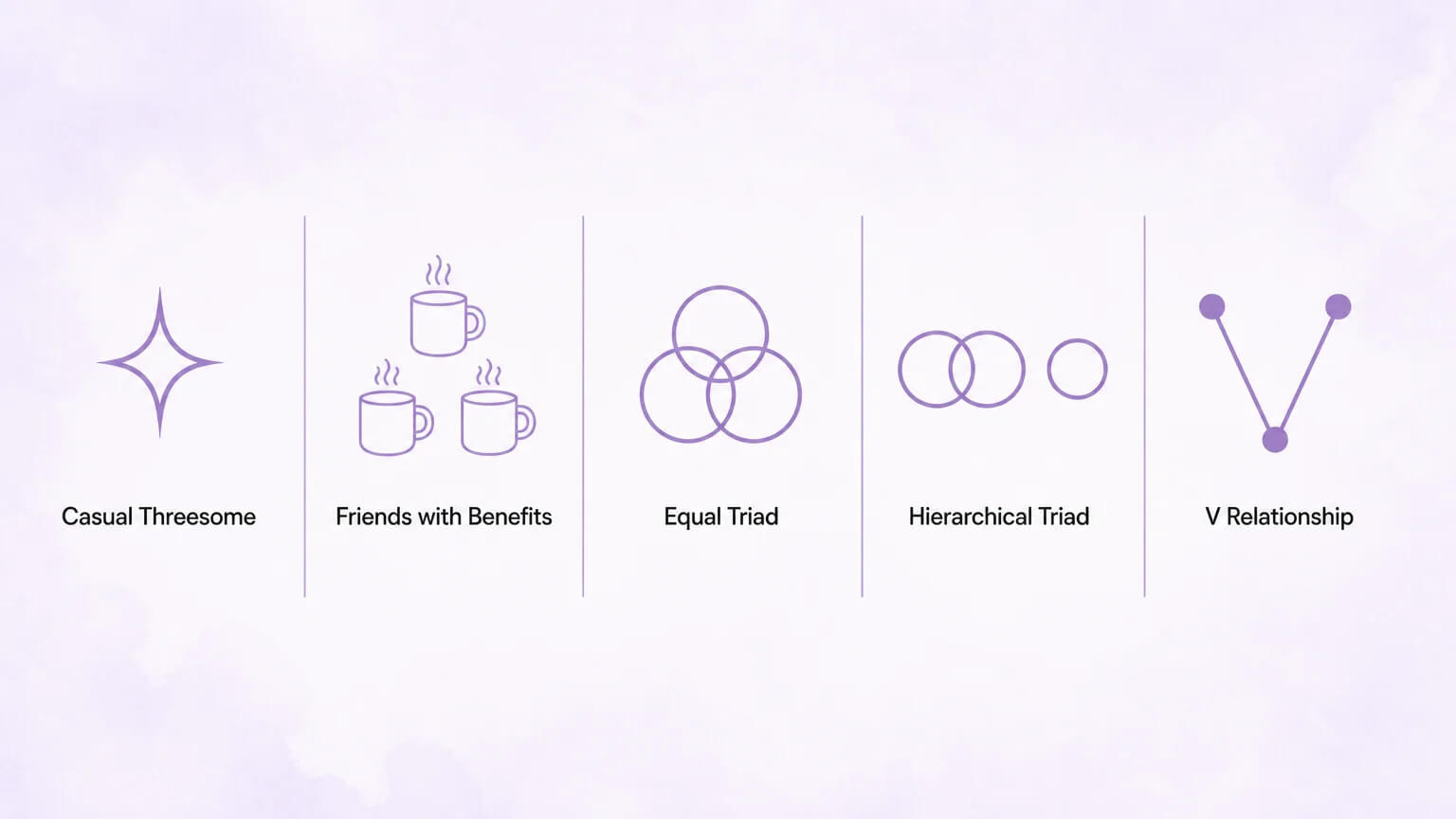
Casual Threesome (Guest Star). A one-time or occasional sexual encounter. Lowest emotional investment, clearest boundaries. The risk: if aftercare is neglected, the third feels used. If either of you catches feelings, this model will not contain them for long.
Friends with Benefits. An ongoing sexual connection with friendship but without romantic commitment. A strong middle ground for couples new to ethical non-monogamy. The watch point: feelings can develop unevenly. Discuss upfront what happens if they do.
Equal Triad (Throuple). All three partners have equal standing and equal commitment. This is not “a couple plus a third.” It is four distinct relationships: A and B, B and C, C and A, and all three together. Each dyad grows at its own pace. Polyamory educator Leanne Yau notes that triads formed by couples actively hunting often neglect the two new dyads. If you cannot imagine your partner developing an independent emotional connection with the third, you are not ready for an equal triad.
Hierarchical Triad. This one is controversial, and for good reason: the original couple remains primary and the third is a secondary partner. Valued and cared for, yes, but the original relationship takes priority. It gives the third less power. If you choose it, disclose immediately.
V Relationship. One person dates two people who are not romantically or sexually involved with each other. This is the most common, most sustainable polyamory structure, though not what most couples seeking a threesome initially picture.
Answer these together: Is this sexual or romantic? How much time can you offer? Are you open to the third dating others? What if the third connects more with one of you? Are you prepared for your original relationship to change in ways you cannot predict?
Honest answers reveal the right model. Vague answers reveal the conversations you still need.
Step 3: Build Your Privacy and Safety Foundation
You want to explore. You also want to keep your private life private. These two goals are not in conflict. They just need a system. And if reading a whole section on privacy feels paranoid, it is not. It is what lets you relax later.
Privacy is the number one concern for couples entering this space. Careers, custody, family dynamics, and social circles can all be affected by how and where you show up.
Digital separation. Create a dedicated email address for dating, completely unlinked from work, social media, or financial accounts. Use unique passwords with two-factor authentication on every dating account. Never link dating profiles to Facebook or Instagram: that creates a data trail to your real identity. Once trust is established, move sensitive conversations to encrypted messaging like Signal.
Profile visibility. If privacy is critical, consider photos that show your body and style without full face. Avoid identifiable landmarks, workplace backgrounds, or clothing with company logos. Use apps with built-in privacy features: 3Fun’s incognito mode and private photo albums keep your photos visible only to people you match with. Feeld offers similar controls. For extreme privacy, use a dating-specific nickname.
Data hygiene. Clear old chats regularly. Review active sessions and revoke anything outdated. Agree with your partner on what information gets shared publicly, what stays private, and what can be shared with a third only after trust is established. Never share a third’s information without their explicit consent.
Safety plan for first meetings. Meet in public. Tell a trusted friend where you are going. Arrange a check-in call. Have your own transportation. Trust your gut. If something feels off, leave. Simple stuff. But most couples skip it. These rules apply whether you are the couple or the single guest.
Step 4: Choose Your Platform and Build a Great Profile
Where you search shapes who you find. How you present yourselves determines whether they respond.
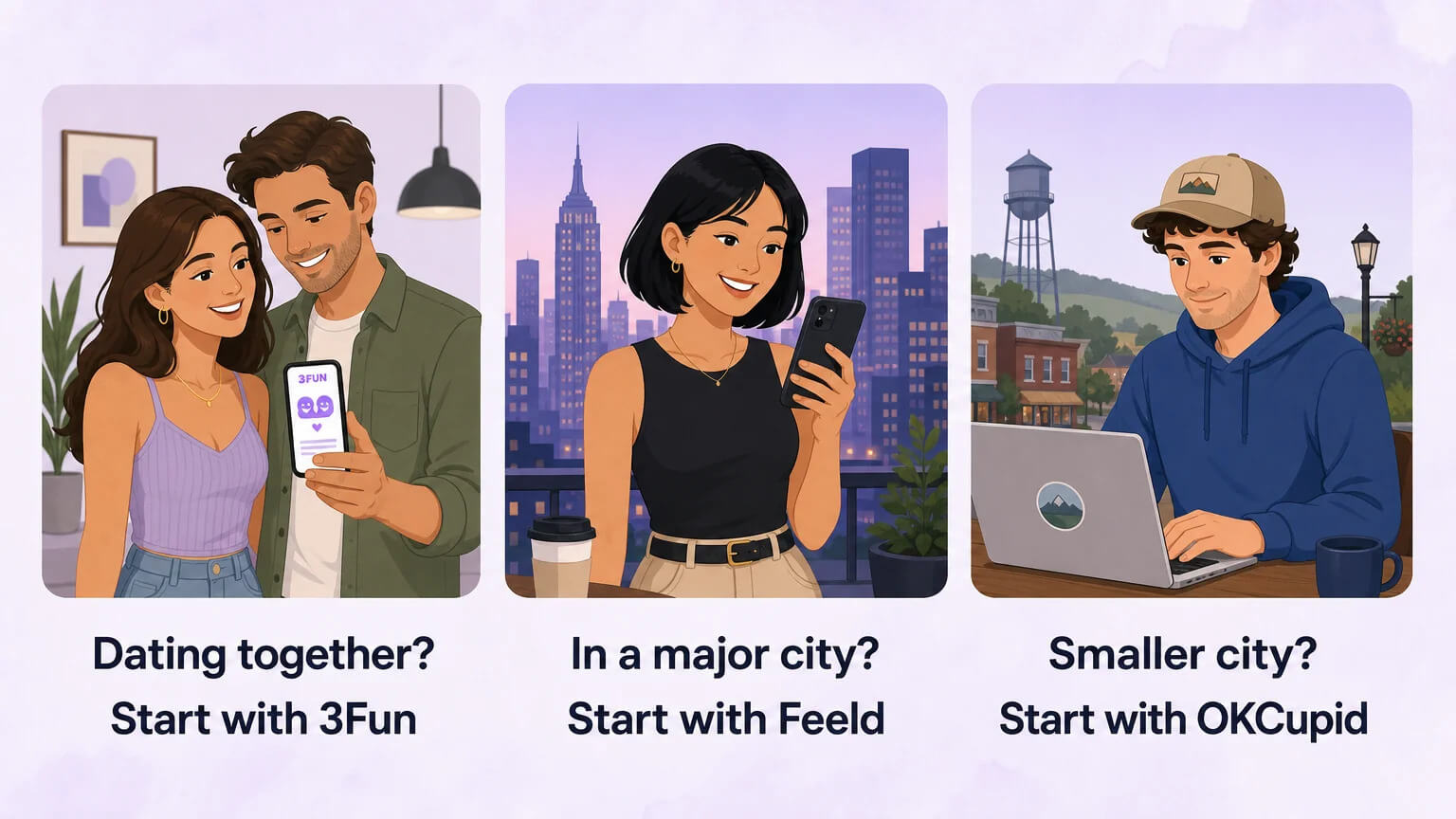
3Fun is built for couples dating together. Couple-synced accounts, group chat, ten-plus sexuality options, photo verification, incognito mode, and private photo albums are standard. Free tier includes unlimited messaging. VIP runs $29.99 per month. Roughly 1.5 million users, strongest in New York, Los Angeles, Chicago, San Francisco, and London. If you are dating together as a couple, start here (Get 3Fun on Google Play or Apple Store).
Feeld has the largest dedicated ENM user base. Twenty-plus gender and sexuality options, couple profiles, and desire tags like Threeway, MMF, and FFM. Majestic membership is $11.99 per month. Strongest in major metro areas. The catch: roughly half of profiles are fake or OnlyFans promotions, and quality has declined.
OKCupid is the sleeper pick, and for a lot of people outside big cities, it is the only pick. Roughly 50 million total users dwarfs every dedicated ENM app combined. Explicit “polyamorous” and “open relationship” labels, partner profile linking, 22 gender identity options. Best option if Feeld and 3Fun have thin user bases in your city. Most users default to monogamy, so be explicit in your profile.
#open offers hashtag search, community flagging, and partner-linked profiles with cross-verification. It is also tiny, with roughly 2,100 monthly active users globally. Use it as a supplement, not your primary search tool.
Reddit personals (r/threesomes, r/polyamory, r/swingers) offer direct connections with anonymous posting but have no verification, high catfishing risk, and zero built-in safety features. Use for research only.
Tinder and Hinge were not designed for ENM. Couple profiles risk account bans. Avoid for searching together.
Bottom line: couples exploring together start with 3Fun. Individuals in major cities start with Feeld. Anyone in a smaller city starts with OKCupid. Budget-conscious searchers use Feeld Majestic at $11.99 or the free app MoreThanOne.
Building a profile that works. Your profile does two jobs: attract compatible people and filter out everyone else. Lead with your relationship style. Be specific about what you are looking for. Include photos of both partners. State what you offer, not just what you want.
Template 1, direct:
“We are [Name] and [Name], a loving couple in [City]. We are exploring ethical non-monogamy together and are open to connecting with someone who might be interested in a [casual/ongoing/serious] dynamic. We value honesty, consent, and emotional maturity above all. We enjoy [hobby], [activity], and [interest]. If this resonates, tell us what you are curious about in relationships.”
Template 2, warm:
“Hi, we are [Name] and [Name]. We are exploring ENM with care and integrity. We are open to dating together while nurturing our existing relationship. We value empathy and honest talk about boundaries. We like [hobby], [travel], and [creative pursuit]. If you want to chat, tell us what you are curious about in relationships.”
Both work. Pick the one that sounds like you, fill in the blanks honestly, and resist the urge to soften what you are looking for. A profile that attracts the wrong people is worse than a profile that attracts nobody.
Step 5: Search, Connect, and Start the Conversation
Before you send a single message, understand how your profile looks from the other side. Singles vetting couples are looking at everything: your word choices, your photos, which partner is doing the talking, and whether your message reads like it was written to a person or to a fantasy.
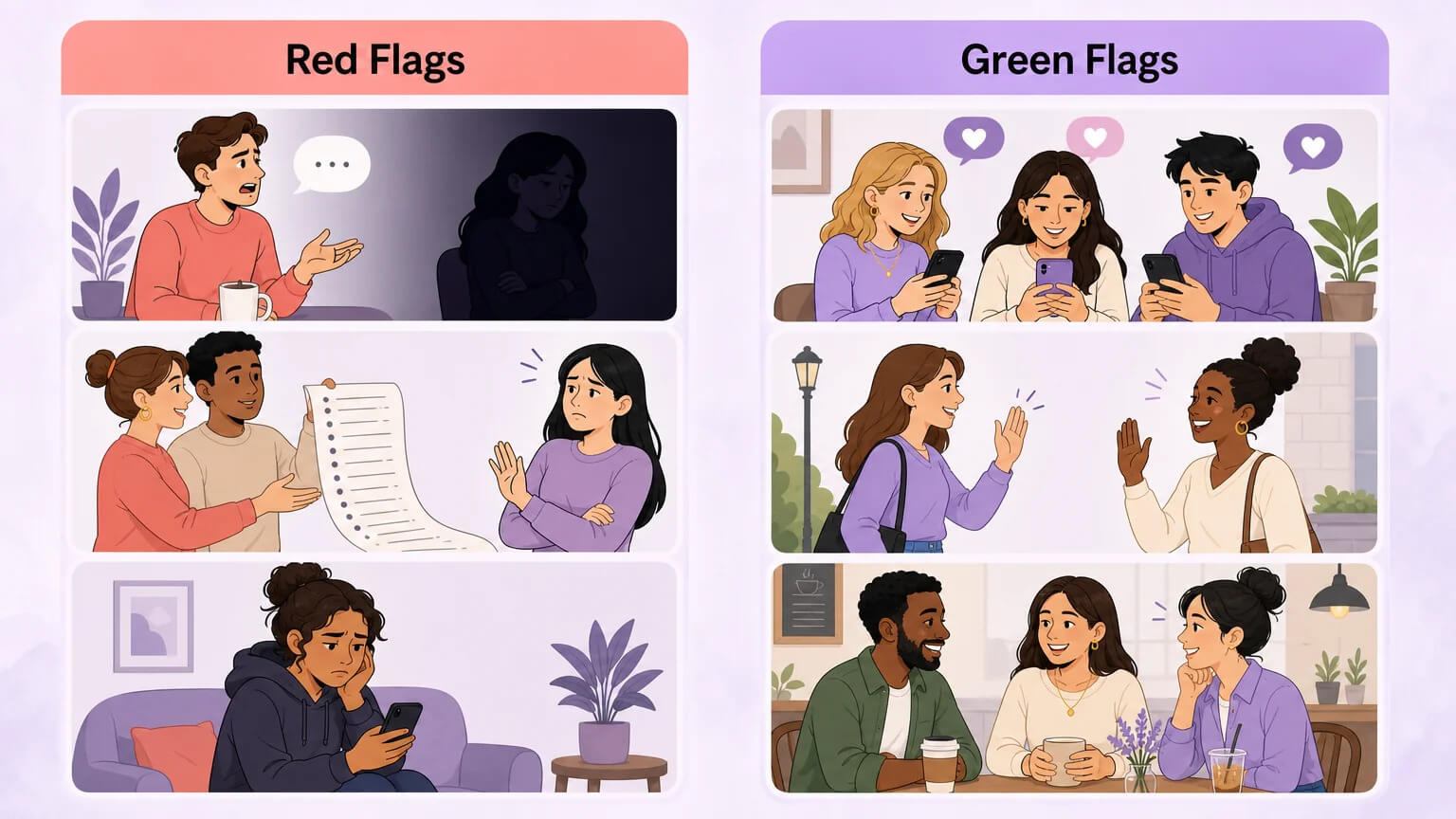
Red flags you must avoid. Only one partner communicating signals unequal investment. A laundry list of rules without asking what they want says they are an accessory. Veto power without disclosure means they are disposable. Billing the encounter as a gift or bucket-list item makes them a checkbox, not a person. One partner seeming reluctant is a setup for drama that will land on the third. Bait-and-switch profiles are a consent violation. Interrogation-style screening, overly sexual opening messages, and “we are clean, be clean” language all say the same thing: you are being auditioned, not invited.
Green flags you should embody. Group chat with both partners from day one. The research is unanimous: the female-identifying partner should be the initial point of contact, then move to a group chat immediately. As Kela, a 26-year-old who has been the third, told Feeld: she prefers being approached by the woman because she has encountered “a lot of men who have lied about their situation.”
Ask about their desires, boundaries, and fantasies, not just state yours. As Vu put it in VICE: “Are they genuinely interested in what gets me off?” That question alone screens out most bad actors. Suggest a casual, no-expectations first meeting. Volunteer your STI testing status and ask about theirs mutually. Both partners should be equally enthusiastic. Talk openly about jealousy and have a plan. Plan aftercare in advance.
Your first message:
“Hey [Name]. We love your profile, especially [specific detail]. We are a couple, [Name] and [Name], exploring together. We would love to grab a casual coffee or drink sometime to see if there is mutual chemistry. Zero expectations, just good conversation. Are you open to that?”
Key principles: mention something specific from their profile, be transparent about being a couple immediately, propose a no-pressure meetup, let them set the pace. If you need privacy, adapt: “Before we go further, I believe in absolute transparency. We are practicing ethical non-monogamy. We cannot risk advertising this publicly, but we want you to know upfront so you can decide if this works for you.”
Give them the information to decide. That is the baseline.
Step 6: The First Meeting: Low Pressure, High Honesty
Every unicorn we heard from requires a pre-sex date. Every single one.
This is the most important filter you have. It tells you whether chemistry in text translates to in-person. It shows you how the couple operates together when they are not performing for a profile. It gives all three people a chance to answer the one question that matters: does this actually feel right?
Pick a neutral, public location. Coffee, drinks, or pizza. Keep it to 60 to 90 minutes. Both partners must attend and participate equally. This is a conversation among three equals, not an interview. If logistics make an in-person meeting difficult, a video call is a strong screening step.
What the couple should watch for. Does the third seem comfortable with both of you, or are they gravitating toward one partner? Do they engage with each of you individually, or only respond to you as a unit? Does nervousness read as excitement or discomfort?
What the third is watching for. How the couple treats each other in public says everything. Are they a team, or is tension visible? Does conversation feel natural or scripted? Do they ask about your life, or only about your availability?
The boundary conversation. If the first meeting feels right, use this script:
“What are your non-negotiables? How do you prefer to handle communication and time management in a multi-partner dynamic? We want to make sure this works for you, not just for us.”
This signals that you see the third as a full participant in designing the dynamic. If it is not an enthusiastic “yes” from everyone, it is a hard “no.”

Step 7: The Encounter: Check-ins, Consent, and Aftercare
The best encounters feel spontaneous. They get that way because someone did the prep work.
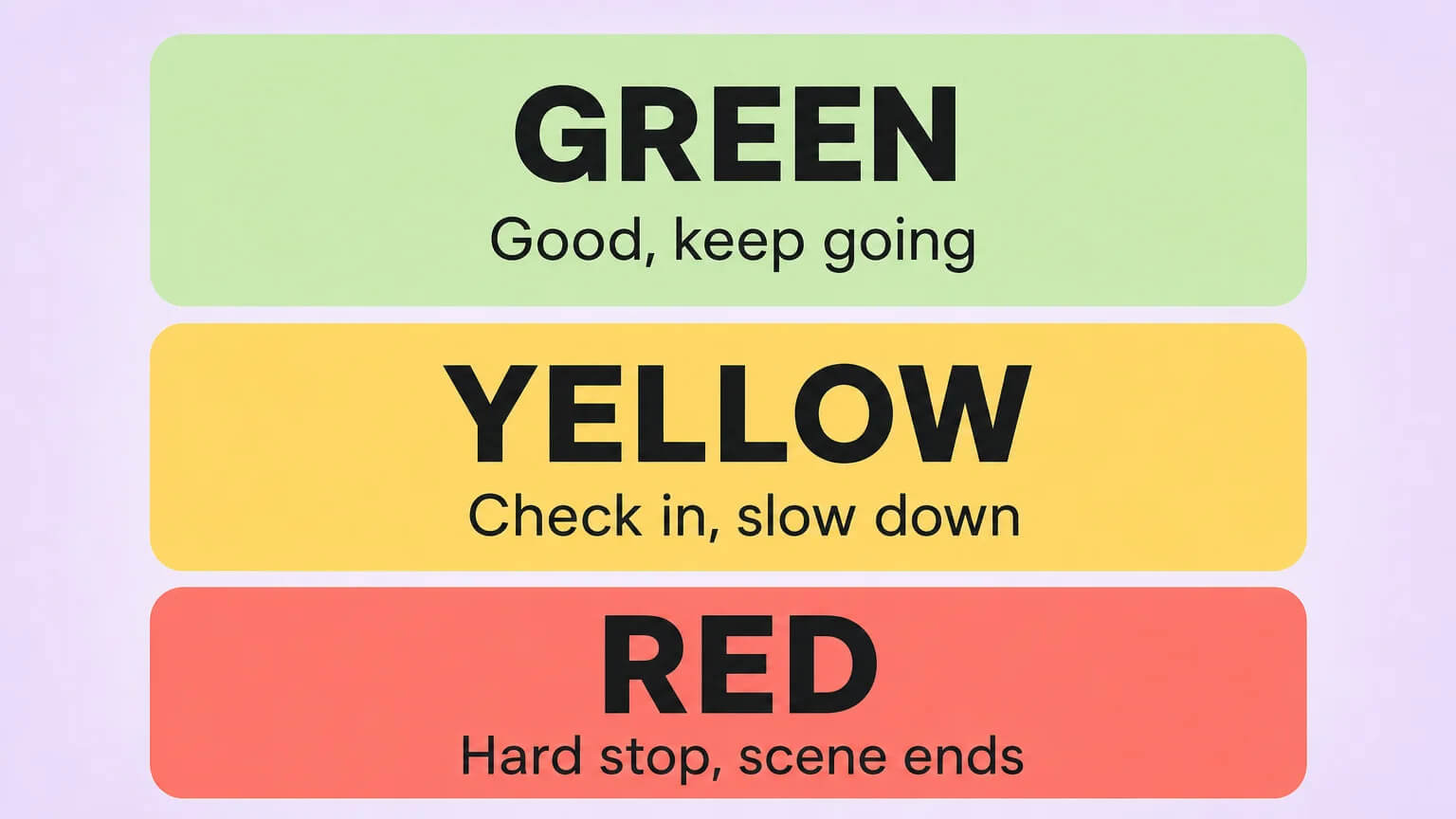
Before. Set boundaries before clothes come off. Pack supplies: condoms, lube, electrolytes, boric acid, probiotics, cotton underwear. Establish safe words using the traffic-light system: green means good, yellow means caution or check in, red means hard stop. Agree on what happens if someone wants to stop mid-encounter. No negotiation, no pressure. Red means the scene ends, and everyone respects it.
Do not present a pre-made rule list to the third. Co-negotiate boundaries together. Ask what they want. Ask what they need. A rule list handed down from the couple says “you are entering our world on our terms.” A co-created agreement says “we are building this together.”
During. Anyone can call “light?” to check comfort level at any moment. Watch body language, not just words: hesitation, stillness, averted eyes can all say what someone is not saying out loud. Take turns as the center of attention. The bathroom break is a built-in exit: use it to decide whether to continue or end.
Right after. The encounter is not over when sex ends. Cuddle together. Talk about what you liked. Have fresh fruit or snacks if you are hosting. Do not show someone the door right after sex. That is the fastest way to make a person feel used.
Send a check-in the next day:
“Hey [Name], just wanted to check in and see how you are feeling after last night. We had a really wonderful time with you. No pressure to respond, but we are here if you want to talk about anything that came up. Take care of yourself today.”
Reconnecting as a couple. Schedule a couple debrief within 24 hours. This is not jealous surveillance. It is emotional hygiene. Talk about what went well. Name anything that felt complicated. Check in on each other’s emotional state. The original relationship is the foundation, and foundations need maintenance.
Step 8: After the Encounter: Debrief, Maintain, and Exit Gracefully
What happens after the initial excitement fades is where most dynamics succeed or fail. The after is the entire long game.
Ongoing maintenance. Dismantle couple privilege. Move from “adding a third” to “forming new relationships” where the guest co-creates the dynamic. Schedule regular check-ins. Nurture all four relationships: A and B, B and C, C and A, and the three of you together. Watch for “sneakyarchy”: claiming non-hierarchy while deprioritizing the third during conflict.
The four emotional dynamics. Envy: the third may envy the original couple’s established bond. Jealousy: one original partner fears displacement. Identity gaps: couples who thought they would be fine with non-monogamy discover they feel jealousy, conflicting with their self-concept. Compersion: taking genuine pleasure in your partner’s happiness with someone else. Compersion is the goal and hardest to feel. All four are normal. Name them when they appear.
When things go wrong. Use the six-step repair framework. Pause and assess. Identify emotional impacts. Articulate needs. Design a repair plan together. Re-enter gradually. Evaluate and adjust. If the connection is not working, do not ghost. Use the respectful rejection script:
“Thank you so much for the conversation. We really enjoyed getting to know you. After talking it through, we do not think we are the right match. We wish you the absolute best.”
Ghosting is a cruelty that costs you nothing to avoid.
Graceful exits. Not every connection works out. The third should never be scapegoated or discarded when the original couple feels threatened. They are a guest in your playground, not a toy in your toybox. Agree in advance on how to end things respectfully.
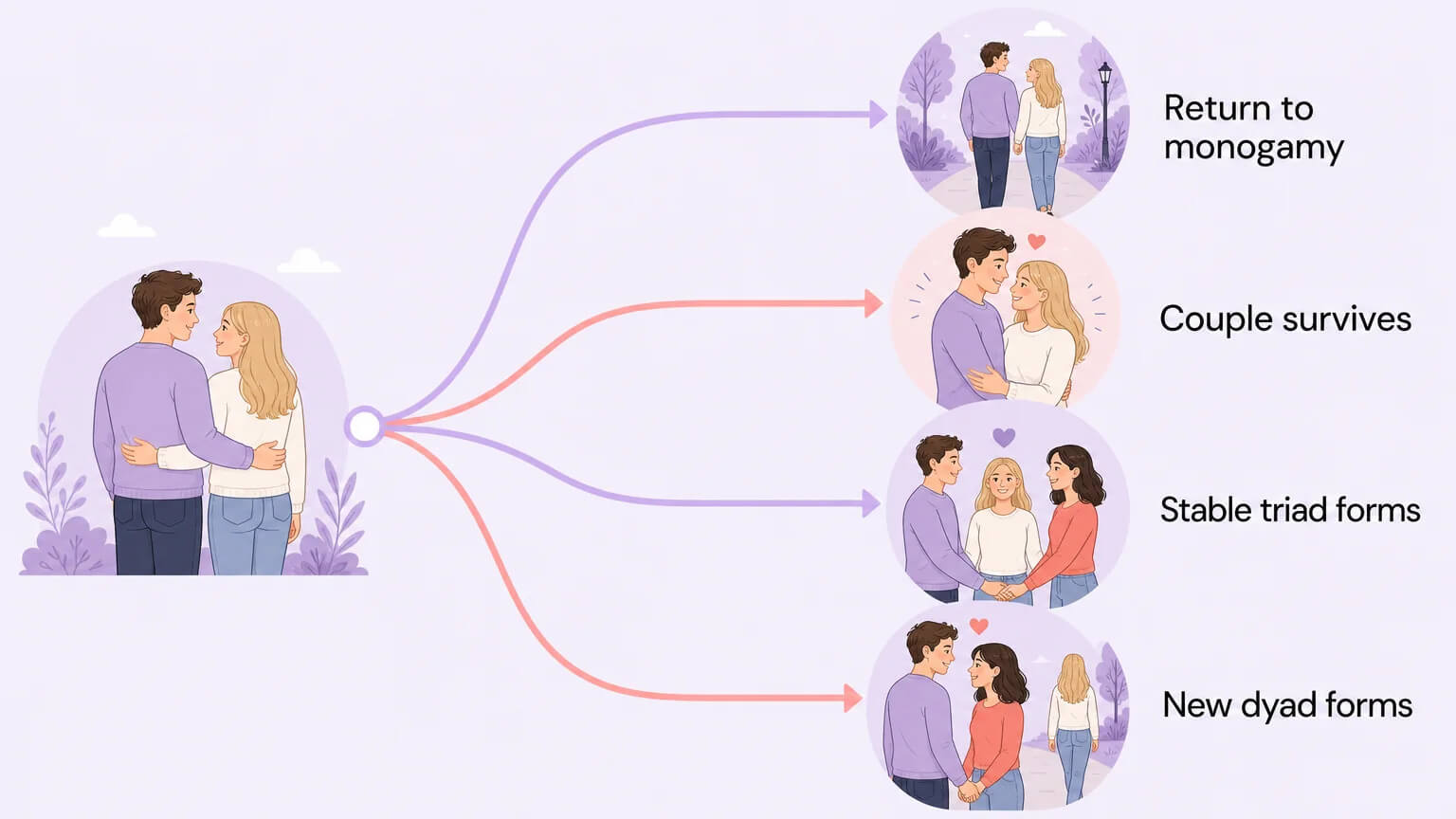
What the long term actually looks like. Four common outcomes: the couple returns to monogamy; the triad dissolves but the couple survives; a stable poly-fi triad forms; the unicorn bonds more strongly with one original partner, and the original dyad breaks up. A real-life unicorn and her “amazing pair of ethical Unicorn Hunters” have been “living the fantasy for 15 magical years.” These are the exception, but they prove the model can work with genuine equality, constant communication, and treating the third as a full partner.
Prepare thoroughly. Proceed slowly. Communicate relentlessly. Treat every person in the dynamic as exactly that: a person.
FAQ
How long does finding a unicorn actually take?
Months, not weeks. The supply-demand imbalance is steep: the LA Times reports apps are “disproportionately outnumbered by couples than by single girls.” Realistic breakdown: Weeks 1 to 2 for internal preparation. Weeks 2 to 4 for profiles and browsing. Months 1 to 3 for active searching, dates, and vetting. Months 3 to 6 and beyond for a genuine ongoing connection. One-night encounters may happen faster.
What if we do not want to use dating apps?
Yes. Polyamory meetups on Meetup.com and Facebook groups are the lowest-pressure entry. Kink munches on Fetlife attract ENM crowds in casual pub settings. Swinger clubs are couple-focused but research rules before attending. LGBTQ+ spaces like queer bars and Pride events have high overlap with poly communities. Everyday strategies: hobby groups, polyamory pride pins, friends-of-friends. TorontoUnicorn’s top five for sex clubs: do not be pushy, respect “no,” do not get too drunk, do not separate without a plan, tip the staff.
Is hiring a sex worker an ethical alternative?
Yes. Several of the educators and community members we consulted recommend this for couples who want a purely sexual experience without the emotional complexities of unicorn dynamics. Clear boundaries, professional safety, no risk of emotional exploitation.
I am single and considering joining a couple. What should I ask myself first?
Ask yourself these before your first date: Special guest or active co-creator? Open to watching or being watched? One-time or regular? Egalitarian or secondary? Individual relationships or only as a unit? Exclusivity or dating others? Long-term plans? Answer honestly. Practical safety: traffic-light safe words, bathroom break if something feels off, move private conversations back to group chat. You are in the driver’s seat.
What are the actual chances of this working long-term?
Most triads formed through active hunting do not last. Those that do share common traits: genuine equality, constant communication, willingness to let the original relationship change, and treating the third as a full partner. The 15-year success stories prove the model can work. They are also the exception.