Dating apps built for exploration have seen a 34% increase in couples actively looking for a third partner. Nearly three in four British couples on Feeld are searching for a shared experience with someone new. This conversation has left the fringe and is sliding into the mainstream faster than most people realize.
The word at the center of it is “unicorn.” Depending on who you ask, it is either the most exciting idea in modern dating or the most loaded term in the room.
Here is the clean version: a unicorn in dating is a person, most commonly a bisexual woman, who is open to joining an existing couple. That can mean a single shared evening or an ongoing, committed connection. The label came from 1970s swinger and polyamorous communities because someone who fits this description felt, at the time, as rare as a mythical creature.
What follows is the full picture: what the dynamic looks like across its spectrum, an ethical framework for couples who want to do this well, a safety guide for singles considering the role, and an honest look at the emotional reality underneath the fantasy.
What Is a Unicorn in Dating?
The word “unicorn” arrives with baggage. Some people claim it proudly as an identity. Others find it reductive or outright dehumanizing. We need a working definition before the rest of this conversation goes anywhere, so here it is.
A unicorn is a person, most commonly a bisexual woman, who is open to joining an existing couple. The term traces back to 1970s swinger and polyamorous circles, where someone willing to connect with both partners without disrupting the primary relationship was considered genuinely rare. The name stuck.
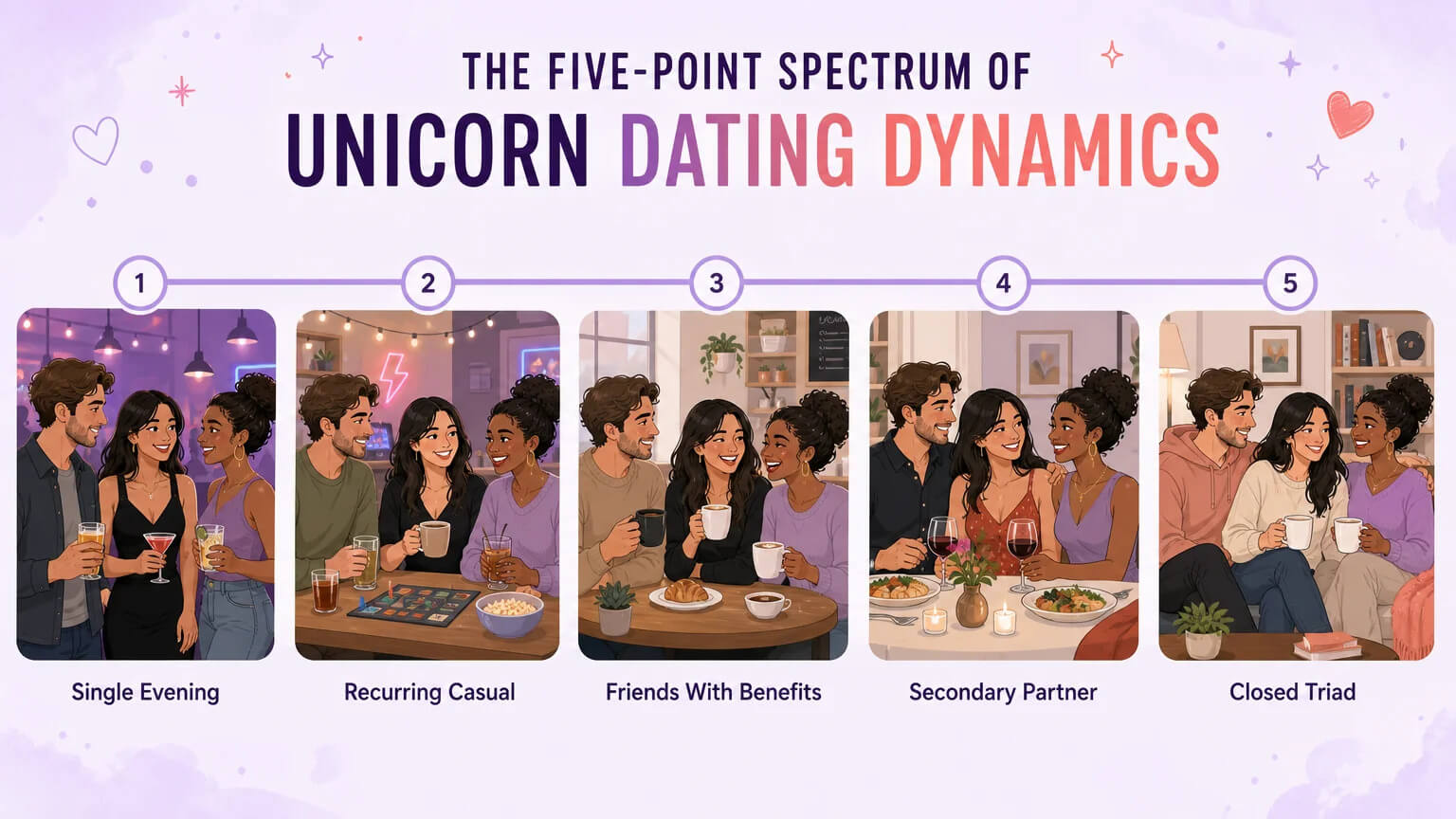
What most explainers miss is that this is not one thing. The dynamic spans a full spectrum.
On the lightest end, a single shared evening. One encounter with no expectation of ongoing contact. This is common in swinger culture, where the third is a special guest for the night and nothing more.
One step deeper, recurring casual. The guest returns periodically for intimate experiences but keeps full independence. No commitment beyond the next invitation.
Further along, an ongoing friends-with-benefits dynamic, where the connection includes some social and emotional warmth without full partnership status. Someone you genuinely like and see regularly, whose life remains separate from yours.
Then the secondary partner arrangement. An acknowledged, ongoing relationship, but the original couple remains the primary bond. The third is a real partner, not a guest, but the couple’s relationship anchors the structure.
At the deepest end, the closed triad. All three are equal partners with no hierarchy, potentially including cohabitation and long-term commitment. No one is primary. No one is secondary.
Where you land on this spectrum determines who holds power, how decisions get made, and what protection the third person has if things change. Naming your position honestly, before anyone else gets involved, separates a shared adventure from collateral damage.
Polyamory educator Leanne Yau offers the structural insight that reframes everything: a triad involves four distinct relationships. Partner A with Partner B. Partner B with Partner C. Partner C with Partner A. And all three together. Each requires individual care and attention. It is never simply “a couple plus a third.” You are not adding one person to an existing unit. You are building four new connections from scratch.
Why the Unicorn Label Stirs Debate
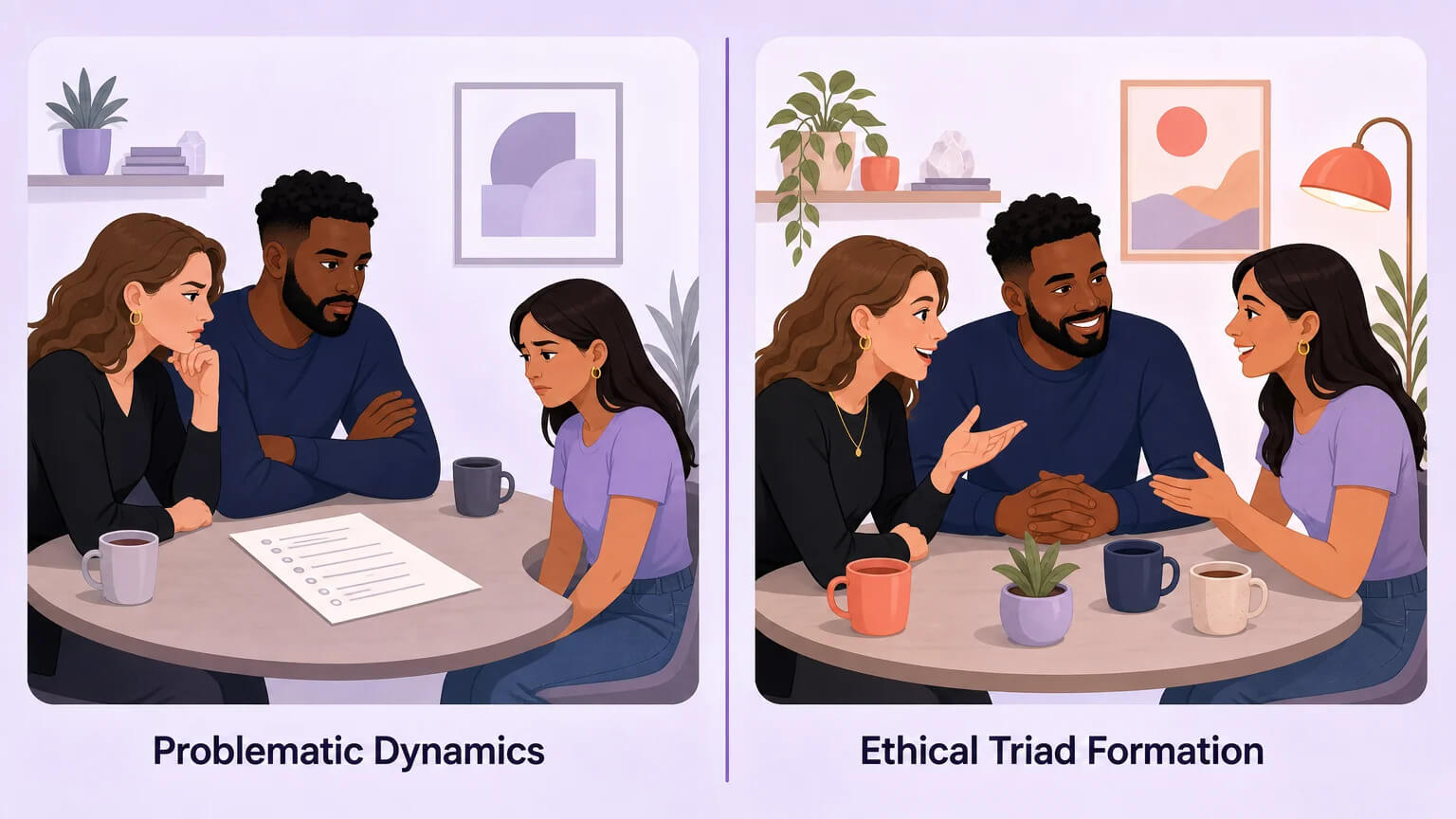
Search for “unicorn” in any polyamory forum and you will find fire. Three people sharing intimacy is not the issue. The issue is how the dynamic is typically pursued.
Start with couple privilege. The established pair holds advantages the third person will likely never access: joint leases and mortgages, hospital visitation rights, tax benefits, social recognition as a “real” couple, the ease of walking into any restaurant as a pair. The world is built for two. These are not perks the couple earned by being thoughtful. They are structural defaults handed to every pair in a society designed around couples. Andre Laroussini from Houston Polyamory calls it “a rigged system that makes your third expendable before you have even met her.” This is not about intention. It is about structural reality, and it is the water the couple swims in long before they ever open an app.
Then layer on the behavioral patterns that compound it. Couples who reserve veto power to end the connection unilaterally. Couples who arrive with a pre-written list of demands the third had no part in creating. Couples who treat the third as a fantasy fulfillment tool rather than a whole person. As the Wikipedia entry puts it bluntly: in these dynamics, it is assumed the couple makes the agreements while the third has to follow them.
The label itself is contested. Some argue “unicorn” is inherently dehumanizing. It mythologizes a real person and sets an impossible standard. Others have reclaimed it without apology. Luna Matatas, a sex educator, calls herself a “card carrying unicorn.” Academic researcher Sally W. Johnston has proposed “symbiosexuality” as an alternative framework: attraction to the energy and connection between people in an existing relationship, described without the baggage of the older term. The word matters because the frame it sets shapes how everyone in the dynamic sees themselves and each other.
Problematic dynamics and ethical triad formation are not the same thing. The rest of this article is about how to do the latter.
For Couples: Welcoming a Guest With Care
If you are a couple reading this before acting, you are already ahead of most. The actual work starts before you ever open an app.
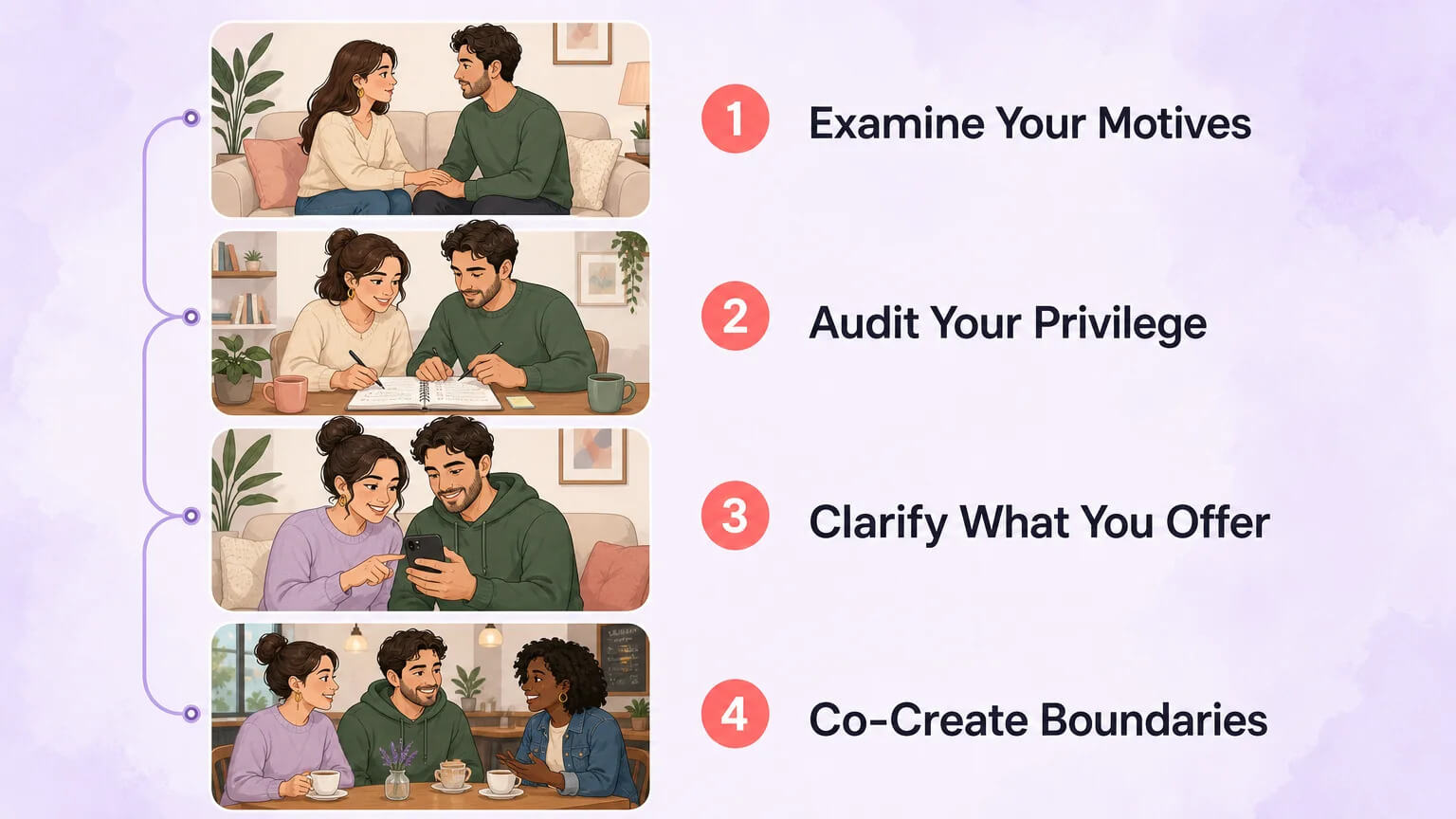
The pre-search preparation has to come first. Examine your motives honestly. Are you enhancing something already strong, or trying to patch something cracked? A third person is not adhesive. Do the inner work: can you handle watching your partner light up with someone new? Have you both genuinely consented, or is one of you reluctantly going along to please the other?
Audit your couple privilege concretely. Discuss how you will ensure the third person has equal voice, genuine autonomy, and the freedom to walk away without penalty. Clarify what you are actually offering. One shared evening? Ongoing but casual? The possibility of a full triad? Be honest with yourselves and any potential guest.
Where to look matters. Feeld is the most established platform for this specific search, with joint profiles via Constellation, desires tags like Threesome and ENM, more than 20 gender identities, and incognito mode for privacy. 3Fun focuses specifically on threesome and group dating, built for connecting couples with singles and couples with other couples. Smaller ENM-native alternatives like #Open and MoreThanOne are worth exploring. For in-person connection, sex-positive event communities like Killing Kittens offer spaces where meeting couples is normalized and consent culture is built in. What to avoid: mainstream apps like Tinder and HER are not the right venue. Couples posing as single women on these platforms is a documented source of community frustration and often backfires. LGBTQ+ spaces should not be used for this unless the couple is genuinely queer and the space explicitly welcomes couples.
How you communicate sets the tone for everything that follows. Be a couple openly. Use joint profiles. State clearly what you are looking for. Do not arrive with a pre-written laundry list. Co-create boundaries together rather than presenting demands the other person had no part in shaping. Allow individual connections to form at their own pace. The third may connect more naturally with one of you first. That is normal and should be allowed.
No veto power held exclusively by the couple. If you need an off-switch, build it into a shared agreement that includes the third’s equal right to do the same. Include the third in your social life. Being a secret humiliates people. Being introduced to friends signals respect.
Plan aftercare before the encounter. Cuddling, tea, conversation, a next-day check-in. These are not afterthoughts. They are the infrastructure of trust.
For the Solo Guest: What to Know Before You Say Yes
If you are the person being approached by couples, or you are curious about the role, this section is your field guide.
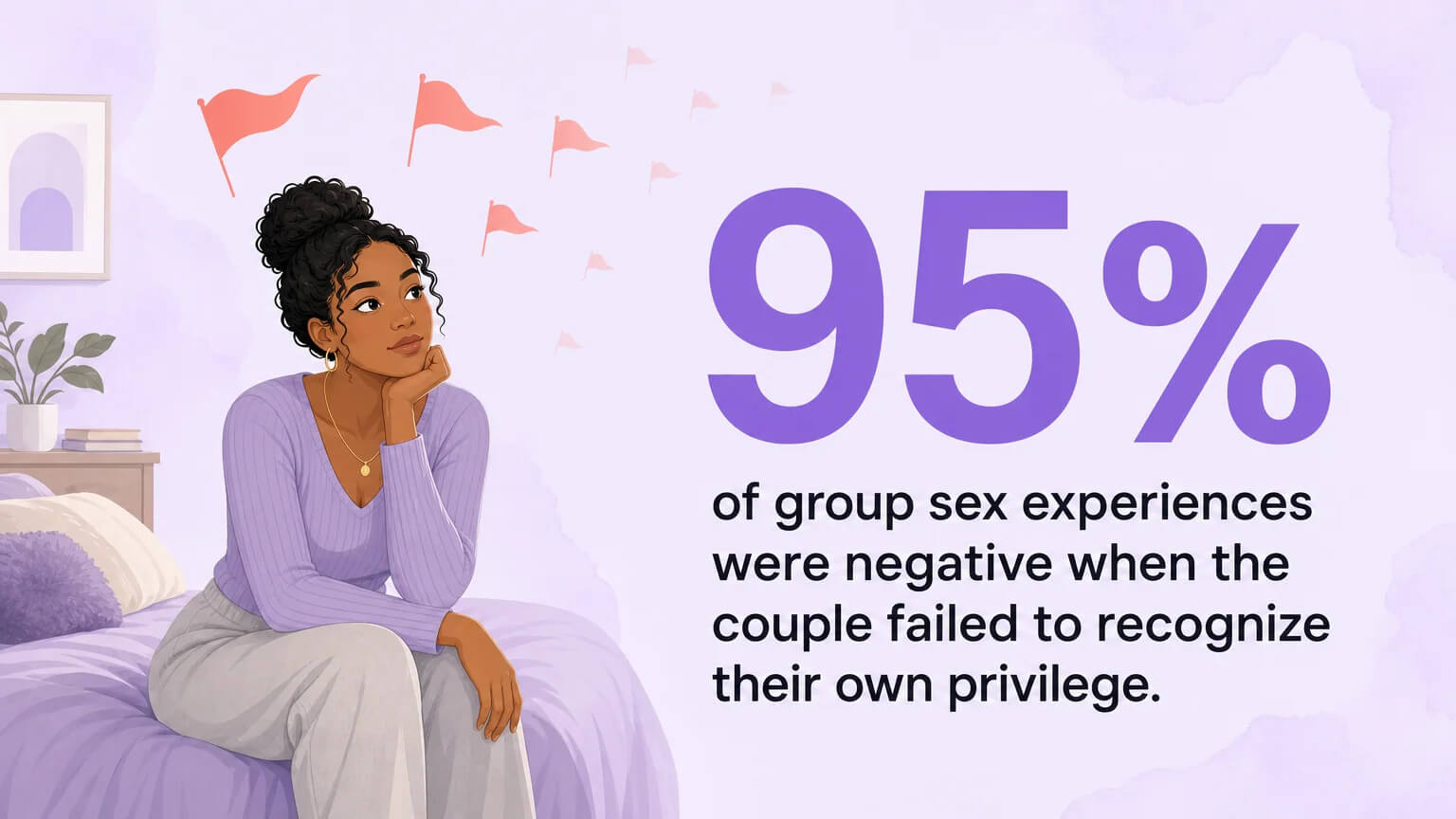
Luna Matatas, a sex educator who has been a unicorn many times, reports that 95% of her group sex experiences were negative when the couple failed to recognize their own privilege. Women interviewed by VICE and HuffPost describe bait-and-switch deception: a woman dates you solo, then reveals a boyfriend. Boundary erosion: you say no to nudes, the male partner asks again anyway. One woman was befriended and dated for two years before realizing the entire relationship was engineered to get her to sleep with the boyfriend. These are not edge cases. They are the pattern when couples skip the preparation work.
Here is the part most people miss: you have genuine leverage. Unicorns are sought after in non-monogamous circles. You will have options, which means you can and should be selective. The goal is not to avoid these dynamics entirely. It is to filter ruthlessly.
Watch for these patterns. Communicating with only one partner: if you never hear from the other, the couple has not done their internal work. A pre-written list of demands handed to you like a job description. Veto power held exclusively by the couple, meaning they can end your connection at any time for any reason without your input. “No drama” on the profile with no positive traits listed, which almost always means “we do not want you to have needs or emotions.” The woman reaches out first, then the man suddenly takes over the conversation. Never being included in social events or introduced to loved ones. Pressure to meet immediately with no space for individual dates. And the biggest tell: no one asks what you want. The conversation centers entirely on the couple’s desires.
Before you say yes, clarify your own desires. Do you want to be the special guest showered with attention? Are you seeking an ongoing connection or a one-time experience? Do you want individual relationships with each person, or are you comfortable dating them as a unit? What are your thoughts on seeing others outside this arrangement?
Vet carefully. If only one partner seems genuinely interested, walk away. Discuss the jealousy plan openly before intimacy happens. Advocate for yourself even in a casual role. You are entitled to respect, pleasure, and a voice. They are inviting a guest into their space. You are not a toy in their toybox. Ready to take the next step? Our full guide walks you through every stage: how to be a unicorn — from choosing the right platform to navigating aftercare.
Jealousy, Compersion, and the Emotional Reality

Bringing a third person into an intimate dynamic will surface feelings you did not know you had. That is normal. That is the work.
A 2024 study by Clemons-Castanos at California State University studied 122 polyamorous individuals and found that mindfulness is associated with both lower jealousy and greater compersion, the quiet joy of seeing a partner happy with someone else. But the finding that should change how we approach this: emotion regulation and distress tolerance were the skills that actually made the difference. Empathy was not a significant mediator. What this means in practice: learning to sit with discomfort, name it, and let it pass is more effective than trying to understand your way out of jealousy. Your body does not run on intellectual agreements. It runs on cues of safety and threat.
Compersion is not a requirement. It is an emergent property. Chasing it often backfires because it adds performance pressure to an already charged dynamic. When it arrives naturally, it is a byproduct of security, not a goal to optimize for.
New relationship energy, or NRE, hits differently when you are watching it happen to your partner. Their excitement with someone new may trigger your nervous system regardless of how committed you are to the arrangement intellectually. The attention shift reads as a threat cue. Naming this out loud, “I know this is NRE and I am feeling it in my body, even though my brain is on board,” is often the first step toward metabolizing it.
Aftercare is emotional scaffolding, not an add-on. It is checking in the next day. It is not ushering someone out the door the moment the encounter ends. It is debriefing as a couple afterward without turning the third into a subject of clinical analysis. For the guest, aftercare might mean a quiet text the next morning that says “we are thinking of you” without asking for anything in return. These small gestures separate feeling like a cherished guest from feeling like a delivery that has arrived.
When It Works: What Healthy Arrangements Look Like

The question is whether people actually pull this off. They do. Here is what it looks like when they get it right.
Nicole Everett entered a relationship with married couple Thomas and Cathy after meeting at a Killing Kittens sex party. Organic connection, not an app-driven search. She calls them “my family and my rocks.” The relationship works because of specific practices: “two-time” for one-on-one dates with each partner, “three-time” for shared time, early cross-communication, and processing difficult feelings as they arose. When she briefly felt jealousy over Thomas dating someone new, she realized it was protectiveness, pointing toward care, not threat.
One woman spent a year in an arrangement with her best friend and the friend’s husband. It started as a joke over drinks, became serious through open conversation, included individual time with each partner, and ended on good terms when she wanted her own children. Her advice: discuss exit boundaries upfront. Agree whether you will stay friends after it ends, before it begins.
Laura casually dated a couple through a summer. “From the start that summer, everything was so easy.” No games. When her life circumstances changed, the transition to friendship was graceful. “I still fancy them so much. I love them, in a way that does not feel painful or difficult.”
The common threads across all three: genuine curiosity about the other person, not checklist fulfillment. Individual relationships growing at their own pace. The couple did their internal work first. Clear, direct communication. Respect for the third person’s autonomy and the reality that they may need to leave. An exit that preserved dignity and, in two cases, friendship.
What makes the difference: couples who treat the third as a co-creator of the dynamic, not a guest handed a list of agreements at the door.
FAQ
What exactly is a unicorn in dating?
A unicorn is a person, most commonly a bisexual woman, open to joining an existing couple for a single evening or an ongoing relationship. The term originated in 1970s swinger and polyamorous communities.
What is the difference between a unicorn dynamic and a throuple?
In a unicorn dynamic, the original couple remains the primary partnership and holds more power. In a throuple or closed triad, all three members are equal partners with no hierarchy. A triad is four distinct relationships, not “a couple plus a third.”
Can couples approach a third person ethically?
Yes, but it requires internal work first. Examine motives honestly, audit couple privilege, co-create boundaries rather than imposing them, allow individual connections to form naturally, and never hold veto power over the third without their reciprocal right.
Where can couples actually find someone?
Dedicated apps like Feeld and 3Fun are designed for this. Sex-positive event communities like Killing Kittens offer in-person connection. Mainstream apps like Tinder and HER are not the right venue. Couples posing as singles there frustrates the community and often backfires. For the full guide to find a unicorn, check this guide: How to Find a Unicorn >>
What should a single person watch for?
Top red flags: only communicating with one partner, a pre-written list of demands, veto power held exclusively by the couple, “no drama” profiles meaning “no needs,” the woman reaching out then the man taking over, and no one asking what you want. For a complete breakdown of each sign — with real stories, conversation scripts, and an exit framework — see our guide: 9 Signs You’re the Unicorn in a Polyamory Relationship >>.
Is the term “unicorn” offensive?
It is contested. Some argue it dehumanizes a real person. Others have reclaimed it, like sex educator Luna Matatas. Academic Sally W. Johnston proposed “symbiosexuality” as a less loaded alternative.
How do people handle jealousy in these arrangements?
Jealousy is normal and expected. Research shows mindfulness, emotion regulation, and distress tolerance help more than trying to suppress or rationalize jealousy away. Practical steps: name feelings out loud, create specific communication agreements, and consider therapy if the dynamic persists without shifting.