If your relationship is good, genuinely good, why would you ever want to bring other people into it?
The question comes with an assumption built in: wanting sexual variety must mean something is broken. The data runs the other way. The median swinger is 44 to 46 years old, according to a 2023 analysis of nearly 23,000 German lifestyle platform users, the largest demographic study of its kind. These are people who have been in relationships for years or decades, making the choice to explore from a place of stability. Married people, in fact, are 32% more likely to swing than other relationship types. The stereotype of the restless bachelor or the bored housewife does not match the data.
When researchers asked swingers directly why are people swingers, five reasons surfaced. None of them are about fixing a broken relationship. Here they are.
1. The Drive for Sexual Variety Which Is Biologically Normal
Experimental research confirms something most people suspect but rarely say out loud: humans show a measurable, hardwired preference for sexual novelty. In a 2021 study published in the Archives of Sexual Behavior, researchers documented the Coolidge Effect in human subjects. Men exhibited a stronger preference for novel partners than women, and these sex differences held regardless of the target’s attractiveness or age. The researchers described it as a “salient sex-specific evolved component of human mating strategies.” The desire for variety is not a character defect. It is your nervous system doing what nervous systems do.
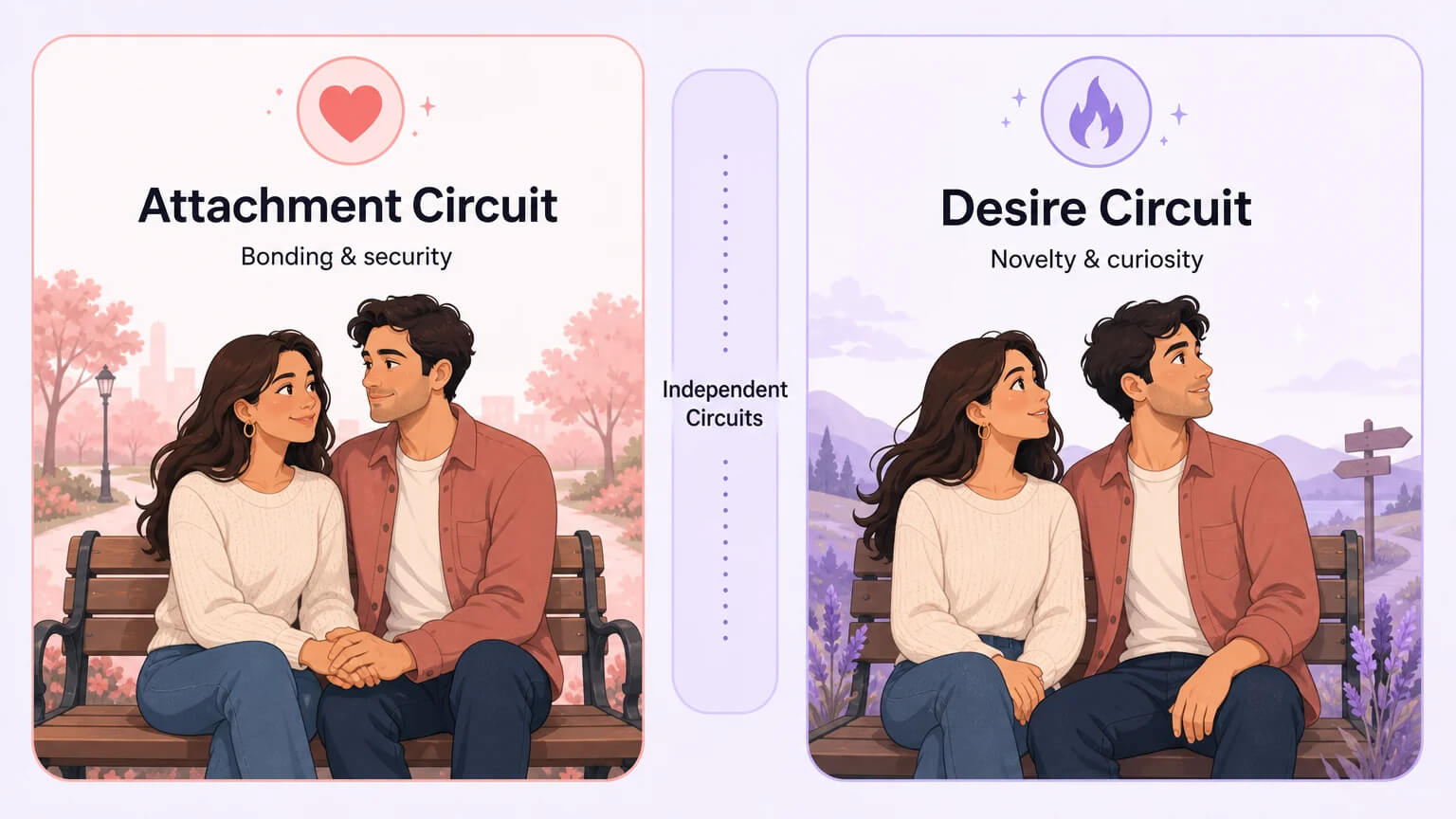
Psychologist Dr. Todd Berntson explains the neuroscience plainly. The human brain runs on three hardwired emotional circuits: fear, rage, and lust. The lust circuit has its own dedicated neurological track, independent of the attachment and bonding system. You can be deeply in love with your partner and still experience desire for others because you are running two operating systems at the same time. Berntson puts it directly: “Our hearts are wired for one person, but our sexual desire is not.”
What swingers say confirms the biology. A 2022 study by Kelberga and Martinsone, published in Frontiers in Psychology with nearly 600 participants, found a clear motivational split. Sex with a primary partner is driven by love, commitment, and connection. Sex with a secondary partner is driven by novelty, thrill, kink exploration, and the experience of a different gender. Both rated physical pleasure similarly across the two contexts. The two sets of motivations are complementary, not competing. One set feeds the heart. The other feeds the senses.
Swinging is one way to honor both circuits honestly. It does not eliminate the tension Berntson describes. It acknowledges it and builds a framework around it, rather than pretending one of those circuits does not exist. The biology at the center of why are people swingers is straightforward: the desire for variety is not a malfunction. It is a feature. What matters is what you do with it.
2. A Safe Way to Explore Bisexuality While Staying Together
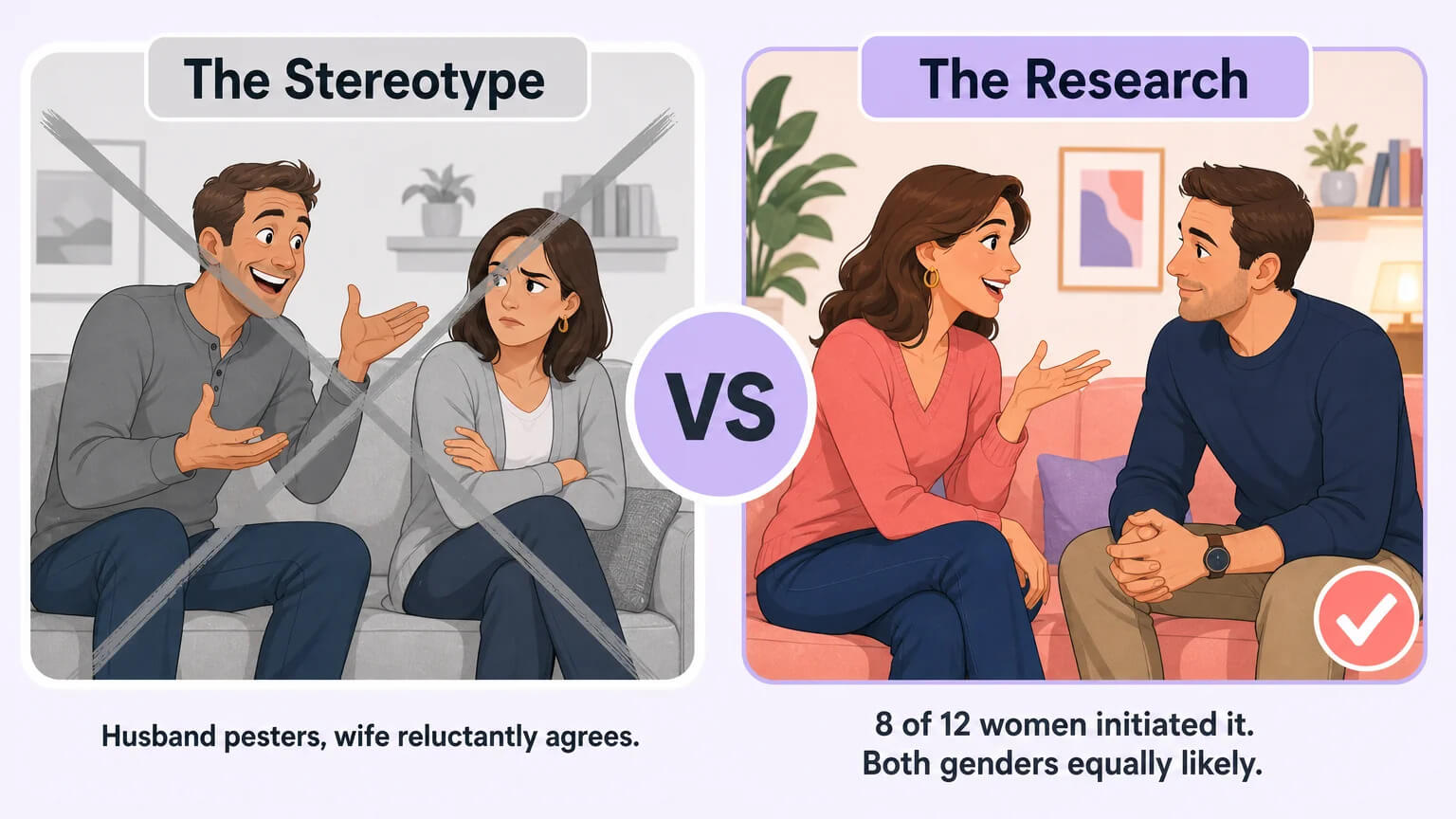
There is a persistent assumption that men drag reluctant women into swinging. The research dismantles it entirely.
A 2017 master’s thesis from Middle Tennessee State University interviewed 12 swinger women and found eight of the twelve were self-initiated. They brought the idea to their partners, not the other way around. Every single self-initiated woman identified as bisexual. They described swinging as a way to explore their sexuality on their own terms, within the security of their primary relationship. They were widening the frame, not walking away from it.
Approximately 76% of women visiting UK lifestyle clubs identify as bisexual or bi-curious, according to a 2022 study of nearly 7,000 participants. Among men in the same spaces, about 20% identify similarly. Swinging holds far more sexual diversity than the general population, and women are at the center of that diversity.
Researcher Katherine Frank identified what became known as the “women rule” principle, a foundational norm in lifestyle spaces. Women’s comfort and consent set the pace, and men who cannot accept that do not last. “A man who cannot accept that one of the basic tenets of lifestyle sexuality is women’s freedom to consent to multiple sexual encounters is not going to find the lifestyle pleasurable or welcoming.” The number of single men at group events is often planned around the comfort of the women present. Consent, pace, and boundaries are set by the women. That is the rule.
For many women, swinging offers something no other relationship model provides: same-sex exploration without stepping outside the partnership they have built together.
3. Making the Primary Bond Stronger with the Radical Honesty
When was the last time you told your partner about a sexual desire you were afraid to say out loud?
For most couples, the honest answer is never. The desires exist. What does not exist is the framework for naming them. Swinging creates conditions where dishonesty stops being an option. That turns out to be its own reward.
The most cited academic study on swinger satisfaction comes from Kimberly and Hans, published in 2017 in the Archives of Sexual Behavior. They conducted 32 in-depth interviews with husband-and-wife couples, interviewing each partner separately to ensure honest answers. The central finding was about communication. Not partner count, not frequency. Communication. Effective verbal and non-verbal communication was the strongest predictor of both marital and sexual satisfaction. The couples who thrived were the ones who talked to each other well. Adventure count was irrelevant.
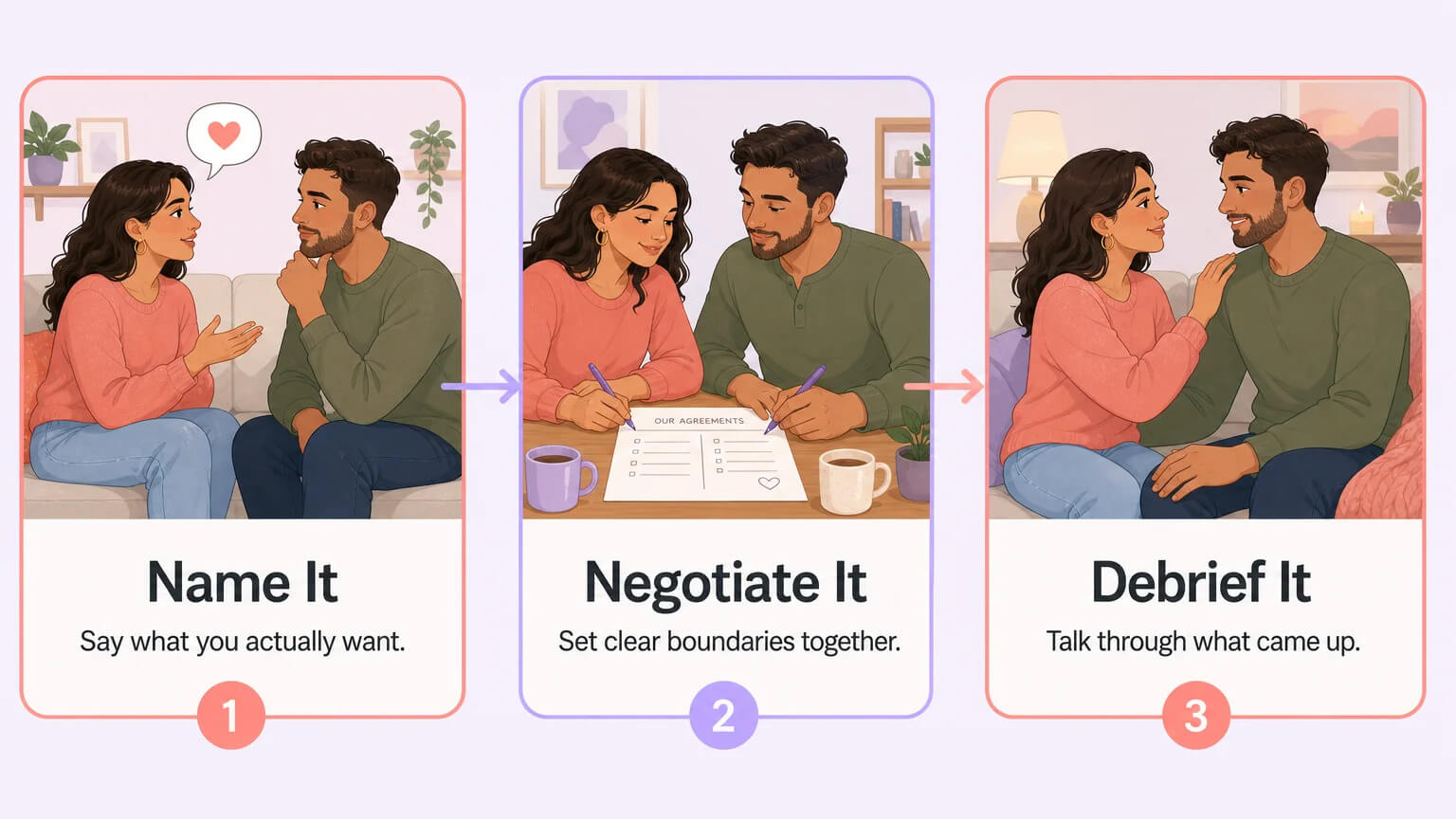
A more recent international study validated the Multiple Relationships Maintenance Scale with 4,290 participants and identified nine key practices for sustaining consensually non-monogamous relationships. Nearly all of them are communication-based: disclosing attractions to your partner instead of hiding them, communicating openly about jealousy instead of suppressing it, practicing compersion, negotiating clear boundaries, maintaining sexual health. The skills that make swinging work are the same skills that make any relationship stronger.
Swingers describe a transparency paradox. They told journalist John Stossel that their marriages are stronger “because they don’t have affairs and they don’t lie to each other.” A 2000 study found that 60% of swingers said the lifestyle improved their relationship. Nearly 70% reported no problem with jealousy. The communication skills swinging demands are transferable. Couples who learn to negotiate boundaries, debrief after encounters, and name difficult emotions together apply those skills to everything else in their relationship. Across every reason people give for why are people swingers, one thread runs through all of them: communication, the kind that would strengthen any relationship, monogamous or otherwise.
4. Bringing Couples Closer with A Shared Adventure
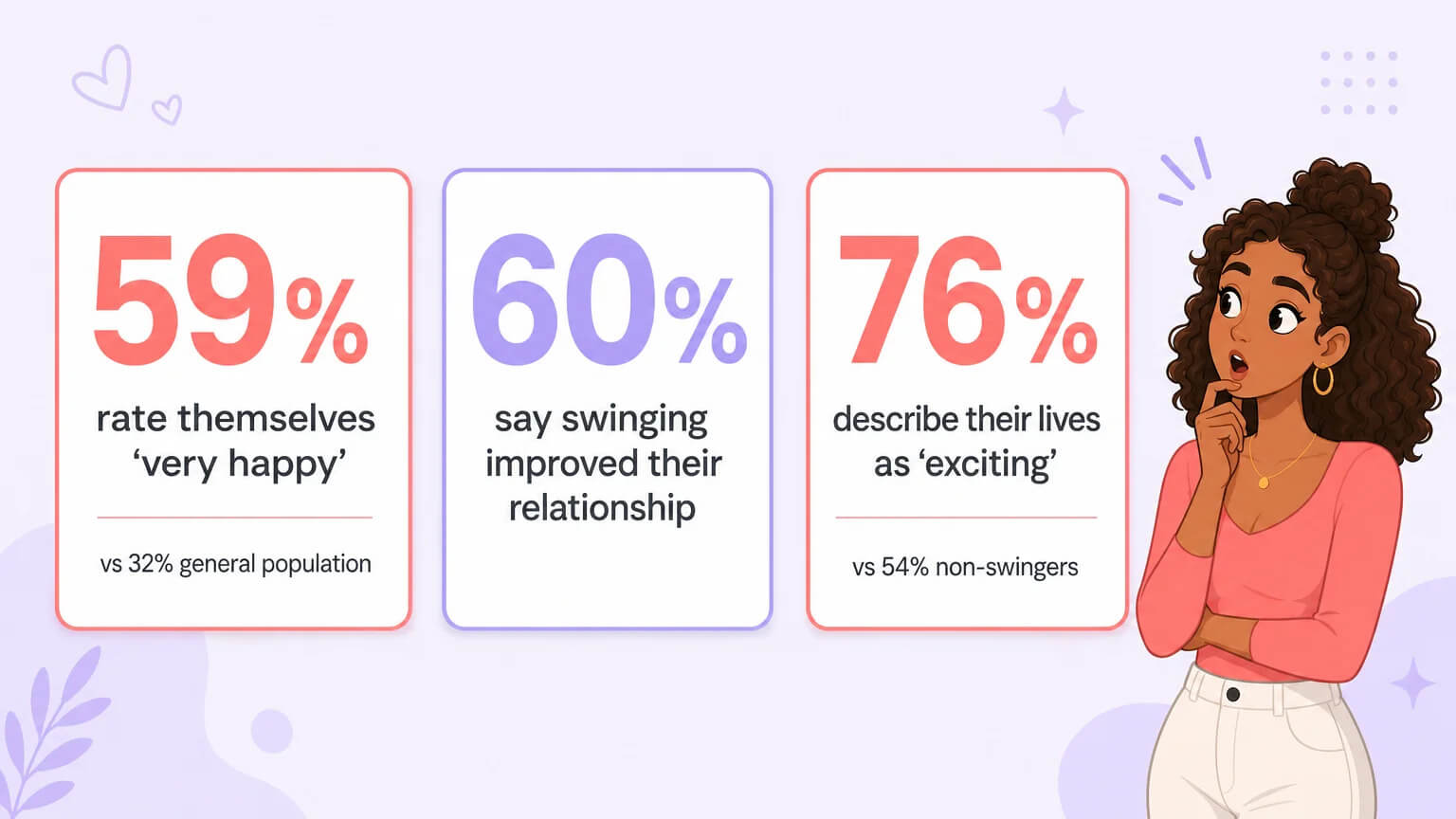
Start with the numbers. Swingers are nearly twice as likely as the general population to rate themselves “very happy”: 59% versus 32%. Seventy-six percent found their lives more exciting, compared to 54% of non-swingers. These are people who were already doing well, looking for more.
Researcher Terry GouldResearcher Terry Gould identified a motivation that sounds contradictory until you sit with it: many couples swing specifically “in order to not cheat on their partners.” Swinging is a shared activity. Couples research it together, negotiate boundaries together, choose play partners together, and debrief afterward together. It is something they build as a team.
Experienced swingers describe their relationship using what has become known as the cake analogy. The relationship is the cake: the foundation that gives everything structure and meaning. The love and trust are the icing. Swinging is the sprinkles. The sprinkles are optional, and sprinkles on their own do not make a cake. They only work when the foundation is already solid.
The demographic picture is shifting. One female-centered sex party organization reported a 400% increase in attendance between 2022 and 2024. The under-30 share on swinger apps has doubled. Younger couples are increasingly building non-monogamy into relationships from the start, not as a repair tool added later.
Wood and colleagues (2021) compared structured forms of consensual non-monogamy against less structured open relationships in the Archives of Sexual Behavior. Swinging and polyamory consistently outperformed open relationships on satisfaction, trust, and passionate love. The active ingredients were communication quality, intrinsic motivation, and clearly negotiated boundaries. Structure and communication are what separate thriving couples from struggling ones. When both partners want to be there for their own reasons, the research shows it works.
5. Rebuilding a Relationship on Total Transparency
This is the least common path into swinging and the most misunderstood. Not every couple arrives at the lifestyle from peak stability. Some arrive from the opposite direction entirely.
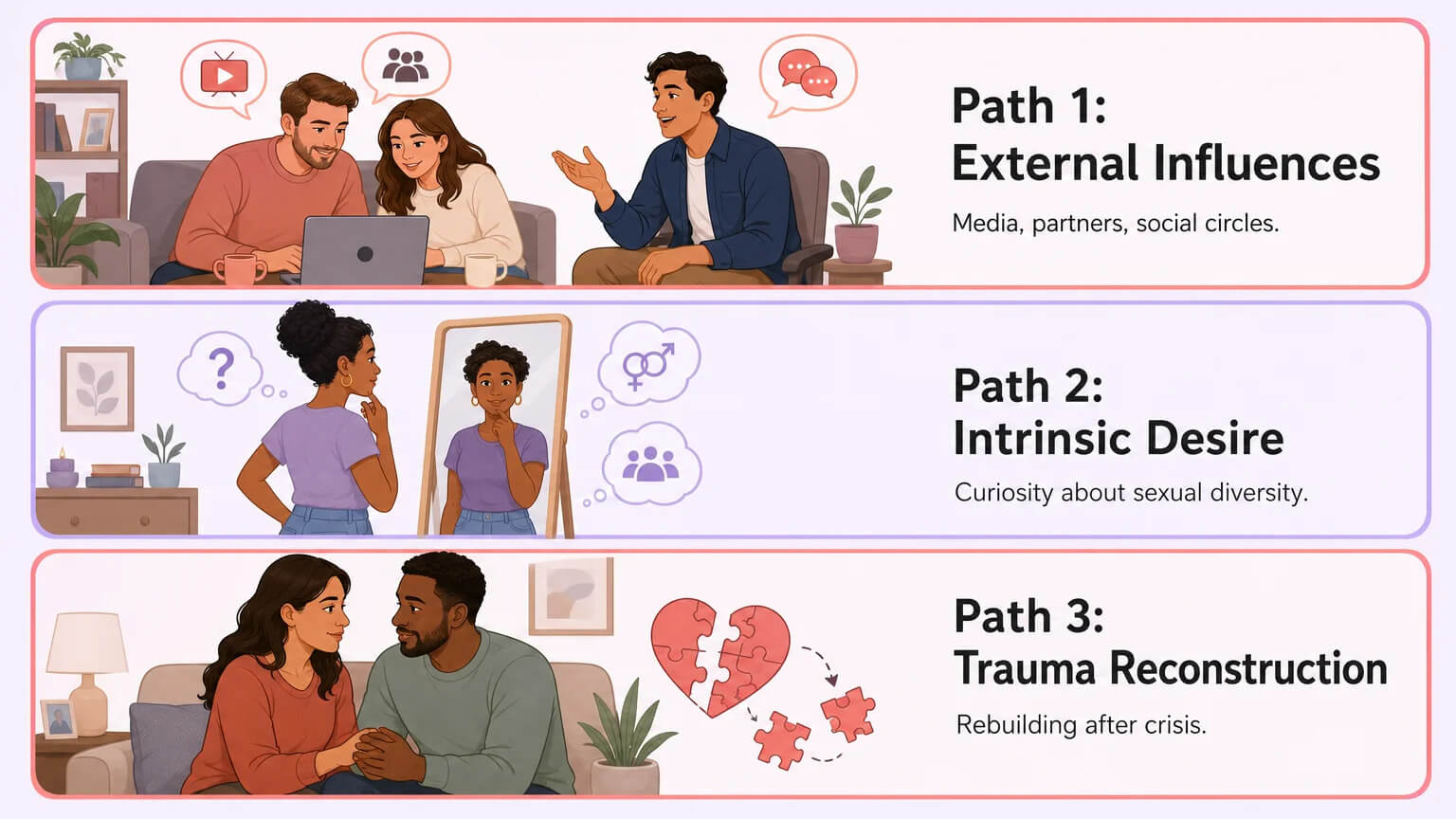
Dr. Marina Basson’s doctoral research at North-West University in South Africa identified three distinct routes into swinging. The first two cover most couples: external influences (media, a partner’s suggestion, social circles) and the intrinsic desire for sexual diversity and authenticity. The third path is trauma reconstruction.
Some couples enter swinging after the death of a partner, after infidelity, or after a relational rupture that could have ended everything. They choose to rebuild on a foundation of total transparency rather than retreat into silence or separate. This is reconstruction, not degradation. It is the harder path. It means having the conversations that could end a relationship, and coming out the other side with something built on honesty.
This path is not the majority story. The first four reasons cover most couples in the research. But it matters because it confronts the assumption that swinging only works when everything is already perfect. Sometimes people rebuild through it. They construct something new from what broke.
Not every couple stays. Some try it, decide it is not for them, and step away. A couple married 30 years might visit a club twice and never return. A pair of podcasters with 15 years in the lifestyle might record an episode called “Why We Quit Swinging” and walk away with their marriage intact. Both outcomes, staying and leaving, are valid. Curiosity does not mean the end of anything. Sometimes it is just the start of a conversation you have not had yet.
FAQ
Is swinging just cheating with permission?
No. Cheating involves deception, broken agreements, and betrayal of trust. Swinging involves mutual agreement, explicit boundaries, and ongoing communication. Researcher Terry Gould found that many couples swing precisely to avoid cheating. As one swinger told journalist John Stossel: “Our marriages are stronger because we don’t have affairs and we don’t lie to each other.” The real dividing line is honesty. Other partners are the variable. Honesty is the constant.
What if I get jealous?
Jealousy is normal and expected. Nearly 30% of swingers report experiencing it. Jealousy is a dashboard light, not a stop sign. It tells you where your emotional engine needs attention. Research psychologist Dr. Joli Hamilton has shown that compersion, the experience of joy in your partner’s joy, and jealousy can coexist. People feel both at the same time, the way something can be bittersweet. The skill is learning to identify the specific trigger, communicate it to your partner, and adjust boundaries accordingly. Most experienced swingers describe jealousy management as exactly that: a skill you develop, not a fixed trait that disqualifies you.
What if we try it and one of us hates it?
Discuss this possibility before you start. The universal advice from experienced swingers: start small. Visit a club with no expectation of participation beyond watching and being together. Establish a mutual veto, meaning either partner can call stop at any time, no questions asked. Go at the slower partner’s pace. Some couples try it once and never again. Others find it reshapes their relationship in ways they did not expect. The goal is facing whatever happens together, not guaranteeing a specific outcome. Both outcomes count. There is no wrong answer here.