Here is the answer first. Historically, which ear is the gay ear was simple: the right. A man with a single right-lobe piercing was read as gay, a man with a single left-lobe piercing as straight. The whole rule fit one rhyme, “left is right, right is wrong,” where “wrong” meant gay.
Today, neither ear means anything reliable. The code is dead, and that is good news.
That piece of metal was once a survival tool, a signal you wore when being seen could cost you your job, your housing, or your safety. It became a punchline in school hallways, then a fashion statement, then nothing. A signal born under threat, made into a taunt, worn as a trend, and finally retired.
By the end, you will know the correct historical answer, why it carried so much weight, and what a single piercing means for you now. Spoiler: it means whatever you decide it means, and nothing more.
How the Gay Ear Started: 1970s Roots, 1980s Peak
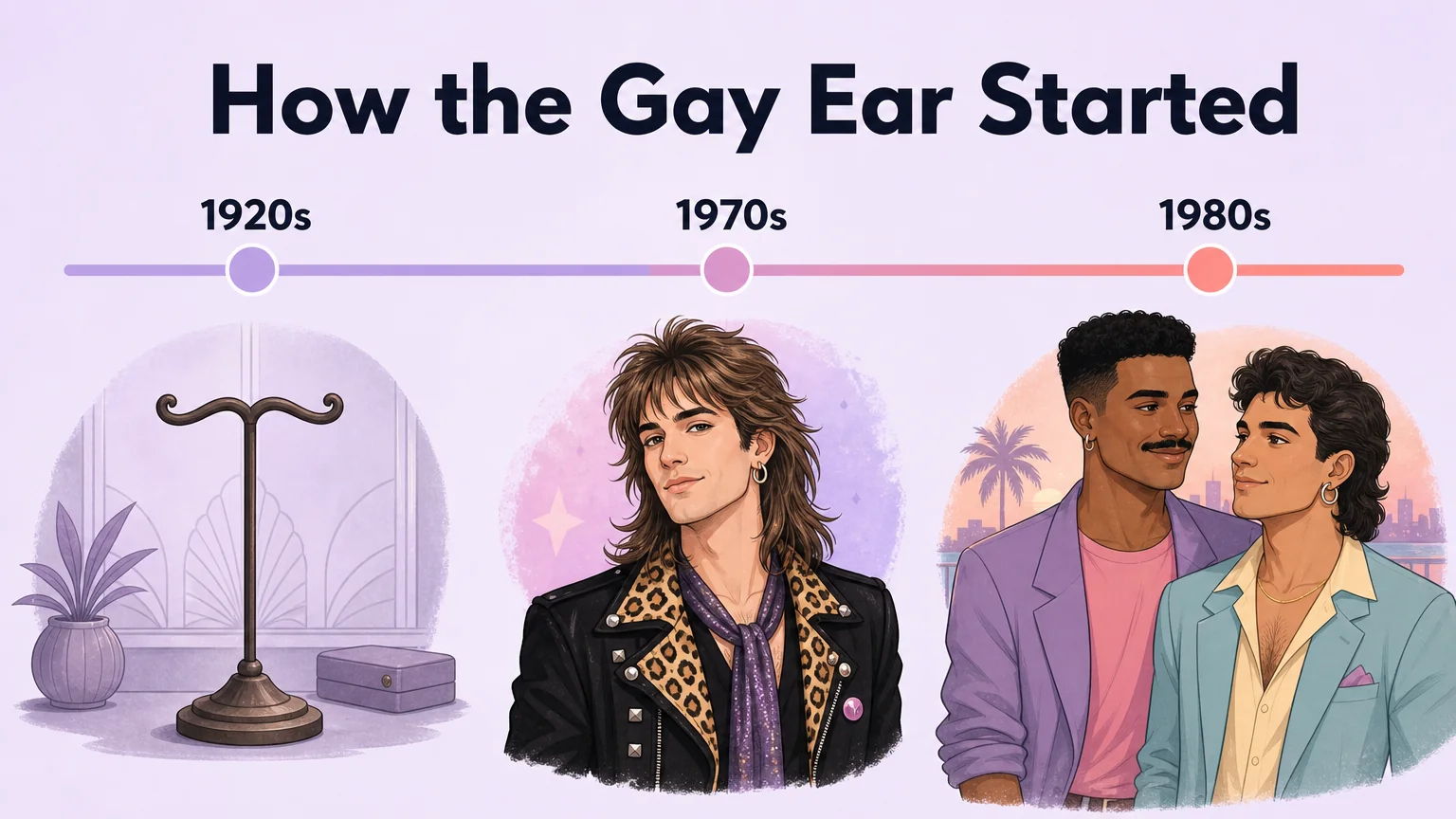
The dates disagree. The story of which ear is the gay ear has two start dates, decades apart, and both are partly right. Both make sense once you separate the piercing from the code.
Men’s ear piercing fell out of fashion in the United States in the 1920s. It did not return until the 1970s, carried back in by glam rockers, rock stars like Keith Richards, and European punk. That decade is when the practice was reborn, so a 1970s start date is fair.
The code’s cultural peak came in the 1980s. AIDS arrived in 1981, public homophobia hardened, and the cost of being visible climbed sharply. A quiet signal mattered more than ever, so it spread. That is why the 1980s feel like the center of gravity.
The famous rhyme, “left is right, right is wrong,” is where the meaning lived. Unpack it and it stops being nonsense: “wrong” meant gay, and the gay ear was the right one. Some people did the opposite on purpose, piercing whichever ear their local rule did not designate, so nothing could be read off them at all.
The queer historian Amanda W. Timpson frames the single earring as a discreet way to flag orientation. The professional body piercer Lynn Loheide places the origin in the 1970s and 1980s, and she does not soften that era. Being open could mean getting fired, losing housing, or being turned away at the door.
Why a Single Earring Could Cost You Your Job
The casting director James Scully remembers driving with his mother and aunt in the late 1970s when they slowed to stare at a man with a pierced right ear. They looked at him like some sort of creature. A piece of jewelry had turned him into a spectacle.
The threat behind that reaction was policy, not disapproval. In April 1953, Eisenhower signed Executive Order 10450, making “sexual perversion” grounds for federal investigation and dismissal. It covered more than six million federal workers and troops.
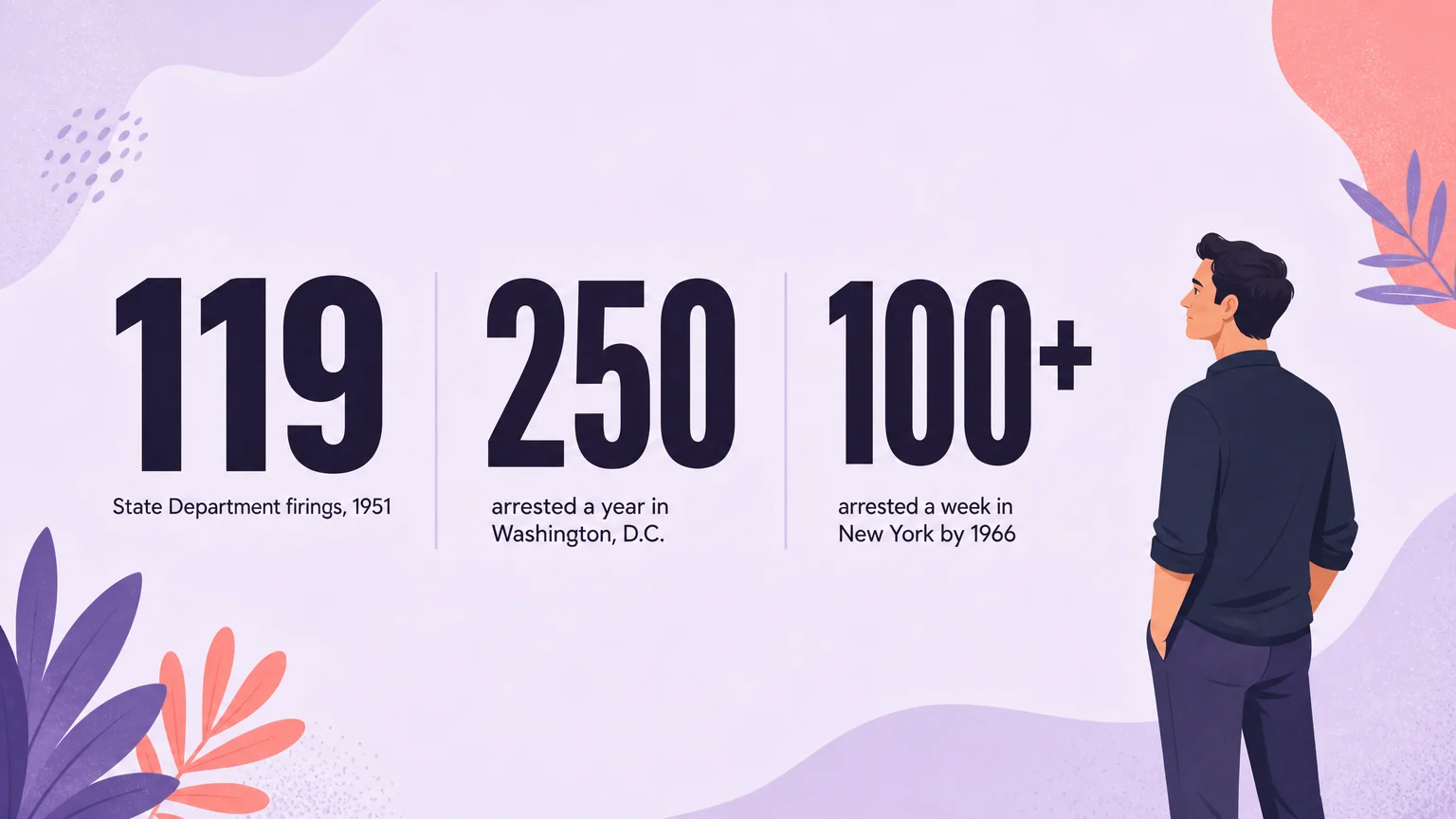
Under Truman, dismissals of gay employees rose from about five a month to more than 60. In 1951, the State Department fired 119 people for homosexuality against 35 for other security risks, widening to 134 versus 70 in 1952. Between 1947 and 1950, the FBI denied government jobs to 1,700 applicants over a “record of homosexuality or other sex perversion.”
Enforcement ran on the street too. Washington, D.C.’s Morals Squad arrested 250 men a year in 1953, all caught by plainclothes officers. By 1966, more than 100 men a week were arrested in New York City as vice squads raided bars and baths.
The Stonewall Inn was raided monthly. When the 1969 raid sparked the uprising, gay sex was illegal in every state but Illinois, with penalties up to 20 years or life.
Exposure carried a public price. A name, an address, and an employer could end up in a newspaper. A 29-year-old Floridian lost his law license in 1957.
Then the meaning curdled. The same visibility that let queer people find each other flagged them for hostile strangers. A single earring in the “wrong” ear got queer and straight people alike targeted for violence in the 1980s and 1990s.
The rhyme escaped the community and became a classroom taunt about which ear is the gay ear. That is how a survival signal dies: the people it protected stop trusting it, and the people who hated them turn it into a joke.
The 1991 New York Times Story That Declared the Gay Ear Dead
The code got an obituary, and it ran in The New York Times.
On May 19, 1991, the paper published “Piercing Fad Is Turning Convention on Its Ear.” One of its subheads read, in plain print, “A Gay Signal Is Lost.” The piece ran in Section 1, page 38.
The best line came from a New York man named David Menkes, who was pierced in several places. “In a world where you can’t dress flamboyantly, that’s a very discreet signal,” he said. The earring was a workaround for people who could not say who they were.
The article also brought in Charles Lindholm, an anthropology professor at Boston University, who observed that Westerners think they do not engage in strange body-altering practices because whatever they do, they consider normal. It opened with a nine-year-old Brooklyn boy whose mother had promised he could pierce his ear at 13. That is how fast the fad had traveled, from a coded adult practice to a playground promise.
The article’s own conclusion was blunt. Once enough straight men had joined in, the placement no longer suggested anything about sexual preference. The mainstream declared the code over in 1991.
The myth outlived the obituary. In a 2009 edition of the Times style magazine, a piece on the return of men’s earrings asserted flatly that “the rule of thumb has always been that the right ear is the gay one.”
So the culture was told which ear is the gay ear decades ago, and the question never stopped.
Why Nobody Could Agree on Which Ear Was the Gay Ear
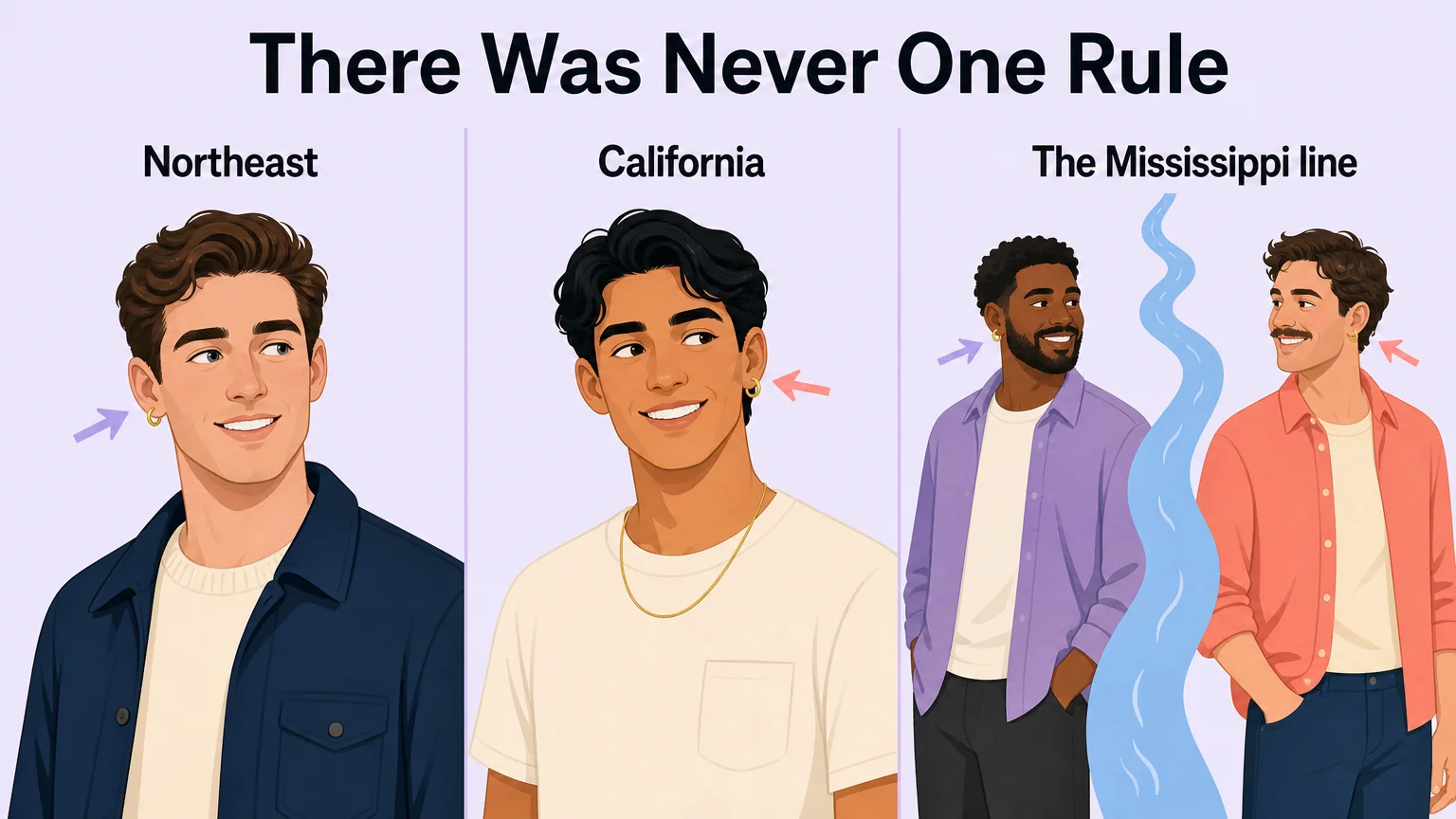
There was never one rule. The answer to which ear is the gay ear changed depending on where you stood.
In the Northeast, the gay ear was the right. California reportedly flipped it, making the left ear the gay one. Northern West Virginia, eastern Ohio, and western Pennsylvania remembered the opposite rule. Others recalled friends deciding it “depended what side of the Mississippi you were on.”
The splits are documented inside the United States. The claim that Britain or Europe reversed the convention is a different matter. The evidence points only to US variation, so treat a reversal abroad as rumor.
Even the people the code was built for could not keep it straight. The piercing pioneer Jim Ward got his first ear piercing in 1969, when the right ear was the conventional gay ear, and deliberately chose the left. One era observer said some men swore the right was gay while others insisted on the left, so nobody was sure.
Caitlin McDiarmid of The Point describes the meaning drifting “like a game of telephone.” Desmond Morris, in The Naked Man, noted it collapsed because nobody could remember which side was which.
The hanky code worked on two layers: color signaled the act, and the back pocket signaled the role, left for top and right for bottom. The 1983 second edition of Larry Townsend’s The Leatherman’s Handbook II listed black for S&M, dark blue for anal sex, light blue for oral sex, red for fisting, and, tellingly, purple for piercing. Bob Damron’s Address Book began printing a yearly chart around 1980.
The earring was never only American. In the UK, queer people used a coded verbal language called Polari, a shield more than a cloak. In Russia, straight men reportedly pierced their right ear after sleeping with a woman, as a defense against gay advances. In China, a left earring once marked a life in danger, and men’s earrings are now banned.
Who the Gay Ear Left Out: Women, Bi, and Trans People
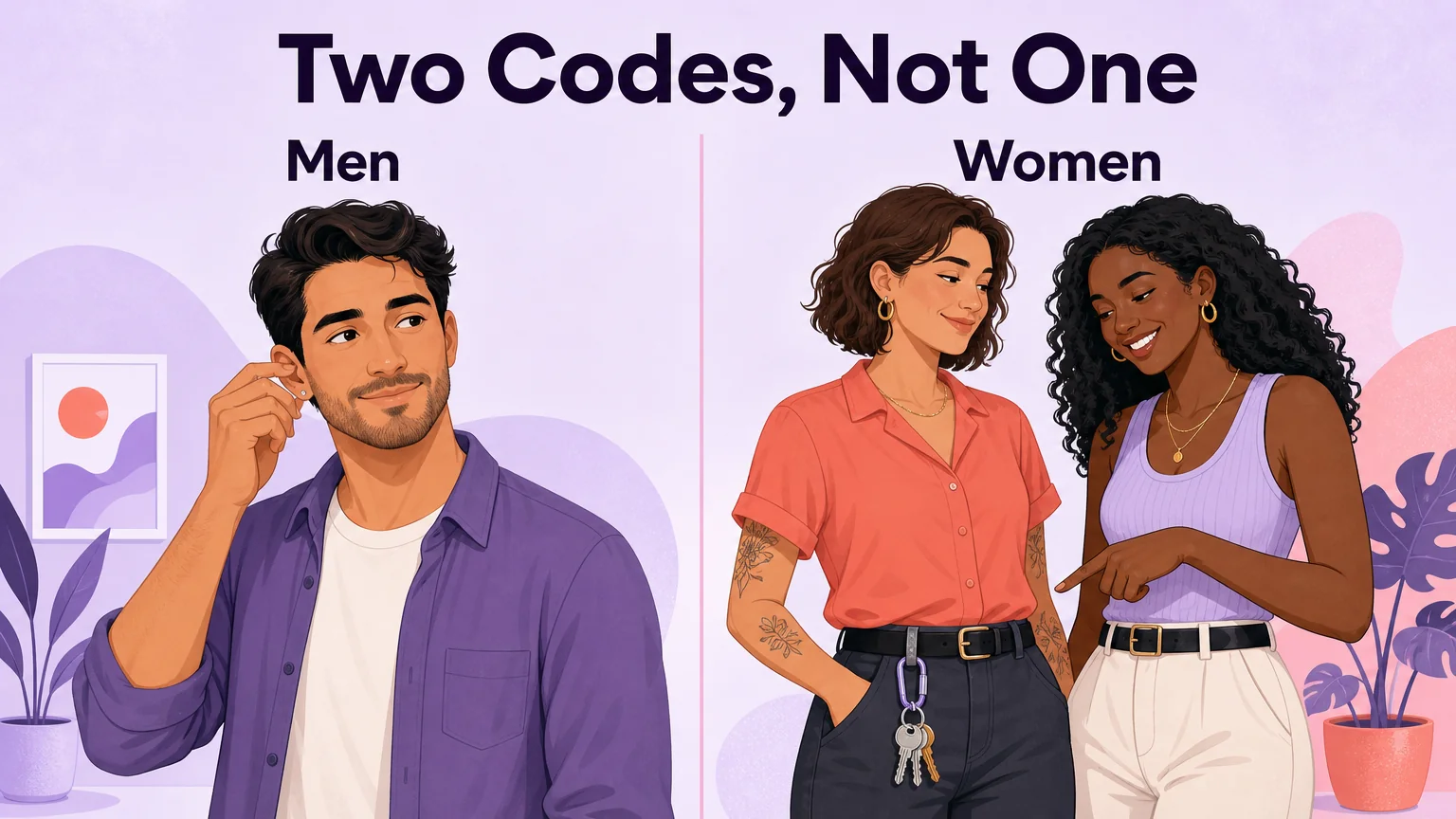
The single-earring code was built by men, in a world that mostly feared men being caught. Women were largely outside it. For them, which ear is the gay ear was a question the code never answered.
Queer women built something else instead. The carabiner, often clipped to a belt loop with a ring of keys, became a sapphic signal readable across a room. It traces back to mid-century women in manual and blue-collar jobs who needed somewhere to hang their keys. It stuck for two reasons: it was deniable as a practical item, and it announced itself with a jangle before anyone looked.
Alison Bechdel’s Fun Home gives the signal its emotional center. In the “Ring of Keys” moment, a child watches a masculine deliverywoman and feels something click into place. The keys were not a costume. They were a recognition.
A mirror version existed for women too: a single left-ear piercing read as a lesbian signal. Within one subculture, lesbians on the S&M scene sometimes stacked or enlarged left-ear piercings to signal dominance. Even the carabiner carries the same left-versus-right confusion as the earring. The accounts contradict each other, and many people just wore it on the comfortable side.
Then there is who the code could not see at all. It was strictly gay or straight, right or left. The only documented space beyond that binary was a regional variant that read both ears as bi or trans.
There was no pan, non-binary, or ace reading, because the system was never built to hold them. A code designed for one shape of desire had no slot for anyone else.
Nobody who wore one is on trial here. This is simply what happens to any signal built narrow. The people left outside it did not wait to be included. They made their own, and those signals outlasted the earring.
The Gay Ear in Pop Culture: From The Breakfast Club to Harry Styles
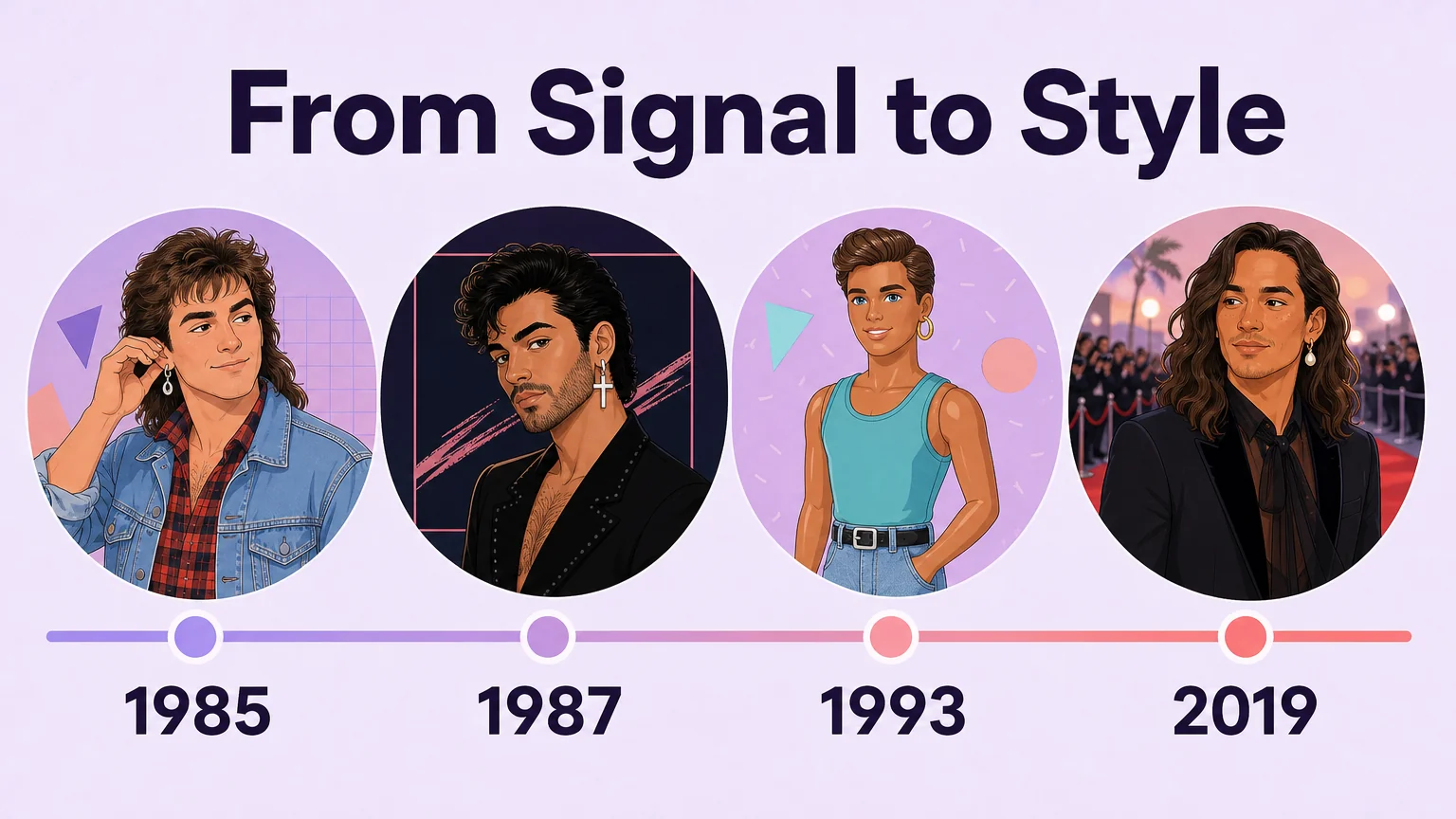
If you learned which ear is the gay ear without ever living under the code, a movie probably taught you. In The Breakfast Club in 1985, the rebel takes the earring a classmate hands him and threads it into his left ear, not his right. The film enforces that a man could wear a single earring the right way or the wrong way, and both a queer historian and a body piercer point to it as the moment that cemented the rule.
Others wore the same signal as a deliberate wink. On the cover of his 1987 solo debut Faith, George Michael wore a Catholic cross earring in his right ear and talked to the press about how it might be “wrong” to wear the cross. Prince and Elton John wore single earrings on the right in defiance of the convention, turning the signal into a rebellion or an inside joke.
Then the mainstream absorbed the look and drained it. In 1993, the Earring Magic Ken doll wore a right-ear loop, which unsettled parents already nervous about the doll. Meanwhile, straight icon-men wore single earrings and nobody read anything into them. Harrison Ford, Michael Jordan, and Mr. Clean all wore one.
Mr. Clean’s left-ear ring goes back to 1957. Once men who were never coded as gay wore the look, the question of which ear piercing is gay had nothing left to answer.
By the present, the meaning had fully inverted. Harry Styles wore a single pearl earring to the 2019 Met Gala, and Nicholas Galitzine wore single earrings on screen. The earring survived the code. What it means now is taste, not membership.
What Replaced the Gay Ear: How People Signal Now
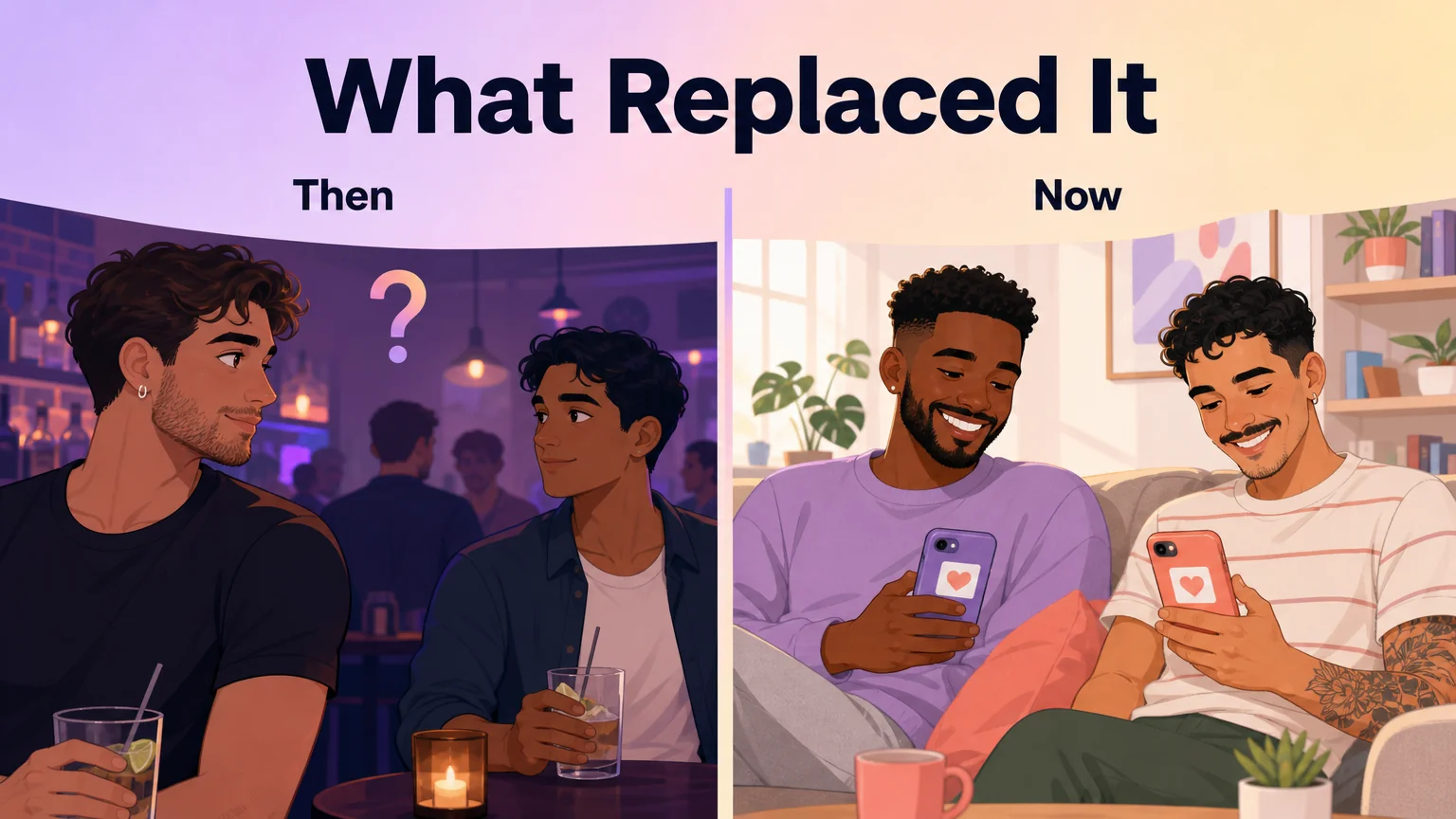
Nothing replaced the earring one for one, and nothing had to.
Dating apps solved the exact problem the code existed for. Instead of reading a stranger across a bar and hoping, people find each other instantly, from home.
It came with a cost. Moving queer desire off the street has thinned out the physical spaces where the code once lived. Police have also used dating apps with fake profiles to entrap people in public restrooms, an old decoy tactic in a new coat.
The signals that survive are chosen, not required. The carabiner has a modern rule of thumb, left for top and right for bottom, though many wear it where it sits comfortably. The old cloth codes are having a revival too. In 2025, a “cruising corner social” at a Brooklyn queer bookstore brought back the hanky code’s language of signals, and a mapping app now points cruisers to tens of thousands of spots where street and phone meet.
Search interest in men’s earrings rose about 147 percent since January 2021, according to the fashion platform Lyst, as reported in early 2022. That is search interest, not sales.
More queer and lesbian clients now choose a single right-ear piercing to celebrate who they are, the one place where which ear is the gay ear still has a live answer. The piercer Lynn Loheide proposes a replacement for the old taunt: “you’re safe here, right is queer.” The MEL Magazine writer Quinn Myers reads the whole thing as something that now “seems to matter less.”
The modern rule is short. Your ear means what you decide it means, and a straight man in a single earring signals nothing but his taste. The code is dead, and a world where nobody has to encode desire in metal is progress.
That is the premise 3Fun was built on: a dating app where you say what you want instead of signaling it.
Your Gay Ear Questions, Answered
Which ear is the gay ear?
Historically, the right. A single right-lobe piercing on a man read as gay, while a single left-lobe piercing read as straight. The rhyme summed it up: “left is right, right is wrong.” Today, neither ear carries a reliable meaning, so pick the side you like.
Which one is the straight ear?
Historically, the left, the mirror of the gay ear. The rule was regional, though, and some places reversed it, so no live “straight ear” exists today. If you want the historical gay ear for men, it still points to the right.
Was the code reversed in the UK or Europe?
No. Everything documented shows variation only inside the United States, where the rule flipped between the Northeast and California and even across the Mississippi. Treat any claim that Britain, Europe, or Australia reversed the convention as unconfirmed, never as settled fact.
Did the code ever apply to women?
Not meaningfully. It was built for men, and it stayed a men’s code. Women used their own signals, mainly carabiners and rings of keys, and where a single-earring reading existed for women it pointed to the left ear, not the right.
Was the gay ear real, or just a myth?
Real but unreliable. It was a genuine community practice that nobody enforced consistently, and even the men who used it could not agree on the details. That inconsistency is exactly why it faded instead of hardening into a settled rule.
Why do guys wear an earring in each ear?
Mostly style. A both-ears reading existed in a few local variants as a marker of being bi or trans, and an old sailor tradition used both ears to mark a round-the-world voyage. Neither carries real meaning today, so read it as style.
Did it start in the 1970s or the 1980s?
Both, depending on what you mean. Men’s ear piercing returned as a trend in the 1970s via glam rock and punk, but the code peaked in the 1980s, when the AIDS crisis made visibility costlier. That is why the dates collide.
Is it okay for a straight man to pierce his right ear?
Yes. The old reading is dead, plenty of straight men wear a right-ear ring, and nobody is keeping score. If anything, the revived meaning belongs to the queer people who choose that ear on purpose, so wear it in good health.
What was the hanky code?
A system where a colored bandana worn in a back pocket carried two messages at once. The color signaled the act, and the pocket side signaled the role, left for top and right for bottom. It was never fully standardized, so local meanings drifted.
Do people still use the gay ear today?
Not as a code. Some queer people do pierce the right ear deliberately to reclaim it, so the side can be a chosen signal rather than an accident. For everyone else, it is simply a piercing with no fixed meaning.