SOGIE stands for Sexual Orientation, Gender Identity and Expression. That is the whole expansion, and it answers what SOGIE is in one line. Here is the part that changes how the word reads: every person has one. Not only LGBTQ people. You have a sexual orientation, a gender identity and a way of expressing gender, whether or not you have ever put words to them.
That makes SOGIE a category rather than a label. It names attributes instead of groups, which is why a benefits office can put it on a general intake form and why a straight, cisgender person can answer every question on it and still be telling the truth. That is the difference between a category and a club.
The definition comes first, because it is the least contested part. From there come the three questions behind the acronym, the distinction between SOGI, SOGIE and SOGIESC, the reason the category exists, where it appears on forms and in law, and the criticism it has attracted.
Sexual Orientation, Gender Identity, and Expression, Defined
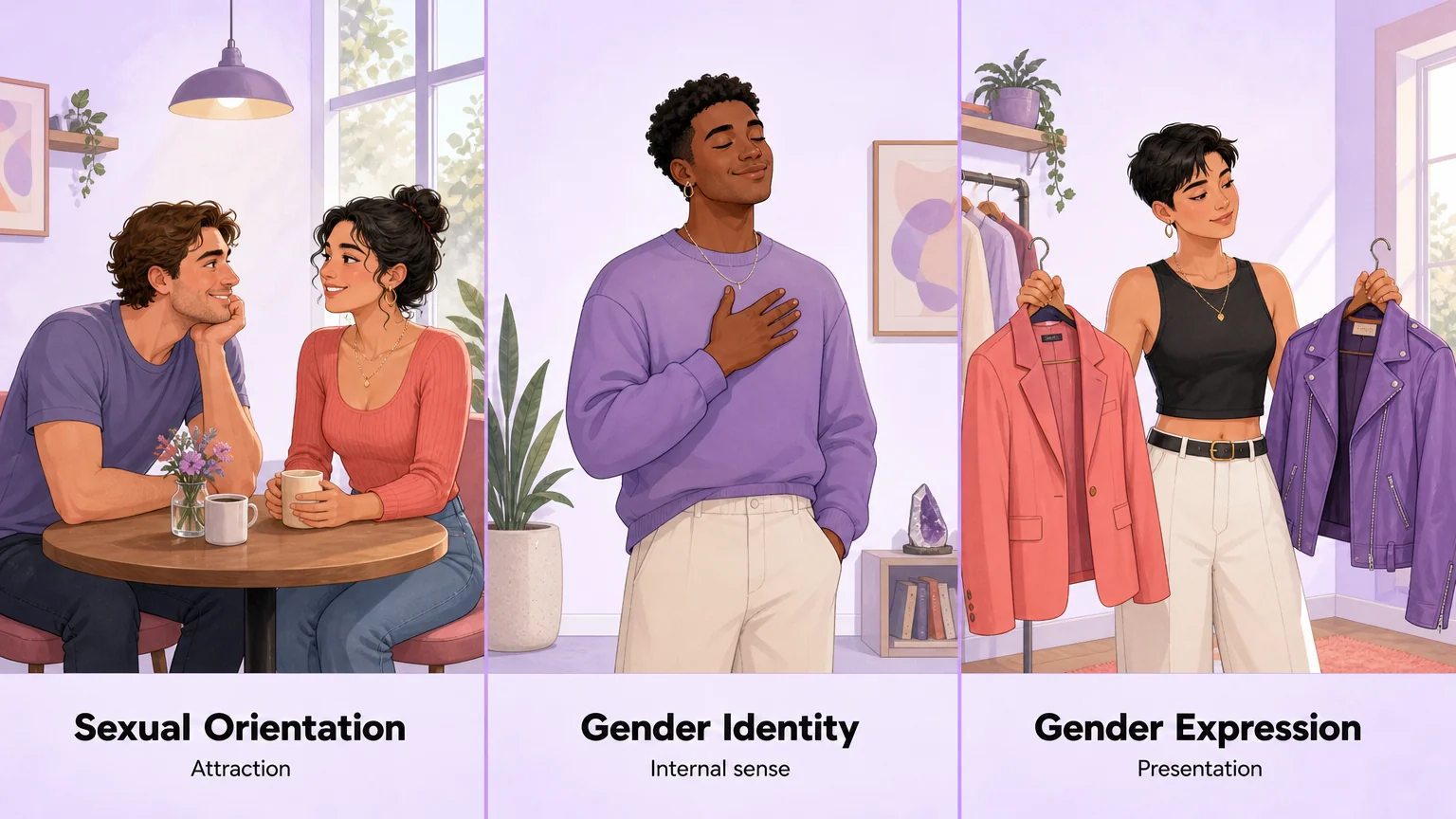
The SOGIE meaning is three answers, one for each part of the acronym. Each part answers a different question, and the questions keep the parts from collapsing into one another.
Sexual orientation answers one question: who are you attracted to? The American Psychological Association defines it as an enduring pattern of emotional, romantic or sexual attraction to men, women or both sexes. Enduring is the operative word. It describes a direction that holds over time, not a single experience and not a decision. The APA treats it as one of several distinct concepts, sitting alongside biological sex, gender identity and social gender role.
Gender identity answers a different question: what is your internal sense of your own gender? It may or may not correspond to the sex you were assigned at birth. Someone can be a woman, a man, neither or both, and no observer can verify the answer from the outside. You are the source of it.
Gender expression answers a third: how do you present gender outwardly? Name, pronouns, clothing, hair, voice, mannerisms and behavior all carry it. The International Labour Organization defines it as each person’s presentation of gender through appearance and manner, then adds the caveat that expression may or may not conform to identity.
Pronouns belong to this third part, and the phrase to use is “pronouns,” not “preferred pronouns.” GLAAD’s guidance is direct: pronouns are a fact, not a preference.
Sex assigned at birth is not part of SOGIE at all. It is a separate item, which is why sex characteristics can enter later as a fourth ground without disturbing the first three.
None of the three questions asks which group you belong to. Each asks for something you are the only reliable source on. That is why a form can put it to everyone.
What Each Part Does Not Tell You

Presentation is not a disclosure. A man in a skirt, a woman with a shaved head, a person whose voice sits higher than you expected: none of it tells you their gender identity, and none of it tells you who they are attracted to.
Gender expression may or may not conform to gender identity, and the mismatch runs in both directions. Many cisgender people have gender-nonconforming expression. Not all transgender people do. UNHCR’s instruction to field staff states the rule plainly: gender expression is not always indicative of gender identity, so do not assume.
Identity does not determine orientation either. Transgender people have sexual orientations like anyone else: straight, lesbian, gay, bisexual, pansexual, queer or asexual. A trans woman attracted only to women would typically call herself a lesbian; attracted only to men, she would typically call herself straight. Being trans is not itself a sexual orientation, and it says nothing about who someone wants.
Orientation is not behavior. Attraction can exist without experience, and experience can happen without attraction. People can be celibate and still know their orientation, as the APA points out, and sexual activity does not define it. Self-identification does.
The practical version is easy to test. Someone tells you their pronouns and you still do not know their orientation. Someone tells you their orientation and you still do not know their gender identity. Both statements can be true, and neither fills in the other.
These dimensions answer different questions, and none reliably predicts another. The ILO notes that the Yogyakarta Principles plus 10 treat gender expression as part of gender identity, while the ILO’s own definition keeps expression separate and says it may or may not conform. Either way, the rule for dealing with a person is the same: do not infer one from another.
The cost of collapsing them is not abstract. Clinical training on these concepts warns that confusing them leads to misassessment, invalidation or ethical harm, which is a formal way of saying that guessing wrong about a person has consequences.
SOGI, SOGIE, and SOGIESC: What Each Version Adds
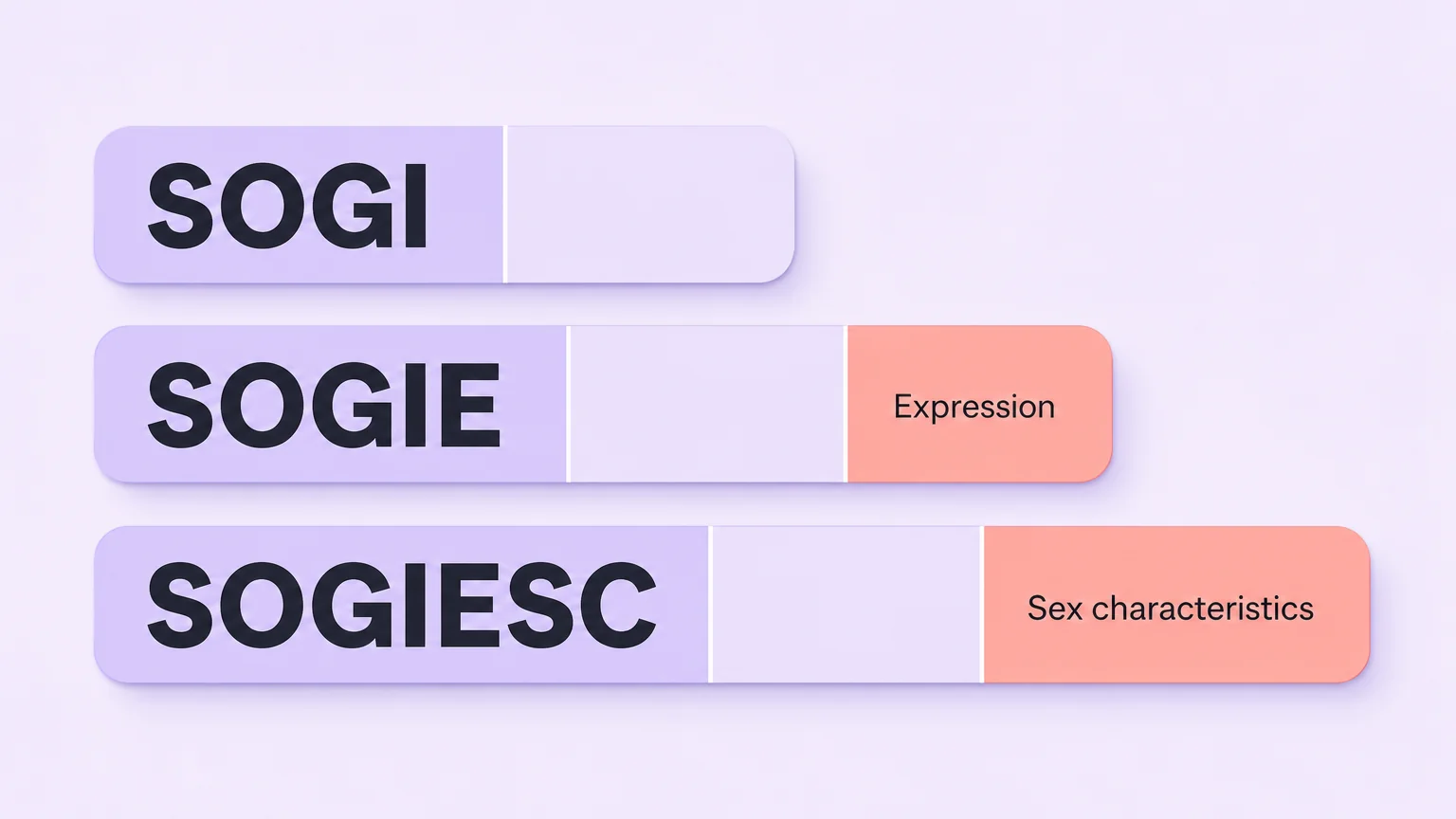
The versions of the acronym are not variants of one definition. Each is a different scope, and the difference is which dimensions it can speak about.
SOGI covers two: sexual orientation and gender identity. It is the shortest and the most widely used, and it is the form the UN human rights system runs on. The trade-off is recorded inside the system. A review by the International Peace Institute quotes practitioners describing SOGI as “a shorter but less inclusive term that is more widely used.”
SOGIE adds gender expression, the visible dimension. That addition matters most where expression is what gets policed: a dress code, a haircut, a voice on a phone. The three-part form is standard in Philippine and Asian advocacy and in US county service delivery, which is why many people meet this version first in a California benefits office.
You will also see the third letter expanded as “expression” and as “gender expression,” sometimes within one document. The meaning does not change; the wording is not standardized.
SOGIESC adds sex characteristics, and here the acronym stops being about identity and attraction altogether. Sex characteristics are the chromosomal, gonadal and anatomical features of a person, primary and secondary: reproductive organs, genitalia, chromosome patterns, hormones, muscle mass, hair distribution, breasts, stature. The ILO’s 2019 paper concludes that after the 2017 Yogyakarta supplement, “it is now considered to be more correct and complete to refer to SOGIESC grounds instead of only SOGI.” UNHCR uses the four-part form throughout its explainer, and Canada’s refugee guidance uses it too, so the term travels through both humanitarian and legal settings.
Intersex is distinct from gender identity, transgender identity and sexual orientation. An intersex person can be cisgender or transgender, straight or gay. The bodily variation is the thing that needs the ground.
That is why the advocacy asks for a separate one. OII Europe campaigns for anti-discrimination law on the ground of sex characteristics, covering people regardless of how those characteristics appear. Folding intersex people into gender identity would answer a question they are not asking.
None of this makes the longer acronym a correction of the shorter one. It is a sequence of additions, each naming a ground someone needed.
Why SOGIE Exists: A Category for Everyone
Start with the function, because it explains everything downstream. SOGIE describes attributes every person has, so a form can ask for it without asking anyone to announce something private. A form asking for your sexual orientation and gender identity is not a form asking whether you are gay. The county guidance behind such forms puts the rule in five words: “All individuals have a SOGIE.”
That is the difference from an identity list. LGBTQ+ names groups of people, which makes it precise for the people it names and incomplete by design for everyone else. The plus sign admits as much. A list of groups cannot describe a whole population.
A list of attributes can. That is a data question as much as a language one: a category everyone can answer produces information about everyone, including the majority who would never check an LGBTQ box.
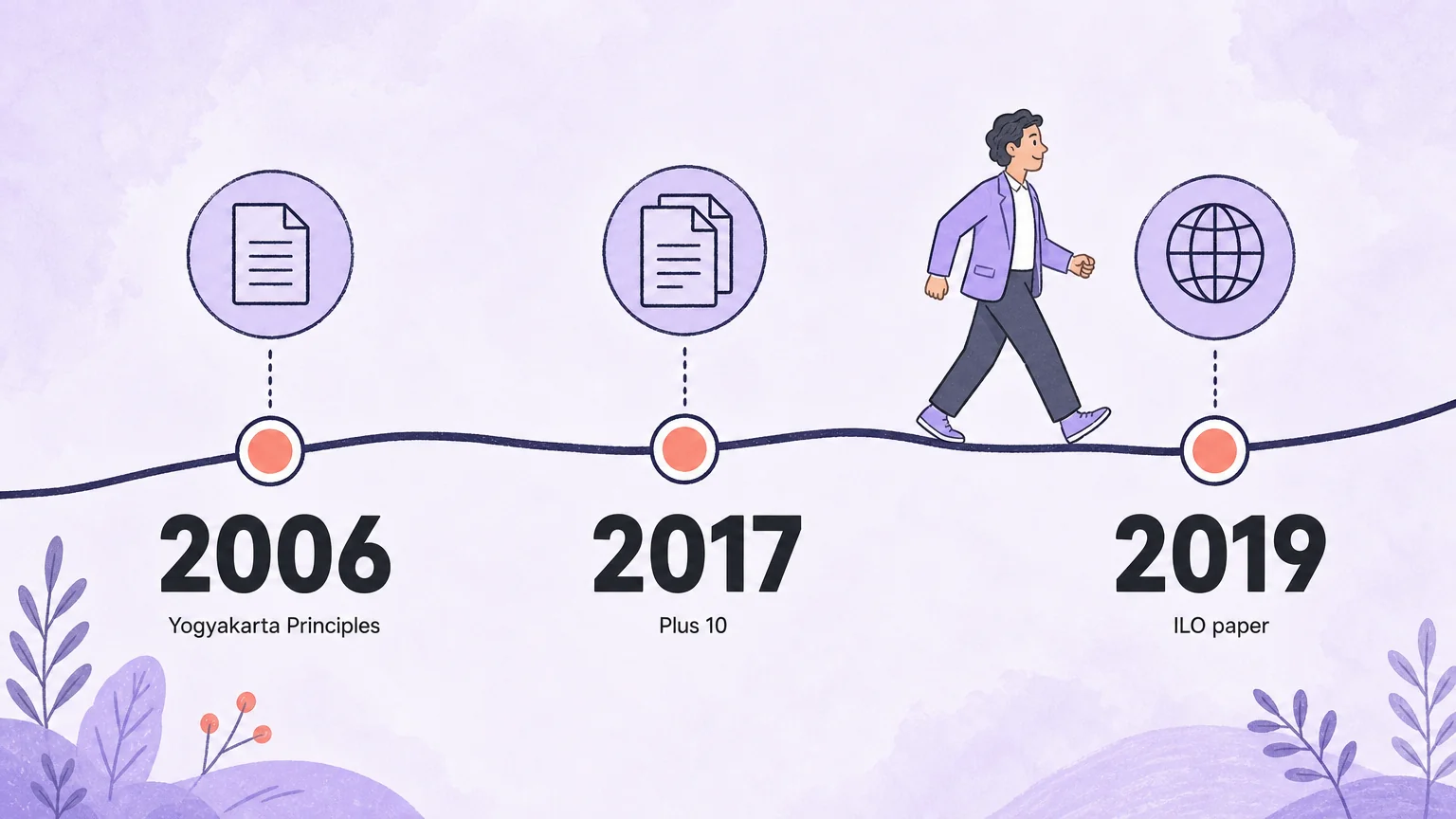
The documented record starts in 2006. The pairing of sexual orientation and gender identity entered international human-rights language through the Yogyakarta Principles, produced by a meeting of international human rights experts in Yogyakarta, Indonesia. The Principles apply existing human rights law to those two grounds, and they became the reference point for the pairing.
It continues in 2017. A second expert panel adopted the Yogyakarta Principles plus 10 on Nov. 10, 2017, adding gender expression and sex characteristics as explicit grounds for protection. Two years later, the ILO put its weight behind the four-part form in a 2019 information paper, and the longer acronym has been the standard in that work since.
No single person coined the acronym. It accumulated, ground by ground, as the institutions doing the work kept finding gaps in their own categories.
Where SOGIE Shows Up in Practice

The likeliest place you will meet the word is a benefits form. California counties ask SOGIE questions at intake and at redetermination, on forms known as the CW 2223 and SOC 814. The questions are voluntary and have nothing to do with whether you qualify for anything. Every question offers a decline-to-state option, and staff are instructed to write down what you say rather than interpret it.
The stated purpose is demographic: find service gaps, measure whether programs are reachable, and inform case planning. The statutory push came from California’s AB 959 in 2015, which required four state departments to collect voluntary SOGI self-identification data by July 1, 2018.
County practice follows from that mandate. So the question on the page asks for a data point you are free to withhold. Nothing on it requires you to declare a community, and the form is supposed to work whether or not you answer.
Outside a benefits office, the rule that travels best comes from humanitarian work. Aid workers are told never to assume someone’s sexual orientation, gender identity or sex characteristics, because only the person can tell you. That holds for a caseworker with a clipboard and for anyone else meeting someone new. It is the same rule as the forms, stated without the paperwork.
Where the Acronym Draws Criticism
The acronym has critics, and they do not line up on one side. The criticisms come from scholars, from practitioners inside the UN, and from groups it has not fully reached.
The most developed case comes from Jena McGill, writing in the Canadian Journal of Human Rights in 2014. McGill calls SOGI the “term of inclusion” through which sexual and gender diversity entered UN human rights work, then names three risks in building the discourse on it.
First, it can marginalize trans people, gender expression and intersex people, whose grounds sit at the edge of or outside the two-part form. Second, it entrenches Western-based identity categories that do not travel cleanly into every legal and cultural context. Third, adding SOGI to existing human rights frameworks produces fragmented and unpredictable norms rather than a coherent body of protection.
The International Peace Institute’s review of UN work records the same trade-off from the inside: the shorter term is the more used one, and both SOGIESC and LGBTI have drawn criticism of their own. Reach and precision pull against each other, and no version wins both.
OII Europe’s position points at the same seam from the outside. Its demand for a separate legal ground of sex characteristics implies that a framework built on identity and attraction cannot carry intersex people as intersex. That is a criticism of scope, not of intent.
Nothing here shows a community turning against its own word. These are arguments about what a category can hold and who it leaves at the edge, made by people who use it. The disagreement stays open, which is where a working vocabulary usually sits.
Frequently Asked Questions About SOGIE
Is SOGIE a gender?
No. Gender identity is one of the three components, and gender expression is another. SOGIE is the container for all three, so it describes a set of attributes rather than a gender category. A gender is one answer inside it.
Is SOGIE the same thing as LGBTQ?
No. LGBTQ names groups of people. SOGIE names attributes that every person has, including straight and cisgender people, which is why a government form can ask everyone for a SOGIE without asking anyone to come out. The two overlap in subject and differ in kind.
Can a transgender person be straight?
Yes. Being trans says nothing about who you are attracted to. Transgender people may be straight, lesbian, gay, bisexual, pansexual, queer or asexual, and a trans woman attracted only to men would typically call herself straight. Gender identity and sexual orientation are separate questions.
How do you pronounce SOGIE?
It is spoken as a word of two syllables, not spelled out letter by letter. No style guide issues a ruling on the exact vowel sound, so say it as a word and follow the people around you who use it.
Is “SOGIE people” the right way to say it?
It is not the phrasing the bodies that work with the concept use. The ILO’s guidance refers to “persons of diverse sexual orientations and gender identities,” which keeps the acronym describing attributes rather than labeling a group. Where you mean the communities, “LGBTQ people” is plainer.
Does Japan have a SOGI anti-discrimination law?
No enforceable one. Japan’s 2023 Act on the Promotion of Public Understanding of the Diversity of Sexual Orientation and Gender Identity states that discrimination is unacceptable, but its duties are promotional: awareness, training and consultation systems. It sets no penalties and no prohibition to enforce.
Is the SOGIE Equality Bill law in the Philippines?
No. As ABS-CBN reported in November 2026, a House committee approved 11 consolidated bills in principle and moved to draft a substitute. The bill’s own title uses the four-part form, SOGIESC, and it still needs plenary approval, Senate passage and presidential signature.