LGBTQ shows up on a flag, on a form, in a headline, and in a sentence someone says about themselves. It stands for lesbian, gay, bisexual, transgender, and queer. That takes a second to spell and much longer to answer, because five letters are doing four different jobs at once.
The Q also covers questioning, and LGBTQ+ is the same term with an explicit catch-all attached. LGBT, LGBTQ, and LGBTQ+ are all in ordinary use, and none is a mistake.
The letters do not all describe the same kind of thing. Some describe who a person is attracted to; one describes gender; one describes the body; one is a catch-all that admits the list has an edge. That mismatch is why the acronym can feel arbitrary on first contact, and why it stops feeling arbitrary once the parts are separated.
What follows takes them in order: the four axes the letters bundle, the letters one at a time, the history behind the order, the people at the edges of the umbrella, and the language that works out loud.
The Four Axes Behind the Letters: Orientation, Identity, Expression, and Sex Characteristics
The T is not a sexual orientation. Neither is the I. The letters sit in a row and look like a list of the same kind of thing, and they are not. That is the one fact that makes the rest of the acronym readable.
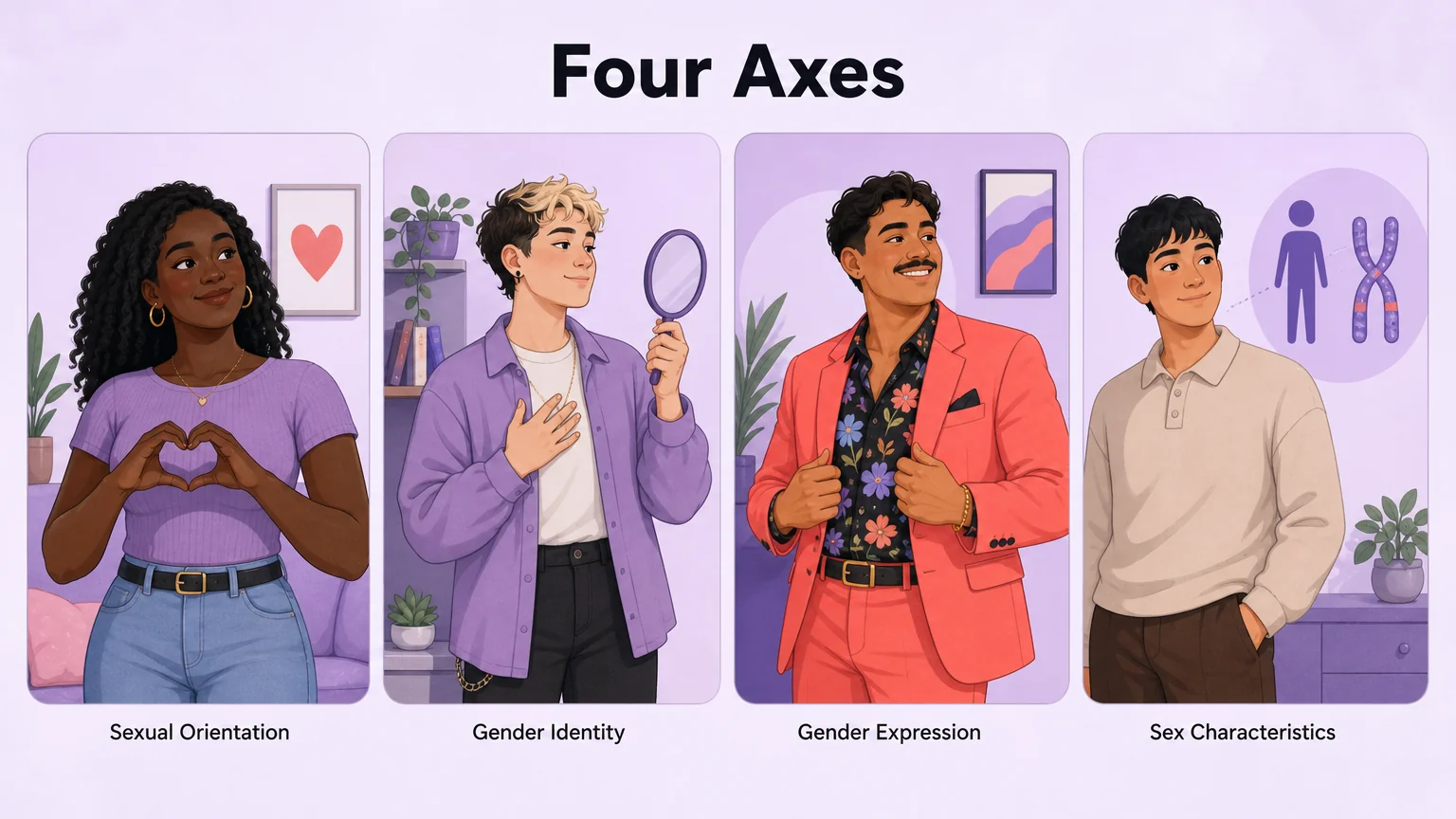
The professional shorthand for the four axes is SOGIESC: sexual orientation, gender identity and gender expression, and sex characteristics. GLAAD notes that the term is more common outside the United States, and that it is explicitly inclusive of everyone, straight and cisgender people included. That inclusivity is exactly why a separate term for the marginalized group still exists. A category that holds all of humanity does not tell you who is being talked about.
Sexual orientation is who someone is attracted to. Gender identity is the internal sense of being a man, a woman, both, neither, or something else. Gender expression is how a person presents that outwardly, through clothes, hair, voice, and manner. Sex characteristics are the body’s anatomy, hormones, and chromosomes.
These axes are independent, and none of them is a vote on the others. A cisgender woman can dress in a way strangers read as masculine; that changes her expression, not her identity. A transgender person can be conventionally dressed, and an intersex person can be straight. A fact on one axis says nothing about the rest.
A transgender woman attracted exclusively to women would typically describe herself as a lesbian. If she were attracted exclusively to men, she would most likely describe herself as a straight woman. Her gender identity and her sexual orientation are two separate facts, and neither one can be derived from the other.
Now map the letters and notice the unevenness. L, G, and B are orientation; T is gender identity; I is sex characteristics; Q and the plus are the catch-all, the place where the tidy mapping runs out. That unevenness is the plain reason the acronym has never been symmetrical, and it is not a flaw somebody forgot to fix.
L, G, and B: What Lesbian, Gay, and Bisexual Actually Describe
Three definitions, in words you can use in the next conversation without checking anything first.
Lesbian describes a woman who is attracted to women. Gay typically describes a man who is attracted to men, and it also works as an umbrella for same-sex attraction more generally. Both are adjectives. Say that a person is gay or that a person is lesbian; do not say that a person is a gay.
Bisexual is where the definition needs care, because the wrong version of it is everywhere. Bisexual describes the potential to be physically, romantically, or emotionally attracted to people of more than one gender, and GLAAD’s phrasing is the one worth keeping: not necessarily at the same time, in the same way, or to the same degree. The bi refers to genders the same as and different from one’s own. It does not mean men and women, and the reading that it does quietly deletes most of the people the word describes.
A reader carrying the two-gender definition will misread the numbers later in this piece, and will misread bisexual people in their own life, because that definition leaves no room for attractions that do not split evenly or stay fixed.
Experience is not the test. A person can know their orientation without having acted on it.
Pansexual sits under the bi+ umbrella as one of several terms rather than as a replacement for bisexuality, naming attraction to any person regardless of gender identity. People choose between the labels for reasons of their own, and neither is the more advanced position. The fuller comparison gets its own answer at the end.
The T: Gender Identity, Not Sexual Orientation
Being asked to explain your own gender, in a room where nobody has yet explained the difference between gender and attraction, is a specific and familiar irritation. The T is where that happens most, because it is routinely filed under the wrong heading.
Transgender describes a gender identity that differs from the sex a person was assigned at birth. It is a gender term, never an orientation term. Transgender people have orientations, and they may be straight, gay, lesbian, bisexual, or queer. Nothing about a person’s gender tells you who they are attracted to, and inferring one from the other is the mistake the four axes were built to prevent.
Nonbinary describes a gender outside the categories of man and woman. Many nonbinary people also call themselves transgender and consider themselves part of the trans community; others do not. Both are correct, because the person deciding is the one who lives in it, and no external test settles the question better than they can. Nonbinary is not an incomplete version of transgender, and transgender is not a more committed version of nonbinary.
One practical note, since it comes up in writing more than in speech: do not shorten nonbinary to NB. The abbreviation is widely read as shorthand for non-Black, and the confusion costs nothing to avoid.
None of this requires a debate. A reader working out which word applies to themselves, or to someone they love, is asking a question with an answer.
The Q: Queer, Questioning, and a Word Still Being Argued Over
The Q is the only letter in the acronym that means two things, and one of those meanings is still an argument.
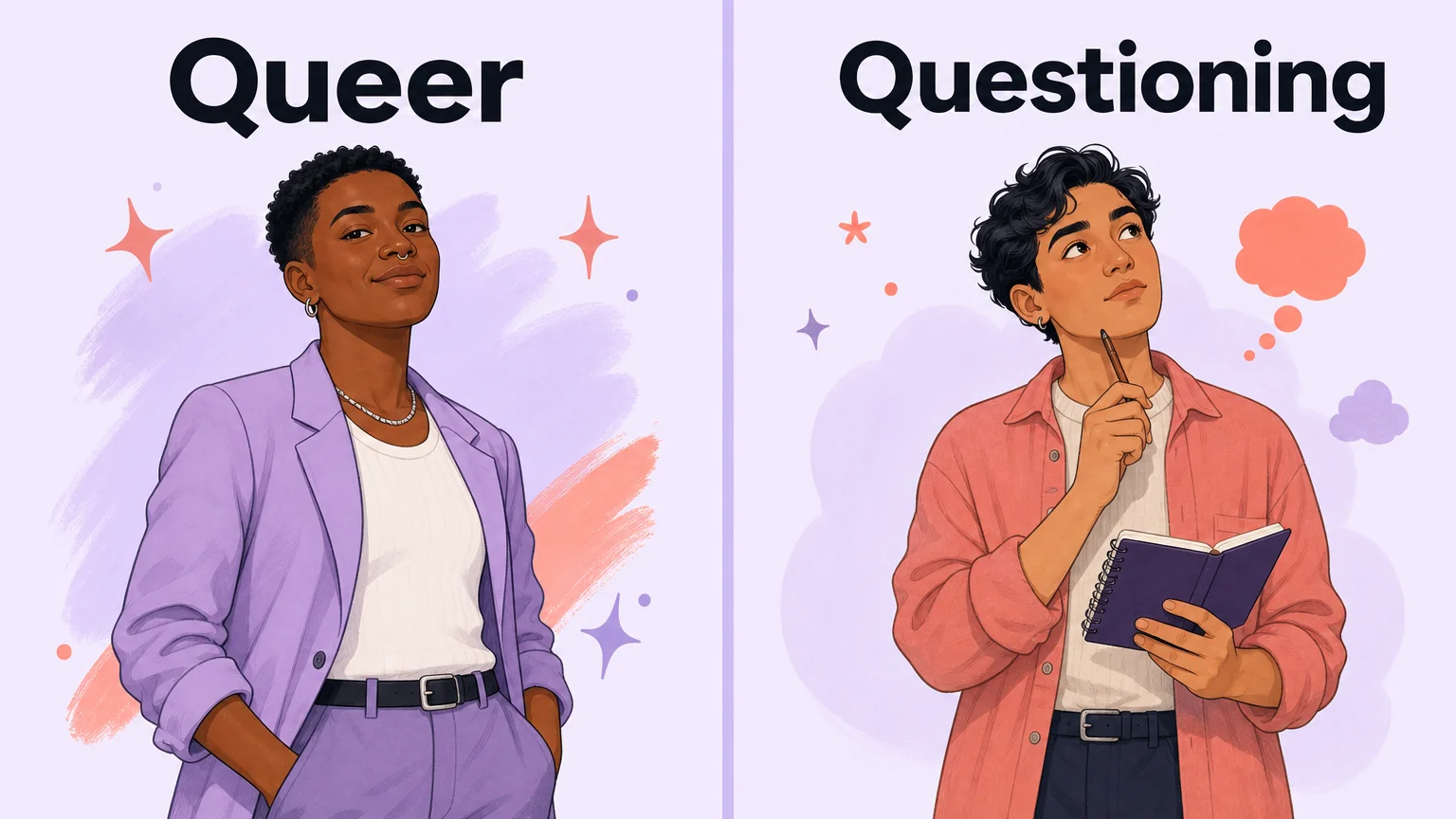
Questioning describes someone in the process of exploring their sexual orientation, their gender identity, or both. In youth support settings, the Q can mean questioning. There is no deadline attached to it and no exam at the end. It is a state rather than a label, and it does not have to resolve into one.
Queer is an adjective used by some people, particularly younger people, whose sexual orientation is not exclusively heterosexual. It was once a pejorative, and many people have reclaimed it as a word that fits better than the narrower options. GLAAD’s caution is the usable part: it is not a universally accepted term even within the LGBTQ community, so it belongs to self-description and direct quotation rather than to outside application.
The disagreement is live, and it is not fringe on either side. Some LGBTQ people, particularly older people who remember the word as the insult they grew up with, do not use it and do not want it applied to them. Many others, particularly younger people, describe it as the word that finally covered them when the narrower labels did not. The community has not settled the question, and this piece is not going to settle it for them.
Underneath the vocabulary argument is a question about respect. Gerard Koskovich, curator at the GLBT History Museum in San Francisco, describes naming as a discussion about respect, about who is given visibility, and about how power is distributed. The vocabulary is the proxy, not the subject.
So: if the word describes you and you want it, it is yours. If someone applies it to you, you are not obliged to take it, and meaning it kindly does not make it yours to give.
The Plus: What It Covers, What It Cannot Cover, and the Longer Versions
The plus admits the list was never going to be complete, and admitting that costs something.
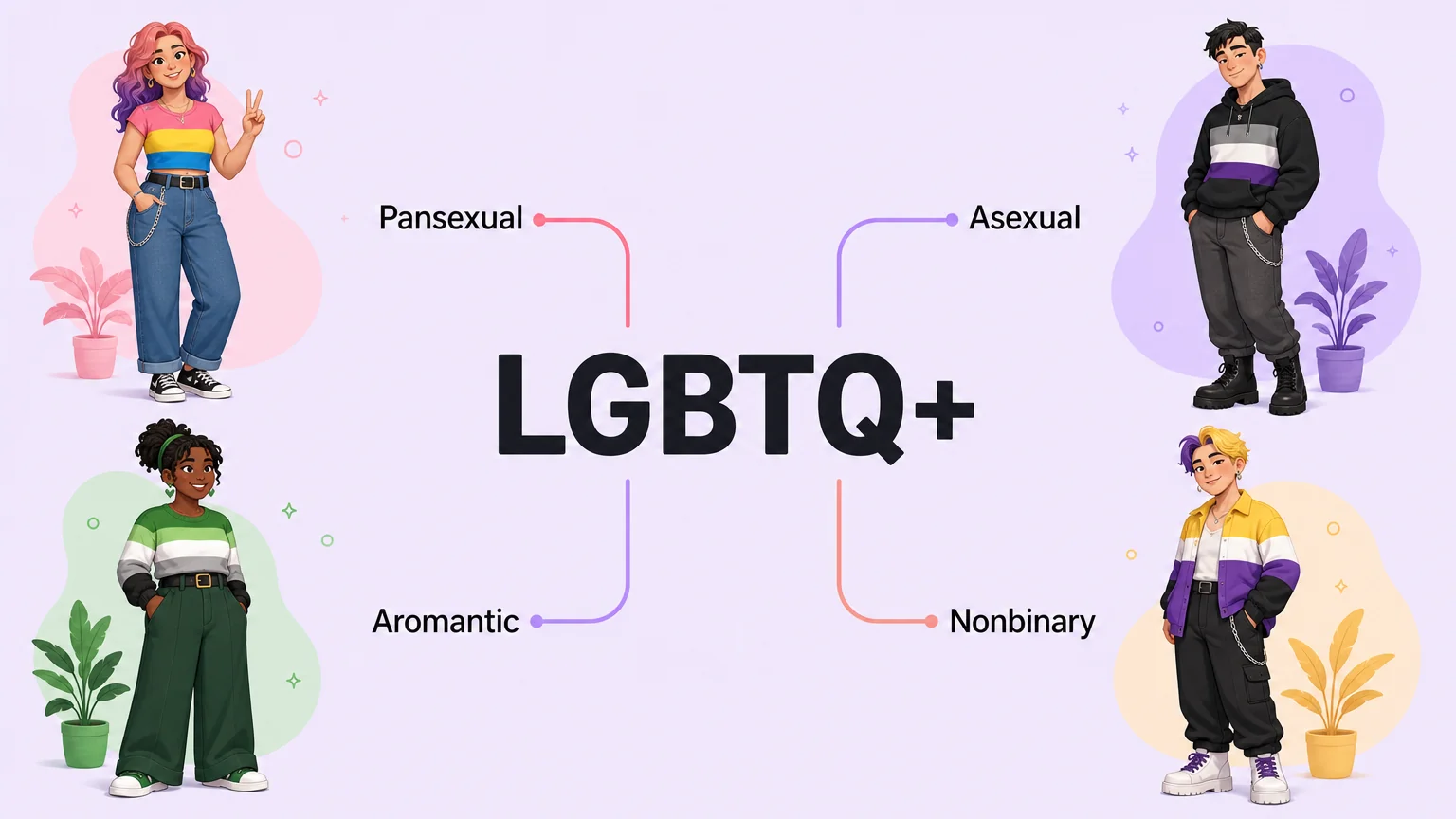
What it covers is people who are part of the community but whose identities the letters do not fully name. GLAAD describes it as added in recognition of all non-straight, non-cisgender identities. It covers identities, not behaviors. Pansexual, asexual, aromantic, and nonbinary people are among those it names. It is the shape of a sentence that trails off on purpose, and it keeps the string from being rewritten every time a term appears.
The longer versions push the same idea further. LGBTQIA+ adds intersex and an A that can stand for asexual, aromantic, or agender. interACT’s condition is the part organizations should keep: add the I only when there is intersex leadership, consultation, or resources behind it. PFLAG’s glossary also records 2SLGBTQ+, which puts Two-Spirit first.
interACT includes the I itself and notes that the practice is becoming much more common in the United States. GLAAD treats LGBTQ and LGBTQ+ as equally acceptable, along with other versions, so a writer choosing between the two is not making an error.
Then there is the cost. The more identities a single acronym absorbs, the less specific it becomes, and some people inside the community find the long string harder to use than the older, narrower words. The complaint is fair. Completeness and sayability pull against each other, and neither answer has won. Wanting a shorter word does not mean wanting fewer people under it.
Why the Letters Are in That Order: A Short History of the Acronym
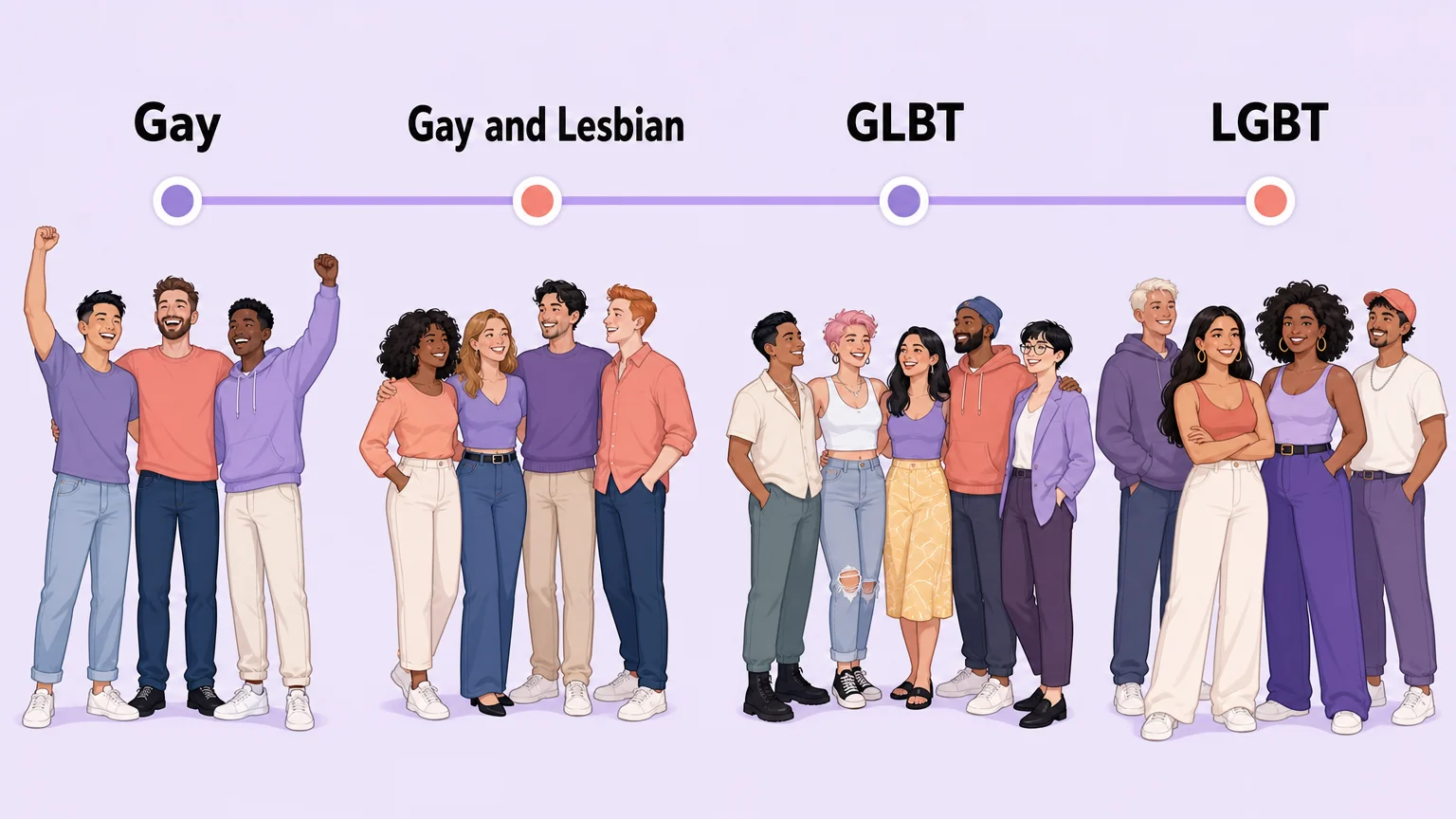
Nothing about the order is alphabetical, and there is no committee behind it. The L is first because of a fight over who gets seen.
The lineage runs from the clinical vocabulary of the mid-century to gay, then to gay and lesbian, then to GLBT, then to LGBT. Bisexual and transgender people were added to the description in the late 1990s, long after the first demands for inclusion, with bisexual organizer Maggie Rubenstein and transgender activist Susan Stryker pushing organizations to change their names. GLBT was the common form through the early 2000s.
LGBT replaced GLBT as the most common term in the mid-2000s, on the reading that the change would give lesbians more visibility again.
That reading has a history under it: lesbians had pressed for the phrase gay and lesbian in the first place because gay was being read as male, and putting the L first was the same argument made a second time. No body voted on it and no style guide decreed it. Usage moved, and the reason it moved was visibility.
A date for the first use of the initialism has not been traced to an originating document, so treat the exact year as unsettled. The documented shift is the mid-2000s.
What the sequence shows is simpler than a timeline. Every letter that arrived late arrived because a group was being left out of a name that claimed to include them. That is why the acronym keeps changing, and it is why people keep arguing about it. A name that has to expand is a name that was too small.
Who Sits Under the Umbrella, and Who Gets Pushed to the Edge
The largest group under the acronym is the one most often talked about as if it were not there.
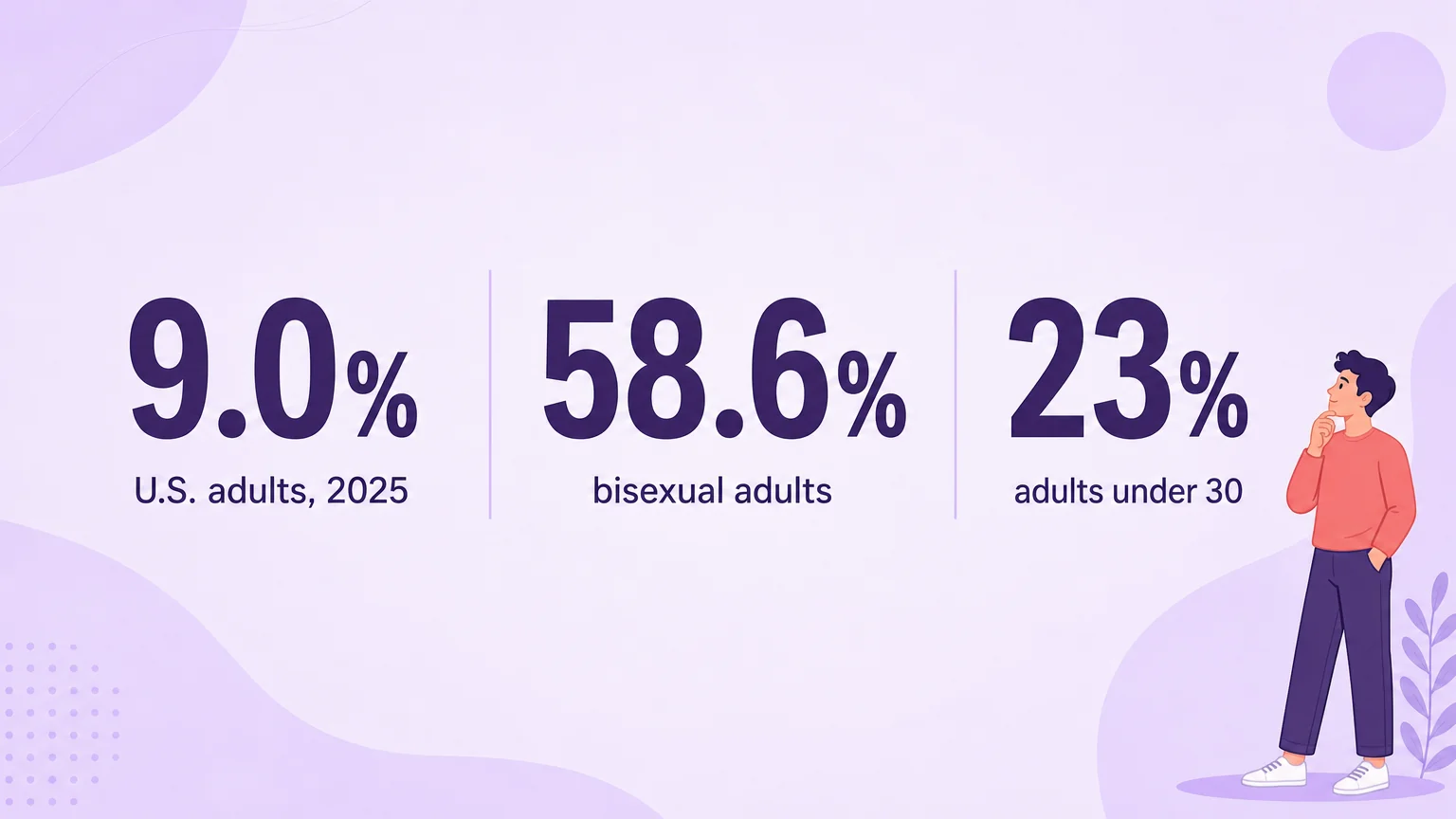
In 2025, 9.0% of U.S. adults identified as LGBTQ+, more than double the 3.5% Gallup first measured in 2012. Within that population, bisexual adults are 58.6%, ahead of gay adults at 17.4%, lesbian adults at 16.0%, and transgender adults at 12.1%. Among adults under 30, 23% identify as LGBTQ+, against roughly 2 to 3% of the oldest Americans.
Then the erasure inside the number. Bisexual people are routinely read as straight or as gay depending on the gender of whoever they are with at the time. A bisexual woman dating a man is filed as straight; the same woman dating a woman is filed as a lesbian. The B names this pattern, and it still happens: the largest group under the acronym is also the one most often misfiled.
Intersex describes sex characteristics, including genitals, internal reproductive organs, and chromosomes, that fall outside traditional conceptions of male and female bodies. About 1.7% of people are born intersex. It is not a gender and not an orientation, and many intersex people are cisgender and straight.
The trait is often internal, hormonal, or chromosomal rather than visible, and the word hermaphrodite does not belong unless a person uses it for themselves.
Asexual describes a person who does not experience sexual attraction. Aromantic describes a person who does not experience romantic attraction. Both sit inside the umbrella, and the answer to whether they belong is yes.
Two-Spirit is an umbrella term used by some Indigenous and First Nations people for people who are not straight or cisgender, and it belongs only to a person who uses it for themselves, never to someone who is not Indigenous.
The contested edge is not hypothetical. Some people deliberately say LGB and argue that trans and queer people do not belong in the name. That position is held and disputed, and bisexual and transgender people were added against resistance in the first place. This piece will not rule on it: you are watching an argument, not asking for a definition.
Still Figuring It Out? You Do Not Have to Pick a Letter Today

There is a pressure to have an answer already, often before you have one. For many people, the answer is that they are in the middle of it.
Questioning is part of the Q for a reason. The answer usually arrives in stages: a first word, then a more specific one, sometimes a different one entirely. In a 2025 Q&A from It Gets Better, one young person describes coming out as bisexual in sixth grade and as nonbinary at the end of eighth. He picked a car for the second conversation, reasoning that “if we’re both in the car, she’d either have to wreck the car to get me out of it or things would be fine.”
A label is a descriptor, not a contract. Only you decide which of these you are, and you can choose none of them. No one has to audition for a word, and no one has to keep a word that stops fitting. The word is a tool for saying something true about yourself, not a pledge about the rest of your life.
If the question has a faith dimension too, what the Bible says about LGBTQ people walks through the passages and the readings without telling you what to conclude.
Some people work this out while dating, and 3Fun is one of the places where gay, bi, trans, and queer people look. If that is where you are, you can start at here.
There is no deadline on any of it. The word can wait until it is useful.
What to Say, What to Avoid, and How to Ask
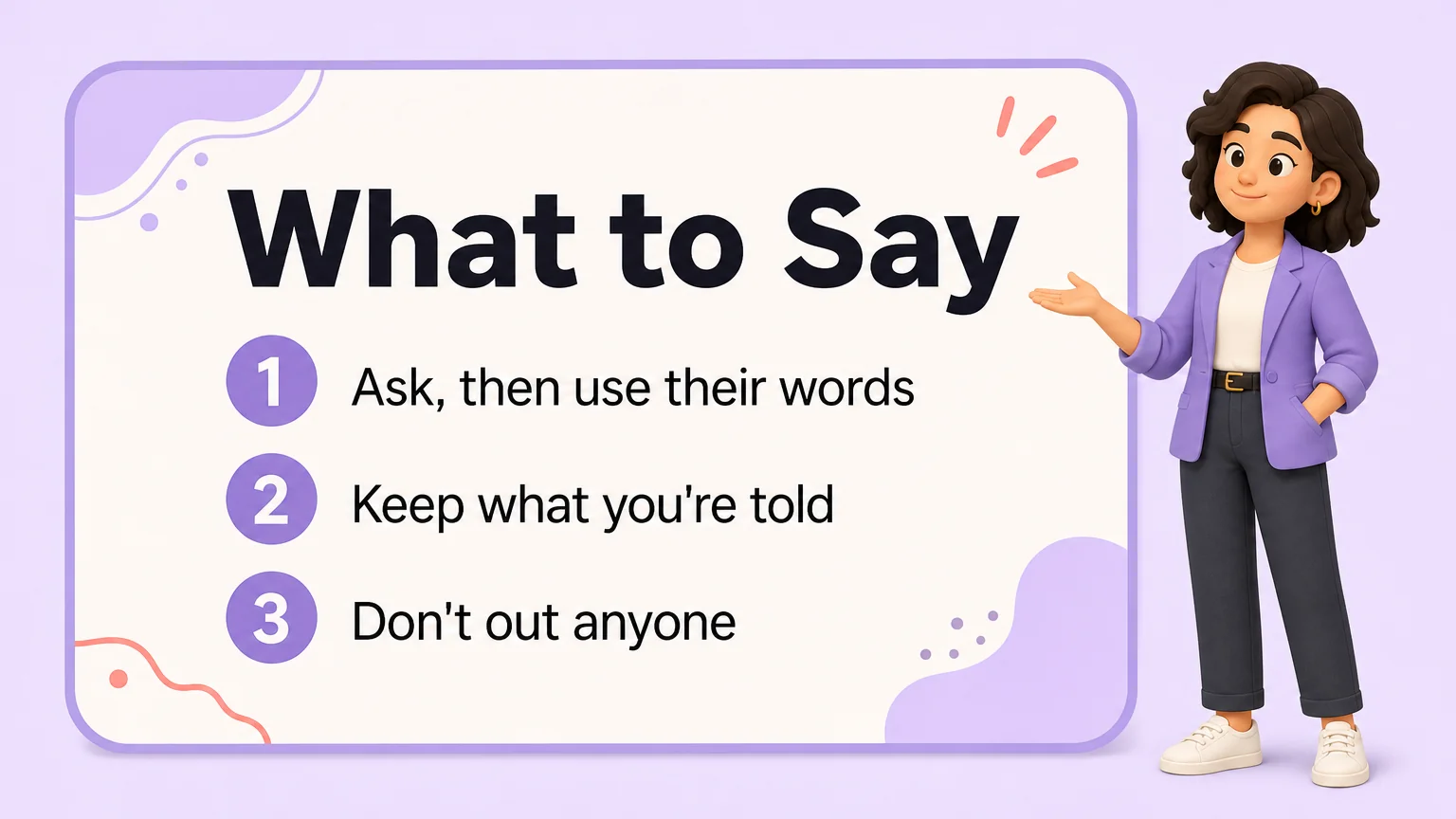
You already want to get it right. That instinct is the whole qualification, and the rest is a short list you can hold in your head.
Ask, then use their words. The term a person uses for their own orientation, gender, and expression is the correct term for them, and it does not transfer to the next person. Do not infer a transgender person’s orientation from their gender. Do not ask anyone to justify an identity or produce evidence for it.
When someone comes out, keep it. What you were told is information they chose to give you, and passing it on without consent is outing. GLAAD calls that inappropriate and potentially dangerous, and the reason is concrete: a person may be out in one room and not another because a job, a lease, or a family depends on the difference. Do not demand proof, and do not be thrown if a more specific term arrives later.
Retire three phrases, and one habit. Homosexual, except in a direct quote: it reads as clinical, and it is often used to suggest that same-sex attraction is a disorder. Sexual preference and lifestyle, both of which imply the identity is voluntary and changeable, a notion the American Psychological Association and the American Psychiatric Association discredited in the 1970s. And never apply queer to someone who has not claimed it.
On intersex language, use intersex as an adjective for a body, never as a gender or an orientation, and use hermaphrodite only if the person uses it for themselves.
None of this requires you to perform expertise. It requires you to ask once and then listen to the answer.
FAQ
What does the Q in LGBTQ stand for?
The Q stands for both queer and questioning. When organizations, leaders, and media use it, it typically means queer. In youth support settings it can mean questioning, which describes someone still exploring their sexual orientation or gender identity. Queer is an adjective some people use for an orientation that is not exclusively heterosexual, and it is not universally embraced.
What does the plus mean in LGBTQ+?
The plus covers people in the community whose identities the letters do not fully capture. GLAAD describes it as added in recognition of all non-straight, non-cisgender identities. It covers identities, not behaviors. LGBTQ and LGBTQ+ are both correct, and so are several other versions of the acronym.
Is intersex part of LGBTQ?
Intersex describes sex characteristics that fall outside traditional male and female conceptions. It is not an orientation and not a gender, and many intersex people are cisgender and straight. Some organizations include the I in LGBTQIA+. interACT advises adding it only with intersex leadership or consultation in place.
What is the difference between bisexual and pansexual?
Bisexual is attraction to more than one gender, not necessarily at the same time, in the same way, or to the same degree. Pansexual is attraction to any person regardless of gender identity. Pansexual sits under the bi+ umbrella as one term among several rather than replacing bisexuality, and the reading that bi means two genders is not accurate.
Is being LGBTQ a choice?
No, and the professional position is more than fifty years old. The American Psychiatric Association removed homosexuality from its list of mental disorders on December 15, 1973, and the American Psychological Association endorsed that in a January 1975 resolution stating that homosexuality implies no impairment in judgment, stability, reliability, or general social and vocational capabilities. Sexual preference is avoided because it implies a choice.
Is LGBTQ the same as LGBTQIA+?
No, and neither is more correct. LGBTQIA+ adds intersex and an A that can stand for asexual, aromantic, or agender, while the plus covers identities the letters do not name. GLAAD treats both as acceptable, as it does other versions. The plus and the longer letters are doing the same job at different levels of detail.
Is nonbinary the same as transgender?
Sometimes, by the person’s own choice. Nonbinary describes a gender outside the categories of man and woman. Many nonbinary people also call themselves transgender and consider themselves part of the trans community; others do not. Transgender describes a gender identity that differs from the sex assigned at birth, and both descriptions are correct because the person is the one deciding.
Why does the L come first in LGBTQ?
Visibility politics, not an alphabetical rule. LGBT replaced GLBT as the most common term in the mid-2000s, on the reading that the change would give lesbians more visibility again, after lesbians had pressed for the phrase gay and lesbian because gay was being read as male. No committee and no founding decree sits behind the order.
When was the Q added?
The Q came later than the B and T, as queer was reclaimed. Bisexual and transgender were added to the description in the late 1990s, after years of demands for inclusion. GLBT remained the common form through the early 2000s. A widely repeated date for the first use of the full LGBTQ form cannot be traced to an originating document, so treat the exact year as unsettled.