
The difference between a great first club night and a relationship crisis often comes down to one conversation most couples never have. That conversation is about the choice between soft swap vs full swap. Two labels. Two very different experiences. And no single correct answer, only the one that fits your relationship.
This article will maps the distinction criterion by criterion: physical boundaries, emotional risk, communication demands, club dynamics, aftercare needs, and what each style means for the single person joining you.
By the end, you’ll know which style matches where your relationship actually is, not where you think it should be. Let’s start with what the labels actually mean, since most couples use them without defining them.
What Soft Swap and Full Swap Actually Mean: Beyond the Labels
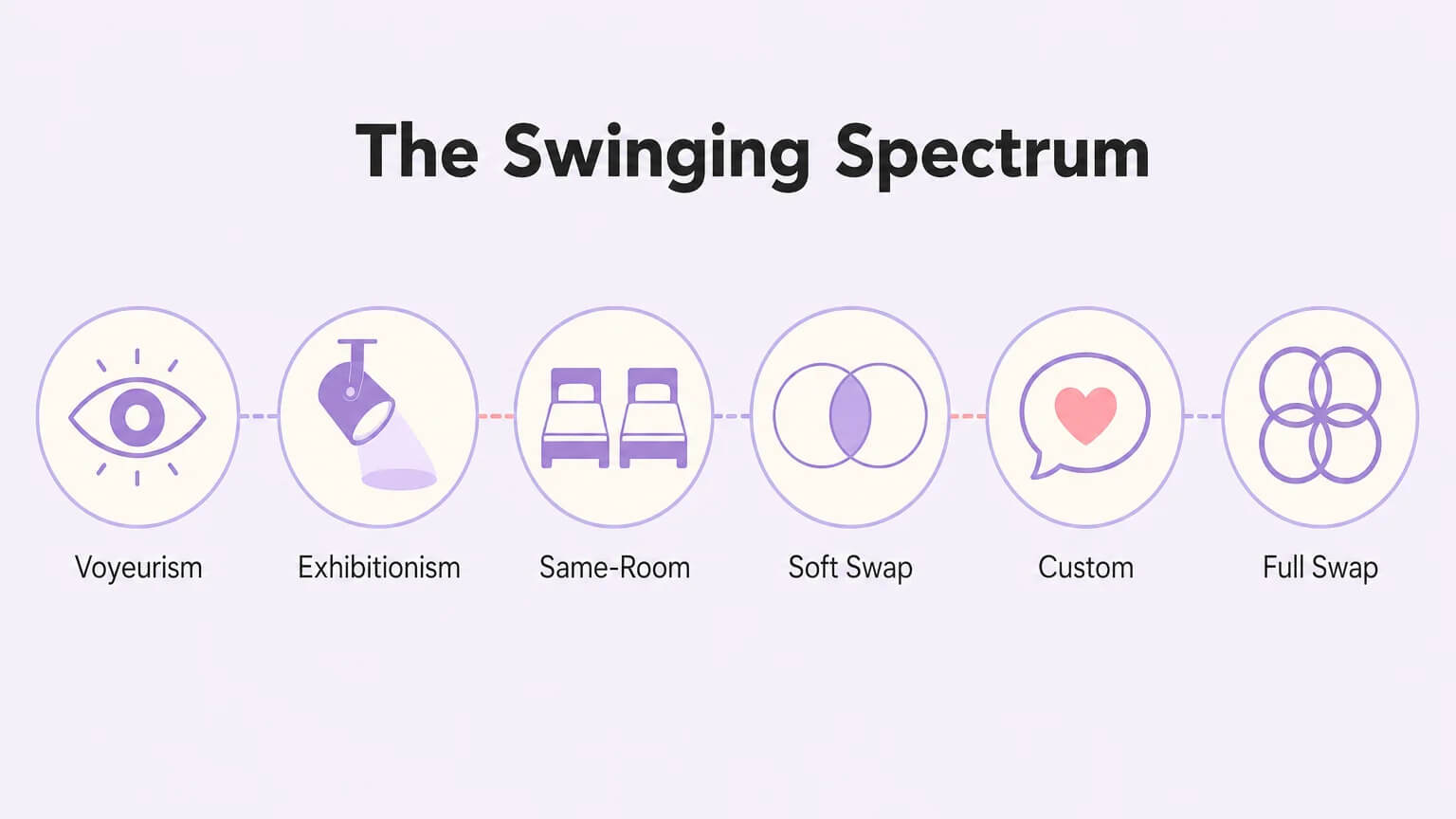
he swinging spectrum isn’t a toggle switch. It has at least six distinct levels. Voyeurism: watching others, taking in the atmosphere of a club without participating. Exhibitionism: being watched while you’re with your own partner, the thrill of an audience. Same-room play: sex with your own partner alongside another couple doing the same, parallel and electric. Soft swap: partner exchange that excludes penetrative intercourse. Custom middle-ground agreements: the vast creative space between soft and full that most experienced couples eventually inhabit. Full swap: partner exchange that includes penetrative sex.
Most couples don’t land permanently on one level. They move between them depending on mood, setting, and who they’re with. A couple might be full swap with trusted regulars and soft swap only when traveling or visiting a new club. That flexibility isn’t inconsistency; it’s intelligence.
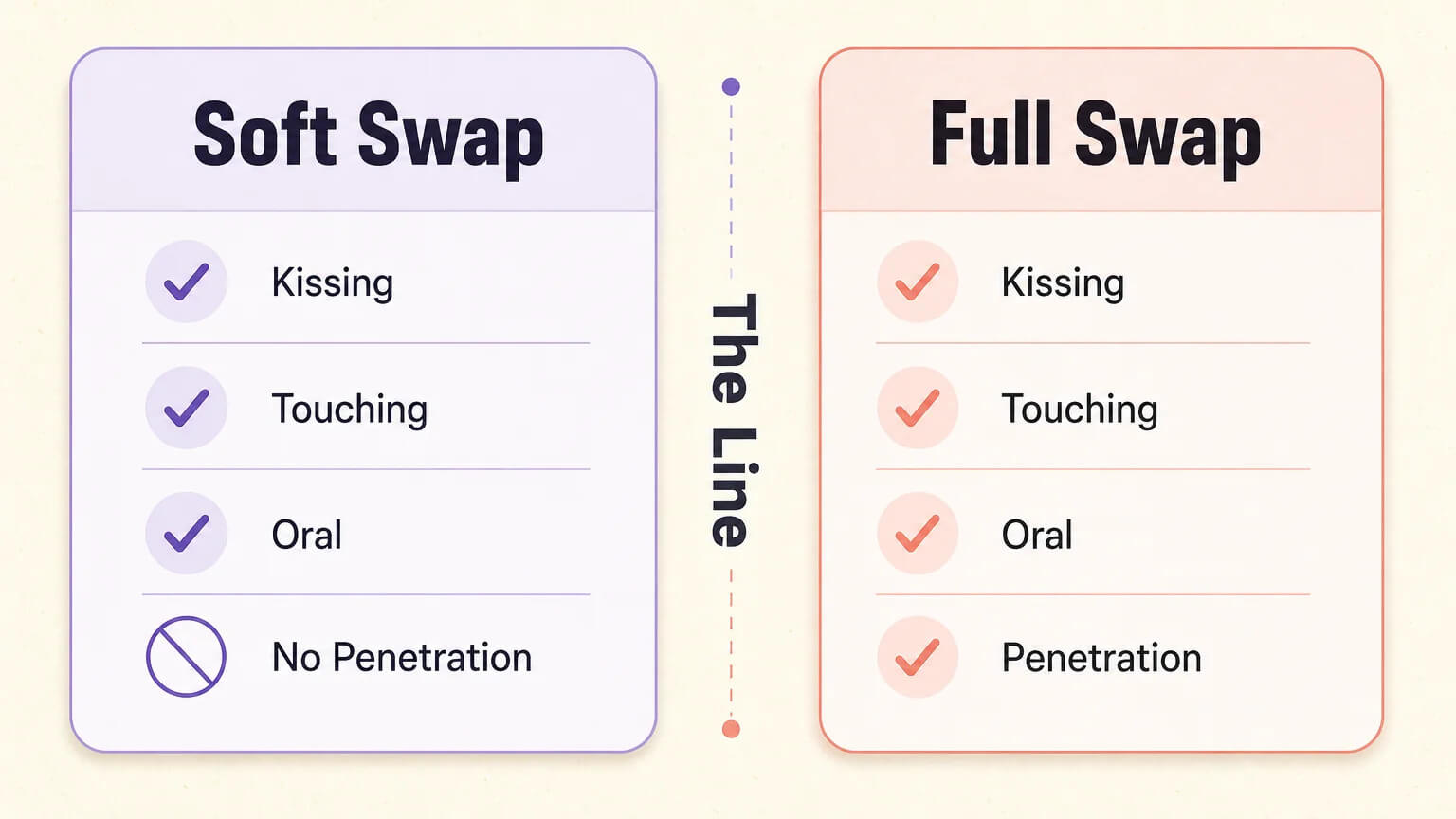
Soft swap means partner exchange that excludes penetrative intercourse. Kissing, touching, oral sex, manual stimulation, toy play. Each couple defines their own specific boundaries within this framework. Some include oral. Some don’t. The label is a starting point, not the whole conversation. A couple who says “we’re soft swap” hasn’t told you their boundaries. They’ve told you where the conversation starts.
Full swap means partner exchange that includes penetrative sex. Vaginal and anal intercourse are on the table. Same-room or separate-room configurations. Condom use is nearly universal here, and worth discussing even in soft swap contexts for oral. Same-room play keeps everything transparent and shared. Separate-room play requires deeper trust and its own set of agreements about timing, signals, and reconnection.
Some couples have a no-kissing agreement even within full swap. They consider kissing more intimate than intercourse. If that sounds contradictory, it shouldn’t. The point is simpler: these labels are conversation starters, not the conversation itself. Specific acts must be negotiated individually because “soft” and “full” don’t capture what two people are actually comfortable with.
Sex therapist Gigi Engle points out the term “soft swap” is problematic because it implies penetrative sex is the only “real” version of sex. She’s right. But shared language matters for boundary-setting. The labels work when couples treat them as shorthand and then get specific about what they mean. Every couple negotiates their own version. The couples who thrive understand that “soft swap” and “full swap” describe the edges of a spectrum they get to draw themselves.
Soft Swap vs Full Swap: Where the Physical Line Gets Drawn
Two couples meet at an event. Both say they’re soft swap. One couple includes oral; the other doesn’t. Thirty minutes later, someone feels violated and someone feels rejected. Nobody was trying to cross a line. They just had different maps.
This is the most common source of mid-scene conflict in the lifestyle. Couples use labels without defining what the labels mean to them. Then they discover the mismatch when there’s no easy way to correct course.
Soft swap territory, act by act. Kissing varies dramatically by couple. Some ban it entirely from any swap because they consider it more intimate than anything else on the table. Others see it as the warm-up that makes everything else feel natural. Touching and manual stimulation are nearly universal within soft swap. Oral sex is included by many but not all. Some couples draw the line at oral, keeping that act between themselves. Mutual masturbation is common. Toy play with non-penetrative toys rounds out the typical menu.
The defining feature of soft swap is structural, not just behavioral. The penetration boundary creates a clear, automatic hard stop. Everyone in the room knows where the line is, even if they haven’t discussed every specific act. There’s no ambiguity about what “no penetration” means, and that clarity is protective. It prevents the most common source of mid-scene boundary violations: the assumption that something was probably fine.
Full swap adds vaginal and anal intercourse. But here’s what matters: even full-swap couples have boundaries. Specific acts they keep between themselves. Positions that are off the table. Scenarios that belong only to the primary relationship. “Everything is on the table” is almost never true. Full swap requires couples to define the line act by act, because the automatic hard stop is gone and nothing is assumed.
The Soft/Hard/Home decider is the simplest pre-event alignment tool you’ll find in the lifestyle. Before any event, agree whether tonight is soft only, full on the table, or just the two of you. It takes two minutes and costs nothing. One couple using this approach avoided a meltdown when the husband assumed full swap was on and the wife had silently decided on soft only. They caught the mismatch over coffee an hour before the event instead of in a playroom at midnight. The couples who skip this conversation are the ones who find themselves having it in the parking lot at 1 a.m. after something has already gone wrong.
How Jealousy, Attachment, and Trust Actually Differ Between Soft Swap and Full Swap

The Mormon MomTok soft-swap scandal produced a divorce and destroyed friendships. Every act fell within soft swap boundaries. No intercourse occurred. The emotional damage was still catastrophic. The husband developed romantic feelings for his swapping partner. The wife was blindsided. The friend group fractured.
Sex therapist Angie Rowntree: “While the word soft may sound less consequential, it does not make the experience emotionally or physically neutral.” Oral sex is still sex. Intimacy is still intimacy. Soft swap demands the same emotional preparedness as full swap.
Soft swap triggers less intense jealousy for most couples. Penetration carries deeper cultural associations with intimacy, and skipping it removes that specific trigger. Relationship therapist Shelly Dar identifies two reasons soft swap appeals: “It can add excitement without triggering the same level of jealousy or insecurity,” and “it lets couples tell themselves: we’re exploring together, not replacing each other. That sense of control is key.”
But watching your partner give or receive oral sex isn’t emotionally neutral. Soft swap does trigger jealousy. The couples who get blindsided are the ones who assumed it wouldn’t. They treated “soft” as a guarantee rather than a description.
Full swap demands stronger jealousy-management skills. But couples who develop those skills often report the jealousy fading faster than expected. The anticipation is worse than the reality. One experienced couple described it this way: the first time they watched each other with other partners, they braced for an emotional earthquake. What arrived was more like a tremor, and by the third time it was barely a ripple. Their jealousy management had become a muscle, not a wall.
Attachment risk cuts across both styles. Emotional connections form through kissing and oral as readily as through intercourse. The no-kissing agreements in some full-swap relationships exist precisely because couples recognize this. Kissing can feel more intimate than penetration. Different couples protect different acts, but the underlying mechanism is the same. Trust builds on different timelines: soft swap incrementally, one encounter at a time; full swap faster when the experience goes well because more vulnerability gets processed in a shorter window.
The de Visser and McDonald study found couples manage jealousy through discussion, negotiation, and shared agreements. Some reframe it as arousal fuel. None of the couples in the study eliminated jealousy. They redirected it. Jealousy isn’t a stop sign. It’s a dashboard light indicating where your emotional engine needs attention.
The question is which style’s jealousy profile matches what your relationship can currently handle, not which one has less of it.
The Communication Gap That Separates Soft Swap and Full Swap
The failure mode in swinging isn’t jealousy. It’s the couple who had smooth soft swap experiences and assumed full swap would be “the same thing, just with penetration.” It isn’t. The communication demands scale fast, and couples who underestimate this gap are the ones who run into trouble.
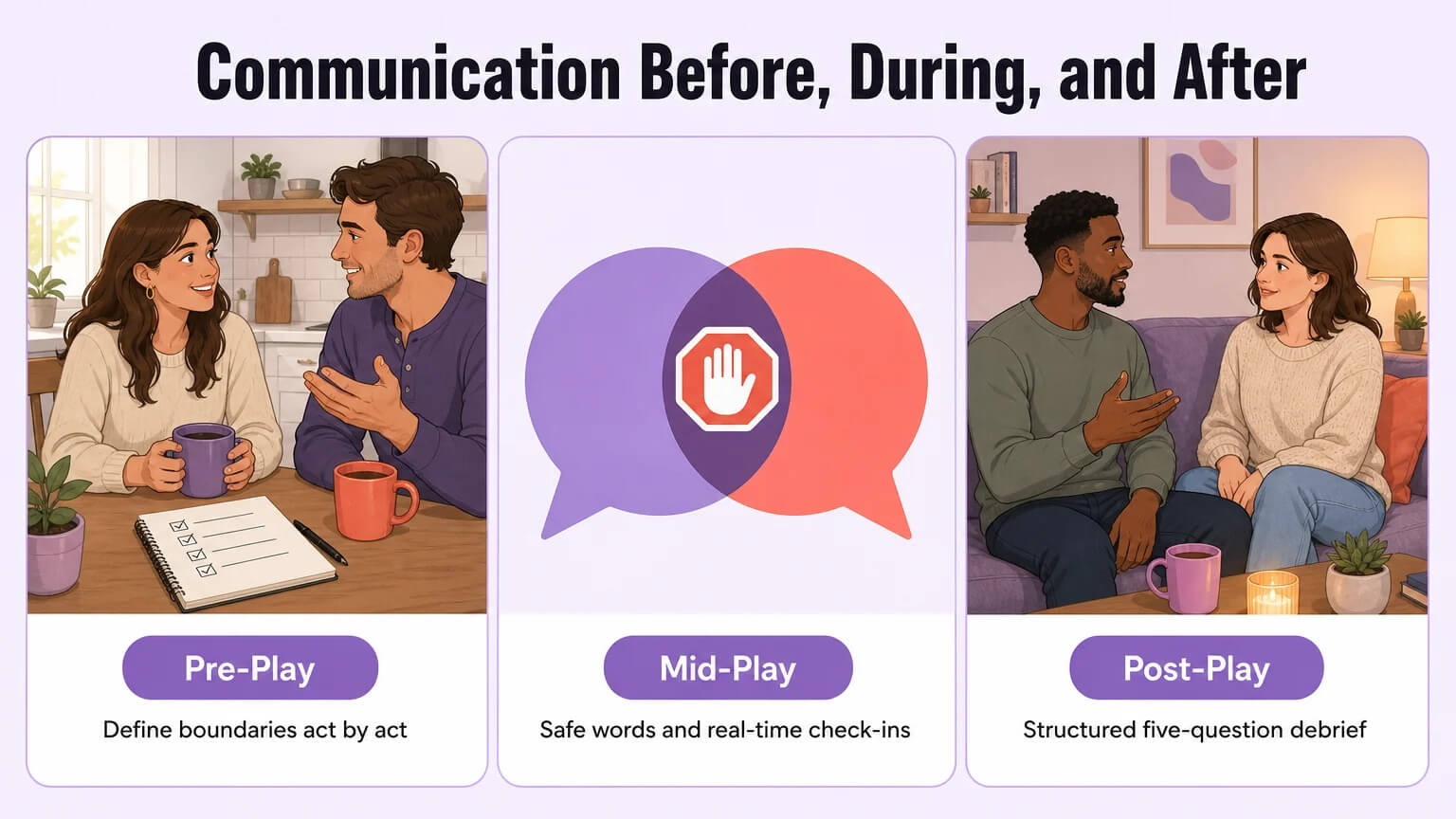
Pre-play, soft swap negotiation is relatively contained. “Penetration is off the table” covers a lot of ground. You still need to discuss kissing preferences, oral comfort levels, and any specific acts that feel different to each of you. But the framework is efficient. Full swap requires act-by-act clarity: which specific acts are on and off the table, barrier expectations for each type of contact, same-room or separate-room configuration, duration signals, how to call a pause, what happens if one partner finishes earlier, whether reconnection sex is expected afterward. You negotiate things you didn’t know needed negotiating until you sat down to do it. One couple discovered during their first full-swap negotiation that they’d never discussed what “done” meant. He assumed the night ended when he finished. She assumed everyone kept going until satisfied. They caught it, barely.
Mid-play, soft swap has a natural checkpoint. The penetration boundary serves as an automatic safety rail. When the boundary is the same for everyone, you don’t need to invent a checkpoint system. Full swap has no built-in checkpoint, which means couples must create their own. A safe word or signal that stops everything immediately. The comfort to use it without guilt or fear of disappointing anyone. Most boundary violations in the lifestyle happen not because someone intended harm but because someone assumed. A boundary was vague. A signal was never discussed. A partner figured “this is probably fine” instead of checking.
Post-play, both styles need debriefing. But full swap debriefs cover more ground because more acts happened, more emotions surfaced, and more needs to be processed. The structured five-question template becomes non-negotiable at this level. What went well for you? What would you change next time? What emotions came up and how intense were they? What does your partner need from you in terms of support? What are the next steps for your agreements? Run through all five even when the experience was smooth. The uneventful nights still leave residue.
Soft swap rewards communication. Full swap demands it. If your pre-play conversations feel rushed or incomplete at the soft swap level, full swap will amplify that gap. Build the communication system first, then decide whether you want to use it for something bigger.
Soft Swap vs Full Swap at the Club: Same Venue, Two Completely Different Nights

A lifestyle club has distinct zones. Bar and social area where everyone starts. Dance floor where the energy builds. Play areas where things escalate. The venue is the same whether you’re soft swap or full swap. But the night inside it changes completely depending on what you agreed to before walking through the door.
The universal first-visit recommendation from experienced swingers applies regardless of your eventual style: don’t play on your first visit. Go. Watch. Walk every zone so you understand the layout. Soak in the atmosphere without the pressure of participating. Go home. Have reconnect sex. Talk about it for a week. If the fantasy still holds after processing, go back. This one piece of advice prevents more bad first experiences than any other. The couples who skip it are the ones who discover halfway through an encounter that they weren’t ready.
Soft swap at a club gives you room to be spontaneous. Finding play partners is easier because the ask is lower-stakes. You can negotiate boundaries in two minutes at the bar: “We’re soft swap only. Kissing, touching, oral are all fine, but nothing penetrative.” Most experienced couples respect this immediately. They remember their own first nights. The play area experience tends toward same-room by default, keeping everything transparent and shared.
Full swap at a club is a different experience. Pre-play negotiation is longer and more specific. Barrier use. Same-room versus separate. Specific acts. Exit signals. All of this needs to be covered before clothes come off. Some full-swap couples prefer separate rooms, which adds logistics and deeper trust questions. How do you signal you’re done? How long is too long apart? What happens if one pair finishes and the other is still going? The screening dynamic shifts: full-swap couples at clubs tend to be more selective because the stakes are higher.
Club etiquette that matters across both styles: the woman often leads the approach. Make eye contact with both people, not just the person you’re interested in. Start conversations normally. “How’s your night going?” not a proposition. The first ten minutes are typically the worst. Nerves are normal. They’re not a sign you’re doing something wrong.
Soft swap lets you be exploratory at events. Full swap rewards preparation and selectivity. The couples who have the best time in either style decided their style before they walked through the door.
Soft Swap vs Full Swap Aftercare: Why One Is a Conversation, the Other a Ritual
Aftercare is the deliberate emotional and physical work couples do after a sexual encounter with others to rebuild safety and strengthen their primary bond. For full swap, it isn’t optional. The research consensus across lifestyle coaches and experienced communities is unambiguous: aftercare for full swap is “essential, a necessary ritual even after a calm experience.” Couples who skip full-swap aftercare report more relationship drift over time. The drift is subtle at first. A little less eye contact. A little more distance in casual conversation. Then it compounds.
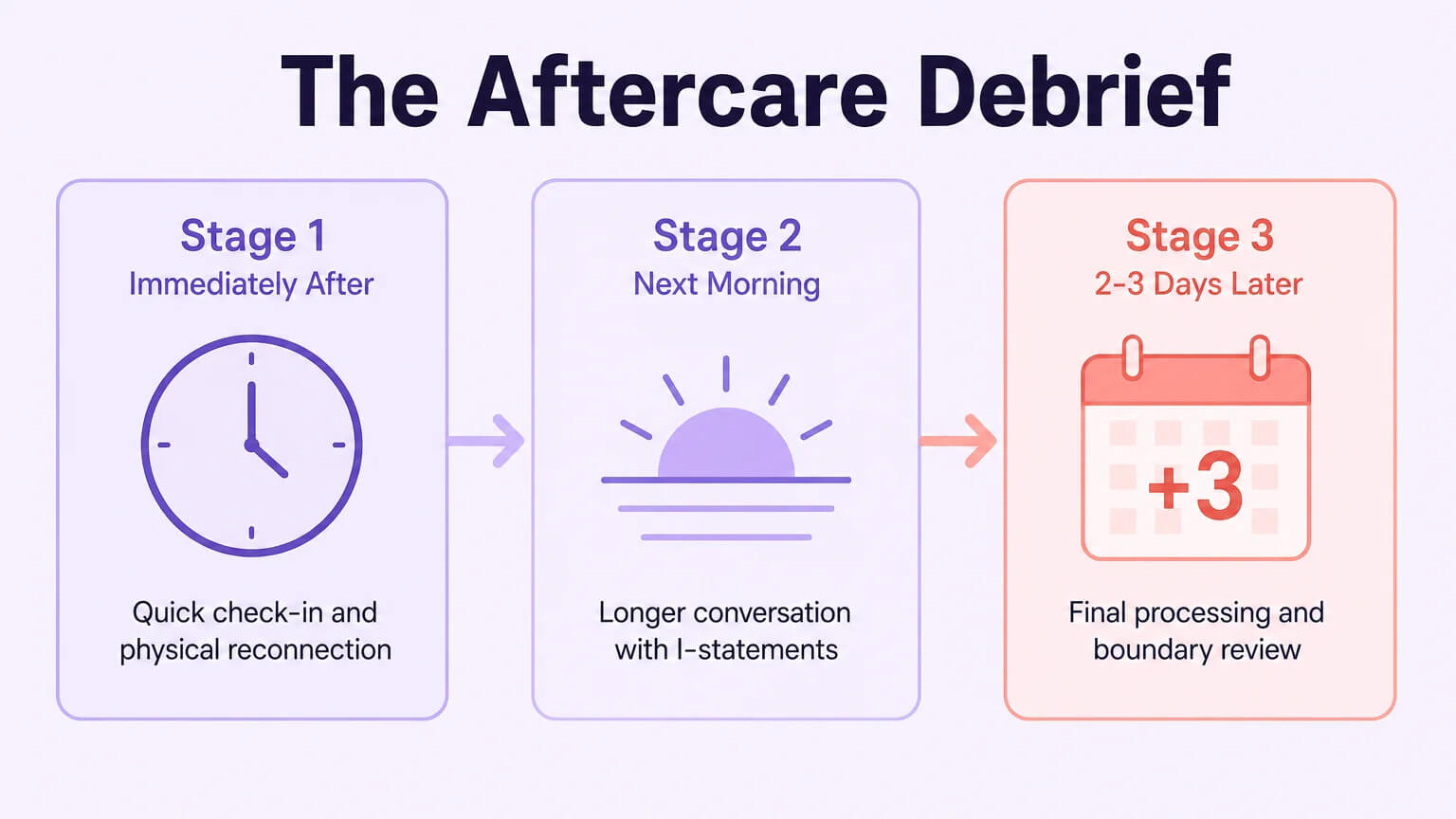
The three-stage debrief template makes the comparison between styles concrete. Stage one: immediately after. A quick check-in. “How are you feeling right now?” Brief. In the moment. No deep analysis while everyone is still processing. Physical reconnection: cuddling, hand-holding, showering together, the simple animal comfort of skin on familiar skin. Soft swap couples often skip this stage and are fine. Full swap couples who skip it tend to wake up with unresolved tension they can’t name.
Stage two: the next morning. A longer conversation with coffee and clear heads. What was hot. What was unexpected. Any twinges of jealousy or discomfort. Use “I” statements: “I felt X when Y happened” rather than “You did X.” The distinction matters because the goal is processing, not prosecuting. Both styles benefit from this stage. Full swap needs it.
Stage three: two to three days later. Final processing after emotions have fully settled. This is where full swap is categorically different. Emotions from penetrative sex with others can surface days later in ways soft swap emotions rarely do. A full-swap couple might feel fine on Sunday morning and blindsided by a wave of insecurity on Tuesday afternoon. Discuss whether agreements should shift based on what you learned. Whether anything surfaced late that wasn’t obvious in the first two conversations. Whether the next encounter should look different. Ask directly: “Is there anything you haven’t told me yet because you weren’t sure how to say it?” That question makes room for the thing they couldn’t say until now.
Physical reconnection rituals work across both styles: cuddling, comfort food together, intentional reclaiming sex if that feels right for your dynamic, a shared activity that’s just for the two of you. Aftercare is the gentle glue that keeps a swinging couple connected.
Soft swap aftercare can be a conversation. Full swap aftercare should be a ritual. The couples who thrive in full swap treat the debrief with the same seriousness they bring to the play itself.
How Soft Swap and Full Swap Shape the Guest’s Experience Differently

Most swinging advice is written for the couple. But every swap involves at least one person who isn’t in that couple. Their experience of your style choice matters, and couples who understand this have better encounters. They screen better. They communicate better. They get better enthusiasm from their guests. And people who feel respected come back.
Soft swap through a single’s eyes: the boundaries are clear from the start, which can be a relief. The evening has defined edges. Nobody’s going to push for something that was explicitly off the table from the start. Singles joining soft-swap couples often appreciate the lower pressure and built-in respect for boundaries. They’re not being asked to go all the way with two people they just met. The container feels safer. But soft swap can also feel exclusionary if the couple treats the single as a safe accessory rather than a full participant. If all the focus is on what the couple is experiencing together while the single’s pleasure is an afterthought, the encounter leaves a bad taste.
Full swap through a single’s eyes: a more vulnerable position. They’re entering a couple’s sexual dynamic at the deepest level, often without the safety net of their own partner in the room. The couples who do this well make the single feel like an honored guest, not a tool. They check in during the encounter. They read body language. They understand that the single’s enthusiasm matters exactly as much as their own. They are a guest in your playground, not a toy in your toybox.
Red flags singles notice and remember. Couples who haven’t discussed agreements with each other first, which means the single becomes an unwilling participant in the couple’s unresolved negotiation. Couples where one partner is clearly less enthusiastic, radiating reluctance while the other barrels forward. Couples who attempt to renegotiate boundaries mid-scene when arousal has lowered everyone’s judgment. Couples who ignore the single’s stated boundaries as if they’re less important than the couple’s. Singles remember these encounters. They don’t repeat them.
Before approaching any guest, ask yourself: does our swap style create a good experience for them, or just for us? The couples who ask that question are the ones people want to play with again. For singles reading this: your comfort with soft versus full swap is equally valid. Your boundaries carry exactly the same weight as anyone else’s in the room.
How to Transition from Soft Swap to Full Swap: A Framework That Survives Contact With Reality
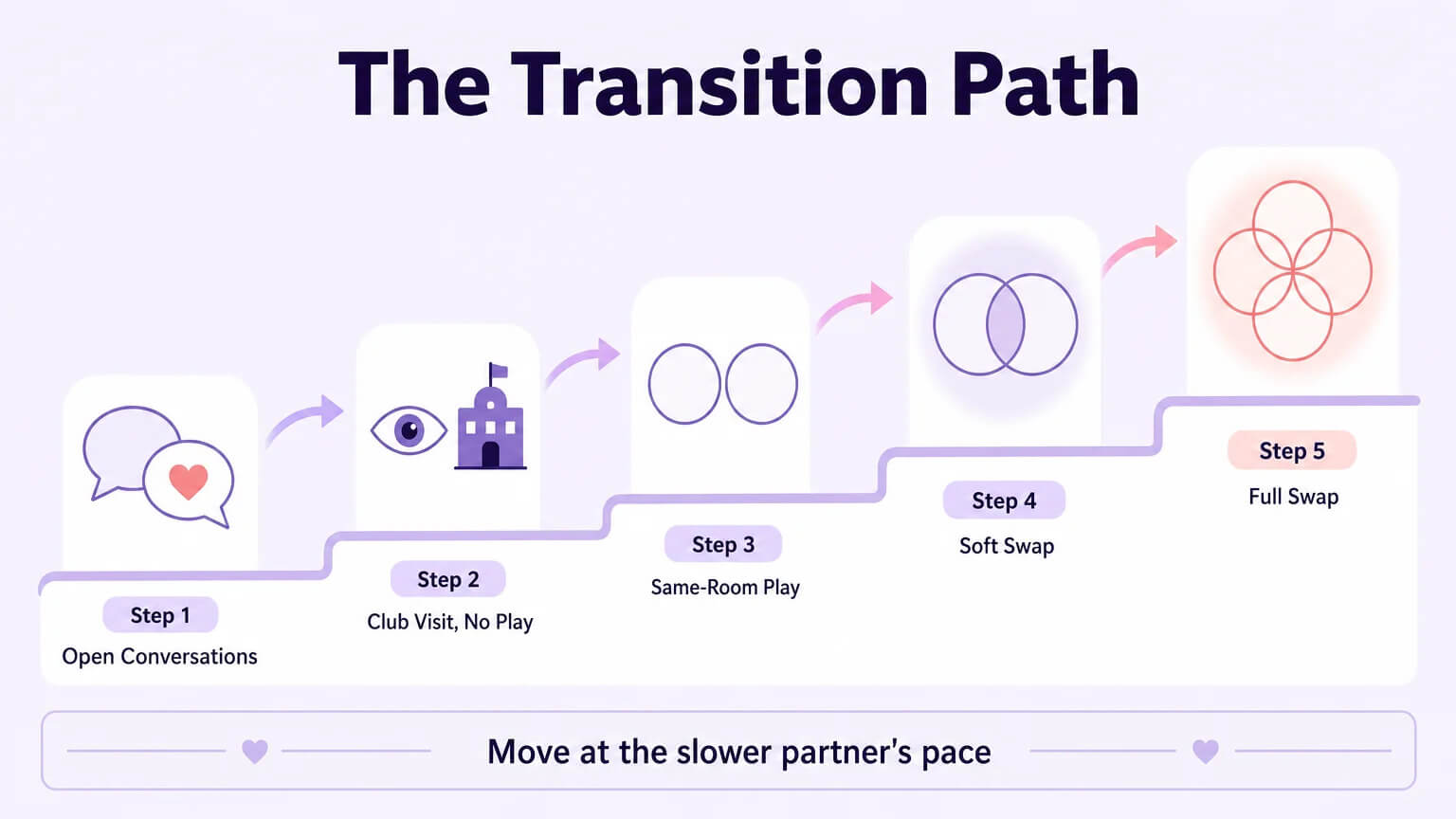
One partner is ready for full swap before the other. This is the norm, not the exception. Ashley and Kyle lived this dynamic. Kyle was ready immediately. Ashley wasn’t. They’d never been with anyone besides each other. Kyle waited. Ashley got there on her own terms. That’s how this works when it works.
The transition isn’t about when the faster partner is ready. It’s about when the slower partner is genuinely enthusiastic, not just willing. The difference between enthusiasm and willingness is the difference between “I want this” and “I can tolerate this.” One builds connection. The other builds resentment. Enthusiasm extracted under pressure isn’t consent. It’s a future resentment with a timestamp.
A progressive exposure path creates the structure most couples need. Start with open conversations about fantasies. No pressure, just shared honesty. Watch content together and discuss what appeals. Attend a club with a firm no-play rule. Observe only. Try same-room play with your own partner at a club. Then soft swap, starting with kissing and touching and expanding as comfort allows.
Nine steps that prevent disasters. Ensure full comfort with soft swap first. Have deep conversations about why you want to progress: genuine desire or perceived pressure? Define explicit full-swap boundaries in advance. Agree on an exit strategy that stops everything immediately. Start with a trusted couple you already know. Let the slower partner set the pace. Debrief thoroughly using the three-stage template. Practice intentional aftercare. Never change agreements mid-scene when everyone is aroused and distracted.
The troubleshooting most couples need but rarely find. What happens when you hit an unexpected emotional wall? Stop and step back to the previous level that worked. That isn’t failure. It’s responding to data. Going back to soft swap after a bad full swap experience isn’t regression. What if one of you froze in the moment despite thinking you were ready? Use your exit signal immediately. Go home. Process. The discomfort of calling a stop is a fraction of the damage caused by pushing through it. A partner who says yes but whose body language says no? Pause and check in privately. An awkward check-in is always better than a genuine violation. Even experienced swingers have bad nights. As Ashley and Kyle put it: “Everyone has those experiences.”
The fastest car in the convoy can only move as fast as the slowest car. If your partner needs six more months at soft swap, six months is the timeline. The couples who rush are the ones in the cautionary tales. The ones who don’t are still swinging happily five years later.
The Bottom Line
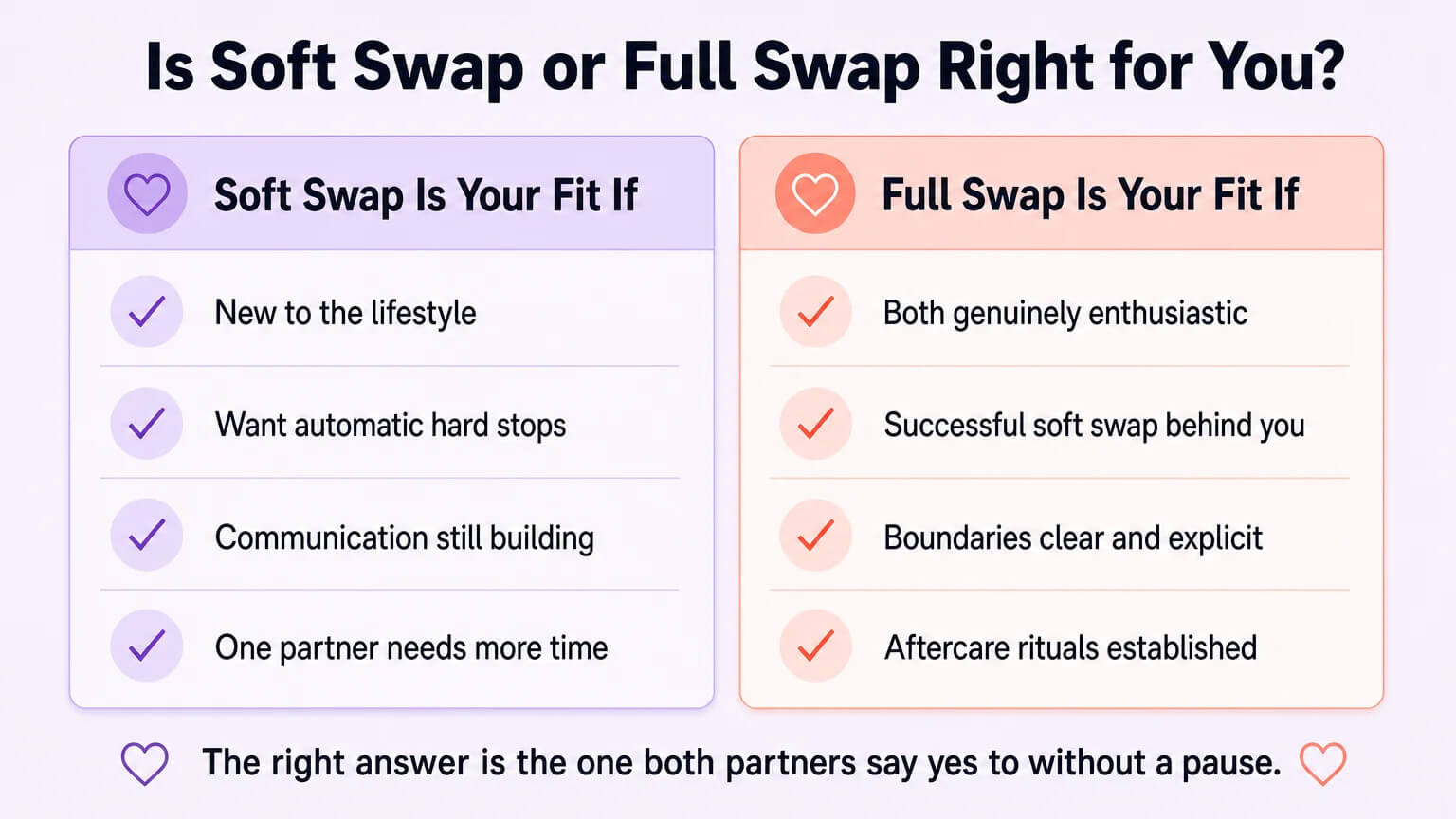
Choose soft swap if you’re new to the lifestyle, uncertain about your reactions, still building your communication system, or want room to discover your boundaries before committing to bigger ones. Soft swap isn’t training wheels. For many couples, it’s the destination.
Choose full swap if both partners are genuinely enthusiastic, you have successful soft swap experiences behind you, your boundaries are explicit and feel clear rather than anxious, and you have established aftercare rituals and an exit strategy you both trust.
A quick self-check, criterion by criterion:
| Criterion | Soft Swap Fit | Full Swap Fit |
|---|---|---|
| Experience level | New or early-stage | Multiple successful soft swaps behind you |
| Emotional readiness | Uncertainty about reactions | Both partners genuinely enthusiastic |
| Communication system | Still building the muscle | Tested and trusted under pressure |
| Boundary clarity | Want automatic hard stops | Comfortable defining lines act by act |
| Aftercare capacity | Conversation-level works | Ritual-level commitment |
| Pace alignment | Slower partner still exploring | Both partners aligned on readiness |
This isn’t a permanent identity. Most experienced swingers started with soft swap and evolved. Some stay soft-swap-only permanently and they’re satisfied. A few skip soft swap entirely and thrive. The right answer is the one both partners can say yes to without a pause. If there’s a pause, more conversation is needed. If it’s not an enthusiastic yes from everyone in the room, it’s a hard no.
Take the Soft/Hard/Home decider into your next event. Treat the night as a data-gathering experiment. Debrief with the five-question template. Move at the pace of the person you love.
FAQ
Is soft swap a required step before full swap?
No, but coaches recommend it as practice ground for communication and boundary skills. Skipping it means testing your emotional edges at the highest difficulty from day one. Most couples who thrive in full swap built their foundation through soft swap first.
What if one partner wants full swap and the other only wants soft swap?
The slower partner sets the pace, always. Enthusiasm under pressure isn’t consent. Stay at soft swap until both are genuinely enthusiastic. Some couples stay soft-swap-only permanently and are perfectly satisfied. There’s no finish line you’re required to cross.
Is there a middle ground between soft swap and full swap?
Yes, and most experienced couples land somewhere on it. Custom agreements include selective penetration only with trusted couples, no-kissing full swap, condom-only policies, or soft swap plus toys. The labels are tools for conversation, not boxes you have to fit inside.
Can swinging fix a struggling relationship?
No. Swinging amplifies what’s already there. Secure couples get closer. Struggling couples watch every crack widen. Don’t enter the lifestyle from anywhere but a position of security. Swinging is a celebration of a strong relationship, not a repair kit.
Does a past agreement to full swap imply consent for future encounters?
No. Each encounter requires fresh consent. What you agreed to last month doesn’t bind you tonight. Either partner can say “soft swap only tonight” at any time. Past consent doesn’t imply future consent.
What are the biggest red flags when screening other couples?
Boundary-pushing mid-scene. Inability to articulate their own boundaries. One partner talking while the other is silent. Evasiveness about STI testing. Heavy drinking before play. A couple who won’t respect a simple agreement at the bar won’t respect a more complex one in the playroom.
What happens at a lifestyle club for first-timers?
Expect nerves. The first ten minutes are the worst. Do a lap to learn the layout. Observe. Start normal conversations, not propositions. Don’t play on your first visit. Go home, process together, have reconnect sex, and talk for a week before returning.