Financial domination is a real practice with a real structure. Almost everything you have read about what it pays was never measured.
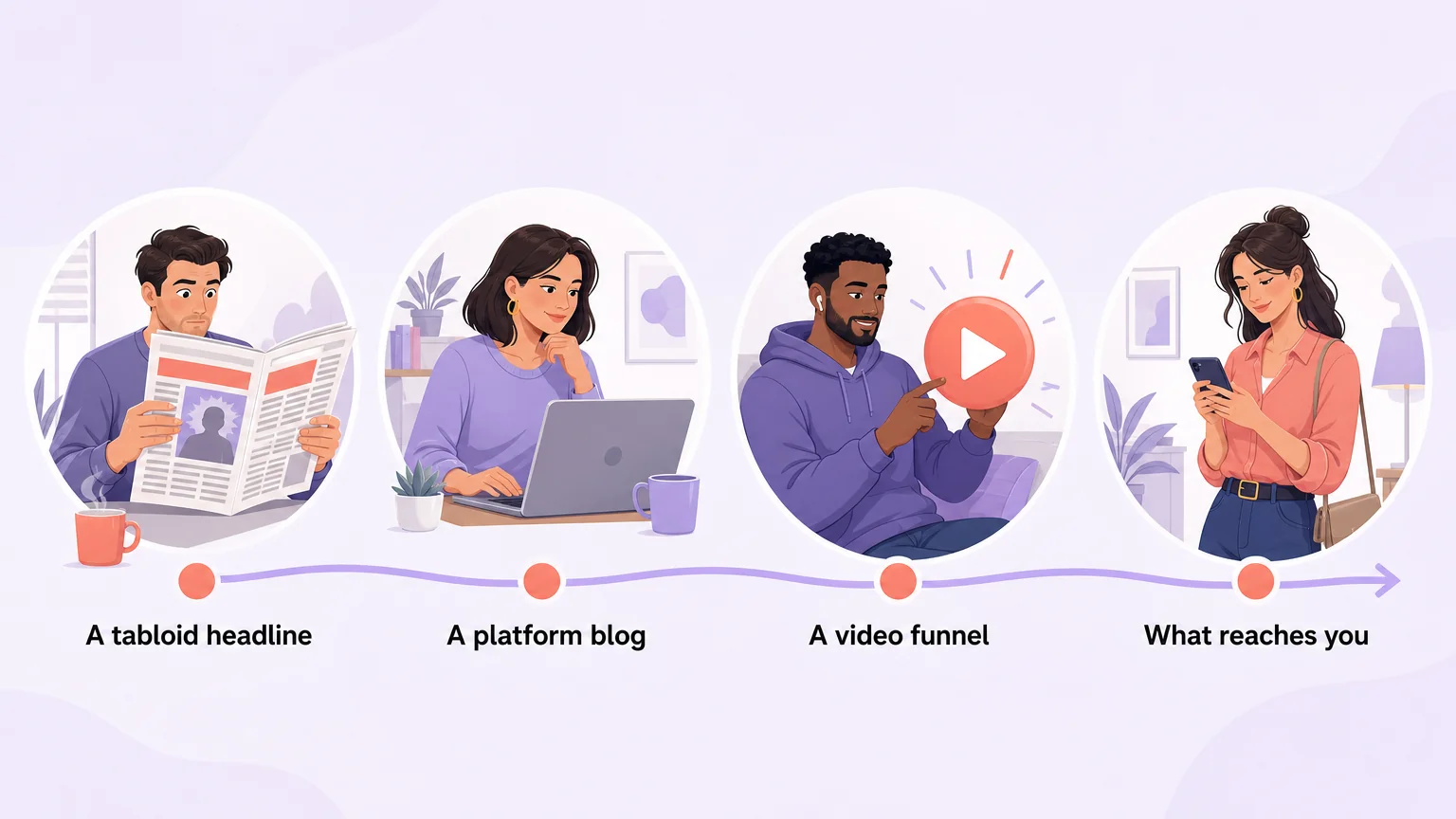
The numbers attached to it in the wild got there by a route you can trace. A tabloid runs a headline about one dominatrix and one week of her earnings. Years later a live-cam platform’s blog lifts the headline into a how-to of its own, and a video funnel rounds it up into a title. By the time it reaches you it reads as an industry standard, and at no point in that chain did anyone count anything.
The nearest thing to a first-hand income record you will run into is an April 2020 interview set in which four working financial dominants gave four different answers about their own income. Same publication, same month, four people. Interviews, not a survey.
Four questions decide whether this is a good idea for you, and the numbers you have seen do not answer any of them. Is any of this legal where you live? How does the tax work? What do payment platforms’ published rules actually say? And what do you do when a sub cannot afford what he is offering? This article answers those, starting with the money limit, because that is the part that separates a kink you are running from harm you are causing.
What Is a Findom? Financial Domination Explained

Start with the vocabulary, because the framing you absorbed on social platforms is transactional and the practice is not.
Financial domination, or findom, is a consensual BDSM power exchange in which money is the instrument. The submissive, called a finsub or a paypig, gets arousal from handing over financial control. The dominant, a findom or findomme, gets it from holding that control. A tribute is a payment a sub sends, and in some arrangements it is also the entry ticket. Mistress Karina Kalashnikova, interviewed by VICE in April 2020, described requiring a minimum tribute before she would discuss terms with a prospective sub.
The therapist Kate Balestrieri, writing for a clinic’s blog, frames financial domination as a form of BDSM built on the exchange of power, and stresses that communicating boundaries and the parameters of consent “are essential parts of exploring any type of sexual fetish.” She describes men socialized to read their own worth through their financial status finding a release in handing that status over, inside a dynamic both people chose.
The distinction that gets lost most often is between findom and a sugar relationship. In a sugar arrangement, money or gifts buy time, dates, attention, sometimes sex. In findom the sub receives nothing material back, and there is often no sex involved at all. Goddess Jo, one of the four in that 2020 set, was nine years into dominatrix work before she added financial domination at a client’s request, and reported that her clients never saw her naked. What the sub pays for is the exchange itself. Take the money out and there is nothing left to submit, which is why an arrangement with no clear limits is a different thing wearing the same name rather than a stricter version of the kink.
Kalashnikova works to what practitioners call SSC, for safe, sane and consensual; you will also see RACK. What each framework means varies by who is using it, and the history people recite for them is not something this article can stand behind.
How to Set a Money Limit Before Any Money Moves

The money limit is what decides whether this is a kink you are running or harm you are causing, and it comes from what the sub can afford, not from what he offers. Here is what the practitioner record supports about setting one, holding it, and ending it.
Set it from what the sub can afford, disclosed before anything is sent. Not from what he offers, and not from what you guess he can take. Kalashnikova put the principle plainly: “I practice the fundamental principle of safe, sane, consensual BDSM, which means that I am careful and establish limits with my slaves based on affordability. It’s not fun if someone’s making themself destitute.” Affordability is the constraint that keeps this a kink instead of extraction, and it has to be verified rather than assumed. The anonymous paypig interviewed by ABC’s triple j in March 2024 described his own arrangement running on a weekly cap that gets tallied, with transparency about his income and what he needs to survive on. That is the shape of a limit that holds. A cap set from a sub’s eagerness in a heightened moment is not a limit. It is a number he will regret.
Write it down, and declare your own hard limits in the same conversation. What you will and will not do belongs in the terms, not in the moment. An undated community guide written by a self-described domme lists safety, safewords, domme and sub drop, aftercare and stated limits as baseline knowledge rather than advanced practice. It also gives the correct answer to the most common pressure point: a sub who wants something the dom is not comfortable with gets a no, regardless of what he is offering. “Prioritize your boundaries,” she writes, “and don’t tag along with just anything that gives you money.”
Build in the right to withdraw, in both directions. Consent in kink is not a one-time signature. If a sub’s circumstances change, a lost job or a debt or a household that notices, the limit changes with them, and the right move when someone cannot afford what he is offering is to stop rather than escalate. The failure mode is the one ABC’s paypig described hearing about: people “sending way too much and putting financial pressure on themselves and not being able to survive and not getting the satisfaction they wanted after they had sent the money.” He was repeating stories rather than describing his own experience. It is still the clearest statement of the risk in the record.
Know that the extreme version exists and decide about it deliberately. Goddess Jo described findommes who take full control of a client’s bank accounts, paying a client’s bills and leaving him the minimum to live on. She told VICE she does not do that, and gave a reason rooted in his welfare rather than her comfort: “You have to be really careful to look after the mental health of your clients.” If a sub asks for that arrangement, you are being handed custodianship of another adult’s survival. Not something to accept because it sounds like the deep end of the fantasy.
Plan the come-down, including your own. Subspace is the altered state intense submission produces. Drop is the flat, low crash that can follow it, and doms get it too. Jo described the duty in the plainest terms available: “the responsibility you have to support the client as they come out of it. For instance, after a session, you need to communicate with them and give them emotional support.” The community guide lists domme drop alongside sub drop as something to know about in advance.
Two hard cases decide whether any of that holds. The first is the sub who wants something you will not do. The answer is no, and money is irrelevant to it. A limit you trade away for a payment was never a limit. The second is the sub who cannot afford what he is offering, including the one who insists he can. You will not be able to tell those two apart from the outside, which is why the number comes from his real budget and not from his enthusiasm.
No practitioner account in this article offers a formula for how large a limit should be. There is no percentage, no rule of thumb, no safe multiple. Anyone who hands you one is guessing on your behalf. The limit is set correctly when the sub could tell a friend what he spends without flinching, you would be comfortable explaining the arrangement out loud, and either of you could end it this week without the other being hurt by it.
How Much Do Findoms Make? What the Evidence Actually Says
There is no reliable income data for findom. That is not a hedge. It is the finding.
What exists instead is thin, self-selected and old. The April 2020 VICE set is four interviews. Karina Kalashnikova, in Liverpool, three years in, described running it as a business with products, subscriptions and paid sessions. Your Favourite Dominatrix, in Devon, said it was her only job. Goddess Mia, on the US East Coast, was a student who lived at home and paid no rent. Goddess Jo, in Yorkshire, worked it part time alongside her work as a beautician, after nine years as a dominatrix. Their answers about income did not agree with each other.
They cannot be averaged, totalled or expressed as a range, and the reason is structural rather than squeamish. Four self-selected people, in one publication, in one month, in 2020, in two currencies, with four different working arrangements, are not a dataset. Taken one at a time, they are four people’s answers. Collected into a list, they become something none of them said.
The nearest thing to measured income data in this territory is not about findom at all. The Beyond the Gaze study, reported by BBC News in January 2018, surveyed more than 640 online sex workers in the UK and concluded that most earned under £20,000 a year. All of online sex work, not financial domination. A UK figure, from 2018, for a different population. It is a reason to be skeptical of the numbers you have seen, not a prediction about you.
Practitioners say something the data cannot say at all, which is that the pace is slow. A community thread titled “Findom is no fast money,” whose original post has since been deleted, collects accounts of income arriving irregularly and long dry spells being ordinary. “I definitely believe it shouldn’t be thought of as primary income, especially if you’re just starting out,” one commenter wrote. Another said that while people can get money in their first week or even their first day, it is rare, and that some months are slow while others feel like hitting the lottery. These are anonymous and self-selected, with no figures attached, and they agree with each other on the one point that matters most to a beginner: the start is slow.
Which brings the circulating numbers back into focus. The very high figures you have seen are claims about claims. A US technology and lifestyle site reported in August 2024 that some doms are said to average sums in the thousands per month, attributing those numbers to other outlets rather than to anything measured. A cam platform’s blog, in a 2021 guide for aspiring findommes, cited a UK tabloid headline about one dominatrix’s weekly earnings and quoted a practitioner calling the work “complete mental manipulation, and control without the sub even realizing you’re doing it.” Read the chain. A tabloid, quoted by a platform, quoted by this article. Three steps from anyone who counted anything, and a marketing page presenting it as the shape of the opportunity.
Two conclusions follow. There is no honest income range to give you. And the framing that says otherwise is manufactured by parties with something to sell.
Findom Taxes and Payment Platforms
Dates are attached to every claim here, because these facts move.
US federal tax. All income is taxable regardless of where it came from. 26 U.S.C. § 61 defines gross income as “all income from whatever source derived,” expressly including compensation for services. IRS Publication 525, the 2025 edition for use in preparing 2025 returns, goes further: income from illegal activities must be included in income, reported on Schedule 1 (Form 1040) line 8z, or on Schedule C if it comes from self-employment activity.
Read that carefully, because it is easy to misread in both directions. Publication 525’s illegal-activities passage is about taxability, not about whether findom is unlawful anywhere. It says the tax code does not care whether the activity is lawful, and that self-employment income goes on Schedule C. Nothing here says findom is legal or illegal in your jurisdiction, and this article is not going to say. If money arrives, the tax position is yours, and it is ordinary self-employment reporting. State tax, self-employment tax rates and deductible expenses are past what this article can support, so an accountant who knows self-employment income is the right next call.
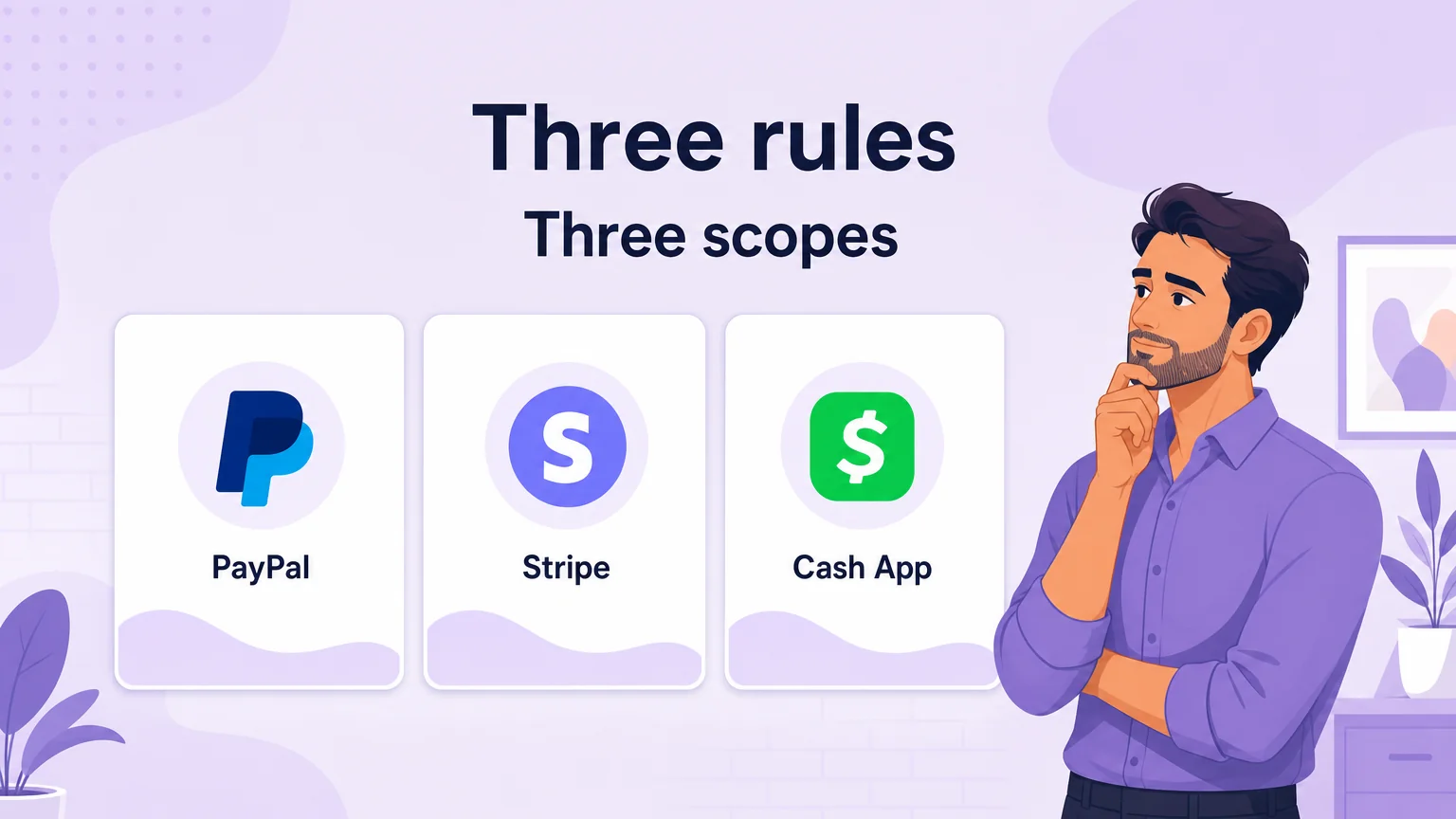
Payment processors. The common shorthand is that processors ban findom outright. They do not, and the difference matters, because you are the one who will have to read the terms. No processor’s published clause names financial domination. What exists is three published category rules, at three different scopes.
| Published policy | What it actually covers | As of |
|---|---|---|
| PayPal Acceptable Use Policy | PayPal US services. Prohibits transactions involving “certain sexually oriented materials or services,” and lists “Mature Audience Content — Any adult content delivered digitally including video on demand (VOD) and web-cam activities” under Activities Requiring Approval. | Last updated October 29, 2022 |
| Stripe’s Prohibited Businesses list | Businesses accepting payments through Stripe. Names “adult content and services,” expressly including “fetish services,” in the bucket Stripe defines as industries that can’t use it. | Last updated May 13, 2026 |
| Cash App Terms of Service | Sellers receiving Earnings Transactions. Under “Selling on Cash App” it bars “adult entertainment oriented products or services,” opening with “where prohibited by law.” Not a rule about person-to-person transfers. | Effective February 7, 2024; last updated September 11, 2026 |
Venmo’s user agreement, effective August 24, 2026, incorporates the PayPal Acceptable Use Policy by reference, because Venmo is a PayPal, Inc. contract. Venmo carries the PayPal restriction rather than one of its own. Its agreement contains no transaction-level rule about adult content at all; its only sexual-content provision governs what users post on the service, not what may be paid for. Counting Venmo and PayPal as two processors confirming the same thing inflates one fact into two.
Three things follow. These are published category rules, not enforcement records, so nothing establishes what happens to any individual account, and card-network rules are a separate layer this article cannot speak to. “Certain sexually oriented materials or services” is PayPal’s phrasing, and PayPal has not published a definition of it that this article could locate, so the honest statement is that the category is restricted, not that your arrangement is banned. And the scopes differ practically: the Stripe rule bites when you are a business taking payments, while the Cash App rule bites on the seller path, which is not the same surface as a person receiving a tribute into a consumer account. Read the policy that applies to the surface you are actually using.
Real-name exposure and reversal. A sub on the other end of a payment can see the recipient’s real legal name, and money already sent can be taken back. The community practitioner who raised this also reported that PayPal has a reputation for banning sex workers, which the company’s own published category rule makes plausible without proving. What the source does not establish is the mechanism, so treat the mechanism as unknown and the exposure as real. A payout that can be clawed back after you have delivered is not income yet. The advice that circulated alongside that warning, using an account under a false name, is not repeated here. It converts a payment problem into an identity problem, which is a worse trade.
Jurisdiction. Sex-work law is set jurisdiction by jurisdiction and it varies. This article cannot tell you what applies where you live and does not try to. If the answer matters to your decision, and it should, get it from a lawyer who practises in your jurisdiction. Any confident one-line answer from anywhere else is a guess about your situation and your state.
The Risks of Being a Findom

The published figures on digitally facilitated crime and harassment in online sex work are not findom figures and must not be read as if they were. They are also the closest thing that exists, and the direction is consistent. The Beyond the Gaze study (UK, 2018, more than 640 online sex workers, all of online sex work) reported that more than 80% had been a victim of crime, two-thirds had been harassed in the past five years, and nearly half feared their privacy being breached and being outed to family and friends. Forty percent said they would not go to the police.
The practitioner guidance that responds to that risk is specific, and it is one person’s practice rather than a standard. From the same community guide:
- Keep a separate email address for findom accounts, and keep your location, workplace and school off them.
- Use a VPN, and screenshot images before posting to strip the data that rides along inside the file.
- Do not reuse photos you have already posted on personal accounts. They can be reverse-searched back to you.
- Watermark what you post, because accounts impersonating established dommes are a reported and recurring problem.
In-person meets need their own protocol. Before a cashmeet, the same practitioner advises getting the sub’s ID, video-verifying them, meeting somewhere public, and sharing your live location with someone you trust, including the meeting window, so that a person who is not there knows when to expect you to check in. Impersonation cuts both ways: being catfished by someone posing as a sub is the mirror image of someone posing as you.
Then there is the load nobody warns you about. Jo described looking after a client’s mental health as the ongoing obligation of the role, and the community guide names domme drop as a thing that happens to the person holding the power. If you find it hard to stop giving when someone is in a bad place, this work will find that out about you. Decide in advance who you talk to about it, because the reflex to keep a kink private means the person absorbing the emotional weight has nobody to put it down with.
Findom Ethics: The Line Between Kink and Harm
Everything above is operational. This part is the spine, and without it the rest is a manual for something else.
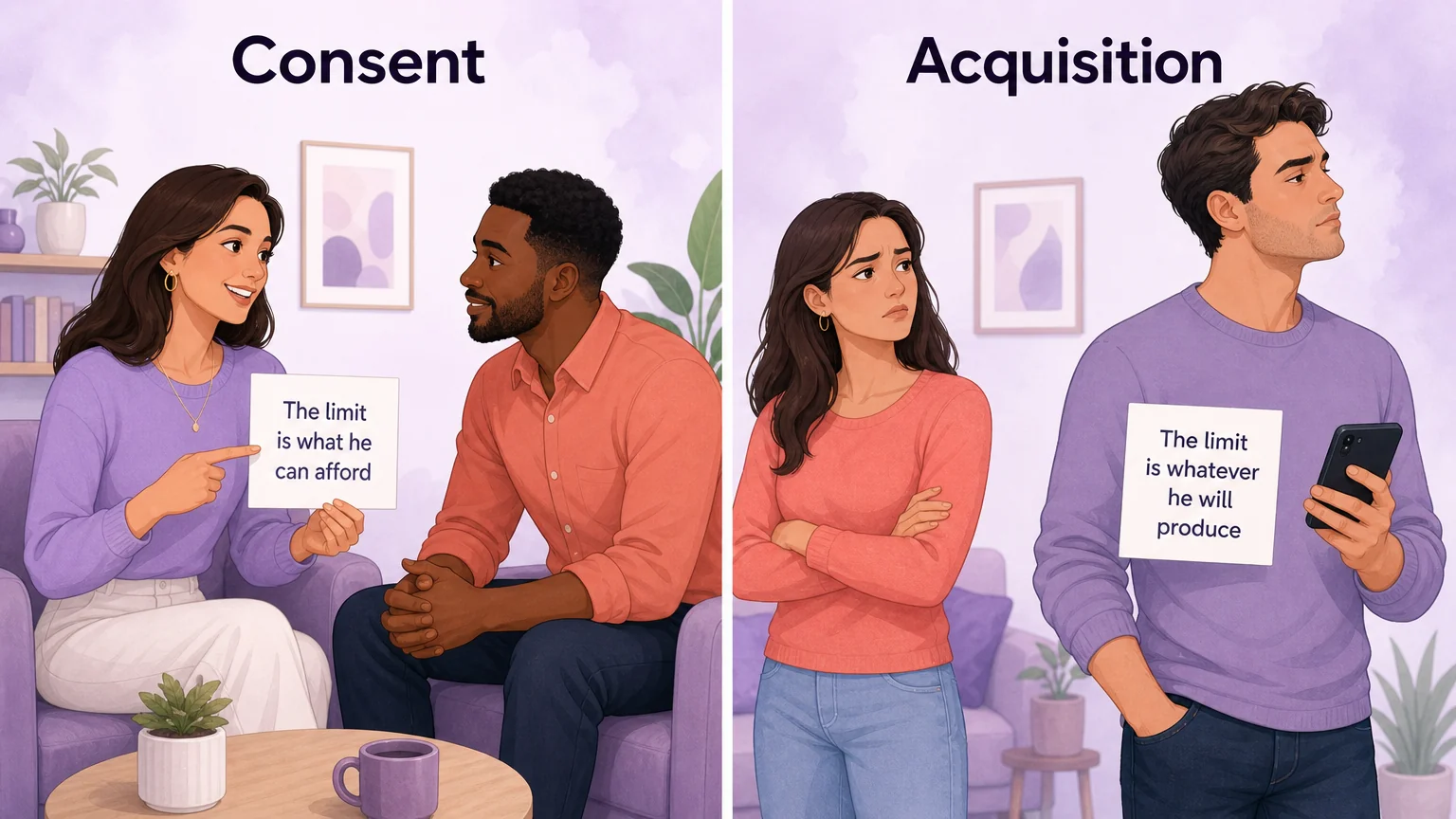
Two frames for this work are circulating, and they are not equally honest. The first treats findom as a power exchange between two adults, with affordability as the hard boundary and the sub’s welfare as the dom’s responsibility. That is the frame every named practitioner in this article works from, and the frame this article takes.
The second frame is sold rather than practised. It treats a sub’s desires as inventory to be worked and withheld attention as a collection method, and it ends by steering the reader toward a signup: a platform, a course, a gated guide. That is the acquisition frame, and it is the thing this article rejects. The sub is a supply, and the arrangement is a funnel. You will meet it again, dressed better, with a price on it.
The difference between those frames is not tone. It is where the limit comes from. In the first, the limit comes from what the sub can afford and what the dom will do, and it holds even when the money on offer is larger than usual. In the second, the limit is whatever the sub will produce, which leaves the arrangement with no floor and the person on the other end of it discovering that.
The psychologist Sarah Ashton, interviewed by ABC’s triple j in March 2024, offered a test for the sub’s side that works just as well as a test for yours. She suggests asking: how do I feel about this? Is this consistent with who I want to be? And then the two questions that do the work. Is it doing any harm to me at all, and is it consensual? Run your own side of the arrangement through it. If a sub’s honest answers would embarrass you, you already have your answer.
A sub’s destitution is a failure of the arrangement. Not a big win, not proof you are good at this, not his problem to manage. Kalashnikova’s line about destitution being the thing that makes it not fun is the shortest version of the ethics available, and it is not sentimentality. It is the boundary that keeps the practice on the right side of the line it sits next to.
Findom Scams: The Ones That Target You and the Ones That Sell to You
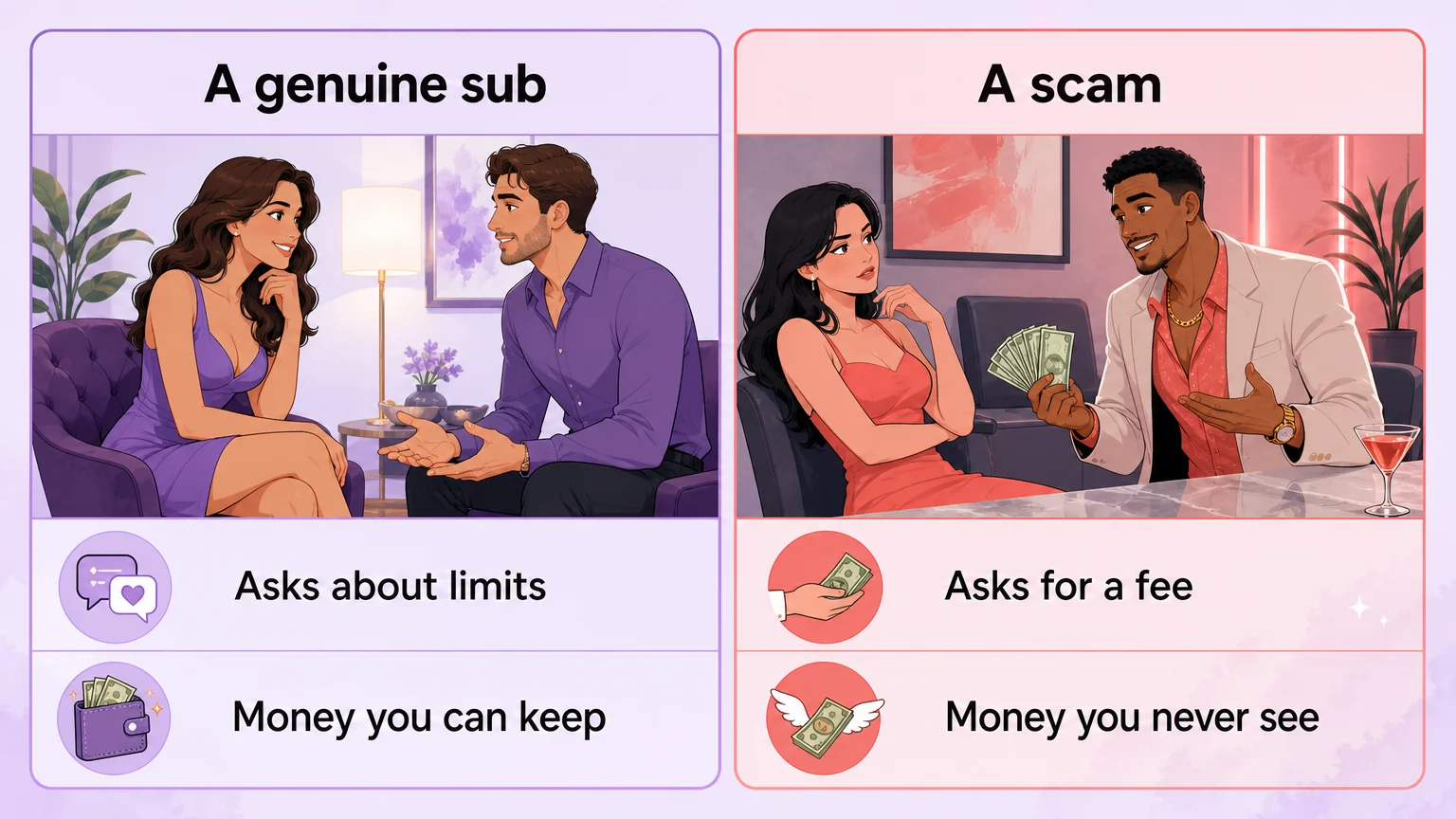
The scam ecology around findom runs in both directions. Three scams target you specifically.
The advance-fee scam. Someone approaches you as a sub who wants to send money, then explains that a fee must be paid before the payment can go through. The community guide answers this in capital letters: you do not have to pay a transaction fee to receive money, and anyone who says otherwise is running a scam. It is ordinary advance-fee fraud with a kink costume on.
The stolen-instrument scam. Your Favourite Dominatrix described a version of this in 2020: purported paypigs using stolen cards to buy goods in a dominatrix’s name from an online retailer. The immediate theft is not from you. What you receive is traceable to fraud, and the goods or the money move back out again while your name stays attached to the transaction.
Impersonation. Accounts set up to catfish as you are a reported and recurring problem in the community, using the handles you have mentioned in your own videos. The mitigation given is a watermark on everything you post, which costs you a few seconds and stops the easy version.
Then there is the tier that does not steal from you. It sells to you. A whole layer of findom advice exists to sell courses, gated guides and platform signups to people who want to do this, and its pitch is an outcome: a large one, presented as the ordinary result of following the method. The evidence cannot support that outcome, and the pitch does not need it to, because the numbers it leans on are the recycled ones this article has already taken apart. That tells you what the advice layer has become. It is not a body of knowledge about a kink. It is a market in hope, and it recruits.
The way to tell a genuine sub from a scam is less about the person and more about the sequence. Money that arrives with conditions attached before it arrives is not a tribute. A sub who wants to skip the conversation about what he can afford is not being shy. And anyone who asks you to pay anything, at any stage, for the privilege of being paid, has told you what they are.
How to Start as a Findom
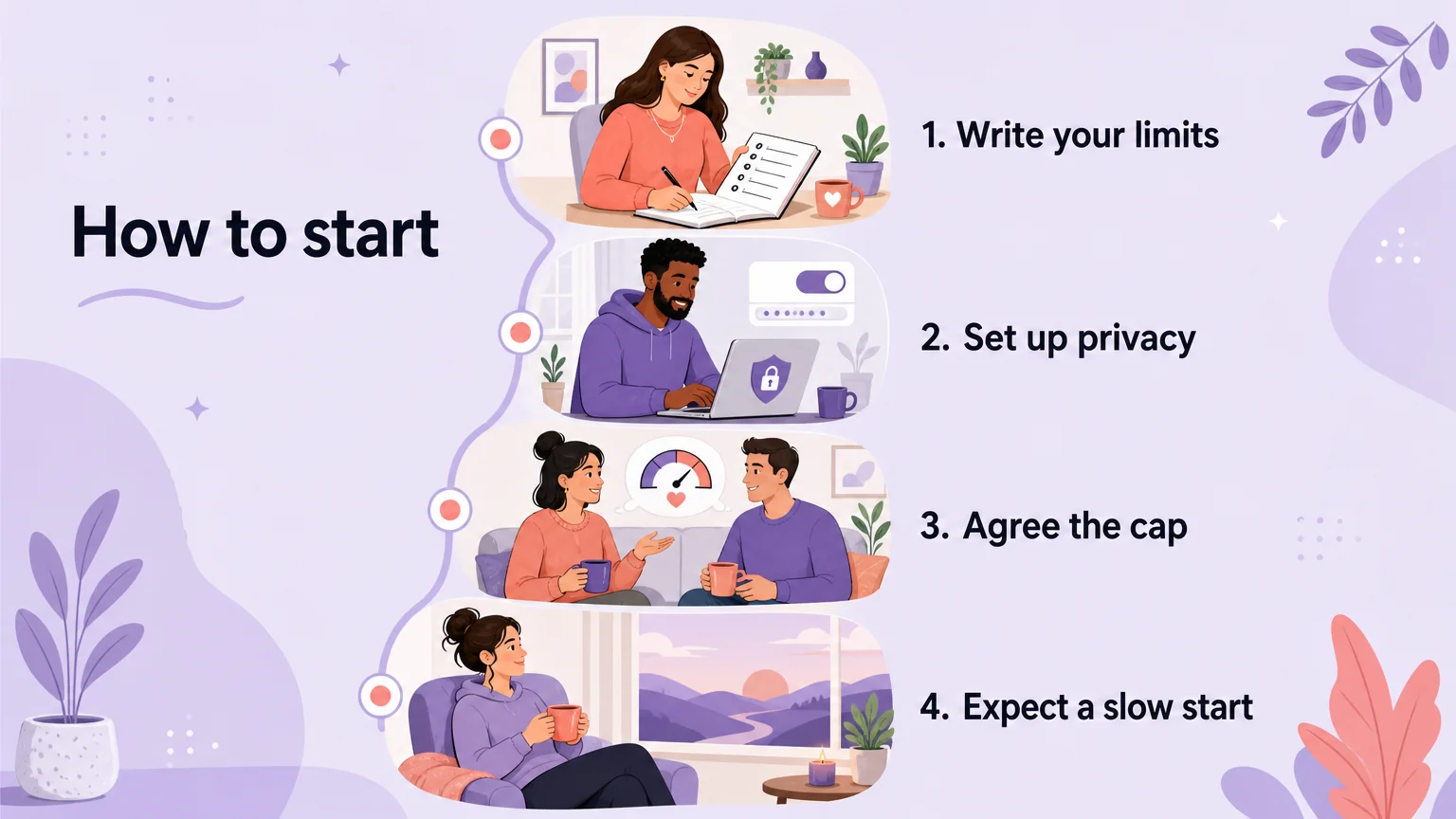
The path the evidence supports is unglamorous and it has an order. Money is last.
- Decide what you will and will not do, in writing, before you are asked. Include the things you would refuse even for a large payment, because that is the only version of the list that survives contact with one.
- Set up privacy before you set up a profile. Separate email, no location or workplace anywhere, a VPN, watermarked images that have never appeared on a personal account.
- Establish the limit before the first payment, from the sub’s real budget. Not from what he offers. Verify the number rather than accepting it.
- Put the exit in writing too. Both of you can stop, and what stopping looks like is agreed in advance.
- Plan aftercare for both of you, including who you talk to when it is your own come-down.
- Expect a long quiet start. The practitioner accounts agree on this. If you need the money this month, this is the wrong month.
On experience: you do not have to have been a dominatrix first. Goddess Jo had nine years of it and said financial domination came easier because of what she already understood about subspace and the come-down. That is a signal about what the work draws on, not a prerequisite. What it draws on is the ability to hold a limit while someone pushes against it, and to keep caring about the person doing the pushing.
The check that tells you the setup is finished is not your follower count. It is whether a sub could describe the arrangement accurately to a third party from what you have written down. If he could not, nothing has been agreed yet, and you are not ready to accept anything.
Frequently Asked Questions About Financial Domination
Is being a findom legal?
It depends where you are. Sex-work law is set jurisdiction by jurisdiction, within countries as well as between them, and a US-centric answer, including one written in an article like this one, does not transfer to you. What this article can support is that the question varies and that the answer is local. What it cannot support is a verdict, and a confident one-sentence answer from anyone who has not asked where you live is guessing about your situation and your state. If this affects your decision, ask a lawyer who practises where you live.
Do findoms pay taxes?
In the United States, on the same basis as anyone else who earns. Section 61 of the Internal Revenue Code defines gross income as “all income from whatever source derived,” expressly including compensation for services, and IRS Publication 525, the 2025 edition, directs that income from illegal activities be included in income, on Schedule 1 line 8z or on Schedule C where it comes from self-employment activity. Note that the second citation is not a claim that what you are doing is unlawful. It is the clearest published statement that taxability does not depend on legality, and that self-employment income is reported on Schedule C. State tax, self-employment tax rates and expenses are outside what this article can tell you.
What do you actually say to a sub?
Less than the internet suggests, and none of it should be a line somebody sold you. What the sources agree on is that the first conversation is about parameters, not persuasion. Balestrieri’s point is that communicating boundaries and the parameters of consent is a precondition for any of this, not an icebreaker to get past. Kalashnikova describes the conversation as establishing terms: what the arrangement includes, and in her case whether the sub wants a standing agreement with payments at intervals. The community guide’s rule is the one to keep. If a sub wants something you are not comfortable with, the answer is no, and the money does not change it. There are plenty of scripts online. They are written to convert a reader into a payer, and not one of them knows what you are willing to do.
What do finsubs want?
Not one thing, and the published accounts split in ways that matter. Balestrieri’s clinical account is that men are often socialized to read their worth through their finances, and that handing that over inside a chosen dynamic can be a release; she notes there is frequently no sex involved at all. The paypig interviewed by ABC’s triple j in March 2024 describes something closer to administration: a weekly cap that gets tallied, honesty about his income and his survival needs, and, in his own words, “there’s no blackmail or anything like that involved.” At the other end, Goddess Jo reported that some findommes take full control of a client’s bank accounts, paying his bills and leaving him the minimum to live on, and said she does not do it because of what it does to his mental health. What a sub wants is the thing you establish before you accept anything from him, not the thing you find out afterwards.