
You swipe past a profile that says “happily partnered with an anchor,” or your partner drops the phrase at dinner and you nod like you get it. You don’t. But something lands anyway: a flicker of recognition. Trust that.
Anchor partner is a term that grew out of polyamorous communities in the late 1990s and early 2000s. No single person coined it. No committee approved it. People needed language for the partner who holds the center, someone steady, without dragging in “primary” baggage or reducing everything to “nesting” logistics. That’s why the word carries emotional weight, not clinical precision.
What follows: a clean definition, the distinctions that matter, a way to figure out if you already have one, and scripts for talking about it. Scripts that won’t feel like a corporate negotiation.
The Core Definition: What Makes Someone an Anchor Partner
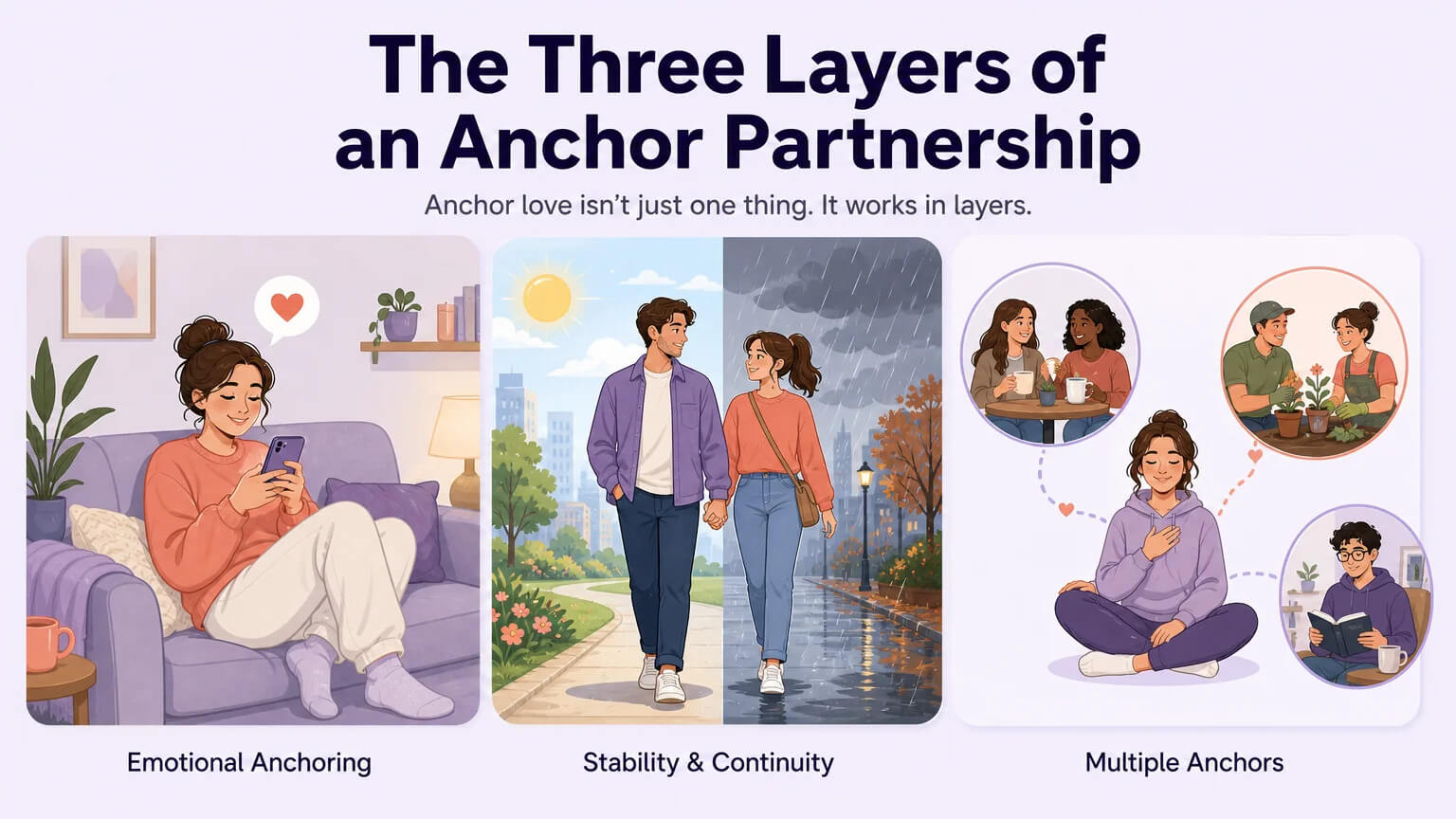
An anchor partner is someone who provides emotional stability and a sense of home base, whether or not you live together, share finances, or call each other primary. That’s the coffee-shop version. The rest is detail.
First: emotional anchoring, not logistical anchoring. An anchor partner is the person you text when something goes wrong, whose opinion shapes your decisions, whose presence settles something in you. You might not share a lease or see each other every day. The anchoring is emotional, not administrative. Relationship coach Roy Graff calls this your emotional home base, distinct from the logistical hierarchy of primary or nesting partners.
Second: stability defines the thing, not exclusivity. An anchor partnership earns its name through steadiness. The relationship persists across other connections, life changes, and time. It’s not about being the “most important.” It’s about being the one that holds. Therapist Rachel Wright, LMFT, puts it plainly: the anchor partner is “the main character aside from self”: the person who provides continuity when everything else shifts.
Third: you can have more than one. Some people have two or three anchors, each grounding a different dimension. The term describes a function, not a slot. Graff has lived with two anchor partners for four years. “I did not plan for it,” he says, “but I knew that I don’t believe in a formal hierarchy that prioritizes one partner over others.”
What an anchor partner is not: not necessarily your most frequent partner, your longest, or someone you label boyfriend, girlfriend, wife, or husband. The title is about what the relationship does, not what name it wears.
Anchor Partner vs Primary Partner vs Nesting Partner: What’s the Difference
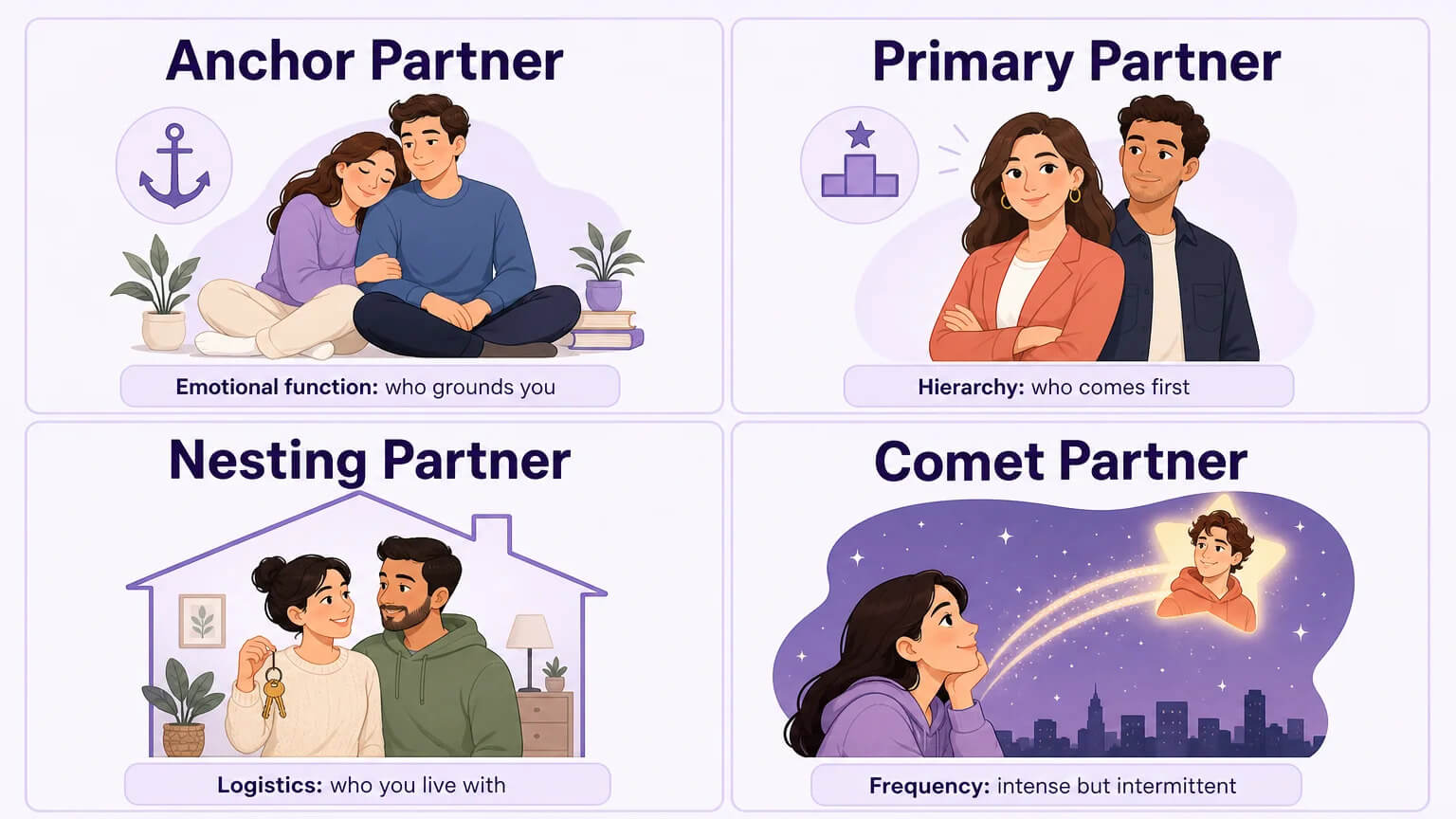
Most people using “anchor partner” on dating apps actually mean “primary partner.” The difference matters. Using the wrong term sets expectations you didn’t intend to set.
Anchor partner describes emotional function: who grounds you. May or may not live with you. May or may not involve hierarchy. Stability and emotional centrality are the point.
Primary partner describes hierarchy: who comes first in decision-making, time, and life planning. Explicitly ranks relationships. Often implies veto power. More about structure than feeling.
Nesting partner describes logistics: who you share a home with. Purely descriptive. A nesting partner might also be your anchor. Or not.
A fourth term worth knowing: comet partner. Someone you see rarely but connect with deeply when you do: passionate, intermittent, no daily involvement. Can anchor you emotionally without regular presence.
These terms answer different questions. Mixing them up creates confusion no amount of good communication can undo.
A nesting partner who isn’t your anchor is a real configuration. A primary partner who isn’t your anchor is also real. These are common arrangements people feel ashamed to name because nobody talks about them.
If you’re writing a dating app profile, “anchor partner” signals something different than “primary partner.” Use the one that’s true, not the one that sounds more enlightened. The writer at nonmonogamyhelp.com notes that emotional hierarchy (ranking loved ones by feelings) is “rarely done unless something has gone terribly wrong,” while time hierarchy is unavoidable because you only have 24 hours in a day. Your terms should reflect what you practice, not what you want to be seen as practicing.
Where Anchor Partners Show Up: Beyond Polyamory
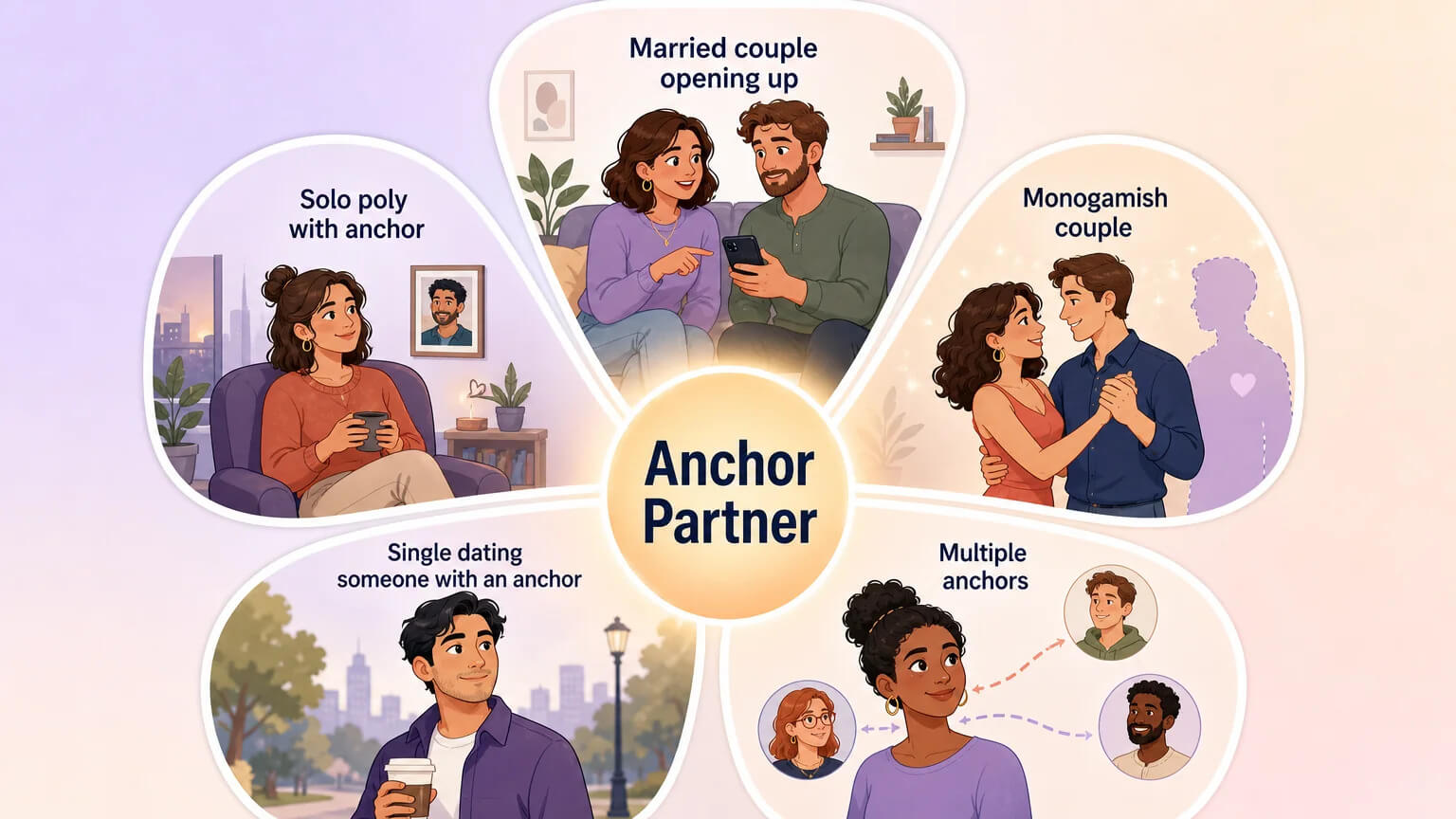
If you’ve only seen “anchor partner” in polyamory forums, you’d be forgiven for thinking it’s a poly-only concept. It’s not. The dynamic, emotional grounding, predates any framework and shows up everywhere.
The married couple opening up. They’re each other’s anchor: the person they come home to, debrief with, build a life around, even as they welcome a guest into their playground. The anchor is what makes exploration feel safe.
The solo poly person with an anchor. Lives alone, dates around, but has one relationship that provides emotional continuity. They don’t share keys. They share everything that matters.
The monogamish couple. Exclusively romantic, occasionally adventurous together. They’d never call themselves poly, but they absolutely have an anchor: each other. The concept helps them articulate why their adventures don’t threaten their bond.
The single person dating someone with an anchor. Your partner has someone else who grounds them. Understanding what that means, and what it doesn’t mean about your place in their life, is the difference between feeling secure and feeling like a placeholder.
The person with multiple anchors. Two or three relationships, each grounding a different dimension. One emotional, one creative, one domestic. The function splits; the concept holds. Alex Alberto describes a metamour who became an anchor through “a mix of friendship, fondness, intimacy, and trust that stemmed from our romantic love for the same human.”
Wherever you sit on the spectrum, the anchor concept has something to offer. Desire doesn’t require an apology, and understanding your anchors doesn’t require a polyamory membership card.
Six Signs You Have an Anchor Partner: A Self-Diagnosis Checklist
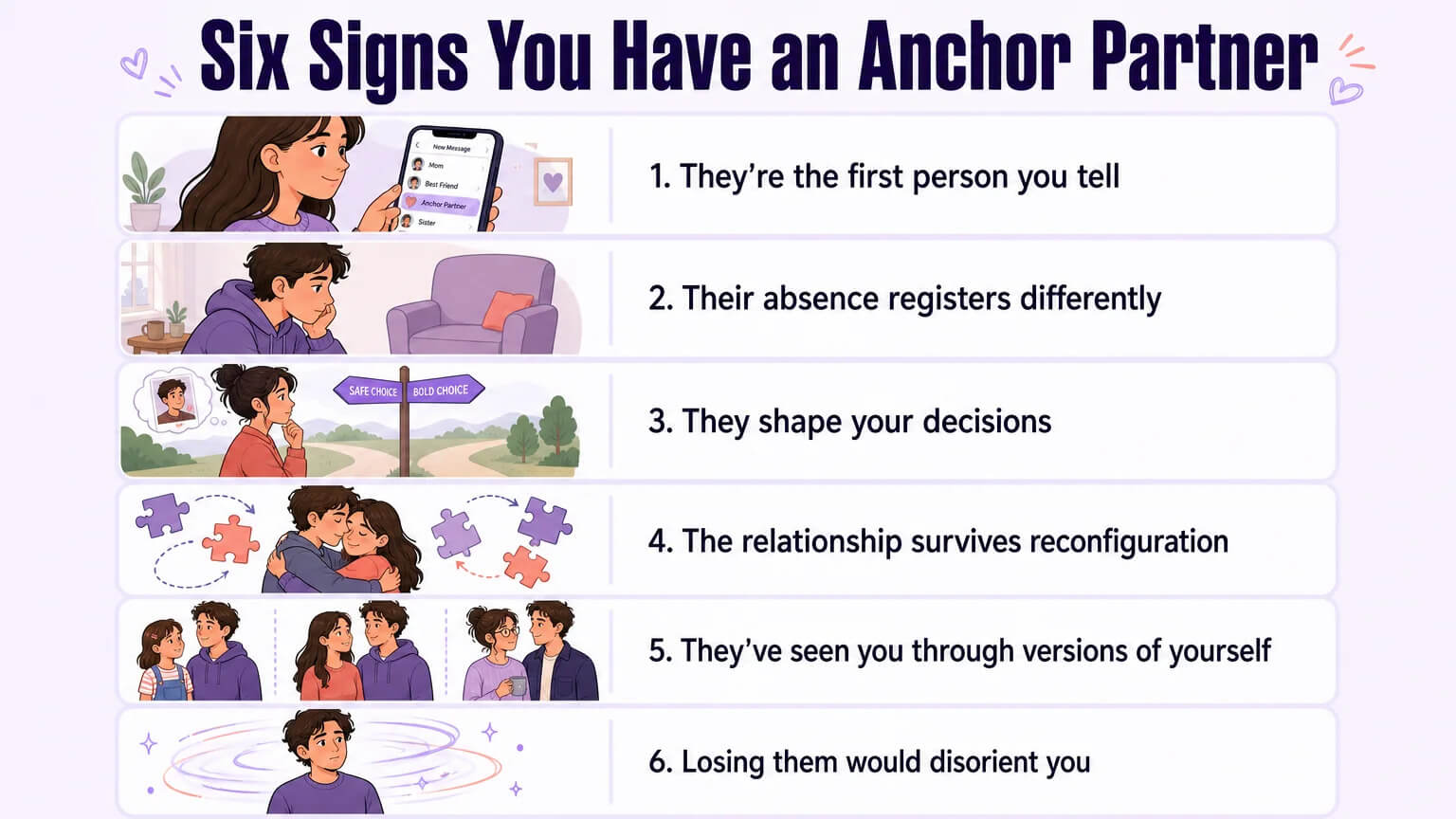
You probably landed here because you’re trying to answer a quieter question: “I think I know what this is, but I need someone to confirm I’m not imagining it.” Fair. This isn’t a test you pass or fail. Think of it as a mirror.
1. They’re the first person you tell. Good news, bad news, confusing news: their name is the one your thumb finds. Telling them makes the thing real. Emotional anchoring at its most instinctive.
2. Their absence registers differently. When you’re apart from other partners, you adapt. When the anchor partner is unavailable, something feels untethered. That’s not dependence. That’s orientation.
3. They shape your decisions without making them for you. You ask “what would this mean for us?” not out of obligation but because “us” is part of how you think. Anchoring, not hierarchy. Integration, not permission.
4. The relationship survives reconfiguration. You’ve changed structures, living situations, agreements. This person stays at the center. Dr. Joli Hamilton notes that anchor partnerships adapt across structural changes rather than breaking.
5. They’ve seen you through a version of yourself you no longer are. Anchors hold through evolution. The person who knew you before the career change, before you understood your own desires, and is still here. That’s anchoring, not just longevity.
6. Losing them would disorient you, not just hurt you. Losing any relationship hurts. Losing an anchor partner disorients. They’re part of how you navigate, not just what you enjoy.
These signs are descriptive, not prescriptive. The framework names what’s there. It doesn’t rank what matters.
How to Have the Anchor Partner Conversation Without Making It Weird
People freeze on this. The worry: “If I use the wrong word, I’ll sound like I’m demoting them.” Or: “If I bring this up to someone new, they’ll think I’m overcomplicating everything.” Real fears. Here are the scripts that get past them.
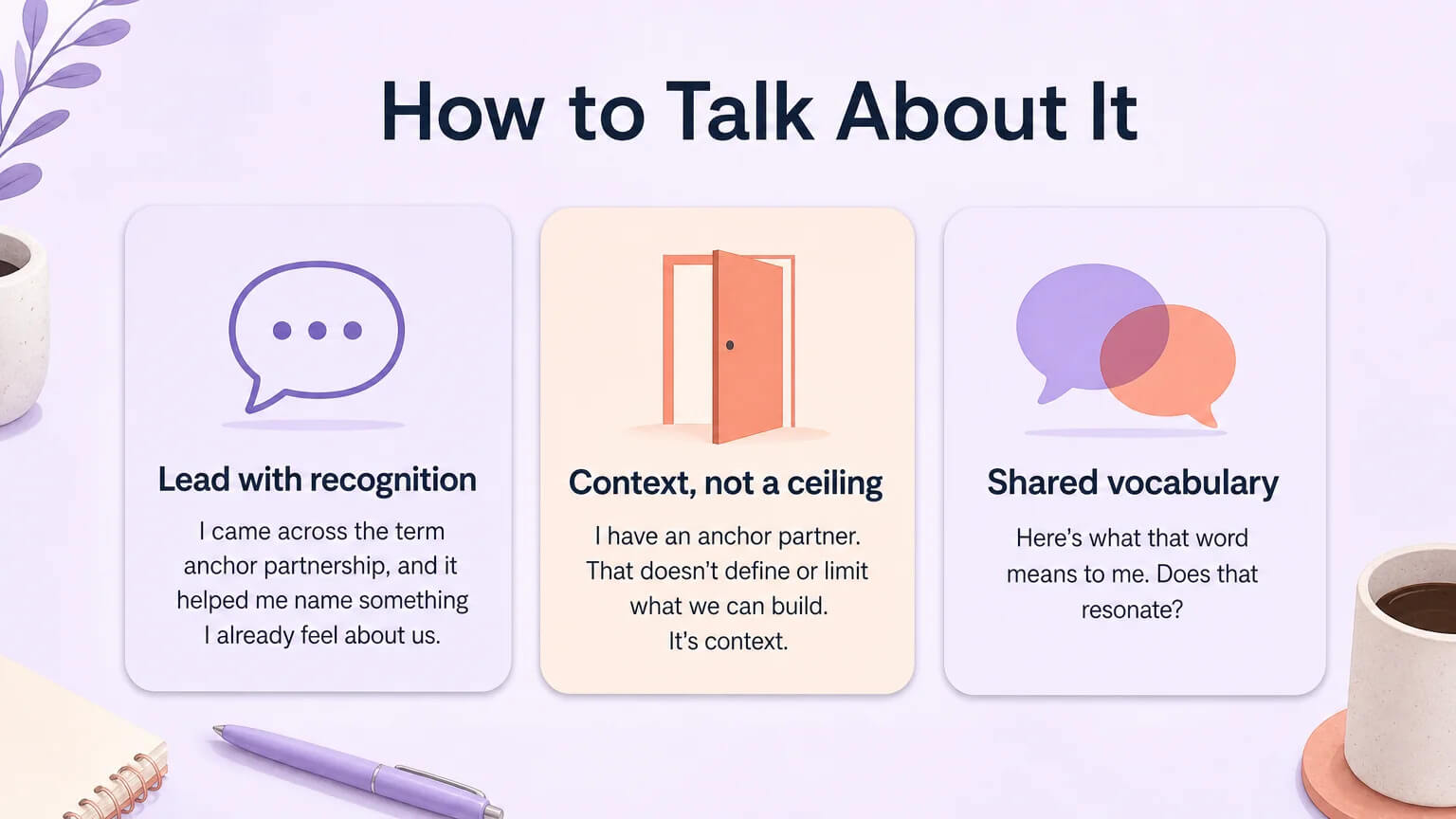
With your existing partner: lead with recognition. “I came across the term anchor partnership, and it helped me name something I already feel about us. It’s not about changing anything. It’s about having better language.” You’re naming something that’s already there. Not proposing a new structure, not asking for anything.
With someone new: context, not a ceiling. Tell a new connection: “I have an anchor partner, someone who provides emotional stability in my life. That doesn’t define or limit what we can build. It’s context.” Separate the fact from the assumptions. Information, not a warning label.
The reusable template. “I’ve been thinking about what [Name] means in my life, and the word that fits is anchor partner. Here’s what that means to me: [your definition]. Does that resonate with how you see us, or does a different word feel truer?” You define it, then hand it over. Shared vocabulary, not an imposed label.
Agreements, not permanent decrees. An anchor partnership doesn’t need a contract, but clarity helps. What do we tell each other? What’s off the table? These are agreements, revisable. If it’s not an enthusiastic “yes” from everyone, it’s a hard “no.”
The first time you say “anchor partner” out loud, it’ll feel clunky. So did “boyfriend” in seventh grade. Use it anyway.
Dating Someone With an Anchor Partner: What to Expect, What to Ask, and What to Watch For
You’re excited about someone. They mention an anchor partner. Now you’re googling at midnight, wondering if this is solid or something that’ll hollow you out.
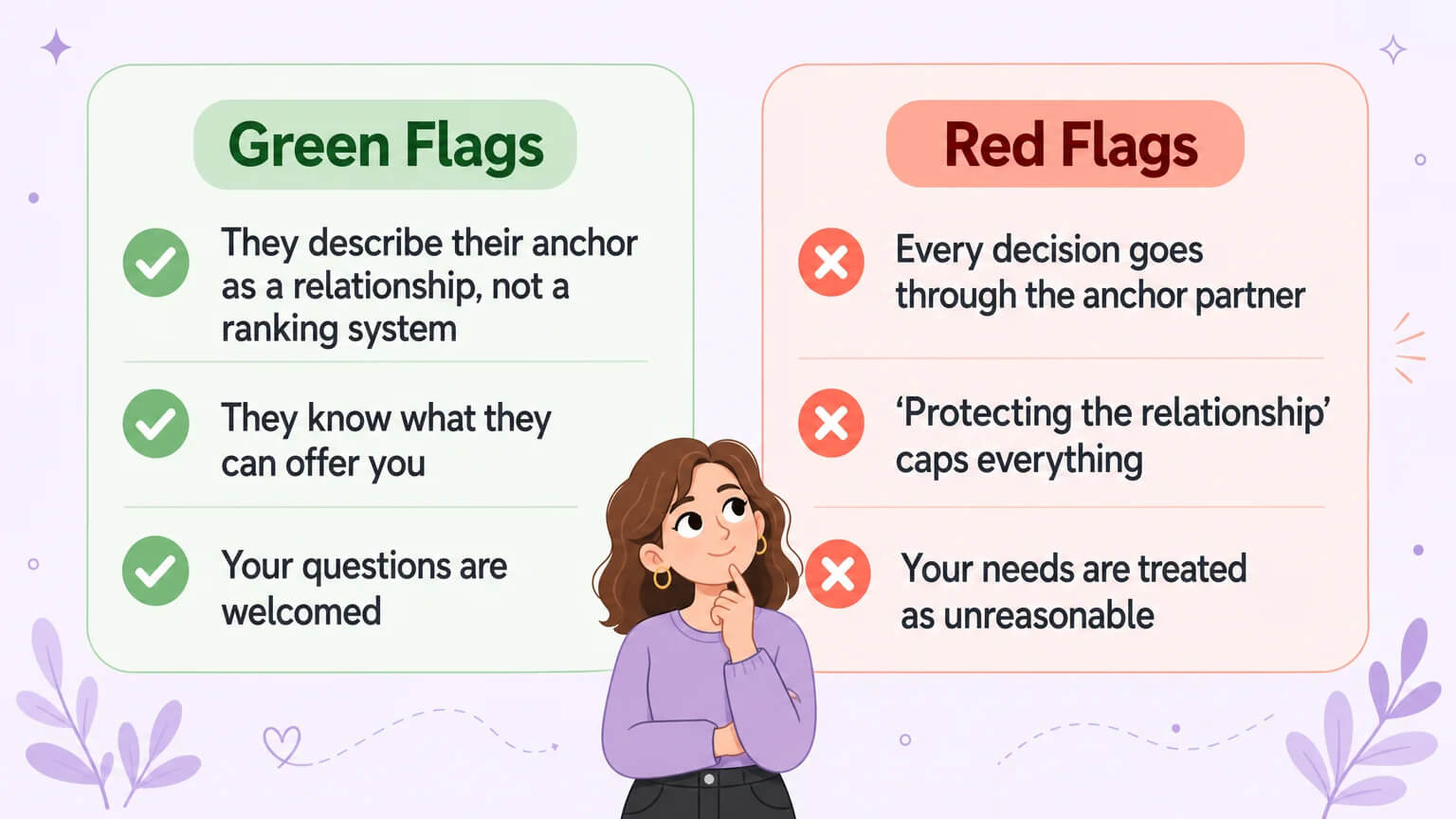
Green flags: their anchor partnership actually makes room for you.
They describe their anchor as a relationship, not a ranking system you’re outside of.
They know what they can offer, not just what’s off the table. “I’m available for regular dates, overnights, and emotional connection” is a green flag. “I have an anchor” without more is yellow.
Your questions are welcomed, and the anchor partner knows you exist and is okay with that.
Red flags: the anchor partnership is going to swallow you.
Every decision gets referred back to the anchor partner. You’re never in the room.
“Protecting the relationship” becomes shorthand for capping everything.
You’re an experience for the couple, not a person connecting with a person.
Your emotional needs are treated as unreasonable because “you knew I had an anchor.” Knowing someone has an anchor partner isn’t agreeing to be disposable.
Questions to ask early. “What does having an anchor partner mean in practice for you, your daily life?” “What are you available for? What are you hoping to find?” “How does your anchor partner feel about you dating? What agreements do you have?” “What happens if feelings develop? Are those welcome, or is there a ceiling?”
Dating someone with an anchor partner can be wonderful: someone who’s done the work. Or painful, if the anchor partnership hasn’t made room. Find out whether there’s genuine space. Walk if there isn’t.
FAQ: Anchor Partner Questions People Google at 2 AM
Can you have more than one anchor partner?
Yes. Some people have two or three anchors, each grounding a different dimension. The term describes a function, not a slot.
What’s the difference between an anchor partner and a nesting partner?
A nesting partner is someone you live with. An anchor partner is someone who grounds you emotionally. They can be the same person. They don’t have to be.
Does “anchor partner” apply in swinging, or is it only a polyamory term?
The term came from polyamory, but emotional stability exists everywhere. Swinging couples often have it in their marriage even if they never use the word. The concept travels; the vocabulary is optional.
Is an anchor partner the same as a “primary” partner?
Not necessarily. “Primary” describes hierarchy. “Anchor” describes emotional function. A primary is usually also an anchor; an anchor doesn’t have to be primary.
What if my anchor partner and I want different things?
Wanting different things doesn’t mean it’s broken. You need a conversation. Anchors hold through evolution. Can you build agreements that honor both sets of wants?
How do I know if someone is my anchor partner or just a very close friend?
The distinction is centrality, not closeness. A close friend hears everything. An anchor partner’s presence shapes your stability. If their absence disorients rather than saddens, that’s anchoring.
I’m single and dating someone with an anchor partner. What are the red flags?
Your needs are consistently secondary, and “my anchor partner” becomes the reason every limitation stays permanent. A healthy anchor partnership makes room. An unhealthy one builds a wall.
Does having an anchor partner mean the relationship is hierarchical?
Not inherently. Anchor describes emotional function; hierarchy describes structure. You can have an anchor in a non-hierarchical setup. It’s about stability, not ranking. Some use “anchor” as a softer “primary.” It’s not.
How do anchor partnerships and Old Relationship Energy (ORE) connect?
ORE is the earned comfort of a long-term connection: shared history, inside jokes, trust that doesn’t need rebuilding. An anchor partner carries the most of it. That steadiness isn’t boring; it’s the foundation.
You came here for a definition. You’re leaving with a framework. Use it however it fits.