Fifty-one percent of adults under 30 now say open marriage is acceptable. Tinder added a non-monogamy option. Celebrities talk openly about their polycules. Your coworker probably knows someone in a throuple. Why are people polyamorous has moved from a niche curiosity to a question millions are asking, whether they’re considering it themselves or just trying to understand someone they care about.
The problem is that most of what you find online falls into one of two camps: it either treats polyamory like a relationship failure that needs a clinical explanation, or it cheerleads so hard the actual reasons get buried under enthusiasm. Neither approach answers the real question.
Here are the real reasons, backed by research, told without an agenda.
One Person Cannot Meet All Your Needs, and They Were Never Supposed To
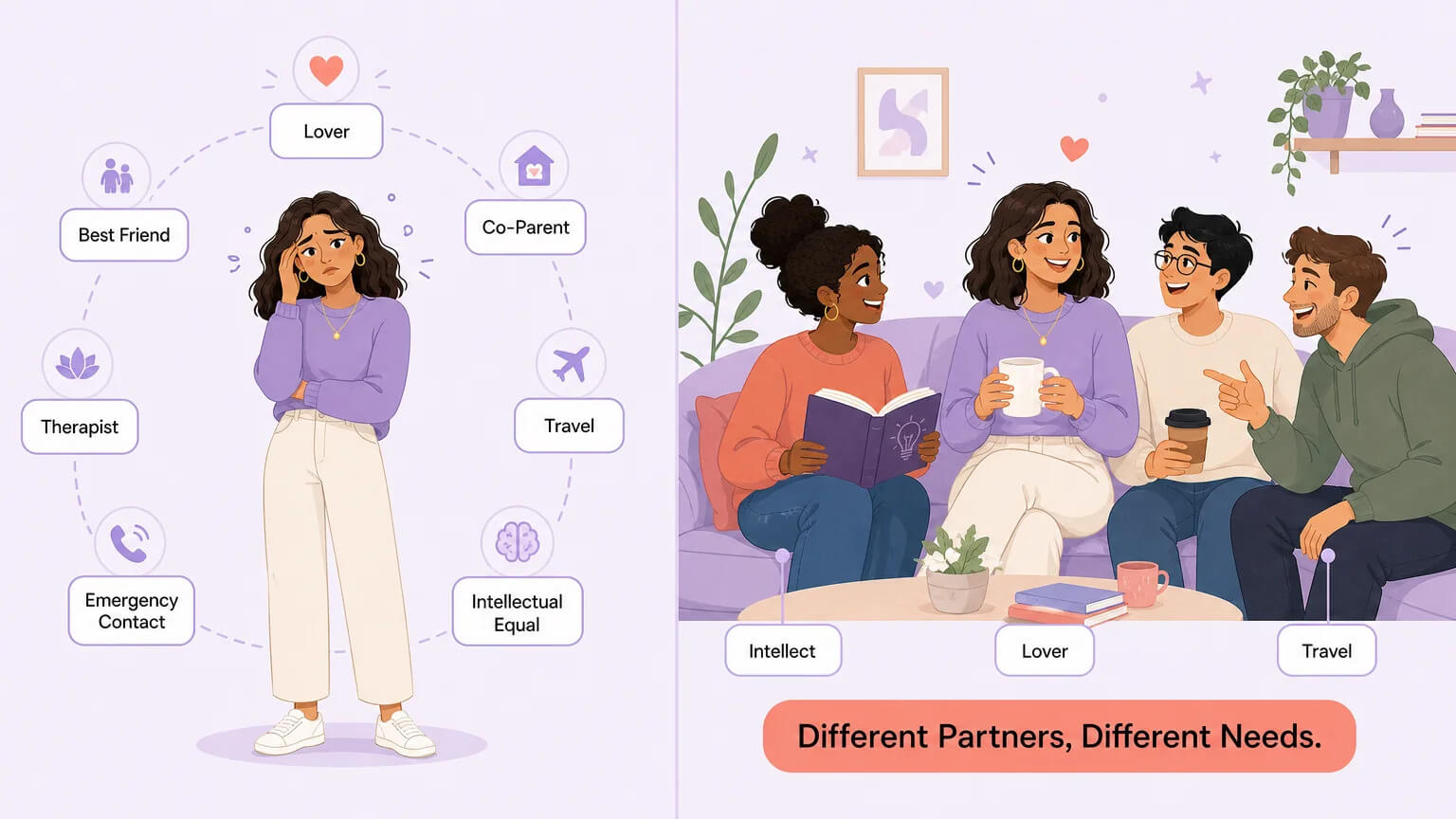
Think about what we expect from a romantic partner today. Lover, best friend, co-parent, financial partner, emotional sounding board, intellectual equal, travel companion, emergency contact. We want one person to be everything.
This expectation is historically unprecedented. For most of human history, marriage served clear, practical functions: safety, financial security, child-rearing, social standing. It was not designed to deliver self-actualization, deep emotional intimacy, and sexual fulfillment all at once.
Now it’s supposed to. And some people look at that ask and think: that’s a lot to put on one human being.
Researchers Hnatkovicova and Bianchi analyzed the academic literature on polyamory motivations and found that “fulfilling needs unmet in monogamous relationships” was the most consistently reported reason across studies. Not because monogamous relationships are broken. Because expecting a single person to meet every emotional, intellectual, sexual, and social need is an extraordinarily high bar. Some people would rather distribute those needs across multiple loving connections than feel perpetually disappointed that one partner can’t be everything.
A 2025 study published in Archives of Sexual Behavior identified four themes in how polyamorous people describe their relational autonomy: assertive communication about boundaries, independent emotional regulation, feeling authentic and “able to be who I truly am,” and freedom from the expectation of being everything for one person. Autonomy doesn’t mean escaping responsibility. It means designing relationships that actually fit instead of inheriting a template that doesn’t.
This isn’t an argument against monogamy. Plenty of people thrive in it. But for some, distributing needs across partners feels less like a workaround and more like the design that should have been the default all along.
For Some, Polyamory Feels Like an Orientation, Not a Choice
One of the biggest questions about polyamory is whether people choose it or just are it. The answer, depending on who you ask, is both.
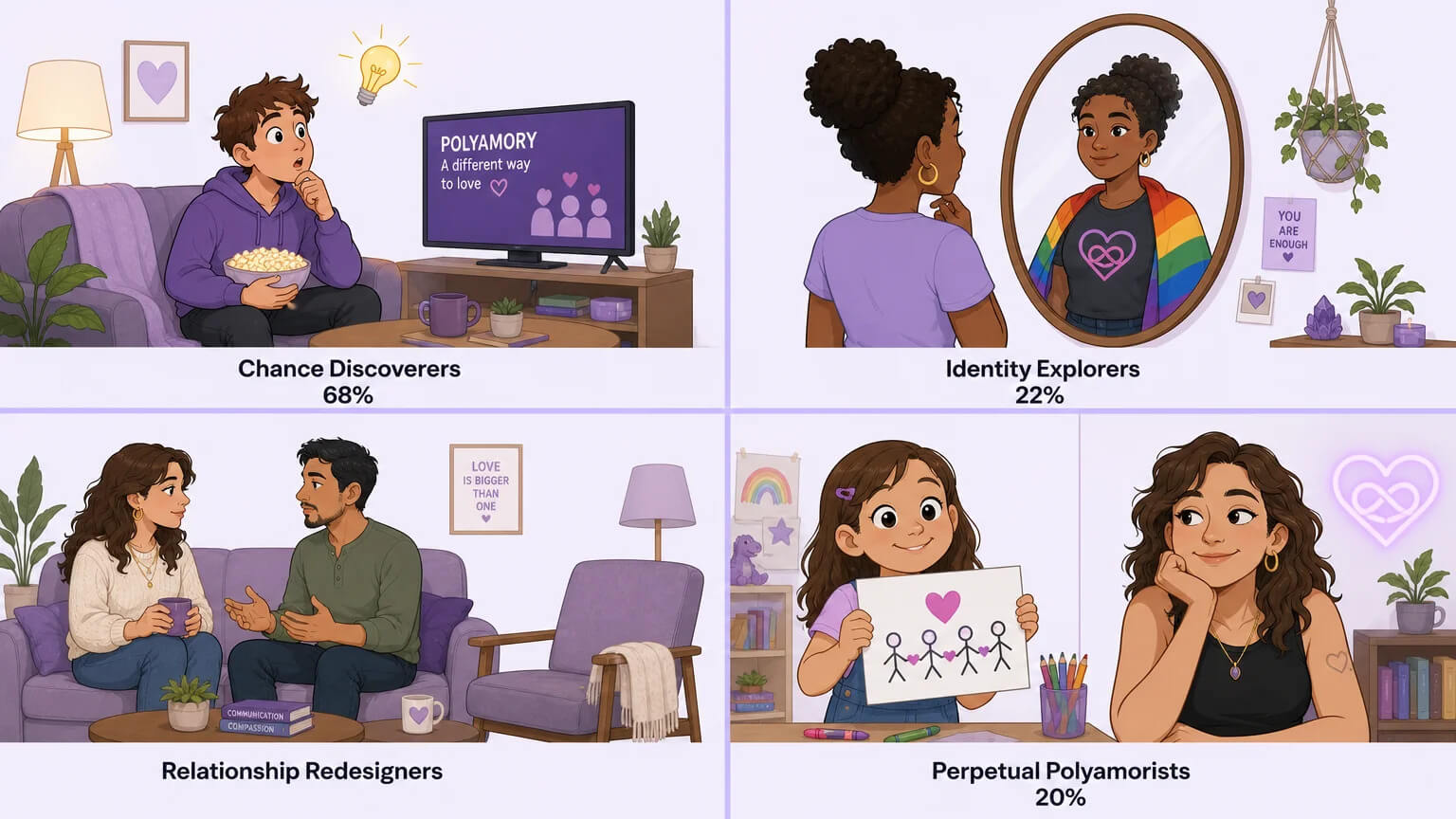
Researcher Emily Fogle spent years interviewing polyamorous adults and found four distinct pathways people take into polyamory. About a fifth describe themselves as what she calls “perpetual polyamorists.” They tell some version of the same story: they never understood monogamy, even as children. Some had polyamorous relationships in high school without knowing the word for it. One participant said, “We didn’t have a name for it. It was just, I liked girls, he liked a girl, and she liked us.”
Then there are the “chance discoverers,” who make up over two-thirds of polyamorous people. They stumbled across the concept through a TV segment, a podcast, a book like The Ethical Slut, or a partner who introduced the idea. Their reaction tends to follow the same arc: initial resistance, then research, then a paradigm shift. One described it as: “I just, I loved it! I’d never heard of anything like that and it just sort of dawned on me that that’s for me.”
The other two pathways are identity explorers, who arrive at polyamory through exploring their queer or gender identity, and relationship redesigners, who open existing relationships for practical or emotional reasons.
The orientation-versus-choice debate matters because it shapes how polyamorous people understand themselves and how they ask others to understand them. The born-this-way framing has political power. It’s harder to stigmatize something someone didn’t choose. But the choice framing has its own dignity: these are people who looked at the default option, thought about it carefully, and consciously designed something different.
Most polyamorous people blend both frames. They’ll tell you they chose this structure, and also that choosing anything else would feel like lying.
Humans Were Never Built for Strict Monogamy
There’s an unspoken assumption underneath most conversations about polyamory: that monogamy is what humans naturally do, and anything else needs an explanation. The science tells a more complicated story.
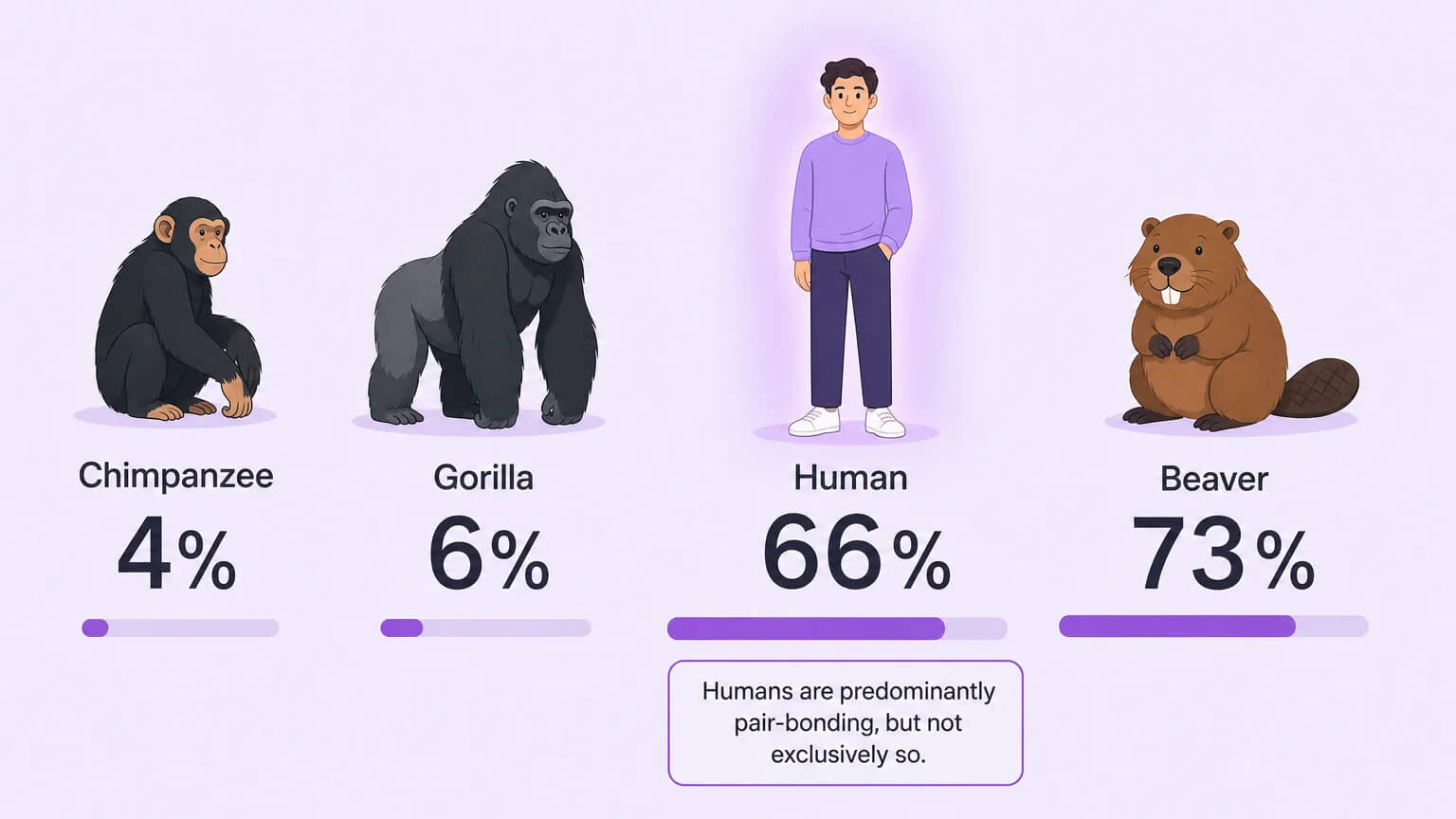
In 2025, Cambridge researcher Mark Dyble published an analysis comparing monogamy rates across mammal species by measuring how many siblings in a litter share the same father. Humans came in at 66 percent. That puts us between beavers and meerkats, and it makes us unusual among primates. Our closest relatives clock in much lower: chimps at 4 percent, mountain gorillas at 6 percent. We are predominantly pair-bonding, but we are not exclusively so.
Sexual Strategies Theory, developed by evolutionary psychologists David Buss and David Schmitt, proposes that humans evolved a repertoire of mating strategies, not a single one. Short-term and long-term, monogamous and non-monogamous. What gets expressed depends on ecological conditions, social norms, and individual circumstances. A 2025 framework called Contextual Adaptability Theory extends this further: monogamy isn’t a fixed trait. It’s a flexible strategy that shifts with context.
The practical conclusion is not that monogamy is unnatural or that polyamory is more evolved. It’s that human beings come equipped with the capacity for both pair-bonding and novelty-seeking. Neither impulse is pathological. Polyamory is one way some people reconcile the two.
Cross-cultural evidence reinforces this. Many pre-industrial societies, from Polynesian cultures to parts of pre-colonial Africa and the Americas, practiced forms of sanctioned non-monogamy long before the modern polyamory movement existed. What we treat as the obvious default is, in historical terms, one cultural arrangement among many.
Polyamorous People Are Not Afraid of Commitment. They Want a Different Kind
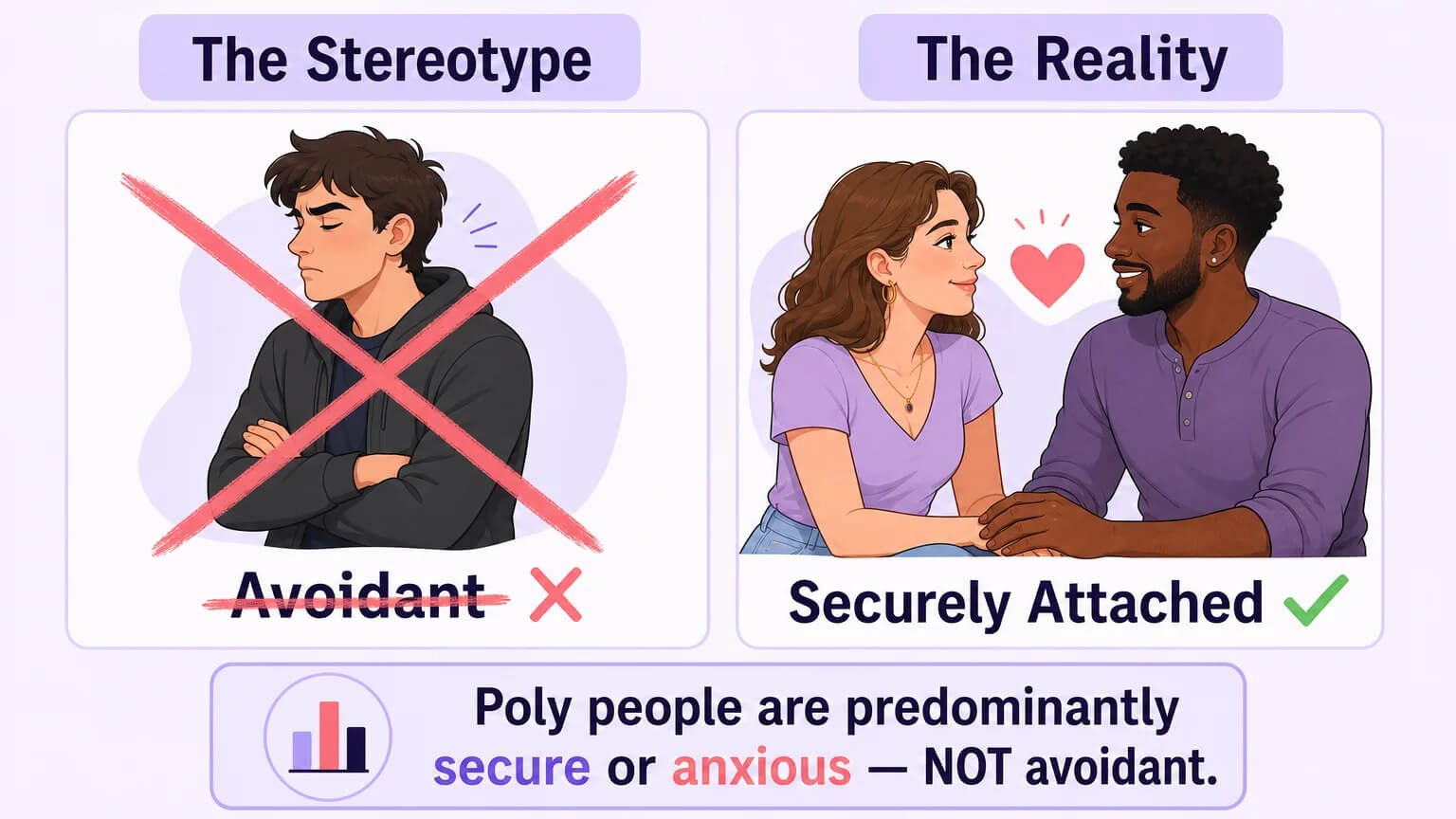
The most persistent stereotype about polyamorous people is that they’re afraid of commitment, allergic to intimacy, or too emotionally damaged to do the real work of a relationship. The research tells a different story.
When psychologists Katz and Katz analyzed attachment patterns in polyamorous populations in 2022, they expected to find high rates of avoidant attachment. That’s the attachment style characterized by discomfort with closeness, difficulty trusting others, and a tendency to keep partners at arm’s length. It seemed like the obvious explanation.
Polyamorous people are predominantly securely or anxiously attached. The avoidant ones, it turns out, are mostly at home thinking about non-monogamy. The people actually doing it, and making it work, tend toward secure attachment.
An earlier study by Moors and colleagues found that people engaged in consensual non-monogamy actually report lower levels of attachment avoidance than monogamous individuals. The people successfully practicing polyamory are more comfortable with intimacy and trust, not less.
Moors later studied 357 polyamorous people with at least two concurrent partners and discovered that attachment orientation can vary across partners. Someone can be securely attached to Partner A and anxiously attached to Partner B, and the anxiety with one doesn’t spill over into the other. Each relationship functions independently.
Non-hierarchical polyamory, where no partner is designated as primary, showed the highest attachment security across all partners. Hierarchy introduces structural uncertainty for secondary partners that can amplify attachment anxiety.
The takeaway isn’t that polyamorous people have transcended insecurity. It’s that polyamory requires substantial emotional investment, communication skill, and the ability to maintain trust across multiple relationships. That’s not less commitment. It’s commitment distributed differently, and it takes real work.
They Feel Joy, Not Just Jealousy, When Their Partner Loves Someone Else
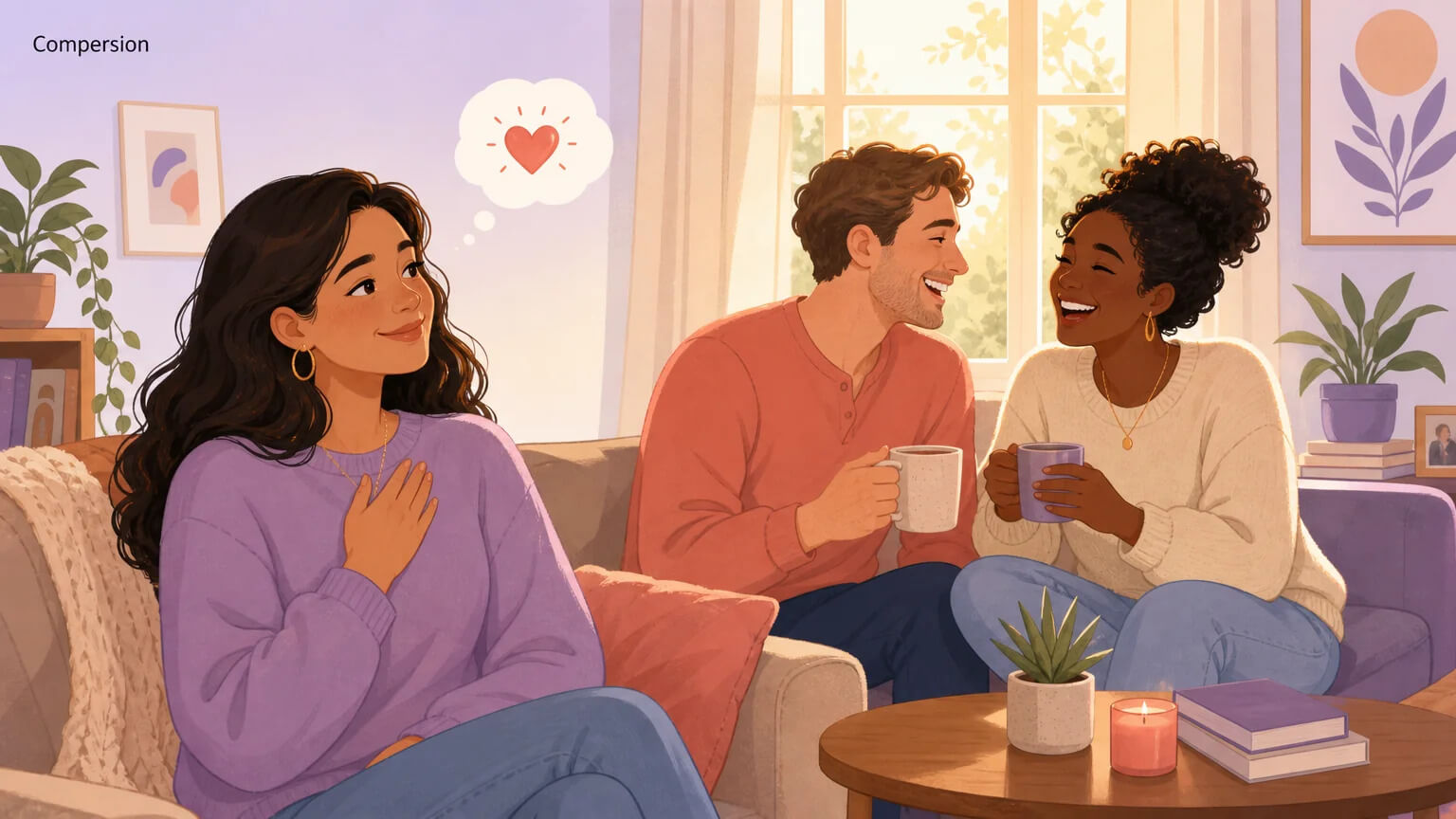
If you’ve only ever experienced relationships through a monogamous lens, the idea of feeling happy about your partner being with someone else might sound impossible. But there’s a word for this emotion, and researchers have been studying it systematically.
Compersion is the experience of positive emotion in response to your partner’s relationship with another partner. It isn’t the absence of jealousy, and it isn’t the opposite of it either. The two emotions can coexist. You can feel a pang of jealousy and genuine happiness for your partner in the same moment.
The first standardized measurement tool, the COMPERSe scale, was published in 2021. It identified three dimensions of compersion: happiness about your partner’s connection with someone else, excitement for new relationships entering the picture, and even sexual arousal from your partner’s other relationships.
A large 2021 study surveyed over 3,500 polyamorous people and confirmed that compersion and jealousy operate independently. People who scored high on compersion didn’t necessarily score low on jealousy. The two emotions sit side by side, and both can be present in a healthy polyamorous dynamic.
Cognitive empathy appears to be the strongest predictor of compersion. People who can vividly imagine and share in another person’s emotional experience are more likely to feel joy rather than threat when their partner connects with someone else.
Compersion isn’t required for successful polyamory. Plenty of polyamorous people experience it rarely or not at all. But its existence challenges the assumption that non-monogamy is fundamentally about tolerating pain. For some people, the real surprise wasn’t that they could handle the hard emotions. It was that they discovered a positive emotion they didn’t know existed.
For Neurodivergent People, Polyamory Often Feels Like the Most Natural Relationship Structure
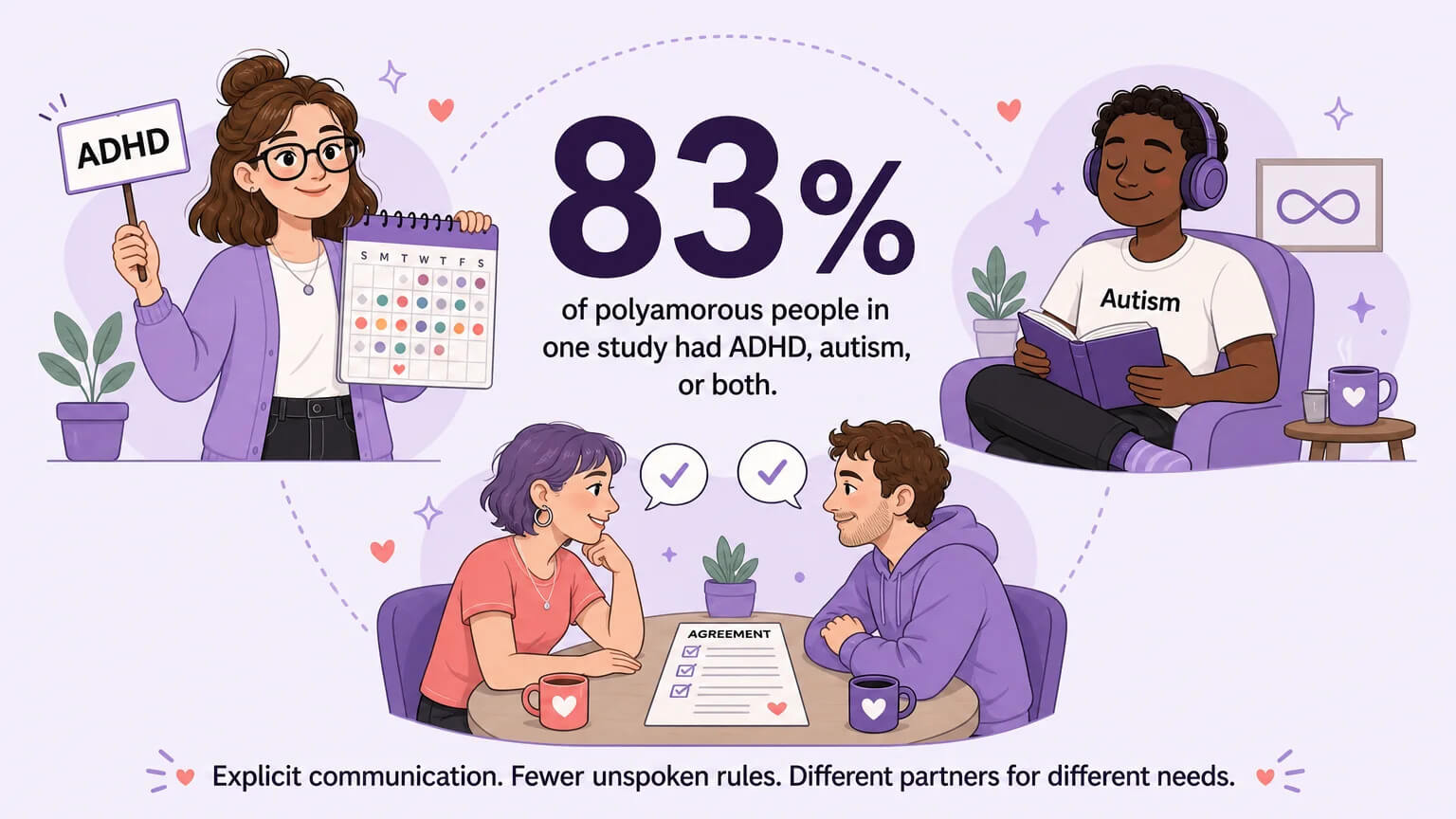
A French doctoral study from 2024 found that 83 percent of its polyamory research sample had either an ADHD diagnosis, an autism diagnosis, or both. The connection isn’t random, and it’s not about causation. It’s about fit.
Therapist Maya Attia, who specializes in the intersection of neurodivergence and ethical non-monogamy, puts it this way: if your brain already works differently from what society expects, exploring alternative relationship structures feels like a natural extension. Neurodivergent people spend their lives questioning defaults that don’t fit them. Relationship structure is just another default to examine.
There are more specific reasons the overlap exists. Consensual non-monogamy communities place enormous emphasis on explicit communication and clearly stated boundaries. There are fewer unspoken social scripts to decode. For autistic people who find implicit social rules exhausting, and for ADHD people who benefit from directness, this can feel like relief rather than restriction.
Different partners can also meet different needs. One shares your special interest. Another provides physical comfort. Another brings novelty and spontaneity. In a monogamous framework, having diverse relational needs can feel like being too much or not enough. In a polyamorous framework, it’s an asset. You’re not asking one person to be everything.
The challenges are real. Multiple relationships mean multiple calendars, a genuine executive functioning demand for ADHD brains. Social energy management across partners can contribute to autistic burnout. Rejection sensitivity, common in ADHD, can amplify the emotional stakes. But for many neurodivergent people, the structural fit outweighs the logistical complexity.
Not Every Reason to Try Polyamory Is a Good One, and That’s Worth Saying Out Loud
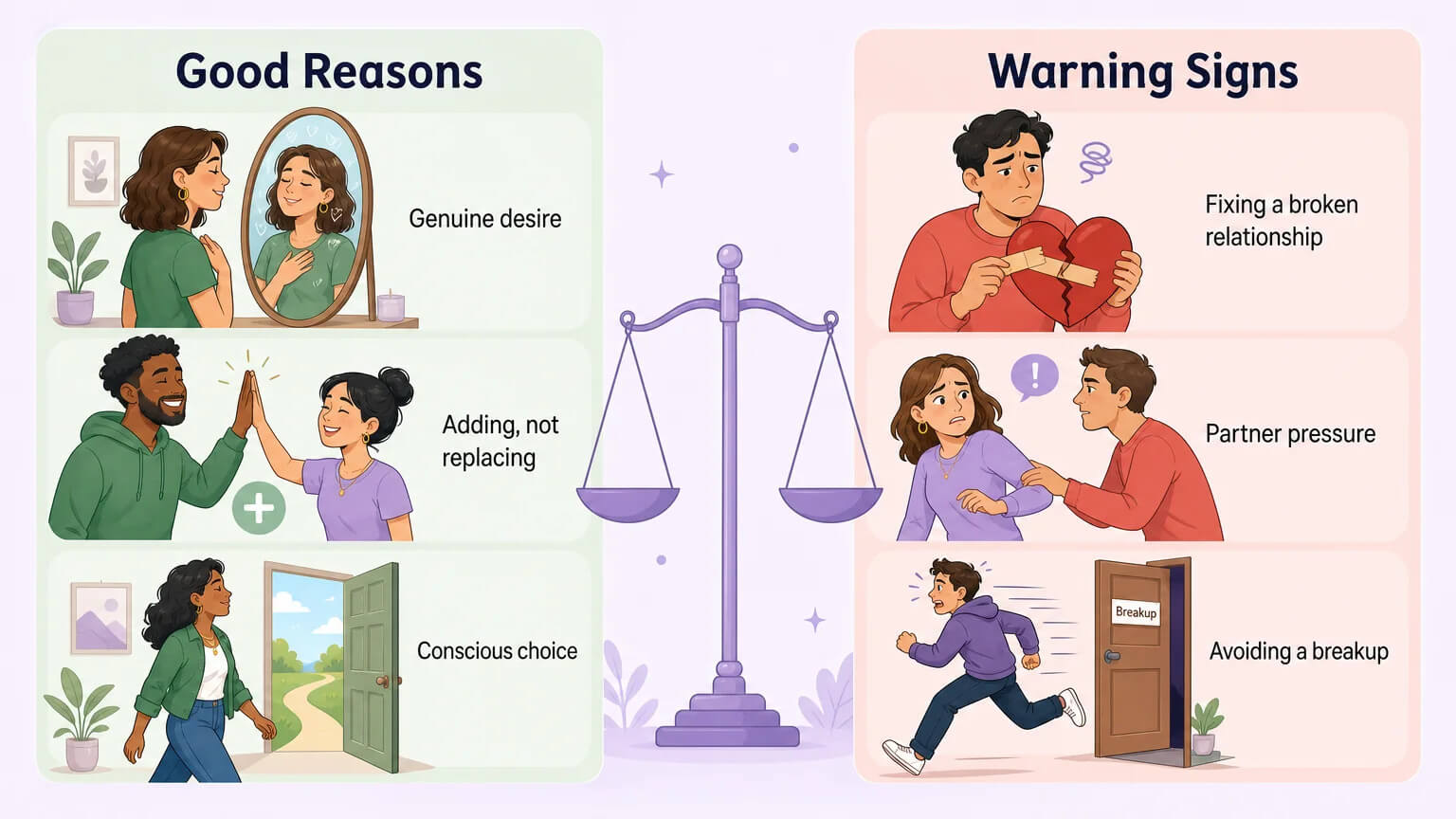
An article that only lists benefits eventually stops sounding honest. So here’s the part most polyamory content skips: some people try this for the wrong reasons, and when they do, it usually ends badly.
The research itself flags problematic motivations. Hnatkovicova and Bianchi’s systematic review included a psychodynamic category: narcissism, fear of loneliness, and avoidant attachment as drivers of polyamorous interest. These motivations correlate with poorer relationship outcomes regardless of structure, but polyamory can amplify them rather than solve them.
Some people open their relationship because it’s already broken and they’re hoping new partners will patch the cracks. This almost never works. Polyamory magnifies existing relationship problems. Communication gaps become chasms. Unresolved trust issues become emergencies. A relationship struggling under the weight of two people’s needs does not get easier when you add a third person’s needs to the equation.
Some people agree to polyamory because a partner pressured them into it. That’s not ethical non-monogamy. That’s duress. The research consistently shows that polyamory pursued under pressure predicts poor outcomes for everyone involved.
Some people use polyamory to avoid breaking up, stretching a relationship past its natural endpoint by outsourcing the parts that aren’t working. This delays the inevitable and usually makes the eventual ending messier.
A poly-affirming therapist will tell you the same thing a monogamy-affirming therapist will: the structure isn’t the issue. The motivations are. Good reasons feel like genuine desire, not an escape hatch. They feel like adding something, not replacing something. And if you’re agreeing because you want to, not because someone talked you into it, you’re probably on steadier ground.
FAQ
Is polyamory just cheating with a different name?
No. The defining difference is consent. In polyamory, all partners know about and agree to the arrangement. Cheating requires deception. As researcher Riki Thompson puts it, ethical non-monogamy means everybody’s aboveboard. The ethical framework, not the number of partners, is what distinguishes the two.
Do polyamorous people get jealous?
Yes. They also experience compersion, the feeling of joy in a partner’s other relationships. These emotions can coexist. The goal in polyamory isn’t eliminating jealousy. It’s learning to process it constructively rather than letting it dictate behavior.
Is polyamory just a trend?
The data suggests it’s an enduring shift, not a passing fad. Openness to Experience, a major personality trait, has been rising across generations for decades. More than half of adults under 30 accept open marriage. Dating apps have integrated non-monogamy features. The cultural trajectory points toward normalization, not regression.
Are polyamorous relationships as satisfying as monogamous ones?
Research says yes. A study in the Journal of Sex Research found that people in consensually non-monogamous relationships report similar levels of relationship satisfaction, commitment, and trust compared to monogamous individuals. Some studies suggest the variety of connections can lead to greater fulfillment, though this varies by person and relationship quality.
Can polyamory work long-term?
Yes, though it demands ongoing communication work. The research shows long-term polyamorous relationships can be as stable as monogamous ones when practiced with clear communication, consent, and mutual respect. The structure isn’t what predicts longevity. The skills of the people in it do.
What’s the difference between polyamory and an open relationship?
Polyamory involves the potential for multiple romantic and emotional connections, not just sexual ones. Open relationships typically refer to a sexually non-exclusive partnership where the primary relationship remains the only romantic connection. Swinging focuses on couples engaging sexually with other couples. These exist on a spectrum. Some people’s actual practices blur the boundaries between them.
What if my partner wants polyamory and I don’t?
This is a fundamental compatibility issue, as significant as disagreement about having children. Don’t agree under pressure. The research is consistent: polyamory pursued under duress rarely produces healthy outcomes. A poly-affirming couples therapist can help you both navigate the conversation, but incompatible relationship structure preferences are not something you can compromise on by splitting the difference.