
In today’s polyamory relationship series comes to quad polyamory.
Picture two couples around a dinner table. They share a mortgage, a calendar, a bed rotation, and a future they are building together. They are not two relationships that happen to coexist. They are one relationship with 11 living, breathing pieces: six dyads, four triads, one full-group dynamic. Tension in one corner travels. Joy in another amplifies.
This is a quad polyamory relationship. Most people have never heard the word. Those who have usually picture chaos. The reality is quieter than the fantasy, harder than the stigma, and, for the people who make it work, more nourishing than any other structure they have tried.
This is not a sales pitch. It is a map. Whether you are a couple curious about expanding your dynamic, a single wondering if this shape could hold you, or someone who heard the word at a party and wants the real architecture: here is what actually matters. The structural realities. The predictable failure patterns. The communication habits that keep four people aligned when feelings shift. The uncomfortable parts most guides skip. No jargon. No judgment. Just what happens when four people try to build something bigger than two.
What a Quad Actually is: the Structural Anatomy
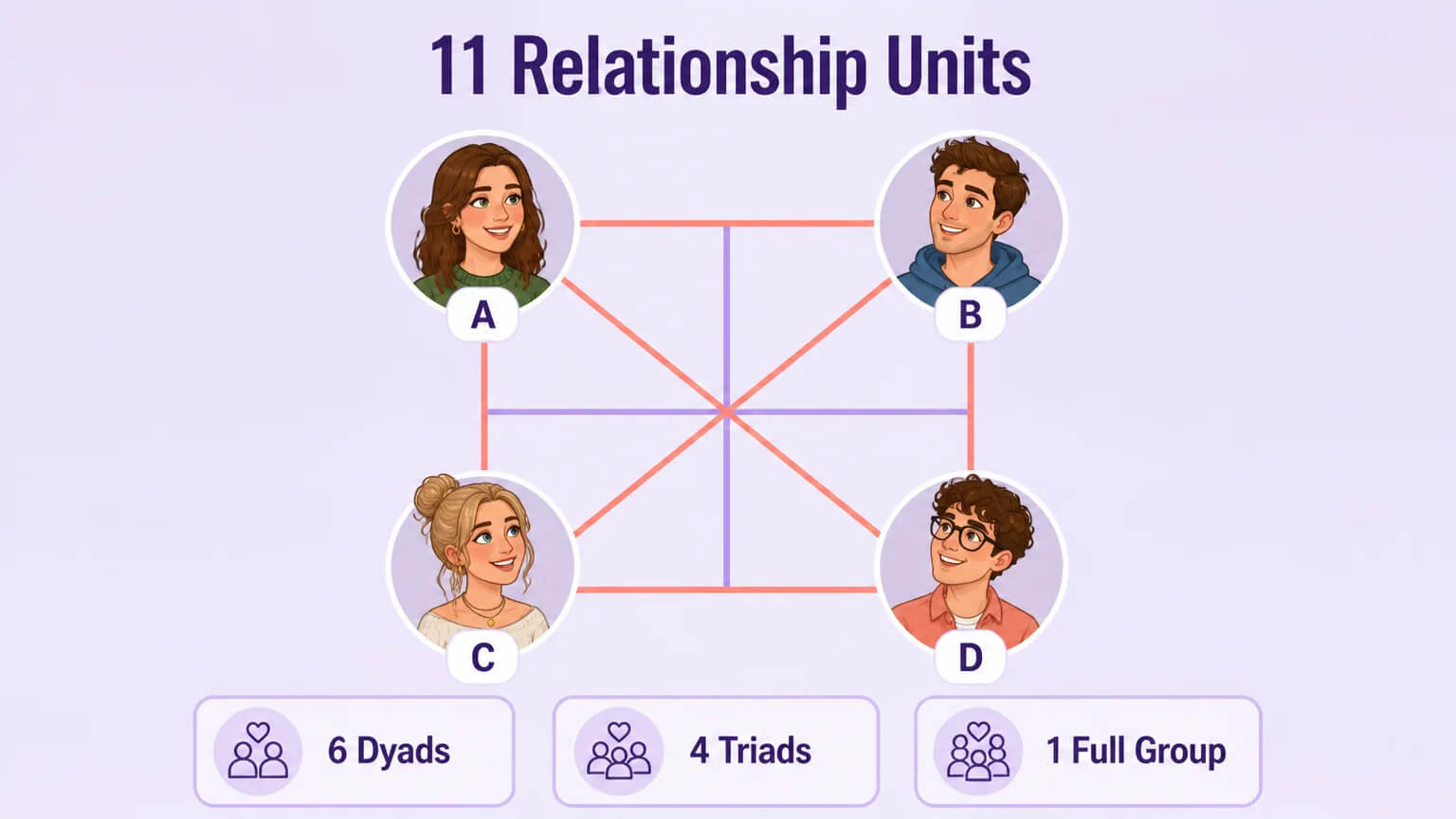
A quad is not one relationship. It is also not four. It is 11 distinct relationship units: six dyads, four triads, and one full-group dynamic. Each one is alive, shifting, and demanding its own care.
That number explains nearly everything about why quads feel overwhelming at first, and why the ones that last all have explicit infrastructure. When you feel something toward one partner, that feeling does not stay in one dyad. It travels. Your mood with A shapes how you show up with B, which affects B’s dynamic with C, which shifts how C engages with D. The system never stops moving.
Two independent dimensions define any quad, and people confuse them constantly. The first is internal wiring: “full” versus “partial.” A full quad means every member is romantically or sexually connected to every other member, all six dyads active. A partial quad means some of those connections are inactive by choice, not by failure. The second is boundary policy: “closed” versus “open.” A closed quad is sexually and romantically exclusive to the four. An open quad allows connections beyond the group.
These dimensions do not depend on each other. A quad can be full and open. Partial and closed. Any combination. Most quad pain comes from assuming one configuration is the real one and pressuring people into connections they do not feel.
Consider the TLC Polyfamily quad: two married couples, closed boundary, the men switch bedrooms nightly but do not date each other. Three of four members are straight. That is partial wiring with a closed boundary. It is still a quad. It works because nobody is pretending.
The structure serves the people. When people serve the structure, it breaks.
The Many Shapes of Four: Quad Configurations That Actually Exist
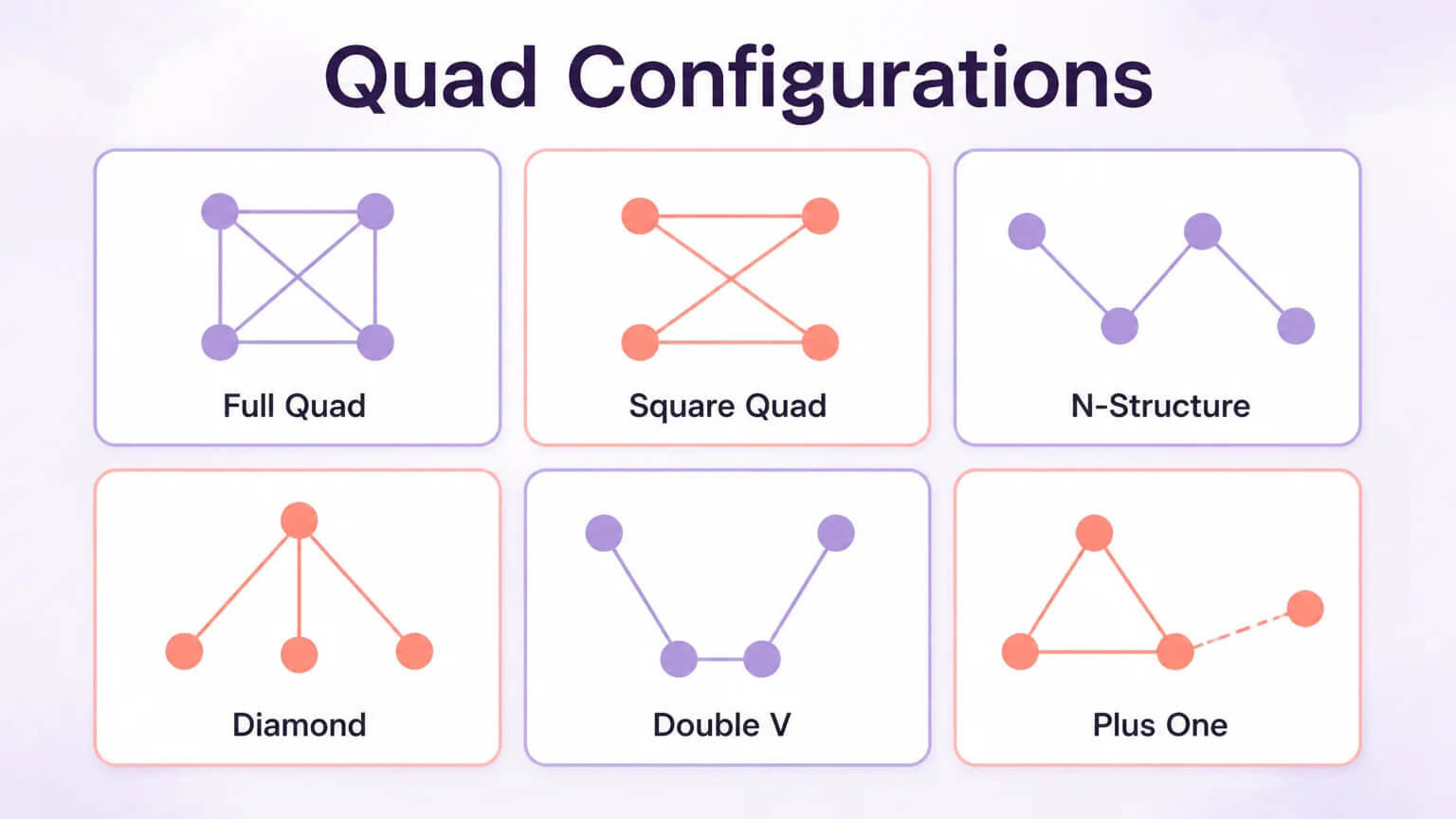
Most real-world quads are not the Full Quad fantasy. The Full Quad, with all six dyads romantically and sexually active among all four members, is the most demanding configuration and the rarest to form organically. Beautiful idea. Very heavy lift.
The Square Quad is far more common: two couples with cross-connections between them, typically four or five active dyadic bonds, everyone with at least two intimate connections. This is where most real quads land.
The N-Structure runs like a chain: A dates B, B dates C, C dates D. Not everyone is connected. That is the point. Linear, not dense.
The Diamond places one person at the center, connected to the other three. Those three may or may not share connections among themselves. The center person carries a different weight, and pretending otherwise is its own kind of structural lie.
The Double V: Person A dating B and C, Person D also dating B and C. B and C do not date each other. A and D do not date. Two Vs sharing a base. Simple on paper, delicate in practice, because B and C become the hinge and every shift travels through them.
The Plus One is a triad with an external partner connected to one or more members of the core three. The “plus one” is not an accessory. They are a full member.
None of these shapes is more evolved than another. A Square Quad where four people genuinely want to be there beats a Full Quad where two people are performing desire they do not feel, every single time.
If you are the single joining an existing three, your voice carries equal weight. The shape forms around everyone in the room. “What do we actually want?” beats “What configuration are we supposed to be?”
Quad vs. Swinging: Two Different Emotional Languages
Nearly every swinging-to-quad story contains some version of the same line: “We didn’t intend to fall in love.” It is one of the most common formation paths and one of the most reliable collapse points. The emotional ground shifts under your feet, and most people do not notice until the foundation is already cracked.
Swinging and quad polyamory run on different emotional hardware. Confusing them is where most quads break before they begin.
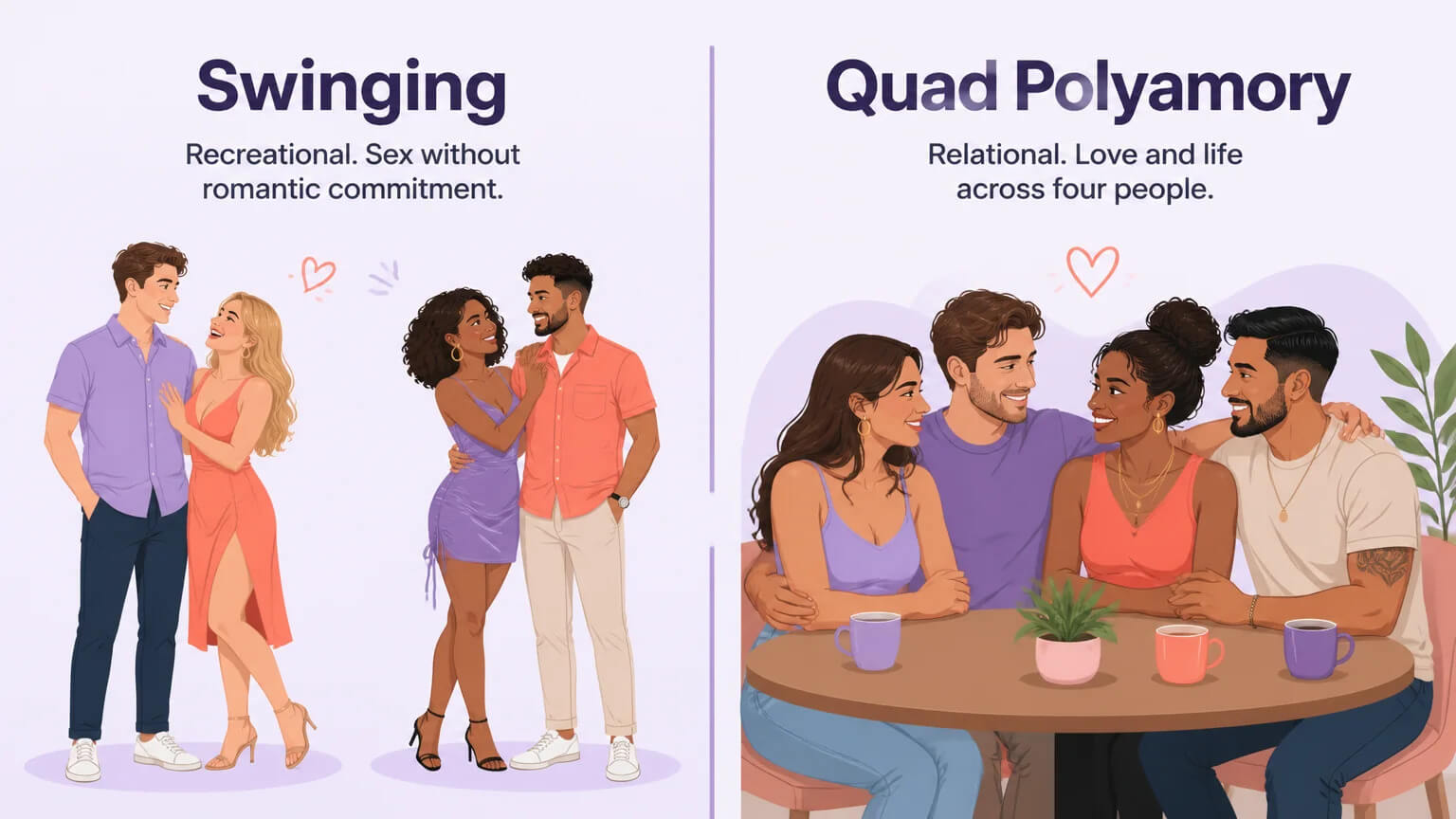
Swinging is recreational. Two couples share sexual experiences while the primary emotional bond stays anchored to the original partner. Sexual variety layers on top of a dyadic foundation. The container is the couple. The contents vary. Emotional exclusivity stays intact even as physical experiences expand.
Quad polyamory is relational. Romantic commitment and emotional intimacy extend to additional partners. You build a life that includes them: calendars, holidays, medical decisions, the unglamorous logistics of existing together across time. The emotional foundation expands to hold four people, not two.
When couples stumble into romantic feelings without recognizing the structural shift, they end up running quad emotional hardware on swinging’s toolkit. No RADAR check-ins. No de-escalation protocols. No framework for telling the difference between “I am jealous you enjoyed sex with them” and “I am jealous you are building a life with them.” Those are not the same emotion. The toolkit for the first does not touch the second.
That gap is where quads collapse. Not because four people cannot love each other. Because nobody updated the system.
If you are a couple developing real feelings for another couple, missing them between events, texting about your day, imagining a shared future, you are already in quad territory whether you have named it or not. Time to build the right container for what is already happening.
The Case for Four: What Quads Actually Deliver
Most people hear “four-person relationship” and think complexity. Fair. Nobody who has lived inside a quad would claim it is simple. But the complexity buys you something you cannot get any other way.
Emotional support redundancy comes first. You have three people who know you intimately, each bringing different strengths. When one partner is not the right person for a particular kind of support, another often is. As one quad member put it, having “four different strengths when it comes to meeting needs” removes the crushing pressure of expecting one person to be everything. That pressure breaks dyads every day. In a quad, it spreads across more shoulders.
Then there is the shared load. Four adults raising children. Four incomes. Four sets of hands when someone is sick, exhausted, or simply done. The TLC Polyfamily quad parents five children across four adults. The Baltimore quad splits all household bills equitably by income. The math of shared living is not romantic, but it is one of the quietest, most durable benefits of a functional quad.
Sexual variety inside emotional security is the benefit people expect. Novelty and exploration happen inside a committed container where you are known, loved, and safe. Different partners bring different chemistry, different dynamics, different ways of being intimate. You do not have to choose between adventure and stability. The quad holds both.
Compersion, the joy of seeing a partner experience joy with someone else, operates across six dyads at once. When it clicks, it is not “I am happy for you.” It is “I am genuinely happier because all four of us are thriving.” The quad together four years, posting in May 2025, captured it simply: “Still together. Still happy. Still us.”
None of these benefits are automatic. They require the structure the next section describes. Without it, the math flips the other way fast.
The Hard Parts: What Actually Breaks Quads
Quads do not fail because people are bad at relationships. They fail because four people and 11 relationship units amplify normal challenges into crisis. When one unit strains, every other unit feels it. That is not a metaphor. That is the geometry.
Asymmetrical connection is the first thing that breaks. One dyad deepens faster than the others. The people in that dyad feel pressure to slow down, to pace themselves to someone else’s timeline. The people not in that dyad feel pressure to catch up, to manufacture feelings that are not there. Both resent it. One experienced quad member described the pressure to artificially restrain a flourishing connection: “Stepping back is deliberately artificial. It is like faking an orgasm to boost someone’s ego.” Forced symmetry does not solve insecurity. It builds resentment toward the person whose insecurity is being prioritized, and toward the structure that demands the performance.
Couple privilege is the second fault line, and the one most quads are least willing to name. When a quad forms from two pre-existing couples, the original dyads retain implicit power: legal marriage, shared finances, nesting rights, social legitimacy, decision-making priority. Even when everyone claims egalitarianism, structural advantages create a two-tier system. The standard is not “try to be fair.” It is “aggressively dismantle couple privilege through intentional protocol design.” That is not hyperbole. It is the minimum for the quad to function.
Polyfidelity pressure is the third pattern. Closed quads create what one analyst calls a “high-pressure erotic ecosystem.” All sexual needs must be met internally. Libido mismatch, a normal variation, becomes a structural crisis with no ethical outlet. Members may feel obligated to perform sexually for group harmony. Performance is not consent. It is the prelude to resentment, and resentment kills quad relationships quietly, from the inside.
The cascade is the fourth. Because all six dyads are interdependent, one failing connection does not fail in isolation. If A breaks up with B but A still dates C who dates B, the resulting strain destabilizes every other connection. The quad does not break one bond at a time. It fractures in webs.
These patterns are known. Quads that survive implement weekly dyadic time audits, regular full-group check-ins, and quarterly boundary reviews. The question is not whether these challenges will appear. They will. The question is whether you have the protocols to meet them when they do.
How Quads Actually Form: the Paths That Work and the Ones That Do Not
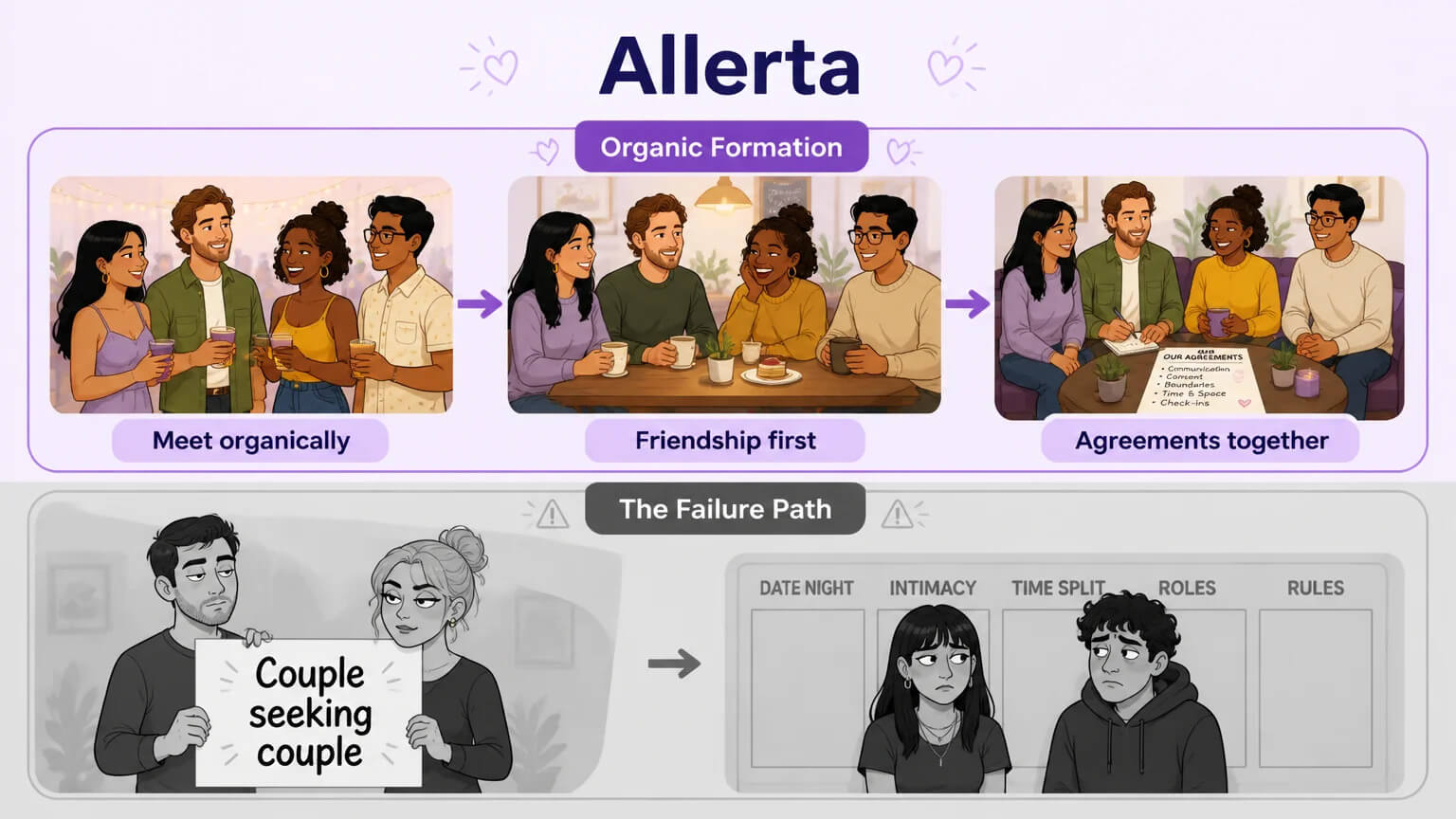
Couples who successfully form quads almost never set out to find one. Matt and Bianca met their partners at a lifestyle takeover. The Baltimore quad met on Twitch in 2020 and moved in together two years later. The Polyfamily quad met at a pool party. None of them posted “Couple seeking couple for closed quad.” None of them were shopping.
The organic path follows a recognizable rhythm. Two couples meet with no agenda. Cross-couple chemistry emerges: genuine interest in each other as humans, not just sexual curiosity. Attraction gets named internally first, then with the original partner. This is the hinge: someone says “I have feelings for them” and their partner receives that without panic.
Group hangs increase. Friendship builds before anyone discusses formal structure. This is the step people skip when they are in a hurry, and skipping it is how you build a quad on attraction that has never survived an ordinary Tuesday dinner. After friendship is real, agreements get negotiated, together, all four voices equal. Check-ins start from day one, not day 100 when something is already breaking.
The failure path is the mirror image: “Couple seeking couple.” The language treats people as components. It imposes a template on human beings who have not met. It pressures attraction to arrive on a schedule. Couples who set out to “find their quad” are not looking for people. They are looking for actors to fill roles in a script they already wrote. That script has never produced a quad that lasted.
If you are a single joining an existing three, the ethical test is one question: “Can I say no to any individual connection without losing access to the others?” If the answer is no, the structure is not ready for you. Desire requires no apology. Neither does its absence. Not an enthusiastic yes from everyone means a hard no.
The essentials: strengthen your existing relationship first, meet people organically, let friendships form before naming anything, name attraction before acting on it, maintain transparency, start check-ins from week one. Never require equal pacing. Feelings do not keep a schedule.
The Communication Engine: Frameworks That Keep Four People Aligned
Every important decision in a quad touches at least four relationships. A and B argue. A’s mood hits C, who mentions it to D, who brings it up with B. A dyadic conflict becomes a quad event. This is the structure, not a bug. The question is whether you have protocols or you are improvising with four people’s emotional wellbeing on the line.
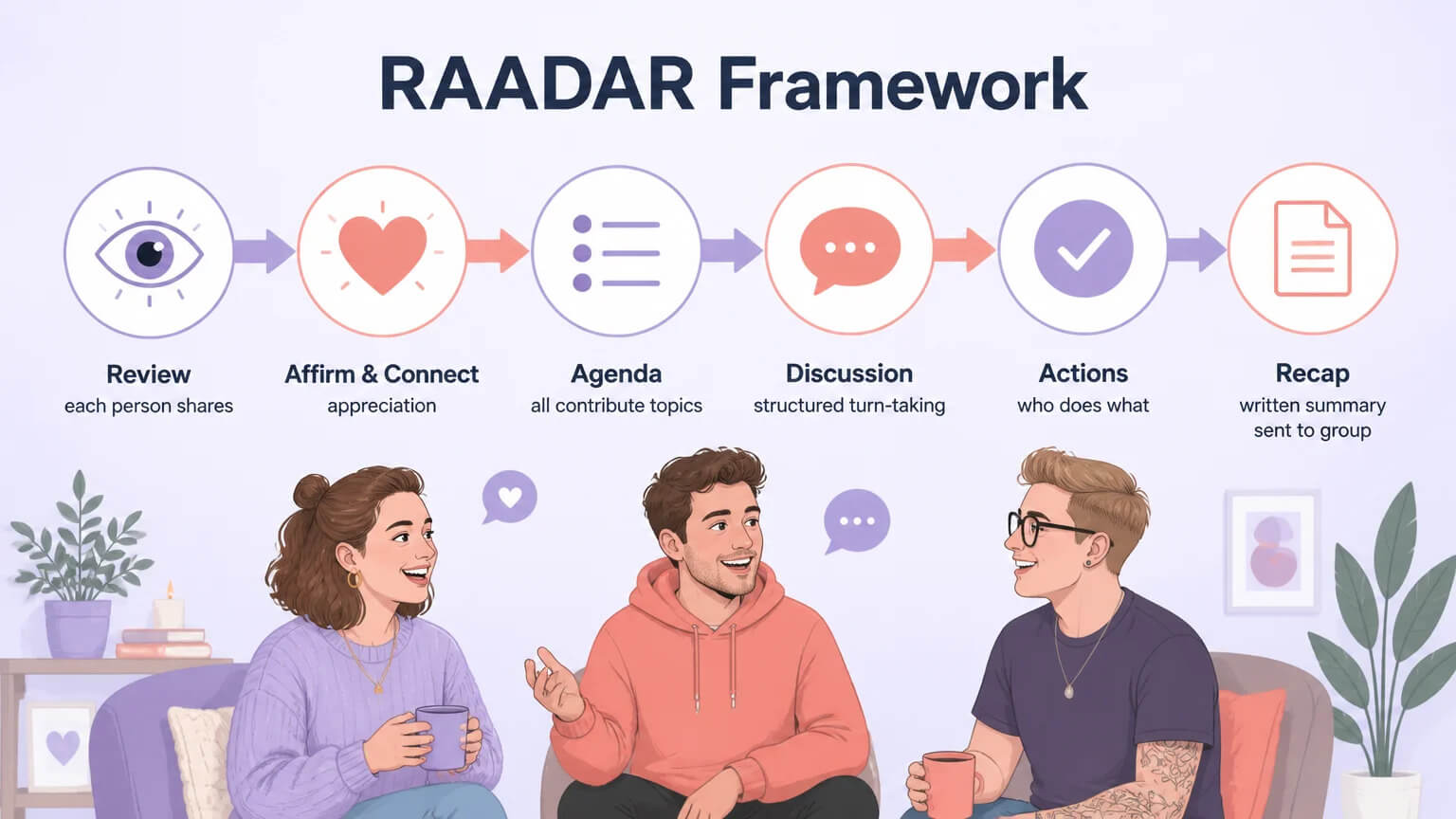
RADAR is the framework that shows up across nearly every quad longevity story. Created by the Multiamory podcast, it stands for Review, Agenda, Discussion, Actions, Recap. It is a container that makes hard conversations survivable when four people’s needs, fears, and resentments share one room.
Adapted for quads, the expanded version is RAADAR. Review: each person shares how they have been feeling since the last check-in, one at a time, no interruptions. Affirm and Connect: each person offers genuine appreciation for something specific about each of the other three. Hearing you are valued before hearing something difficult changes what you can absorb. Agenda: all four members contribute discussion topics, written down so nothing disappears. Discussion: structured turn-taking through each item. Use a timer if one voice dominates. In a quad, the quietest member often carries the heaviest weight unspoken. Actions: specific next steps, who does what by when. Recap: one person summarizes, sends it in the group chat, and the role rotates each time.
Some operational basics. The group chat is for transparency: no private DMs about quad business without disclosure. Each dyad gets dedicated one-on-one time, non-negotiable. The shared calendar doubles as an equity audit: if one dyad consistently gets Saturday nights while another gets Tuesday lunch breaks, the calendar is telling you something.
Jessica Fern, author of Polysecure, notes that an anxiously attached person in a quad faces three abandonment vectors instead of one. Without explicit protocols as external scaffolding, that person’s attachment system stays in constant low-grade alarm. RADAR is not emotional theater. It is scaffolding.
New quads need RADAR weekly. Established quads can shift to bi-weekly. The framework is free. The Multiamory book is about twenty dollars. It is the most-recommended tool across every quad longevity story and the most frequently skipped one by quads that do not last.
When the Shape Shifts: Change, Loss, and De-escalation
Quads change shape. One dyad ends. Someone realizes they want outside partners. The quad was right for a season and is not anymore. None of this is failure. It is relationship evolution. But without de-escalation protocols, evolution becomes collapse.
The most common shift: one dyad ends while remaining connections survive. Three things make this survivable. Acknowledge grief without making it everyone’s problem: the two people whose dyad ended need space; the others need to resist mediating, fixing, or taking sides. Renegotiate structure explicitly: old agreements were built for the old shape, and what emerges needs its own. Resist all-or-nothing thinking: an N-structure or Double V is not a consolation prize. It is a valid outcome that preserves what can survive.
When someone leaves entirely, they are not the villain. They are making an honest choice about what they can sustain. The ethical response is grief without punishment. Punishing honest limits is how quads become nightmares. The people who stay need to ask: can the remaining three function as a triad? Can two couples coexist as close friends without the romantic architecture? The shape changes. The people do not have to be enemies.
Sometimes the shift is toward openness. A closed quad opens. This transition needs the same structural care: name it, affirm the connections not being threatened, write new agreements, check in more frequently during the transition, resist framing one person’s desire for expansion as a betrayal.
Ambiguity is what kills quads during transitions. The fix is explicit de-escalation protocols, written when things are good so they are ready when things are hard. This is not pessimism. It is the same logic as a prenup. You do not write one because you expect the relationship to fail. You write one because you respect what is at stake.
FAQ
What is the difference between quad polyamory and swinging?
Swinging is recreational sex between couples who maintain emotional exclusivity with their original partner. Quad polyamory builds romantic commitments across four people: emotional intimacy, shared life planning, long-term investment. Many quads start as swingers who caught feelings they did not plan for. If you are asking because something has shifted, name what is happening before the structure outruns your agreements.
Do all four people have to be romantically or sexually involved?
No. Most functioning quads are not full quads. The Square Quad, two couples with cross-connections, is the most common and most stable. What matters is that every connection is authentic and voluntary. Pressuring attraction that is not there is the fastest route to resentment. Partial configurations are not less-than. They are often more sustainable.
What is couple privilege, and how does it damage quads?
Couple privilege is the implicit power advantage retained by original couples: legal marriage, shared finances, decision-making priority, veto power over cross-relationships. It creates a two-tier system where two people hold the keys and the other two hope the doors stay unlocked. Addressing it requires explicit agreements giving all four members equal say in structure-defining decisions, plus regular audits of how power actually flows, not just how people say it flows.
How do you handle jealousy in a quad with four people?
Jealousy in a quad is normal. Experienced members describe it as expected, not failure. Name it openly without shame. Understand what is underneath: abandonment fear, comparison, FOMO, the ache of feeling deprioritized. Ensure equitable one-on-one time across all dyads. Use structured check-ins to surface jealousy before it hardens into resentment. Suppressing it is what makes it destructive. The most attractive thing you can bring into a quad is absolute clarity about what you are feeling.
Can children thrive in a quad family?
Existing examples suggest yes, under clear conditions. The TLC Polyfamily quad raises five children with this approach: “Treat them like you treat us, like parents.” What matters: honesty with children about the family structure, consistent parenting across all four adults, protecting kids from external stigma. The real challenge is rarely the children’s adjustment. Kids adapt to the family they have. The challenge is the social pushback: accusations of confusing children, family rejection, navigating schools with no framework for four-parent households.