
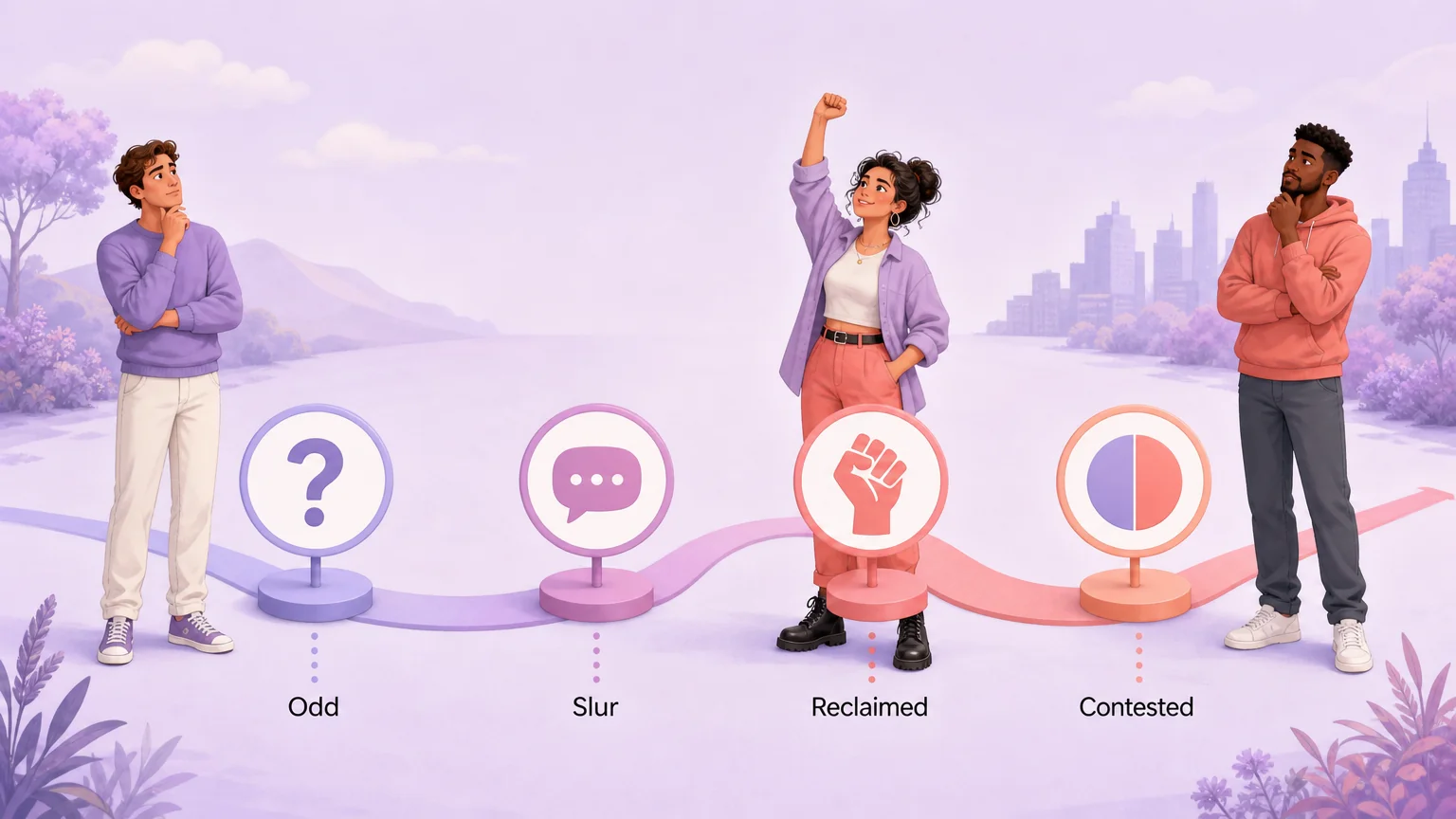
Queer quotes carry a history in the word itself. For centuries, queer meant odd, strange or unwell, long before it became a slur and then a self-description. That history is why a sentence filed under the word can turn out to be about a strange afternoon instead of a life.
This collection keeps the word for lines about queer identity, desire, friendship, family and selfhood. The shelves are arranged by what you need them for, not by fame or by decade: a short line for a caption or a bio, love that has lasted, desire and new love, coming out, Pride and freedom, friendship, longer passages with room to breathe and endings. Some are for a partner, some for a friend, some for a funeral and some for a sentence about yourself.
Every quote carries its speaker, the work it came from and the year wherever the year is confirmed. Where a line is commonly credited to the wrong person, the page names the right one. A quotation is only useful if you can put your name under it without wincing.
1. Short Queer Quotes for Captions, Bios, and Tattoos
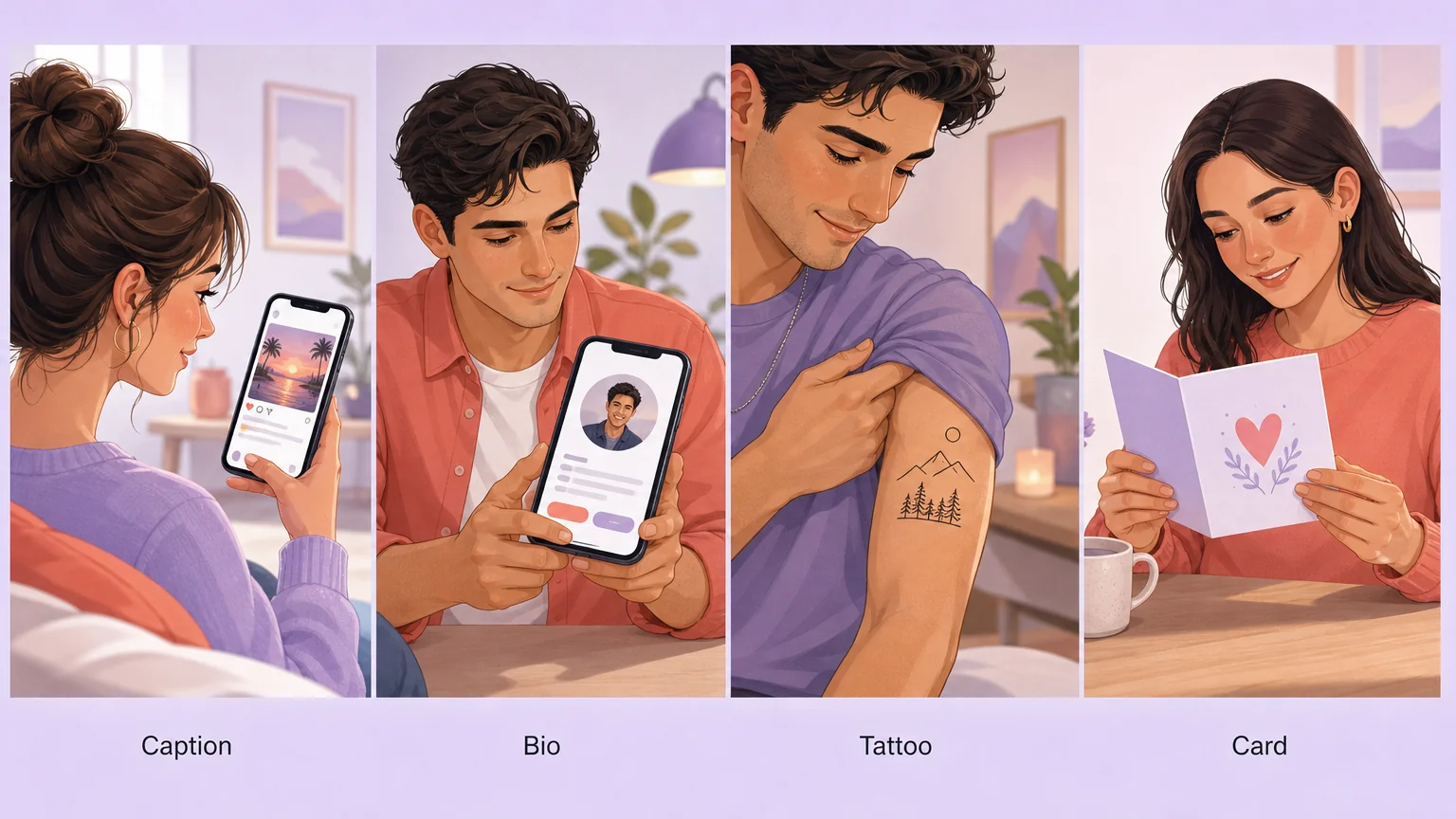
These are the lines that still work when everything around them is cropped away. A caption has room for one clause. A bio has room for less. If a line needs the line before it to make sense, it is not a caption yet. The passages that need their full sentence belong near the end.
“Every time we kiss / we confirm the new world coming.”
Essex Hemphill, “American Wedding,” Ceremonies (1992). Hemphill, the Black gay poet and AIDS activist, turns a private kiss into a public claim, and the poem it comes from is a marriage vow aimed at a state that did not recognize same-sex marriage. For a wedding post, an anniversary caption or the first line of a speech, this is the one.
“I give you my heart, / a safe house.”
Hemphill again, same poem. The metaphor is plain and complete: eight words carry the whole arrangement of trust. No ornament, no hedging. It works on a card or in a short bio without explanation.
“The process of through is ongoing.”
Miller Oberman, “On Trans,” Poetry (March 2015). Oberman, a trans poet and translator, gets an entire transition into six words, with no arrival and no ceremony. Nothing in it promises an endpoint. That suits a life still in progress. A bio line or a tattoo.
“Permit me voyage, love, into your hands …”
Hart Crane, “Voyages III,” White Buildings (1926). Crane, the gay modernist, is formal and brief here, and the poem is in the public domain. Two commas and a verb of permission do all the work. It fits a card or a vow.
“To love oneself is the beginning of a life-long romance.”
Oscar Wilde, “Phrases and Philosophies for the Use of the Young,” The Chameleon (1894). This is the Wilde line worth keeping, hyphen and all. The famous one about being yourself, with everyone else already taken, has no home in his published work. The FAQ explains where it came from.
The cutting rule: take the shortest extract that still carries the turn. If the turn needs the sentence before it, this is the wrong shelf.
2. Queer Quotes for the Love That Lasted

Anniversary cards are fluent in new love and quiet about everything after it. The love that has already survived a decade of laundry, a shared bathroom, a body that changed and several arguments about dishes has less language available. These lines are for the long haul. They are specific, unsentimental and warmer for it.
“I love you until the moment you flush the toilet, then I say it, when the rumble of water running down through the house could mean anything”
Carl Phillips, “Domestic,” Cortège (1995). Phillips, a gay poet and former U.S. poet laureate, lets the joke carry the tenderness, and the tenderness is what lands. It earns its place on an anniversary card, or in a caption that refuses to be solemn.
“I’m immoderately in love with you, knocked out by all your new white hair”
Eileen Myles, “Peanut Butter,” Not Me (1991). Myles, a lesbian poet, writes about middle-aged, unglamorous and specific love in a way that most love poems do not. Save it for the partner who has been there long enough to go gray.
“Parts of your body I think of as stripes which I have learned to love along.”
Myles again, same poem. This is love as accumulated knowledge rather than surprise, the body read like a map you have walked for years. A vow renewal or a quiet caption.
“It was not sex, but I could feel / The whole strength of your body set, / Or braced, to mine”
Thom Gunn, “The Hug,” The Man with Night Sweats (1992). Gunn, a British-born gay poet who wrote through the AIDS epidemic, gives touch after sex in a long partnership, without a single grand adjective. It belongs at an anniversary or in a speech.
“I am amazed by peace / It is this possibility of you / asleep / and breathing in the quiet air”
June Jordan, “Poem for My Love,” Directed by Desire (2005). Jordan, a bisexual poet, essayist and civil rights activist, makes watching someone sleep the most ordinary proof of love there is. A card, a caption, a reading.
“She does not love me less / For her royal, jewelled speechlessness, / She is the sapphire, she the light, / The music in the pearl.”
Michael Field, “Power in Silence.” Michael Field was the joint pseudonym of Katharine Bradley and Edith Cooper, who lived as lovers and wrote together. Quote it as Michael Field, never as one of them. The poem makes silence part of love rather than a failure of it. It suits a long partnership, a quiet anniversary or a reading.
The silence in that last poem is not a lack. After enough years, it is sometimes the line that fits best.
3. Queer Quotes About Desire, First Kisses, and New Love

The second before a kiss is its own genre. So is the week after a first date, when everything is still possible and nothing has been decided. These lines are for a crush, a first date, an engagement or that early stretch when the whole thing is still a question.
“let’s love each other (so good) on the moon, let’s love the moon on the moon”
Chen Chen, “i love you to the moon &,” Poem-a-Day (2021). Chen Chen, a Chinese American poet, makes the joke the point, and the joke is sincere. The title is already in on it. A text, a caption or a card that should not take itself too seriously. Keep the parentheses.
“anything seems possible, so we stop by an ancient cottonwood to kiss.”
Janice Gould, “Six Sonnets: Crossing the West,” Doubters and Dreamers (2011). Gould, a Two Spirit (Maidu/Konkow) poet and scholar, puts a kiss inside a landscape, which is where most kisses happen. The landscape is not scenery; it is what makes the kiss possible. An engagement post or a caption.
“Will these kisses seal her to me? I her lover, she my wife? / Is all of this a dream, my whole life?”
Gould again, same poem. Gould wrote the lines before marriage equality. The question lands differently now. The wife is not a metaphor, and that is the point. A wedding reading or an anniversary.
“Might I but moor – tonight – / In thee!”
Emily Dickinson, poem 269, “Wild nights – Wild nights!”, published 1891 in Poems, Second Series. Dickinson never named her sexuality, so reading this as a woman addressing a woman is an interpretation, not a biography. It is also one of the shortest desire lines in English. The punctuation is doing half the work. The spaced hyphens make the pause audible, so read it with them. Use it, and let the reading stay a reading.
One note on the last line. It is strong enough to carry that reading. Put it on a card because it is a great line, not because it settles anything about her.
4. Queer Quotes for Coming Out and Finding the Words

There is a gap between knowing and saying, and most coming-out language jumps over it. It arrives as a confession or as a victory lap, and neither is much help while you are still standing in the gap. The lines that help are the ones about the period before the words exist.
“My silences had not protected me. Your silence will not protect you.”
Audre Lorde, “The Transformation of Silence into Language and Action,” a 1977 address collected in Sister Outsider (1984). Lorde, who described herself as a “black, lesbian, mother, warrior, poet,” treats speech as survival rather than confession. For a coming-out post or a speech, that is the hard part, said plainly.
“it is not difference which immobilizes us, but silence. And there are so many silences to be broken.”
Lorde again, same address. This is the collective version of the same insight: silence is the barrier, not difference. It belongs in a speech or a post about why coming out is political.
“Something in me knew that I was transgender. It was something I’d always known, but didn’t have the words for, wouldn’t permit myself to embrace.”
Elliot Page, Pageboy (2023). Page, an actor and the author of the memoir, names the before-language stage better than any triumph line does. A message to a younger self or a journal entry.
“I was transgendering and drinking the rough red at roughly the same rate and everyone who looked, saw.”
Miller Oberman, “On Trans,” Poetry (March 2015). Oberman makes transition ordinary, social and witnessed rather than medical, and the wit keeps it from becoming a lecture. A caption or an essay epigraph.
“I don’t call myself a woman, and I know I’m not a man.”
Kate Bornstein, A Queer and Pleasant Danger (2012). Bornstein, a trans writer and performance artist, is plain and first-person here, and the line refuses the binary without a lecture. The memoir is usually cited as the source, not Gender Outlaw, where the line is often filed. Check the wording against the book if you can.
“this book is a lesbian novel and a transgender novel—making ‘trans’ genre a verb, as well as an adjective”
Leslie Feinberg, 2003 Author’s Note to Stone Butch Blues. Feinberg, a trans/butch activist and novelist, shows that one book can belong to two categories at once. It works when a label feels too small: a bio, an essay or a reading-group note.
Choose the line that describes the before, not the after. The before is what someone else is still living.
5. Queer Quotes About Pride, Survival, and Freedom
Start with the correction, because it is the most useful thing on this shelf. The Pride slogan most often attributed to Marsha P. Johnson is not hers. The artist Micah Bazant wrote it in 2013 for a poster celebrating Johnson, and has said they are happy for Johnson to receive the credit. If you use it, credit both: Bazant as the author, Johnson as the occasion. That is how a movement remembers its writers. A movement that mislays its writers will mislay its arguments too.
“So it is better to speak / remembering / we were never meant to survive.”
Audre Lorde, “A Litany for Survival” (1978). Lorde makes survival a fact rather than a plea for sympathy. That is why the line has outlasted so many slogans. It is about having been counted out and speaking anyway. Say it in a Pride speech or put it on a caption.
“I am not only a casualty, I am also a warrior.”
Lorde, “The Transformation of Silence into Language and Action,” 1977, collected in Sister Outsider (1984). This is the one-line rebuttal to pity framing. Pity is not the same thing as respect. Reach for it when a post about struggle starts to sound like a plea.
“No Pride For Some of Us Without Liberation For All of Us”
Micah Bazant, poster for Marsha P. Johnson (2013). Put it on a march sign or a caption, with the credit line above, and keep the capital letters exactly as Bazant set them. It is built to be read across a street.
“queer and trans people … have always been here, will continue to be here … there’s nothing wrong with us.”
Elliot Page, Democracy Now! interview (June 2025). Page, an actor and author, lets the plainness be the argument. A speech or a post that needs to answer a politician without raising its voice.
“It’s not trans people who suffer from a sickness, but the society that fosters such hate.”
Page, Pageboy (2023). This is the public argument in one sentence. It suits a speech or a comment that needs to stay calm while making the point.
When you use the slogan, the credit line is part of the quotation: Micah Bazant, 2013, for Marsha P. Johnson. Author, year and occasion, in that order.
6. Queer Quotes About Friendship and Chosen Family
Chosen family is older than the phrase. The Combahee River Collective was describing the practice in 1977, before the term was in common use: the people who work for your liberation are the ones who become your people. These lines are for the friend who shows up, for the friendship that outlasted a romance and for the people who became family without a ceremony or a word for it.
“home is nowhere, therefore you, / a kind of dwell and welcome, song after all”
Reginald Shepherd, “You, Therefore,” Fata Morgana (2007). Shepherd, a gay Black poet and critic, makes the beloved a place rather than a person. The grammar is strange and precise, and that is the pleasure. Save it for a friend who became home, or a partner who did the same.
“We realize that the only people who care enough about us to work consistently for our liberation are us.”
The Combahee River Collective, “The Combahee River Collective Statement” (1977). The collective was a Black feminist and lesbian organization, and the line belongs to all of them. Credit the collective, not one member. A chosen-family post, a community speech or a card to the friend who shows up.
“Why speak of hate, when I do bleed for love?”
Julian T. Brolaski, “What to Say Upon Being Asked to Be Friends,” Advice for Lovers (2012). Brolaski, a trans and genderqueer poet and editor, writes a Renaissance-style sonnet about the awkward border between friendship and desire. The old form makes the modern mess feel less lonely. Keep it for the friend you almost loved, or the friendship that survived it.
“With this novel I planted a flag: Here I am—does anyone else want to discuss these important issues?”
Leslie Feinberg, 2003 Author’s Note to Stone Butch Blues. Feinberg, a trans/butch activist and novelist, shows the other way people become family: you put the work out, and the ones who answer become your people. A bio, a reading-group invitation or a post about finding your crowd through a book.
Who is the person in your life who became home without a ceremony?
7. Longer Queer Quotes for Readings, Speeches, and Vows

Some quotes are built to be cropped. These need the full sentence to complete their turn, and cropping them costs the point. This shelf is for a reading at a wedding, a speech at a march or a passage you want to read aloud without stopping to explain it.
“For the one I love most lay sleeping by me under the same cover in the cool night, / In the stillness in the autumn moonbeams his face was inclined toward me”
Walt Whitman, “When I Heard at the Close of the Day,” Leaves of Grass (1860). The pronoun is the argument. Read it slowly, and do not cut the second line, which is where the tenderness lands.
“I want to re-fashion the matrix of creation, make a human being from the human love that passes between our bodies.”
Deborah A. Miranda, “Love Poem to a Butch Woman,” The Zen of La Llorona (2005). Miranda, an Ohlone/Costanoan-Esselen poet and scholar, writes a long-line vow. Read it at a wedding or a vow renewal where the language can take a long breath.
“If Black women were free, it would mean that everyone else would have to be free since our freedom would necessitate the destruction of all the systems of oppression.”
The Combahee River Collective, “The Combahee River Collective Statement” (1977). Credit the collective, not an individual. A speech, a teach-in or a poster with room for the whole sentence.
“I who am bound by my mirror / as well as my bed / see causes in colour / as well as sex / and sit here wondering / which me will survive / all these liberations.”
Audre Lorde, “Who Said It Was Simple,” From a Land Where Other People Live (1973). This is the intersection passage. Reach for it when a short line would flatten the point into a slogan.
“The arc of history does not bend towards justice automatically—as the great Abolitionist Frederick Douglass observed, without struggle there is no progress”
Leslie Feinberg, 2003 Author’s Note to Stone Butch Blues. This is the long view in one sentence. Carry it into a speech that needs to answer despair without promising a happy ending.
“we are in a world that is not ours. what do we do with the dreams that touch our consciousness in the nude each night?”
tatiana de la tierra, “Dreaming of Lesbos,” For the Hard Ones: A Lesbian Phenomenology (2002). The lowercase and the question are part of the passage. Keep them. Read it aloud, or set it as an essay epigraph about living in a world that was not built for you.
Do not rewrap a passage to fit a square. If it needs the full sentence, give it the full sentence or choose a different line.
8. Queer Quotes for Grief, Breakups, and Endings

A death and a breakup are not the same loss, and the lines should not be swapped between them. The distinction sounds obvious until you are the one choosing a line at 2 a.m. Both need language that does not tidy the ending up. What separates them is permanence: one ending has a person you can no longer call, and the other has a person you could, which is its own kind of grief. A breakup that was nobody’s fault gets less language than a death, and it needs some.
“even blindfolded / I would find my way / to you”
Assotto Saint, “The Language of Dust,” Sacred Spells: Collected Works (2023). Saint, a Haitian American gay poet, performer and AIDS activist, wrote the poem as an elegy for his partner Jan. The blindfold is the whole poem: love as muscle memory. Reserve it for a memorial or a reading, never a romantic card.
“another gorgeous thing that should not have happened, gone again.”
Michelle Tea, “Oh God,” The Beautiful: Collected Poems (2004). Tea, a lesbian memoirist and the founder of Sister Spit, gives a breakup line, not a death line. The word “gorgeous” is doing the damage. Save it for the end of a relationship that was good and still ended.
“Romance is an act. The perimeter stays intact.”
Jericho Brown, “Trojan,” Poetry (October 2018). Brown, a gay poet and Pulitzer Prize winner, is cynical and adult here. It is a line for the version of you that has already packed. It fits the post-breakup caption that refuses to be sad in public.
“Patroclus died because he could not see what he really was inside his lover’s armor.”
Brown again, same poem. The Iliad’s same-sex pair becomes a lesson about self-knowledge rather than tragedy. Achilles’ armor is the point: what protects you can also hide you. It works in an essay, a speech or the caption after a relationship that cost you your sense of self.
For a death, use Saint. For a breakup, use Tea. Do not swap them. The wrong line at the wrong funeral is worse than no line at all.
FAQ
Why does the word “queer” show up in quotes that have nothing to do with being queer?
Because the word has two histories. For most of its life in English, “queer” meant odd, strange or unwell. That older sense survives in phrases like “a queer feeling,” so a line can contain the word and still say nothing about queer life. A quote belongs here only when it speaks to queer identity, desire, community or selfhood, not when it merely contains the word.
Did bell hooks write that queerness is “about the self that is at odds with everything around it”?
It comes from a talk, not a book. Accounts of a 2014 conversation at The New School have bell hooks describing queerness as “about the self that is at odds with everything around it,” and calling herself “queer-pas-gay” there. Cite the conversation rather than a title. The remark was spoken, and no published text of the talk is available.
Did Marsha P. Johnson say “No Pride For Some of Us Without Liberation For All of Us”?
No. The artist Micah Bazant wrote it in 2013 for a poster celebrating Johnson, and states on their own site that the line is theirs. Bazant has said they are happy for Johnson to receive the credit. Credit Bazant (2013) and note the popular attribution.
Did Oscar Wilde say “Be yourself; everyone else is already taken”?
No one has found it in his published work. The quotation researcher Garson O’Toole traced the earliest exact match to an anonymous Usenet post from December 1999. The line Wilde wrote on the subject is “To love oneself is the beginning of a life-long romance” (1894).
Is “the love that dare not speak its name” a Wilde line?
It comes from “Two Loves,” an 1894 poem by Lord Alfred Douglas. Wilde quoted the phrase at his 1895 trial while defending it, and it has been attached to him ever since. Attribute it to Douglas, and use the poem’s title when you credit it.
Did Rita Mae Brown say “The only queer people are those who don’t love anybody”?
The earliest book appearance is usually traced to Brown’s novel Sudden Death (1983), where the line is presented as something a fictional character, Jane Fulton, once said. An unsigned 1982 printing in Mother Jones has been cited, and no contemporaneous transcript of the Gay Games speech usually credited has surfaced. Treat it as a line from the novel, not a verified remark by Brown.
Did Kate Bornstein write “I don’t call myself a woman, and I know I’m not a man” in Gender Outlaw?
No. The line is usually sourced to her memoir A Queer and Pleasant Danger (2012), not Gender Outlaw, where it is often filed. The memoir is the source to cite. Check the wording against the book if you can.
Is “queer” a slur, and who should use it?
The word was a slur, and for some people it still is. GLAAD’s media reference guide calls it “once considered a pejorative term” that “has been reclaimed by some LGBTQ people to describe themselves” but is “not a universally accepted term even within the LGBTQ community.” Use it for people who use it for themselves, and do not assign it to anyone else.
How do I credit a quote in a caption or on a card?
Name the speaker, the work and the year: Audre Lorde, “A Litany for Survival” (1978). Credit a collective to the collective. Keep a poem’s line breaks; if it will not fit, choose a shorter extract rather than rewrapping it. If the line is disputed, say so in the caption. A correction is better than a clean-looking error.