You have probably heard queer temporality used as a joke about being late. “Sorry, I’m on queer time.” It is a good joke, and it is also a small act of misdirection, because the thing it names is not a joke at all.
Queer temporality is the study of how LGBTQ+ lives meet time differently from the standard schedule of school, career, marriage, children, and retirement. It describes lives that reach those markers later, in another order, or not at all. Then it asks a sharper question: what does that difference reveal about the schedule, rather than about the people who keep missing it?
The standard timeline is a script, not a law. Noticing that will not fix your life. It does something quieter and more useful: it takes away the ruler you have been measuring yourself against.
The schedule does its loudest work in relationships: in who sets the pace of a life, and how quickly it is supposed to move. But it starts earlier, with the schedule itself.
The Script You Were Never Consulted On
The sting arrives in a group chat. Three engagement photos, a sonogram, a set of house keys, and suddenly you are doing arithmetic about your own life, and the sum keeps coming out negative.
Nobody in that chat set the terms. The terms were set long before.
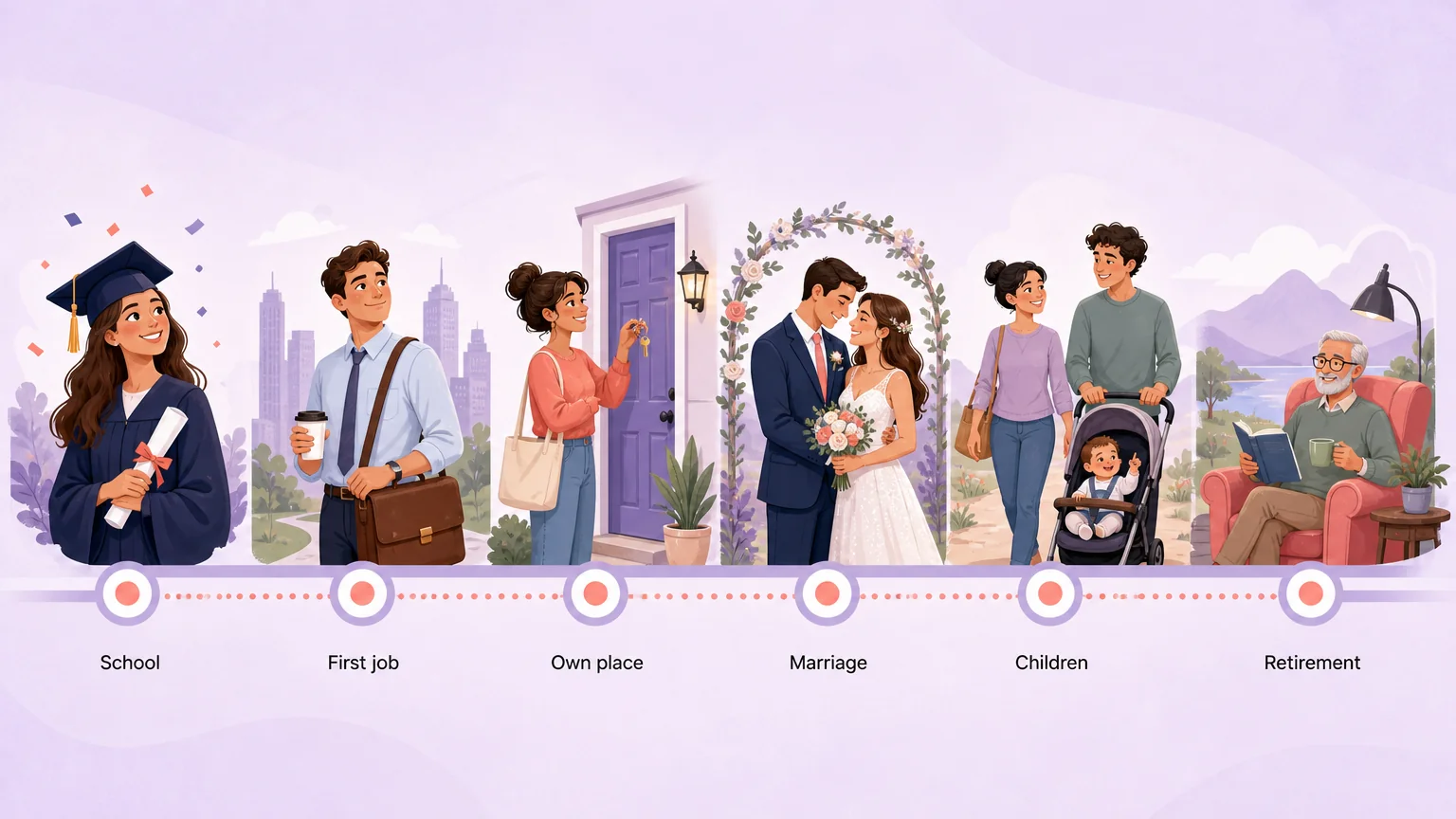
Written out plainly, the expected sequence goes like this: school, a first job, your own place, a serious relationship, marriage, a house, children, retirement, death. Read as a list, it looks like a train schedule. That is exactly what it is. A schedule tells you not only where to go but when you should already be there.
The timetable was calibrated to a particular life: straight, cisgender, middle class, and formed in a set of decades when a career started on time and a wedding was a family event rather than a negotiation.
Its timing assumes you could date openly in your teens. It assumes your parents would come. It assumes the first serious relationship happened at nineteen, in a dorm, with nobody to hide it from.
Where those assumptions fail, the schedule stops being a description and becomes a verdict. The friend who bought a flat at 27 is not better at life. She hit a checkpoint that was built for her.
The relative who asks every holiday when you are going to settle down is reading from the same script, usually without knowing it. Even the tax form assumes a spouse.
None of this is an argument against the destinations. Plenty of queer people want marriage, children, a house, a career, all of it.
The claim is narrower. The timing was never yours to set, and noticing that is different from rejecting the life you actually want. Queer temporality starts here, with a schedule nobody handed you to sign.
The feeling has a history, and it did not begin with dating.
Where the Idea Came From: AIDS and a Generation With No Future
AIDS killed 324,029 people in the United States between 1987 and 1998. That is an eleven-year toll, and the length of it is part of the point.
For a whole generation of gay men, the future was not merely uncertain. It was statistically missing. In 1990, AIDS caused 61 percent of all deaths of men aged 25 to 44 in San Francisco and 35 percent in New York.
By 1995, one in nine gay men in the country had been diagnosed and one in fifteen had died. Planning for old age in those years was not optimism. It was a category error.
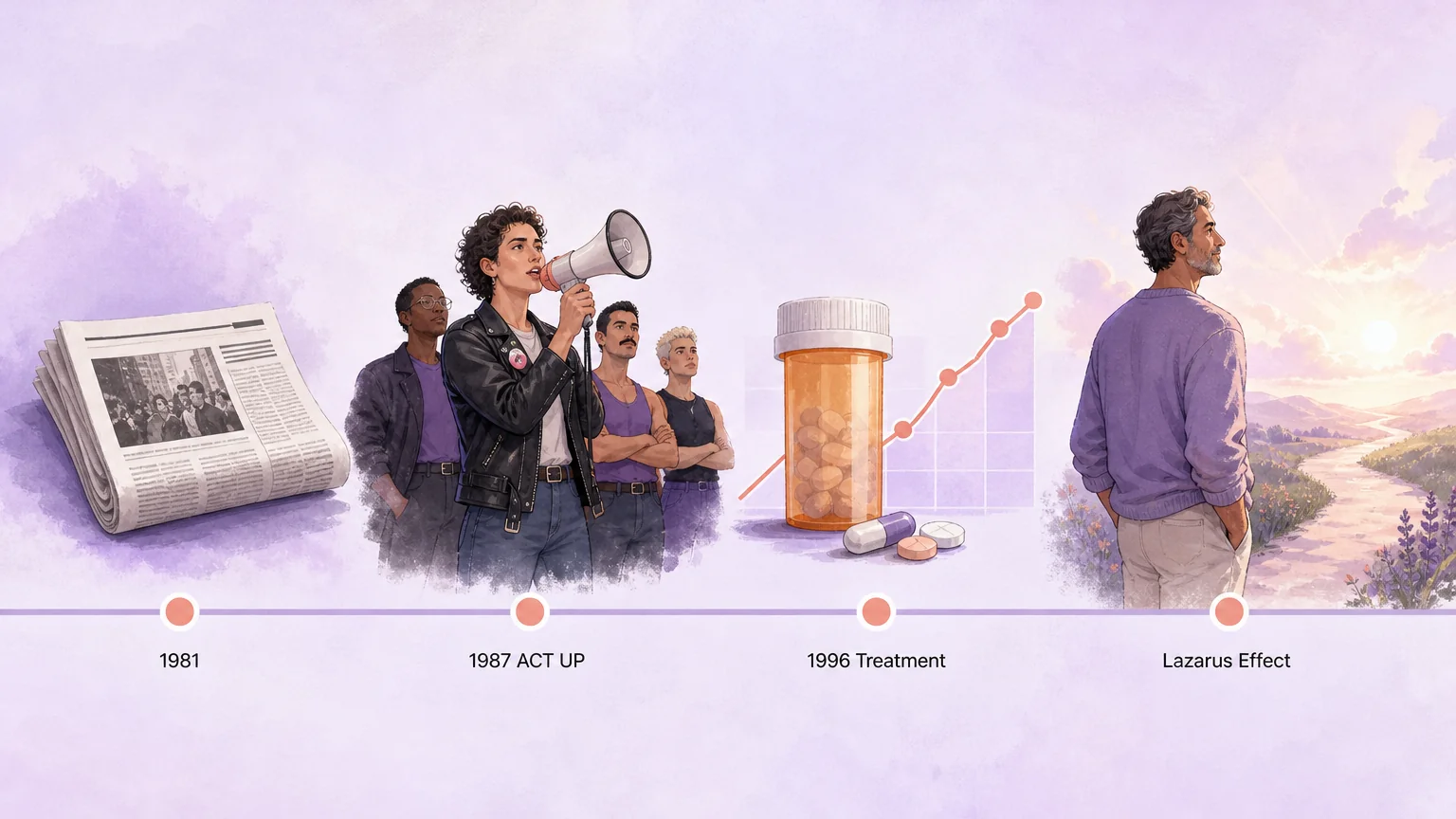
Queer temporality was not dreamed up in a seminar room. It was written in a decade of funerals. The political response was a claim on time: the first official report of what became AIDS appeared on June 5, 1981.
ACT UP formed on March 12, 1987, after Larry Kramer’s speech at the Lesbian and Gay Community Center in Manhattan, and marched on Wall Street on March 24. Its protest at the FDA on October 11, 1988, over slow drug approval was followed within a year by a much faster approval process. Direct action was, among other things, an attempt to force the future to arrive sooner.
Then the future came back, which was its own kind of shock. Effective antiretroviral treatment arrived in 1996, and the CDC recorded a 47 percent drop in AIDS deaths in 1997. Long-term survivors who had left work on medical advice, expecting to die, had to build careers and finances they had never planned for. Sociologist Dana Rosenfeld calls this the Lazarus effect.
Queer time is not only about death. It is also about what happens when a future you had already said goodbye to turns up.
The Vocabulary: Queer Time, Chrononormativity, and Straight Time
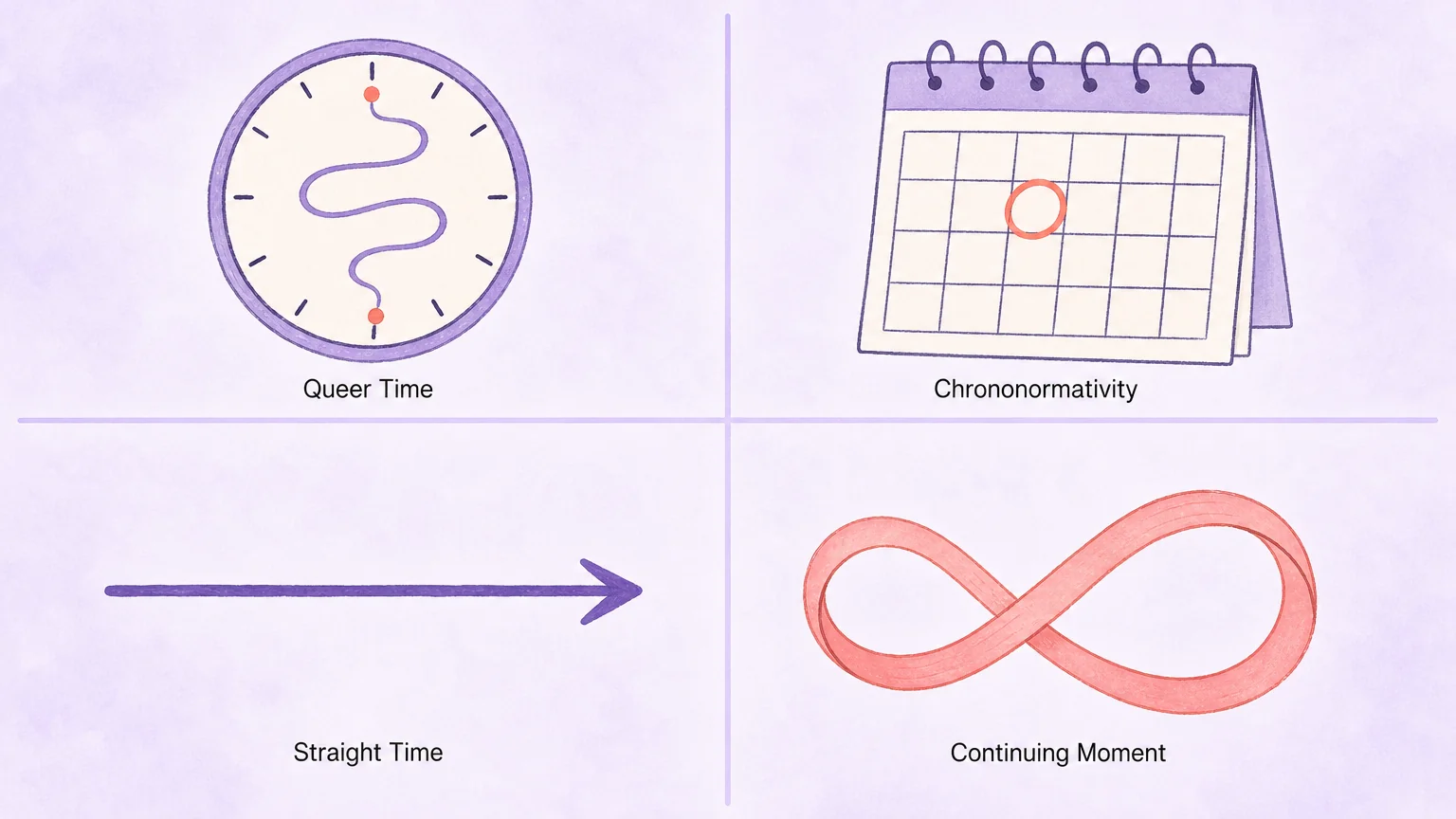
Four terms do most of the work here, and each fits in a sentence you could say at dinner.
Start with the definition. In a 2003 essay called “What’s That Smell?: Queer Temporalities and Subcultural Lives,” Jack Halberstam writes that “queer uses of time and space develop in opposition to the institutions of family, heterosexuality, and reproduction, and queer subcultures develop as alternatives to kinship-based notions of community.” It is the definition most often quoted, and it earns the attention.
The second sentence from the same essay does the real work: “Queer subcultures produce alternative temporalities by allowing their participants to believe that their futures can be imagined according to logics that lie outside of the conventional forward-moving narratives of birth, marriage, reproduction, and death.”
Halberstam is not describing a preference or a subculture’s hobby. They treat queerness as an outcome of how a life is scheduled, of “temporality, life scheduling, and eccentric economic practices,” rather than only as a sexual identity. Sex is not the subject. The calendar is.
The mechanism has a name. Elizabeth Freeman calls it chrononormativity, in her 2010 book Time Binds. Institutions schedule bodies: the school bell, the work week, the tax year, the anniversary, the deadline for having a baby.
Keep it up long enough and the schedule stops feeling like a schedule and starts feeling like biology. That is why missing a step registers as a defect in you rather than a rule you never agreed to.
Tom Boellstorff’s term is straight time, from a 2007 essay. It names the assumption that a life moves forward on schedule, and that the schedule is both chronological and heterosexual. A life that runs on time and a life that runs straight turn out to be the same instruction.
Eve Kosofsky Sedgwick, in Tendencies, describes queer as a continuing moment, a movement, a motive: recurrent, eddying, troubling. The word’s root means across. Which is why it can describe a way of moving through time, not only a category of person.
One example each, then. Chrononormativity is the office that schedules a meeting at 8 a.m. on the first morning of Pride. Straight time is the aunt who asks whether you have met anyone nice, meaning someone who fits the shape she has in mind. A continuing moment is the way a song from a bad year can still make you feel twenty-two.
The Fight Over the Future
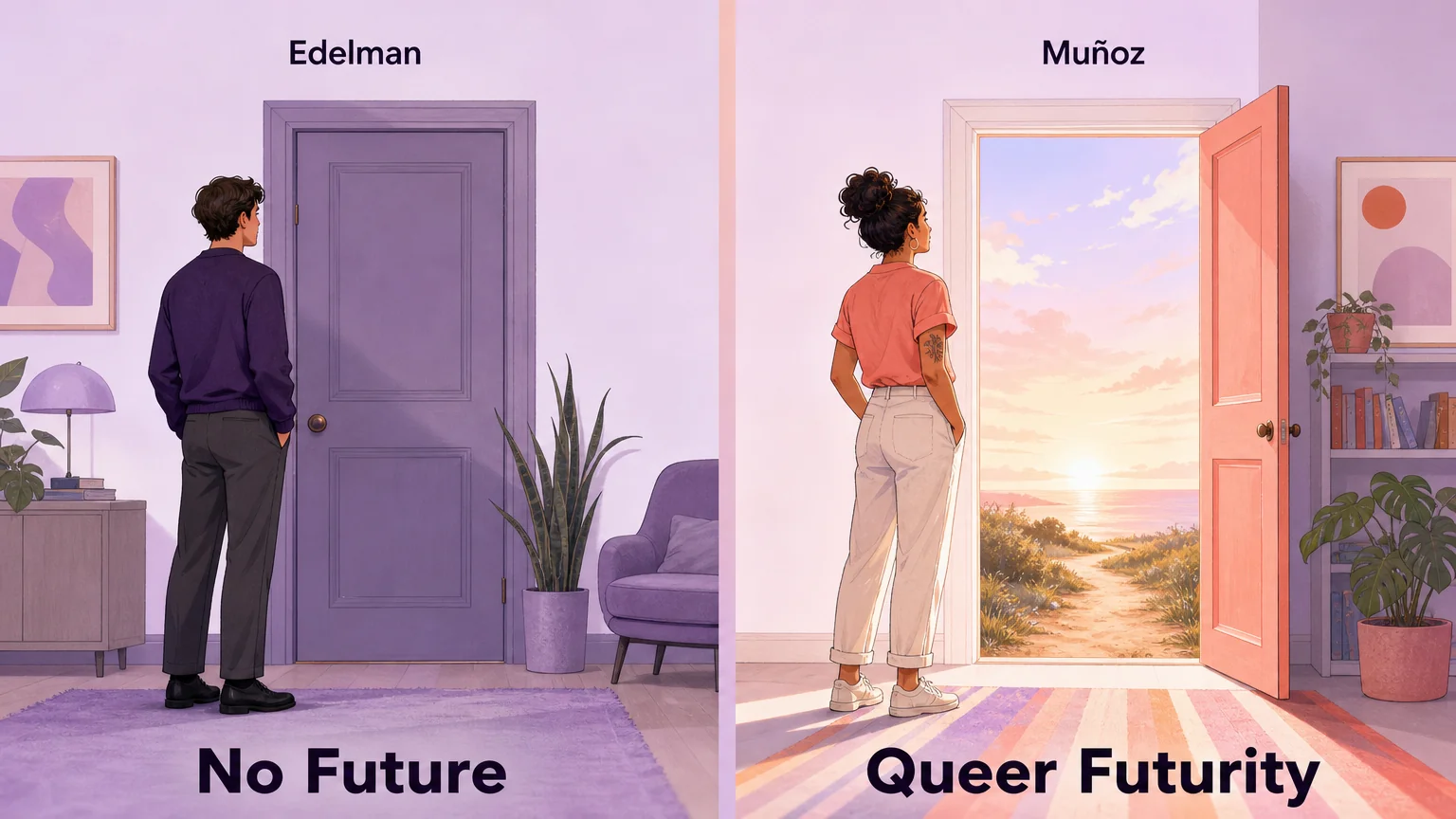
One of the most cited books in queer theory is called No Future. The title is not a wish. It is an argument, and it belongs to one side of a fight that is still going.
Lee Edelman published No Future in 2004. The claim is that politics organizes itself around what he calls reproductive futurity: the figure of the Child as the guarantee that anything matters, that there is a reason to keep going. Every policy debate, in his account, gets conducted as a defense of the children. Queerness, he argues, should refuse that arrangement rather than ask for a place inside it.
José Esteban Muñoz answered five years later, in Cruising Utopia. For Muñoz, the future is not only a threat or a trap. Queerness is a horizon, visible but not yet arrived, and the insistence on another world is the point. Where Edelman hears a demand to reproduce, Muñoz hears a door that has not opened yet.
These are two positions, held by two named theorists, and the argument is still running. It is worth saying plainly, because it gets compressed into a slogan on its way out of the seminar room and into ordinary life. The disagreement is central to queer temporality, and it is unresolved.
One correction matters most here. The anti-reproduction reading belongs to Edelman. It is not a description of queer people, most of whom have opinions about children that range from devoted to indifferent. It also leaves out same-sex parents and trans people who had children before transitioning, a limit critics have raised against the frame.
What you believe about the future changes what you plan for. That part is not abstract at all.
The Evidence: Queer Milestones Arrive Later and Further Apart
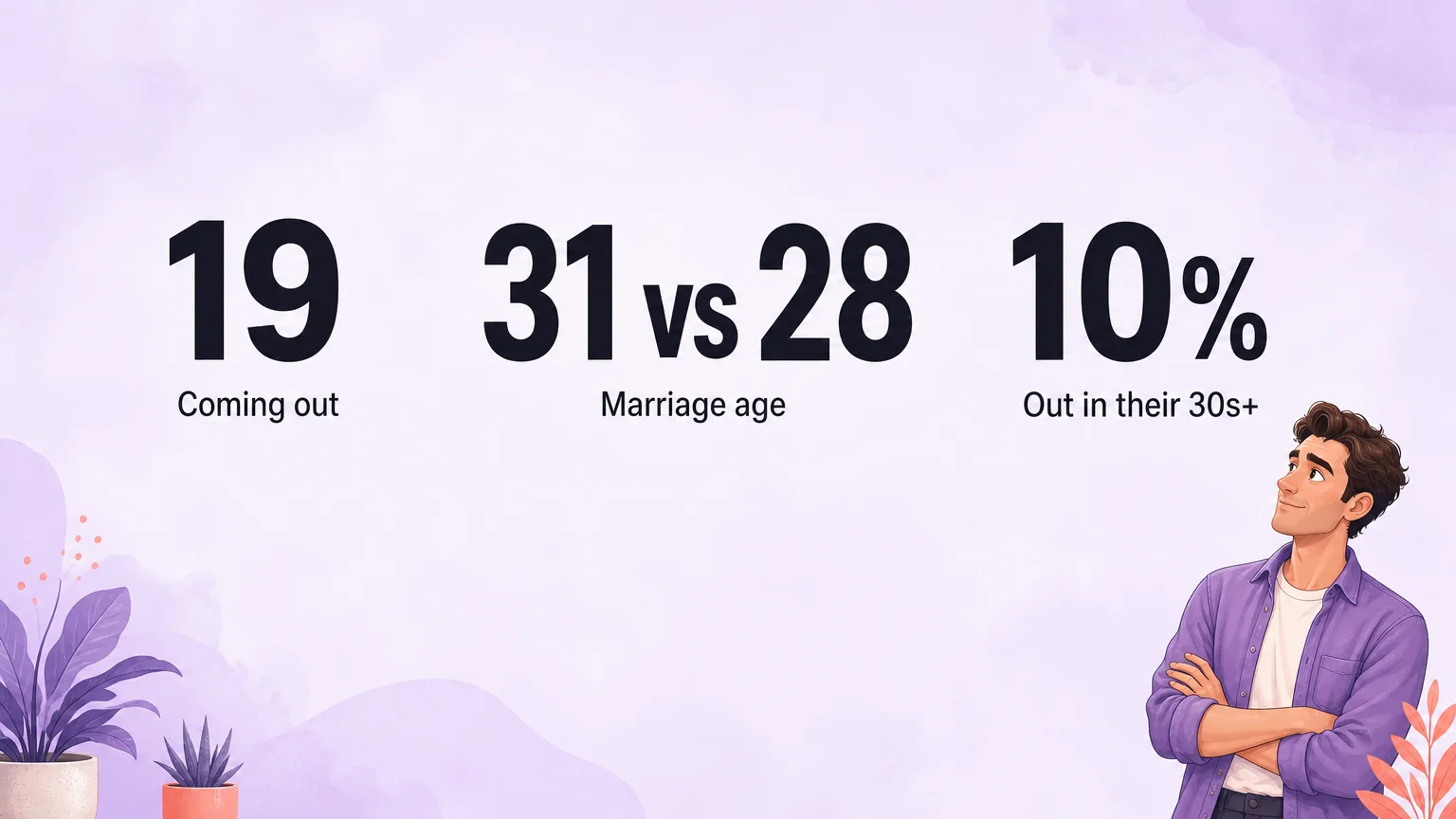
The median age at which LGBTQ+ adults come out is 19. For people 65 and older it is 26. For people aged 18 to 29 it is 17. Already the timeline is doing something the standard script cannot account for: it is moving.
Gallup’s 2024 survey, which reached 46,933 US adults including 4,879 LGBTQ+ adults, puts the gap between knowing your identity and telling another person at three years for the youngest group and ten years for the oldest.
Eighteen percent have never come out to anyone. Ten percent came out in their 30s or later, including one percent at 50 or older. Bisexual adults are far more likely never to come out at all: 23 percent, against 5 percent of gay and lesbian adults. The stretch between knowing and telling is its own queer time, and it runs for years.
Marriage shows the pattern too, in a more interesting way. Among 2019 US newlyweds, the median age at first marriage was 31 for women in same-sex marriages and 28 for women in different-sex marriages. For men it was 35 and 30.
Later, yes. But the better finding is the spread. The middle 50 percent of same-sex newlyweds span 15 years of age for women and 16 for men, roughly twice the range for different-sex couples. The National Center for Family & Marriage Research produced that analysis from American Community Survey data.
This is not a scoreboard of delay, and it is not a ranking of who is doing queerness properly. It is evidence that there is no single queer schedule, which is exactly what queer temporality predicts. A wide distribution is what you get when a life is not being run on one timetable.
These are patterns, not rules. If you married at 24, you are not doing queerness wrong. You are one of the people who makes the distribution wide.
The Relationship Escalator and the U-Haul Myth

What do lesbians bring on the second date? A U-Haul. The joke is about thirty years old, it has a real history, and the evidence behind it points somewhere else.
Underneath the joke is a mechanism. Amy Gahran, a journalist who has written a book on relationship structures, describes the relationship escalator as “the bundle of social norms that govern how relationships that include significant levels of intimacy, especially sexual romantic intimacy are supposed to work, how they’re supposed to begin, how they’re supposed to progress.”
In practice that means dating, exclusivity, meeting family, moving in, engagement, marriage, children, until death. The escalator moves on your behalf, which is why staying at one step takes a decision while advancing takes none. Queer temporality shows up here as a question about pace.
People step off in both directions. Some move slower: living apart together, friendship as a primary bond, staying single by choice. Some move faster. Non-monogamy is one route off the escalator, not the only one and not a definition of queer time.
Now the U-Haul. The line is usually credited to Lea DeLaria on The Arsenio Hall Show in the early 1990s. The stereotype says lesbians couple fast, and plenty of people have done it.
But a 2018 Stanford study reported no significant difference in cohabitation rates between couple types once couple age is controlled for. Something else is doing the work.
Three things, most likely. The dating pool is smaller, so a good match feels rarer than it is. Disclosure comes early and runs deep, because you have already had the conversation about family that most couples reach in year three.
And there is history: under Executive Order 10450 in 1953 and the Lavender Scare that followed, some lesbian couples lived together as apparent roommates so that nobody would ask. Moving in fast was sometimes a safety strategy before it was a romance. Therapist Lynda Spann notes that a sense of scarcity can push people to go all in quickly, and scarcity is not a personality trait.
So the useful question is not fast or slow. It is whether the pace was chosen. 3Fun is one ordinary place where people say what they are looking for before momentum sets the pace.
When Queer Time Hurts: Foreshortened Futures and Whose Time Counts

Some readers recognize queer time not as freedom but as a quiet certainty that they will not get old. That deserves a name and an explanation, not a silver lining.
Psychologists use the phrase foreshortened future for a trauma response in which a full lifespan stops feeling possible. You can picture a career, maybe, and not a retirement. You can picture next year and not the year after.
For queer people the condition is shaped by hostile policy, by negative messaging absorbed early, and by the daily labor of living in an environment that was not built with you in mind. Naming the mechanism is not the same as diagnosing the person reading it.
Disability studies scholar Alison Kafer makes the sharpest critique of queer temporality from inside it. She notes that Halberstam conceded some bodies are treated as expendable, and that the shortened life spans of Black queer people or poor drug users never generated the same theorizing about curtailed futures. Her argument is not that the concept is wrong. It is that a framework about which futures count has to hold disability, incarceration, and institutionalization inside the frame, because those are temporal experiences.
The point has a race and class version. Treating time as a playground assumes a material cushion that not everyone has. Precarity is not a lifestyle choice, and a refusal to plan for the future looks different when it is a refusal and when it is an accurate reading of the odds.
The concept also strains in the other direction. Stretch queer time to cover any refusal of a conventional definition of success and it starts to include nearly everyone: same-sex parents, trans people who had children before transitioning, heterosexuals who do not want children. Critics ask whether a category that wide is still doing any work. It is an open question, not a ruling on who counts as queer.
None of this dissolves the idea. It sharpens it, which is the more useful outcome.
You Are Not Behind

You are not behind. Both halves of that are true at once: the delay can be real, and the yardstick can still be arbitrary.
What people often describe is a second adolescence. Coming into queerness later means doing formative firsts at an age when everyone around you seems to be past them.
A first relationship. A first Pride. A first queer friend group. Learning, in your thirties or forties, how to be seen.
Clinicians who work with LGBTQ+ clients describe this as a normal developmental phase of queer time, with grief for the missed years on one side and genuine joy on the other. It explains late skill building. It is not a license, because the consequences are still adult consequences.
Late is also more common than the timeline admits. Ten percent of LGBTQ+ adults came out in their 30s or later, including one percent at 50 or older. If you came out at 45, you are not an outlier. You are in a large group that the standard schedule renders invisible.
Chosen family runs on another clock entirely. Half of LGBTQI+ adults have relied on chosen family for support with a health-related need, against a third of non-LGBTQI+ adults, according to a 2024 nationally representative survey by the Center for American Progress. That is care infrastructure, not a consolation prize. It also does not follow the wedding schedule, or any schedule.
Near the end of I Saw the TV Glow, a trans allegory told as a horror film, someone chalks a line on a wall: there is still time. Take it lightly and let it land anyway. Queer temporality is not a consolation for a delayed life. It is a description of how the delay was built, and the script you were handed can be read, borrowed from, or written past.
Frequently Asked Questions
What is queer temporality in simple terms?
Queer temporality is the study of how LGBTQ+ lives relate to time differently from the standard schedule of school, career, marriage, children, and retirement. It looks at lives that reach those markers later, in a different order, or not at all, then asks what that tells you about the schedule itself. The vocabulary gives the pattern a name.
Is queer time the same as queer temporality?
Yes. Queer time is the shorthand, and the two are used interchangeably. There is a colloquial drift worth knowing: “running on queer time” usually means running late, which is a joke, not the theory. The joke and the concept are both suspicious of clocks. Only one is making an argument about how a life is scheduled.
What is chrononormativity?
Chrononormativity is Elizabeth Freeman’s term for the way institutions schedule bodies: the school bell, the work week, the tax year, the deadline for a baby. Do it long enough and the schedule feels natural, so missing a milestone reads as a personal failure rather than a social arrangement. The word names the arrangement. It does not describe a defect.
Am I behind if I came out late?
No, though both halves of the feeling are real. The delay is measurable: same-sex newlyweds marry later, and 10 percent of LGBTQ+ adults come out in their 30s or later. The timeline they are measured against was built for someone else, which makes the comparison less informative than it feels. Late is a position on a schedule, not a verdict on a life.
Does queer time only apply to LGBTQ+ people?
No. Housing costs, precarious work, and later marriage affect everyone, and the average age of leaving a family home keeps rising. The theory’s claim is narrower than universality: queer people tend to meet these pressures earlier and more sharply, because the standard schedule was never calibrated to them in the first place. The pattern is shared. The intensity is not.