In May 2015, Ireland became the first country in the world to legalize same-sex marriage by popular vote. Eleven years later it sits 14th of 49 on ILGA-Europe’s Rainbow Map, at 61% and two points down.
So is Ireland LGBTQ+ friendly? Yes, with caveats that matter. The law is welcoming, and social attitudes have shifted sharply, most visibly in Dublin and the other cities. Conversion practices remain legal, non-binary people have no legal recognition, trans healthcare access is under pressure, and LGBTQ+ people report the highest discrimination rates of any group measured in the State.
The rest of this guide works through three lenses: what the statute book says, what surveys and firsthand accounts show, and what an ordinary Tuesday looks like for someone living or traveling here. One distinction matters from the start. The island holds two jurisdictions, the Republic of Ireland and Northern Ireland, and their laws diverge. There is no single national verdict; the answer changes by county.
LGBTQ Rights in Ireland: Marriage, Hate Crime and the Legal Record
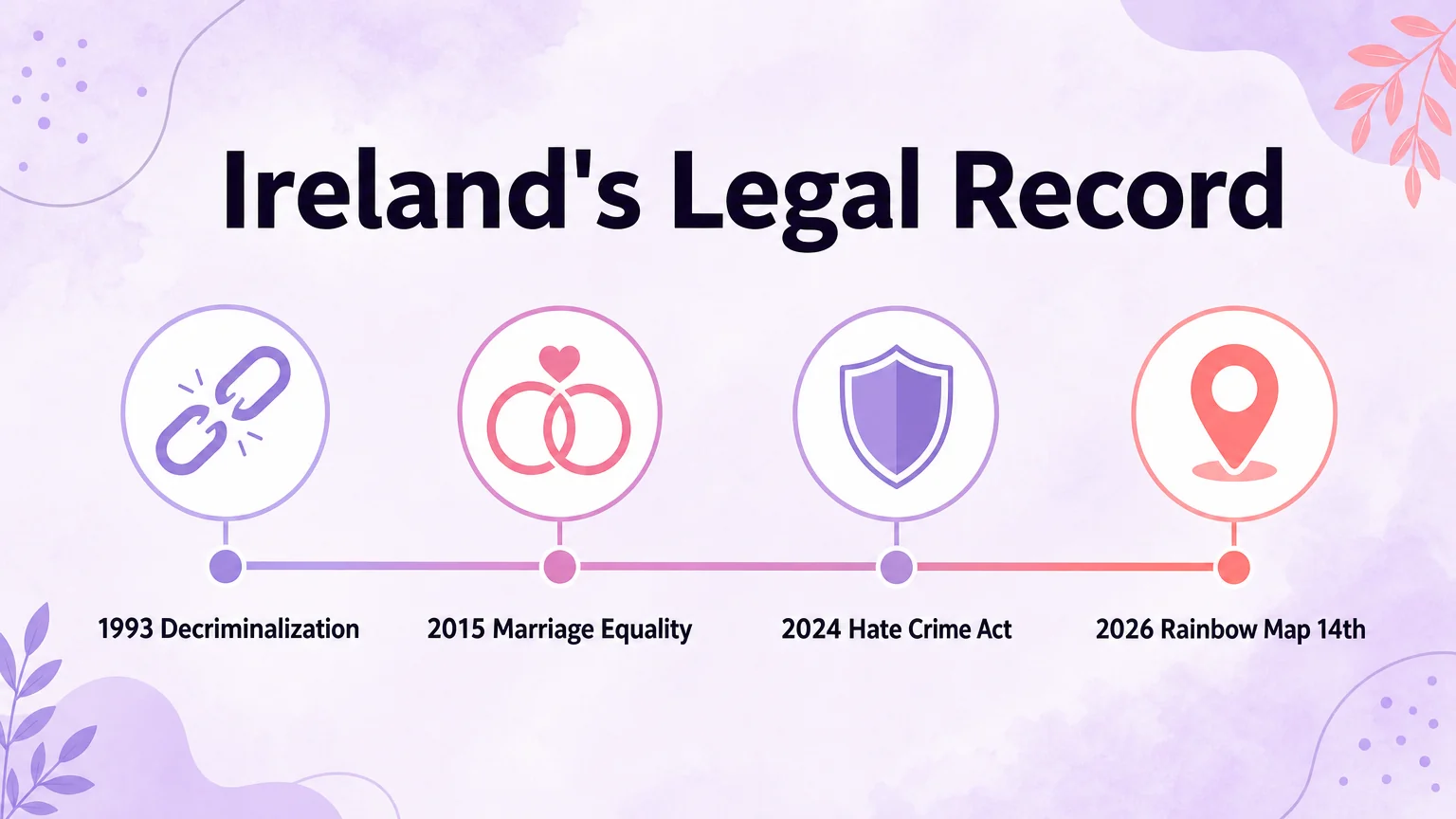
Start with the statute book, because it carries the clearest answer to whether Ireland is LGBTQ+ friendly. The legal spine runs in four dated moves.
Decriminalization came in 1993. In 2015, the marriage referendum made Ireland the first country to legalize same-sex marriage by popular vote, and the Gender Recognition Act 2015 followed in the same year. The Criminal Justice (Hate Offences) Act 2024 came into force on 31 December 2024 under S.I. No. 730/2024. It covers sexual orientation, gender (including gender identity and expression) and sex characteristics, and it lets hatred as a motivating factor aggravate a sentence. It also creates standalone aggravated offences where hatred is proven. It is not a hate speech offence: the underlying offence still has to be made out.
The 2026 scoreboard is less flattering. ILGA-Europe ranks Ireland 14th of 49 on its Rainbow Map, at 61% and down two points, with Spain displacing Malta at the top.
That drop is the useful part. It is a check on the celebration rather than the argument for it, and it says almost nothing about marriage. What it does say is that the record making Ireland LGBTQ+ friendly on paper is unevenly spread across the people the law covers. The statute book is generous to married couples and thinner for anyone outside that template.
Where Irish Law Still Falls Short
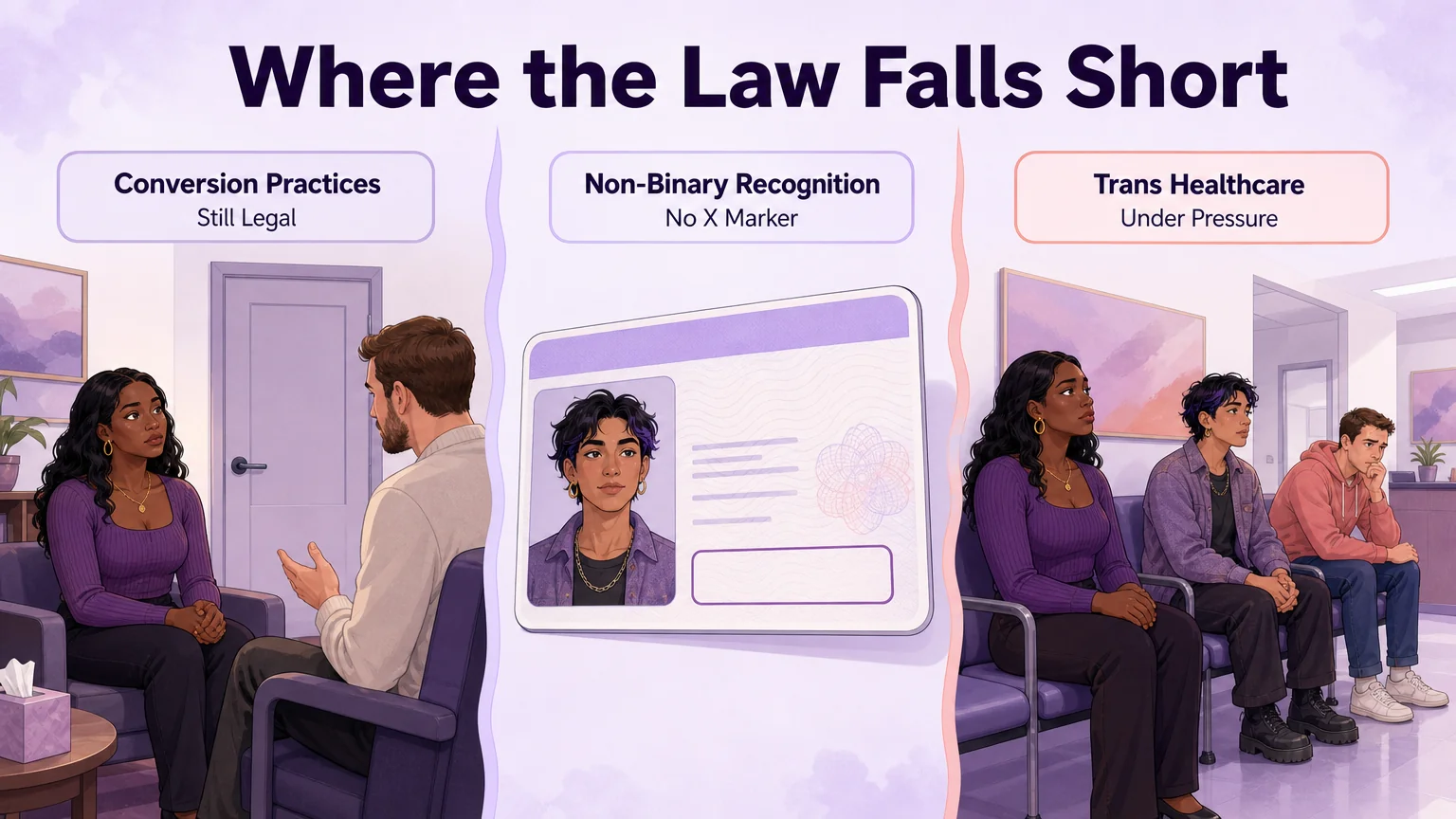
The gaps in Irish law are not spread evenly. They concentrate on trans and intersex people, which turns whether Ireland is LGBTQ+ friendly into a question about who is asking.
Conversion practices are lawful in the Republic, and no bill has been published. The Minister for Children, Disability and Equality told the Dáil in a written answer on 17 February 2026 that the proposed legislation raises “complex and sensitive policy and legal questions,” that her department is working through the principles, and that officials continue to engage the Office of the Attorney General. The Programme for Government commits to a ban. No timeline was offered. Japan is in the same position on conversion practices: no national ban and no bill before the Diet.
Recognition is narrower still. The Non-Binary and Intersex Recognition Bill, a Private Members’ Bill, was defeated by 87 votes to 63 on 21 October 2026. It would have added an X marker to State registers and made sexual characteristics a discrimination ground. Neither exists, and Ireland scores zero on intersex bodily integrity, the Rainbow Map measure of protection against medically unnecessary interventions on intersex minors. ILGA-Europe reports that 39% of intersex respondents underwent medical interventions, most of them non-consensual or without informed consent.
Healthcare access is under pressure. ILGA-Europe reports that the National Gender Service signaled it would close its waiting list from March 2026, and advocacy groups warned that more than 2,470 people could be left without care. The HSE said the list remained open.
A country can rank 14th and still fail all three tests. A ranking measures law against a continental rubric. It does not measure whether a trans teenager can get an appointment.
What Social Acceptance in Ireland Actually Looks Like
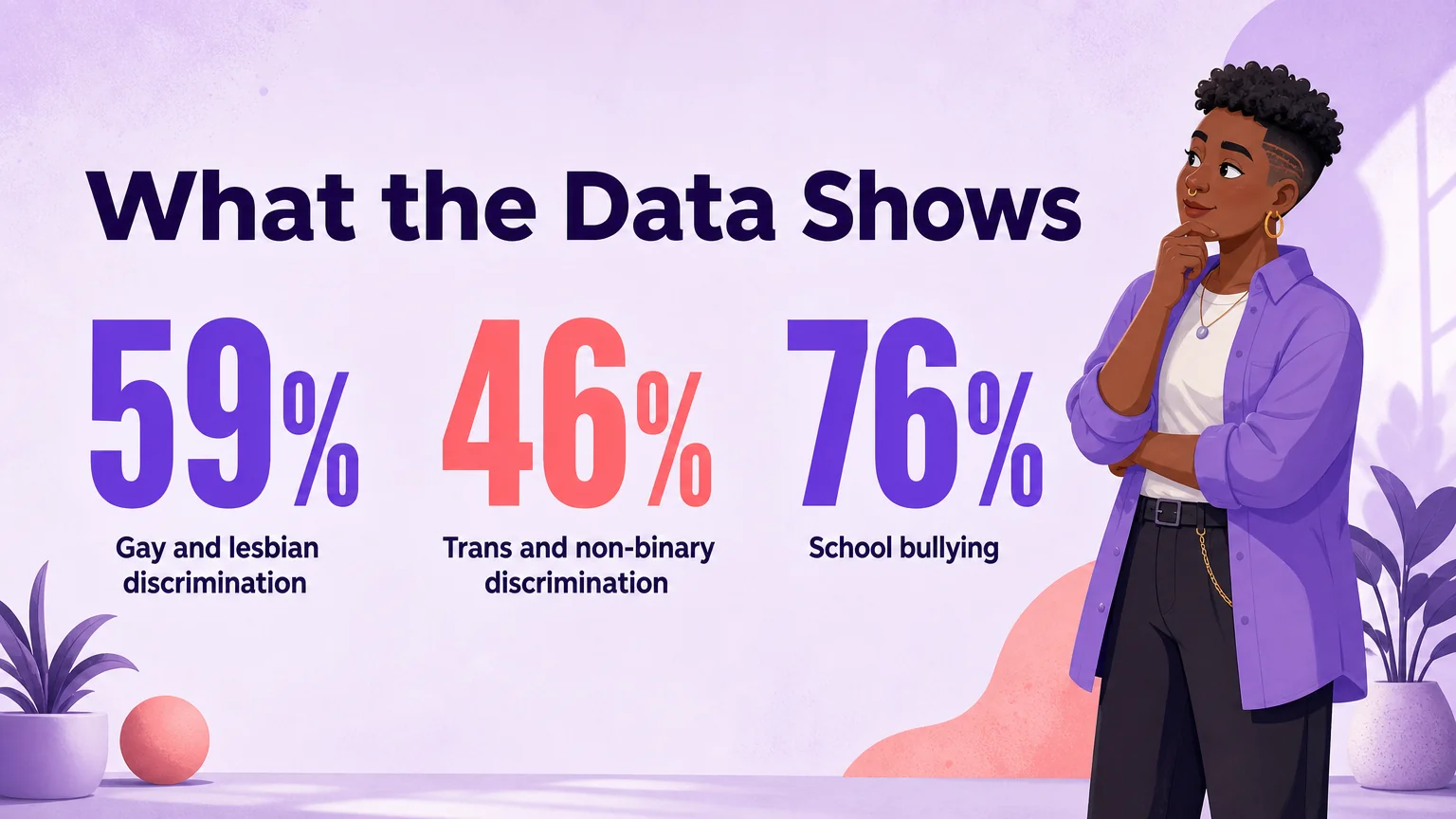
In the Central Statistics Office’s Equality and Discrimination 2024 survey, 59% of gay and lesbian respondents reported discrimination in the previous two years, against a national average of 22%. Bisexual respondents reported 55%. The national figure itself rose from 18% in 2019.
Transgender and non-binary respondents reported 46%, against 23% for cisgender respondents. In the workplace, 22% of gay and lesbian respondents and 22% of transgender and non-binary respondents reported discrimination, against 7% of heterosexual and cisgender respondents. When looking for work, 12% of gay and lesbian respondents reported discrimination, against 4% of heterosexual respondents. In social settings such as gyms, pools or parks, 15% of gay and lesbian respondents reported discrimination, against 2% of straight respondents. The reference period is two years, which is easy to misread as the past twelve months.
Schools supply the sharpest figure. The EU Fundamental Rights Agency’s 2024 report records school bullying highest in Ireland, at 76%.
Read those as what they are. They measure reported experience across a population, not the risk one visitor carries into one weekend, and they sit beside legal equality rather than contradicting it. If Ireland is LGBTQ+ friendly in law, this is the distance between the statute and the room. A country can protect a marriage and still fail a fourteen-year-old in a classroom.
Is Dublin LGBTQ+ Friendly? Inside the City’s LGBTQ+ Scene
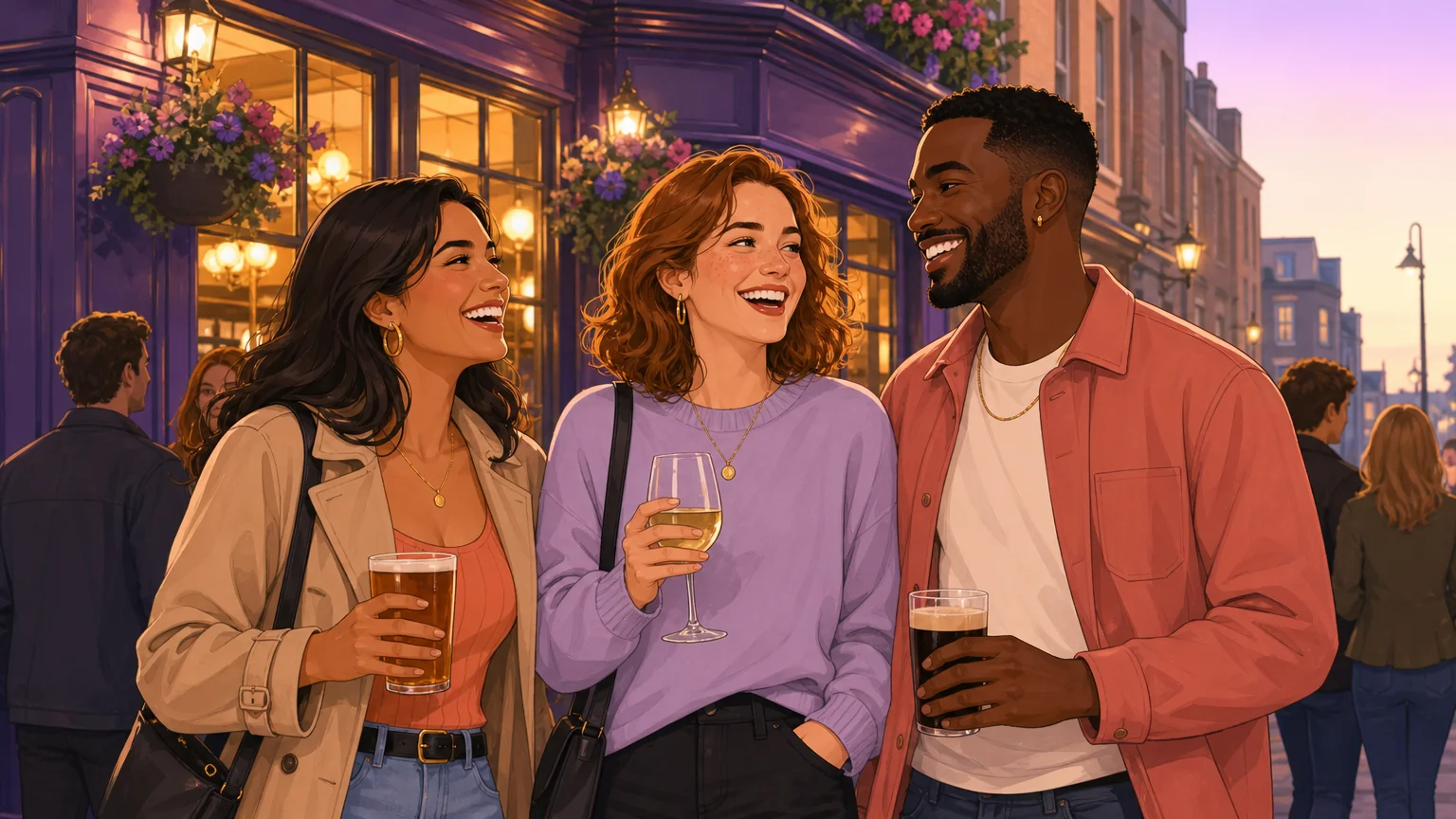
Yes, and the scene is easy to use because it is small. Dublin is also where the answer to whether Ireland is LGBTQ+ friendly is least complicated.
Nothing in Dublin works like a gay village. There is no single street to book a hotel beside. What exists instead is a cluster: a handful of venues within a short walk of each other, so a night out is easy to plan within an hour of arriving.
The George on South Great George’s Street has traded since 1985, with drag shows and the Shirley Temple Bar bingo. PantiBar on Capel Street and Pennylane nearby anchor the north side. Mother is the long-running Saturday club night. A handful of smaller bars and one-off nights fill out the rest of the map.
Capacity is the practical catch. Rooms are small, drag fills early, and arriving after 10pm on a Saturday can mean waiting outside. Check each venue’s own listings for the night you are there, because schedules move.
For timing, Dublin Pride 2027 runs 23 to 27 June, with the parade on Saturday 26 June 2027 and more than 100,000 people taking part. The Mother Pride Block Party at Collins Barracks is a separate event, and GAZE, the city’s LGBTQIA film festival, runs in late July. Check tickets and listings before you travel. A busy scene says nothing about the walk home from it.
Beyond Dublin: LGBTQ+ Life in Irish Towns and Counties
“Ireland is vastly different from county to county,” the comedian Gearóid Farrelly said in a June 2026 interview. He also said there are things “very good and very bad about being gay in Dublin,” and that he would have been bullied badly at school for being gay.
Michael Barron, who helped establish BeLonG To, in an August 2025 interview described his Kilkenny upbringing as an “extremely macho, homophobic environment” organized around hurling, where being gay meant you were “not masculine enough” and where it was not possible to talk about it.
Those two accounts carry more than any statistic here, because of who is speaking. Both men are describing places they know from the inside.
The texture of a rural trip is often quieter than the politics suggests. One same-sex couple’s travel vlog of a week through Galway, Killarney, Dingle and Limerick contains no hostile encounter at all. Hosts and guides treated them as a couple. What shaped the week was logistics: rural taxis are scarce, bookings cancel, and small towns close early.
Treat the absence of harassment as tone rather than proof. It is not evidence that rural Ireland is unsafe, and it is not evidence that every county will feel the same. The question of whether Ireland is LGBTQ+ friendly gets its hardest test here, and the answer is local. Treat the county as a planning variable, not a warning.
Trans and Non-Binary in Ireland: Documents, Healthcare and Daily Life
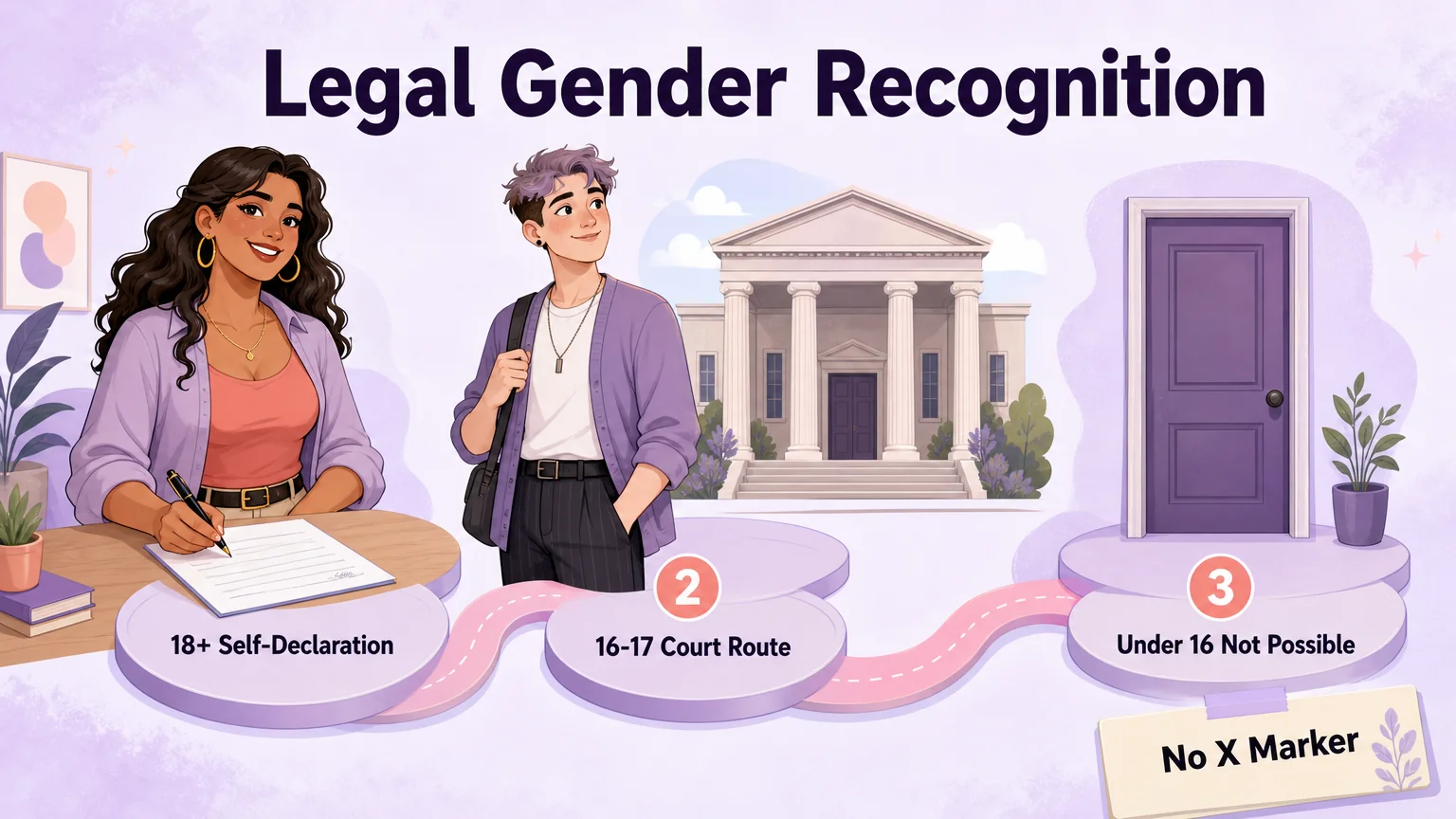
For a trans or non-binary reader, the useful question is not whether people are friendly. It is what the paperwork costs.
Legal gender recognition runs on the Gender Recognition Act 2015. It is binary, and no X marker exists. At 18 and over, the route is a statutory declaration witnessed by a Peace Commissioner, Notary Public, Commissioner for Oaths or solicitor. There is no fee, and a revised birth certificate costs EUR 20. At 16 or 17, the route runs through the Circuit Family Court with parental consent and two medical certificates. Under 16, it is not possible. A passport marker follows the certificate, so an Irish passport reflects a recognized gender. Crossing into Northern Ireland brings UK document rules.
Healthcare is the harder edge. ILGA-Europe reports that the National Gender Service signaled it would close its waiting list from March 2026; advocacy groups warned that more than 2,470 people could be left without care.
Support exists, which matters in a country where the reputation for being LGBTQ+ friendly runs ahead of the paperwork. TENI is on 01 873 3575, and the Transgender Family Support Line is on 01 907 3707.
On toilets and changing rooms, no Irish statute restricting access by gender identity was identified. That is a statement about the law, not a promise about any individual venue, so treat it as silence, not a guarantee.
The recurring cost here is administrative rather than hostile. Documents, waiting lists and court routes take time nobody else has to spend, and that is where whether Ireland is LGBTQ+ friendly gets decided in practice.
Republic of Ireland vs Northern Ireland: Where LGBTQ+ Law Diverges
One island, two legal systems. The two-hour drive from Dublin to Belfast crosses a border that changes the legal answer.
Northern Ireland decriminalized in 1982 and the Republic in 1993. Same-sex marriage reached the Republic by referendum in 2015 and Northern Ireland in 2020, after Westminster intervened while the Assembly was suspended.
Conversion practices split them again. The Republic has no bill. Northern Ireland’s Conversion Practices (Criminalisation) Bill completed Second Stage on 28 September 2026 and is at Committee Stage. It is not law, and it could fall before the May 2027 Assembly election.
Hate crime runs the other way. The Republic’s 2024 Act covers gender identity and expression. In Northern Ireland, the new hate crime aggravator excludes transgender identity, and the Justice Minister told the Assembly that Northern Ireland is the only part of the UK and Ireland without that protection for transgender people.
For a visitor, the practical gap is narrower than the legal one. Same-sex marriage is recognized on both sides now. Belfast has a visible scene, and Pride there marked its 35th anniversary in 2026, running 17 to 26 July.
Neither jurisdiction is friendlier in some general sense. Whether Ireland is LGBTQ+ friendly depends on which side of the border you mean, and the divergence is legal rather than temperamental.
LGBTQ+ Travel in Ireland: Safety, Reporting and Support
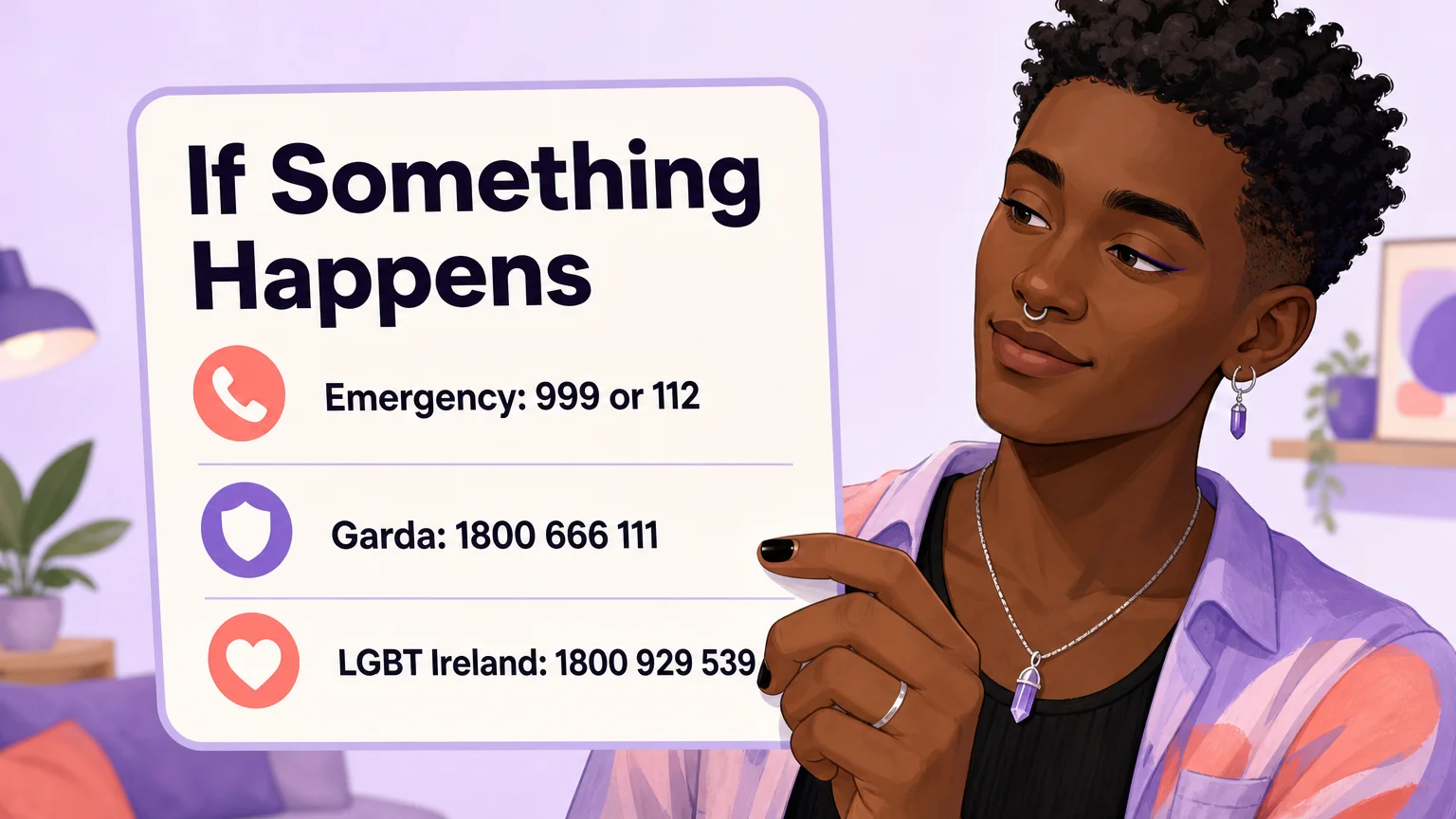
If something happens, what you do next matters more than whether Ireland is LGBTQ+ friendly on average.
In an emergency, call 999 or 112. Otherwise report at any Garda station, on the confidential line 1800 666 111, or at garda.ie/reportahatecrime, and ask for a Garda Diversity Officer. A hate incident does not have to be a crime to be reportable.
For a small town, one detail matters: the Garda National Diversity Unit on +353 1 666 3150 or diversity@garda.ie will liaise with a local station, so you do not have to walk in and be recognized.
Support is separate from reporting. LGBT Ireland runs 1800 929 539 and a chat service at lgbt.ie, with evening hours: 6:30pm to 10pm Monday to Thursday, 4pm to 10pm Friday, 4pm to 6pm weekends. A daytime visitor cannot rely on it. BeLonG To is on 01 670 6223 for people aged 14 to 23.
The 2024 Act aggravates an offence when hatred is a motivating factor, but the underlying offence still has to be made out. Save the numbers before you need them, and keep your own judgment about a venue, a taxi or a walk home. On the ordinary nights, 3Fun is one of the apps you can use to meet someone.
LGBTQ+ Ireland: Frequently Asked Questions
Is Ireland LGBTQ+ Friendly?
Yes, with caveats. Marriage equality and hate crime law exist, and the cities are welcoming. But conversion practices remain legal, non-binary people have no legal recognition, trans healthcare access is under pressure, and LGBTQ+ people report the State’s highest discrimination rates. It varies by county.
Is Dublin LGBTQ+ Friendly?
Yes. Dublin has a compact, long-established scene, a Pride parade of more than 100,000 people, and venues within walking distance of each other. There is no gay village, rooms are small, and drag shows fill before 10pm. Book ticketed Pride events early.
Is Conversion Therapy Illegal in Ireland?
No. Conversion practices remain lawful in the Republic, where the Government has promised legislation but published none, citing “complex and sensitive policy and legal questions.” A Northern Ireland bill passed Second Stage in September 2026 and is at Committee Stage. It is not law.
Can I Get an X Gender Marker on an Irish Passport?
No. Legal gender recognition under the Gender Recognition Act 2015 is binary, and a passport marker follows the certificate. The bill that would have added non-binary recognition and an X marker was defeated on 21 October 2026 by 87 votes to 63.
Is Northern Ireland Different From the Republic for LGBTQ+ Visitors?
Yes. Northern Ireland decriminalized in 1982 and the Republic in 1993, and same-sex marriage arrived there in 2020, after Westminster intervened. Its new hate crime aggravator excludes transgender identity, and it has no conversion practices ban.
What Should I Do if I Am Harassed in Ireland?
Call 999 or 112 if it is happening. Otherwise report at a Garda station, on 1800 666 111, or at garda.ie/reportahatecrime, and ask for a Garda Diversity Officer. A hate incident need not be a crime to be reported. LGBT Ireland’s helpline is 1800 929 539.