Is Spain LGBTQ friendly? Yes, and more decisively than almost anywhere else. Same-sex marriage has been legal since 2005, the country sits at the top of the major rights indexes, and in Madrid or Barcelona a gay couple can hold hands on a terrace without a second thought.
That is the headline. Here is the part the headline misses.
The useful answer behind any gay friendly Spain claim depends on three things. Where you go: Barcelona’s Gaixample and a village of 8,000 people are governed by the same national law and experienced very differently. Who you are: a cis gay couple on a beach week and a trans traveler whose passport marker does not match their presentation meet different obstacles, one social and one administrative. And which Spain you mean: a 10-day holiday is not the same country as an attempt to live there.
One thing sits awkwardly under all three. Recorded anti-LGBTQ+ attacks have risen sharply over the same period in which Spain won recognition as the most legally protective country in Europe. Both facts are true. They measure different things.
By the end of this piece you will know what the law guarantees, what the street has been delivering, which regions alter the picture, and what to do if something goes wrong. Enough to plan a trip without blind optimism and without unnecessary fear, and to tell which parts of the country will ask more of you and which will ask nothing at all.
Spain’s LGBTQ Record: Top of the Law, Uneven on the Street
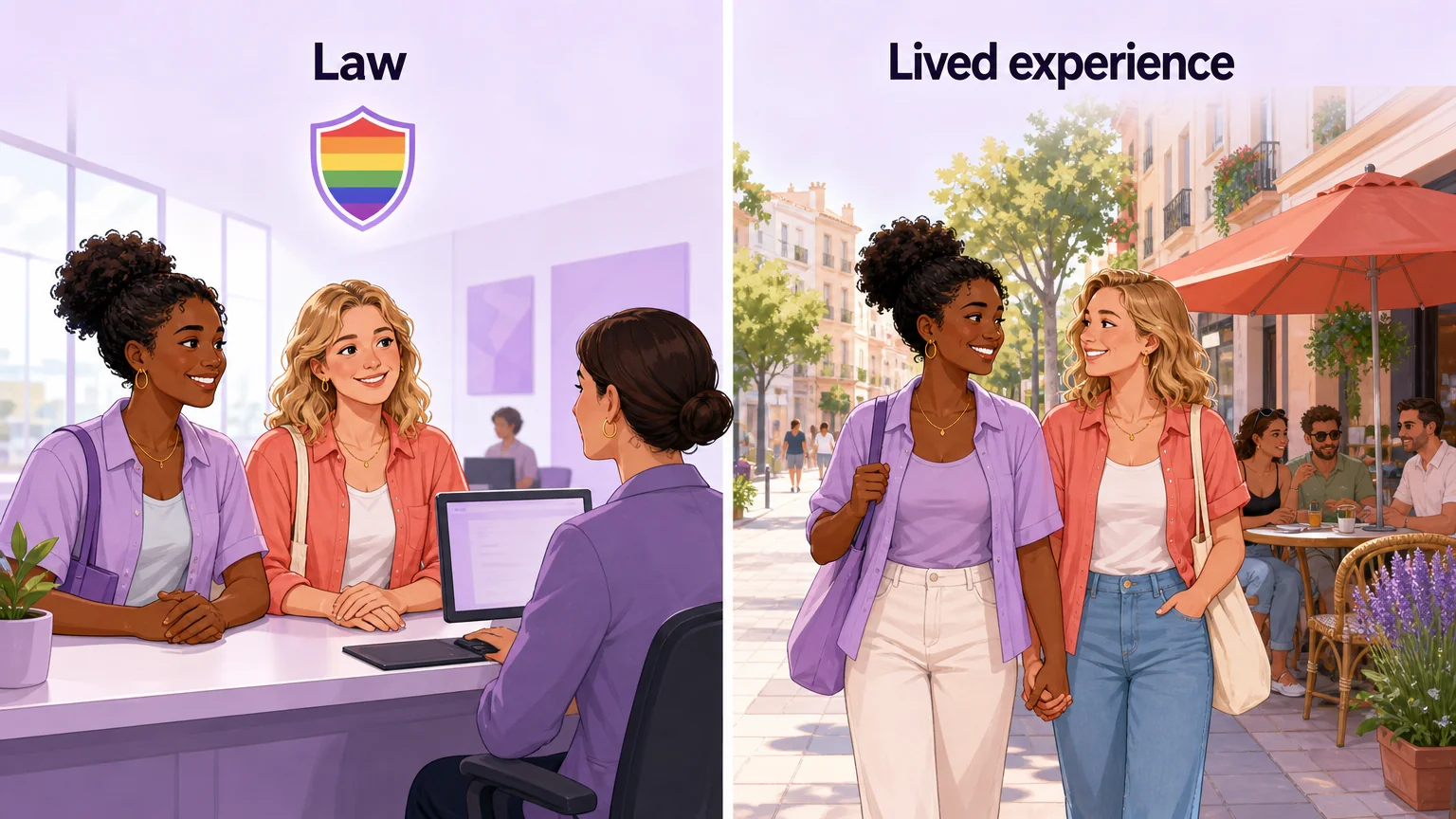
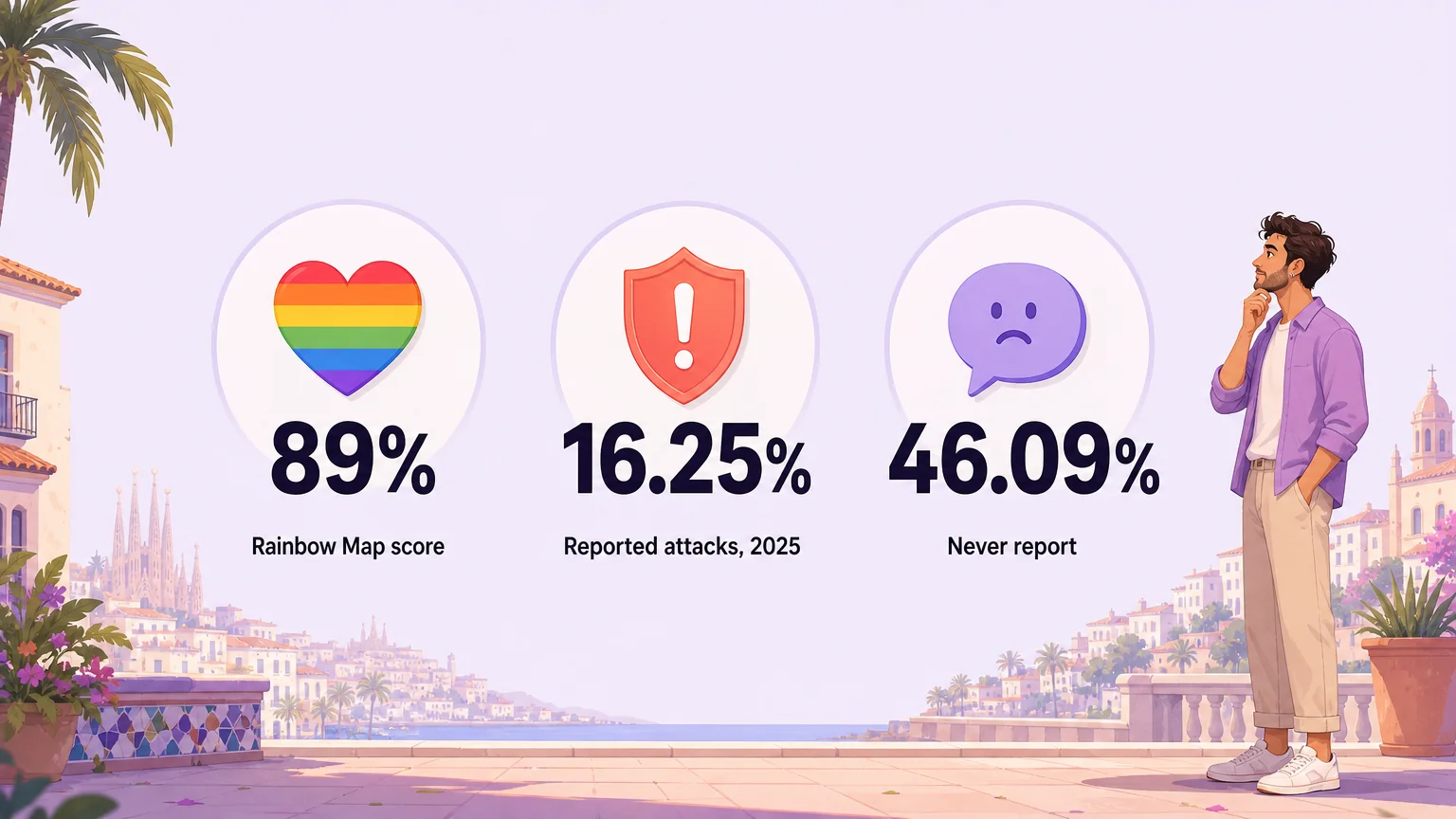
In 2026, Spain took first place on ILGA-Europe’s Rainbow Map with 89%, ending Malta’s 10-year run at the top. Malta fell to second on 88%, Iceland third on 86%. Spain had climbed four places and gained 11 points in a single year, a jump large enough to read as a verdict on the country rather than on its statutes.
The Rainbow Map scores 49 countries against 76 criteria in seven categories, from equality and non-discrimination law to family recognition, legal gender recognition and asylum. More than 200 country experts feed the data. It is also a legal inventory.
ILGA-Europe says so itself. In the release announcing Spain’s first place, the organization states that a top ranking measures laws and policies, not lived reality. The same release notes that assaults against LGBTI people in Spain are up 15% since 2024. The body that handed Spain the trophy is the body that attached the caveat.
A second ranking measures something different. The Spartacus Gay Travel Index 2025 placed Spain first of 216 countries and regions across 18 criteria weighted toward what a visitor actually encounters: marriage equality, adoption rights, anti-discrimination law, gender-affirming policy. Where the Rainbow Map asks what a citizen can claim, Spartacus asks what a guest can expect. Spain tops both, which is genuinely rare.
Both signals are real. They are not the same signal, and neither resolves the question of what your week in Seville will feel like. A country can write excellent law and still have a bad year on the street. It can also have a bad year on the street while remaining one of the safest places in the world to be openly queer.
The rest of this piece walks two tracks. What the law guarantees you anywhere in the country, and where one regional government has pulled back. Then what the street has actually been delivering since 2024, including the numbers that make the rise hard to wave away.
The Rights That Hold Everywhere in Spain
The moment that matters is not the wedding. It is the hospital desk at 2 a.m., when a partner needs to be recognized as next of kin and a form asks what they are to you. In Spain, the answer is the same in every region.
Same-sex marriage has been legal since 2005, when Spain became the third country in the world to legalize it. Adoption, inheritance, next-of-kin recognition and spousal benefits follow from that status and apply identically to different-sex couples. A Spanish immigration lawyer puts it plainly: there is no different regulation by region for marriage, adoption or inheritance. That one sentence should settle the anxiety of anyone wondering whether booking a flat in Madrid is somehow riskier than booking one in Barcelona. It is not.
The rest of the legal floor is national too. Anti-discrimination protection covers sexual orientation and gender identity across the country. The age of consent is equal. LGBTQ+ people serve openly in the armed forces. None of this varies by autonomous community, and none of it depends on which city you land in.
For a visitor, the practical version is narrower than the statute. You are unlikely to marry, adopt or inherit on a two-week trip. What you might do is give a statement at a police station after a theft, check into a hotel as a couple, or need a partner admitted to a hospital. In each of those moments the law treats you as a couple because you are one, and no clerk or officer has grounds to decide otherwise.
Paperwork is where a trip goes wrong fastest, and here the paperwork is on your side.
That is what a legal floor is worth. It does not guarantee warmth. It guarantees standing. The next question is what happens when the warmth runs out.
Spain’s Rising Anti-LGBTQ Attacks: Reading the 2024 to 2026 Data
The distance between two headlines is the story. In 2025, ILGA-Europe noted that assaults against LGBTI people in Spain had risen 15% since 2024. By May 2026, FELGTBI+, the country’s state federation of LGBTQ+ organizations, was describing a country where one in four LGBTQ+ people had been attacked in the previous year. That is not a 15% problem. That is a tripling.
Start with the federation’s own numbers, because the baseline is reported two different ways and the discrepancy is worth seeing. Its 2025 survey, built on 800 interviews, put physical or verbal attacks at 6.80% for 2024 and 16.25% for 2025. When FELGTBI+ summarized the record in May 2026, it described 2024 as one in ten and 2026 as one in four.
Hold both as the federation’s figures. The direction is unambiguous even where the starting point shifts.
That 16.25% is not an abstraction. Applied to Spain’s LGBTQ+ population, it implies roughly 812,000 people attacked in a single year. Let that sit.
The increase is not one incident, one city, or one bad night in a club district. The 2025 survey recorded it across a national sample. The federation points to political discourse and hate speech as the driver, and 78% of LGBTQ+ people said rising hate speech threatened their physical safety and equality.
The reporting gap is the reason to distrust any official total. In the 2025 survey, 46.09% of victims never went to the authorities. Only 26.82% filed a formal complaint. Another 27.09% took the incident to an LGBTQ+ organization instead.
The reasons given were the ones you would guess and hate to guess: a belief that it would achieve nothing, a lack of evidence, a fear of not being believed. A third of those who did report, 33.33%, said the process was as traumatic as the incident itself.
Where it happens is specific. Physical attacks concentrate in the street at 35.28%, then in schools and education centers at 16.92%, then at work at 8.46%. Harassment was reported by 20.3%, discrimination in employment, services or housing by 25.25%.
The geography splits too. In municipalities under 10,000 people the attack rate is 20.83% against 16.25% nationally, with harassment at 26.39%. A village stay and a city break are not the same trip.
None of this makes Spain unsafe in the way that word usually means. It does mean that any official hate-crime count you read is a floor rather than a ceiling, and that the floor is rising.
Where Spain Changes: Big Cities, Small Towns and Madrid’s Rollback
The same survey that puts the national attack rate at 16.25% puts it at 20.83% in towns under 10,000 people, with harassment at 26.39%. Scale is the first variable. A week in Sitges and a week in a whitewashed village of 4,000 are different trips, even though both are Spain.
The second variable is political, and it runs through Madrid.
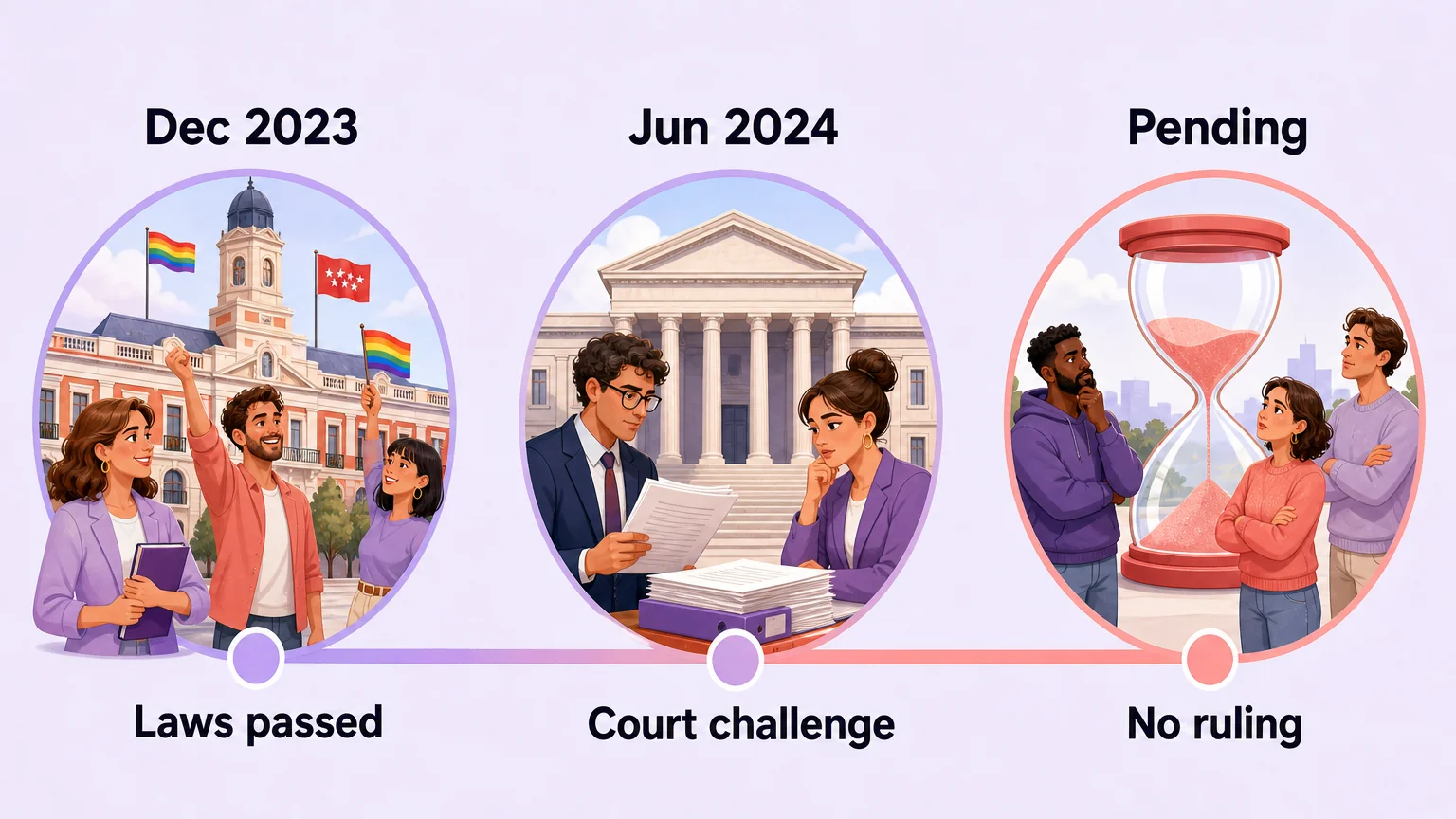
In December 2023 the regional government passed two laws, Ley 17/2023 on trans rights and Ley 18/2023 on LGTBI rights. On June 25, 2024, the Ministry of Equality announced that the Council of Ministers had filed unconstitutionality appeals against both, and sought their suspension while the court decides.
Four provisions sit at the center of the challenge. The first creates an exception to the absolute ban on conversion practices, allowing psychological counseling or psychiatric assessment. The second requires trans minors to obtain a favorable medical report before transition treatment. The third adds facilities wording protecting the intimacy of other users, especially girls and women. The fourth removes LGBTQ+ organizations from the status of interested parties in sanction proceedings.
The government’s argument is that the counseling exception could cover disguised conversion therapy. That is the government’s argument, not a finding, and the court has not ruled.
What does not change is the national floor. Marriage, adoption, inheritance and next-of-kin rights are set by national law, and no region can withdraw them. ILGA-Europe notes that 15 of the 17 regions retain LGTBI protections and that attempted rollbacks have been blocked on constitutional-rights grounds.
For a visitor the practical consequence is bounded. You are not personally subject to regional rules on transition treatment or conversion practices while passing through as a tourist. What changes is the political temperature of the place you are standing in, and the chance that a local institution treats your family as less settled than national law says it is.
Madrid is where you will most likely go, and Madrid is also where the political fight is loudest. Both things are true at once. Neither the sky-is-falling reading nor the nothing-to-see reading survives contact with the detail. Book the trip, and know what you are booking into.
Trans Travelers in Spain: Documents, Borders and Daily Life

Spain’s self-identification law requires no medical or psychological report, and it will not help you if you are visiting.
Ley 4/2023 lets a Spanish national aged 16 or over change registered gender by declaration, with a second appearance within three months to ratify it and no medical or psychological report required. Article 43.1 limits that procedure to Spanish nationals. A trans visitor’s legal gender remains whatever the passport says, however long they stay and however they present.
So the friction lives in paperwork, not in law. Spanish forms, hotel check-in systems and border control compare your stated gender against your document. An immigration lawyer’s rule is to enter what the document says, because the official on the other side is checking that the person and the paper match, not adjudicating your identity. Carry name-change documentation with you, so that a mismatch between name and appearance can be explained in one sentence rather than a long conversation at a desk.
The goal is a 30-second exchange, not a debate you did not plan to have.
Some countries meet the same moment at the border instead. Thailand, for example, runs Welcome Pride by Immigration desks for travelers whose passports do not match their appearance. It reduces friction without changing the underlying document. Ireland is the middle case: self-declaration for adults since 2015, but binary only, and a bill that would have added an X marker was defeated in October 2026. Japan is the harder case: surgery and a court order for its own nationals, and no recognition for visitors.
Healthcare is a separate calculation. Public healthcare covers transition-related treatment, including surgery, for residents, with waiting lists that vary by region. Visitors are not covered by it. A private travel policy may exclude transition-related care entirely, so read the exclusions before you buy rather than after, and budget for it as a cost rather than a formality.
Two accounts show the range.
A trans man four months into a medical transition stayed with a host family, at a stage where he sometimes passed and sometimes did not. The host parents misgendered him at first. He corrected them once, and they never did it again. The queer men he met treated his identity as unremarkable. What stayed with him was that the acceptance felt cultural rather than merely legal, something in the people rather than in the statute book.
A trans woman in Barcelona describes a harder social field. The straight scene is difficult to enter because people there do not know much about trans people, and dating apps work poorly for her, so she leans on Pride and community events instead.
Both things are Spain. FELGTBI+’s surveys name trans people among the most exposed groups in the hate data. Warmth and risk sit on the same page, and neither cancels the other.
Lesbian and Bisexual Women: A Smaller, Event-Based Scene

The mistake most visitors make with Spain’s lesbian scene is showing up at midnight. By then it is over.
The format is tardeo: dancing that starts around 6 p.m., often in a rented venue, and often ends at a reasonable hour. Madrid has few permanent women-only bars, so the scene runs on events. Arrive at midnight and you will find shuttered doors and conclude the scene is dead. It is not dead. It is early, recurring, and built around parties rather than addresses. Once you know that, Madrid opens up.
In Madrid, Fulanita de Tal is the anchor, with Escape and El Truco in the same orbit. El 33 is now more mixed than it once was, and Chueca has gentrified enough that the neighborhood reads more polished than radical. For a different night, Lavapiés runs more alternative and more intersectional, at La Berenjena, La Mala Mujer and Como vaca sin cencerro. If Chueca feels like a brand, Lavapiés feels like a room. Both are worth checking before you commit to a neighborhood for the night, because the atmosphere shifts with whatever is running that week.
Barcelona has Aire Chicas as the large women-only club, Carita Bonita on Carrer de Balmes as the dedicated bar, and the Girlie Circuit Festival as the annual anchor for the whole scene.
The caveat matters as much as the list. Venues and promoters move, and the best-known nights, Lady’s Lab and MíraLES Tardeo among them, are events rather than fixed addresses. Check what is actually running for your dates before you build an evening around it, this list included.
Plan around the hour, not the address. Treat a Thursday as a tardeo and a Saturday as a party, rather than expecting a women’s version of Chueca. It is smaller. It is also warmer, cheaper, and easier to walk into alone, which for a lot of people is the whole point.
If Something Happens: A Safety Playbook for LGBTQ Travelers
Save this section before the trip, not after.
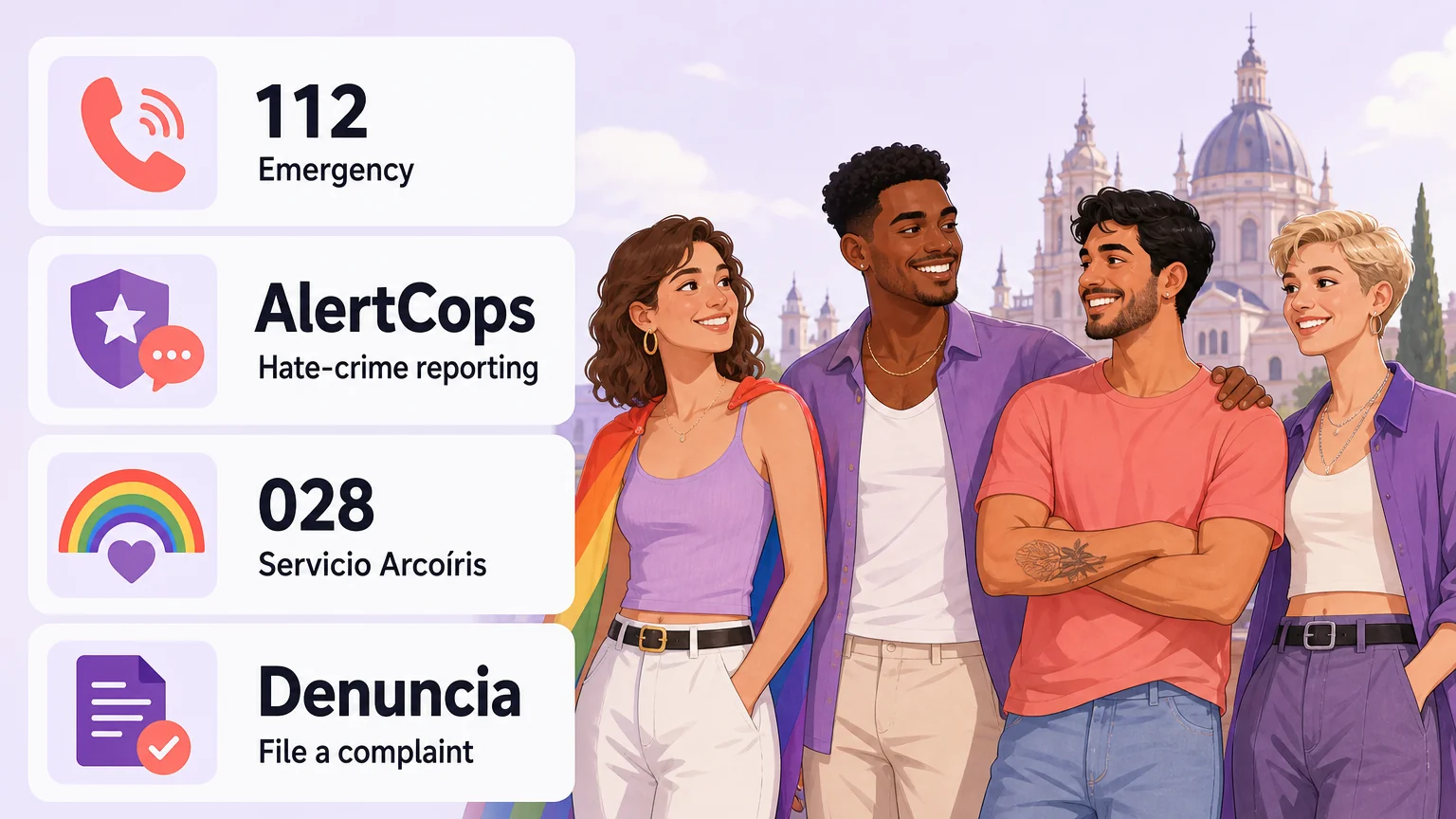
If there is danger in progress, the numbers are 112 for emergencies, 091 for the Policía Nacional and 062 for the Guardia Civil. Those three work anywhere in the country. Nothing else on this list replaces them.
If speaking is unsafe or impossible, the Ministry of the Interior’s AlertCops app includes a hate-crime channel for reporting without a phone call. Treat it as a supplement to 112 rather than a substitute. It needs a charged phone and a data connection, and its features vary by version, so do not count on a specific function unless you have opened the app and found it.
In the aftermath, 028 is the Ministry of Equality’s Servicio Arcoíris line, formally assigned by a BOE resolution of July 6, 2022, for information, legal advice and psychological support. It is not an emergency number. If you are unsure whether what happened counts as a hate incident, call anyway and describe it.
File a denuncia. A formal complaint is what feeds official statistics, and its absence is exactly why recorded totals understate what happens. When you give your statement, note what lets police classify an incident as a hate crime: the exact words used, symbols or clothing on the aggressor, witnesses, and anything anti-LGBTQ+ about the encounter. Specifics are what move a case from assault to a hate crime.
Set expectations plainly. 46.09% of victims never report, and a third of those who did found the process as traumatic as the incident. An LGBTQ+ organization can accompany you through a complaint, and for many people that is the difference between reporting and letting it go.
One last distinction. In Madrid, the realistic risk to a visitor is pickpocketing in crowded areas and on the Metro, not targeted violence. Keep your phone out of a back pocket and your bag zipped, and you have handled most of what is likely to happen to you.
Cities, Neighborhoods and the Queer Calendar
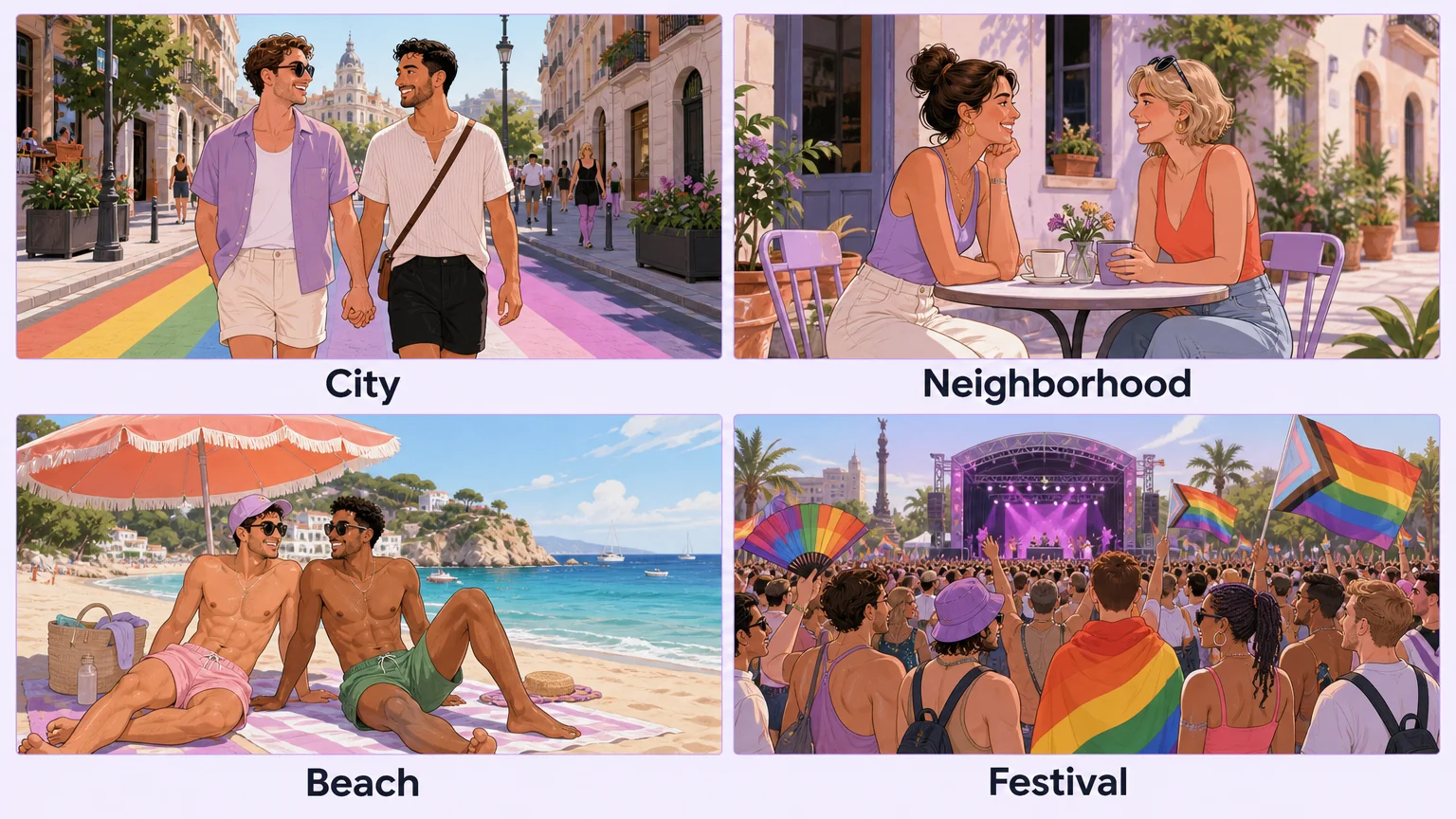
Spain gives you four shapes of trip, and the right one depends on what you want the week to feel like.
Madrid is the city break. Queer life centers on Chueca and spills into Malasaña, Lavapiés and La Latina. Room Mate Oscar and Axel Madrid are bookable bases, the first for location and a rooftop, the second for a design chain that is hetero-friendly.
Barajas is about 30 minutes from the center on the Metro with a €3 airport supplement, and a 10-ride card can be shared between two people. Late-night coverage thins, so plan a taxi home rather than assuming a train.
Barcelona is the neighborhood break. The Gaixample sits inside the Eixample, and its main street has been made car-free and elevated, which changed the whole experience of walking it. La Federica and El Cangrejo are the bars, Arena and Safari Club are the clubs and sit outside the neighborhood, and Casanova is the 24-hour sauna that stays busy when the bars are quiet. Budget hotels start around €100, mid-range runs to about €330, five-star to about €360, and both peak season and Circuit Festival in August push those numbers hard.
The beach and island trip is its own thing. Sitges is 40 minutes from Barcelona, with Balmins beach a 15-minute seafront walk from the old town. Torremolinos covers the Costa del Sol. Maspalomas in Gran Canaria puts the gay section near kiosks 5 and 6, a 45-minute walk from the Yumbo Centre with no shade, so bring water and real footwear.
The fourth is the festival trip: a Pride week or Circuit Festival, with the calendar deciding where and when. Madrid Pride runs in early July, draws more than 2 million people, keeps its stages free and sends its parade from Atocha to Plaza de Colón. Sitges Pride is confirmed for June 9-13, 2027. Dates circulating for Maspalomas Pride and Sitges Bear Week 2027 have not been confirmed by their organizers. EuroPride 2027 is in Turin, Italy, June 18-26, if that is specifically what you want. Gay Games XII in Valencia already ran, June 27 to July 4, 2026.
One planning note. Chueca and Sitges read as mixed and easy for a couple or a solo traveler alike. Axel is a hetero-friendly chain rather than a queer-only one. And La Kama Café in Chueca, upstairs, is a good first night alone in Madrid, before you know anyone.
Families, Marriage Paperwork and Surrogacy Rules
Children are where the paperwork gets serious.
Surrogacy contracts are void in Spain under Ley 14/2006. Since an instruction of April 28, 2025, from the Directorate-General for Legal Security and Public Faith, effective May 1, 2025, Spanish consulates no longer register children born through surrogacy abroad. Families now need to establish parentage through the ordinary legal routes inside Spain, a process that takes longer and gets harder where only one parent has a genetic link.
The instruction did not change the ban on surrogacy itself. It changed how a child born elsewhere is recognized here. If you were planning to bring a child home through a Spanish consulate, that route closed. The replacement is a legal process, not an appointment.
The re-marriage trap catches a different group. Spain requires proof that you are single to marry, so an existing valid marriage blocks a civil wedding here. Only an annulment in your home country opens that door. Couples from countries where their marriage could later be challenged sometimes assume Spain offers a backup ceremony, a second registration that would hold if the first one fell. It does not.
Couple registration is the flexible piece. It varies by city, with some offices registering a partnership immediately and others declining, and unregistered couples can evidence a stable relationship of about a year for residency purposes. Ask your local office what it requires before you assume either answer. Adoption carries age rules of roughly 24 to 45 that apply to every applicant, not specifically to LGBTQ+ ones.
For most readers this section lands one of two ways. You are traveling with children, in which case national law treats your family as a family at every hotel desk and hospital counter. Or you are considering a move, in which case the paperwork above is the part to research properly, with a lawyer, before you sell anything.
If the trip is also about meeting people, that is part of travel too. 3Fun is one place to do it.
Common Questions About LGBTQ Travel in Spain
Is Spain safe for gay travelers, or is the reputation marketing?
Spain is legally protective and socially welcoming in its cities, and the reputation is earned. Same-sex marriage, adoption and anti-discrimination law apply nationwide. Reported anti-LGBTQ+ attacks roughly tripled between 2024 and 2026, and most victims never report, so totals understate reality. Risk concentrates in the street and in towns under 10,000 people.
Is Spain safe for trans travelers specifically?
Legally, yes: self-identification without medical proof, public healthcare covering transition treatment for residents, and national anti-discrimination protection. The friction is administrative. Spanish self-ID is limited to Spanish nationals, and hotels, borders and forms compare your stated gender to your passport. Trans people also appear among the most exposed groups in the federation’s hate-crime data.
Can a same-sex couple marry in Spain as tourists?
Not if you are already married. Spain requires proof that you are single before a civil wedding, so a valid existing marriage blocks a second ceremony. A home-country annulment would open the door. Residents can register as a couple instead, though partnership registration rules differ from city to city.
Is Spain good for lesbian travelers, or is it a gay men’s destination?
Spain is welcoming, but the women’s scene is smaller and event-based. Madrid works as a route of recurring women-led nights around Fulanita de Tal, with Lavapiés as the alternative hub. Barcelona has Aire Chicas, Carita Bonita and the Girlie Circuit Festival. The dominant format is tardeo, early-evening dancing rather than 3 a.m. clubbing.
Is public affection safe in Spain?
In Madrid, Barcelona, Sitges and Torremolinos, yes. Couples describe holding hands and being read as a couple as unremarkable. In municipalities under 10,000 people the reported attack rate is higher than the national figure, so read the room more carefully there.
Can same-sex couples have a child through surrogacy in Spain?
No. Surrogacy contracts are void under Ley 14/2006, and since an April 28, 2025, instruction, Spanish consulates no longer register children born through surrogacy abroad. Families must establish parentage through the ordinary legal routes inside Spain, which takes longer and is harder where only one parent has a genetic link.
Where does Spain rank on the Rainbow Map, and does it matter for a trip?
Spain ranks first on ILGA-Europe’s Rainbow Map 2026 with 89%, ahead of Malta at 88% and Iceland at 86%. The index weighs 76 legal and policy criteria, not lived experience, and ILGA-Europe says so directly. It tells you the law will be on your side. It does not tell you what a street will feel like.
Which Spanish event should I plan a 2027 trip around?
Sitges Pride, confirmed for June 9-13, 2027, and Madrid Pride in early July are the two Spanish anchors. Gay Games XII in Valencia already ran in summer 2026. EuroPride 2027 is in Turin, Italy, June 18-26, so it is not a Spain trip. Maspalomas Pride dates remain unconfirmed.