Trade, in gay slang, is a masculine, straight-presenting man who has sex with men. Historically the word carried an economic edge, a man who took something in return. Today it mostly means a man someone finds attractive.
The same word can name a hustler in a 1937 novel, a compliment in a group chat, and a label a man never agreed to. In a 2026 episode of The Gay Rugby Podcast, the host admits he cannot follow it. “What is trade? I’ve been hearing trade a lot recently in the gay community. I just don’t understand.” His guest, the comedian Michael Henry, answers, “I call any hot guy trade, okay?”
That exchange is the whole problem in miniature. He runs a gay podcast and has still lost the thread, which tells you the word is doing several jobs at once. It has a history, a racial politics, and a present tense. All three are more interesting than the definition.
The Man, the Look, and the Label: Three Ways Trade Gets Used
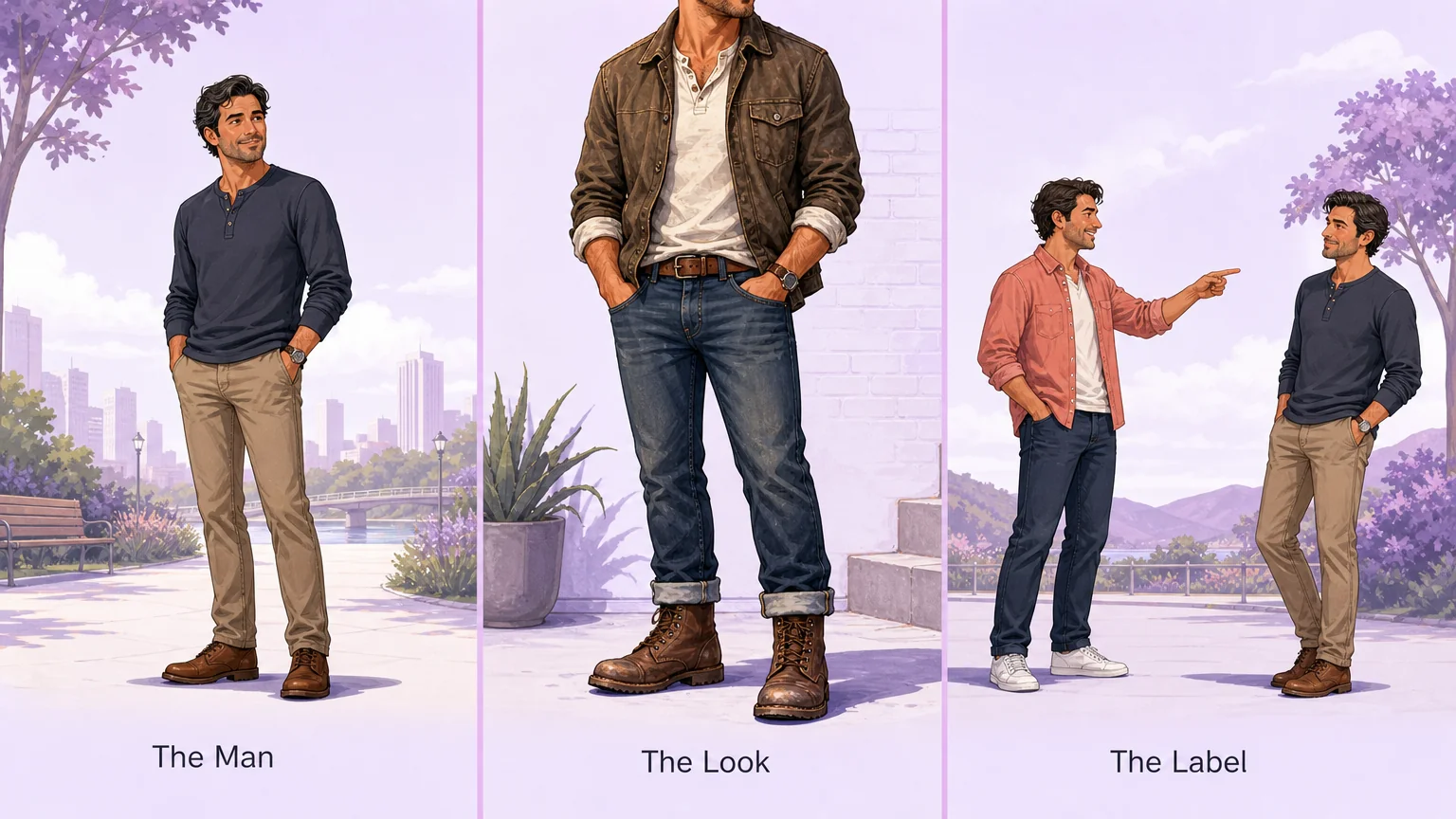
Trade does three jobs, and confusing them is what makes the word feel slippery. It names a kind of man, it works as an adjective, and it is a label other people apply.
One, the man. Participants in Seth E. Davis’s study of Black queer men settle on “straight masculine men who have sex with gay men and transwomen.” Nothing in that definition requires the man to say anything about himself.
Two, the look. “He’s trade.” “That’s trade.” Khumo Markham keeps the working-class sense alive in a single phrase from a 2025 video: “blue collar trade, we see you.” The phrase names a job and a class in one breath.
By 2026 the adjective has come loose from identity. Michael Henry again: “a twink could be trade to me.” That is the use a newcomer meets first, because it needs no knowledge of the man’s life.
Three, the label. Trade is put on a man, not claimed by him. Davis’s participant Courtney describes the mechanism: “You might not even know if they’re gay but you look at them and be like ‘Oh, that’s trade.'” Recognition on sight, not disclosure.
The three uses share a spelling and almost nothing else. The first asks what a man is, the second asks what he looks like, and the third asks neither.
The word describes what a man reads as, not what he has said. That is why it can be a compliment and a risk in the same breath.
Where Trade Comes From: 1900, 1937, and the Sex Work in Between
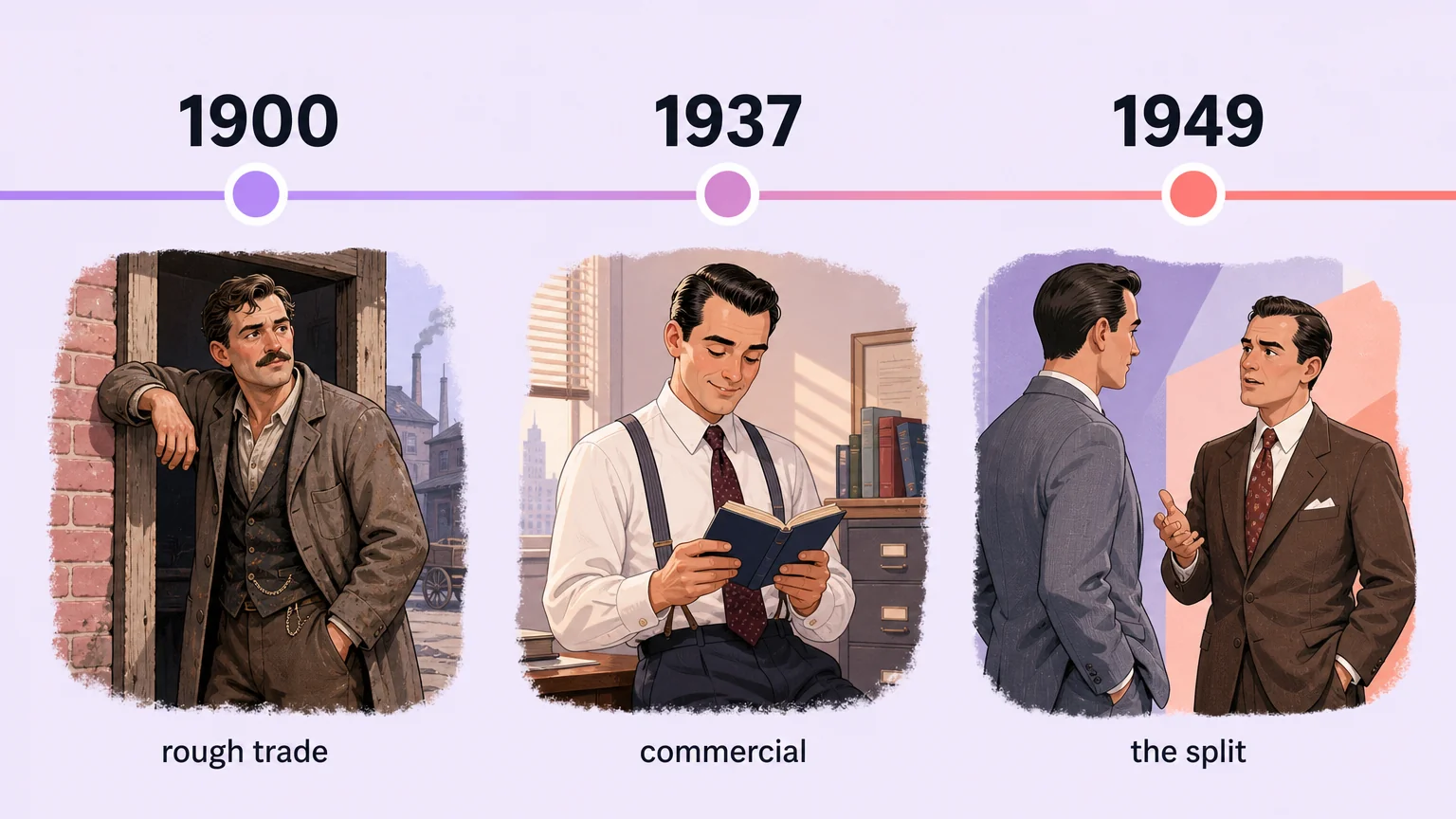
The dates are the solid part. Green’s Dictionary of Slang dates the adjective to 1937, in J.M. Cain’s novel Serenade, where the line is about a woman: “a downright piece of trade goods.” The entry defines it as slang “used of someone involved in commercial sex.” Money is inside the first citation, not added afterward, and the word was not yet about men.
Within twelve years the word had already split. A 1949 citation in Green’s distinguishes two kinds of gay trade: a man open about being queer but opposed to oral sex, and a basically straight man who enjoyed kissing and went further. That is the identity-versus-behavior confusion the word still carries, visible within a decade of its first appearance. Green’s also records “trade queen” from 1949, “a homosexual man who has sexual relations only with ‘trade’,” which shows the word building compounds early.
Then rough trade. Green’s earliest citation is 1900, in a letter by Oscar Wilde, and the definition is “a violent sexual partner,” often “a man who is, or poses as, a construction worker.” The class marker is the job. The Wikipedia entry on the term describes the stereotype: physically strong, rough and tough, a laborer in construction, trucking, factory work and farming. It says most gay men avoided such men because they “frequently commit violence and sometimes murder out of homophobia.”
What the phrase did afterward is harder. Accusations of rough trade have been used as a form of victim blaming, and gay journalists sometimes avoided covering attacks for fear of inviting it. A word for a dangerous man became, in some hands, a way of blaming the man he hurt.
The Polari route is the usual one: British Polari, the slang of “gay actors, circus performers, sailors, sex workers, and criminals,” had a word for a casual sex partner. Paul Baker’s Fantabulosa is the reference usually cited. Treat it as the standard account rather than a closed case.
Keep two senses apart. Trade as a commercial exchange and trade as a compliment about a handsome man both survive. Neither is a euphemism for the other, and the second did not replace the first so much as grow beside it.
How Trade Became Black Queer Vocabulary, and the Dispute Over Its Origins
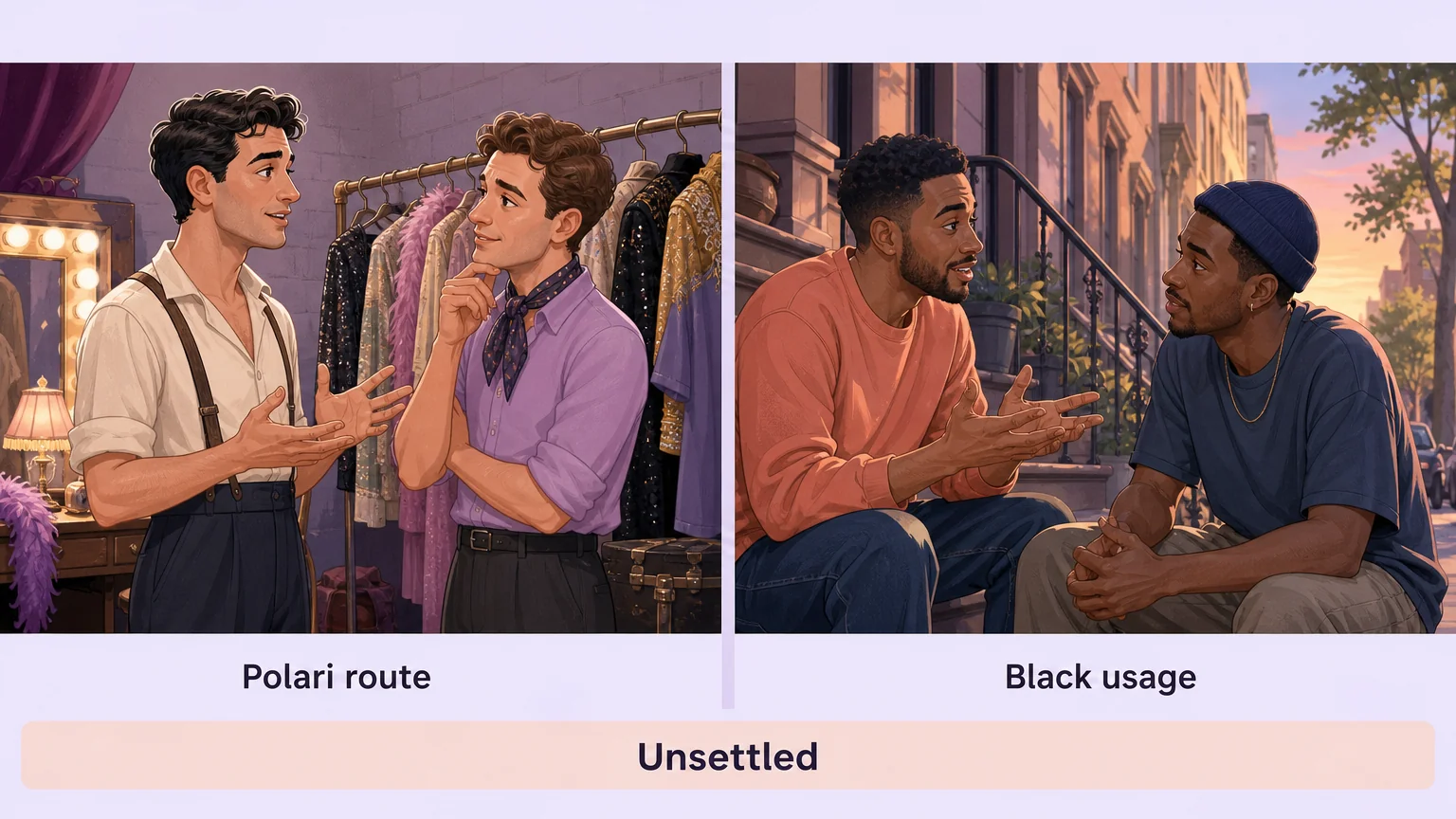
Seth E. Davis dates trade to the late 1800s, earlier than the dictionary record, and argues it “has particular traction in the Black queer community.” His 2022 study of Black queer men is where the claim gets its detail, and his sharper point is the one to hold onto: “it is the Black queer experience that gives trade complexity and meaning.” That places the Black usage at the center of the story rather than at the end of a British word’s long drift.
The meaning moved in two stages. First, trade meant any uncommitted partner. Then it came to mean masculine, attractive men who were straight or could pass as straight, a sense that took hold in ballroom culture.
In old-school ballroom and drag, a trade is “a masculine-passing LGBTQ+ guy who has a certain edge to their look.” The edge is the point. It is a way of carrying yourself, not a costume.
That history is not settled, and the argument about it is public. One position, argued by users like MxSilverWare on X, holds that trade was Polari, that white gay men stopped using Polari in the 1970s, and that the word was rebuilt in Black usage with a different meaning. On that account, anyone using it now is using the newer term. The other position, argued by users like JazyProduction, holds that trade is Black American English slang for a masculine Black gay man and that everyone else has taken it. Neither has been settled.
Inside Davis’s study the boundary shows up as something people enforce and also make exceptions to. One of his participants calls trade “a Black gay term used to describe primarily Black and Latino men” and then insists that white trade exist. Both statements come from the same person, and the tension between them is the shape of the category rather than a mistake.
A third origin story circulates too. The TikTok creator David Brandyn describes straight and DL men going to neighborhoods where queer and trans sex workers worked and exchanging money for sex. That is his account, and it competes with the Polari-first version rather than extending it.
The people arguing about the word are the people who made it mean what it means. The disagreement is part of the meaning, not noise around it.
Trade, DL, and Bisexual: Three Labels That Are Not the Same
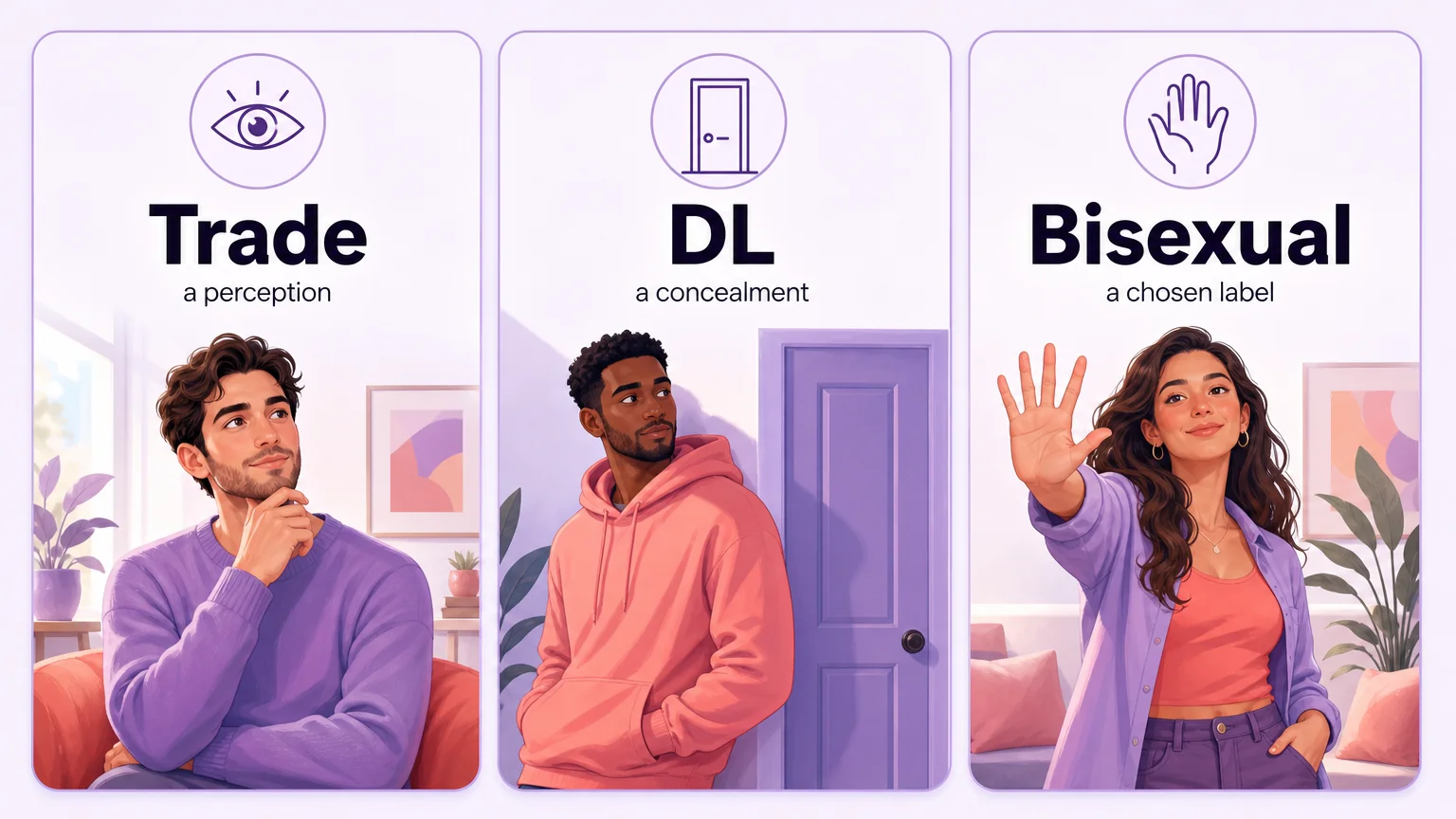
The three terms get used as if they were interchangeable, and they describe different things. Only one of them is chosen by the person it describes.
Davis puts the key distinction in one line: “DL represents sexual identity being hidden, trade speaks to an identity in flux.” Hidden versus unresolved. That is the difference worth keeping.
A DL man is concealing something. A trade may be concealing nothing at all, because he may have no gay identity to conceal. He can be trade without being on the down low, and a DL man is not automatically trade, even though people say “DL trade” often enough that the mashup has become its own phrase. Confusing the two is how a word about ambiguity turns into an accusation about hiding.
Bisexuality is the easiest of the three to get wrong. Bisexual and pansexual are labels people choose for themselves. Trade is a label other people put on a man, and it says nothing about how he describes his own orientation. A man called trade may be straight, bi, gay, or none of the above. The word is not making a claim about that, which is exactly why it is useful and exactly why it is presumptuous.
If a man tells you what he is, that answer outranks the word anyone else used about him.
How People Use Trade Now: Apps, Memes, and Drag Race
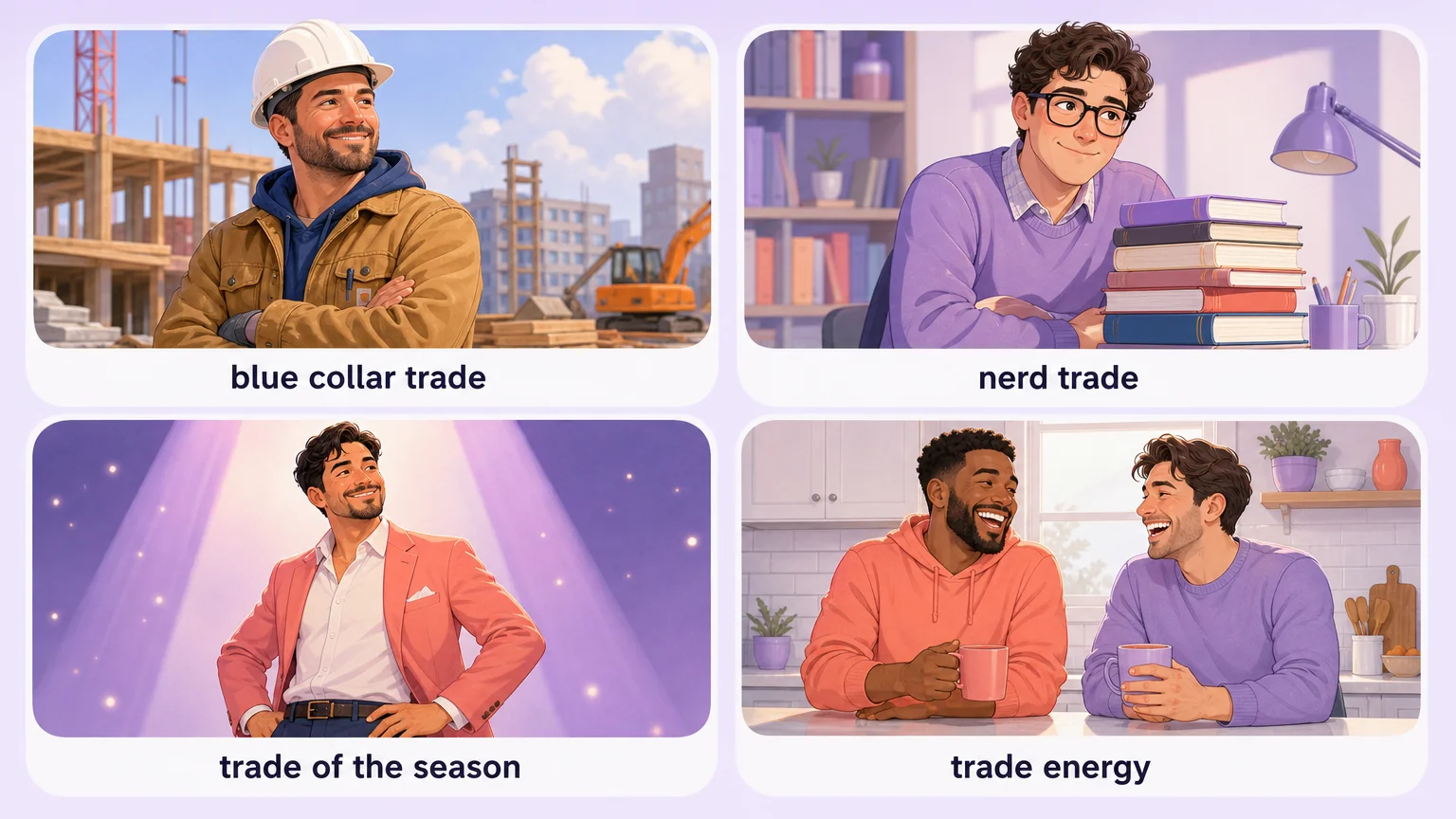
Michael Henry uses trade constantly and admits he usually means something else. “A lot of times when I say trade, I should be saying trick. But trade I like better.” His reason is the clearest evidence the word has left identity behind: “Trick sounds a little deceptive.”
He still offers the old definition. “Trade is really straight-passing, like hunky guy or whatever. But I just call everybody trade.” The adjective now simply means attractive: “Oh my god, who’s that trade?”
The meme record shows the same drift. The “Trying to Impress the Trade” template began in May 2025 as “me trying to impress brat trade” and within weeks had produced “bugs bunny trade” and “flappy bird trade.” Once any noun can sit in front of it, trade is a suffix for desirability.
Compounds keep pieces of the old meaning alive: “nerd trade” shows how far the prefix can travel, and “it’s giving trade” keeps almost none of it, meaning only that he looks good.
Drag Race did its own version. Used of Kahanna Montrese in season 11, “trade of the season” now means the sexiest queen of a season, a woman rather than a man. Some people have objected that this erases the sex workers the word came from.
On apps the word changes shape. A profile advertises the same information in a labeled field rather than an adjective, which is why “masc” does the work in a bio that trade does out loud. On apps, including 3Fun, a man describes himself, which is the one thing trade never does.
One of Davis’s participants thought the word had slowed down since the 2000s. That is one person’s observation, not a measurement. The word is splitting rather than fading. One half is becoming a general word for attractive, the other is surviving as a class marker.
Is Trade a Compliment, a Slur, or Neither?
In ordinary use it is not a slur. It is a descriptor, usually an admiring one, and occasionally a small cruelty. Those three things are true at once, and the last is the part people skip.
Davis gives the word a pejorative edge: trade “pejoratively speaks to ‘how they (collectively) be.'” It is a riff on the idea that all heterosexual men act and think alike. Calling a man trade says what he is like by naming the category he belongs to, and the category is a stereotype.
The strongest objection comes from inside the community, from Davis’s participants rather than an outside critic. One of them says, “It seems to be that the more effeminate men are looked down upon,” and names “the effemiphobia in the community” as his concern, adding that “it was the more effeminate men (and transwomen) that started the Stonewall Riot.”
The compliment works by contrast. If a man is desirable because he is not feminine, the word measures how far he sits from femininity. That measurement is taken in front of the men it ranks below him.
The consent problem is the practical one. Davis puts it plainly: “Anyone who is not obviously legible as gay is trade.” The label lands on how a man reads, so being called trade can mean being read as closeted. For a man whose safety depends on not reading that way, the compliment is a hazard.
There is an ownership question too: some Black users object to outsiders using a word they consider theirs, on grounds of history rather than manners.
So: not an insult, and not neutral either. It is a compliment with a measuring stick inside it.
How to Use Trade Without Getting It Wrong
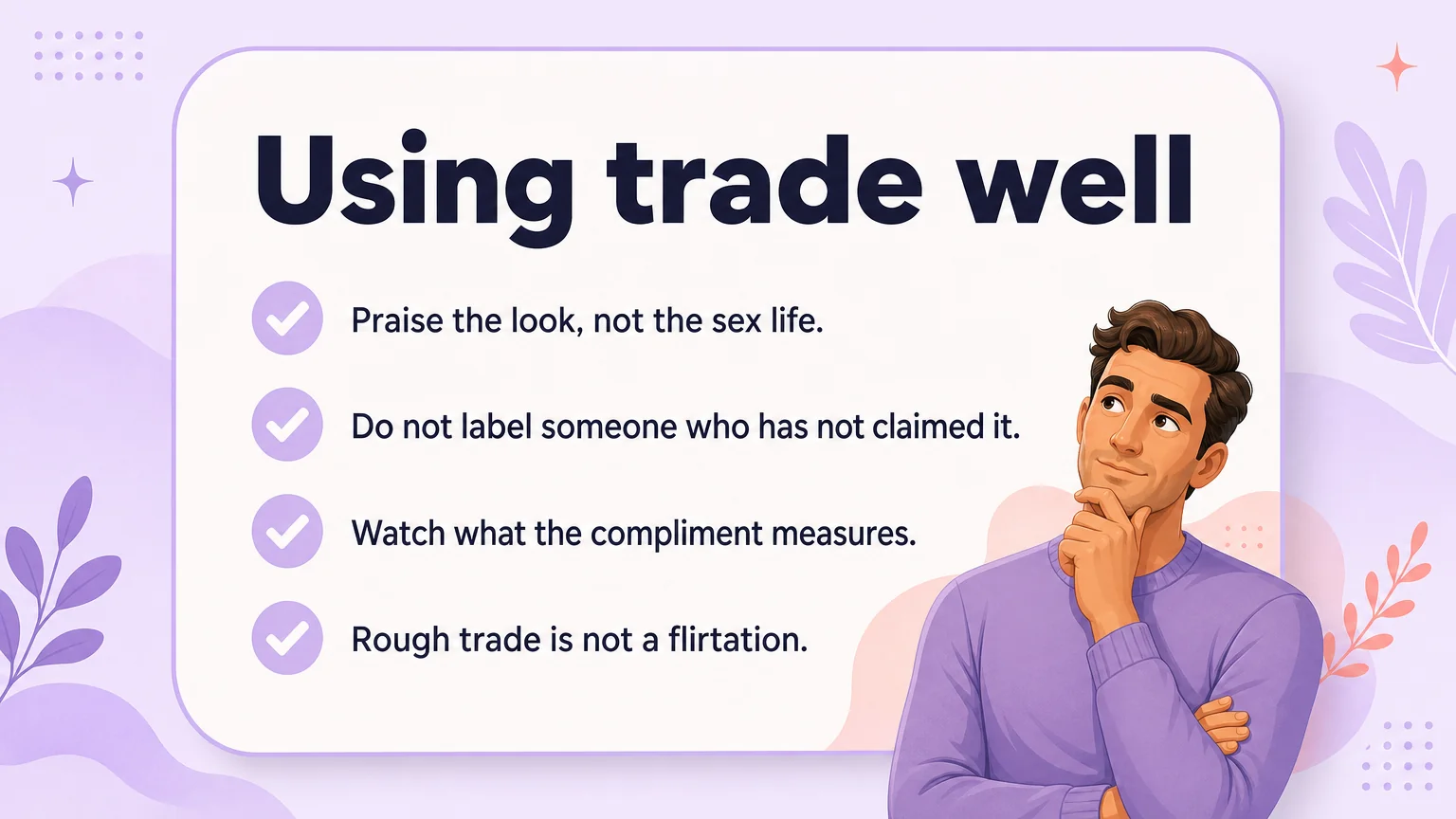
Trade is applied from outside, so anything you do with it is something done to a man who did not ask for it.
Praise the look, not the sex life. “He’s trade” is ordinary as a comment on how a man reads. Using it to imply something about who he goes home with is a claim you cannot make for him.
Do not label a man who has not claimed anything, especially in public or in front of strangers. The word reads as an outing because it was built to describe men who were not out.
Watch what the compliment is measuring. If the praise only works because the man is not feminine, the word is doing effemiphobia’s work, and the men it ranks can hear it even when you did not mean it.
If the word is not yours, use it with care. Some Black users consider it theirs and say so publicly. The word has a home, and visitors should act like visitors.
Rough trade is not a flirtation. The dictionary definition includes violence, and the history includes men who were killed. Do not use it to signal an appetite for risk.
The principle: the word is fine when it describes someone’s style, and it stops being fine when it describes someone’s private life without him.
Frequently Asked Questions About Trade
Does trade mean the man is straight?
Not necessarily. The working definition is a straight masculine man who has sex with gay men and trans women, but the word marks how a man reads, not a verified orientation. Plenty of openly gay men get called trade because they read as straight. Nothing about the label requires the man to confirm or deny anything.
Is trade the same as DL?
No. DL means a sexual identity is being hidden, while trade means the identity is in flux or simply unreadable. A man can be trade without being on the down low, and a DL man is not automatically trade. The phrase “DL trade” fuses them, but the distinction underneath still holds. The words answer different questions.
Is trade the same as bisexual?
No. Bisexual and pansexual are labels people choose for themselves. Trade is a label other people apply, and it says nothing about how the man describes his own orientation. A man called trade may be straight, bi, gay, or none of the above. The word is a comment on how he looks.
What is rough trade?
A trade who fits an extreme masculinity stereotype: physically strong, rough, often a laborer in construction, trucking, or factory work. The dictionary definition of the term is “a violent sexual partner,” which is where the danger in the phrase comes from.
Where does the word come from?
Green’s Dictionary of Slang dates the adjective to 1937 and rough trade to 1900. The Polari route is the standard account. The Black queer usage is where the modern meaning comes from, and it is not simply a continuation of the British one. That last point is where the record is most contested, and the disagreement is live.
Do younger gay men still use it?
Yes, but more often as a general word for an attractive man than as an identity category. In a 2026 podcast exchange, one speaker says he often means trick, and his reason for preferring trade is a single line: “Trick sounds a little deceptive.” The word is current, and it has been repurposed rather than retired.