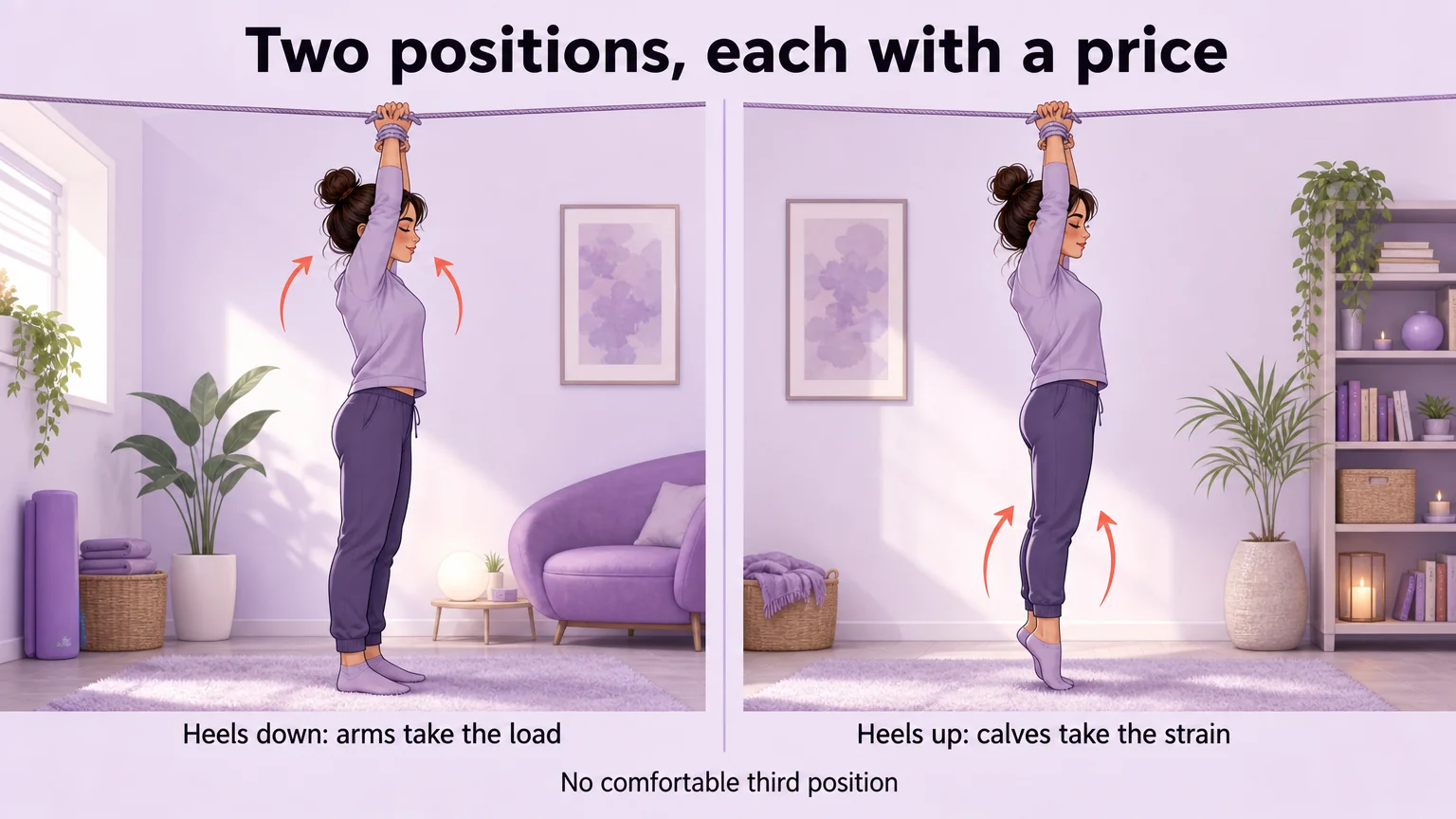
Your hands are tied above your head. You are up on tiptoe, because staying there eases the burn in your arms while dropping your heels pulls the rope taut across your shoulders, and there is no third position that is comfortable. That is predicament bondage: restraint where every position available costs you something, so the person tied keeps deciding instead of holding one pose.
Ordinary bondage takes choice away. This hands back a narrow slice of it and prices every option.
The tiptoe image is the whole idea in miniature. Two people built a situation where every position has a price, then handed the choosing to the person inside it. Nobody is enduring a pose. They are solving a problem with their body.
What follows covers how these scenes get designed, the four most common shapes, where the physical risk sits, how to negotiate one, what a good first attempt looks like, and what to do the next day.
What Predicament Bondage Is, and What It Is Not
A predicament does not depend on how much it hurts. It depends on how much choice it leaves.
The working definition of predicament bondage: a form of restraint where the person tied can choose between positions, and the positions on offer are uncomfortable in different ways rather than one being a way out. The choice has to be real. That retained agency is what everything else hangs on.
Two mechanics cover most of it. First, the trade-off. Tiptoe strains the calves, heels down loads the arms, and eventually neither is available.
The second keeps someone comfortable and still, then adds a trigger: movement pulls a rope, a weight or a clamp that hurts. Tickling or teasing makes the movement involuntary, which is the point.
A third shape exists. Escape is possible but unknown, or the release costs something the person will not pay. It produces intense scenes and the easiest ethical mistakes.
Predicament bondage is not coercion, because the option to stop has to exist and be usable. Not harm, because the goal is a decision, not an injury. Not pain by definition, because pain is only one currency. Not a gear contest, because a single-column tie, an anchor point and clothespins make a complete scene.
Three nearby practices are worth separating. A stress position is raw material: a posture that turns painful through duration. Interrogation play is a theme over a scene, not a structure. Semenawa names the wider genre of torment rope, and a predicament is one device inside it, not a synonym.
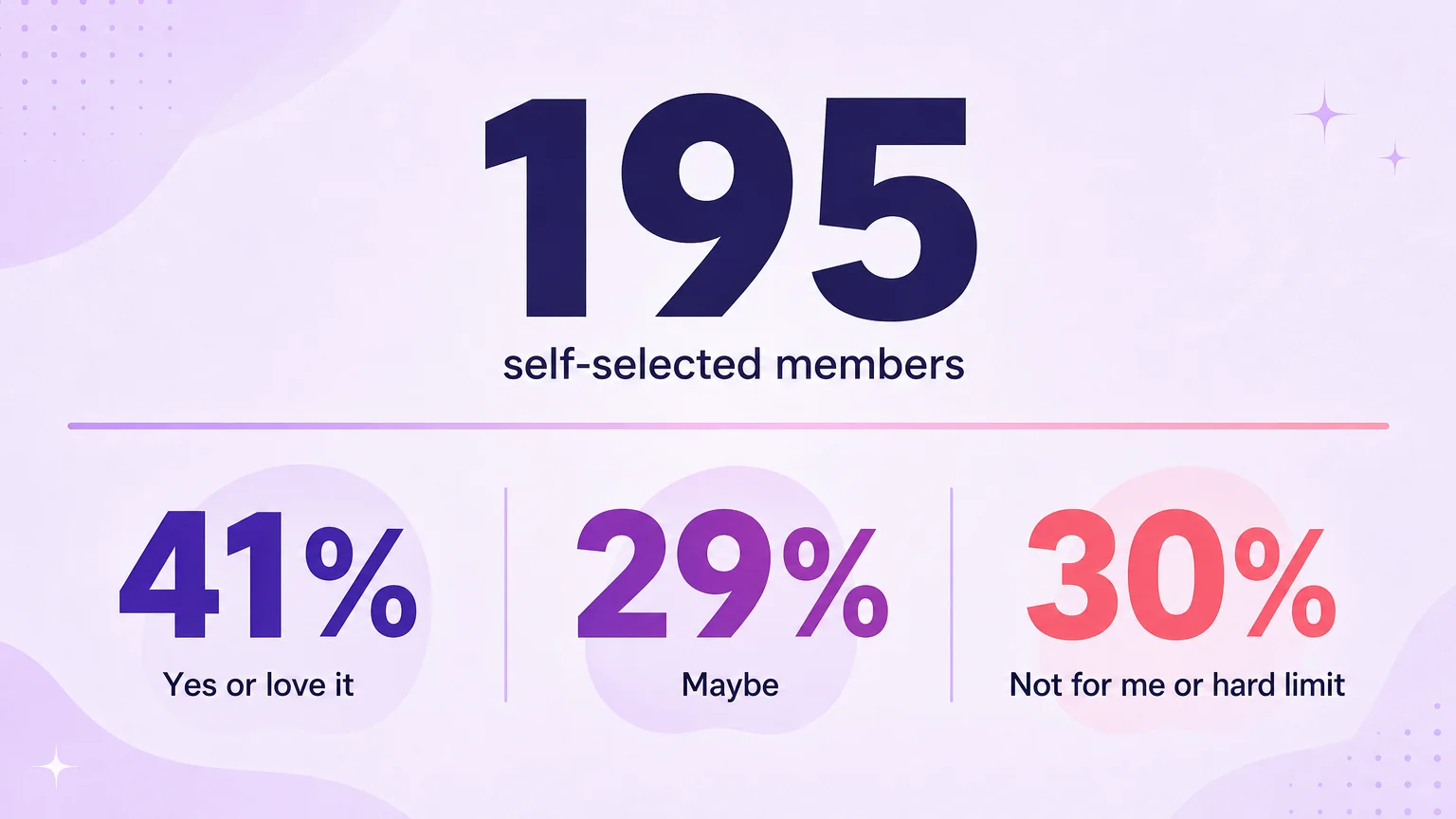
Not everyone wants this. In one kink checklist, 195 members rated the activity. They are a self-selected group already in kink spaces, not a population sample: 41% said yes or love it, 29% said maybe, and 30% marked it not for me or a hard limit. A third of an already kink-identified group rules it out. A no is an ordinary outcome, not a failure of openness.
Stress position: one posture, held until it hurts. Predicament: two postures, each with a price. Semenawa: the genre those devices live inside.
How Predicament Bondage Scenes Work: Five Design Levers
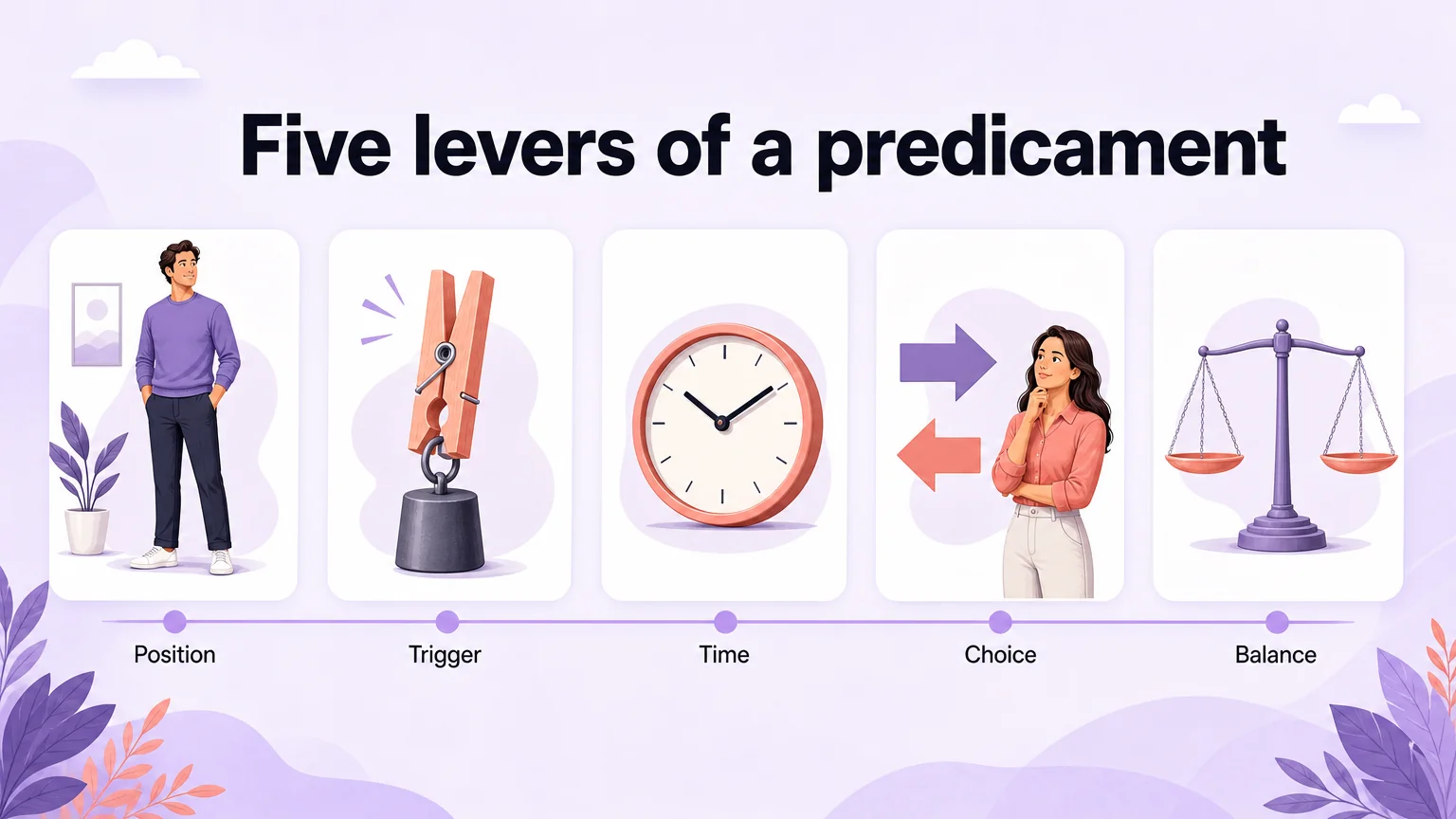
Every predicament bondage scene is five decisions wearing a rope.
- Position: what the body has to hold.
- Trigger: what fires when it fails, whether a clothespin pulled off, a weight dropping or a crop landing.
- Time: muscle fatigue is the clock, so the position degrades on its own without anyone watching a stopwatch.
- Choice: how many options exist and how clearly the person can see the trade.
- Balance: weight that shifts as the body tires, so the decision gets harder the longer it runs.
Those levers produce three strategies, and only one is about pain. Pain-pain is the lesser of two discomforts. Pain-pleasure means enduring something to reach something wanted.
Pleasure-pleasure means two things are wanted and only one is available at a time, like a wand positioned behind while a partner waits in front. Both options are good. The cost is choosing which one to give up.
The lowest-risk version needs no rope. Stand in one spot for a set time, and any movement earns a smack with a crop. That is mental bondage, and it is the cheapest way to test whether the idea appeals before adding gear.
Why it grips is not complicated. The engine is choice inside helplessness: a real decision, made under constraint, with a visible price. The struggle is legible from outside, which gives the person watching something to read, tease, correct and encourage instead of something to perform. The person tied gets hyperfocus, small wins and a sense of competence, because the problem occupies body and mind at once and the rest of the day drops away.
Put difficulty at the edge of ability: hard enough to challenge, not so hard that failure arrives in the first minute.
Whether the person can solve the dilemma decides whether the scene ends in accomplishment or surrender. Both are legitimate. Only one is usually what people think they are building, so choose it on purpose.
Build the choice before the consequence. If the consequence is the only interesting part, there is no predicament yet, just a punishment with extra steps.
Predicament Bondage Examples: Four Scenes and Their Safety Rules
A scene described without its limit is a hazard with good lighting. Four shapes, each with its rail.
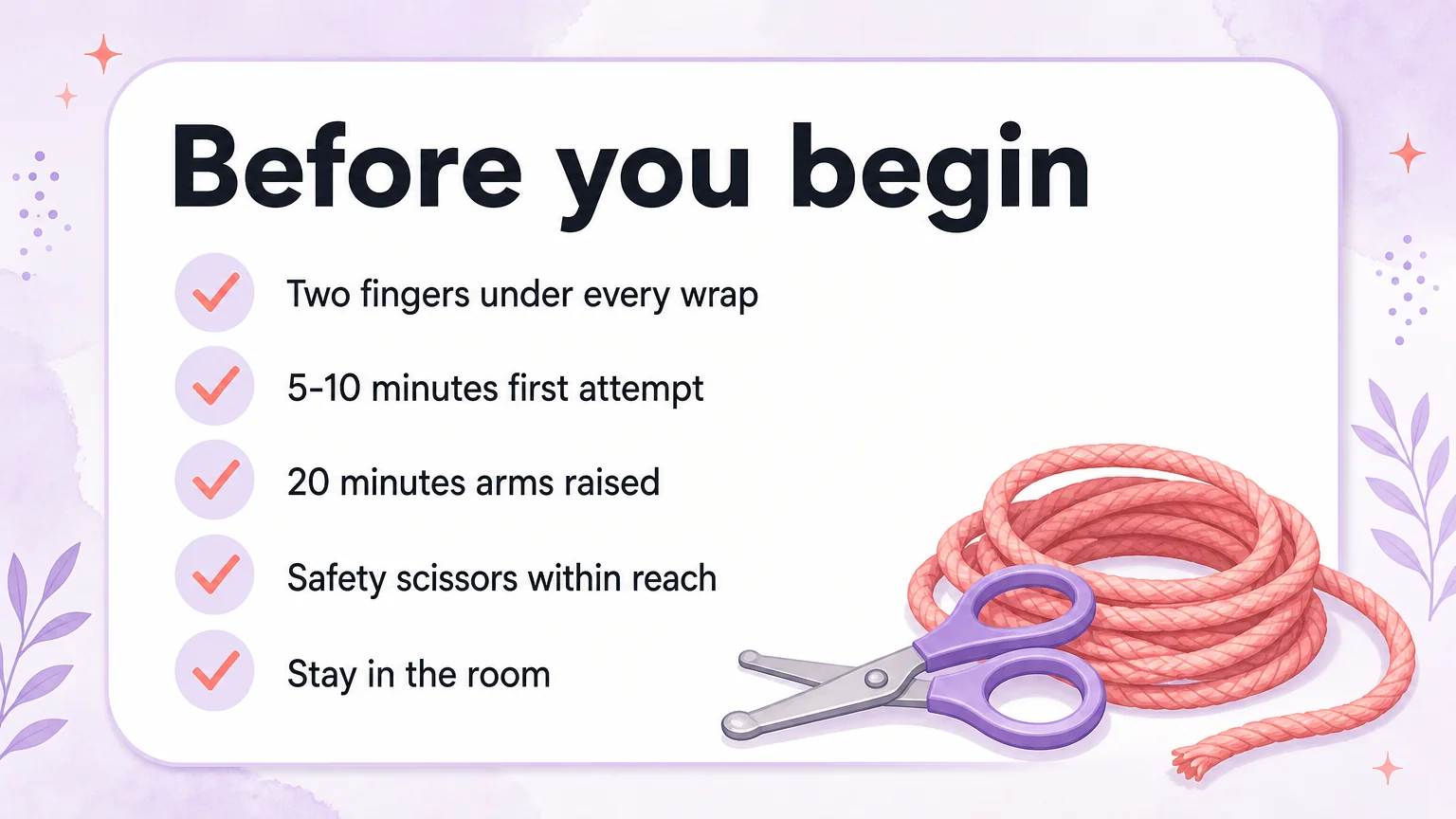
The tiptoe trade-off. Hands tied overhead, standing on tiptoe. Heels down loads the arms and shoulders; heels up strains the calves. Eventually neither is available. Rail: 20 minutes is the ceiling for hands above the head; the top never leaves the room; any chest wraps get the two-finger check before they take load; and the fingers get checked every few minutes for color, temperature and feeling.
The toy out of reach. A vibrator set just past where the body can settle, so easing one muscle gives up the sensation. Rail: nothing around the neck, a quick-release clip so it frees in one movement, the control in the top’s hand, and a check for numbness from pressure and vibration.
The held-still game. A cup of water balanced on the back of each hand, or a coin held to the wall with the nose. Any relief movement spills it. Rail: no rope at all, the lowest-risk scene here, plus a timer so it ends on schedule rather than on someone’s shame.
The threat that never happens. Keys set out of reach behind closed curtains, or a phone lifted mid-scene for a photograph that is never sent. The threat is real to the person tied, and nothing is exposed. Rail: agree the fiction beforehand, keep the shades down, delete the image in front of them, and read the person closely enough to stop before the safeword. If you read it wrong, say at once that nothing was sent.
Midori, a BDSM educator, describes an advanced version: clamps tied to the headboard, a wand at the footboard. Leaning one way eases the clamps and loses the vibration, and the trade changes with every inch. Drop the clamps and offer oral sex; reaching it means leaning away from the wand entirely. Rail: each layer gets its own check, and nothing new goes onto a body that is already numb or overstimulated.
Start with the held-still game. Save the exposure scene until both people can say out loud what is real and what is theater.
Predicament Bondage Safety: Nerves, Time Limits, and the Kit
A tie that is fine at minute two is not fine at minute 20. Held positions combine load, duration and restricted movement, and the body gives way slowly before it gives way all at once. Most of the risk in predicament bondage is specific and checkable.
Before you load a wrap, run the two-finger check. Two fingers should slide comfortably under the rope where it crosses the arms. A harness can be completely secure without being painfully tight.
During the scene, check four things in the same order every few minutes: color, temperature, sensation, and whether the person can still move their fingers or toes. Same sequence every time, so nothing gets skipped. Then ask about specific territories instead of asking how it feels.
Numbness on the back of the hand and the lower parts of the thumb, index and middle fingers points to the radial nerve. Palm-side numbness in the thumb, index and middle fingertips points to the median. The little and ring fingers point to the ulnar. Those are answers you can act on.
Time is the next number. Five to 10 minutes is a reasonable first attempt. Twenty minutes is the ceiling for hands held above the head. Ten minutes is the cap for clamps on skin.
Set the timer before the scene starts, because nobody should negotiate duration while someone is under load. Every number is a ceiling, not a target.
The design rule that matters most: stay more than one accident away from disaster. Walk the failure chain out loud before anything gets tied. If this knot slips, if that weight drops, if that tether snaps, what happens next?
If the answer is serious injury, the design is wrong regardless of experience. Failure should be uncomfortable, not dangerous.
The kit stays within arm’s reach: EMT shears, keys, bolt cutters if there is metal, an inhaler, a blood-sugar kit, an epi-pen, a first aid kit, a charged phone with signal, a fire extinguisher, a fire blanket, and something soft under the body. Test the shears on a spare length of the same rope before you need them. A rescue tool you have never used is a prop.
And the rule that does not bend: never leave the room, and never leave the person alone.
Emotional Safety in Predicament Bondage: Panic, Red Flags, and Safewords
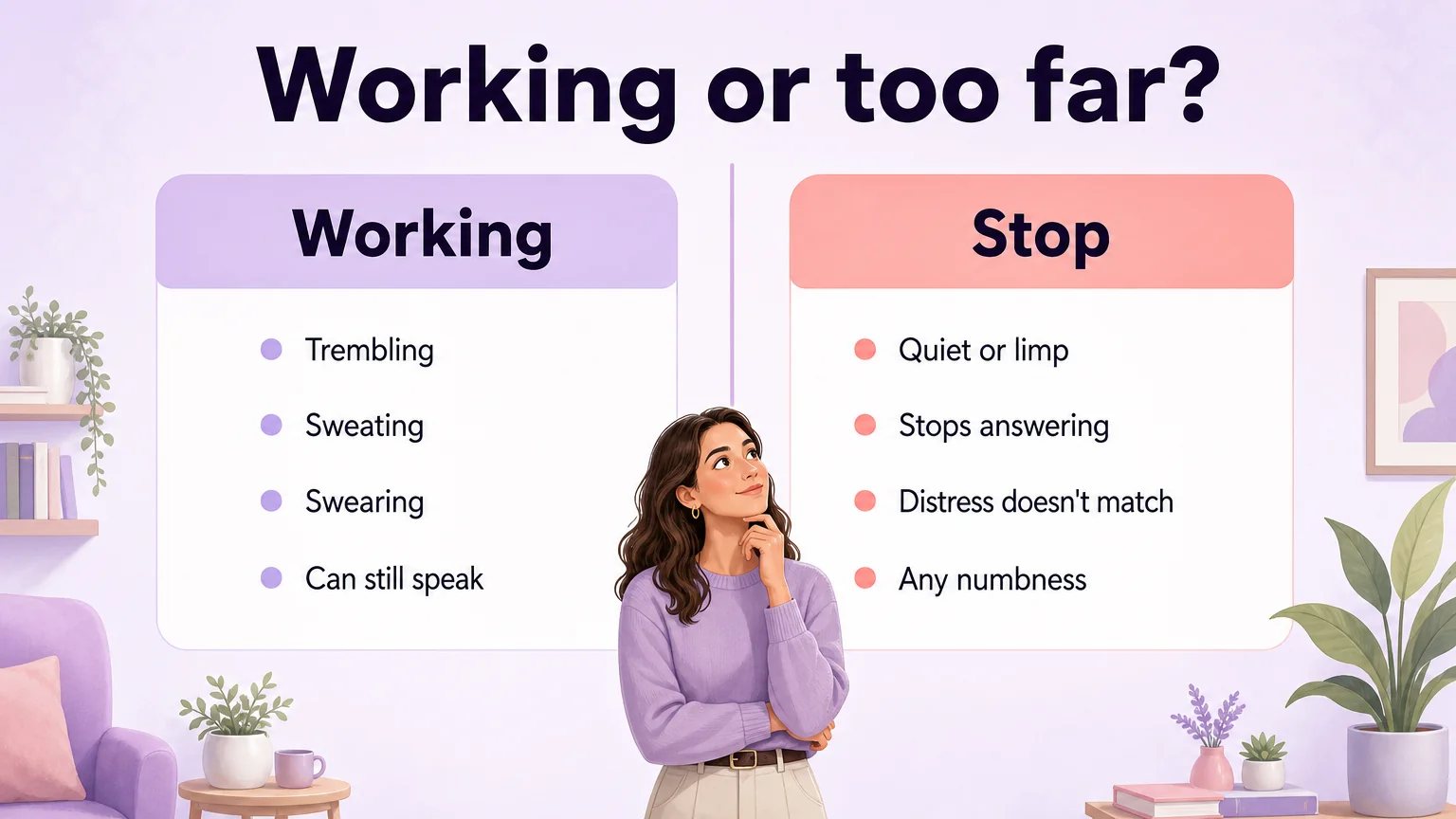
Two states look almost identical and mean opposite things.
Manageable struggle is the scene working: trembling, sweating, swearing, losing the ability to form a sentence. That is a body under load and a mind fully occupied, often exactly what the design was for.
Panic is different. The person goes quiet or limp, stops answering, or answers from somewhere far away, and the distress does not track what is happening in the room. Read the body, because words are the first thing to go.
The safeword’s job is information. It adjusts the scene. It is not a verdict on either person’s competence.
Using it is not failing. Pushing past it is.
Some things end a scene on the spot: a safeword, numbness, tingling, sharp joint pain, dizziness, a limb going cold or discolored, and overwhelm that has left the game.
This is where the practice does damage, and rarely from the rope. One person planned for two days, then stopped mid-setup when a warning voice cut through. They wrote: “I feel disgraced, scared. But this is only one failure.”
Their own postmortem found breathing trouble from a hood, a gag and a corset, clamps that were too strong, and not enough flexibility. Every one was a design problem, not a character problem.
The delayed version is quieter. Shame can arrive days later with cold sweats and an upset stomach, and the thought underneath is some version of: what I enjoyed says something about me.
What helped was a plain reframe. You are not broken. Nothing went wrong. A scene is information, not a test of your submission.
What makes it worse: leaving someone alone with the feeling, treating the abort as a disappointment, or building a consequence that implies they did not deserve the reward. Turning failure into a verdict on someone’s worth is not clever design. Midori calls it unkind.
Name the failure out loud as the scene working, then change one design element next time instead of changing the person.
How to Negotiate Predicament Bondage Before You Tie Anything
Negotiation for predicament bondage has a reputation problem, and most of it is a framing problem. Treated as a contract, it reads as a mood killer. Treated as a conversation, it becomes the interesting part.
Do the homework first. Write a yes, maybe and no list so you know what you are asking for, then say it out loud once. The first barrier is usually embarrassment at your own vocabulary.
Cover five things plainly:
- What: positions, restraint, toys, and what is out.
- Where: the room, the privacy, the anchor point.
- When: start time, duration, hard stop.
- Who: who tops, who can call it, who is responsible for what.
- Why: what each person wants, in emotional terms rather than a list of acts.
People skip the last one, and it predicts whether the scene lands.
Open with the connection, not the request. Name the trust before the ask, and say out loud that they can take time. Then ask when to check back.
Plan for a no before you ask. If it comes, regulate yourself instead of negotiating on the spot, and ask for a specific time to revisit.
Safewords: pick an ordinary word, an herb or a food, so you can practice saying it outside the bedroom. Add a non-verbal signal for when speech is gone, such as dropping a held object or three hand taps. Agree whether the word means stop or slow down, and add a second signal for gradations.
During the scene, ask a question that requires an answer, not a nod: at the top, at the midpoint, and after any position change. One professional dominant opens every scene by standing behind the person, hands on the chest, three slow breaths, reading whether they are nervous, tired or not ready.
A contract is signed once. A conversation gets reopened every time, which is the point of it.
Predicament Bondage for Beginners: Difficulty, Bodies, and Adaptation
Start with plain bondage, then add one element. A single stress position is already a predicament, so the second element is optional. Get competent at the tie first: a reliable single-column tie, tension judged by feel, a nerve symptom noticed before it becomes a problem.
Calibrate to the edge of ability. Hard enough to be interesting, not so hard that failure arrives in the first minute. Err toward easy, because designs that look simple from outside reliably prove harder from inside.
Test the mechanism on yourself first, with the weight alone if there is one. Cap a first attempt at five to 10 minutes, design the failure to be uncomfortable rather than dangerous, keep an exit available, and acknowledge the effort whether the position held or not.
Ask everyone the same body questions, not only the people who volunteer a condition. Pain, nerve symptoms, injury history, mobility, sensation in the limbs about to be tied. Know baseline pain in advance, or you will misread it as scene feedback. If your partner is disabled or lives with chronic pain, do not hand them the job of teaching you their body on the night.
Adapt the setup instead of the person. Chair, stool and mattress configurations replace kneeling and standing. An under-mattress strap system lets the mattress carry the body’s weight, needs no drilling and packs away.
A stool keeps knees and back out of the equation and puts the top at a working height. Cotton rope suits sensitive skin and gives more than synthetic cord. Keep mobility aids within reach and out of the rope path, and plan how the person will stand up before you plan how they will stay down.
Measure every scene against able-bodied standards and you will miss what was available.
Start seated or bed-based if either person has a back, knee or shoulder history. Skip standing predicaments until the basics have gotten boring.
Predicament Bondage Aftercare: Drop, Debrief, and the Day After
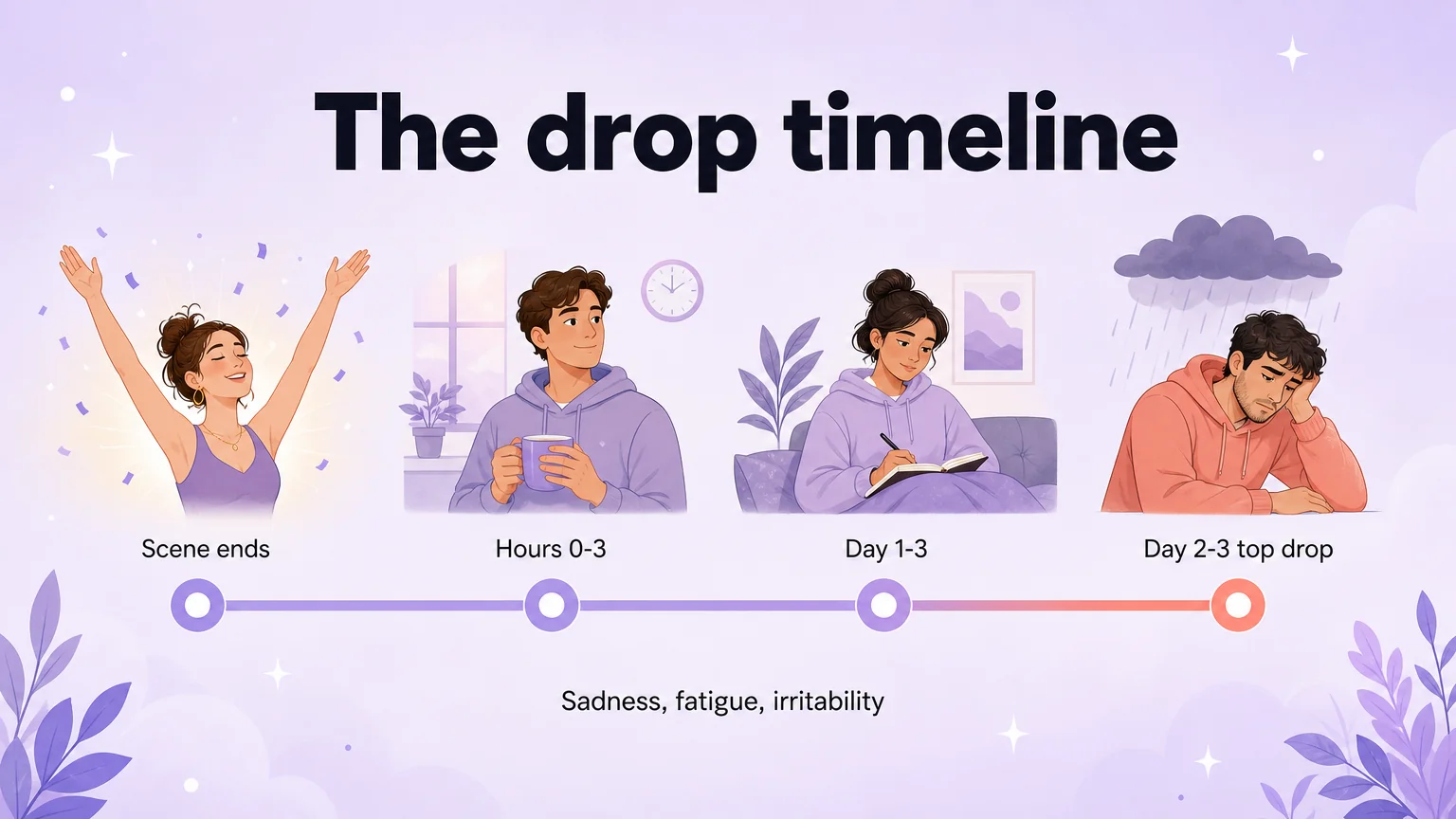
Drop has a timeline, and knowing it removes half the alarm. It usually arrives hours to three days after a scene: sadness, irritability, fatigue, a sudden raw vulnerability, or a flat emptiness. Top drop often lands two to three days later, sometimes after seeming completely fine. It is a nervous-system response, not evidence that the scene was a mistake.
The mechanism explains why aftercare is not a blanket and a glass of water. The arousal cascade a scene produces does not switch off when the scene ends. Without another calm person’s cues, the system can stay in unresolved arousal, which is the substrate of a crash.
Aftercare is co-regulation: presence, warmth, a settled nervous system in the room with yours. Duration is individual. Some people need 20 minutes. Some need two hours.
Agree the plan before the scene, when both of you can think clearly, rather than improvising after it. The basics: warmth, water, simple food, touch calibrated to the person or quiet proximity without it, and staying through the transition instead of leaving when the scene ends. Keep the phone nearby. Make no major relationship decisions during a drop window.
The debrief happens a few days later, when both people are clear, and it has four questions:
- What felt good?
- What felt uncomfortable?
- What surprised you?
- What would you change?
Keep the answers specific and physical, the way you would describe a knot that sat wrong, because specifics are what calibrate the next scene. Stay in contact across those days rather than checking in once and disappearing.
The debrief is where a scene turns into trust. Everything before it is just the scene.
How to Talk About Predicament Bondage With a Partner

One person is often curious while the other is not sure, and that does not have to be a crisis.
If you are the curious one, lead with the why rather than the act. Name what the interest means to you in emotional terms, because that is what a hesitant partner can respond to. Say out loud that a no is allowed, and mean it.
Offer the smallest adjacent version: one element, one night, with an agreed stop. Ask for a specific time to revisit instead of leaving the question hanging. Pressing converts a maybe into a permanent no, and a no about one practice is not a verdict on the relationship.
If you are the hesitant one, you can be interested in your partner’s curiosity without doing the thing. A clear no, said early and without contempt, is kinder than a reluctant yes that builds a year of resentment. If what you need is time, say so, because a maybe with a date on it is easier to live with than a maybe with no end.
If you are single, separate vetting from negotiation. Vetting decides whether to play with this person at all. Ask about experience, the rope they enjoy, how they handle negative emotions, their limits, how they prepare, whether they drink or use drugs before playing, and their aftercare.
Ask for past partners as references and follow through. Ask people who have played with or watched this person. Watch how they respond to a small no before you are naked and tied. Treat green flags as evidence, not a guarantee, and vetting as continuous rather than a gate you passed once.
If you would rather start with people who already speak this language, an open-minded dating app puts the conversation on the table earlier, and 3Fun is one of them.
Predicament Bondage: Frequently Asked Questions
Can you do predicament bondage alone?
No. This is the one hard line. It depends on a second person who watches, reads the body and can release. Self-bondage accounts describe restraint turning from pleasure to anger once escape becomes impossible; one account describes a near-miss with breathing restriction that ended the setup.
Does it have to involve pain?
No. Pain is one of three currencies. Pain-pleasure trades discomfort for something wanted; pleasure-pleasure offers two things that cannot be had at once. A psychological version needs no rope: stand still for a set time and let movement carry an agreed consequence.
Can you build one without rope?
Yes. Standing in one spot with a crop, balancing a cup of water, or holding a coin to the wall with your nose are complete predicaments. It runs on choice and price, not hardware. Rope is optional; the structure is not.
Does it have to be sexual?
No. A scene can be erotic, grounding, playful or intense without sex, and arousal does not obligate performance. Orgasm is a goal only if both agreed. Plenty show up for the puzzle and leave sex out.
What if my partner isn’t into it?
Their no is allowed, and pressing turns a maybe into a permanent no. Lead with why it matters, say they can refuse, and set a specific time to revisit. A no about one practice is not a verdict on the relationship.
Is it normal to feel low days later?
Yes. Drop runs from hours to three days, sometimes longer for the top, and it is a nervous-system response, not a sign something is wrong with you. It often arrives as fatigue or flat emptiness. If it lasts longer, talk it through.
How much rope skill do you need first?
Enough to tie a reliable single-column tie, judge tension by feel, and recognize a nerve symptom before you add anything on top. Plain bondage competence comes first. A predicament adds a second variable, and you cannot troubleshoot two unknowns at once.
Run the physical safety checks above.