What is light bondage? It is consensual restraint at the low-intensity end of the spectrum, and it does not require pain, equipment, or a particular role. Bondage itself is the practice of consensually tying, binding, or restraining a partner for erotic, aesthetic, or somatosensory stimulation, and it does not necessarily imply sadomasochism. Light describes how much intensity and risk you are taking on, not a fixed list of approved acts.
The entry point is closer than it looks. You can start with your own hands holding a partner’s hands together. You can start with a sentence: stay still. Neither costs anything, and neither carries the risks that come with rope. Bondage can be an end in itself, not a warm-up to something harder.
This guide covers the line between restraint and other kinds of play, how to plan a first attempt, what gear is worth buying, the safety rules that prevent injury, how to negotiate, and what to do afterward, including the crash that can arrive days later.
One decision comes before all of it: which of those activities you are curious about. Start there.
Light Bondage vs. Soft Bondage: Restraint, Sensation, and Impact
Light bondage and soft bondage name the same practice. Soft bondage is its low-intensity end, where one partner holds the other’s hands together or gives a verbal order not to move, with no gear at all. That zero-equipment rung is bondage. It tests the psychological dynamic of handing over control without a knot, a cuff, or a circulation risk.
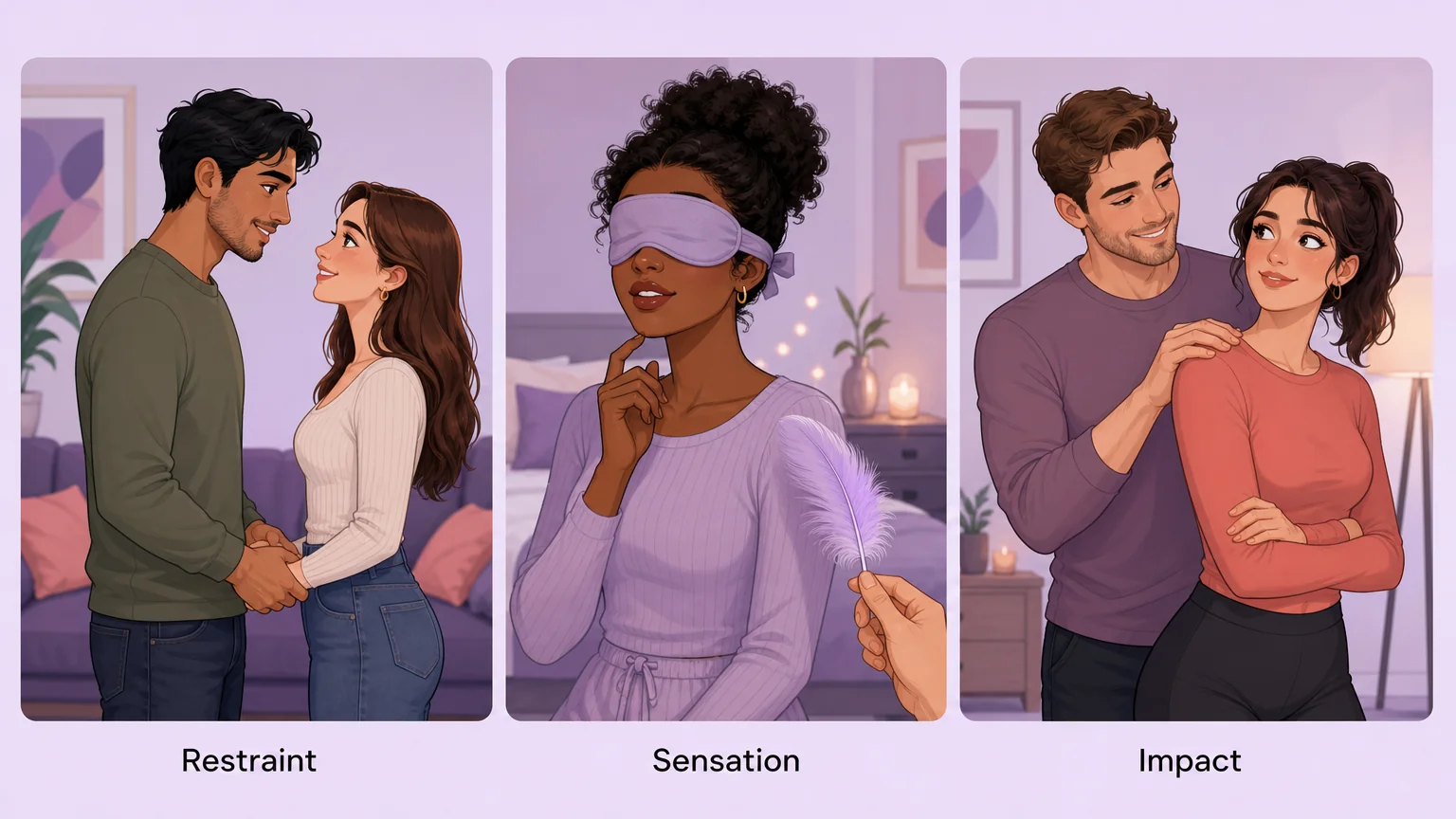
From there, “light” describes three different kinds of activity, and each carries a different risk profile.
Restraint is tying, binding, or holding someone in place. Sensation is a blindfold, ice, a feather, temperature, or light scratching. Impact is spanking, paddling, or flogging.
Light bondage is a restraint practice. Adding a blindfold or a light spanking makes a scene, not a new definition. A blindfold alone is sensation play; the same blindfold over a bound partner is both. You can want one without the others.
Ask three questions to sort out what you are agreeing to:
- Is force being applied?
- Is movement being limited?
- Is sensation the point?
If movement is limited, it is restraint. If force is applied, it is impact. If the point is what the skin feels, it is sensation. Two or three can overlap in one scene, which is fine as long as both people know which parts are in it.
“Light” has no objective threshold. What counts as light depends on experience, positioning, and how easily either person can stop. The label matters less than whether the risk matches both people’s experience, and whether either person can get out without asking a favor.
Name the activity before you name the intensity. Restraint, sensation, or impact, then how much.
Why Light BDSM Can Feel More Intense Than Rough Play

Rough is not automatically more exciting. A beginner workshop in Paris opened with that correction: soft touch can create more anticipation, more desire, and more intensity than harsher play. The mechanism is anticipation, not force. Waiting is the point.
Restraint also changes what two people are doing together. It is a shared activity, and the process of being tied matters as much as the result. In that workshop, roles were set by a physical prompt: whoever placed a hand on top chose to lead that round, and partners alternated, debriefing after each round. Trying both sides in one evening teaches more than any explanation.
A move that worked for years can stop working. One attendee described her body shutting down when her partner reached for her chest the way he always had. She could not say so in the moment, because they were in a scene and objecting felt like breaking it. She raised it in the debrief instead.
That is the skill worth practicing, and it is not gendered or reserved for couples. Whoever is leading can check in, and whoever is following can say “not that.” A date can hear it, a new partner can hear it, and someone exploring alone can notice it.
Going slow is light bondage with room to notice what is happening. Nothing about that is timid.
Light Bondage for Beginners: Planning Your First Scene
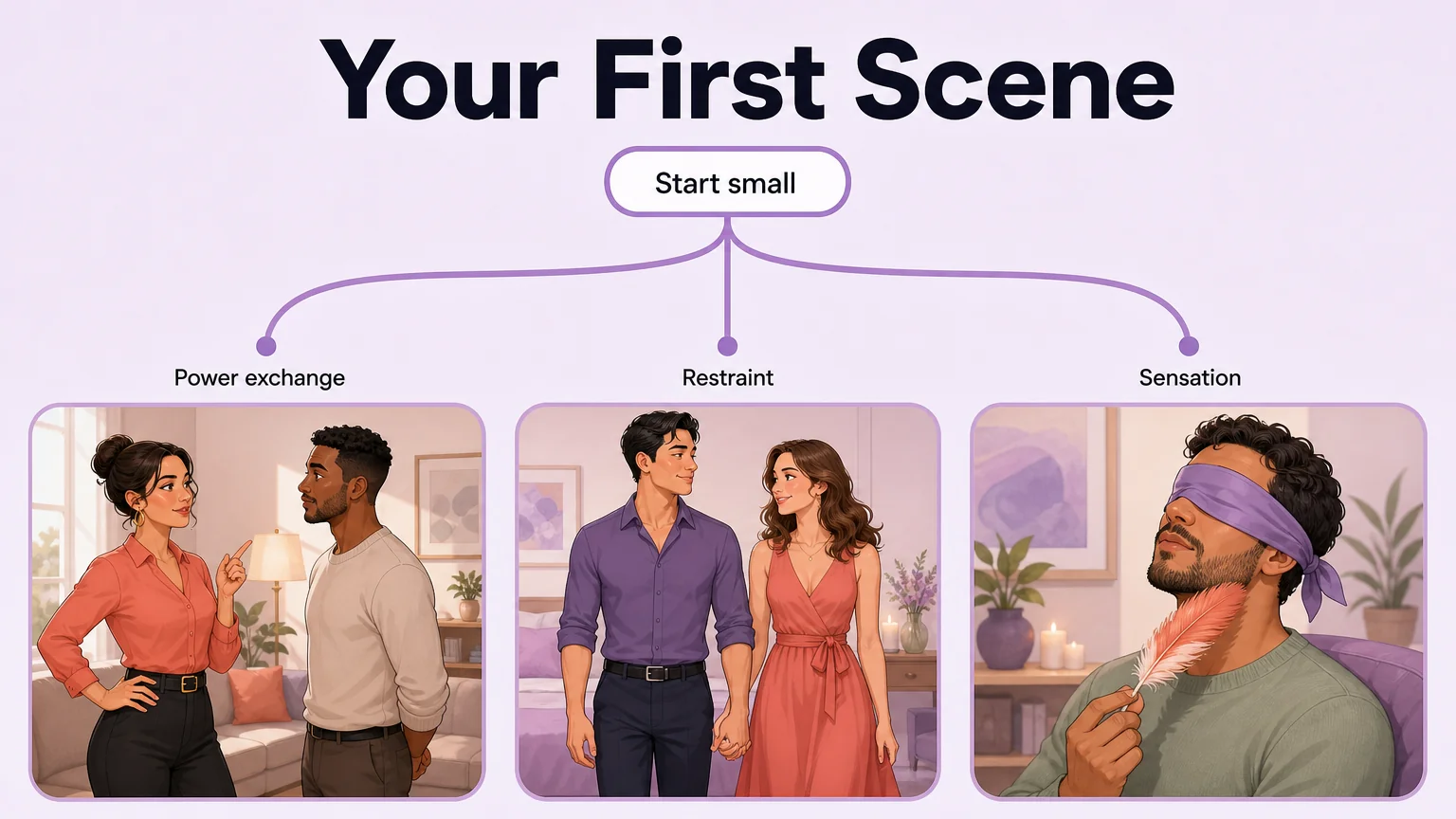
Start with the interest, not the equipment. What are you curious about?
Power exchange. The lowest rung is one element, not a full scene. What you are called. A single instruction, held for a minute. That is enough to learn whether the dynamic interests you.
Restraint. Start with hands held. Then a verbal instruction not to move, sometimes called honor bondage, which involves no physical restraint at all. Then a flat top sheet, which has no stretch, is soft and bulky, and can be cut off in seconds. Padded cuffs come after that.
Sensation. Take the slowest, lowest-intensity version of whatever it is. A blindfold before anything else. One ice cube, moved slowly, not held in place.
Four rules apply to all three:
- Stay on the floor or the bed.
- Skip suspension entirely.
- Plan the exit before anything starts, so both people know how this ends.
- Set a timer if either of you is anxious, because a timer makes “we said ten minutes” a fact rather than a negotiation.
A first light bondage scene does not need a beginning, middle, and end. One instruction, held for a minute, and a debrief afterward is a complete first attempt.
If you want to learn knots, practice on someone you are not sleeping with. It separates the mechanical skill from the sexual context and lowers the stakes of getting it wrong.
If you are exploring alone, self-bondage is a different and higher-risk category, not a beginner version of this. Restraint you cannot release yourself from removes the person who would notice a problem. Fantasy and sensation are the lower-risk ways in.
Before the first attempt, say the plan out loud: what we are trying, how long, what stops it, and what happens afterward.
Then pick the smallest version and do that one tonight.
Light Bondage Gear: Why Cuffs Beat Rope for Beginners
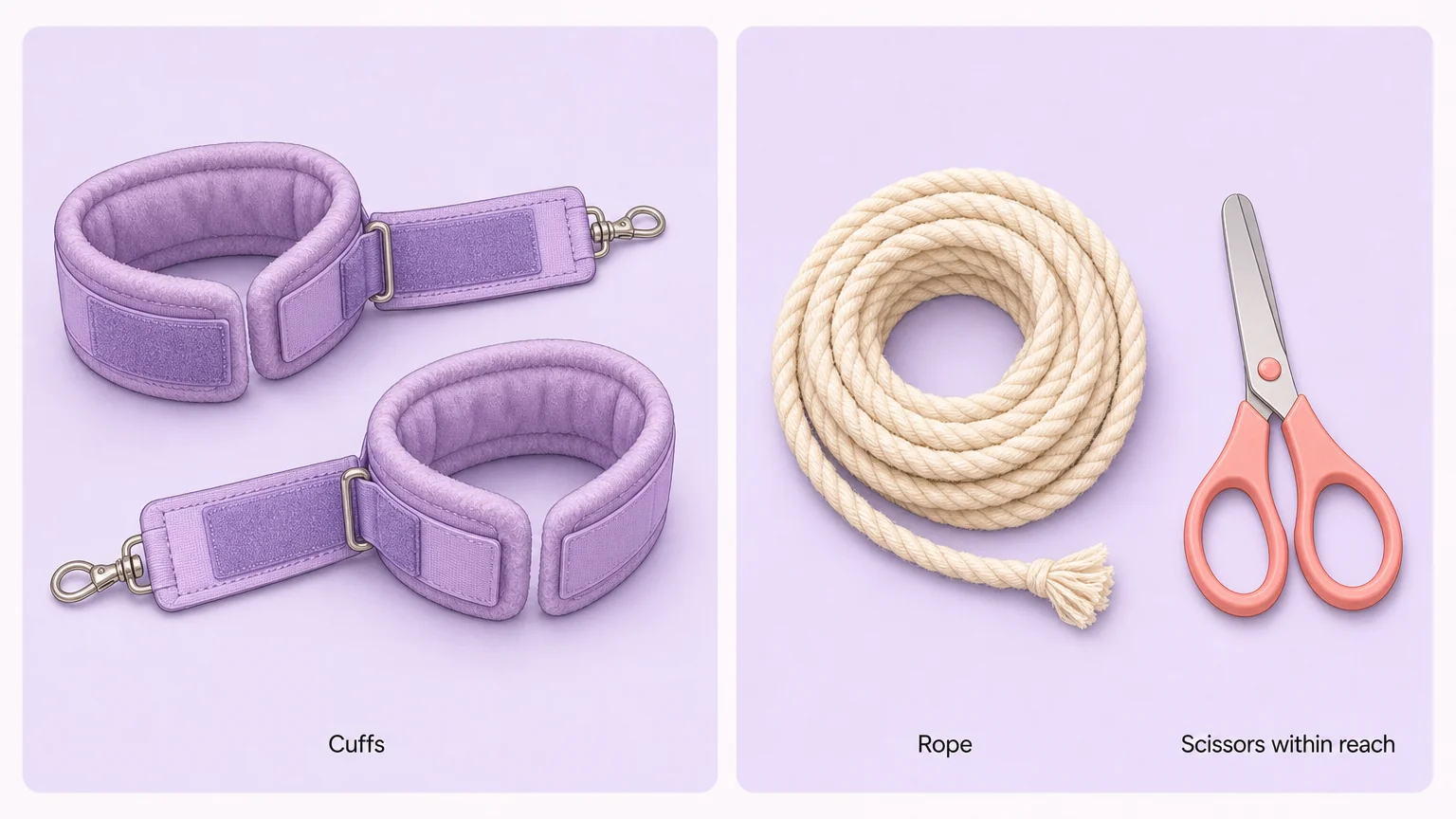
For a first light bondage scene, cuffs beat rope. Padded cuffs need almost no knowledge to use, come off in seconds, and fail in ways you can see. Rope asks for a skill you do not have yet and introduces three failure modes at once: a knot that jams, a wrap with no fast way out, and nerve compression that can be silent.
Whichever you use, two things are non-negotiable.
Fit. Two fingers of space under cuffs or rope. Tie off with non-collapsible knots that will not tighten when pulled. If the knot collapses under load, the two-finger check stops meaning anything.
Cutting tools. Safety shears within reach before anything is fastened, not in a drawer, not in another room. Keep a fresh pair, because one already used on rope may be too dull to trust.
The improvised version, a scarf or a necktie, is the worst option available. Scarves, neckties, and stockings are slippery, pull tighter than intended over time, and pinch. An ordinary bag knot keeps tightening under load. Metal handcuffs are too narrow even when lined, because they concentrate pressure on a small area.
Sizing. Wrist cuffs commonly adjust from about 5.5 to 8.5 inches, ankle cuffs from about 7.5 to 11 inches. Add half an inch to an inch for comfort, and measure the narrowest point rather than guessing. The usual failure is a product that cannot close small enough, not a lack of padding.
Look for double-locking, which stops a cuff tightening during movement. Keep the strap off the ulnar side of the wrist and off the peroneal area at the ankle.
If you want rope anyway. Learn the single-column tie first. It is a double wrap around a single column, it forms the base of almost every other tie, and it can carry a whole session on its own. Hemp is soft and slightly stretchy, which makes it forgiving for floor work. Jute is stiffer and grips itself.
Gear is a failure plan, not a costume. Buy the version that comes off fastest.
Is Suspension Light Bondage? Where the Line Actually Sits
No. Suspension is not light bondage at a higher setting. It is a separate practice with its own risks: load, falling, and nerve injury that can arrive in seconds.
A bed spreader bar or an under-bed strap system positions a partner. It does not suspend them, and it does not carry the same consequences when something fails.
Nerve damage under suspension can mean losing the use of a hand for days, weeks, or even months. A compressed nerve can also be silent, so the person in the harness may not feel the damage as it happens.
The people who rig for it describe years of dedicated training. A rigger with 14 years of experience still keeps a beginner session on the floor. Rope guidance for sex likewise says to skip acrobatic suspensions and stay on the floor or mattress. The distance between a bed and a rig is not a matter of confidence.
Floor work carries nerve risk too. It is easier to stop, easier to reach, and easier to watch. The next two sections apply to every scene, suspended or not.
The boundary to repeat out loud: floor and bed only, until a qualified instructor says otherwise.
Light Bondage Safety: Fit, Time Limits, and the 10-Minute Check
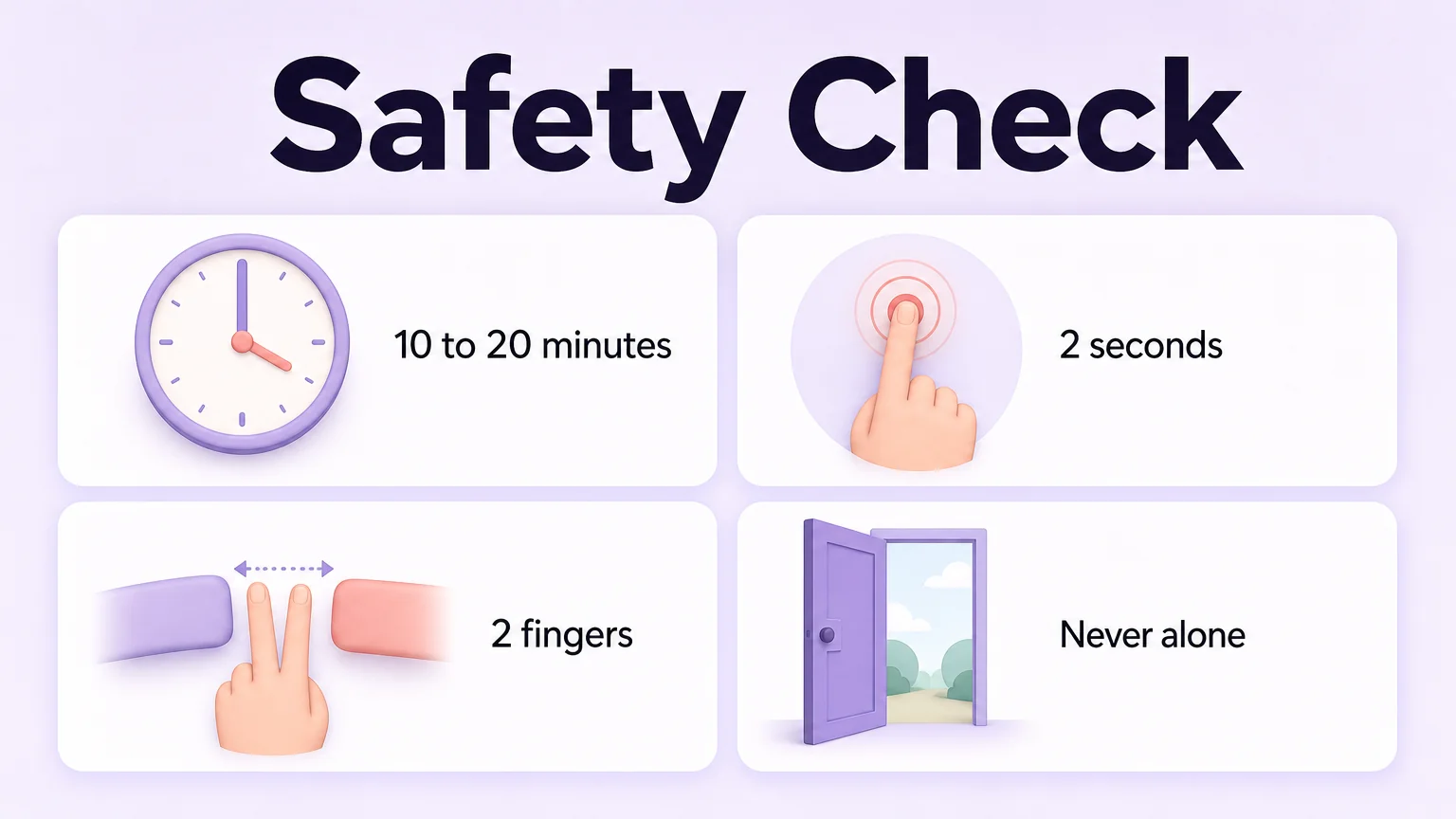
The light bondage rules that prevent most injuries are unglamorous, and they fit on an index card.
Fit. Two fingers of space under cuffs or rope. Knots that do not collapse or tighten under load. Nothing over a joint, and nothing pressing on the bony points of the wrist, ankle, elbow, knee, or neck.
Time. Limit continuous restraint to 10 to 20 minutes before a check-in, then reset and check roughly every ten minutes, even when nothing seems wrong. Put the timer where both of you can see or hear it. The interval is about how long a compressed nerve can go unnoticed before anyone thinks to look.
Circulation. Press a fingertip until it pales and count. Color should return in about two seconds. Slower than that, or a hand that stays cool, is a reason to release.
What you are watching for. Pale or bluish skin, swelling, cold skin, sharp pain, numbness, tingling, or weakness. Any one of these ends the restraint immediately, without a discussion about whether it is probably fine. At the ankle, the same compression can leave a foot that will not lift.
Two more rules belong on the card. Never leave a bound person alone, not even for a few minutes, because the thing that goes wrong is usually the thing nobody is in the room to see. And no alcohol or drugs, because the judgment required to notice a problem and report it is the first thing to go.
There is a difference between a check-in and a check. A check-in asks how it feels; a check answers that and looks at color, feels for temperature, and tests the hands. Do both, and do them on a schedule rather than when you remember. Write the card once, and keep it where you play.
When a Hand Goes Numb: Nerve vs. Circulation and What to Do
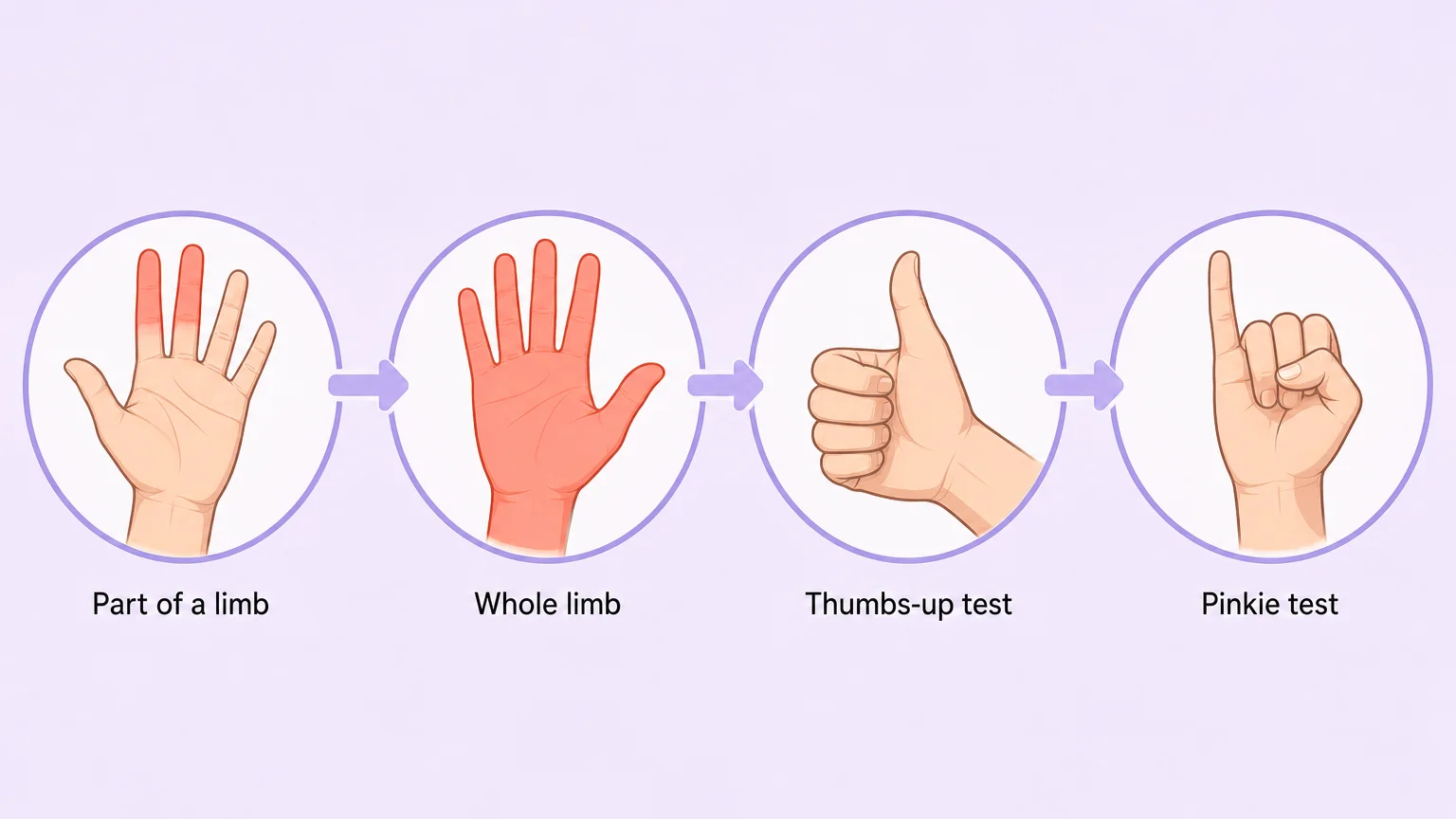
Start with where the sensation is, because that answer decides the next step.
Part of a limb, or the whole thing. Tingling or numbness in two fingers points to a compressed nerve. Numbness across the whole hand or foot points to reduced blood flow. La Quarta Corda’s rope safety guidelines draw that line.
Ask for a thumbs-up. Thumb lifted, other fingers closed. Difficulty points to radial or median nerve involvement.
Ask them to extend the pinkie. Difficulty extending it fully points to ulnar nerve compression.
Ask them to touch each fingertip with the thumb. Compare strength and sensation across the fingers. One side weaker is information.
Release the restraint. All of it. Let the limb recover before you decide anything else, and do not test while the pressure is still on.
Then watch the clock. If mobility does not return within 10 to 20 minutes, or there is strong pain, deformity, or swelling, seek medical attention. That is the threshold, and it is not a suggestion to wait longer. Note the time you released the restraint; whoever you call will ask when the numbness started.
Do not massage or stretch the area. Do not re-tie over the same spot until full function is back.
Two facts change how you act on this. Nerve compression can be asymptomatic, so a quiet partner is not evidence that nothing is wrong. And nerve damage is cumulative, so repeated short sessions can compound into the kind of injury a long one would cause.
Placement matters more than it looks. Keep rope and knots off the dimples on either side of the wrist, where you feel the pulse. Sideways pressure there compresses the radial and ulnar nerves, which is the injury pattern behind the numb hands people associate with handcuffs.
When in doubt, take it off and start over. No light bondage scene is worth a hand that does not come back.
Light Bondage Limits: Safe Words, Maybes, and the Yellow-Light Test
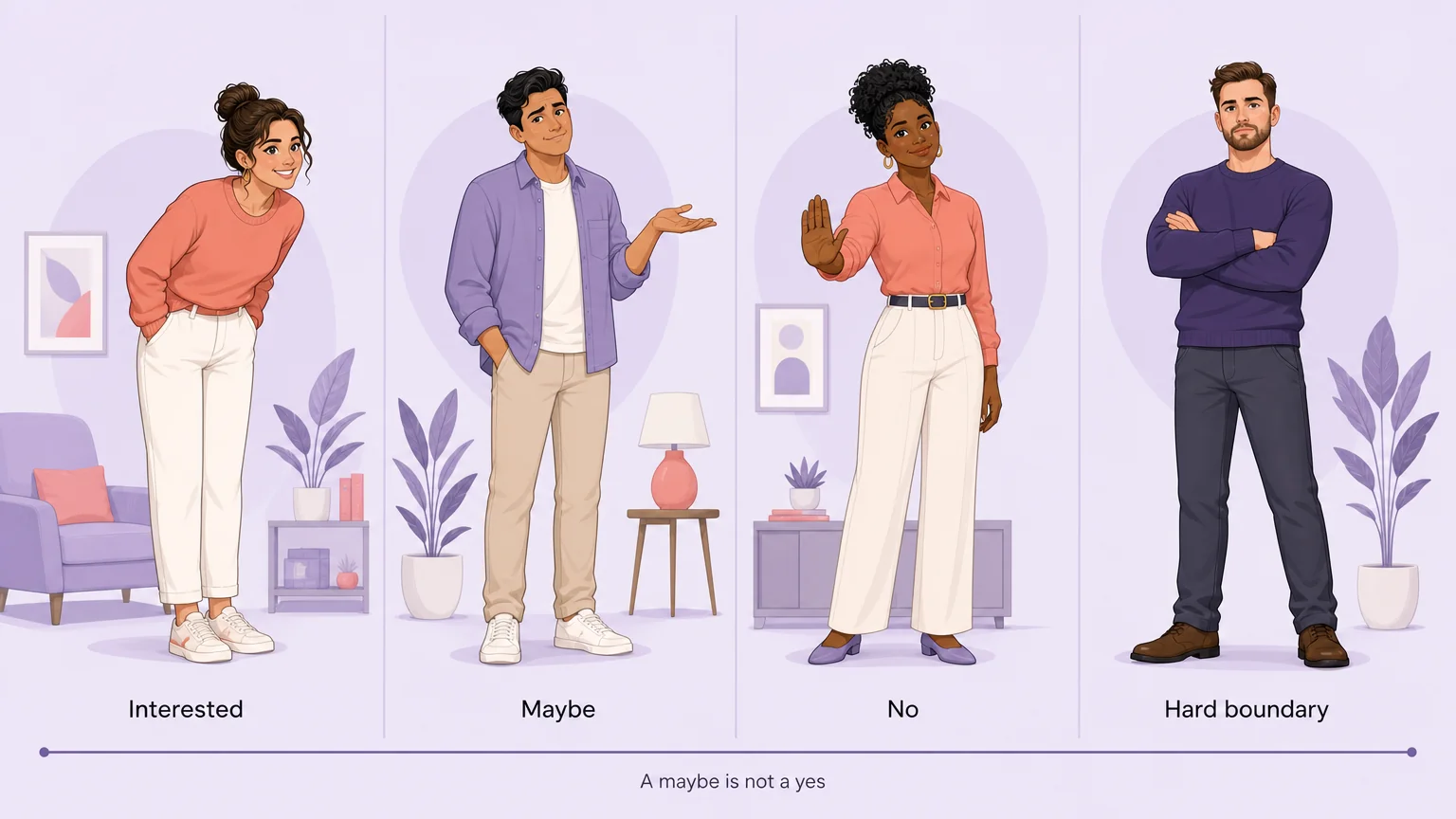
A light bondage negotiation is a conversation, not a contract. It is also not one conversation. It happens before the first scene, before the second, and any time something changes.
Four states, not two. For each act, each person gets four answers: interested, maybe, no, and hard boundary. A maybe is an invitation to discuss conditions, not permission to start. The absence of a clear answer is a no.
Signals. Pick a stop word you would not say by accident. “Ouch” and “ah” do not count, because people say them during scenes for reasons other than stopping. Pair the stop word with a slow-down signal and a non-verbal one, in case speech is hard.
A safe word is a backstop, not the system. Evie Lu Pine, a kink educator, describes safe words as communication tools rather than the thing that makes a scene consensual. The rest of the system is plain language and a partner who acts on visible distress without waiting to be told.
The pre-scene checklist, all ten items:
- Safe words for stop and slow, plus a non-verbal signal.
- The mood and purpose of the scene.
- Setting, privacy, and who else is present.
- Sobriety, for everyone involved.
- Current injuries and medical conditions.
- Triggers to avoid, and what you want included.
- Sexual scope, and what “sexual” means here.
- Aftercare for both people, and who checks in when.
- Photos and video, and whether they can be shared.
- The difference between wanting something and being willing to do it.
That last one is the quiet one. Willing is not the same as enthusiastic, and the gap between them is where regret comes from.
The yellow-light test. Rae Szereszewski, a certified sex educator, puts it as a question: if they do not respect your yellow, how will they respect your red? Someone who treats a slow-down as a challenge has told you what a stop will be worth.
A no is information, not rejection. Meet it with gratitude rather than disappointment, and do not renegotiate mid-scene or immediately after. Judgment can stay impaired for hours to days. Renegotiate before the next session, when both of you are clear.
Clarity is the turn-on. The paperwork is just how you get there.
How to Bring Up Light Bondage With a Partner
Get specific before you speak. Decide what you are asking for, so the request is not a vague mood. Then pick a relaxed moment, outside sex and outside an argument. Not during a serious talk either.
Open with a low-stakes invitation:
“There’s something I’ve been curious about, and I’d like to tell you about it. You can say no.”
Then be concrete, and offer one small optional step rather than a package:
“I’d like to try [one specific thing] sometime. What comes up for you?”
If the answer is maybe, treat it as a real answer:
“That’s a real answer. What would make it a yes, or what would make it a no?”
If the answer is no:
“Thank you for telling me. That’s useful, and I’m glad you said it.”
Then let it go. No renegotiating, no hovering, no second attempt with a different framing. A partner’s ability to say no is what makes their yes worth anything.
With a new or casual partner, be specific about what you are asking for and what you are not. They are entitled to the information they need to consent to their own situation, including your relationship status and your sexual health practices.
In an open relationship, tell outside partners what they need to know about your agreements, and revisit those agreements rather than assuming they are permanent.
Name the emotional risk in advance. Endorphins and intimacy can produce attachment that is easy to mistake for wanting a relationship. Rae Szereszewski names this as a distinct risk, and it matters most when you are playing outside a primary relationship or with someone new.
If you are single, the same light bondage script works on a date. 3Fun is a place to meet people who are open to the conversation.
The no is the point of asking. A clear no is worth more than a reluctant yes.
Light Bondage Aftercare: Drop, Debrief, and the Day After
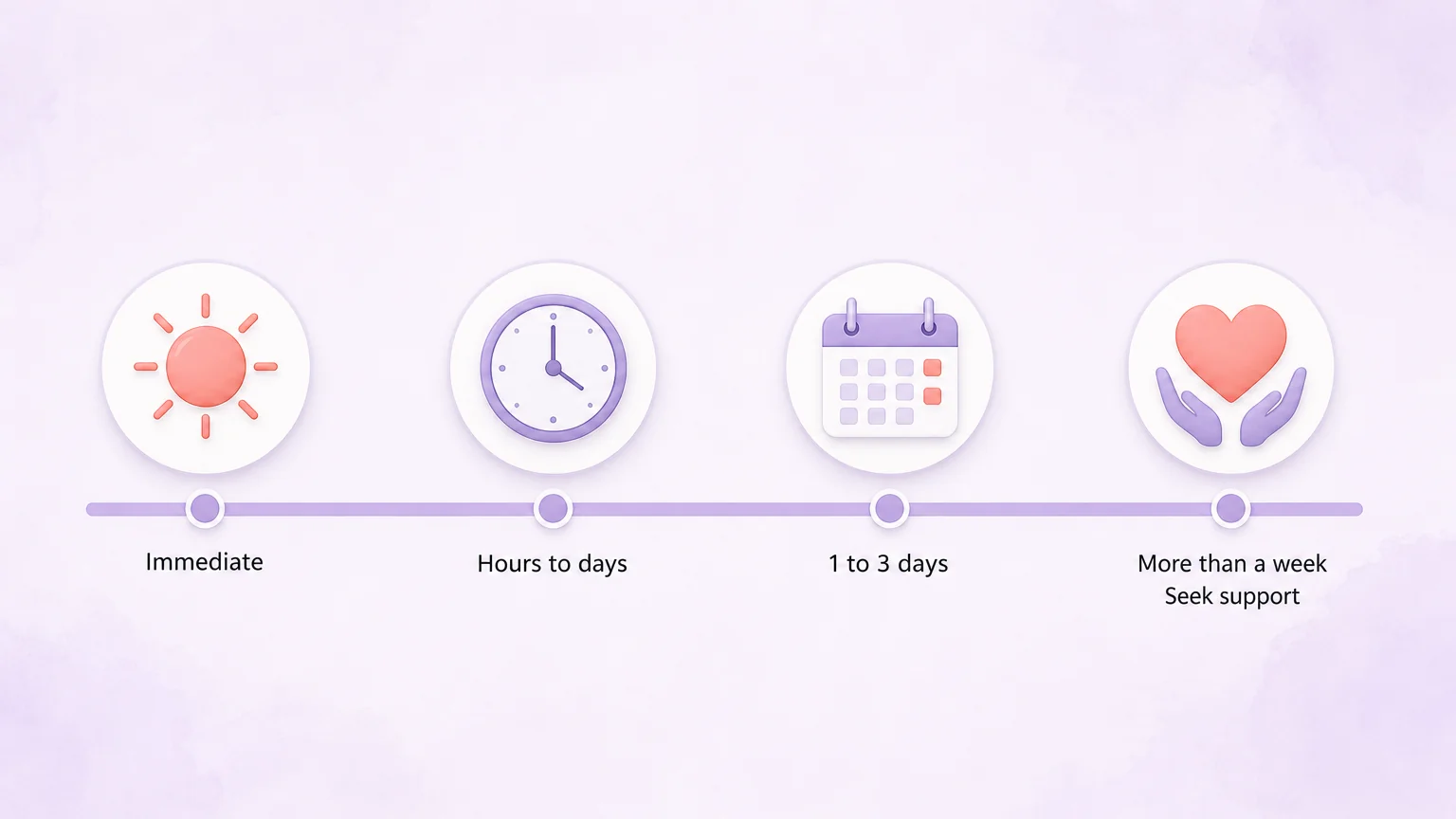
The scene ends at release. Light bondage aftercare does not, and neither does the experience for the person who was restrained.
Drop is physiological. It is the comedown that can follow an intense experience, closer to a neurochemical withdrawal than to a verdict on what happened. Immediate drop is the most intense and the shortest; with good aftercare many people move through it within an hour or two. Overall it usually resolves within hours to a few days.
Delayed drop can arrive one to three days later with no obvious trigger, which is why it catches people out. Symptoms that last more than a week without improvement are the point to seek support.
What helps, in order. Remove the restraints and check the body for marks, broken skin, and areas of numbness. Then warmth, water, electrolytes, and food, because blood sugar and hydration both drop after an intense scene. Give reassurance that is specific to what happened rather than generic praise, and say plainly what you enjoyed. The other person may be quietly wondering whether you wanted it.
Negotiate aftercare before the scene. Say what you need and ask what they need. Mismatch is information about fit, not a failure.
Keep aftercare and the debrief separate. Aftercare regulates the body. The debrief comes later, and asks different questions: what did we like, what was too much, what would we change, what needs a different setup next time. Doing the analysis while someone is still crashing is how a good scene gets remembered badly.
Agree a check-in for later the same day or the next morning, and treat the following one to three days as the delayed-drop window. Do not make major relationship decisions while either person is in it.
Regret is not the same as unsafe. A scene can be fully consensual and still leave someone wishing they had not done it. That is worth talking about, and it does not make anyone a predator.
The next morning, send the text. “How are you feeling today?” is enough.
Light Bondage FAQ: Safety, Gear, and First-Timer Questions
How tight should cuffs or rope be?
Two fingers of space under the material, and knots that will not tighten when pulled. Measure the narrowest point rather than guessing. A knot that collapses under load defeats the two-finger check, and a cuff that tightens as someone moves becomes a tight one without anyone noticing.
How long can restraints stay on?
Limit continuous restraint to 10 to 20 minutes before a check-in, then reset. Check roughly every ten minutes even when nothing seems wrong. There is no universal maximum, so shorter is the working rule, and any warning sign ends it immediately whatever the clock says.
What should I do if a hand goes numb?
Numbness in part of a limb points to nerve compression; numbness across the whole hand or foot points to circulation. Release the restraint and run the thumbs-up and pinkie tests. If mobility does not return within 10 to 20 minutes, or there is severe pain or swelling, get medical attention.
Is suspension a more advanced version of light bondage?
No. Suspension is a separate practice with load, fall, and rapid nerve-injury risk, and nerve damage can happen within seconds while someone is suspended. It belongs with qualified instruction and years of training, not a first scene or a next step.
Can I do this alone?
Self-bondage is a different, higher-risk category, not a beginner shortcut. Restraint you cannot release yourself from removes the person who would notice a problem, and the risks include severe and permanent injury. Fantasy and sensation are the lower-risk ways to explore alone.