
Soft bondage, a sub-type or entry-level style of bondage, is gentle restraint and low-intensity sensation play, chosen for comfort, trust and anticipation. That is the working answer, and it is where the conversation should start. Soft bondage describes tone, sensation and intensity rather than a fixed checklist of acts.
If you have been circling the term, unsure whether it means a specific set of acts, a beginner level or a marketing phrase, the short answer is none of those precisely.
There is no formal clinical definition. Even which activities count as BDSM has no settled answer, so a sub-label like soft is community and consumer shorthand. That is not a gap that needs closing. It is room to define the practice by feel rather than by appearance.
The label lives in the experience. The same scarf, cuff or bare hand can read as soft or hard depending on pressure, pace and what you agreed to. Gear does not carry the label. The scene does.
What follows covers what soft modifies, how it differs from light bondage and from a soft limit, and what common gear does. It also covers how to keep a scene safe, how to handle the days after and how to say all of it out loud.
What Makes Bondage Soft? Tone, Sensation, and Intensity

The surprise is that soft is not a list of acts. It modifies three things at once.
Tone comes first. Soft bondage is unhurried and attentive. Nobody is performing.
The person in restraint can feel that the person holding them is paying attention, and that attention is most of the charge. It is the difference between being held and being handled.
Sensation comes second. The register is pressure, texture, warmth and anticipation rather than pain. A hand pressed flat against a wrist, a thumb traced along the inside of an arm, fabric drawn slowly across skin. The body stays alert because it cannot predict the next input, not because the last one hurt.
Intensity comes third. Low risk, easy to stop, scaled so that either person can end it without a struggle. That is a design goal, not a limitation. A scene that can end in two seconds is often the one where people relax enough to feel more.
Gear does not carry the label. Leather cuffs worn loose and checked every few minutes are soft in practice. A silk scarf cinched hard is not. Pressure, pace and intention decide what kind of scene you are in.
Soft is also not a skill level. It is not the tutorial before the main event or a badge that expires once you learn more. Experienced practitioners choose it deliberately, sometimes after years of heavier play, because it gives them something intensity alone does not.
Physical simplicity does not mean psychological shallowness either. Practitioners describe scenes with almost no equipment that landed harder than elaborate ones, because the charge came from headspace and attention rather than from anything in the room. A hand on a wrist can do more than a full kit when the person using it knows what they are doing.
Soft Bondage vs. Light Bondage, and Why Soft Limits Are Different
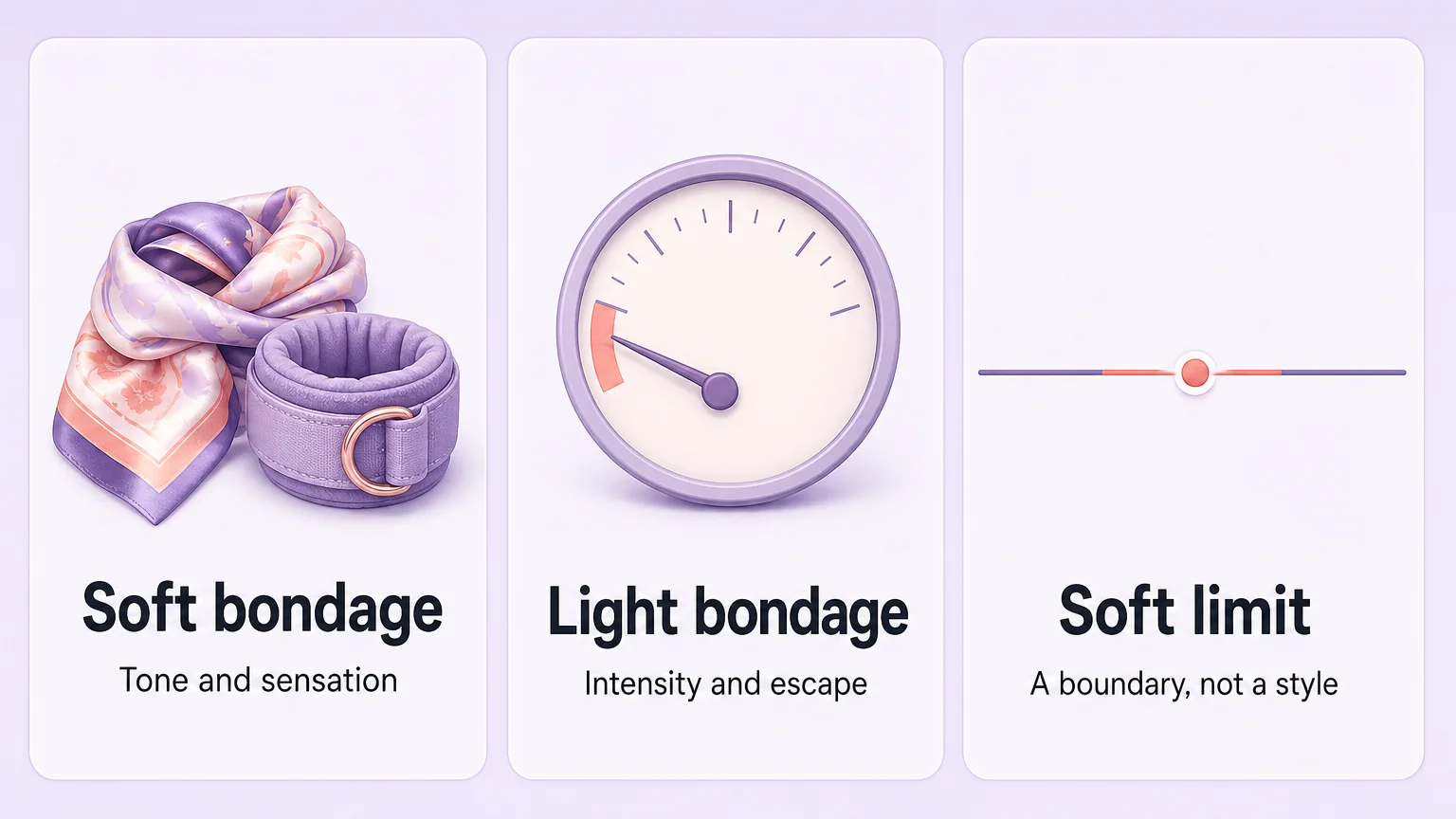
In practice, soft bondage and light bondage are near-synonyms with different emphasis. Soft leans toward sensory and emotional tone. Light leans toward intensity, beginner-friendliness and how easily the restrained person could free themselves. People use the two words interchangeably, and no governing body separates them.
A scene can be both at once: soft in tone, light in intensity.
The word light has a second life. One common way people draw the light line is whether the restrained person could get out on their own. That is a useful rule of thumb, not a standard. Escapability is not the same as safety.
A restraint can be escapable and still compress a nerve, and a restraint can be inescapable and carefully safe. What matters is the setup, the checks and who is watching.
Widen the frame and the labels blur further. Soft and hard sit on a spectrum of risk, intensity and intention. Appearance is a poor guide to any of them.
Loose cuffs can be intense. A firm grip with no gear at all can be gentler than it looks. The useful questions are not whether a scene qualifies but what the risk is, who is in control and what was agreed before it started.
Four things shift along that spectrum: how much force is involved, how much freedom of movement remains, how long the restraint stays on and how much the scene depends on the bound person’s ability to signal. A scene can be high on one and low on another.
Then there is the separate question of soft limits. A soft limit is something a person might consider with negotiation, a maybe rather than a yes. Soft bondage is a low-intensity style of restraint. Same word, unrelated meaning.
If a partner tells you something is a soft limit, they are describing a boundary, not requesting a style of play. That distinction matters in conversation, because agreeing to try something is not the same as agreeing to a genre.
The two labels matter less than whether the people in the scene are describing the same thing. If you say soft and they hear no risk, that is a vocabulary problem worth solving before anything comes out of a drawer.
What Soft Bondage Can Look Like
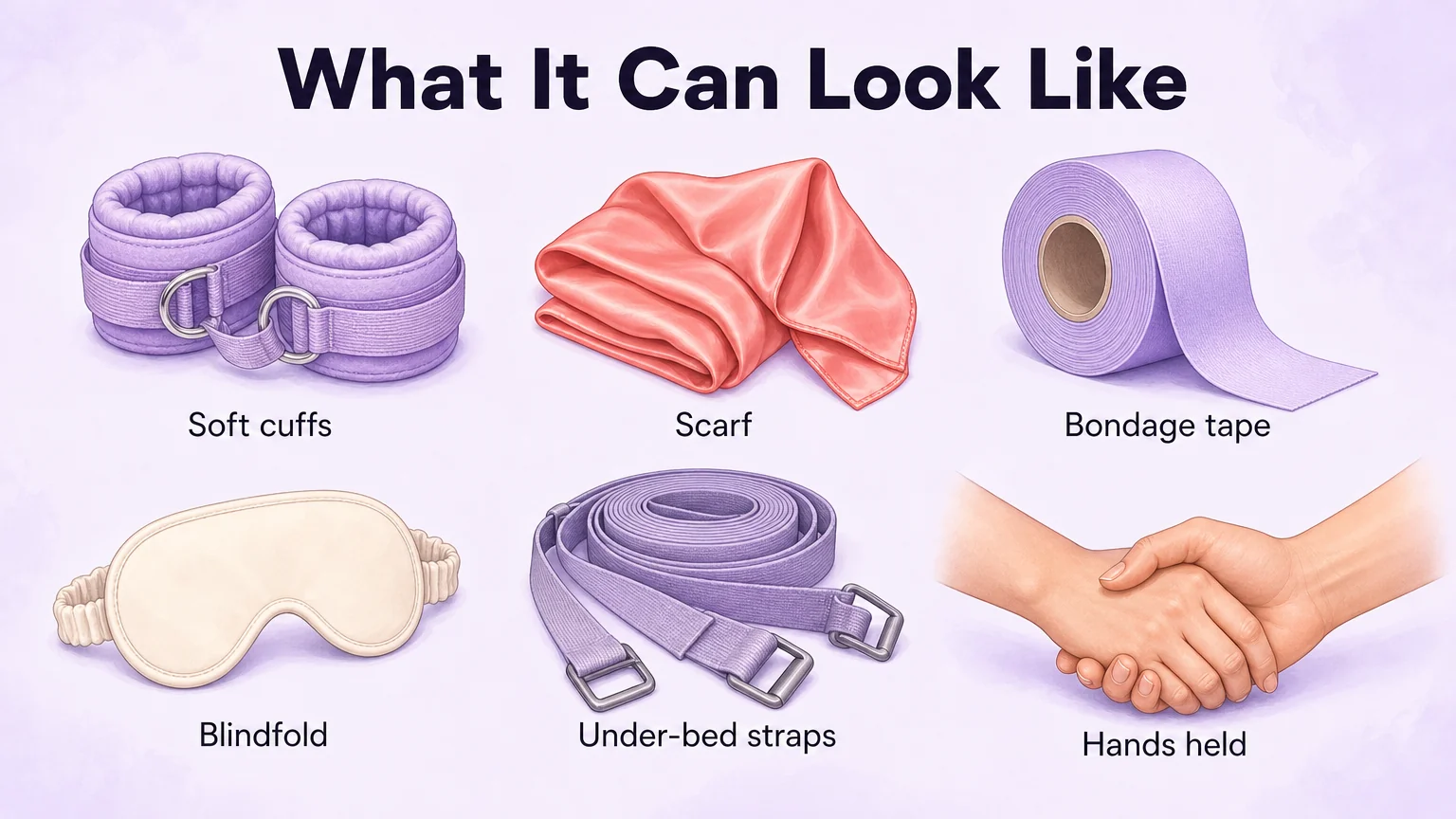
The simplest version requires nothing you do not already own. One partner holds the other’s wrists or forearms during sex, firm enough to register and light enough to release. That is soft bondage, and it is the cheapest way to learn whether restraint appeals before you buy anything.
From there, the common forms differ less in intensity than in what they ask of you.
Soft fabric cuffs. The usual first purchase. Easy to escape, no knots to learn, comfortable against skin. Velcro and buckle closures can still be over-tightened, and fabric stretches over time, so the fit you checked last month may not be the fit you have now.
Bondage tape. Sticks to itself rather than to skin or hair, and comes off fast. Useful for wrist and ankle wraps without knot skill. It still compresses, so it needs the same tightness checks as anything else.
Scarves and neckties. The classic household option, and the one most likely to surprise you. They can tighten under load, and they have no quick release. A scarf that felt loose when tied can behave like a different object after ten minutes of movement.
Under-bed straps. Four-point restraint without bed hardware. Fixed anchors limit repositioning, and the cuffs are sized to a wrist range that will not fit every body.
A blindfold. The lowest-barrier sensory option, and it may involve no restraint at all. It also removes visual check-ins, so it asks more of your verbal ones.
Metal or PU cuffs. A step up in intensity and usually in restriction. Metal without a quick release is a poor first purchase.
Rope. A step up in skill: knots take practice, natural fiber softens with use, and a cutting tool needs to be within reach.
Role structure is just as flexible as gear. A dominant is optional. The whole thing can be collaborative, with no power exchange at all. Partners can switch or take turns, and nobody has to hold the same side of the scene twice.
Solo, self-directed sensation play is a form of the same interest, and community rope jams are social practice spaces rather than couple-only events. If you are single, or if nobody in your bed wants to hold a role, none of that puts soft bondage out of reach.
Why People Choose the Gentler End

Wanting gentler play can feel like a downgrade. It is easy to hear a partner’s change in appetite as a verdict on you, and just as easy to hear your own change as a failure. People can usually describe what they no longer want long before they can name what they do want, and that gap is where a lot of silence lives.
Soft bondage runs on trust, anticipation and sensory focus without pain. Soft touch can generate more anticipation than rough play, because attention and precision carry the intensity.
A hand that hovers instead of grabbing, a pause that lasts a beat longer than expected, a grip that eases just as you brace for it. None of that requires pain, and none of it is a lesser version of anything. People who have played harder choose this end on purpose. It is not a consolation prize for people who cannot handle more.
Curiosity is common, and identity is narrower. In a U.S. probability sample of 2,021 adults, about one in five had ever tied up or been tied up. In a Belgian sample of 1,027 adults, 46.8% had done at least one BDSM-related activity, across 54 activities.
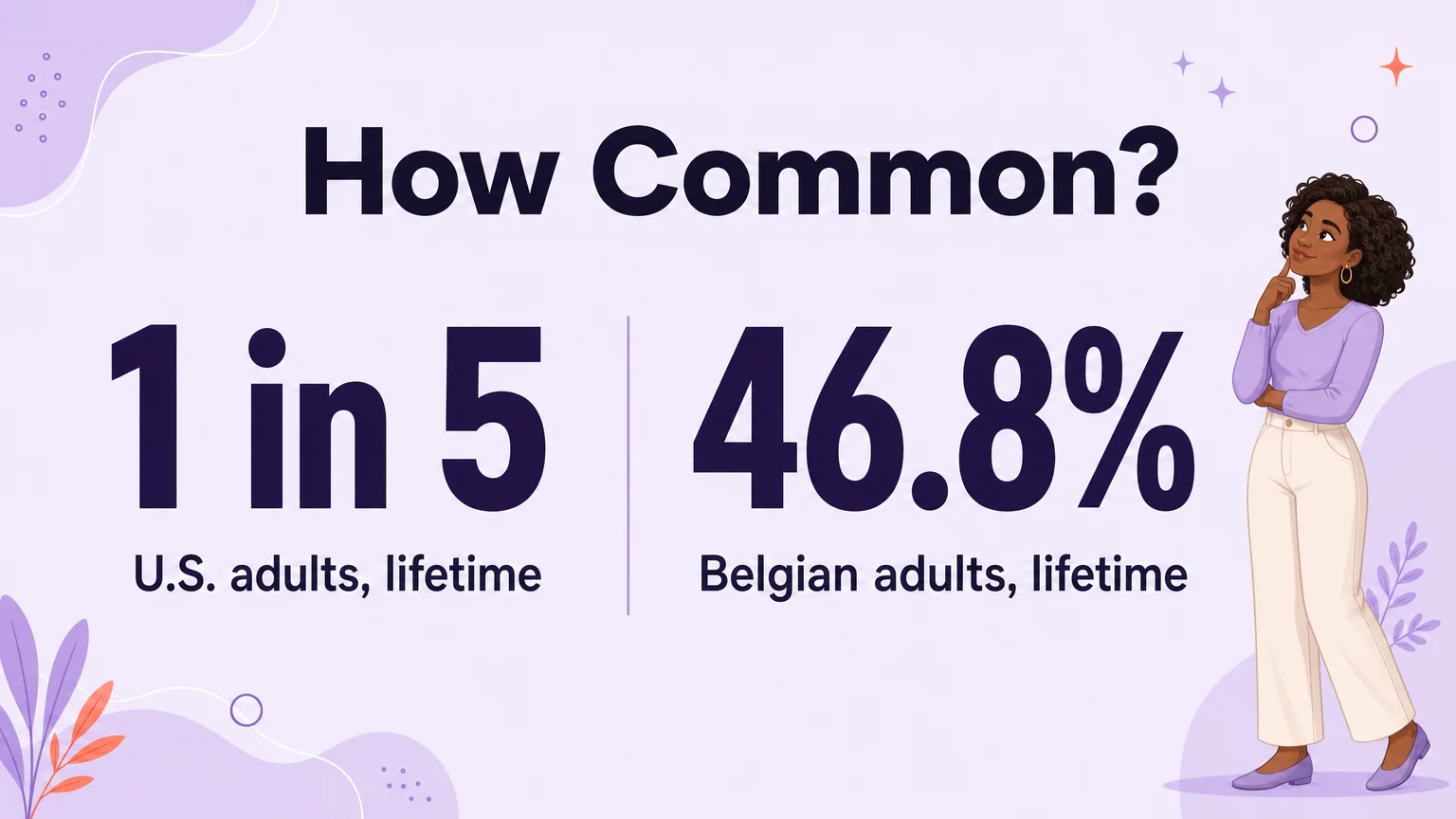
Both are lifetime measures of broad behavior. Past-year participation is much rarer, and identifying as a practitioner is rarer still. Neither figure counts soft bondage specifically. They say that an interest in restraint is ordinary.
Some practitioners find that kink is a setting where support needs are centered rather than accommodated afterward. A partner who asks what your body needs before a scene, and then builds the scene around the answer, is offering something many people rarely receive. Disabled and larger-bodied practitioners often find that mainstream rope education has few modifications built for their bodies, and that comfort-first ties get coded as boring in a culture that pedestals the intense ones. That coding pushes beginners toward risk they did not ask for.
Desires change. A style that worked for years can stop working, and that is information for the next conversation rather than evidence that something broke. Say the change out loud early.
“I want something softer lately” is a complete sentence, and it is easier to hear than a silence a partner fills with their own worst guess. The conversation gets easier the second time, and easier again once the answer is not a surprise.
Consent and Physical Safety: What Keeps You Safe
Soft bondage depends on trust, and trust does not tell your partner what you want, what you fear or what your body does under pressure. Those are three separate things, and affection does not supply any of them. Consent is built from information, and information has to be spoken.
Negotiate before anything starts. Five questions cover the ground. What do you want to happen? What are your hard nos? What are you curious about but unsure of? What helps you feel grounded if you drop? What does aftercare look like for you?
Treat the conversation as part of the anticipation. Naming what you want out loud, before the scene, is its own kind of charge.
Agree a stop signal that works when speech is hard. A safeword plus a nonverbal signal is the baseline. Three taps is common practice, not an authoritative standard, so agree on what yours means and rehearse it before you need it. “Ouch” and “ah” are not safewords. They are sounds a partner can talk themselves into hearing as enthusiasm.
The traffic-light system gives the bound person a middle setting: green to continue, yellow to slow down or change what is happening, red to stop completely. A safeword is baseline, not a substitute for ongoing check-ins. Ask questions mid-scene, and wait for answers.
Follow the physical rules every time.
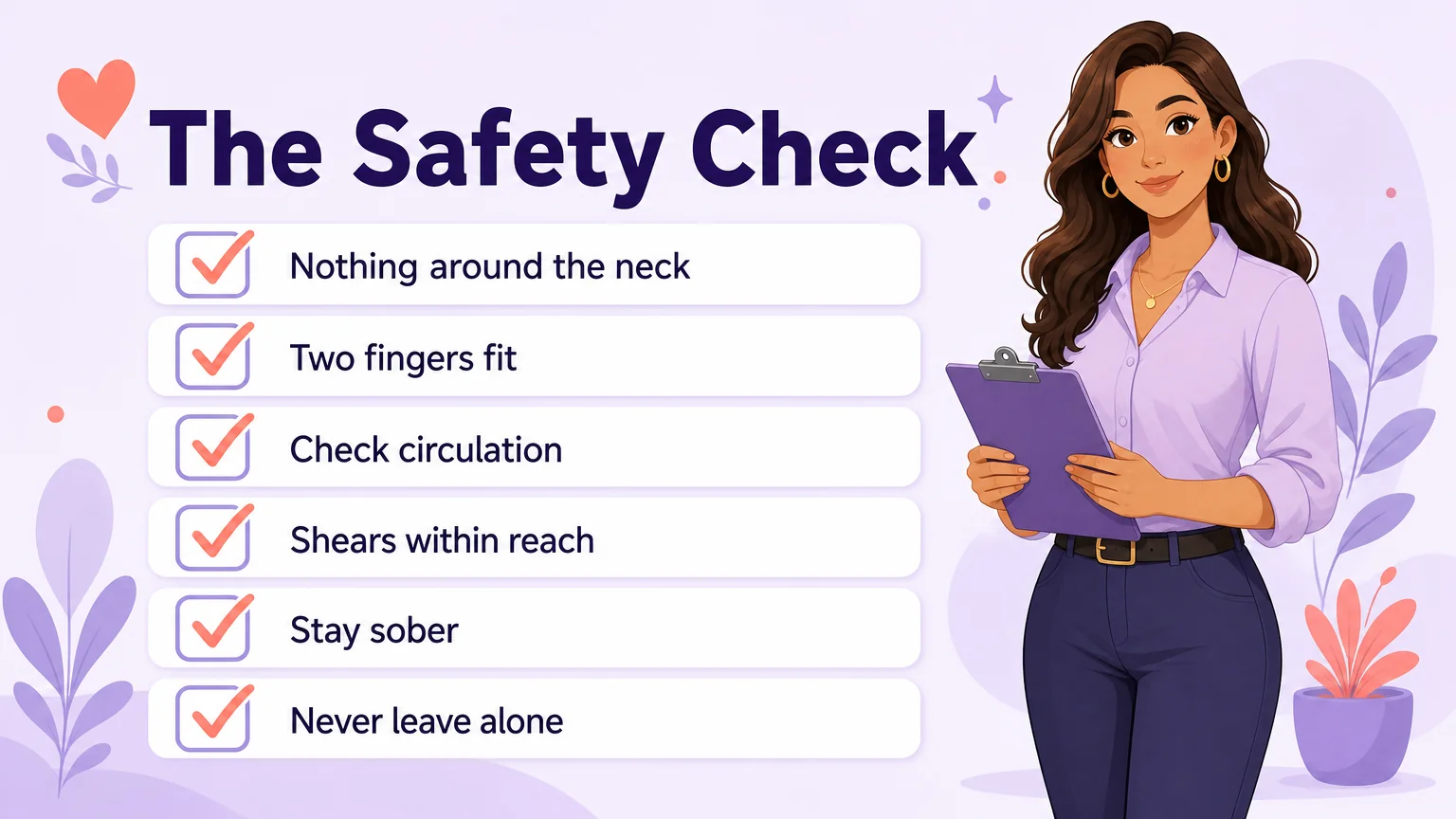
- Nothing around the neck or throat. No exceptions and no light version.
- Place wraps over muscle at mid-limb, away from joints and the inner wrist, where nerves sit close to the surface. Never let weight hang from a wrist.
- Run the two-finger check on every restraint, every time. You should be able to slide one to two fingers underneath. Snug is the goal. Tight enough to need loosening is a failure state.
- Check circulation and sensation on a schedule, not only when something feels wrong. Have the bound person move fingers and toes. Watch for cold, pale, blue or purple skin, numbness, tingling or lost movement. Loosen or release immediately if anything changes.
- Know the symptoms that can outlast the scene: wrist or finger drop, weakness in the wrist and finger extensors, numbness on the back of the wrist, numbness in the front of the thigh or instability in the knee. Persistent weakness after a scene needs medical assessment rather than reassurance.
- Keep quick release and safety shears within reach, and test the shears on the actual material before you play. A tool that cannot cut your rope is decoration.
- Stay sober, and never leave a bound person alone. A bound person cannot self-rescue if circulation fails.
Disclose body-specific risk before the first scene. Circulation problems, diabetes, neuropathy and blood thinners all change what counts as a safe restraint. Pregnancy and acute injury are not settled by any authoritative guidance, so treat them as a conversation with a clinician who knows your situation rather than as a green light or a blanket prohibition.
Treat suspension as a separate category. Documented nerve injuries cluster in full-body suspension, where exposure ran roughly five to 25 minutes. Nothing in that finding argues against light wrist cuffs on a bed. It argues that suspension requires anatomy knowledge, hard-point engineering and a spotter, and that it sits outside soft bondage entirely.
Aftercare and Drop: The Part That Comes After

Drop after soft bondage does not mean something went wrong. It is a predictable response to an intense experience, and it can arrive immediately or a day or two later. The delayed version is the one that blindsides people.
What drop feels like varies. Some people go flat and tearful, some get irritable, some feel far away from their own life for a day. Knowing your own pattern matters more than knowing the label, because company helps one person and overwhelms another.
Plan aftercare during negotiation, not after the crash. Ask what the person wants, because blankets and cuddles are a guess. Some people want touch. Some want space.
Some want food, water, quiet, a specific comfort item or a clear signal that the dynamic stops at the bedroom door. Agree on next-day contact and a debrief, and agree that the debrief will happen even if it is not immediate.
Plan two check-ins, not one. A short check the same night or next morning, then a second at one or two days, because the dip is often delayed. Keep a small drop kit within reach: water, a snack, a blanket, first aid, something soothing.
Name the drop out loud when it arrives. It is easier to ride when it has a name. The debrief is where a scene becomes useful information: what worked, what surprised either of you and what you would change next time.
Tops get drop too. The person who did the tying is often cast as the caretaker and is less likely to ask for care. Check in on both sides, and leave room for the top to say the scene was harder than it looked. A scene that went well can still leave someone shaky, and saying so is not a complaint about you.
How to Talk About Soft Bondage With a Partner
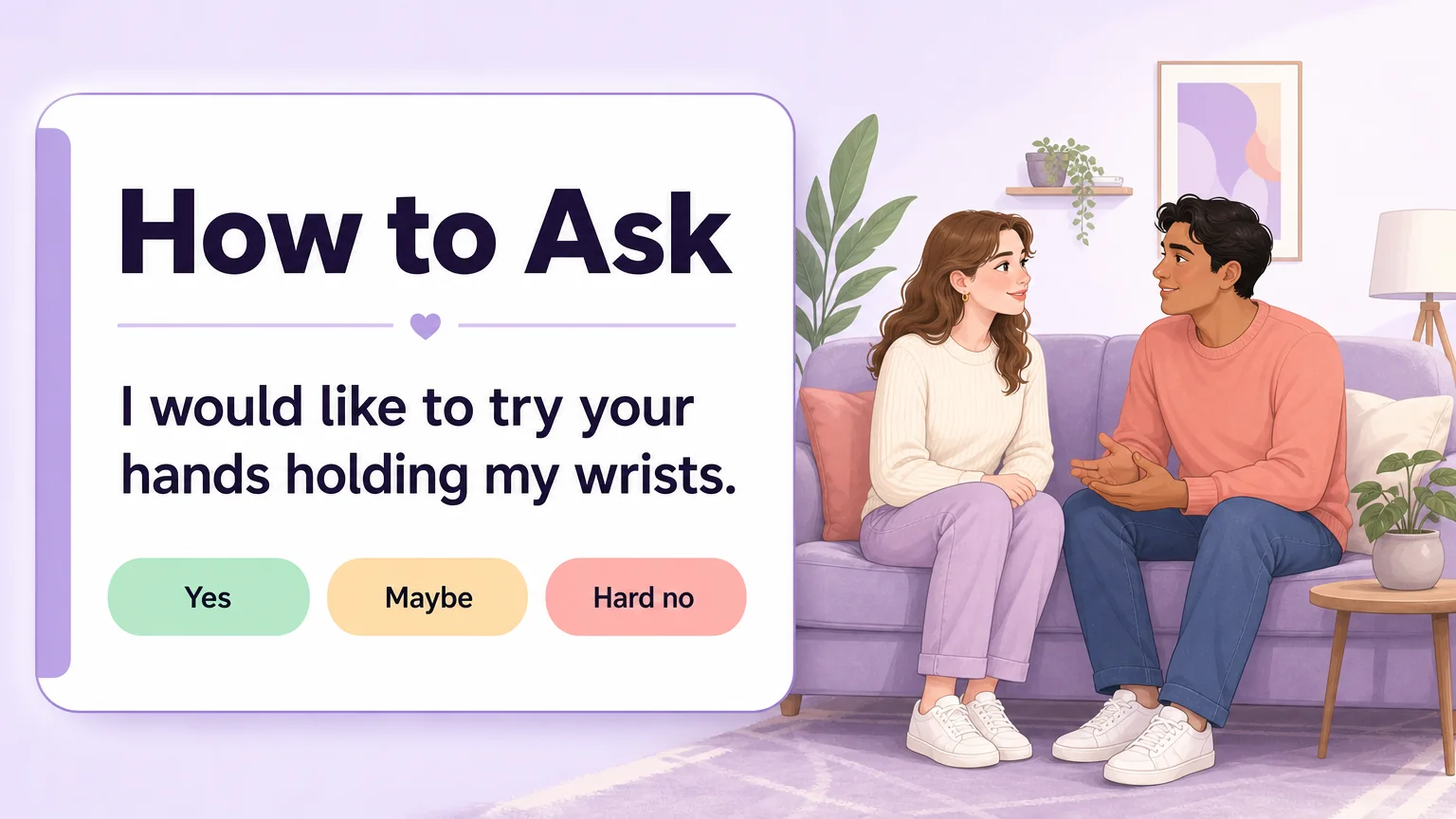
Naming what you want is harder than naming what you no longer want. That is why the conversation often feels harder than the scene.
Raising it. Lead with a specific, low-stakes want rather than a confession or an audition. “I would like to try your hands holding my wrists” is easier to hear than a speech about identity. Curiosity invites an answer. A verdict invites a defense.
Timing helps. Raise it outside the bedroom, on a walk or over dinner, when neither of you is performing or tired. In bed, the same sentence can land like a verdict.
Inventory limits together. Yes, maybe, hard no. Keep soft limits distinct from hard limits, and treat a maybe as an invitation to talk, not consent in advance. Revisit the list when desires, bodies or relationships change. The list is a living document, not a contract signed once.
When the mismatch is intensity. Treat it as information, not rejection. Negotiate a smaller shared version and say plainly where your interest stops. Escalation should be mutual, never a price of admission.
Powerful play does not require going to the extreme. If a partner wants more than you do, the answer is a version you both want, not a performance.
If the answer is no, take it as one and stop negotiating. A no that gets worn down is not consent, and a partner who has to repeat themselves will remember that longer than they remember the scene. No scene is worth crossing a boundary, and a clear no usually means you found the edge of the map, not the end of the conversation.
Keep talking. Negotiation is recurring, not a one-time gate. People who have done this for years negotiate light scenes as carefully as heavy ones, because the body in the restraints is the same body either way, and soft bondage asks for the same attention that any other scene does.
Myths and Misunderstandings About Soft Bondage
“It is not real BDSM.” Intensity comes from headspace and attention, not equipment. BDSM is a spectrum of consensual power exchange, not a difficulty ladder, and practitioners say the same about scenes that would sound basic to an outsider.
“It has to hurt.” Pain is optional and belongs to adjacent practices such as impact play. Soft bondage is defined by low intensity and comfort, so if something hurts, adjust the position, the tightness or the scene.
“It is only for beginners.” Practitioners with years of heavier play behind them choose it, and some of the most intense scenes use almost no gear. Nothing about the gentler end expires with experience.
“You need a full kit to start.” A hand on a wrist is the whole practice in its smallest form. Gear adds sensation and convenience, not legitimacy, and the cheapest version often teaches you the most about what you want.
“It is only for couples.” Singles, switches, solo practitioners and groups of more than two all have versions. Power exchange is optional, and nobody has to hold a fixed role.
“Soft bondage is the same as a soft limit.” They are unrelated uses of the word, already separated above. One is a style of restraint and the other is a boundary, and mixing them up can turn a clear conversation into a confusing one.
Frequently Asked Questions About Soft Bondage
Does soft bondage hurt?
No, not by definition. Discomfort is optional, and pain belongs to adjacent practices such as impact play. Soft bondage is built around comfort, pressure and anticipation. If something hurts, that is a signal to adjust the position, the tightness or the scene, not a requirement to push through.
Do I need a dominant partner?
No. Restraint and sensation can stand alone, and partners can switch or take turns without anyone holding a fixed role. Power exchange is optional.
Some people negotiate a light dynamic, while others keep the whole thing collaborative. Both are complete versions of the practice.
Can I use things I already own?
Yes, with caveats. Scarves and neckties are the classic household option, but they can tighten under load and have no quick release, so they need the same tightness and circulation checks as any restraint. Thin belts and anything that cinches are a poor choice for wrists.
Is it safe during pregnancy or with an injury?
No authoritative source establishes this either way, so treat it as a conversation with a clinician who knows your situation rather than a green light from an article. Disclose circulation problems, diabetes, neuropathy or blood thinners before any restraint, and ask what positions or pressures to avoid in your case.
Do I need a safeword?
You need a stop signal, not necessarily a formal safeword. A shared word works when speech is easy, and plain language works when the bound person stays verbal. Pair either with a nonverbal signal, because “ouch” and “ah” are not safewords and do not reliably stop a scene.
What if I go non-verbal or spacey?
Agree a physical signal before you start, such as three taps or deliberately dropping a held object. If you tend to go quiet or spacey, say so during negotiation so your partner checks more often instead of waiting for a safeword. Three taps is common practice rather than a formal standard, so rehearse it together first.
Can I do this if I am single?
Yes. Solo sensation play and self-directed practice are legitimate forms of the same interest, and community spaces such as rope jams are social rather than couple-only. You can learn the basics alone and bring them into a partnership later.
How common is soft bondage?
More common than it might seem, though no study counts soft bondage specifically. In a U.S. probability sample, about one in five adults had ever tied up or been tied up. In a Belgian sample, 46.8% had done at least one BDSM-related activity.
Both are lifetime measures of broad behavior, not a count of soft bondage, and far fewer people identify as practitioners.
What if my partner wants more intensity than I do?
Treat it as information, not rejection. Negotiate a smaller shared version and say plainly where your interest stops. Escalation should be mutual, never a price of admission.
Powerful play does not require going to the extreme. If the gap stays wide, that is worth knowing early.
Talking about what you want is the whole skill. When you are ready to find people who share your language, 3Fun is one place to start.