
You have been clocked over the phone by a stranger, by a teacher, by a man in a comment section. The question that stays is not whether gay men sound gay but where the sound comes from.
The short answer: there is no single gay voice. There is a cluster of features listeners group together, and plenty of gay men produce none of them. The cluster is real enough to measure. The average differences between groups are small enough that one person tells you almost nothing.
Those differences come from three places, running on different clocks. Small average differences in how the voice is produced. Learned speech norms, picked up from the people and places you spend time in. Moment-to-moment adjustment to whoever is in front of you. The third is the strongest evidence here.
One correction first: sounding gay is not a leak. Listeners infer from a loose set of cues, and they miss often enough that the inference is not a fact about you.
What You’re Hearing: Four Voice Settings, None of Them a Defect
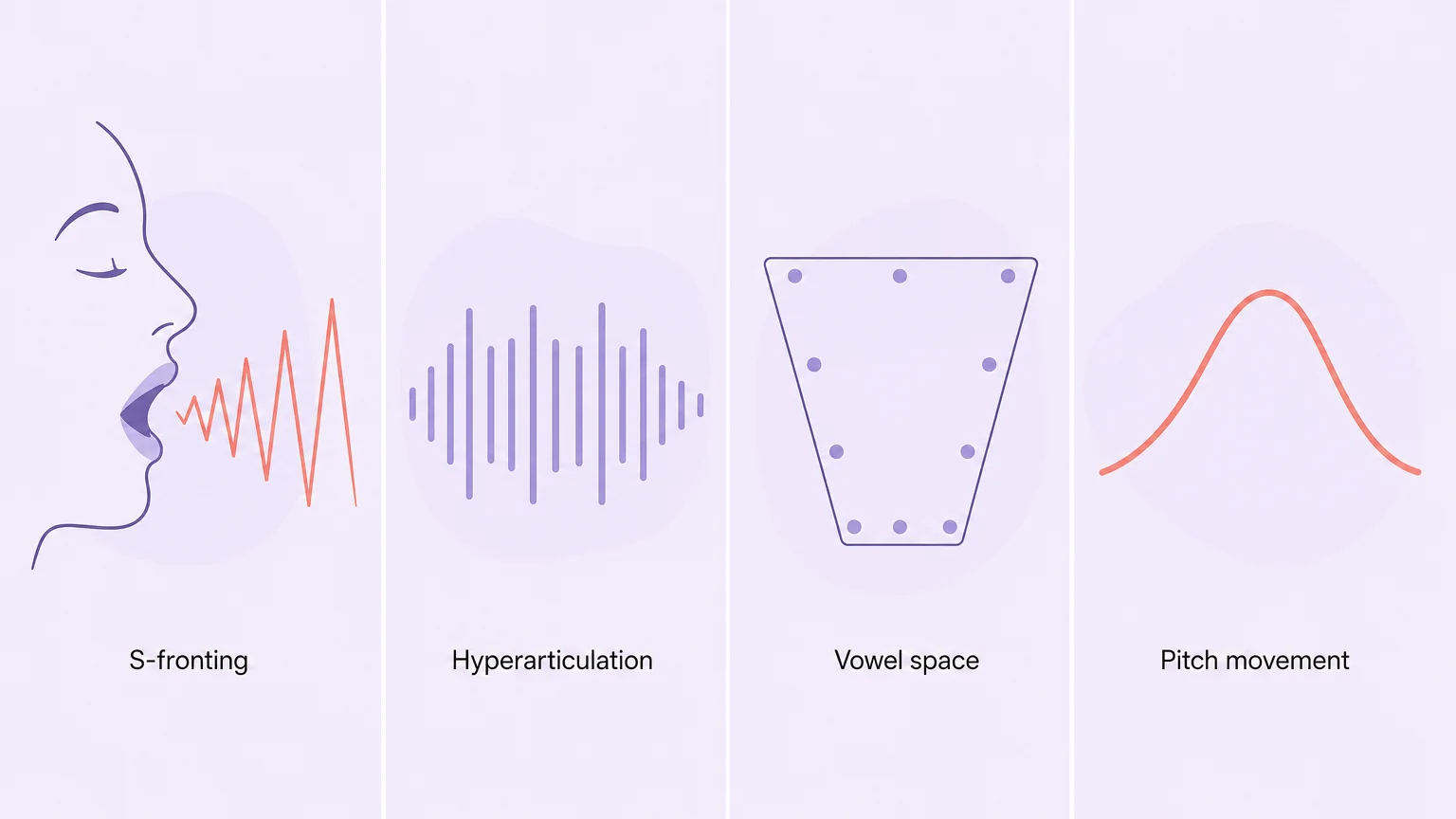
People call it a gay lisp. The word is wrong.
A lisp is an interdental articulation. The tongue moves between the teeth and an S comes out closer to TH. It is a speech sound disorder, and it is not what you are hearing.
The feature people are pointing at is s-fronting. The /s/ is made further forward in the mouth, with the tongue closer to the teeth, and it stays an /s/. Same phoneme, different place of articulation. Erin Broadhurst, a linguist who works on exactly this, draws that distinction, and her description is the one worth keeping.
The folk word survives because the acoustic impression is genuinely sharp. A precise, forward /s/ cuts through a room. It sounds careful, and careful is what listeners hear as affected.
Second setting: hyperarticulation. The sibilants come out with more precision and a little more length than the sentence actually needs. The impression is sharp rather than impaired. That is why the slang word is lisp, and why the slang word is wrong. What reads as a speech problem is usually extra care rather than less.
Third: the periphery. Vowels get pushed toward the edges of the space the mouth has available. Front vowels go further front, back vowels further back, and the whole mouth works nearer its limits. This is one of the things that creates the impression of animation or exaggeration. It is a setting, not a list of individual sounds.
Fourth: movement rather than height. What reads as a gay pitch pattern is often the voice traveling further up and down inside a sentence, not the voice sitting higher. Hold that, because the height question gets taken apart next.
All four are ordinary articulatory settings, the same kind of thing that makes one region sound different from another. None is a disorder. None is a choice. None is a performance.
One guard, and it matters more than the list. These are not a checklist that adds up to gay. They are cues a listener weighs unevenly and often wrongly, and plenty of men produce several of them without anyone reading them as gay.
The Body Cause: Why Biology Explains Less Than You’d Expect
The thing everyone knows is that gay men talk higher. The largest recent test of it came back pointing the other way.
Holmes and her colleagues recorded 142 men and 175 women in five- to ten-minute interviews and analyzed one answer: a description of the weather for someone unfamiliar with it. They scored orientation on a continuous 0 to 6 scale built from attraction ratings instead of forcing a gay or straight box.
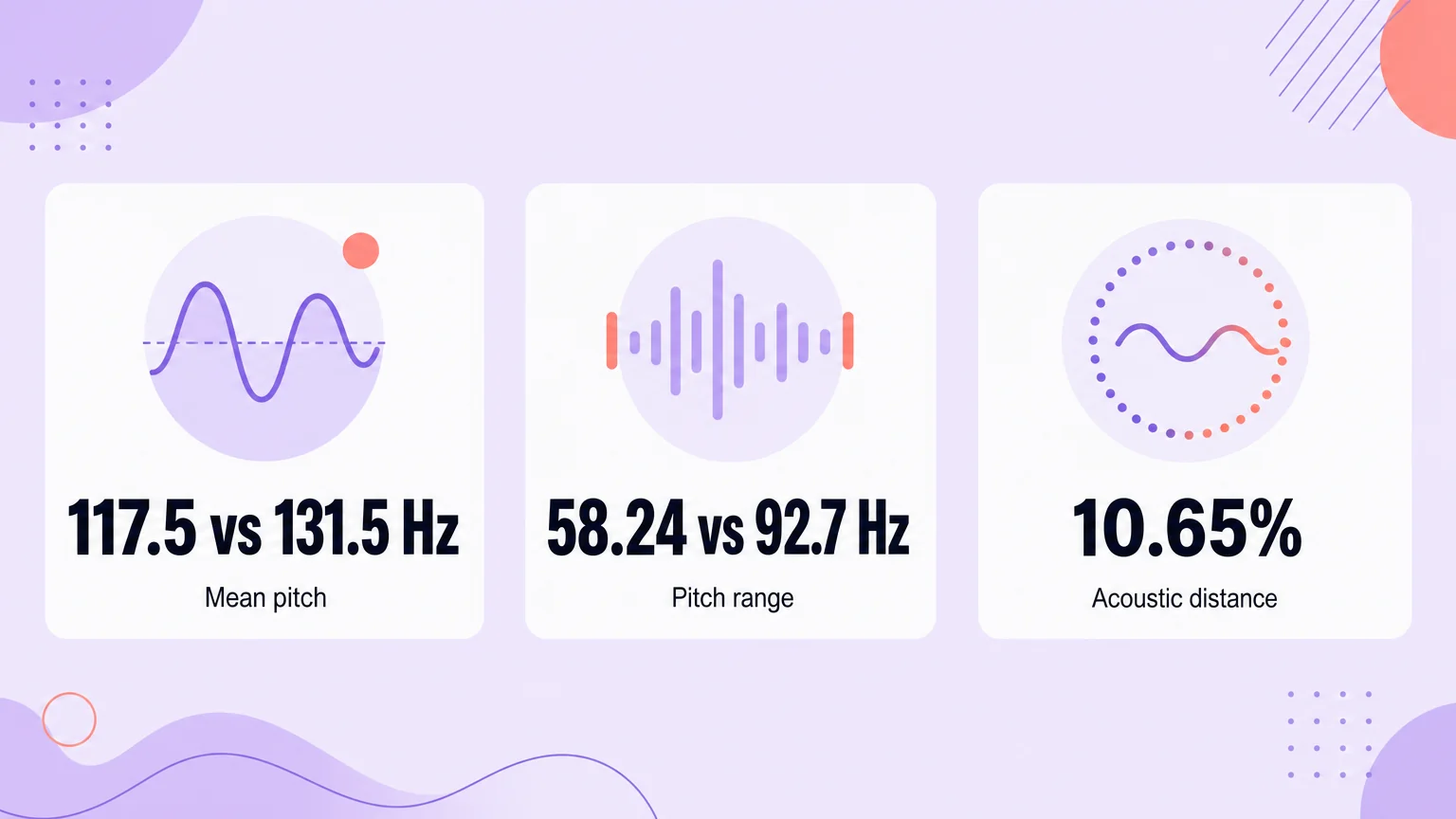
Gay men’s mean pitch came in at 117.5 Hz against straight men’s 131.5 Hz. Gay men’s pitch range was narrower too, 58.24 Hz against 92.7 Hz. The authors had predicted the opposite direction. Bisexual men sat between the two groups.
The second study found nothing to argue about on pitch. One hundred sixty French speakers retold a standard short story, and mean pitch came out statistically indistinguishable, 116.5 Hz against 118.6 Hz. Within a single utterance, though, the gay men’s pitch moved more, a standard deviation of 18.22 Hz against 14.11 Hz.
Why do they disagree? The tasks were different: a live interview about the weather against a semi-scripted retelling of a fixed narrative. The designs were different: a continuous orientation score against two groups. The measures were different.
Total range and within-utterance variability are not the same quantity, and averaging them into a compromise number would mean inventing one. So the direction is unsettled, and neither study found the higher-pitched gay voice the folk belief predicts.
Then there is size. A discriminant analysis put overall acoustic distance between the two male groups at about 10.65 percent. Small, and statistically real.
Most of what makes your voice recognizable as yours is region, class, age, anatomy and habit. Orientation is a minor term in that sum.
The details that circulate as markers do not replicate cleanly either. Harmonics-to-noise ratio ran lower for gay men in the English sample, 3.48 dB against 3.98, and higher for them in the French sample, 10.86 dB against 10.06. Both papers still call gay men’s voices less breathy, because the two studies read the same measure in opposite directions. The descriptor repeats and the measurement does not, so breathiness should not be traded as a settled marker.
Hormones fail in another way too. Salivary testosterone came out effectively identical, 136.65 against 137.61 pg/ml, and predicted none of the acoustic measures. Whatever is happening, it is not a hormone level.
The 2024 authors’ own best guess for why any difference survives is that low pitch and a narrow range both read as attractive. On that reading, the difference may be about sounding desirable rather than about signaling identity. They label the guess speculative, and so should anyone repeating it.
If the production difference is this small, then most of what you hear in a room is not coming from the larynx.
The Learned Cause: Why Community Shapes How You Sound

You did not decide to sound like this. Nobody sits down and picks a voice out of a catalog. And yet people talk about it as though you did.
The popular story is that a boy picks up speech patterns while he is young, by modeling the women around him. It circulates widely. It is also a theory people tell rather than a finding anyone has demonstrated.
No study behind that specific acquisition story could be found and opened, which means the timeline should not be asserted at all. No number, no stage, no window someone names with confidence. Any specific age you are given is a guess wearing a lab coat.
What the evidence does support is broader and less tidy. Speech norms circulate through communities. People converge on the habits of the people they spend time with, and they do it without noticing. Sociolinguistics has moved toward a model of speaker agency: you construct identity through your voice rather than emitting a fixed signal, and the construction shifts over months and years.
That kind of learning is less like copying one person and more like a slow settling into the habits of the people around you, continuing as those people change.
One design gets closer to cause and effect than anything else available. A study compared gay YouTubers’ videos before and after a public coming-out video against age-matched straight controls. Gay creators were perceived as sounding gayer afterward. The straight creators drifted slightly the other way over the same period.
Traffic in a social world moved the voice in a measurable direction. That comes from the published abstract, so treat it as one study’s finding rather than as a law.
The limit is real. No longitudinal study follows a group of men from before coming out, through joining a community, and out the other side. The question of when is genuinely open.
Here is the part that matters if you have been told you are doing it on purpose. Something learned without a decision is not a decision.
A regional accent is learned. Nobody chose it, and nobody is accused of putting it on. The same structure applies here, and the accusation only sounds reasonable because of what people already believe about the voice.
The Room Cause: Why Your Voice Changes With Who Is Listening
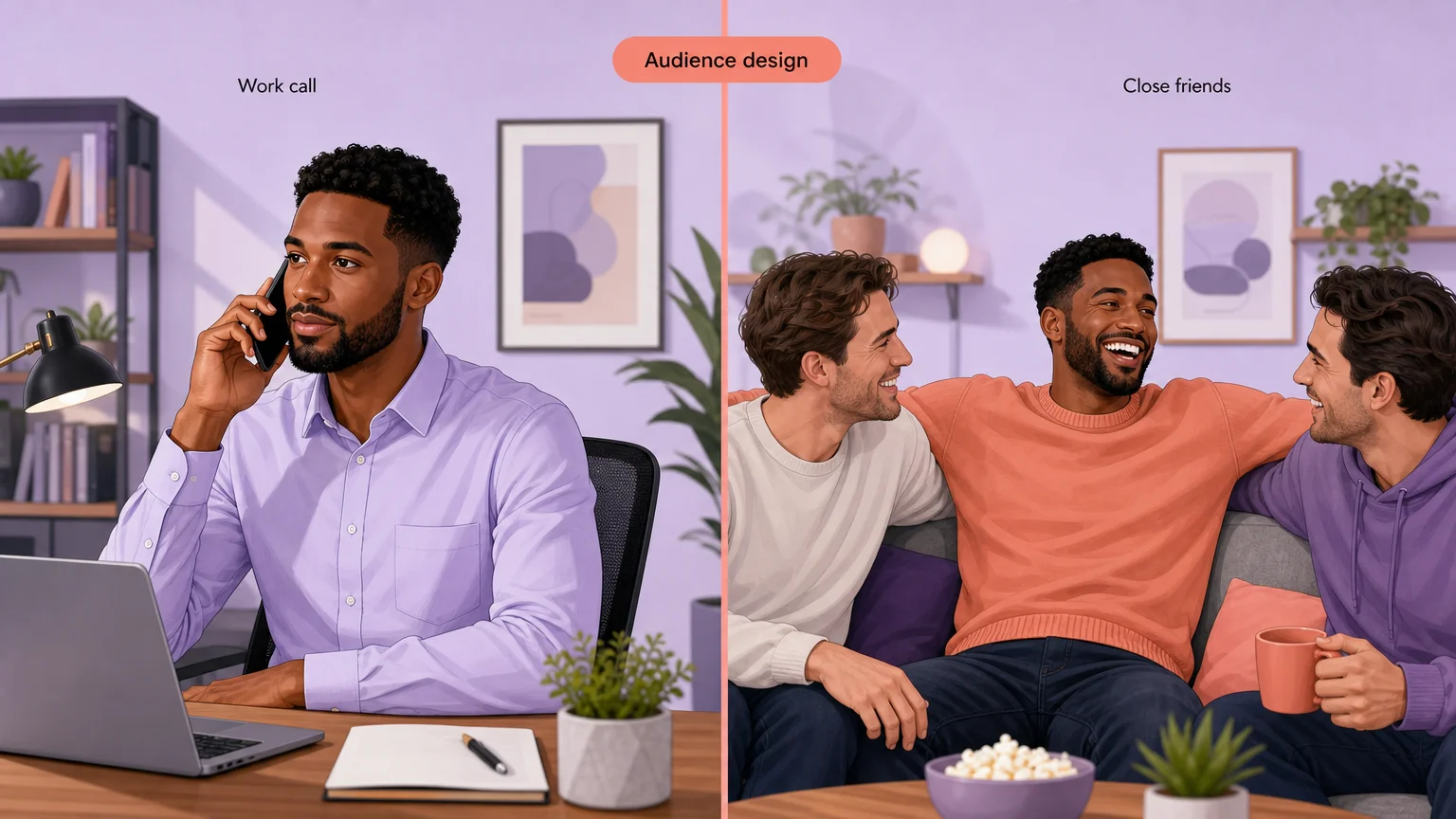
The voice on the phone to a stranger is not the voice in the group chat. You have felt that and probably filed it as a small private inconsistency, something slightly embarrassing, maybe evidence that you are putting something on.
It is not. It is the most ordinary thing a voice does, and you can watch it happen in other people once you know to look.
Start with the natural experiment, which is about as clean as a sample of one gets. Erin Broadhurst compared a pair of identical twins, one gay and one straight, both YouTube creators. Her hypothesis was that the gay twin would hold voiceless consonants longer. The straight twin did.
The finding is smaller than the hypothesis. The gay twin used shorter voice onset time, a difference between two men with the same genes and the same upbringing. The weight is small. One undergraduate case study, assembled in about four months, supports no generalization. What the case does show is how small the difference can be.
The clearest evidence for a listener effect comes from coming out. Gay speakers sounded more gay talking to someone they had come out to easily than to someone where it had gone badly or not at all. The relationship moved the voice, not just the listener’s orientation. That result comes from the published abstract.
Men compete with pitch in the other direction. Lower voices read as more dominant, and dominant men lower theirs in competition. The mechanism is male behavior, not gay behavior. The only difference is which way you are traveling.
There is a name for it. Audience design: you speak for the person you expect to hear you, and that includes an imagined wider audience you cannot see. It is why coming out can change how someone sounds on camera long after the conversation itself is over. The adjustment is usually unconscious, and it tracks the listener more than the topic.
Which means the version of your voice that shows up in a given room is a response to that room. Asking which one is the real voice is asking the wrong question, in the same way that asking which of your laughs is the real laugh is.
The Listener Cause: Why the Label Catches the Wrong People
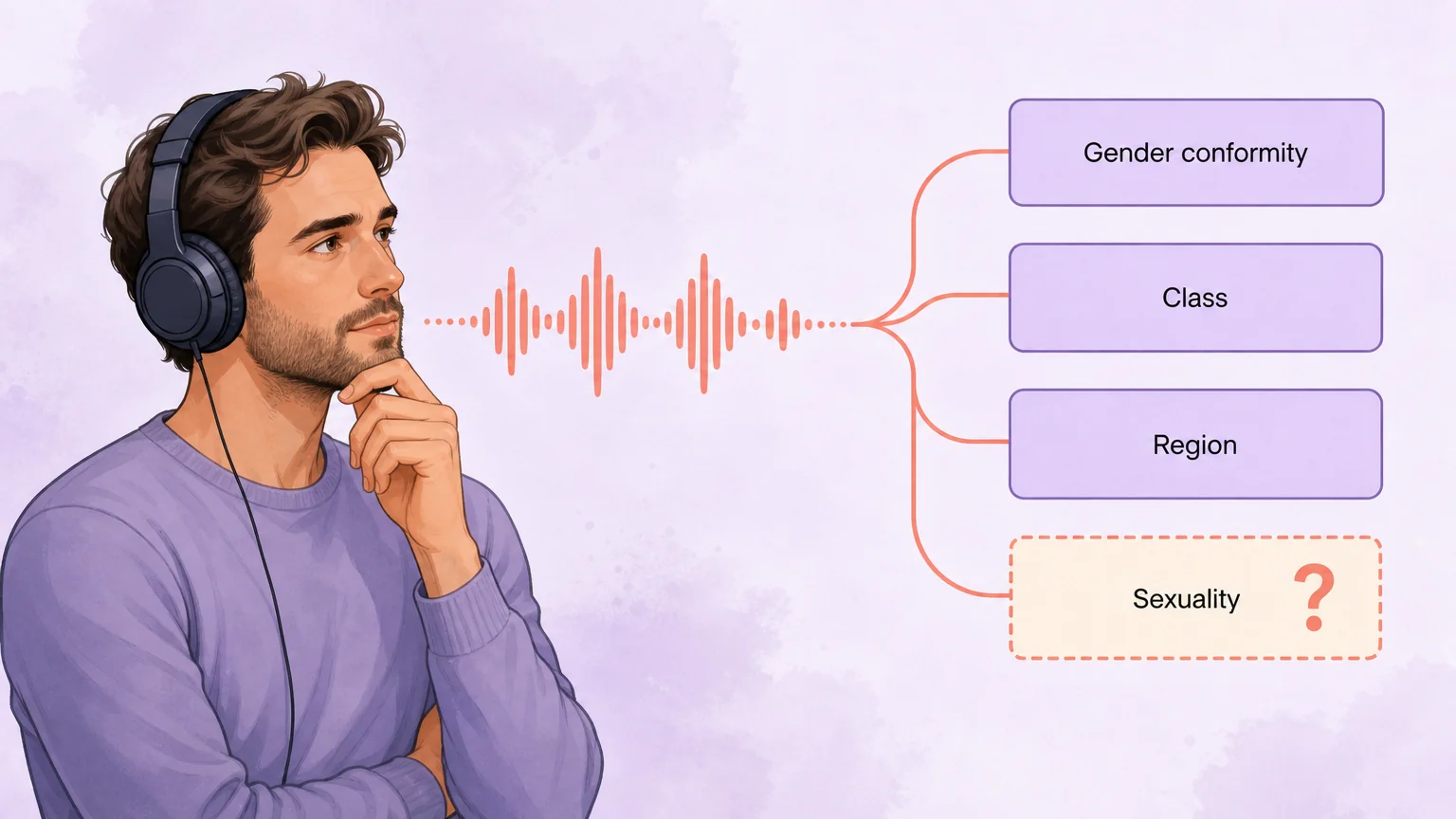
Men who do not sound gay get told they are hiding. Men who do get told they are transparent. Both are being read by an instrument that is worse than advertised.
The acoustic distance between gay and straight men’s speech came out at 10.65 percent. Average differences that small leave heavy overlap between the groups. Straight men get read as gay too, often enough that a replication of a Canadian gaydar study in England produced implausibly high gay ratings for them.
Male voices with higher pitch get rated as gayer, even though the production evidence does not show gay men speaking higher as a group. A significant share of what reads as gay is a listener’s rule of thumb rather than something the speaker is doing. Broadhurst summarizes the perceptual side this way, drawing on Munson and Lindvall, and it is the mechanism the pitch section was pointing at.
Two populations fall out of the category constantly. Plenty of gay men do not sound this way, and plenty of straight men do. The listener gets no warning when the inference is wrong, and the label arrives with the same confidence either way.
Class and region do a lot of the work people attribute to sexuality. In that replication, the speakers turned out to be posh, southern, high-socioeconomic-status Londoners, and working-class listeners read that register as gay. Listeners were detecting class and region and filing the result under sexuality. One caveat: the replication itself was not located, and the account comes from a researcher recalling it, who was not certain of the city.
Race is the open question, and it should be left open. The /s/ patterns that get read as gay were documented mainly in white speakers. Jeremy Calder argues that research on /s/ has centered white, cisgender speakers, that gendered /s/ patterns do not reliably hold in other communities, and that a framework built there cannot be assumed to explain anyone else’s speech.
That is an argument a linguist makes. It is not a settled correction, and the gap should not be filled with invented findings about Black, Latino or Asian gay men’s speech. Where the evidence does not exist, the right move is to say so.
What the label sorts, then, is any male speech that breaks masculine convention. That is why it catches so many people who are not gay and misses so many who are. That spread is what you meet anywhere gay men gather, including on a dating app like 3Fun.
Why Sounding Gay Costs You, and Why Masking Is a Trade

Sounding gay costs you something before anyone in the room knows a single fact about you. That is true, and it is measurable.
Fasoli’s team put the question to 363 heterosexual adults in the US and UK. A man who sounded gay drew more avoidant discrimination than a woman who sounded lesbian: 3.19 against 2.88 on a seven-point scale.
The scope matters. This measured stated willingness to interact. It did not measure hiring, housing or service, and treating it as a hiring statistic goes past the evidence.
The belief that makes it worse is the belief that you could stop. The more listeners believed vocal differences are fixed and controllable, the more they avoided gay-sounding men.
Being able to control your voice did not protect anyone. It read as a reason to hold you responsible. That is the cruelest finding here.
The cost also continues after the room empties. Among gay men, believing you sound gay predicted expecting rejection and voice-related vigilance: the habit of avoiding situations or people who might mock you. Gay men scored higher than lesbian women on all three voice beliefs and on both stigma measures. If you have ever skipped a phone call, rehearsed a sentence before saying it, or chosen the drive-through over the counter, you know the behavior the scale is measuring.
Wider claims circulate too. Voice-based judgments have been reported to affect employability, adoption assessments and teaching evaluations. Those come from earlier studies summarized inside that paper and were not checked directly, so they are reported rather than established. Keep them that size.
Masking is a decision. You get in first with the joke so nobody else can land it. You hear a voice that drifted over a few months and now reads to its owner as annoying rather than as gay. You lower it into something growly, and other people hear the very tell it was meant to hide.
Masking can lower a real cost in a specific room. It also charges rent in vigilance, and both halves are true at once.
Why dropping your pitch disappoints is worth understanding, as explanation rather than instruction. A speech-language pathologist describes voice as five separable dimensions: weight, tilt, resonance, pitch and dynamics. Resonance, how bright or dark the voice is, carries most of the gender signal. That is why dropping pitch alone tends to read as strain rather than as a different voice.
Why Your Voice Is a Signal, Not a Diagnosis

There is no one-to-one mapping between a voice and a sexuality, the same way there is no one-to-one mapping between wearing Doc Martens and being bisexual. Broadhurst makes exactly that comparison. A loose sign got picked up, circulated, and hardened into a rule.
The label runs in both directions. Matteo Lane opens a set with “clap if you can hear my gay voice,” and the room claps. That is in-group recognition happening in real time, a marker claimed from the inside rather than applied from outside. Both uses of the same category exist, and the imposed one is not the whole story.
So here is your standing. If the description fits and you want it, it is yours. If someone applies it to you, you are not obliged to take it, and meaning it as a compliment does not make it one.
The voice earns its keep when it moves with safety. It sounded different with someone you had come out to easily, and it has been documented shifting after a public coming out. That makes it an instrument rather than a defect, and it is the one finding in all of this that points somewhere usable.
None of it requires you to audition for a category. The men you meet already arrive across the whole range, and the ones who get clocked are not more honestly gay than the ones who do not.
Nothing in the causal picture says the voice is a problem to be solved. The mechanisms are ordinary: the same ones that make anyone sound like where they are from and who they talk to. A voice is a record of where you have been and a response to who is in front of you. That is all it has ever been.
Common Questions About Gay Voice
Is a gay voice genetic?
No gene for it has been identified, and the obvious hormonal explanation was tested and failed. In a 160-person sample, gay and straight men had effectively identical salivary testosterone, and it predicted none of the acoustic measures. What the evidence points to is a small biological component sitting alongside learned speech norms. See The Body Cause above.
Do all gay men sound gay?
No. Many gay men’s voices read as conventionally masculine, and many straight men’s voices get read as gay. The acoustic overlap between the groups is large and the average differences are small, so a listener working from voice alone is working from weak evidence. The category is an inference, not a property.
Is the gay voice just a lisp?
No. A lisp is an interdental articulation, the tongue between the teeth, turning an S into a TH. The feature people mean is s-fronting, where the /s/ is made further forward in the mouth and stays an /s/. Different place of articulation, not a speech disorder. The name is wrong, and it has been wrong for a long time.
Can you change your voice if you want to?
The features are learnable in principle, and you already shift your voice by context without trying. What has not been demonstrated is a reliable way to permanently sound straight. Pitch alone rarely does it, because resonance carries more perceptual weight. Whether to try is a decision with a real cost on both sides, and it is yours.
Why do some straight men sound gay?
Because listeners are detecting gender nonconformity, class and region, and filing the result under sexuality. When a Canadian gaydar study was replicated in England, straight speakers drew implausibly high gay ratings. They turned out to be posh, southern, high-socioeconomic-status Londoners, and working-class listeners read that register as gay. This account is secondhand, so hold it loosely.