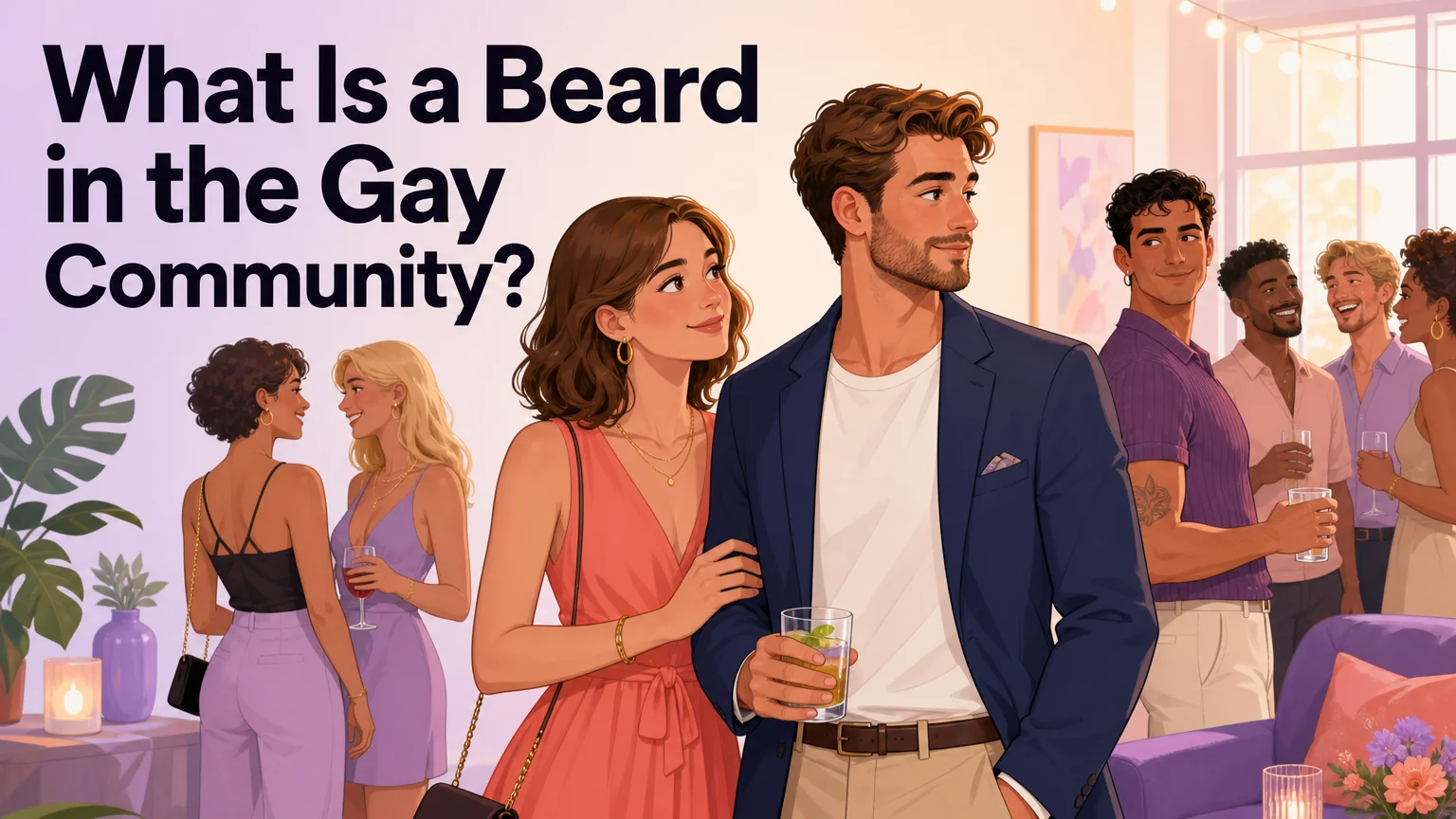
The answer to what is a beard in the gay community fits in one sentence. A beard is a person presented as someone else’s partner so that the other person can appear straight: the date at the office party, the partner in the photograph, the spouse at the family dinner.
It is a role, not a relationship, which is why one word covers a single evening as easily as a thirty-year marriage. Nothing in the word says whether the beard was in on it.
The label covers men and women, and it runs in both directions: a woman covering for a man, a man covering for a woman, or two people covering for each other.
Sometimes the beard agreed to it. Sometimes they never knew. Those two cases are what people argue about, and the split runs underneath every neighboring term, lavender marriage included.
The question underneath all of it stays the same: what did each person agree to?
Beard or Bear? Two Gay Slang Terms People Mix Up
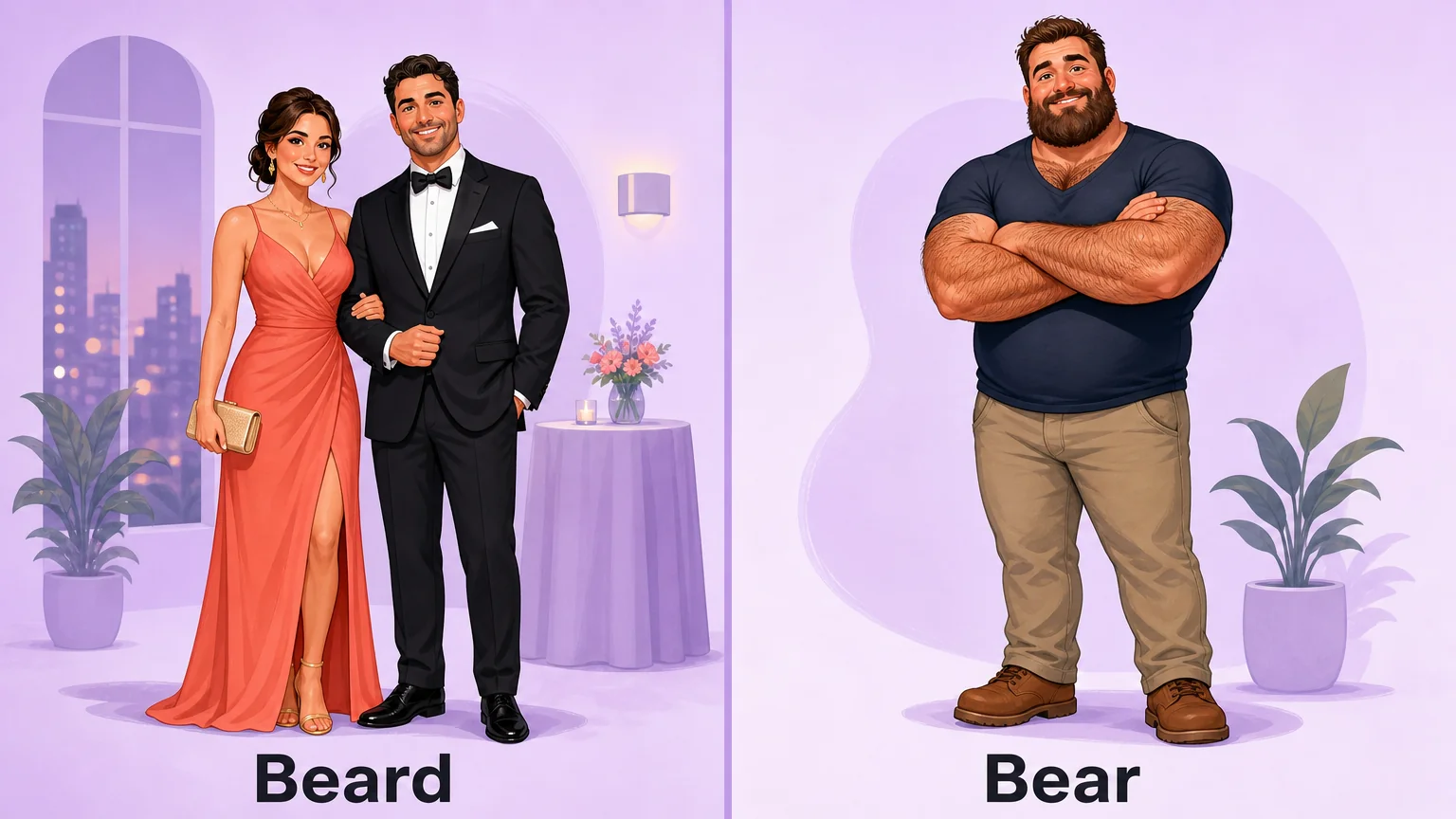
The term beard and the word bear sound alike and mean nothing alike. It is the mix-up people hit first.
A bear is a body type and a subculture, generally associated with hairiness and a larger build. It is about who someone is and who they are drawn to. A beard is a role a person plays in someone else’s life. The words look alike, both are queer slang, and that is the whole relationship between them.
The dictionary sense is narrower than current use. A beard is “a person who escorts another to a social function in order to mask the identity of one or the other’s lover or sexual orientation,” per the New Partridge Dictionary of Slang and Unconventional English. That sense appears in the mid-1950s and spread more widely in the 1960s, and it has since stretched to cover a spouse as readily as a companion at an event.
Why the word is beard is less settled than it looks. One explanation is disguise: a fake beard is the oldest easy costume, so a beard is camouflage. The other is a masculinity signal: appearing publicly with a woman presents a man as straight the way facial hair presents him as masculine. Both circulate, and the origin is asserted more often than it is explained.
Lavender Marriage, Merkin, PLP: The Words Around Beard
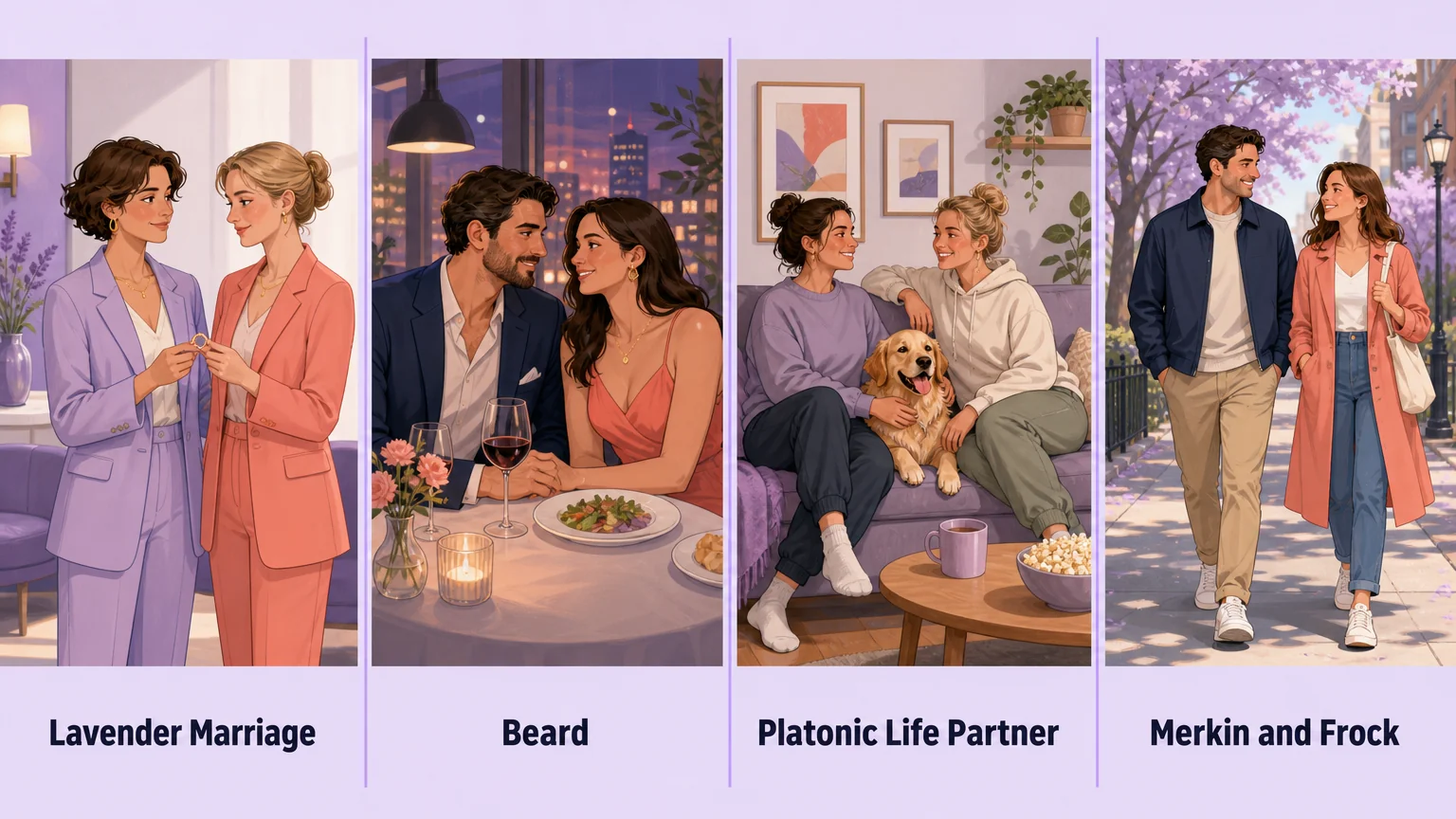
Most of the confusion around the term beard comes from its neighbors.
Lavender marriage. The older name for the union itself, from before the Second World War. It names the marriage where beard names the person, so a beard arrangement does not have to involve a marriage at all. People use the two as synonyms. They are not, and the term has since been reused for something else.
Lavender dating and front dating. The same idea at the dating stage, from the same era. Both have nearly dropped out of use. They get swapped with lavender marriage, which erases the dating-versus-marriage line they drew.
Fauxmance. A public, performed romance. Often it is a commercial publicity arrangement in which nobody is concealing an orientation, which makes it a poor synonym for beard.
Platonic life partner (PLP). A lifelong partnership that may include living together and raising children, and is not necessarily romantic or sexual. It is claimed openly, making it the structural opposite of a beard even though the two look identical from outside.
Merkin (US) and frock (UK). The gender-reversed case: a straight man dating or marrying a lesbian. Both are thinly evidenced, and merkin carries a much older unrelated meaning.
On the down low, or DL. A man who presents as straight and has sex with men without saying so. It names the man in the closet, not the person covering for him. People rarely apply it to themselves.
The word’s own older sense. Before the orientation sense, a beard was sometimes someone concealing infidelity, and that usage has largely gone.
What all of it hinges on: some of these words name a person, some name an arrangement, and one names a person in the closet. Confusing those three categories is where most of the mix-ups start.
Knowingly or Unknowingly: The Line the Word Turns On
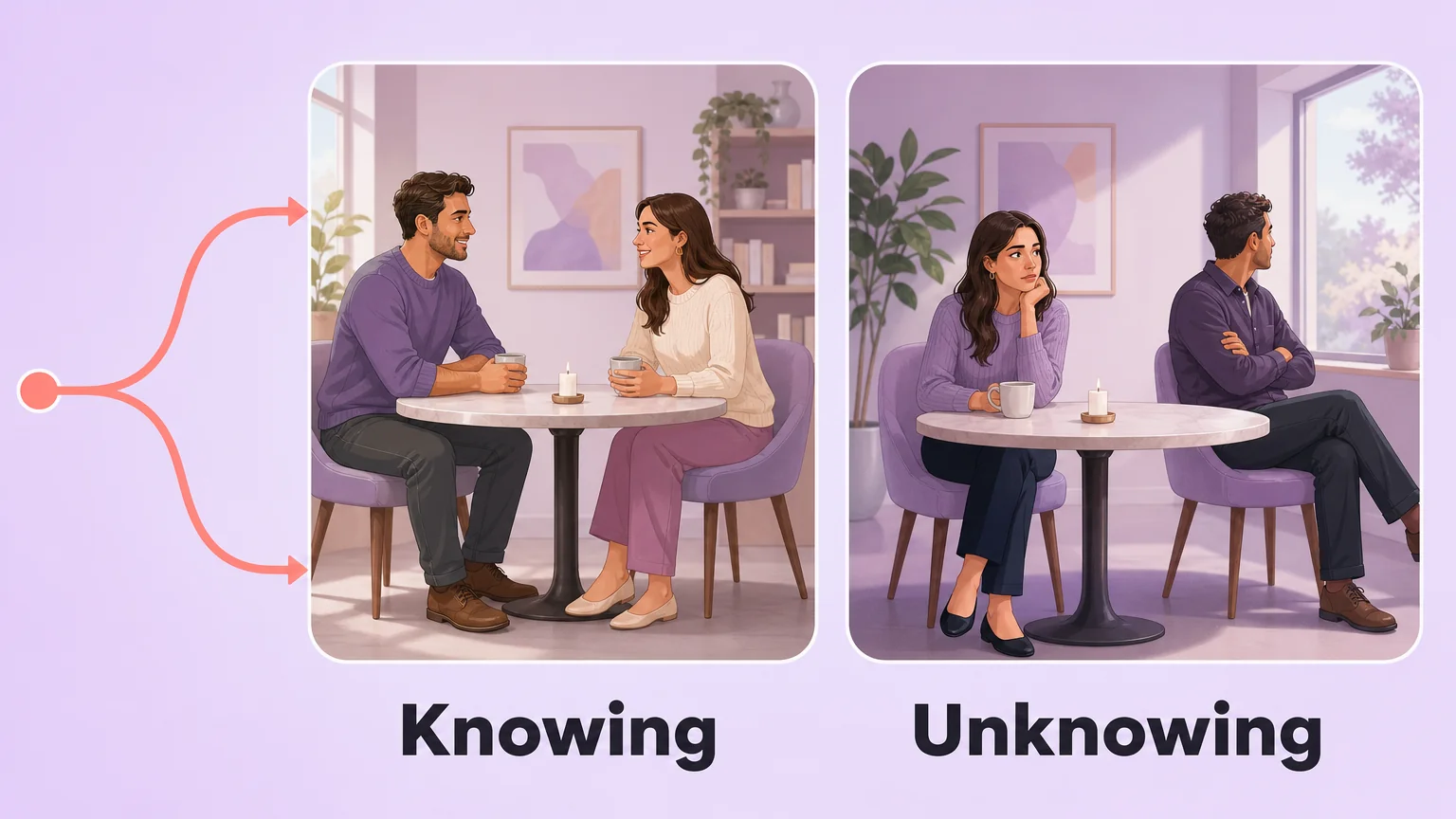
Here is the answer rather than a survey. If both people know what the arrangement is, it is a deal, and the word describes something they chose. If one of them does not know, it is a deception, and that person never agreed to anything.
The word itself does not draw that line. It applies one label to a willing participant and to a deceived spouse, which is a flaw in the vocabulary rather than something you failed to understand. The linguist Victor Mair relayed a commenter’s sharper version of the point: where the spouse does not realize what they are, calling them a beard misdescribes them, because the word carries the sense of being in on it.
The case the ambiguity is named after has been open for seventy years. In 1955, after a magazine threatened to publish an exposé about Rock Hudson’s lovers, he married his secretary, Phyllis Gates. In her 1987 autobiography she wrote that she married for love. Whether she was deceived or knowingly part of the arrangement has never been settled, and it stays where she left it.
That line also explains what a beard is not. An open relationship is agreed between the people in it and known to them. A beard arrangement is built on concealment, and the concealment can run toward the outside world or toward the beard themselves. The difference is disclosure, not exclusivity, which is why one marriage with outside partners reads as an ordinary negotiated boundary and another reads as a serious problem.
3Fun asks the same thing of everyone who joins: say what you are looking for before anyone commits to anything. You can do that now.
Is Bearding Wrong? The Argument People Are Still Having
One position holds that the arrangement is protection, and it has a serious version. A projection built from European Union survey data puts the share of sexual minorities who conceal their orientation from all or most people at 83% worldwide. That is a projection of a global figure rather than a measurement of one.
On that reading, presenting as straight is a safety strategy. It protects a job, housing, and a place in the family.
The people who make this case describe bearding as a long-standing tradition and nothing to be ashamed of, since not everyone is ready or able to live openly. Then they add a qualification: it holds as long as everyone involved is consensual, open and communicative. That qualification is where the argument sits, and the framing offers no answer to it.
Position two holds that the arrangement costs someone, and the cost is usually not the sex. It is the labor and the lie. The pattern named most often is a woman keeping the household while her husband has partners elsewhere, with the old Hollywood expectation that she would not have affairs of her own.
Some harm survives disclosure. The conversation that followed a 2022 film about these marriages centered on the mental-health cost of never being open with family and on how the brunt of it fell on women. Many of those marriages ended in separation.
The middle deserves saying plainly too. Many of these relationships were loving, and the account people give is hurt and anger alongside lasting care once the dust settles.
The law is where the ethical argument stops being the interesting one. A private arrangement between two adults is one thing. Entering a marriage to make a false representation to a government, a court or an insurer is another, because the paperwork cannot see motive. Immigration lawyers describe the exposure as serious: removal, criminal liability, and a permanent bar on future marriage-based petitions.
The Beard’s Side: What It Costs, and What to Do If You Find Out

Start with the people, because the abstraction hides them. In a community for straight spouses of closeted partners, one member writes: “I am a former unknowing beard, also married for 32 years at d-day.” Another: “I was also an unknowing beard married 38 years and together 41.” A third compresses the whole arrangement into four words: “my job was to make the meatloaf and be a beard.”
Discovery tends to look like this. “I remember leaving the house for the day and I just sat in the car and just cried.”
What people describe is not a worse version of cheating. It is a different shape. The deceived spouse has to absorb the affair and, separately, that their partner “is not fundamentally attracted to having sex with you.” One person called it its own kind of mindfuck; another put it as “I feel used, and I feel that collateral damage is really painful.”
One woman describes eight years of a sexless marriage, then a brief resumption after disclosure and crying through the first time. That is grief, not reconciliation.
Where the disclosure comes late, it rewrites the past rather than only the future. One woman describes the premise being withdrawn: “He hated that part of himself and couldn’t reconcile it, he had married me hoping it would go away.” That is a decision made about her, not with her. Decades of ordinary domestic life get re-read through the new information, every shared holiday and milestone re-narrated, which is why the damage does not behave like an ordinary separation.
If this is where you are, the steps people who lived it recommend are specific.
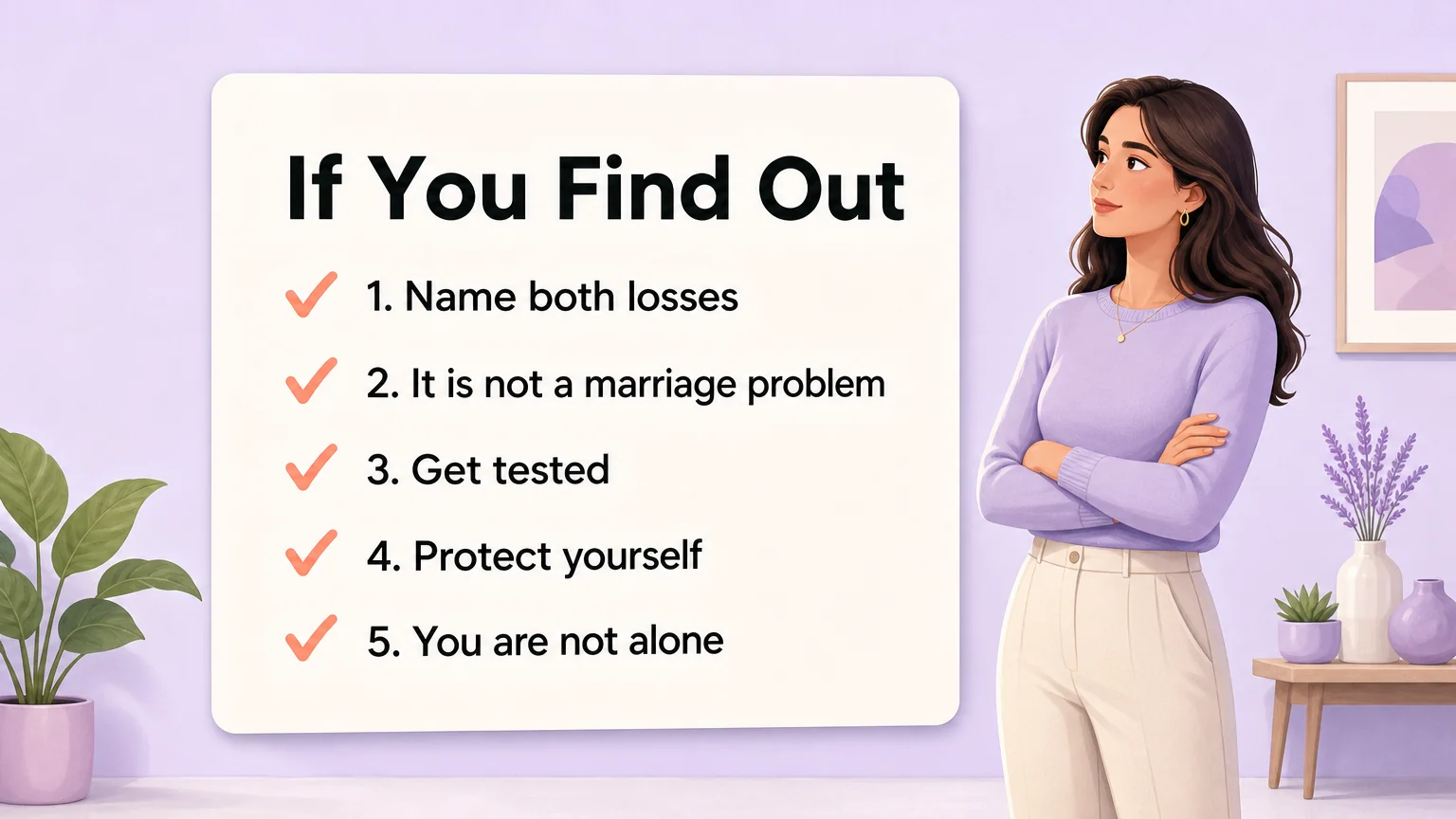
- Separate the two losses. The infidelity is one. The other is learning that desire was never part of it, and each has to be named before it can be worked through.
- Treat it as a false premise rather than a marriage problem. The advice from someone who lived it is a therapist, not a marriage counselor.
- Get tested. That is a practical step, not a moral one.
- Do not assume the other person’s priority is protecting you. A closeted spouse can protect the closet ahead of protecting you.
- Know that it is more common than people assume. That was the single piece of advice one woman had for anyone in the same position.
If you are still working out what you are looking at, Is My Husband Gay lays out what counts as a sign, what does not, and how to have the conversation that follows.
When People Say You’re a Beard and You’re Not

A woman wrote to an advice column because friends and relatives sat her down every six to eight weeks to tell her she was her boyfriend’s beard, on the strength of his looks and his mannerisms. She had a good relationship with frequent, satisfying sex, and the comments still chipped at her confidence.
Her problem was other people’s assessment, not the relationship. That is the advice columnist Rich Juzwiak’s position: speculation about how a couple looks is not evidence about what it is. The interventions treated a non-stereotypical presentation as automatically dishonest, which he called conservatism masquerading as concern. His advice: block out the commentary and talk to your partner.
If you are the one trying to separate what you have observed from what other people are assuming, Is My Boyfriend Gay walks through that evidence question for a relationship that has not become a marriage.
So is the label fair? Sometimes yes, and the word does not tell you which case you are in. Applied to someone who agreed to the role, it is neutral or even protective. Applied to someone who never knew, it is inaccurate as well as painful, because the word implies they were in on it. Applied to someone as a guess, it is a claim about a real person built from a stereotype.
The same logic covers the public figures whose names circulate. Those cases rest on rumor and contested biography, not on anything they said.
How Bearding Started: Studio Contracts, the Hays Code, and Cover Marriages
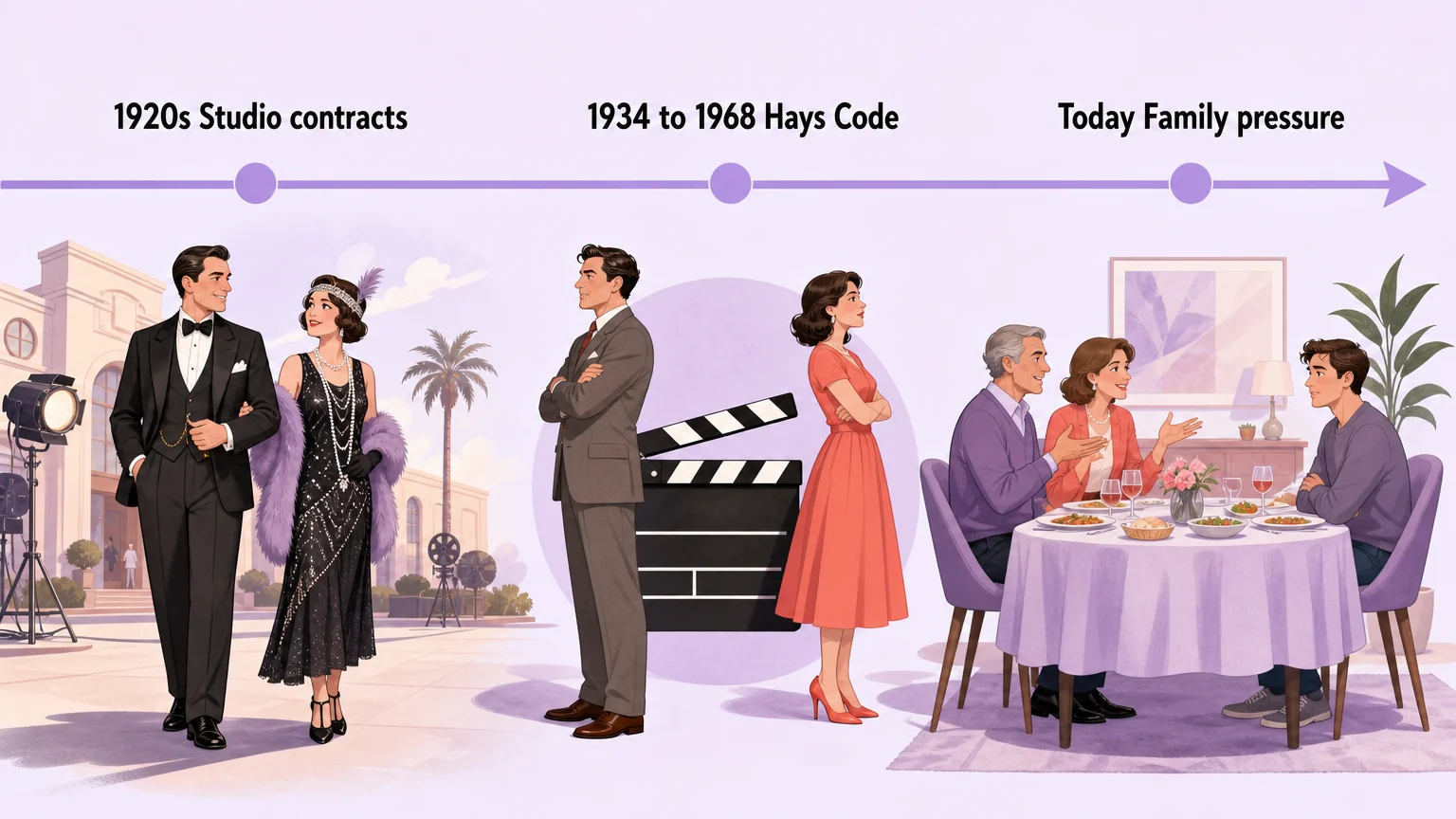
The machinery came before the famous names. From the 1920s, studio contracts began to include morality clauses, and between 1934 and 1968 the Motion Picture Production Code, the Hays Code, barred gay actors from living openly. An actor could arrange a cover relationship privately. More often the studio arranged one, because a box-office asset could not be allowed to become a scandal.
Lavender marriage, lavender dating and front dating were the era’s words for it, in use before the 1960s and the Second World War.
Betty White described her own part in it. She attended events with Liberace to give him a straight alibi, and when she was asked decades later whether there had been any doubt he was gay, she answered, “Not at all.” The 1959 lawsuit he won over a similar insinuation is why the rumors around him are so well documented.
In a 2016 Reddit AMA, the actor Johnathon Schaech said his manager asked him to accompany Ellen DeGeneres to events early in her show because she was scared people would not watch, and he called the request an honor. That one is escorting rather than marriage, which is the dictionary sense in action.
A great deal of what circulates about the studio era rests on rumor, contested biography and speculation rather than on anything the people involved confirmed. That is why only the cases where someone spoke for themselves appear here.
Where the Pressure Comes From Now: Families, and Xinghun at Scale
The pressure moved. It used to come from studios, and now it comes from parents, in-laws and community, which changes who does the asking and who pays for the answer.
The clearest large-scale example is xinghun, literally “form marriage.” It is an arrangement between a gay man and a lesbian woman who each know the other’s orientation, and that mutual knowledge is the entire difference between it and a deceptive beard arrangement. It is why translating xinghun as beard loses the point.
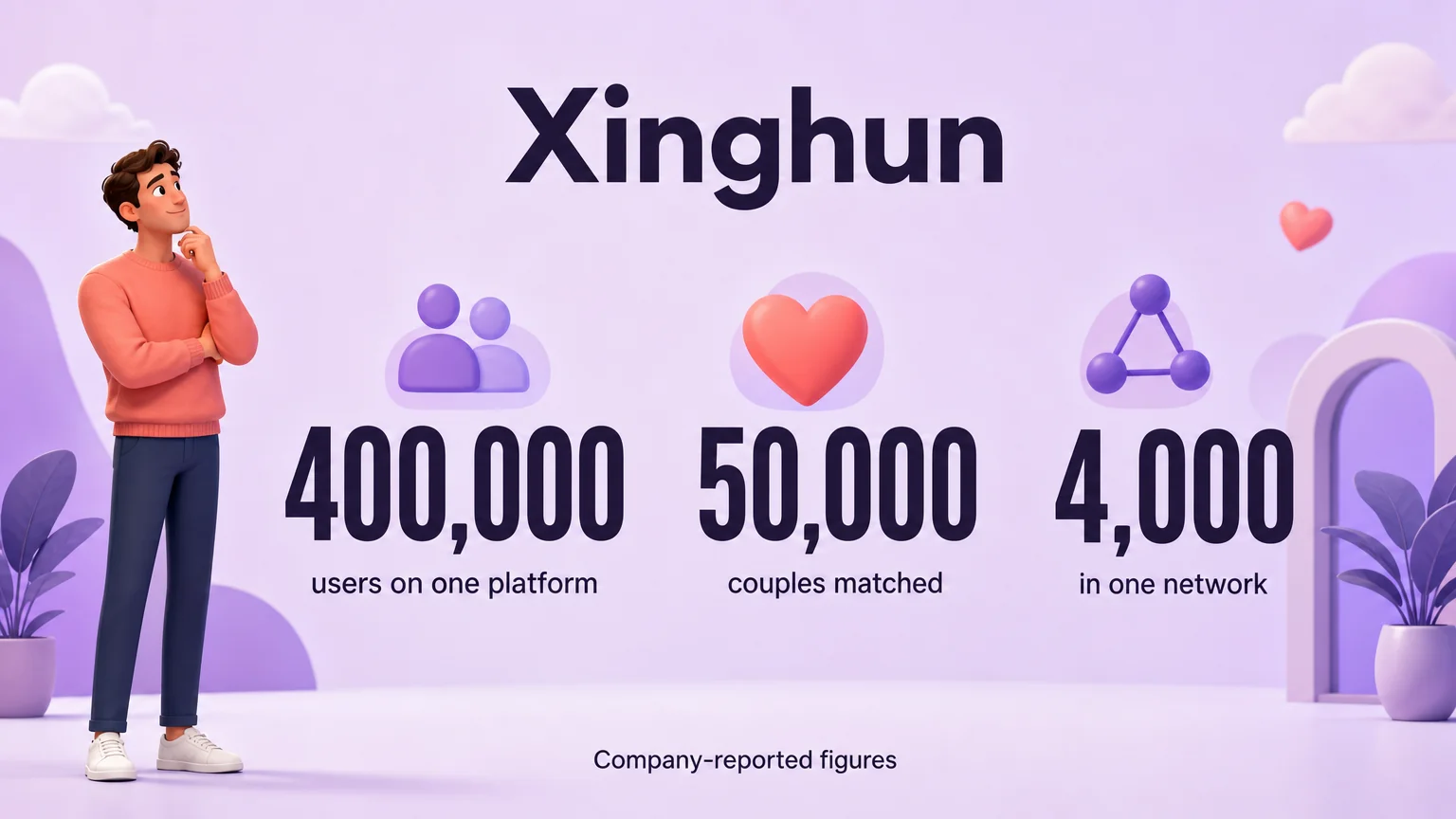
The infrastructure behind it is substantial. A 23-year-old who signed up to an app was connected within minutes to a network of more than 4,000 lesbians looking for a gay partner for a cooperative marriage, and he had not come out to his family. One platform reports more than 400,000 users and claims almost 50,000 couples matched, both figures company-reported rather than independently audited.
The reason people give is consistent. In interviews about the arrangement, the biggest reason for entering one, by far, was keeping family in their lives, alongside the weight of parents’ questions and the feeling that there was no choice but to marry.
One person describes her own from the inside. Xiaobai Ou, who runs a xinghun app, says plainly, “In order to appease my family, I chose xinghun.” Her wedding was in 2012, with her girlfriend as bridesmaid and makeup artist. On the outcome: “My husband is now a good friend of mine, and we go out together to eat and chat.”
She is also candid about the trade-off. Coming out is very hard, she says, and should not be demanded of everyone on a short timeline: pushing it “could bring more harm to the LGBT community.” She calls xinghun “a relatively moderate approach.”
How it goes for most people is the part the advocacy skips. Interviewees reported being miserable and described the arrangement as not a fix at all or not worth it. Many of those marriages ended in separation.
The vocabulary tells you whose story gets told. Chinese names the non-gay spouse rather than the role: tongqi for a wife with a gay husband and tongfu for the reverse, both carrying an accusation of fraudulence rather than a neutral description. Tongqi is discussed far more than tongfu, so half the story is the half with words.
Lavender Marriage’s Second Life
The neighboring term has moved. Since 2024, lavender marriage has circulated on social media for arrangements between two people concealing nothing from each other, chosen for affordability and companionship.
It broke through when a musician with a large following posted publicly for applications. He could not cover mortgage payments, utilities and taxes alone, and he told the applicant to see whoever they wanted. Housing costs for his cohort run 31% higher than what millennials paid a decade earlier.
The upside people cite is real. A legally binding marriage can confer parental rights, healthcare coverage, tax breaks and inheritance rights, and the gender and sexuality expert Edward Reese frames the strongest version as legal family rather than appearance, for people whose families are absent or estranged. The sexologist Sofie Roos adds what gets overlooked: physical comfort and safety that a friend does not provide.
It is not a solution to loneliness. Jealousy and sadness arrive when one partner starts feeling left out, and terms that felt fine when agreed can stop feeling fine later.
Lavender marriage also covers arrangements where nothing is concealed, including a gay man married to a straight woman for close to a decade who describes the marriage as out and open, monogamous, and not a cover-up.
FAQs: Is Beard an Insult, and Other Common Questions
Is a beard the same thing as a bear?
No. A bear is a body-type and subculture identity. A beard is a role someone plays in another person’s life. The words sound alike and mean nothing alike. See “Beard or Bear?” above.
Can you be a beard without knowing it?
Yes. The standard definition says “knowingly or unknowingly,” and people who found out late describe decades of not knowing. Reported durations run to 32 years of marriage at discovery. See “The Beard’s Side” above.
Is calling someone a beard an insult?
It depends which of three situations the person is in. Someone who agreed to the role may hear it as neutral or protective. Someone who was deceived hears an inaccuracy as well as a wrong. Applied to a stranger as a guess, it is a stereotype doing the talking.
What should I do if I think I might be a beard?
Branch on the evidence. If the only thing pointing at it is other people’s comments about how the relationship looks, that is not evidence and can be set aside. If there is real evidence, treat it as a false premise rather than a marriage problem. See “The Beard’s Side” above.
How is a beard arrangement different from an open relationship?
The difference is disclosure, not exclusivity. An open relationship is known to the people in it. A beard arrangement is built on concealment, whether from the outside world, from the beard, or from both.
How is xinghun different from a beard?
Mutual knowledge. In xinghun both parties know each other’s orientation, which is the opposite of the deceptive version. Translating it as beard drops the one thing that defines it. See “Where the Pressure Comes From Now” above.
Does a beard arrangement cause legal problems?
It can, in specific circumstances. Immigration lawyers describe a marriage entered into for immigration purposes as fraud, with consequences for both the immigrant and the citizen who knowingly took part: removal, criminal exposure and a permanent bar on future marriage-based petitions.
Does the arrangement actually work for the people in it?
Sometimes, and it depends which demand it was meant to meet. As a way to relieve family pressure it has a real record of breaking down: interviewees described themselves as miserable and called it not a fix at all. It can also produce lasting friendships.
Is the term still in use, and has the meaning changed?
Yes, and in more than one direction. The core sense is unchanged, and communities still exist for finding a beard and for working out whether you already are one. What moved is the neighboring term, which now often describes a disclosed arrangement chosen for affordability.