An otter in the gay community is a man with a lean or slim build and noticeable body and facial hair, sitting between a twink (typically thin and hairless) and a bear (typically larger and very hairy). It is a self-applied label rather than a diagnosis, and nobody has to accept it.
The definition is genuinely contested, and the answer shifts depending on who is giving it. PinkNews calls the meaning “rather open to debate,” and Queerty concedes “the exact defining qualities are up for debate depending on the gay you ask.”
What follows covers where the word came from, where the lines sit against bear, twink, cub, wolf and fox, how the label behaves on a dating app, what to do if someone has just called you one, and whether the whole vocabulary does more good than harm.
What the Word Otter Means: The Plain Definition
You came for one straight answer and have already met three. That is not you reading badly; the term genuinely moves depending on who is using it.
Here is the version that holds on its own: an otter is a man with a lean or slim build and noticeable body and facial hair, sitting between a twink and a bear. TheGaygency’s glossary calls him “a lean or slim man who is noticeably hairy”; Men’s Health lands on “a slim to average build, with body and facial hair.”
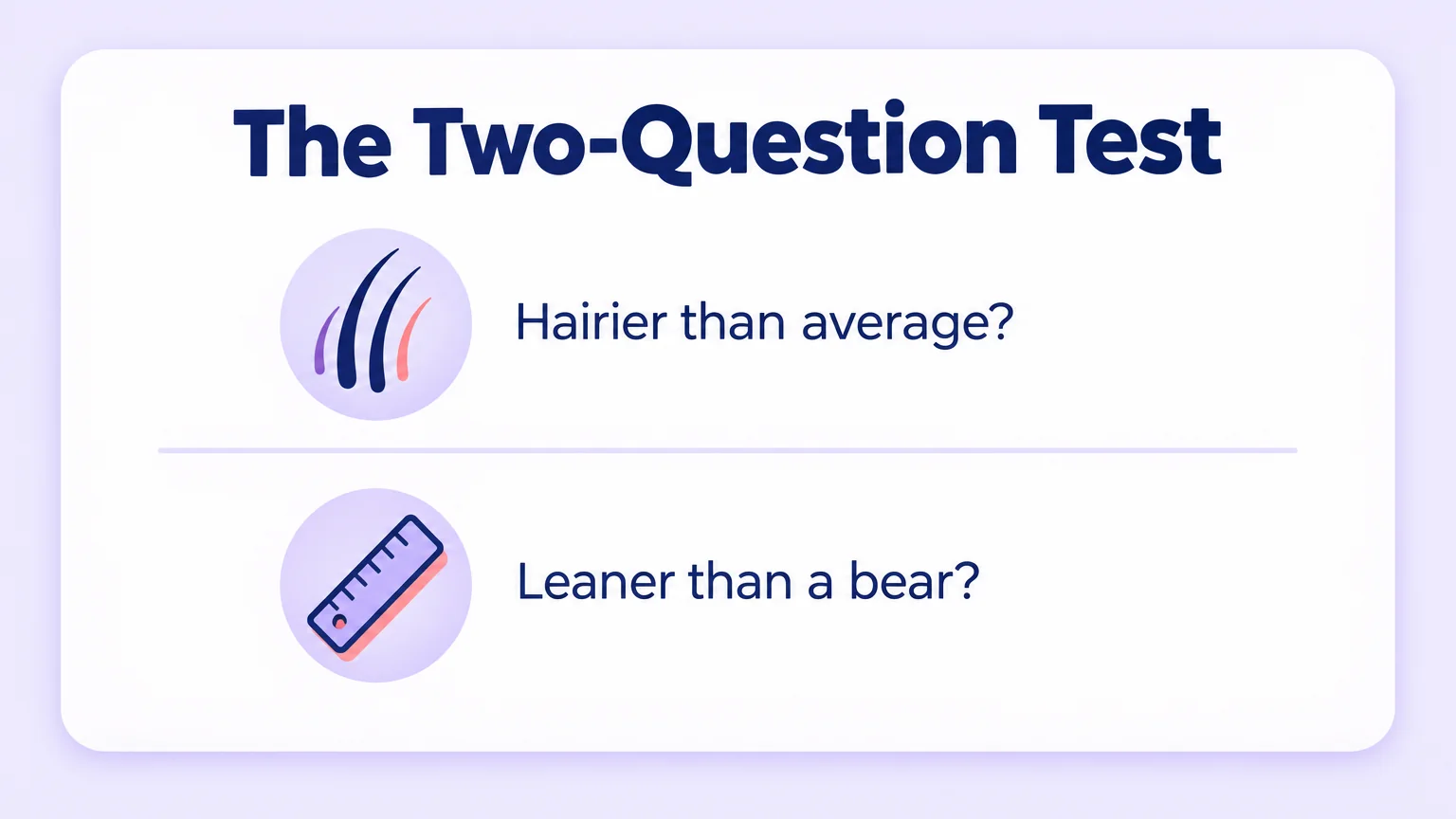
The quickest test is two questions. Are you hairier than average? Are you on the thin to slimly athletic side rather than bear-sized? Dean Modah, a queer linguistics educator, treats body hair as the only firm requirement and the build as varying widely inside the type.
Temperament is flavor, not a criterion. LGBTQIA+ Wiki reads otters as calm and laid-back, and Josh Olsen, who founded the community site Otterj.com, calls one “the guy next door, but with an edge.”
One correction: a young otter is not a cub. Cub means a younger bear, as the community’s own 1991 classification system says (“c – the CUB factor. For the junior up and coming bears”). LGBTQIA+ Wiki agrees, calling otters “distinct from cubs.” Use otter pup, or simply pup.
And what it is not: not an official or clinical category, not enforced by anyone, and not the same as pup play, which VICE’s Thomas Morton calls a master-servant dynamic rather than a physique.
Lean and hairy, self-applied, and a description rather than a membership.
Where the Word Otter Actually Came From
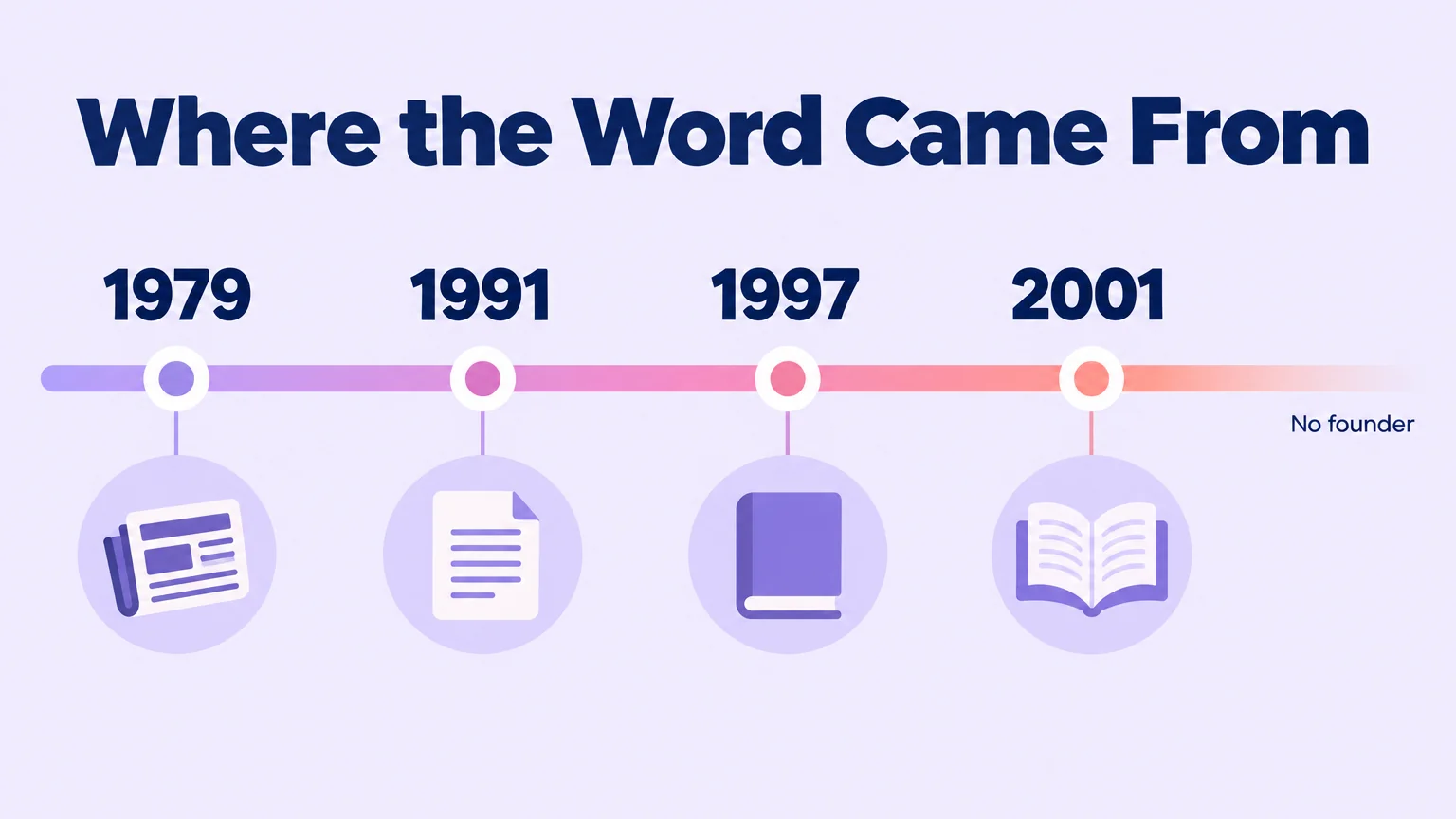
The most repeated account does not hold. George Mazzei’s “Who’s Who at the Zoo?” ran in The Advocate in 1979 and introduced “bear” as a gay descriptor. It named seven types: Bear, Owls, Cygnet, Pekes, Gazelles, Pussycats and Marmosets. Otter is not among them.
The earliest trace sits elsewhere. Bob Donahue and Jeff Stoner invented the Natural Bears Classification System over lunch at a Wendy’s in Boulder, Colorado, in 1989, then circulated it as version 1.9.1 dated 24 March 1991. Its weight code runs from w++ “a round bear/BIG TEDDY bear” through w- “a thin bear (otters!)” to w– “a bony bear.”
That parenthesis is the whole lead. “Otters!” is a gloss, not a definition. Nobody explains a word their readers have never heard, which means it was spoken before it was written down. That is why no one can name its coiner.
Two datings agree. Lee Phillips, a sex therapist, places the term “in the 80s and 90s within the bear subculture,” though he gives no citation; Digital Cultures says it came “from the bear analogy, during the 1980’s.”
The backdrop explains the timing. Bear culture is usually dated to late-1970s and early-1980s San Francisco, formed partly against the thin, gaunt look then associated with AIDS. VICE’s Thomas Morton adds that bears organized online before the first International Bear Rendezvous in 1995.
The paper trail then hardens. The code was reprinted in The Bear Book (1997, edited by Les K. Wright). By 2001, The Bear Book II carried John Milton Hendricks’ “By Any Otter Name: The Negative Space of the Bear,” built around an Otter Questionnaire of 24 men, all gay white men. Hendricks defines an otter by what a bear is not.
The meaning kept moving. Joe Kort, a clinical sexologist, records it: “In the early days, an otter didn’t necessarily have to have body hair—just facial hair. Now, there’s an expectation of body hair, too.” After the 1980s, shaving and waxing dominated gay male grooming, so regrowth is recent.
Otter has no founder. The defensible claim is narrower: a bear-adjacent shorthand hardened into its own category somewhere between the late 1970s and the early 1990s.
Otter vs Bear, Twink, Cub, Wolf and Fox
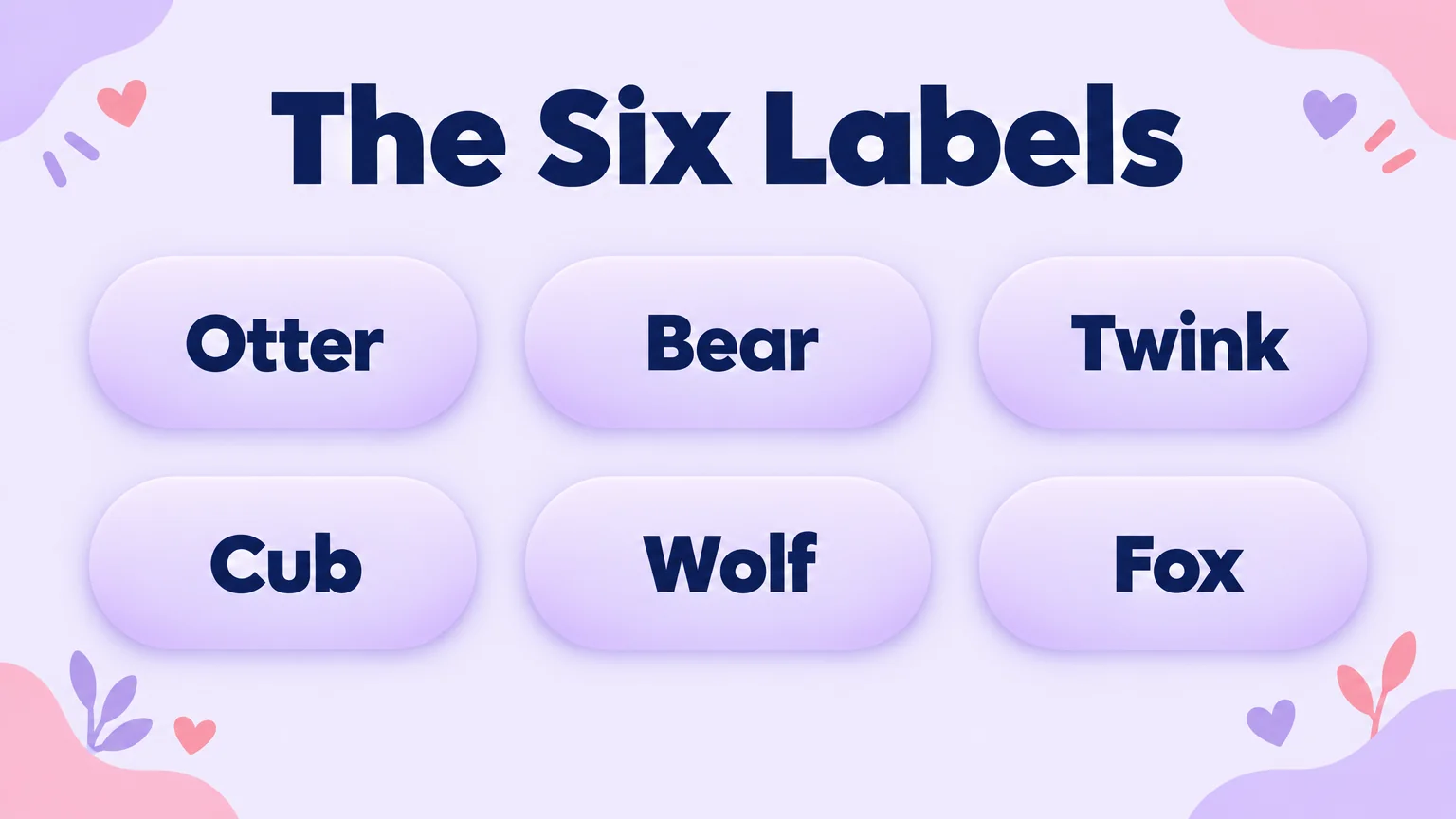
Am I an otter or a bear? The line is soft, and at least two of its edges have no settled answer.
| Label | Best-supported definition | Where sources disagree |
|---|---|---|
| Otter | Lean or slim, noticeably hairy; between twink and bear | Least contested |
| Bear | Larger and hairier; “more of an attitude” | Deliberately loose |
| Twink | Slim, young, hairless, boyish | Whether “twunk” is fixed |
| Cub | A younger bear | Four definitions, below |
| Wolf | A “thin bear,” more aggressive | Body type versus pup role |
| Fox | “an otter over forty” | One 2015 columnist’s proposal |
Otter is the one row that holds flatly.
Bear is deliberately loose. lgbti.org says many men who lack the classic characteristics still call themselves bears, and that the word is “often defined as more of an attitude than anything else.” It calls otters and wolves “thin bears.” The gap is one of degree, so no fixed threshold exists: the line you are looking for is genuinely missing.
Twink is the neighbor on the other side: slim, young, hairless by convention, boyish. Hair divides it from otter. Queerty’s line: an otter is “a grown-up twink with more hair on his chest and meat on his bones.” Twunk, twink plus bulk, has no fixed definition.
Wolf carries two live meanings that do not reconcile. lgbti.org says otter and wolf are both thin bears, the wolf “being more aggressive.” VICE’s Thomas Morton describes wolf as a role in a pup dynamic, not a physique.
Cub is the most contested boundary, with four definitions in circulation. One: a younger bear, per the community’s own 1991 bear code and most other sources. Two: a younger otter, a user-submitted tip repeated by bearwww.
Three: a younger, plus-sized, hairy man, per a Men’s Health profile. Four: a bear without body hair, a 2015 gloss in The Orion. The first is best evidenced; the others survive because people use the word locally.
Fox rests on one source: Joseph Rogers, in The Orion in 2015. “Basically a fox is an otter over forty… the cougars of the gay male community.” One columnist’s proposal, not a rule, and not “silver fox,” the general term for an attractive older man.
Two more words belong to the family: a chub is a larger man, and a chaser is drawn to a particular body type.
One rule of thumb: hair first, size second, age last. And “none of these” is a good answer.
Does the Otter Label Change as You Get Older?

A reader asking this is usually not asking about vocabulary. What happens to a body-type label as the body it describes gets older?
PinkNews reports that some describe otterness as “part of a transitory phase between twink and bear,” and that aging otters “may well become bears ‘physically’.” LGBTQIA+ Wiki agrees and explains why: “It is fairly common for an otter to become a bear as he ages, particularly as the physical aging of men and others with testosterone-dominant bodies tends to bring them in line with the body type expected of bears.” The taxonomy has a route forward built into it, not a cliff.
Gareth, a self-proclaimed otter in Berlin, framed it more simply to PinkNews: “Being an otter is, somehow, entirely a phase.” The anxiety has a name. “Twink death” is the viral, usually half-joking phrase for aging out of a category, tied by its analysts to ageism, fatphobia and the loss of older role models during the AIDS crisis.
Fox, one 2015 columnist’s over-forty label, is an option rather than a rule.
The label can move with you rather than expire on you.
How the Otter Label Works on Dating Apps
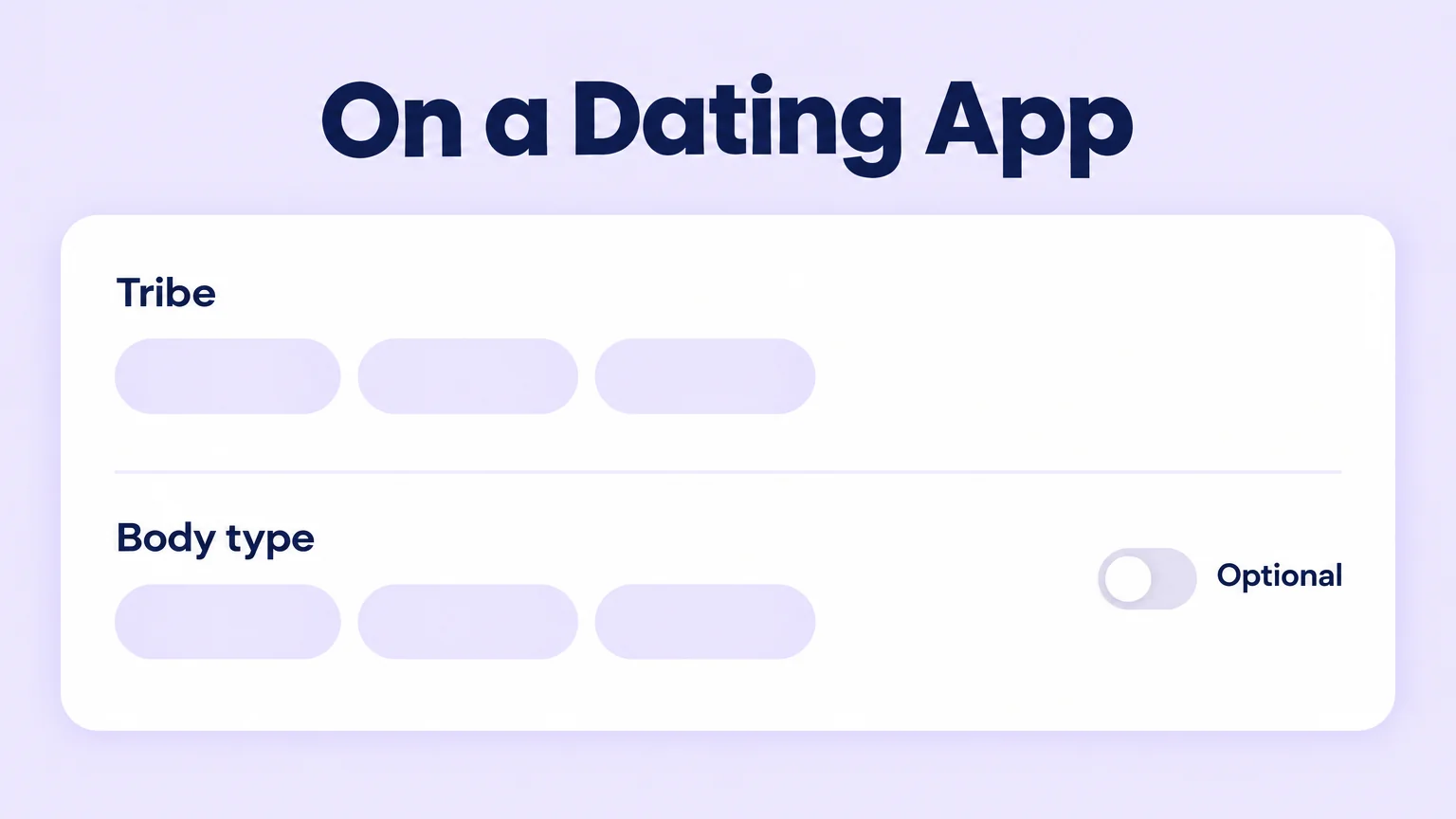
On some gay dating apps, “Otter” is a field you select for yourself. For example, Grindr shipped “tribes” in 2014, and Otter was one of twelve options. Members can list up to three, or none.
Two structures get conflated here. The tribe field says who you are; a separate body-type field says what you look like, and its options are Toned, Average, Large, Muscular, Slim and Stocky. You can set either, both, or neither. Body-type labels are not a Grindr-only behavior: they are a feature of the LGBTQ+ dating-app category, and 3Fun is one of the apps where they function.
The lists leave things out. There is no “fat” option; the heavier end becomes “large” or “stocky.” Research finds no way to identify as femme and no dedicated non-binary option among the prepopulated categories. Uptake is lower than the feature suggests: more profiles omit a tribe than include one, so leaving the field blank is normal and costs you nothing.
What the label does mechanically matters more. Free users can sort on only three criteria, while the paid XTRA tier lets people filter others out by physique, tribe, ethnicity and position. A tribe also works as a search key other people can use to remove you. The same field has an upside: Queerty notes you can also mark which tribes you are drawn to, which helps you “navigate the dating and hookup scene.”
Two takeaways: the field is optional, and the label is descriptive rather than diagnostic. Use it because it is useful to you.
What to Do When Someone Calls You an Otter
Someone has called you an otter, or you have read the word on a profile and are deciding whether it fits. Short answer first.
Take the word as a description, not a ruling. Queerty: these identities “are not meant to be binding, and you’re encouraged to step in or out of them as your physicality changes,” and “Gay subcultures create community, but they don’t enforce it.” LGBTQIA+ Wiki adds that many men who fit the description “consider themselves unaligned.”
What it probably meant when it was aimed at you: in community use it is neutral to complimentary. PinkNews: “A lot of guys may be otters without realising it.” It is unlikely to have been an insult. The friction people report is with being sorted by body type at all.
Do not put the label on someone else. The Orion warned in 2015: “People should be careful applying these terms to gay men they know. Some of us are extremely sensitive to the type we identify with.” Naming another person’s body type is a claim about them rather than a description they chose, and it is not one they consented to. The label belongs to the person whose body it is.
Who the word is available to is wider than the early record suggests. The expert interviewed by wikiHow says anyone describing their own hairy, lean body can use it, “including bisexual and pansexual men.” PinkNews names femme and non-binary otters. Wikipedia’s bear-culture article records that trans men and people who shun labels for gender and sexuality are increasingly included in bear communities.
The limit: the earliest survey of otter identity, in The Bear Book II in 2001, drew 24 respondents, all gay white men.
Take the word, leave it, or use a different one. None needs justifying.
Do Gay Body-Type Labels Help or Hurt?
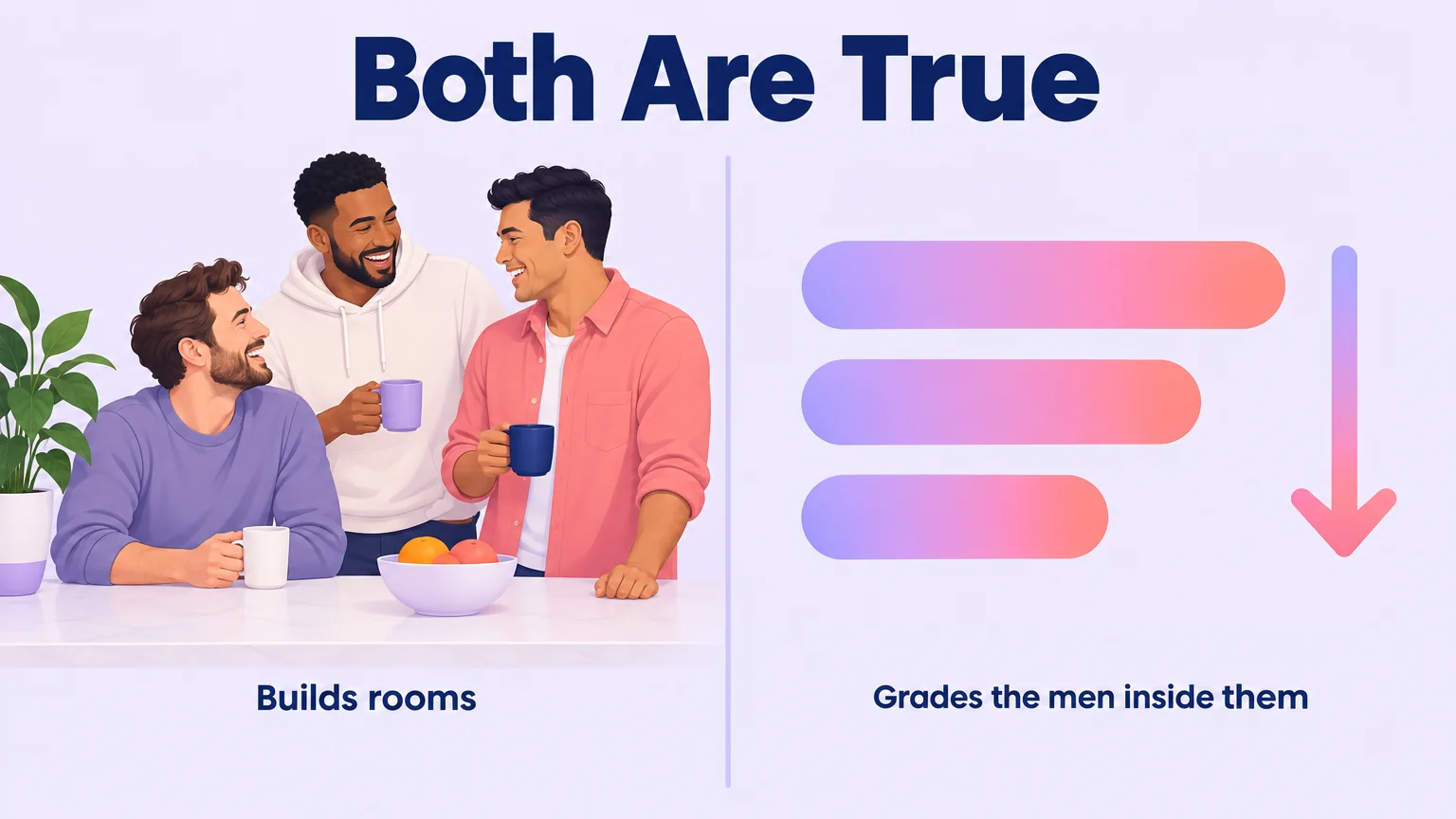
The thesis is uncomfortable: body-type vocabulary builds rooms and grades the men inside them at the same time. Both halves are true, and the useful thing is knowing which one is acting on you.
Take the case for the labels first. Joe Kort, a psychotherapist, says the label gives “a sense of belonging, which can be hard to find in the gay male community.” Lee Phillips describes it creating “a space for sexual and emotional validation” and a sense of chosen family. The bear subculture formed partly against a narrow, hairless, muscular mainstream ideal. Aaron Prior calls it “one of the friendliest and the most accepting” spaces.
The case against is specific. The standards built into this vocabulary are racialized and Anglocentric. A San Diego State University stigma-lab review covering 1979 to 2018 documents racism and weightism inside bear spaces and criticizes their lack of racial, ethnic and weight diversity; other work records a bear Facebook group that banned Asian and African members. The Otter Questionnaire in The Bear Book II drew 24 respondents, all gay white men. That is who was in the room when the label was written down. A 2026 study, “Subcultural desires,” documents intersecting hierarchies of desire along body type, gender expression and race.
The words do mechanical work too. The people using the apps describe the filters as “just another way for guys to filter each other out.”
Hold both at once. The aging anxiety that “twink death” names is tied by its analysts to ageism, fatphobia and the loss of older role models. Inside the bear community, a live GLP-1 debate asks whether a subculture built on celebrating larger bodies is narrowing toward the ideal it once rejected. Both are current, not historical.
The counterweight: boundaries have moved before, so they can move again. The 1991 bear code: “None of the classification materials in any way suggests a ranking or value judgement… Every person has their own favorite type!”
This is not a vocabulary to abolish, nor one to defend uncritically. The useful move is knowing which of the two things it is doing to you.
Otter Questions People Actually Ask
Is there an official otter flag?
No. There is no officially recognized otter flag and no single agreed symbol. A paw print is the common stand-in, and the otter emoji circulates unofficially. Community wikis document several fan-designed flags: the most common, by DeviantArt user Toadhops on 5 June 2018; an alternate chosen by a 2021 Bearbackgear.com member vote; an otter pup flag in 2024; and “sugar otter” and “bi otter” flags in 2025, per LGBTQIA+ Wiki. The bear flag, designed by Craig Byrnes with a copyright dated 1995, is also unofficial, and universally adopted.
Is being called an otter an insult?
In community use, no. It is a neutral to complimentary description of a lean, hairy build, and one of the looser categories here. The friction is usually with being sorted by body type at all, not with the word itself. Queerty’s commenters put it best: “Or, as some of us call them, normal men.”
Do these terms exist in other languages?
Yes, and they translate literally. Italian uses “lontra,” Spanish-language outlets use “nutria,” and French coverage uses “loutre,” so a reader in those languages will not connect the term to bear-subculture history.
What does otter mean on Grindr?
On Grindr, Otter is a self-selected profile tribe, not something an algorithm decides about you. It has been one of twelve options since 2014, members can list up to three or none, and most profiles leave the field blank. If a profile says otter, someone chose that word for themselves.