If you have read about stone femme in more than one place, you have likely come away with two definitions that cannot both be true.
One says she is a femme who receives sexual pleasure and does not give it. The other says she gives and does not want to be touched. Both are in circulation right now, and people use both about themselves.
That disagreement is not a mistake anyone made. It is old, documented on the record, and it has a reason.
What follows covers what the word means, why both readings exist, where the term came from, how it differs from pillow princess and high femme, and whether the label fits you.
If you have been corrected for using it one way, you were not wrong. You were reading one of two live usages.
Stone Femme Meaning: Why You Keep Seeing Two Opposite Definitions
Start with the reading you will meet most often, where the stone femme meaning settles: a femme who prefers to receive sexual pleasure rather than give it, the counterpart to the stone butch.
A 2024 magazine feature defines the pair that way, a how-to site lists stone femme as another name for pillow princess, and a French lesbian magazine files it under stone bottoms.
The other reading is not fringe. A sexual-health site says a femme who only gives and will not receive can be a stone femme, and an LGBTQ outlet lists stone femmes among people who do not want to receive.
One source holds both: a community FAQ saying stone femme can mean always receiving and, less commonly, always giving, and that stone can mean giving and not being touched, or the opposite.
The uncertainty is on the record. On the Queer Collective podcast, the host works through the definitions and says:
“I found some conflicting historical citations with some people believing it meant like a [femme] that only wanted to give and [not] receive. But the majority is like defining it the same as a pillow princess. So I would love to know what people think in the comments, but I found it a bit confusing.”
That is someone who went looking, not guessing. What every usage shares is a boundary around genital touch.
So use the receiving reading when you speak generally, and ask which one someone means when they use the word about themselves.
What “Stone” Actually Means: A Boundary, Not a Direction
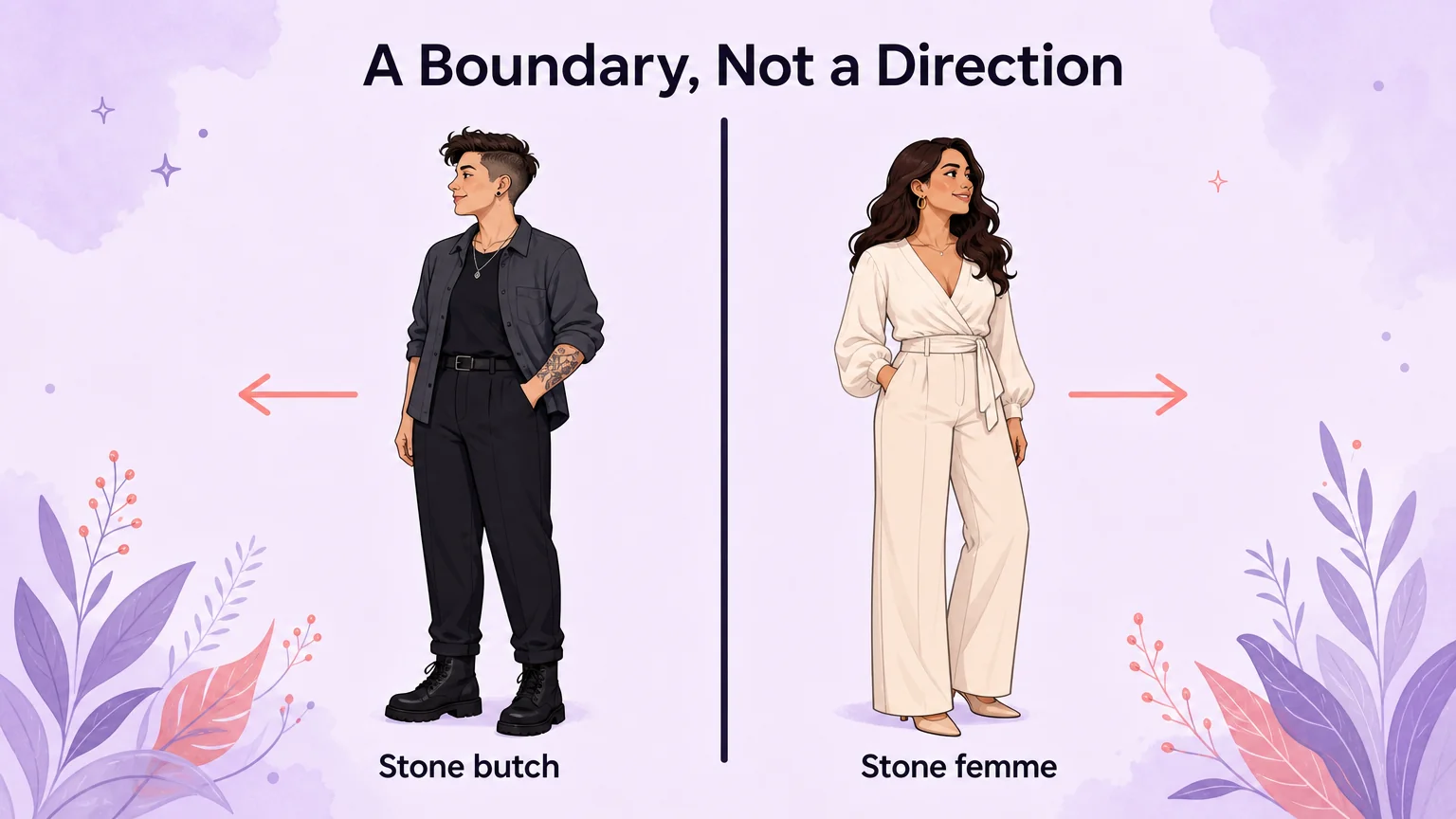
Stone does not describe a direction of giving. It marks a boundary around touch.
A stone butch gives and will not receive. A stone femme receives and will not give. Both are stone, because the word marks where the limit sits, not which way pleasure travels. That reading is assembled from the scholarship, not stated by any single writer.
J. Halberstam reads the stone in stone butch as impenetrability and notes she is only identified by what she will not do. Sally Munt makes the boundary the point: certain limits sustain an identity, and past them not even a lover can push.
Stone also spread sideways: it now covers touch-me-not, stone top, stone femme, and bare stone, and Wikipedia notes it is no longer specific to one orientation or gender. One word covering both directions is what produces contradictory summaries.
That can sound cold, but the scholarship pushes back. Ann Cvetkovich argues that what reads as untouchability is an excess of feeling, not an absence. In Stone Butch Blues, Jess calls it a home alarm system with no on-off switch, where the gates shut even when the intruder was loving. It reaches us through academic sources quoting the novel.
One limit: no source traces the English word stone beyond impenetrability, not to a place, a person, or an acronym.
Once you see that, neither usage looks wrong. The contradiction sits in the word itself.
Where Stone Femme Came From: Bar Culture, Stone Butch Blues, and Why It Went Quiet
The butch half of this story is well documented. The femme half is not.
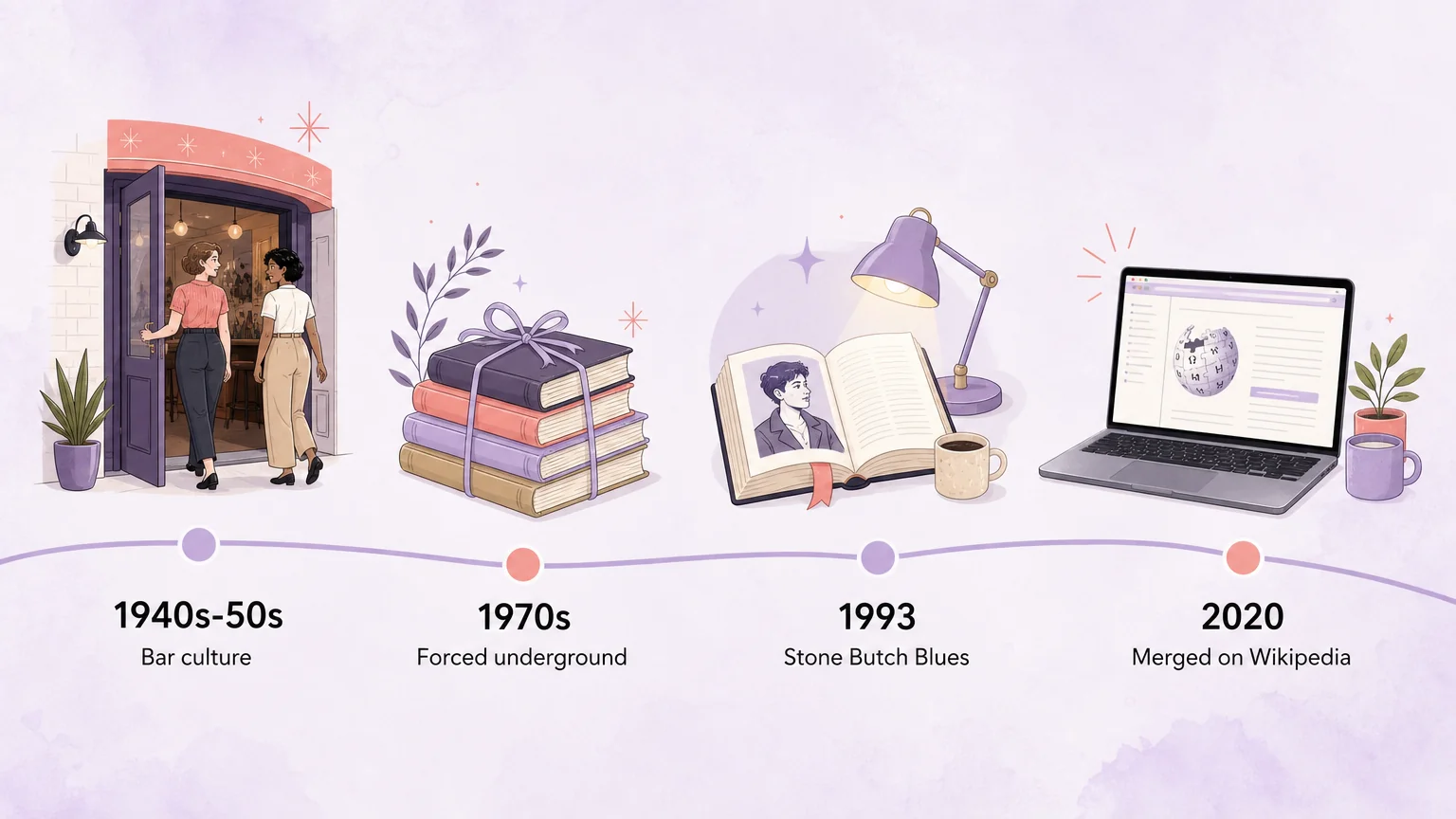
Stone butch comes from the 1940s and 1950s working-class lesbian bar scene, where being stone was expected of all butches and being flipped was taboo. Stone femme’s origins are considerably murkier, in Ollie O’Neill’s words, and no source gives it a founding date.
Then it was driven underground. Arlene Lev writes that lesbian-feminist politics in the 1970s drove butch-femme identities, communities and expression underground, silencing and distorting the record. Sheila Jeffreys called role-play a mild form of sadomasochism and an imitation of heteropatriarchy, a charge that carried an age and class sneer. In 1982, Joan Nestle replied: “I do not want to become a dictator of desire.”
Nestle argued femmes were dismissed twice: for not looking different enough from heterosexual women, and for not being feminist enough. In 1992 she published The Persistent Desire, reversing the subtitle order because the femme woman had been the least understood.
Stone femme was in use before pillow princess entered general usage in the 1990s. The argument never closed. On 11 July 2020, Wikipedia merged Stone femme into Stone butch, over a contributor’s objection that stone femmes have their own boundaries, history and sexuality.
One hard date: Leslie Feinberg’s Stone Butch Blues, 1993, an ALA Stonewall Book Award winner in 1994.
The record is thin because the conversation was interrupted, not because nobody cared.
Stone Femme vs Pillow Princess: Same Identity, or Two Different Things?
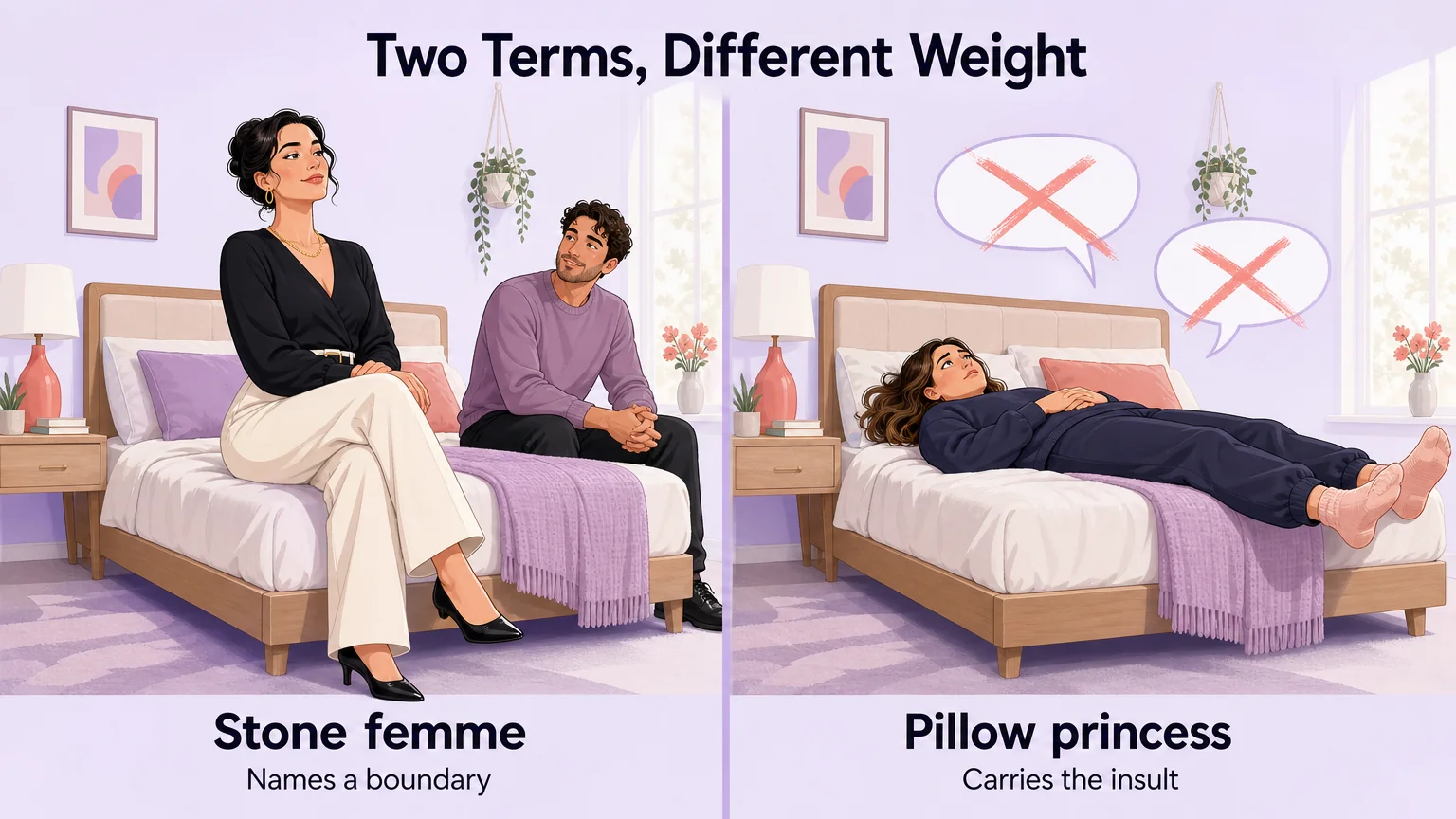
In everyday use the two overlap heavily, and many people treat them as the same experience of receiving without reciprocating in kind.
The overlap is old. A 2024 magazine feature’s author, writing as a pillow princess, adds in parentheses “and stone femmes as we’re sometimes called,” and a how-to site lists stone femme as another name for pillow princess.
But stone femme is older, in use before pillow princess entered general usage in the 1990s, and it is not a derivative of anything, which is the objection that surfaced when its Wikipedia page was merged into Stone butch in 2020.
What differs most is connotation. Pillow princess carries a heavy insult load, used for lazy, good-for-nothing lovers, along with the starfish slur. Stone femme names a boundary and arrives without the sneer, which is why some prefer the older word.
The spectrum is wider than either word suggests. Kiana Lewis, a pleasure mentor with The Expansive Network, describes the range: “Maybe that’s nothing under the belt, maybe it’s nothing at all, maybe it’s only after their partner has received touch and pleasure.”
If you mean the older, boundary-naming term, say stone femme. If you mean the heavily stigmatized one, say pillow princess. If unsure, ask.
Stone Femme vs High Femme: A Sexual Role and an Aesthetic
High femme is not mainly a term about sex, though the word gets used that way constantly.
Two meanings are live. The first is aesthetic: a femme who embraces femininity in an out-of-the-ordinary way, which Amber Hollibaugh called “a woman in feminine drag.” The second is a sexual role: a sapphic woman who only bottoms, the fem version of stone butch.
The record does not back the second reading. Obviously Queer, whose femme history project worked from 1930 forward, reports that “not once did I come across High-Femme as meaning Pillow Princess.” Her conclusion: “it’s not the meaning ‘by definition’ and it IS also an aesthetic descriptor.”
The scholars disagree. Hollibaugh is quoted calling high femme-ness “the one femme identity completely untethered to butches and to sexuality,” the opposite of the bottom-role reading, while Sally Munt describes it as campy femmeness that toys with the tension between high femme and drag queen.
Some of the muddle is shorthand: a how-to site lists pillow princesses as also being called stone femmes or high femmes, and several claims now treated as butchfem history are recent ideas.
The rule of thumb: high femme describes how someone presents, stone femme describes a boundary about touch. Both can be true of one person, and neither implies the other.
Stone Butch, Stone Top, and Touch-Me-Not: The Vocabulary Around Stone Femme
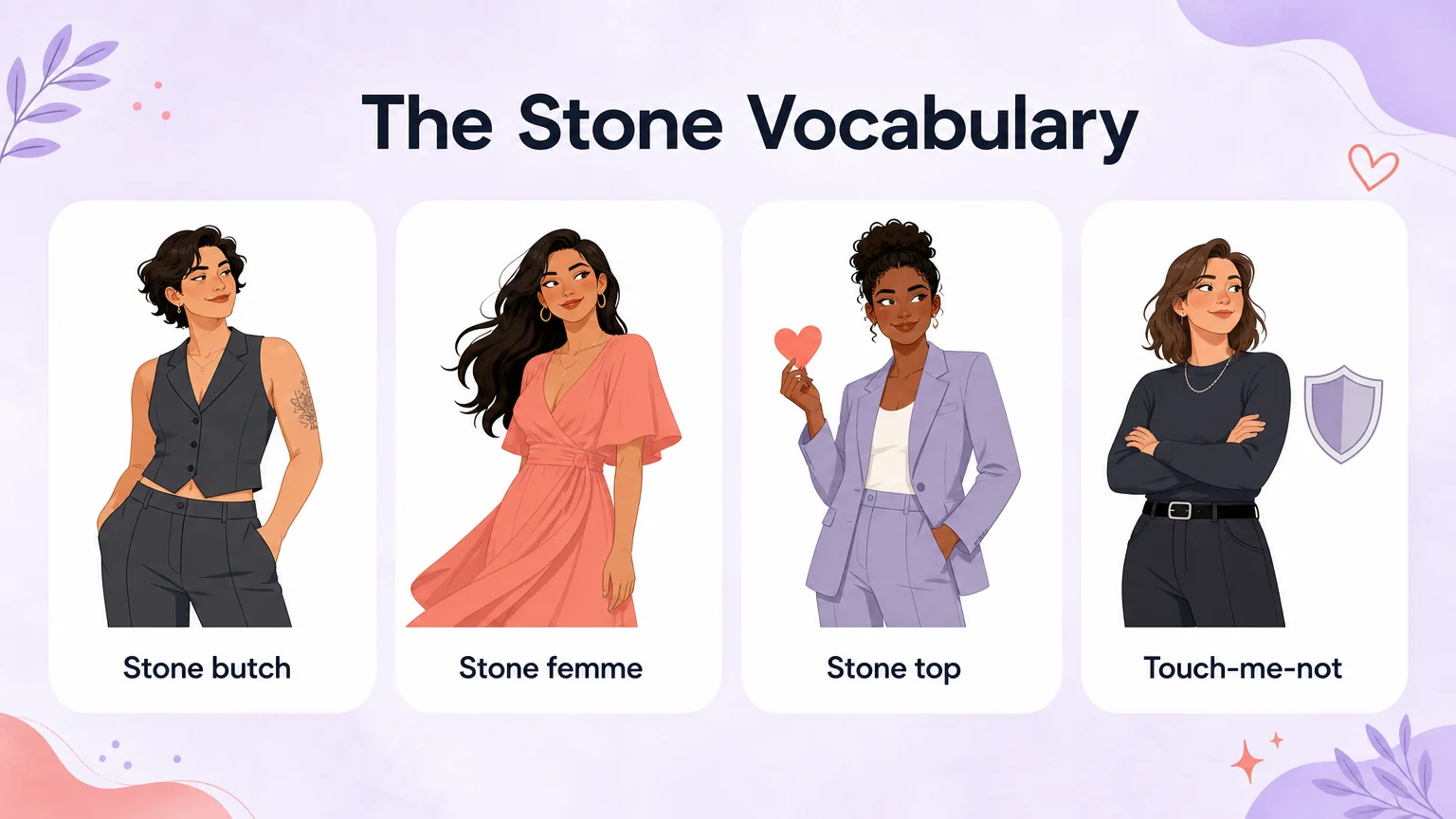
Words most often confused with stone femme:
| Term | What it means | How it differs |
|---|---|---|
| Stone butch | Won’t be genitally touched | Gives, not receives |
| Stone top | Gives, won’t receive | Any presentation |
| Touch-me-not | Won’t be touched | Names the boundary |
| Stone | Bare identity | Both directions |
| Stone bottom | Receives, won’t give | Umbrella term |
| Soft butch | Presentation only | No touch boundary |
| Stud | Black masculine identity | Racially specific |
| Stem | Stud-femme blend | Presentation only |
| Futche | Butch-femme hybrid | Adjacent term |
| Top / bottom / vers | Giving, receiving, both | Often about power |
| Pillow princess | See above | Newer, heavier stigma |
| High femme | See above | Presentation, not touch |
Stone top is what lets a femme be the giver: someone who prefers giving to receiving genital contact, who may still enjoy intimacy without genital touch, whatever her presentation. A femme who gives is a stone top, not a contradiction. It is not an umbrella term.
Touch-me-not names the boundary, not a role, which makes it the plainest of the three. Some Black lesbians and queer people use it.
Stone butch is the parent term, from the forties and fifties: a butch who will not let her genitals be touched and takes gratification from a partner’s pleasure. Halberstam’s test: identified only by what she will not do.
Top, bottom and vers are adjacent vocabulary, not a translation: those dynamics are about power, while stone is about touch.
One rule keeps this from collapsing: not every masculine person is a stone top, and not every stone top is masculine. Xtra Magazine documents dominant stone femmes in the same scene. One respondent puts the independence plainly: “even though I’m only soft butch at best, in bed I’d be stone because I won’t be [touched].”
Historically these words are sapphic and specifically lesbian. They are used more widely now, and the community is arguing about it.
How to Tell If You’re a Stone Femme: Noticing What You Already Want

There is no checklist, no quiz, nobody who certifies it. The closest thing to a test is negative: Halberstam describes the stone person as identified by what she will not do. A boundary is something you notice, not a test you pass.
Some people know intuitively how they want to show up for sex and what their limits are. For others it takes exploration. Sexuality educator Lena Peak: “Labels are complicated. They can empower people and validate their experiences, and they can also be weaponized to perpetuate harmful stereotypes or pigeonhole people into narrow social and sexual scripts.”
Think about the sex you like to have, your fantasies, and what you need to feel in your element, then ask how language could help you say it. A yes/no/maybe chart sorts your answers first.
From the receiving side, pleasure comes from a partner’s enjoyment, and touch reads as uncomfortable rather than uninteresting. Stone looks different from person to person.
If you give and do not want to be touched, the term is stone top, not stone femme.
You do not owe anyone a reason. Trauma and dysphoria are valid paths, not required ones. For many it helps: Kiana Lewis notes that control over your body can be gender euphoric.
Ollie O’Neill: “I’m a stone femme no matter what, but it was through love and community with Stone butches and femmes that I felt able to finally accept that about myself.” It is not a category you qualify for, but something you come to.
Stone Identity With a Partner: How to Say It, Ask About It, and Get It Right
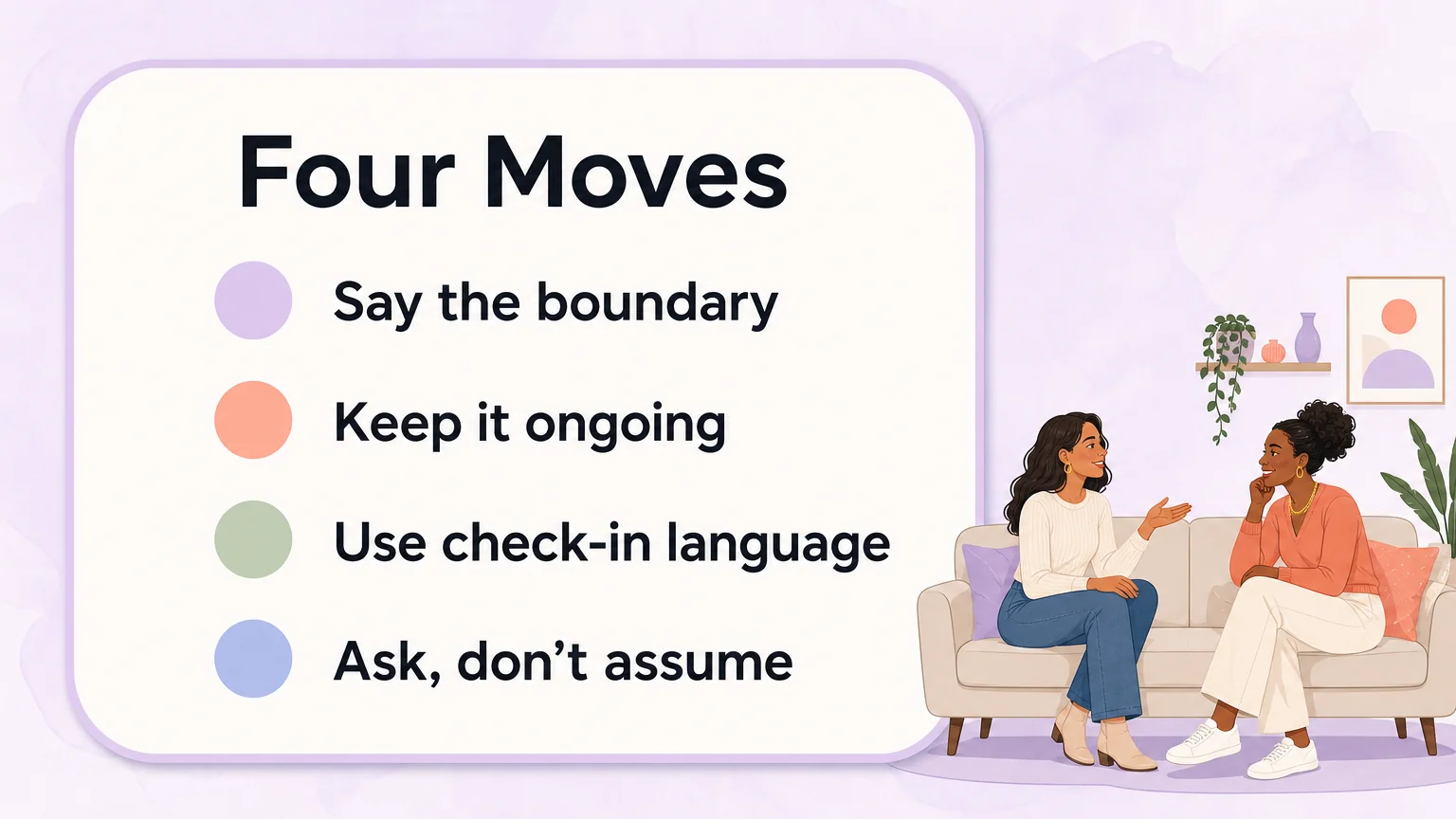
Now comes the pause before telling a new partner you’re a stone femme.
Say the boundary, not the act. One stone top: “be more dominant with me. Hands all over me, kiss me. I want attention. Like you can touch me anywhere.” The limit is genital; everything else is permission, which turns it from what you will not do into what you do want.
Make it ongoing, not a one-time disclosure. Be open with the people you go into dynamics with, and treat consent as enthusiastic, voluntary, ongoing and rescindable. Therapist Casey Tanner calls it a practice that lets you say no halfway through, and a no can be wrapped in a yes to something less sexual.
Use check-in language. Approach these conversations from curiosity and non-judgment. Ask whether it is okay to touch someone there, agree words for body parts first, and stop if a partner freezes or goes silent.
If you are the partner, ask, don’t assume. People who meet through apps are more explicit about wants and boundaries before meeting, so ask what they want to be doing and what they are into. Nothing addresses stone identity in non-monogamous or swinging contexts, so this is general negotiation practice. A boundary can be met differently with different people.
Apps built for this make that first conversation easier. On 3Fun, what you’re into and what your limits are go in your profile, so the boundary is on the table before the first message. See who’s on 3Fun.
Drop the matched-pair myth. A touch-me-not does not need a pillow princess for a fulfilling sexuality, and vice versa. These labels describe tendencies, not obligatory pairings, and the claim that they seek each other out arrives without evidence.
Name the boundary, name what you want instead, and keep naming it. The conversation is the practice, not the preliminary.
Stone Femme FAQ: Direct Answers to the Questions People Actually Ask
What is a stone femme?
A stone femme is commonly defined as a femme who prefers to receive sexual pleasure rather than give it. A minority reading describes her as the one who gives and will not be touched. All usages share a boundary around genital touch.
Is stone femme the same as a pillow princess?
In everyday use they are near-synonyms, but stone femme is older: in use before pillow princess entered general usage in the 1990s, and a 2020 Wikipedia merge drew an objection that stone femmes have their own boundaries. Pillow princess carries a heavier insult load.
What is the difference between stone femme and high femme?
High femme is mainly about how someone presents: a femme who embraces femininity in an out-of-the-ordinary way. Stone femme is a boundary about touch. Some use it as a sexual role, but that usage is recent.
Is being stone just a trauma response?
No. Trauma is one possible path and a valid one, but it is not the definition. Many stone people report no trauma at all. Dysphoria and trauma do appear in some accounts, so the answer is sometimes, not always.
Is stone femme just internalized misogyny, or imitating heterosexuality?
That argument dates to the 1980s, when Sheila Jeffreys said butch-femme roles recreated heteropatriarchy. It lost. Joan Nestle replied in 1982 that she did not want to become a dictator of desire, and Arlene Lev later judged that it drove butch-femme identities underground.
What is the difference between a butch and a stone butch?
Butch describes gender presentation and social role. Stone describes a boundary in sexual touch, so the two are independent: not every masculine person is a stone top, and not everyone who is a stone top is masculine.
Are femmes lesbians, and can bisexual or trans people use stone femme?
Femmes are not exclusively lesbians. The claim that bisexual women cannot be femme has been argued down on historical grounds, and lesbian and bisexual women share butchfem history. These terms are historically sapphic, and they are used more widely now.
3Fun is built for exactly that overlap: queer identity and non-monogamy, both ordinary, neither one something you have to justify. Join 3Fun
What does the term stone woman mean?
No settled definition exists for it, so treat it as a loose variant of stone butch or stone femme rather than a fourth identity. The three terms with established meanings are stone butch, stone femme and stone top. Stone fox is ordinary English for an attractive person.