Two answers come back whenever anyone asks what is a high femme. One says it describes the most deliberate, most maximal end of feminine presentation. The other says it means bottom.
Both get said with total confidence. Only one of them holds up, and the case for the other is more considered than most people assume.
The working definition first. A high femme is someone whose feminine presentation is maximal and chosen on purpose. That is presentation. Sexual role is a separate axis, and treating the two as one is the most common mistake people make about this word.
A real minority reading does exist, argued in public and in detail: the high, on that account, refers to sexual role rather than presentation. It gets a fair hearing here before it gets settled, because a position argued that carefully deserves an answer rather than a dismissal.
The evidence on the bottom claim comes from a 2012 study of 214 women, and the chart behind the confusion has a date on it. By the end you will know where the word came from and whether it is yours to claim.
High Femme, Defined: Presentation on Purpose and the Deliberate Aesthetic
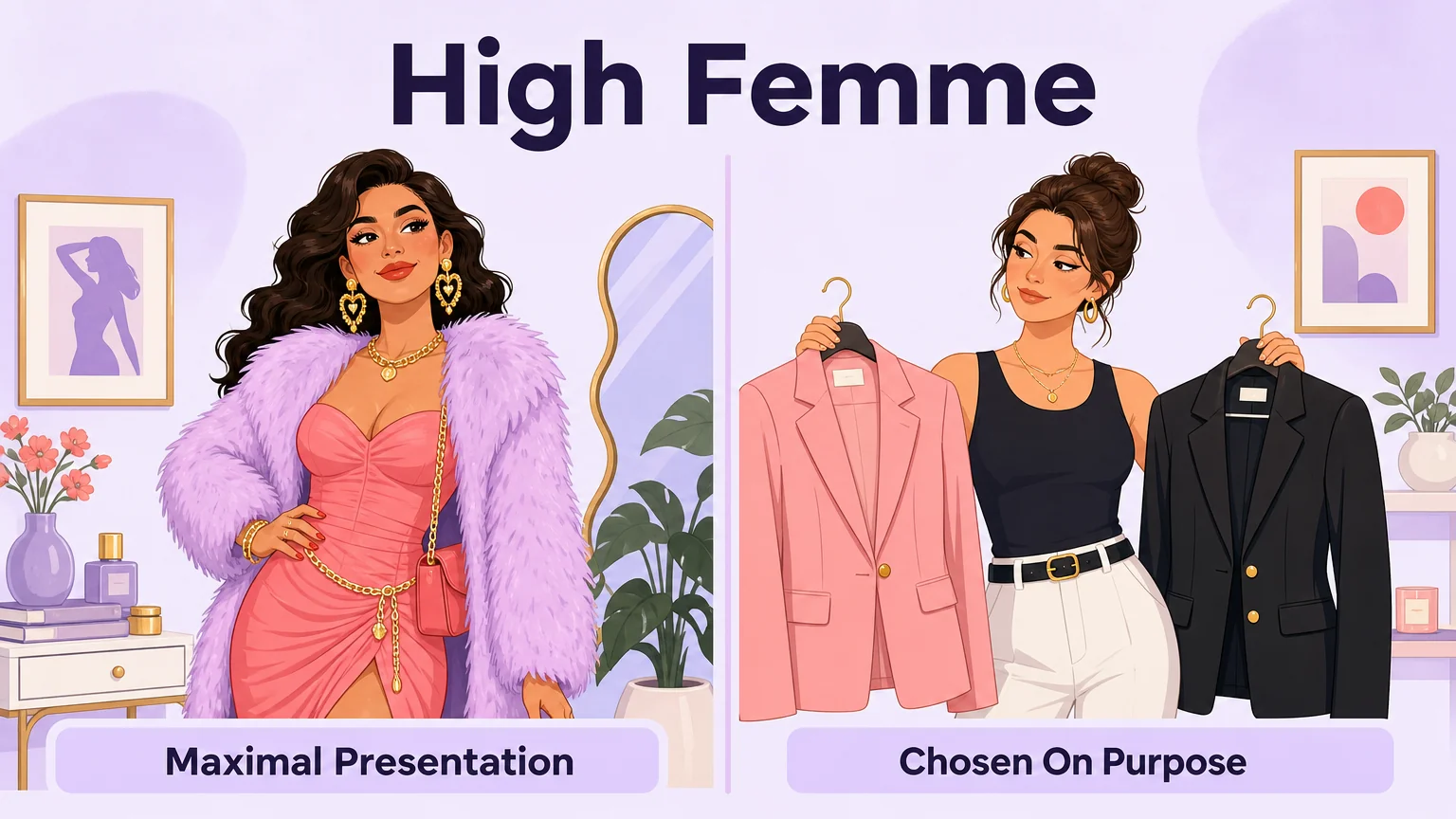
Ask for a definition of high femme and most people answer with a mood. The definition itself is tighter: the maximal, deliberate end of feminine presentation. Intensity plus intention. Nothing in it is about attractiveness or about being girly.
The writer Amber Hollibaugh, describing what she called doing high femme, gave the clearest account of why the word carries weight. The femininity is “profoundly made up.” Real, but not natural, and constructed on purpose. Her comparison was the drag queen’s construction rather than an imitation of heterosexual femininity. That single move turns a style into a practice.
Hana Quist, a designer and drag artist, supplies the second half. For her, high femme means being feminine outside the male gaze and outside traditional femininity. She calls her presentation “a fuck you to men” and describes it as “something I do for myself, not for anyone else, not for any man.” That is what makes it an identity rather than a wardrobe: it runs on a rationale, not a look.
She also names how narrow the alternatives are. “Femininity is either hyper-sexualized or hyper-infantilized, and it’s so ridiculous.”
The look, without the checklist
The aesthetic runs on texture and contrast. Lace tops with jeans. Dresses with Doc Martens. Flannel with heels. None of those require a full face, and some high femmes do not enjoy makeup at all. That surprises people who came expecting a beauty routine.
Rhea Ashley Hoskin’s 2023 study of 97 women found the pressure runs the opposite way. Asked how they changed their feminine presentation after being shamed for it, women overwhelmingly toned it down. Almost none dialed it up, and the few who did were all LGBTQ+. Maximal presentation goes against that current, not with it.
Watch for the am I feminine enough test. There is no threshold to clear, and nothing in the definitions above implies one. It catches people who came to the term late.
Quist’s everyday version is the useful image. Circular cheeks, oversized black eyes, a white face, hair clips. She describes it as a reduced version of her drag, which is the whole argument in one outfit. This is assembled, not inherited.
You will also hear registers named: soft, hard, chapstick, leather, pajama, biker wife. Treat them as registers in live use, not fixed definitions. The fuller map comes later.
That is the settled ground. The fight starts the moment someone decides what the look says about your sex life.
High Femme as a Role: The Case People Make, and the Stone Femme Overlap
The claim that high femme means bottom is not a joke. In November 2020, a long signed argument appeared in a lesbian community forum making the case in full. The author signed off only as “Sincerely, a stone butch.”
Here is the position in its own terms. The high in high femme, she argues, refers to sexual role rather than presentation: a high femme is the receiving counterpart to a stone butch, the exact mirror of the stone butch’s boundary around being touched. Stone butches give and do not receive; high femmes receive. The two roles slot together.
That is not a silly argument. It models itself on a role term with a documented history instead of inventing one, and it borrows pairing language the community already owns. Community educators describe a stone butch and a pillow princess as fitting together “like an erotic puzzle.” The post applies the same logic one term over.
The advocate supplies her own context, and it deserves a plain report. She frames the reading as a minority usage correcting a widespread misreading, and asks people to research a term properly before applying it to themselves.
What she describes is very close to what stone femme already names: the femme counterpart to a stone butch. Stone femme is a role term, less codified than stone butch and heard less often now, but it sits in the historical record rather than on a chart. That overlap is the sharpest reason the position is not invented out of nothing, and it is why the two terms keep getting folded into each other.
The role reading also has a mechanical explanation. A widely shared chart puts stone butch at the opposite end of an axis otherwise made of presentation terms, so the opposite role looks implied by symmetry. The next section takes that chart apart.
One post is not a movement. It is one person’s carefully argued usage, offered with a request to be careful with the term. That request is the fair place to leave it.
Is High Femme a Sexual Role? What the Evidence Says, and Where Pillow Princess Fits
No, not as a definition. Presentation intensity and sexual role are separate axes, and the only direct empirical test found the first does not predict the second.
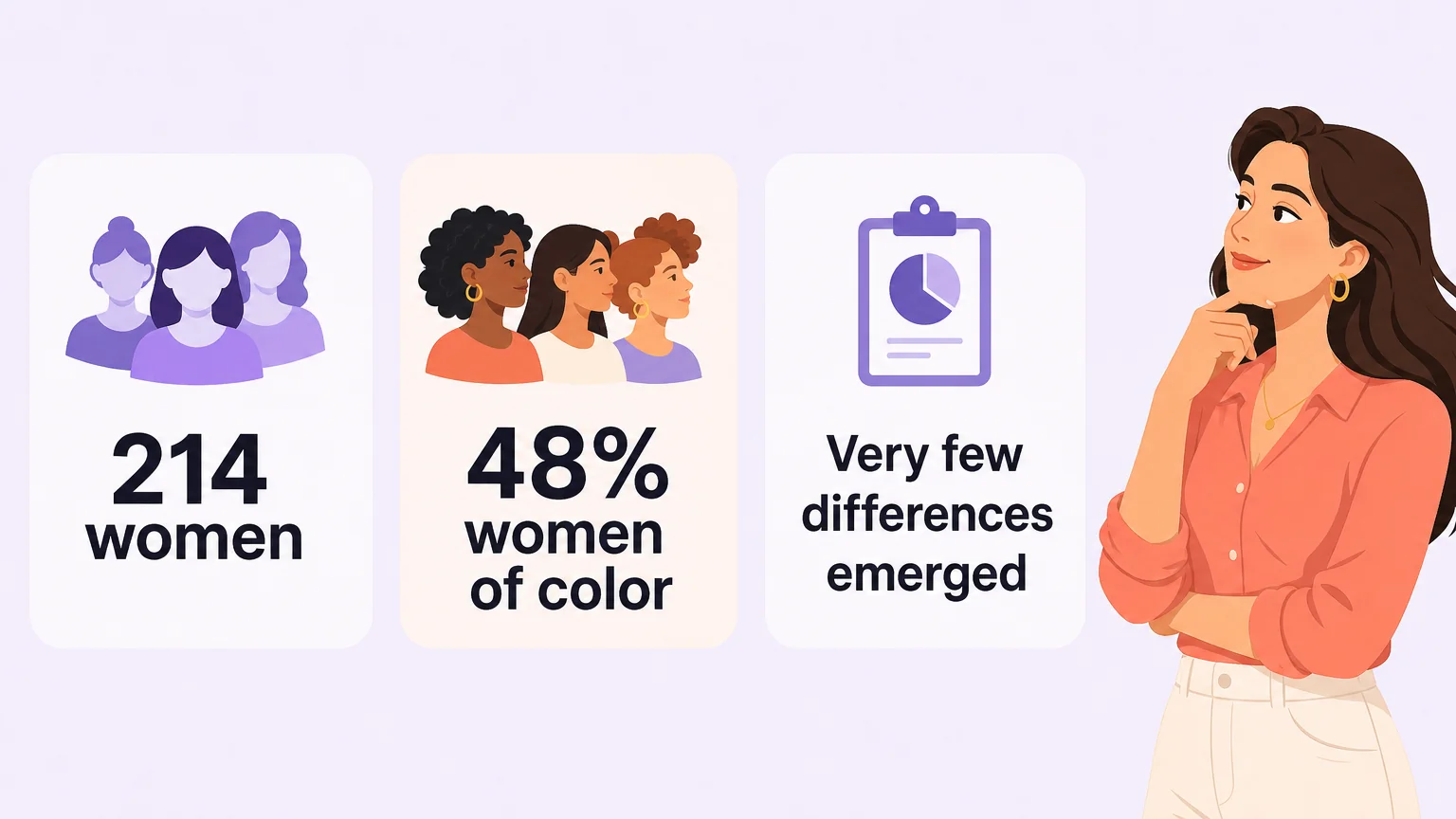
The study is Walker, Golub, Bimbi and Parsons, Journal of Lesbian Studies, 2012: 214 lesbian-identified women, ages 18 to 69, 48% women of color, recruited at two New York City community expos. Each picked one of five gender labels: butch, soft butch, butch/femme, femme, high femme, then rated attraction to six sexual behaviors: giving and receiving oral sex, penetrating and being penetrated with toys, fingering and being fingered.
The result, in their phrase: “very few differences emerged.”
It was built to find the stereotype, not rule it out. The authors expected butches to be least attracted to receptive behavior and femmes the most. It did not appear. They concluded that behavior is fluid across labels, naming the assumption underneath: masculine equals top, feminine equals bottom.
Earlier work went the other way. Singh and colleagues found partial support for the stereotype in 1999, so 2012 is a correction, not a first attempt.
Where the conflation came from
Start with a chart. The Futch Scale runs from high femme at one end to stone butch at the other, with futch in the middle. It circulated first in a Blogspot post on 17 February 2011 and became a Tumblr template on 8 September 2015, spreading mostly through jokes.
The error is mechanical. The axis holds presentation terms and one role term at the far end. Stone butch is defined by what she will not receive, so the opposite end reads as the opposite role. High femme becomes bottom by symmetry.
That is not just a meme problem. A chart is how a community sorts itself, which is why this one carries weight. It is contested from inside, and the quizzes built on it inherit the flaw.
High femme vs pillow princess
Pillow princess is a sexual role: a preference for receiving, with no necessary link to how someone dresses. Educators stress it is not one-sided, because the pillow princess gives back through intimacy and responsiveness.
Presentation entered through another door: older glossaries treated ultra femme as a prerequisite for pillow princess, which is where maximal femininity became a condition for receiving.
A high femme may be a pillow princess, a top, or neither. The role reading is a genuine minority usage, not the definition, and not historical.
Two axes, not one.
High Femme History: Where the Word Came From, and How It Differs From Femme
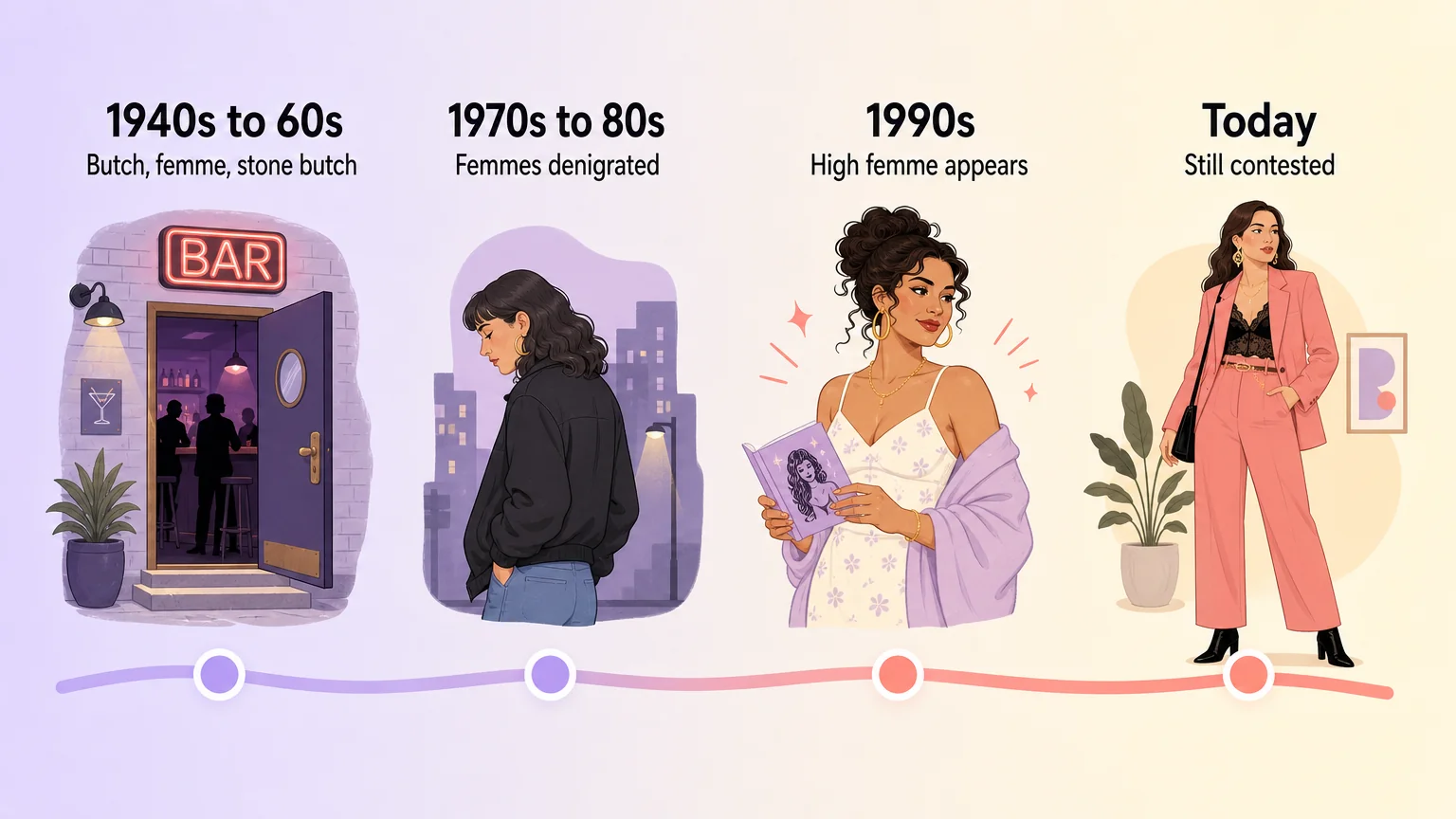
Butch, femme and stone butch are all documented in the standard oral history of the working-class lesbian community in Buffalo, New York, from the mid-1930s to the early 1960s. That is Kennedy and Davis, Boots of Leather, Slippers of Gold, 1993, built on 45 oral histories.
High femme does not appear in it. Let that absence sit as a fact.
The vocabulary that formed next to butch was stone, not high. In the late 1940s the butch role of initiator was loosely defined. By the late 1950s and early 1960s, stone butch had emerged: a butch who would not let her femme touch her, with being flipped treated as embarrassing.
So when does the word show up
Academic glossaries place high femme in the 1990s, describing a gender presentation that is exaggeratedly feminine. Hollibaugh’s account of doing high femme comes from the same decade and is one of the earliest named usages.
One widely read how-to guide argues instead that gay men coined the term in the early 2000s and that lesbians only picked it up in 2015. That claim is uncited and conflicts with the academic dating. Either way, every account places the word decades after the bar era, so neither side can win on history.
What femme was doing in the meantime
Femme is older and better documented. It began in 1940s Western working-class lesbian bar culture as the counterpart to butch, then was redefined through the 1980s and 1990s as a self-designation, expanding past an exclusively lesbian term.
Femmes were denigrated through the 1970s and 1980s alongside butches, sex workers and kink communities. That pressure produced a renaissance of queer femme culture in the 1990s, with Toronto as a documented center. Joan Nestle’s The Persistent Desire, 1992, is the landmark anthology of that revival. Nestle called the treatment of femmes a double dismissal: not different enough then, not feminist enough later.
Karen Duder’s research on Canada in the 1940s through the 1960s found middle-class lesbians avoiding bars for suburban house parties and fearing job loss, calling themselves “butch-y” or “sort of femme” rather than claiming the labels. To be obviously butch or femme was to be out. Intensity tracked class and risk, not sexual role.
Femme versus high femme, then, is partly a date. Femme is the older word; high is the recent layer. The style historian Shuang Bright puts it plainly: she exists as she does because of the people who came before her.
The High Femme Spectrum: Soft, Hard, Chapstick, and How Low Femme Differs
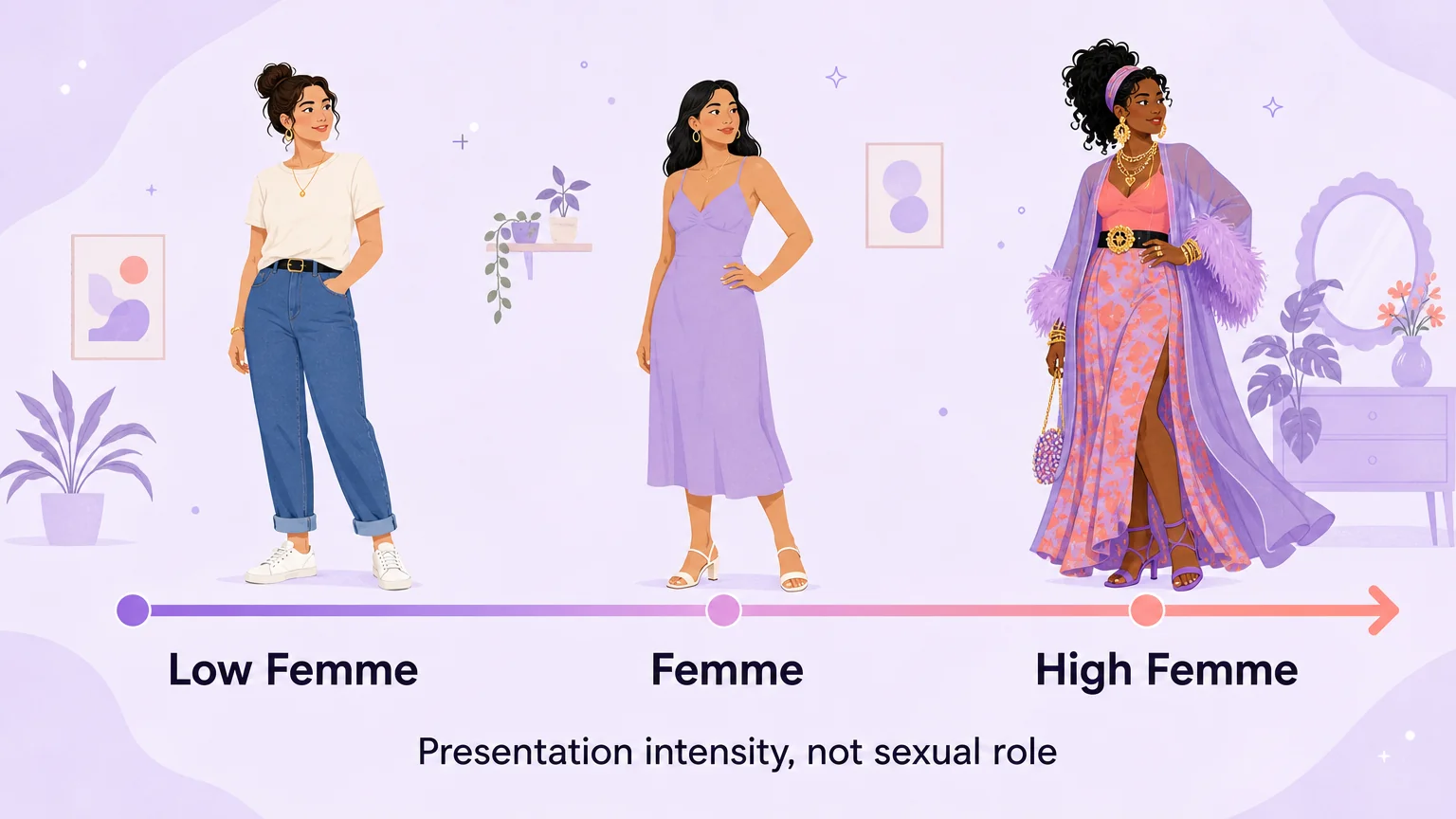
Most arguments about these labels happen because two different questions are being answered at once. One is how much: how maximal is your feminine presentation. The other is what you do: your role in bed. Mixing the two is what makes the whole list feel like a maze.
High femme vs low femme
Low femme is intensity, not temperature, and it is the clearest opposite in everyday use. It is also called blue jeans femme: jeans with a nice top rather than dresses and skirts. Still femme, just casual and low-maintenance.
Academic work theorizes it differently: low femme becomes a position defined by negative affect interrupting a high femme standard. Sweat, crooked eyeliner, chipped nail polish, flat shoes, low feelings. The presentation is shaped by depression and anxiety rather than by preference. Both readings are live. In ordinary conversation, the first is what you hear.
Femme is the category, high femme is a point on it. Femme is a self-identified, trans-inclusive gender expression, performance, identity and aesthetic, and high femme is its maximal end.
The worry that high implies status is twenty years old and still unresolved. Community members keep cautioning that it marks a difference in style, not in worth.
Soft, hard, chapstick, and the rest
The intensity registers are where the vocabulary is most unsettled. Soft femme and hard femme both circulate widely and neither has a stable published definition. Hard femme is a live self-applied label, welcomed by name at femme-for-femme events. Soft femme mostly reads as its intuitive counterpart rather than a fixed category.
Chapstick, leather, pajama and biker wife sit in the same loose family. Futch is the femme and butch midpoint, widely understood, and the term the chart is named for. Ultra femme is the earlier word for maximal expression, and older glossaries wrongly treated it as a precondition for pillow princess, an error covered above.
Stud is a distinct identity in its own right rather than a synonym for butch, so a passing definition would do it a disservice.
Lipstick lesbian is not the same thing
The two get treated as interchangeable and they are not. Lipstick lesbian is an older presentation label with no framework about deliberate artifice and no argument about femininity outside the male gaze. High femme carries both.
Two more terms solve specific problems. Dominant fem names someone visually femme and behaviorally dominant, described from the inside as basically the stud with lip gloss on. Femme4femme encodes who you are and who you want in one token, which makes it the most efficient label in the set.
Do not use any of this as a test. The two axes are the point. If you want to know where someone sits on them, ask.
High Femme in the Wild: Dating, Misreading, and What a Femme Girl Is

Femme girl is what people say out loud. High femme is the more precise word underneath. What the everyday version signals is where the trouble lives.
High femme presentation is routinely invisible as queerness. It reads as cishetero femininity to anyone who does not already know, which means even other sapphic people cannot tell whether a femme is straight or queer. That is why femmes come out over and over.
Writing a profile that says what you mean
Say who you want, not only who you are. Femme4femme does both at once, which is why it travels. Be unmistakable that you are there to meet women, not to find a third.
Skip the checklist. Scorpio, gym three times a week, dog mom, love traveling. Nothing there is a personality. Use texture: a line about cheap flights and a shared spreadsheet beats love to travel.
Do not overperform your queerness to prove it. Auditioning reads as auditioning. Keep boundaries warm, and if you are partnered or non-monogamous, say so in the first lines.
Non-monogamy is ordinary here and the infrastructure has caught up. Femme-for-femme events are open to monogamous and polyamorous attendees, and some sapphic platforms treat poly and ENM as first-class and filter out unicorn hunters.
A 2024 CSCW study of sapphic platforms found that treating pair-based couples as the default excludes polyamorous sapphics, and the recurring complaint across them is couples and unicorn hunting.
3Fun was built the other way round. Couples and singles have equal standing from the start, so nobody arrives as an accessory to someone else’s profile.
What it costs
Femmephobia has four registers in Rhea Ashley Hoskin’s account. Ascribed lives in cultural idioms, perceived is outright discrimination, femme mystification reduces a person to an object, and pious shames someone for being feminine while claiming superior enlightenment. Pious is the one most people meet without a name for it.
Inside the community, high femmes get read as snobby, unintelligent or male-identified, and class runs through it. The tatted biker wife look reads as neither butch nor wealthy, and the people who noticed that called it classism. Jillian Hernandez adds race: aesthetic value racializes the bodies of women and girls of color, and excess is surveilled to police working-class women of color.
The trans high femme double bind is its own problem. Trans women drawn to high femme presentation risk being read as drag queens rather than as women, because of the stereotype that trans women are men in dresses. That is not the invisibility cis femmes describe. Many trans women separate gender identity from drag for that reason, and high femmes and drag queens share the charge: too much femininity, supported as entertainment, never taken seriously.
It comes down to the intensity and deliberateness of your presentation, and whether you are doing it on your own terms rather than for approval. None of it turns on your body, your attractiveness, or what you do in bed.
If you want somewhere that reads you correctly the first time, 3Fun is where that starts.
High Femme FAQ: Definitions, Labels, and Whether Femme Is Only for Lesbians
Are femmes considered lesbians?
Femme is a gender expression and a self-designation, not an orientation. It has not been exclusively lesbian for decades. Community definitions run it as a self-identified, trans-inclusive queer gender expression, identity and aesthetic. Many femmes are lesbians and many are bi, pan or queer, and the term also applies to gay men and gender non-conforming people. The 1940s roots include trans-femme sex workers and drag queens alongside dyke culture.
Can you be a femme and straight?
Femme is a queer positioning. It emerged inside queer and lesbian culture and still signals queerness, which is why high femmes end up re-explaining themselves. Since the 1980s and 1990s it has expanded past an exclusively lesbian term, but that expansion runs toward bi, pan, trans and queer people rather than toward straightness. A straight woman can love maximal femininity. Femme is a different claim, about where you stand rather than how you dress.
What is a soft femme?
There is no stable published definition, and anyone who tells you otherwise is working from usage, not a source. Soft femme reads mainly as the intuitive counterpart to hard femme, the more commonly self-applied of the two, and the safest reading is a softer-edged register rather than a fixed category. People use it confidently, but the confidence is not backed by a definition.
What is the difference between a low femme and a high femme?
Intensity of presentation. Low femme is also called blue jeans femme, meaning jeans with a nice top rather than dresses and skirts: still femme, just casual and low-maintenance. High femme is the maximal end. One caveat: academic work theorizes low femme differently, through negative affect that interrupts a high femme standard. The two readings do not always line up, and the everyday one is what you will hear.
Am I a high femme?
That depends on two things: how deliberate your feminine presentation is, and whether you are doing it on your own terms rather than for approval. It is not about your body, your attractiveness, or what you do in bed. The look runs on lace tops with jeans, dresses with Doc Martens and flannel with heels, and some high femmes do not enjoy makeup at all. If that sounds like a look you assembled on purpose, the word fits. 3Fun is a place to take it.